Tag Archives: Father-Son Birding

Winter Birding at Brazos

It was Saturday, November 17 and I have to admit I was feeling a bit down on myself. Before my work trip to Houston, Braden had set a goal for me of 100 species, something I thought I could easily achieve. My visits to Anahuac and Bolivar Flats, however, had left me only at 75 confirmed species—well short of my goal. With only one free half-day left of my trip, I searched the eBird hotspot map and asked myself, “Where could I score big and still get back to my last book signing on time?” My eyes landed on Brazos Bend State Park.

Alligators seem to be the main attractions at Brazos Bend, but the birds are far more interesting!

The official motto of Brazos State Park is “Come for the gators, stay for the birds.” Okay, I’m making that up—but it should be the motto because the birds are far more interesting. On the recommendation of the park attendant, I kicked off my visit with a counterclockwise circumambulation of 40 Acre Lake. The lake surface held far fewer species than I had predicted: coots, Common Gallinules, Pied-billed Grebes, and only two duck species—Blue-winged Teal and Black-bellied Whistling Ducks. Herons, Anhingas, Cormorants, and other water birds abounded, however, and as I walked, I started picking up some prized forest birds as well.

I first saw a Pine Warbler on Braden’s and my Texas trip in January, so seeing one again was like seeing an old friend.

Before my trip, I had hoped to see all three wintering warblers in the area: Yellow-rumped, Pine, and Orange-crowned but had only spotted the Yellow-rumped earlier. Within fifteen minutes, though, I happened upon a great mixed flock where I picked up my missing two warblers—and Golden-crowned Kinglets to boot! A little while later, I saw a pair of Vermillion Flycatchers—my first ever in Texas. It was a good start, but I wanted more!

Vermillion Flycatchers were a real surprise at Brazos, but I guess they shouldn’t have been.

Driving to Elm Lake, I decided to bushwack through some promising forest across from the parking lot. I could hear a variety of birds there, but needed to see them for the IDs. The birds made me work for them! First, I found the noisiest birds—a pair of Carolina Wrens. Then, I happened to see a Blue-gray Gnatcatcher. I could see something else, but dang it, the bird just kept flitting out of my vision. I thrashed through the brush until I finally managed a decent ID shot with my camera. Slather me in BBQ sauce! It was a Lifer: Blue-headed Vireo! I was elated, and minutes later I scored a Year Bird, Yellow-bellied Sapsucker!

I was tickled to ID this Blue-headed Vireo myself. I didn’t even realize it was a Lifer until Braden later pointed it out to me! Number 778!

Afterward, I hiked the two miles around Elm Lake, but except for some impressive gators, it was fairly unproductive. I didn’t mind. I was thrilled with my “birdservations” for the day. Which I’m sure is leaving you all wondering: did I reach my 100-bird goal? Alas, no. Five species short. But I had discovered a wonderful new birding location, a place I was sure to return.

Tangled!

To subscribe to our posts—and nothing else—please scroll down to the appropriate boxes in the column to the right.

My last post dealt with my recent experiences observing plovers on Texas’s Bolivar Peninsula, but that same afternoon began a more poignant adventure. Continuing walking west along the beach of the Houston Audubon Society’s Bolivar Flats Shorebird Sanctuary, I approached the shipping channel into Galveston Bay. As I followed the curve of the shore to my right, I spotted an unlikely sight: a lone White Pelican sitting in the mud.

Bolivar Flats, one of Texas’s most important seabird sanctuaries, sits adjacent the busy shipping channel into Galveston Bay.

“Hm, that’s strange,” I thought. “I almost never see White Pelicans sitting alone—or in such vulnerable positions.”

As I drew closer, however, the pelican raised itself to its feet and I saw the problem: its legs were tangled in fishing line.

I was suspicious when I approached this White Pelican just sitting alone on the mud.

My heart sank as I debated what to do. Thanks to TSA security restrictions, I didn’t have a pocket knife on me, not to mention anything to throw over the bird’s head to calm it down. Also, pelicans are BIG. “That thing could seriously injure me if I did the wrong thing,” I thought. Feeling helpless and sad, I finished my walk and returned to the car.

Back at my hotel in Houston, however, I decided to see if there was any help available. Earlier, I had met three young employees of the Houston Audubon Society who lived at High Island. I called HAS and left a detailed message about the pelican’s predicament and location and asked if the High Island crew might go out there to free it.

To my astonishment, I got a prompt email from HAS Development Director Meredith Segal, who told me she had relayed my message to their Coastal Sanctuary Manager, Pete Deichmann, who would try to locate the bird. Having done all I could do, I crossed my fingers and went to bed.

The next day, as I stayed busy with speaking and book signing duties, I received another amazing message from Meredith. It read:

“I wanted to update you on the white pelican saga!  Pete, our Conservation Specialist found the pelican and cut off the fishing line.  He said there were three hooks stuck in her and she wasn’t able to fly.  When he cut the line off of her, she was a bit stunned and didn’t take off.  He will check on her again later to see if she is still there or if she was able to take off.  She at least has a chance now because of you!”

“Unfortunately, we see it all too often,” HAS’s Pete Deichmann told me after freeing the pelican of fishing line and hooks. “Shorebirds and wading birds are particularly susceptible, not only because of the considerable amount of time spent in or near the water, but also the time spent on the ground walking and foraging it is easy to become entangled by a bird’s nest of fishing line.”

Part of me reacted with relief. My—or, precisely, Houston Audubon’s—efforts had at least freed the bird of its nylon shackles. On the other hand, I also knew that it was entirely possible that the pelican might still die. It simply may have been bound for too long and become too weak to resume hunting and feeding itself.

The episode personalized our planet’s plastic problems. Fishing line is just a small—but important—part of a global pollution crisis for birds and other wildlife. We have flooded the oceans with plastic of all kinds. Even if it doesn’t entangle seabirds, they consume it—often with deadly consequences. To learn more, please check out websites such as that of the Plastic Pollution Coalition. Just as important, take action by supporting groups such as Houston Audubon that are on the front lines of dealing with and raising awareness about this critical issue. I also urge anyone reading this to reduce their use of plastic bags, straws, fishing line, etc… We will not be able to recycle our way out of this crisis, but by reducing our consumption of plastics, we might make headway.

Please share this post 🙂

According to a recent PBS broadcast, humans have created more than 9 billion metric tons of plastic to date. In the U.S., we recycle less than 10% of what we make. The rest ends up in landfills—or beaches such as here on the Bolivar Peninsula. 

Turkey Day Texas Adventures Part 1: Pursuing Plovers

Join Braden and me at our last book signing of the year at The Well-Read Moose in Coeur d’Alene, Idaho this Friday, November 23 at 6 p.m. Also be sure to share this post and subscribe to our blog in the box down on the column to the right. Happy Thanksgiving!

I just returned from speaking on an author panel at the annual convention of the National Council of Teachers of English in Houston, Texas. It was a terrific event, but I confess that I looked forward to Texas birding possibilities even more!

As soon as I picked up my rental car, I headed toward Winnie, Texas, racing the sun so that I could have an hour or so at Anahuac National Wildlife Refuge before bedding down for the night. I arrived a little later than desired, mainly because of a couple of irresistible caracaras and a Scissor-tailed Flycatcher that almost literally flagged me down. Still, I managed thirty minutes driving the Shoveler Pond Loop. I needed at least an hour but managed fun looks at White and White-faced Ibises, Common Gallinules, a Black-bellied Whistling Duck, and a surprise Common Yellowthroat.

Semipalmated Plovers greeted me at Rollover Pass on the Bolivar Peninsula.

The next morning, after a stop at Rollover Pass, I headed to the Houston Audubon Society refuge at the tip of the Bolivar Peninsula. Before the trip, Braden had been drilling me on plovers, and his work paid off. Plovers are well-known for their ability to distract potential predators by faking wing injuries or sitting on “false nests.” Except for the ubiquitous Killdeer, however, they were a group I’d never knuckled down and studied before and I hoped to see all of the Big Five on my list: Black-bellied, Snowy, Wilson’s, Piping, and Semipalmated. At Rollover Pass, I’d found a number of Semipalmated, so that left me only four more at the Bolivar sanctuary.

Unfortunately, the long beach of the sanctuary seemed bereft of the numbers of shorebirds I had hoped for and I struggled to ID many of the birds in their winter plumages. I patiently began picking away at them, though. “That’s a Willet. I know that one. Those are Sanderlings. Hm…is that a Dunlin? I’ll have to ask Braden about that one later.”

Winter-plumage Black-bellied Plovers were one of several shorebirds I at first couldn’t identify. Once I got them, though, I got ’em!

Then . . . jackpot. Suddenly, I was seeing plovers in all directions. The problem? Identifying them! The two kinds around me looked very similar. Both were tiny and had broken breastbands. Individuals of both also had leg bands. Still, one kind was definitely darker than the other and they had distinctly different-colored legs. When I showed my photos to Braden, he affirmed my thoughts: I had seen both Snowy and Piping Plovers. As a bonus, I saw numerous Black-bellied Plovers, too!

I didn’t realize until after my visit that Piping Plovers are an endangered species, with only an estimated 8000 individuals according to BirdLife International.

Four out of five plovers? I’d take it—especially because Piping and Snowy Plovers are both endangered species due to their preference for the same beach habitats that humans enjoy. These little, cool birds definitely made up for the shortage of gulls, whimbrels, jaegers, and other birds I’d also hoped to test myself against.

Even better, my Thanksgiving Texas birding adventures had just begun . . .

This Snowy Plover surprised me as I’d only seen them on the West Coast before. Note the darker facial markings and differently-colored legs than the Piping Plover in the previous photo.

Fall Surprises

Fall birding can be tough—at least in Montana.

I just completed a five-day return trip from Missoula to Billings, mainly to promote my new book Warblers & Woodpeckers, and I have only question: Where were the birds? Sure, I found some, but with much lower abundance and diversity than I expected. Even at places I’d seen a lot of fall species before, my best lists barely cracked a dozen. I would have notched more if I’d been better at identifying LBBs—Little Brown Birds. For instance, I took photos of a sparrow at Shiloh Conservation Area in Billings and glimpsed another intriguing group at Two Moons Park, but couldn’t ID any of them.

Lousy, no-good rotten sparrows.

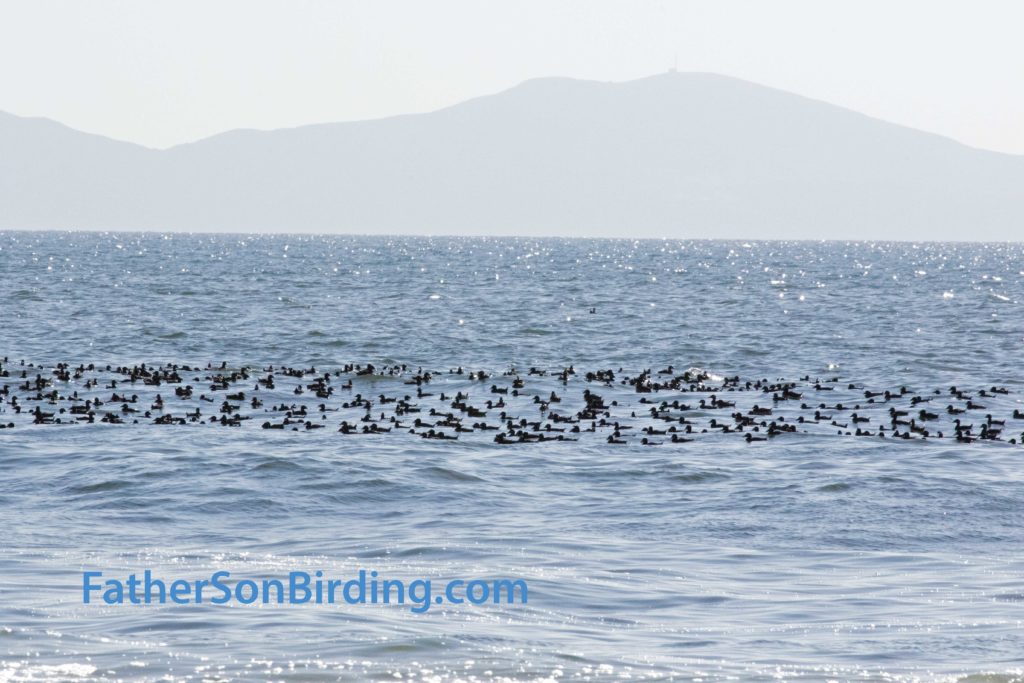
Our first-ever Montana Surf Scoter—to be followed by a second one (a female) a few days later.

I shouldn’t really complain since Braden and I have seen some wonderful birds the past few weeks. About two weeks ago, we saw our very first Montana Surf Scoter at one of our favorite birding spots, the gravel quarry. The bird was a stunning black male and just what such an ocean-loving bird was doing in Montana is a matter for debate. Since we started birding five years ago, however, scoters seem to be rare but reliable visitors.

A few days later, I was giving Braden a driving lesson in the parking lot of the Rocky Mountain Elk Foundation. After practicing parking thirty or forty times, I said, “C’mon. Let’s grab our gear and go see if any birds are around.” Not five minutes later, Braden spotted not one, but two White-throated Sparrows. Normally Eastern birds, these are real finds for Missoula and can only be spotted with diligent effort—and a lot of luck—during fall migration.

This was only our second location seeing White-throated Sparrows in Montana. A delightful surprise!

Alas, we’ve seen fewer warblers and other fall migrants than last fall, and that was reinforced on my trip across the state. I saw a smattering of good ducks (Redheads, Barrow’s Goldeneyes, and Ruddy Ducks) at Warm Springs, Three Forks ponds, and Lake Elmo State Park. I also spotted a Common Loon at Three Forks, and a nice variety of Western, Horned, Eared, and Pied-billed Grebes in most places I looked. But songbirds? They seemed to totally shun me on the trip.

When I returned home, I shared my photos with Braden. As we flipped through them, he nodded and politely murmured, “Nice. Uh-huh. Good one.”

Until I came to that mystery sparrow from Shiloh.

“Whoa. Wait a minute!” he exclaimed, opening Sibley’s. “Now I’m excited.”

“Why? What do you think it is?” I asked.

There are only about fifty records of Swamp Sparrows in Montana. Lucky me, this one decided to say hello!

“What do you think it is?” he countered.

“I couldn’t decide,” I said. “It looks kind of like a Song Sparrow, but doesn’t have the stripes. I thought maybe Lincoln’s, but it doesn’t have the orange colorings.”

Braden handed me Sibley’s. “I’m pretty sure it’s a Swamp Sparrow. They’re like, Code 4 for Montana.”

Now, my adrenaline was pumping too. “Really?”

We pored through the descriptions and compared it with my photos. Not only did the bird look identical to its description and illustration, I had found it in just the kind of habitat that Swamp Sparrows love.

Maybe fall birding in Montana isn’t so bad after all!

All About Alcids

Braden here.

“Pigeon Guillem-wait, no that’s just a pigeon,” my dad said as we stood underneath the ferry dock in Anacortes, Washington, “I must have guillemots on the brain or something.”

Just then, a football-shaped bird shot out from underneath the platform we were on. It was jet black, with white wing patches and strawberry-red feet—an actual Pigeon Guillemot!

“Awesome!” I said as we high-fived, “It appeared just as you said it! Wait a minute…Marbled Murrelet.”

Unfortunately for us, a Marbled Murrelet did not shoot out from under the dock like the guillemot had, but we weren’t that disappointed. My dad hadn’t seen a guillemot since the year we started birding!


A Black Guillemot, identified from a Pigeon Guillemot by the lack of the black stripe across the wing patch.

The Pigeon Guillemot is a seabird belonging to a family of birds called Alcidae, or alcids. Alcids are the penguins of the north, and share many similarities: they both are much better in water than on land, they both(for the most part) live in the colder parts of oceans, and they even share the same coloring! Once upon a time, there was even an alcid that couldn’t fly, the Great Auk. Sadly, it went extinct in 1844 thanks to hunting and invasive species. Guess where the last individual lived? Iceland.

Iceland is a great place to start learning alcids. It has at least six fairly-regularly ocurring species: the Atlantic Puffin, Common Murre, Thick-billed Murre, Razorbill, Dovekie, and Black Guillemot, the last of which is the Arctic-dwelling cousin of the Pigeon Guillemots we saw in Washington.

When I was in Iceland, I saw all of these except the Dovekie, which, during the breeding season, only inhabits the pack ice of the high Arctic. Each one was under slightly different conditions. When it came to colonies, Puffins were the weakest of the bunch, digging burrows in dirt, while Razorbills nested in cracks and ledges on sheer rock cliffs. Unlike most birds, Razorbills actually lay lopsided eggs so that they will roll in a circle and not off the cliff. If not for seasickness and an angry ocean, I would’ve gotten to see Latrabjarg cliffs as we passed it, a huge expanse of rock in western Iceland home to 40% of the world’s nesting Razorbill population!

Razorbills are named for the white stripe that crosses their beaks.

We also saw Razorbills farther away from shore than the other alcids, some accompanying flightless chicks. Once the chicks are ready to leave the nest, one naturalist told me, it would jump straight off the cliff! The parent, and sometimes parents would then join it and undergo catastrophic molt—molting all of their feathers at the same time, meaning that for a few weeks, neither the adults or the chicks would be able to fly!

Not all alcids are as devoted parents, though. After a while, Atlantic Puffins just stop bringing food to the nest, forcing the starving chick to leave and fend for its own. And while this may be for many reasons, it is not for lack of food—using the spines on their bills, puffins can carry up to 20 fish at a time, unlike other alcids. The record for one bird is 80 fish!

Atlantic Puffins are declining in southern Iceland, as their main food supply, the sand eels, moves north. This also is affecting Arctic Terns.

Some alcids live all over the Northern Hemisphere, while others are much more localized For instance, while I saw Common Murres in both Iceland and Washington, every other species was unique to one of the locations. If you are looking for alcids, I suggest you start in Alaska, which is home to 17 species alone!