Tag Archives: Father-Son Birding

Icelandic Seabird Storm

To Subscribe to FatherSonBirding, please fill out your name and email in the appropriate boxes in the right-hand column. Thanks, and don’t forget to share 🙂

Braden here again for my second Iceland post.

Saturday, July 14th, 2018. 9:00 a.m.

I have just finished breakfast and arrived on the bridge of the National Geographic Explorer. We are continuing our circumnavigation of Iceland, and this is our first day with some free time at sea. I have chosen to spend that time on the bridge, searching for marine mammals and possibly life birds. There are two seabirds in specific I am hoping for: Great Skua and Northern Gannet. Neither are particularly rare, but I have yet to see them.

Great Skuas, the “pirates of the seas”, will chase down other birds and steal their food. (Photo by Braden Collard)

James (Jamie) Coleman, one of the ship’s naturalists and leading bird experts, is also on the bridge, and he knows my quest. “You seen a Skua yet?” he asks me. “They’re everywhere this morning.”

“No, I’ve mostly been focusing on sleeping and eating.”

“Ah. I guess that’s also important. Anyways, keep your eyes open. We’ve also seen some White-beaked Dolphins.”

I settle into a chair, and, seeing no activity in or over the water, begin reading a large guide book titled Marine Mammals of the World.

“Is that the one by Bob Pitman?” Jamie asks.

I nod.

“He’s seen every marine mammal in the world but two, I think.”

“Has he seen a Vaquita?” I ask, knowing that the endangered porpoise’s last stand was going down in the Gulf of California.

“Yeah—he’s working with the Mexican government right now to save them.”

“Cool!”

“Oh, I’ve got a skua!” Jamie suddenly exclaims. “Flying right in front of the bow!”

I quickly raise my binoculars to see a large, dark bird with silver wing patches flying directly in front of the ship, its wingbeats heavy.

Approximately one second later, the Explorer’s captain, Aaron Woods, shouts, “Gannet! Even with the horizon—two o’clock and moving left!”

I again raise my binoculars level to the horizon. Far off, a bird that appears to be the opposite of a skua catches my eye. Its feathers are a clean white, with black tips on the wings, and its outline is sleek.

Like their southern cousins the boobies, gannets will perform spectacular vertical plunge-dives while hunting. (Photo by Braden Collard)

“How’s that?” Jamie asks, “Two lifers in the same two seconds!”

I grin. “Awesome!”

During the next couple of days, as we continue back towards Reykjavik, seabird numbers pick up. On my last full day on the ship, it all culminates in one big seabird showdown.

We have just left the island of Heimaey, the only inhabited island of the Westmann Archipelago, and the Explorer is headed for Surtsey, the new island to the south. I am on the bridge again, as is Jamie, talking about what else has been spotted. Suddenly, he looks up and spies a large, white cloud in the distance.

“Feeding frenzy!”

As our ship draws closer, I see large, straight dorsal fins rising from the water. Killer Whales!

Killer Whales, or Orcas, are actually dolphins–the largest in the world!

There are at least 30 Killer Whales, or orcas, on all sides of the boat now, feeding on whatever huge school of fish swarms below the waves. The whales aren’t the only ones feasting. A tornado of gannets has engulfed us, following the whales. At certain points, squadrons of them leave the storm to plunge-dive, torpedoing straight into the water.

Northern Fulmars, the common tubenoses here, are also in large numbers, and have attracted their rarer cousins, Manx and Sooty Shearwaters! These just remind me of how many miles seabirds have under their wings—the Manx’s have probably bred on the coast of Britain, while the Sooties could have travelled from as far as New Zealand!

Northern Fulmars are circumpolar–meaning they live all around the Arctic Ocean. (Photo by Braden Collard)

The Duck Capital of Europe

Braden here.

Lake Myvatn, Iceland, is the Waterfowl Capital of Europe, and maybe the world. Its rich wetlands and nutrient waters provide habitat for more than 15 breeding species of ducks, more than anywhere else on the continent (well, the European Continent. Technically Iceland is on two continental plates, but whatever).

Our tour was not for the waterfowl, however. Myvatn is also famous for its geology—the place is a geologist’s playground. We had just come from Godafoss, the waterfall of the gods, where I’d scored a family of 13 Rock Ptarmigans along with the stunning landscape.

We pulled up at our first and only stop close to the lake. This area was known for its pseudocraters, or fake craters, created by lava running over areas of water. To be honest, though, the “famous” craters were not much to look at. They were just dips in the ground, surrounded by farmland. The bird numbers, however, were incredible.

When I first glimpsed the lake, I found myself staring at hundreds, possibly thousands, of white speckles scattered around the shorelines: Whooper Swans! In mid-summer, apparently, these swans congregated in large numbers in sheltered areas of freshwater, and Myvatn was perfect! Huge rafts of ducks also decorated the surface—closer looks told me that these were mostly Tufted Duck, Eurasian Wigeon, and Greater Scaup, the males transforming into their drab summer or “eclipse” plumages.

Pairs of Whooper Swans dominated the lake, more swans than I’d seen anywhere else at one time. (Photo by Braden Collard)

And another, less obvious species was on the lake in numbers—Red-necked Phalaropes! These tiny shorebirds were barely half the size of the nearest duck, and spun in rapid circles to stir up food from the bottom.

This farmland was not a desert of biodiversity like some—it also had a great number of birds around. In the hedge rows, Common Snipe hid with their newborn young, hoping to avoid their human, camera-carrying “predators.”. Alas, they did not succeed—I got great shots!

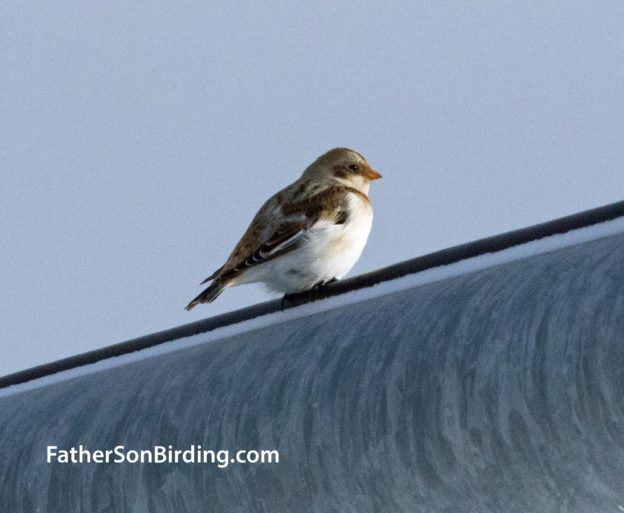
The short grass of the fields was a shorebird and songbird’s feast—Common Redshanks, Dunlins, Red-necked Phalaropes, Whimbrels, Redwings, White Wagtails, Meadow Pipits and Snow Buntings nibbled at the seeds.

Red-necked Phalaropes are one of the few species of birds in which females are brighter than males. (Photo by Braden Collard)

Along one side of the trail, I suddenly heard a haunting, ghostly call echo across the lake—a Common Loon! Known as the “Great Northern Diver” to the Brits, a pair and baby sat amidst a flock of swans, about 100 meters offshore. I spotted another prize, too—Horned (“Slovenian”) Grebes, much closer to shore. They were another reason European birders loved Lake Myvatn, as they were another specialty of the region. Other Iceland-exclusive birds occurring at Myvatn were Harlequin Ducks (which I did not see) and Barrow’s Goldeneye (which I did). However, the loons, grebes and ducks all occurred much more commonly in the United States, so I was more excited about what the Europeans would consider “common” birds—the snipe, redwings, wagtails, phalaropes, etc.

This baby snipe was less than a foot off of the trail! (Photo by Braden Collard)

The Backyard Jungle

Braden is currently in Iceland, where he is birding with mom and grandparents—and will undoubtedly write some great upcoming posts about that—so I thought this would be a great time to talk about backyard bird habitat.

When we moved into our neighborhood in 2006, we faced a daunting task: transforming our property from a biological desert that had been scraped clean by bulldozers into something that not only looked nice, but provided habitat for native animals and plants. It hasn’t been easy. Aside from the usual tasks of battling weeds and keeping plants alive, we’ve faced a ravenous army of deer that consistently ignore signs that read “Deer-Resistant Plants.” Finally, after twelve years, however, we are enjoying a yard that truly resembles the habitat we set out to create.

A pair of Red-breasted Nuthatches took immediate advantage of this new bird condo in our messy yard this year. Audubon, I will expect my product placement check soon. (Photo by Sneed B. Collard III)

Food has certainly been a key to our success. Through luck and persistence, we’ve managed to establish a wide variety of plants that provide berries, nectar, seeds, and insects to multiple bird species. Oh yeah, and a backyard sunflower seed feeder doesn’t hurt!

One thing I underestimated when we began is the importance of structure. Sure, we planted trees, some of which have reached twenty feet or more, but we also have an array of buffalo berry, maple sumac, ocean spray, golden currant, and mountain mahogany that have proved extremely “bird popular” for their cover as much as for their food. We’ve also been helped by a row of lilacs along the back fence that were already here when we moved in and serve as a vital launch pad for birds wanting a turn at the feeder.

Female to Male Tree Swallow at our front birdhouse: “Hm, honey, I like the neighborhood, but the front door is a little small.” (Photo by Sneed B. Collard III)

One final thing we did just this year is put in two chickadee houses. Within days, one had been staked out by Black-capped Chickadees and the other by Red-breasted Nuthatches. For further fun, Violet-green Swallows nest under our eaves while a surprise robin pair has raised a family in a bordering fir tree. We believe that a Song Sparrow pair has also successfully raised chicks, but we’re not sure where!

The end result is that this year has seen an explosion of birds around our house—more than forty species to date, shattering our previous record. The most common residents have been the nesting birds, Evening Grosbeaks, Cassin’s Finches, Song Sparrows, Cedar Waxwings, Pygmy Nuthatches, Flickers, and yes, those pesky House Finches and House Sparrows. We’ve also made sightings of Pileated and Hairy Woodpeckers (thanks to the ponderosa pines behind the house), Common Nighthawks, American Goldfinches, Western Wood Pewees, and Rufous Hummingbirds.

One of this year’s delights has been the daily appearance of our first, apparently resident, Song Sparrows. (Photo by Sneed B. Collard III)

Sadly, few of our neighbors have followed our example in creating habitat, most sticking with pointless lawns and non-native shrubbery that is virtually useless to native animals. I like to hope, though, that our “messy” yard of diverse and unruly plants inspires at least the occasional passerby to boldly go where traditional landscape companies fear to tread. After all, those of us lucky enough to own a home with a yard have a responsibility to give back to the plants and animals that our extravagant human “nests” have displaced.