Category Archives: Woodpeckers

Savoring Sedona: Guest Post by Roger Kohn

We are delighted this week to present only our second ever guest post, by long-time reader of FatherSonBirding, Roger Kohn. Roger and I met at UC Berkeley and roomed together for a time at Cloyne Court Co-op. Since retiring from a distinguished career with the EPA, he and his wife Claudia have settled in Bend and have pursued birding with a passion. Recently, they embarked on their first Arizona birding adventure, kicking it off with a place Braden and I have never birded, Sedona. I asked if he would give FatherSonBirding readers a taste of what it’s like to bird one of the world’s most beautiful places!

Inspired by Sneed and Braden’s adventures in southeastern Arizona last year, and eager to see more bird species and beautiful southwestern landscapes, my wife Claudia and I hopped a flight to Phoenix this past April to start a two-week birding vacation. Our plan was to focus on southeast Arizona. Before heading south, however, we visited Sedona to revel in its awe-inspiring landscapes. Although not known as a birding destination, I was confident we would see some good birds. After all, it was spring in Arizona.

Rising early on our first day, I stepped out onto our deck, which faced a large yard with bird feeders and had more green space beyond. I quickly spotted nine species, including two Lifers: an Inca Dove and a Northern Cardinal (a male, in all its bright red glory), a species I had wanted to see for a long time. Welcome to Arizona! The trip was off to a fine start.

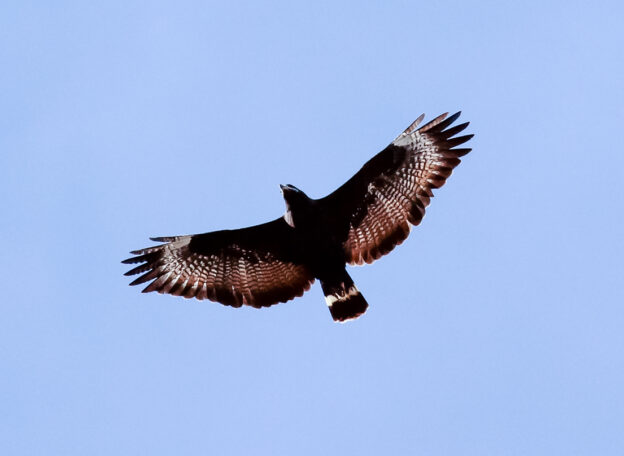
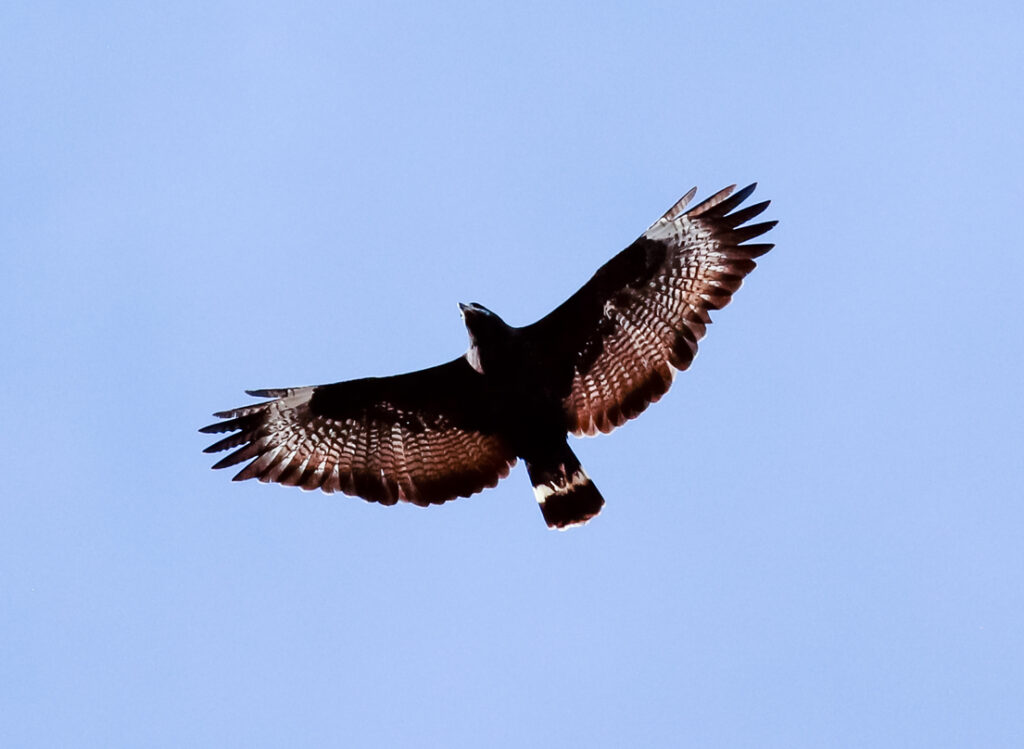
After breakfast we drove a short distance to the location we selected for Day 1 birding: Red Rock State Park, known for its stunning vistas. At the Visitor Center viewing platform, we saw a Turkey Vulture, followed by two dark raptors with white bands on their tails circling above us. “Hawks!,” I exclaimed. I wasn’t sure what species they were, but I knew it was one we hadn’t seen before. The answer came quickly from a park ranger who was standing nearby: Common Black Hawk. Lifer! And who doesn’t love raptors? What a great way to begin our park visit.

A Lifer Common Black Hawk soars above Red Rock State Park.

After getting looks at another Northern Cardinal, as well as Lesser Goldfinches, House Finches, Red-wing Blackbirds, and White-crowned Sparrows, we followed the Bunkhouse Trail a short distance downhill to Kingfisher Bridge, which spans Oak Creek. The creek was wide and gushed with fast-moving water. This would prove to be a surprising theme of the trip: plenty of water and lush landscapes–not what one thinks of in a state known for its desert landscapes! Tall, bare trees grew right out of the creek, giving a bizarre, otherworldly quality to this striking scene.

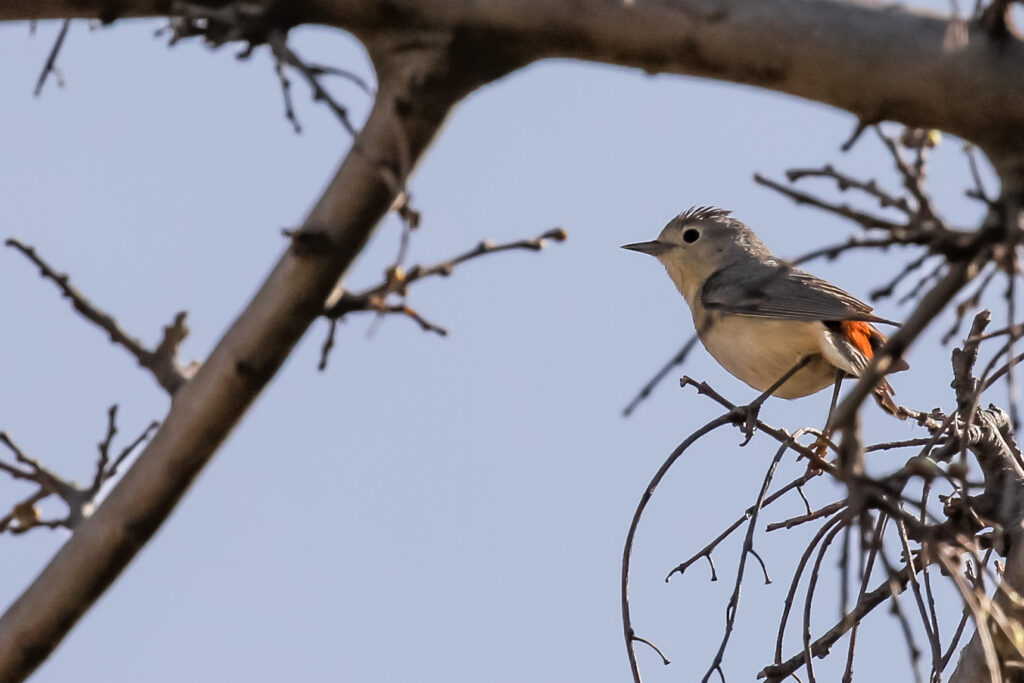
We didn’t see any kingfishers at their namesake bridge, but we did see a couple of Black Phoebes (a flycatcher species) perched on branches above the creek between breakfast-gathering forays. Crossing the bridge, we headed west on the Kisva Trail into riparian habitat next to the creek. It was very birdy here, although not always easy to see the birds. Violet-green Swallows zipped back and forth, and a couple even were cooperative enough to perch and allow me to photograph them. We could hear the harsh calls of Gila Woodpeckers reverberating all around us. The Audubon app describes their calls as “a rolling churrr.” To me, the calls had a bizarre, almost electronic, quality. We were not able to see the woodpeckers, but they are very common in Arizona and we would see them many times in a variety of different habitats on the rest of the trip. A little further on, we could see a lot of bird activity in the treetops. Benefitting from Merlin Sound ID, we knew we were looking at Lucy’s Warblers, another Lifer!

A Lifer Lucy’s Warbler in the treetops along Oak Creek in Red Rock State Park.

The Kisva Trail took us to the Eagle’s Nest Trail, which gradually ascends to a summit with a commanding 180-degree view of the surrounding red-rock country. The scenery in and around Sedona is absolutely jaw-dropping, with layers of colorful rock rising into towering formations that lend an epic, cinematic quality to the landscape. This is why we came to Sedona!

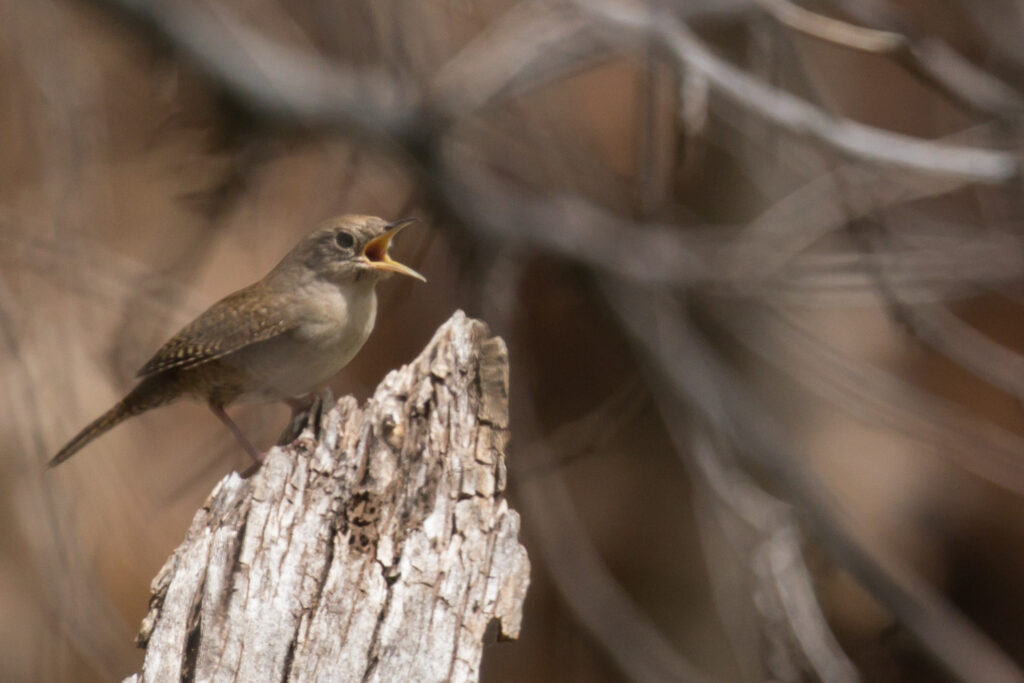
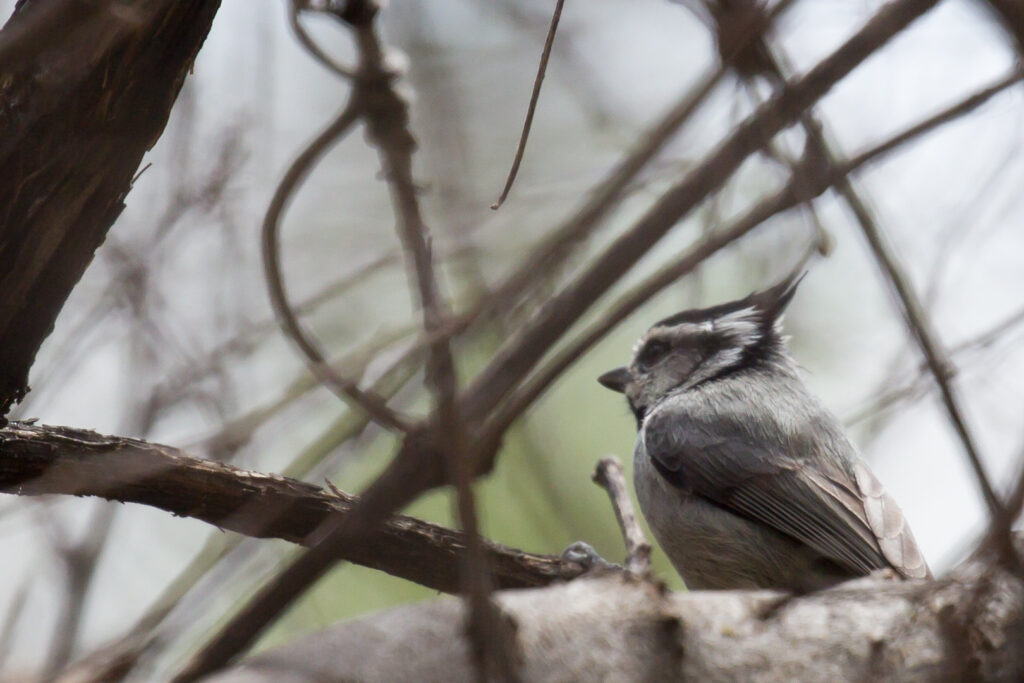
We didn’t see many birds on our way up, or as we descended on a loop trail that took us back to Oak Creek. Walking along the creek, we got good looks at a Townsend’s Solitaire and a House Wren, perched and singing a sweet and enchanting aria for all to enjoy. Later I saw a black and white bird darting back and forth among the trees. I wondered if it could be a species that I was really looking forward to seeing based on my pre-trip bird study. Could it be… yes it was… a Bridled Titmouse! Lifer! With what eBird calls a “crested head with striking black-and-white pattern unlike any other bird,” the Bridled Titmouse makes up for its lack of color with a combination of elegant form and bold contrast that give the species a big WOW factor. We loved these guys and saw them on several other occasions in the next two weeks.

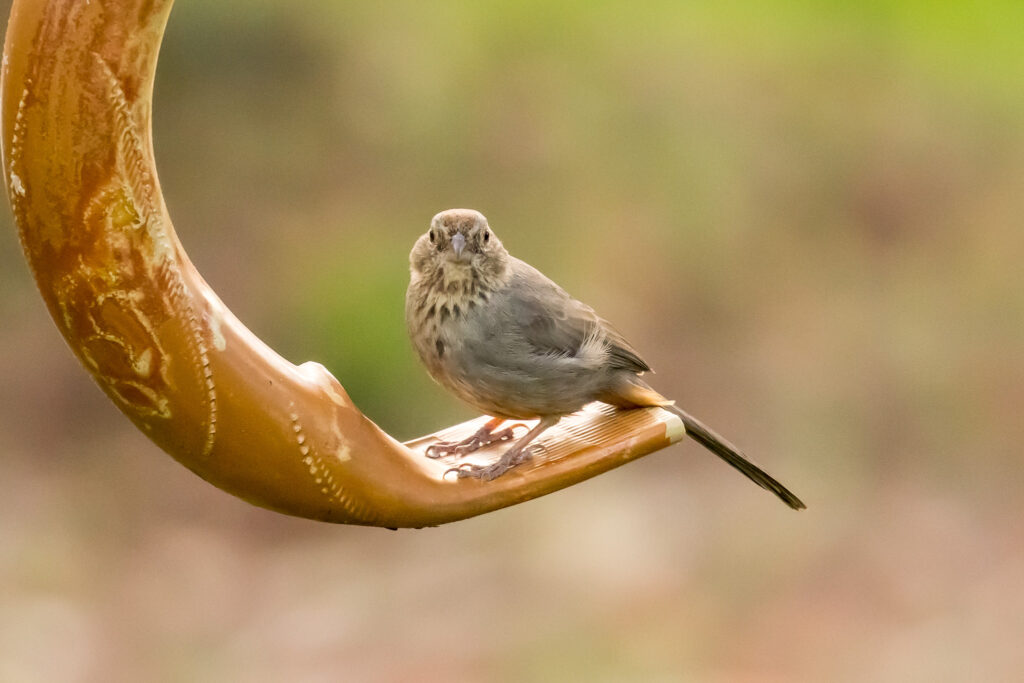
Relaxing back at our rental with a fine locally produced beverage made with barley and hops (and love), we snagged two more Lifers: Woodhouse’s Scrub-Jay and Canyon Towhee. As the sun sunk toward the horizon, we reflected on the excellent first day of our Arizona birding adventure.

A Lifer Canyon Towhee says hi at our rental.

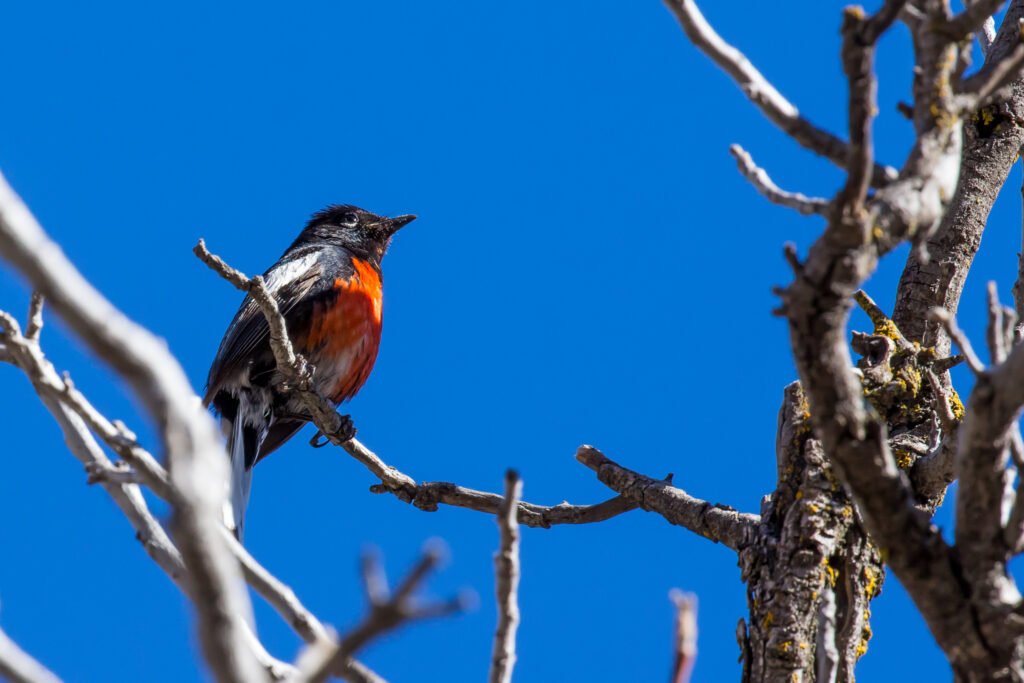
We awoke to another gorgeous early spring morning on Day 2 of the trip. Our plan was to bird the West Fork Trail, which follows Oak Creek in the Coconino National Forest. After a pretty 30-minute drive through rugged country north of Sedona, we arrived. A pair of bright blue Steller’s Jays and a group of cackling Acorn Woodpeckers greeted us in the parking lot. As we gathered our gear to get ready to walk, a few black and red birds flew over us and landed in the trees above us. This had to be something good. Focusing our binoculars in high branches where the birds landed, we were delighted to discover that they were Painted Redstarts, a Lifer for both of us! We got great looks and absolutely loved this warbler species, with its gorgeous black, red, and white plumage. Although we would get glimpses of this species again later in the trip, this was by far our best sighting.

A show-stopping Lifer Painted Redstart in the West Fork Trail parking lot.

Starting our walk, we enjoyed views of three other warbler species near a footbridge that spanned the creek. Lucy’s Warblers were present, although hard to see as they flitted around in the treetops. We got good looks at Yellow-rumped Warblers, and a beautiful Yellow Warbler foraging in the trees.

Continuing, we passed the ruins of an old cabin and were delighted by the beauty of this place, with cliffs in hues of pink, white, and gray rising to dizzying heights above the canyon floor. We saw Ruby-crowned Kinglets, House Wrens, American Robins, and many Acorn Woodpeckers (which live in family groups), with their colorful and clownish face patterns. Soon we reached a waist-high creek crossing that we didn’t want to attempt, so we turned around. On the way back, we enjoyed views of a pair of Common Black Hawks harassing a Peregrine Falcon. The raptors flew gracefully and at high speeds, making sharp turns as the hawks pursued the falcon, all set against a dramatic background of colorful canyon walls.

We loved the beauty of the landscapes in Sedona and would love to return. As our two-day stay wrapped up, we had seen 38 species, including eight Lifers. Now southeast Arizona, which Tucson Audubon calls “one of the most fascinating areas for birding in the United States,” with over 400 bird species seen annually and approximately 500 recorded, beckoned. Early the next morning, we eagerly pointed our car south toward Tucson.

The author in his natural habitat, a brewery in Tucson!

eBird Checklist – 12 Apr 2023 – Red Rock SP – 18 species (+1 other taxa)

eBird Checklist – 12 Apr 2023 – Coconino National Forest, Sedona US-AZ 34.83181, -111.80798 – 4 species

eBird Checklist – 13 Apr 2023 – Oak Creek Canyon–West Fork – 12 species

Birding Japan: Kanazawa

Since we published them, our birding posts about Japan have been read in more than a dozen countries. If you are planning your own trip to Japan, you’re in luck! Sneed’s new book, FIRST-TIME JAPAN: A STEP-BY-STEP GUIDE FOR THE INDEPENDENT TRAVELER, tells you everything you need to know about how to plan your trip to this remarkable, yet sometimes intimidating, country. Order now by clicking here.

Welcome to our Japan birding posts. In this edition, Sneed explores the “less visited” city of Kanazawa, a place that would turn out to be perhaps one of their favorite stops on trip—and with some surprising birds. If you are just tuning in to Japan, be sure to check in on our last post from Kyoto!

Leaving Kyoto, our (non-bullet) train took us through my favorite scenery yet in Japan. Just north of Kyoto, the train hugged the shoreline of Lake Biwa for more than half an hour. Seeing the lake on a map, I envisioned a forested wilderness, marked perhaps by some resorts or getaways, but the entire lakeshore was surprisingly built up with cities, towns, and farmland. Alas, the train was too far away from the lake to identify any birds except Black Kites and crows, though I did see an enticing shorebird flying across a field. Passing through a tunnel, we then entered picturesque mountain areas where I looked in vain for a Brown Dipper in the roaring streams we crossed. No luck. Emerging back onto a large plain, we more or less re-entered civilization until we arrived at our next destination, Kanazawa.

Both Tessa and I were taken with Kanazawa Castle and its grounds from the moment we approached the main entry gate.

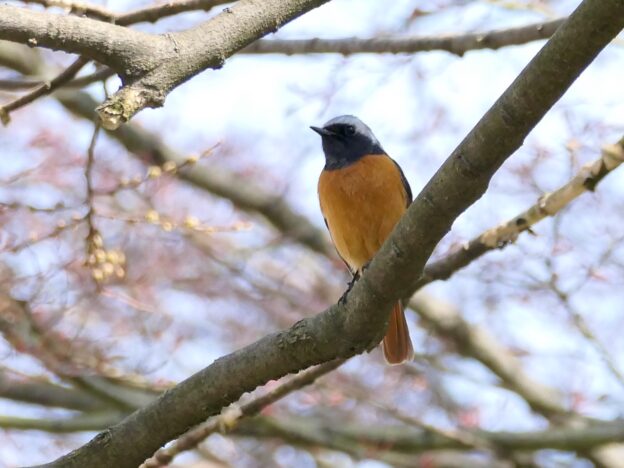
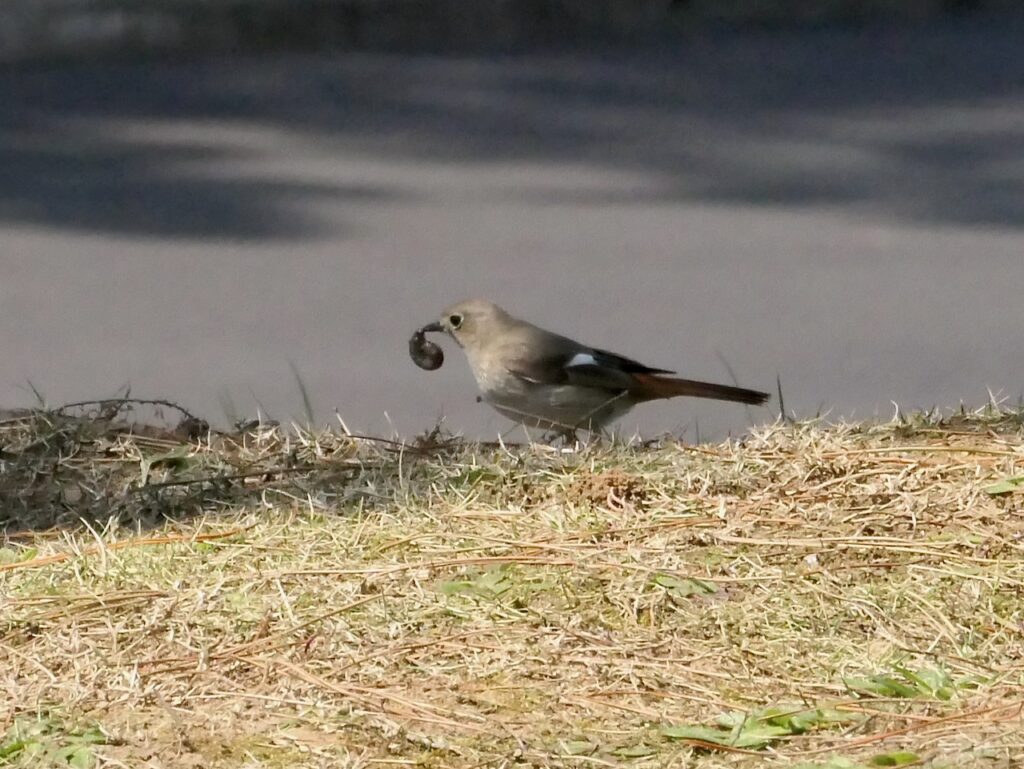
I had booked us a hotel right next to Kanazawa’s major tourist feature, a large castle set in a park-like setting, and as soon as we dropped our bags at the hotel, we grabbed a “set lunch” at a local café and headed straight to the castle. Tessa hadn’t seemed too impressed with other castles on the trip, but this one wowed us both—perhaps because of its dramatic approach and the glorious sakura flowers blooming at the gates. After going inside the castle, we took a wonderful walk on paths above it, where Tessa declared this was her favorite place so far on the trip. The birds also liked it well enough, with the omnipresent bulbuls, crows, and kites surrounding us. Descending back toward the castle, though, I spotted a trio of Oriental Greenfinches, and then a bird that stopped me in my tracks. “Oh my god,” I said out loud, and hurried forward hoping the bird wouldn’t move. It didn’t, and I got my first look at another bird at the top of my “To See” list: Daurian Redstart!

This male Daurian Redstart just made my day—and, of course, my life list. I love the blooming sakura flowers behind it.

As delighted as I was with the redstart, I saved my real birding enthusiasm for the next morning when I left Tessa to hang out and grabbed a cab out to Kenmin Seaside Park, perhaps the only place left on the trip where I might see shorebirds or pelagic species. As soon as I arrived I glimpsed a departing tit of some kind and saw multiple Dusky Thrushes and White-eared Starlings feeding in a field. I hurried past them until I reached my primary destination, the beach. Alas, this was no natural beach. Giant cement breakwaters were piled up offshore and it was clear the area had been heavily worked over by dredging and industry. I saw a few flying birds too distant to identify and a flock of cormorants that took off long before I got close enough to attempt an ID, but that was it. No shorebirds. No waders. Just trash littering an evidently sterile expanse of sand.

Trash has become a scourge on beaches throughout the planet. I was hoping Japan’s dedication to cleanliness might make this Kanazawa beach an exception, but no dice.

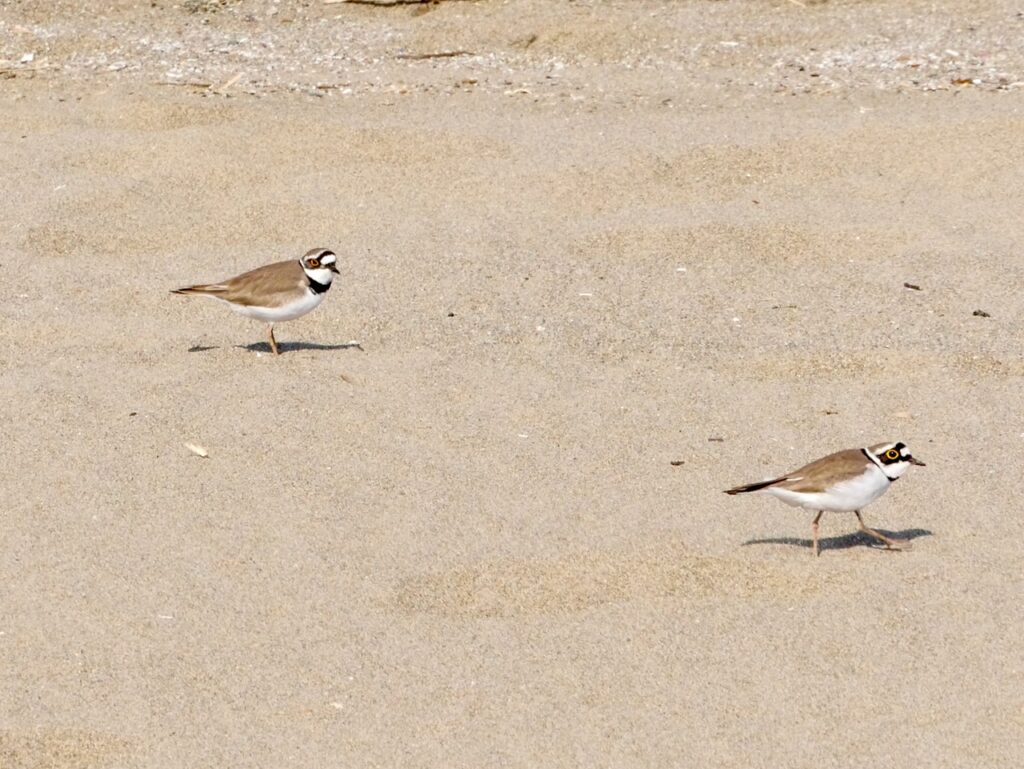
I nonetheless started trudging my way north, planning to round the tip of the small peninsula and make my way back to the park to try some forest birding. Suddenly, my eyes caught movement. There among the trash, I saw one tiny shorebird, then another. I guessed right away they might be plovers and as I moved closer, the yellow rings around their eyes cinched it: Little Ringed Plovers—another life bird and perhaps my most rewarding Japanese species yet. I wish I could tell you that this find unleashed a flood of shorebird sightings, but no. They were it—two hardy survivors on a desolate beach.

Definitely some of my favorite birds of the entire trip, this pair of Little Ringed Plovers were the sole shorebirds on the vast desert of beach next to Kenmin Seaside Park.

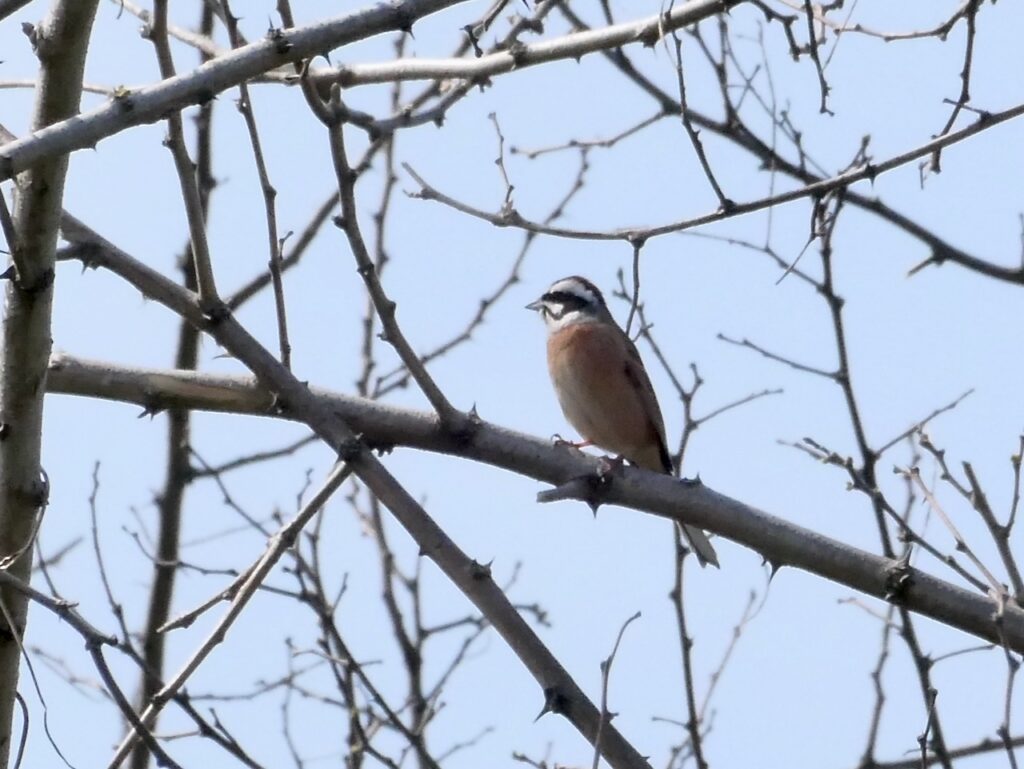
Fortunately, the birding got significantly better as I made my way back toward the main park. I picked up two more lifers in quick succession: Meadow Bunting and Asian House-Martin. Back in the forest, I encountered my best mixed flock of the trip, containing Japanese and Varied Tits, two Japanese Pygmy Woodpeckers, a Warbling White-eye, and a Japanese Bush Warbler.

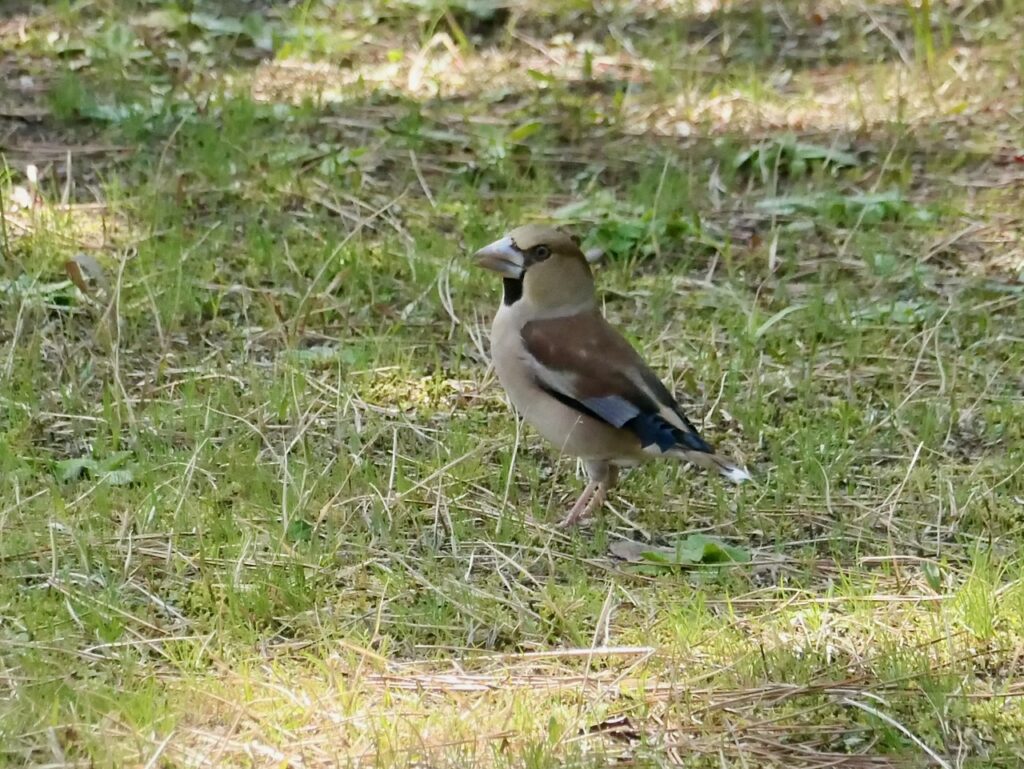
My time to meet my cab was, unfortunately, running out quickly, but as I hurried along a trail, I noticed three birds foraging under some trees. The first was a Dusky Thrush and I automatically assumed that the others were, too. I was wrong. They were Hawfinches! Braden and I had really hoped to see these odd chubby birds in Amsterdam or Israel in 2019, but to no avail. Now, on the other end of the Asian continent, I was staring at two of them cocking their heads at me in between going about their business. It was a great way to end the morning, and fixed Kanazawa as one of my favorite birding spots in Japan.

Sneed’s Kenmin Seaside Park eBird checklist. 

Hawfinch! Need I say more?

Another Accidental Big Year: Sneed’s 2022 Recap

FatherSonBirding’s millions of loyal fans will have no doubt noticed a paucity of posts the past few months, and we sincerely apologize, noting the severe nationwide downturn in consumer confidence and the real estate market that this has obviously precipitated. Fortunately, our silence has been a result of good things happening to Braden and me. Braden has been having some exceptional academic experiences during his fall semester at UMaine while I have been kept busy both birding and working on several exciting book projects that have come my way. That said, we’d like to take a couple of posts to wrap up the last few months and, indeed, our entire year of birding. Since Braden is studying for finals, I’ll go first.

Some of you followed my “Accidental Big Year” last year in which I set a new personal best of 352 ABA species during 2021. Believe it or not, I’ve blundered into another accidental Big Year in 2022. How the heck did that happen? I mean, I have definitely underperformed in my home state of Montana this year, notching my lowest total in several years. Fortunately, our trips to New York City and Arizona put me within striking distance. By early October, my count sat at a tantalizing 335 species, only 17 birds short of tying last year’s record, but where would the additional species come from? Some good writing news led to the answer.

This summer, I landed a contract to write about conservation on military bases, with a special focus on Eglin Air Force Base in the Florida panhandle. I chose this base because I spent all of my summers growing up with my father in Pensacola—adjacent to Eglin. Call it nostalgia or a desire to learn more about the area’s species, but I arranged to interview biologists down there to find out what they were doing. First, though, I decided to stop to see my brother in Atlanta, Georgia.

On my recent trip, I didn’t get photos of my best Atlanta birds, but Tufted Titmice are always a blast to see.

Honestly, I didn’t know how many new birds I’d see in Atlanta. Migration season was waning, and it was possible warblers and other songbirds had already moved through. In general, they had, but thanks to some intensive studying and tutelage by Braden, I was able to score a number of great birds including a trio of wonderful warblers: Blackpoll, Tennessee, and most exciting, Cape May—a Lifer pour moi.

Leaving Georgia to take up a week-long residence with my stepmother Suzanne and her partner Jim in Milton, Florida, I wondered if I was close enough to top 352 for the year? Unfortunately, I arrived in Florida suffering from my first cold in three years—one I am just now getting over six weeks later. Not how I wanted to begin three consecutive long days of work at Eglin! Nonetheless, I persevered and got a bunch of great information from the base biologists. Oh, and I kept adding up Year Birds! In fact, I couldn’t have asked for a better bird to break my record. As biologist Kelly Jones drove me around teaching me about endangered salamanders, we ran into a group of Red-cockaded Woodpeckers, one of America’s coolest and most unusual birds. These birds became endangered due to the catastrophic loss of longleaf pine ecosystems across the Southeast, but many people have been working to restore both the pines and the woodpeckers. Last I heard, Eglin is home to the nation’s fourth-largest population, but this was the only group I ran into while there.

Red-cockaded Woodpeckers are the only North American woodpeckers that carve holes in living trees. Apparently, the sap running down the tree trunk helps deter snakes and other potential predators.

Not wanting to wear out my welcome with Suzanne and Jim, I used the weekend to take a jaunt over to Tallahassee to visit St. Marks National Wildlife Refuge. My dad, a professor at the University of West Florida, led many field trips to St. Marks and always raved about it. More recently, Braden and Nick Ramsey, visited the refuge, seeing among other things a lone flamingo that has lived at the refuge for the past four years. I hoped also to see this bird—dubbed “Pinky”—but kept my expectations low.

I know they’re common, but I love Red-shouldered Hawks, and this is by far the best photo I’ve ever taken of one.

Upon arriving, I discovered that St. Marks truly is a magical place—a remnant of “Old Florida” with towering oaks and pristine marshes—and my visit got off to a good start with great views of a Red-shouldered Hawk and Yellow-bellied Sapsucker at the visitor’s center. I asked the local naturalist if anyone had seen Pinky the flamingo lately and she said yes, but didn’t know where, so I decided to head down to Lighthouse Pool and work my way back. As I reached the pond, I happened to glance right. There, in the middle of the pond, stood a large orange blob.

“No way!” I exclaimed, braking to the side of the road as I reached for my binoculars. Sure enough, there stood Pinky—America’s most famous flamingo. Full disclosure: Pinky was not the most exciting bird on the planet, content to just stand there and preen when s/he felt like it. Taking a walk along the southern edge of the pond, however, I picked up lots of other nice Year Birds including Reddish Egret, Tricolored Heron, Short-billed Dowitcher, Semipalmated Plover, and more.

I’m not sure where Pinky got his name, but to me he looked obviously orange. Still, an official Lifer for me, though I did see American Flamingos thirty years ago in Bonaire.

My visit to St. Marks was far from finished. As I drove back up the road, I thought I spotted a rail at the East River Pool location. I didn’t—and this was not the first time I’d mistaken a Common Gallinule for a rail! Training my eyes out on the pond, though, my heart picked up. Why? Because way out there among a large group of wading birds, I spotted another Lifer: Wood Stork! Along with Roseate Spoonbills, another Year Bird. My Lifer-palooza hadn’t ended, either. Following Braden’s directions I drove to another part of the refuge to hear my Lifer Clapper Rails.

This is at least the second time I’ve mistaken a Common Gallinule for a Clapper Rail. I do believe they’re closely related, though, so I hope that you, my dear readers, cut me some slack!

I returned to Montana with a total of 372 Year Birds and have since picked up a few more, thanks to a fortuitous discovery of Montana’s first Long-tailed Duck of the winter, along with the first Bonaparte’s Gulls I’ve ever seen in Missoula County. These and a Horned Grebe now have me sitting at 375, well in excess of my previous ABA Big Year record. My guess is that I’ll pick up one or two more when Braden gets home in a couple of weeks—though what they might be I have no idea. And you know, it really doesn’t matter. While it’s fun to count birds, it’s even more fun to get out and see them and, hopefully, make some new friends along the way. At St. Marks I met several delightful birders to share my adventures with. I hope that as 2022 draws to a close, you all have your own memorable birding adventures combined with heavy doses of peace and friendship.

My Lighthouse Pool checklist.

Perhaps my biggest score of the year was seeing the first Long-tailed Duck recorded this winter in Montana—and my first male ever. If this isn’t a glorious animal, I don’t know what is!

Golf and Birding

Welcome to our new subscribers! We appreciate your interest in our adventures and experiences, and hope you feel free to share this post with others. If you’d like to support FatherSonBirding, feel free to order some of Sneed’s books from online stores or, better yet, by through your local independent bookstore. Thanks, and have a great weekend! Next week: more of Braden’s High Sierra adventures!

Did you ever stop to think that the words “golf” and “bird” both have the same number of letters in them? No? Good. It’s a stupid lead to a blog. Plus, golf is a sensitive subject for me. In my mid-thirties, I began playing with friends and found I quite enjoyed it. Sort of. In between the tears and swearing and bouts of hopelessness and low self-esteem. After my golf swing betrayed me once and for all, in fact, I tossed my clubs into the basement to collect dust for the better part of a decade. Foolishness springs eternal, however, and a few years ago I began a ritual of golfing once a year with a buddy—only to discover an aspect of golf I had never before recognized: Birds.

Many golf courses’ locations adjacent to wetlands and other natural habitats give them a wide range of opportunity for the golfing birder!

When I golfed in earlier years, Braden and I hadn’t yet become birders. Imagine my surprise, then, when I got back onto the links to discover that birds abounded—at least at Linda Vista Golf Course, my favorite course in the area (and one that happens to have a great cafe). I realized, in fact, that this course could actually be one of the best birding spots in Missoula. The problem? It is challenging to golf and record birds at the same time, and I have to thread a fine line so that my buddy doesn’t brain me with a 4-iron while I’m trying to figure out which kinds of swallows are circling around us. This dilemma, however, gave me an idea—one that I finally carried out last week: to get permission to bird the course sans clubs one morning before the golfers showed up.

Even with the distractions of actually playing a round of golf, I had managed to record 25 species of birds a couple of days earlier. These had included surprises such as Cinnamon Teal and Red-naped Sapsucker. I wonder what I’ll find with more time to study my surroundings? I asked myself as I again headed out two days later.

Almost immediately, it became evident that there were greater numbers of birds than I had noticed before. The Yellow Warblers were particularly insane with a new one spouting off every twenty or thirty yards—about the distance of a short pitching wedge. This made sense because part of what made this course such a great birding spot is that it was shoe-horned between river and wetlands on two sides and farm/pasture on another. Along with the Yellow Warblers I noted an abundance of Red-winged Blackbirds and Gray Catbirds—but was also surprised by an absence of Common Yellowthroats and dearth of Song Sparrows. Hm . . . maybe they were just quieting down for the season?

Spotted Sandpipers are always a welcome sight—though I’m not sure the plastic sheeting around this pond made it a great choice for this bird.

Continuing around to the third hole, I came across several open ponds where I was pleased to see at least seven Wood Ducks, Killdeer, a Spotted Sandpiper, and a pair of Ring-necked Ducks, an unlikely find for the time of year. One of the delights of birding a place that doesn’t get much attention is the frequency of red “unreported” dots that appear on the eBird checklist. The Killdeer were unreported and while I was logging species on eBird, another unreported species, Double-crested Cormorant, flew by. I devoted a good ten minutes to figuring out swallows and quickly noted Tree and Northern Rough-winged. As my binoculars pin-balled back and forth, however, I made another great discovery: Bank Swallows! Braden and I love finding these because they always seem to pop up when we least expect it, and this morning they followed tradition!

Double-crested Cormorants were one of several species that earned me a coveted red “Unreported” dot on eBird!

The rest of my birding round yielded nothing that will upend the scientific community, but proved mightily enjoyable nonetheless. While talking to the lone golfer out this early in the day, I spotted a gorgeous male Western Tanager. A Bullock’s Oriole also flew by. Over on the pasture side of the course, Eastern Kingbirds abounded and Cliff Swallows replaced the Bank Swallows zooming around me. I finished the day with 33 species—not dramatically more than I had found while actually golfing, but I had savored every tee, fairway, and green.

One of the fun things about my round of birding was the number of juveniles about—including this young Eastern Kingbird waiting to be fed by a nearby parent.

Speaking of golfing, I did notice an odd phenomenon while doing the round with my buddy two days earlier. I actually played better than I had in recent memory. It may have been that I had forgotten my bad habits, but I think that the birds actually helped. One of my problems with golf is that I overthink everything. Instead of just hitting the ball, I am telling myself Remember to tuck in your hip as you draw back or Keep that left foot planted and your elbow straight. With half of my mind on birds, I didn’t have time to do that—and hit some of my best shots in years. The lesson? There isn’t one. Just get out there and keep birding, wherever you happen to be.

Note: if you would like to bird your local course, be sure to ask permission—and it obviously wouldn’t hurt if you already golf that course yourself. With the manager, discuss the best time to go out and stay polite even if she/he/they says no. After all, golf courses generally are money-making ventures and they have real customers to take care of. But speaking of that, I can’t help wondering if any particularly birdy courses have considered charging a modest fee to people who would like to bird them? Especially for courses that adopt green practices such as using less water, pesticides, and fertilizers, it might be a great way to earn a bit of extra income while promoting sustainability. Just a thought.

Braden’s Tales from the High Sierras, Episode 2: Bearly Birding

We hope everyone had a nice 4th of July weekend. To help you get back into the usual routine, we’re delighted to present Braden’s second report from his job looking for Northern Goshawks in the California Sierras. So far, the goshawks are few, but the other animals abound! To see his first post, click here. Will there be more goshawks? What other surprises will greet his intrepid crew? Be sure to check in on upcoming posts to find out!

The Brushy Hollow PAC lay about forty-five minutes from Beardsley Lake, a man-made reservoir in the Stanislaus National Forest where we’d be spending the next two nights camping. After waking up at the crack of dawn and unsuccessfully trying to snag some good photos of the Black-throated Gray Warblers around camp, our crew began driving the cliffside road up to Brushy Hollow. As we neared the PAC, my peripheral vision caught a large brown animal absolutely booking it away from the car. Stanislaus National Forest was (unfortunately) filled to the brim with cattle–we either saw them or heard the bells hanging from their necks every time we went out. No cow had ever fled from the car this quickly, though, and as I snapped my head back to look I spotted paws, not hooves, trampling the brush before the mammal disappeared into the forest.

“Bear!” I shouted, but it was too late. The bear wanted nothing to do with us.

Our crew prepares to tackle another PAC in search of Northern Goshawks. But would mammals intervene?

Again, the rest of the crew missed it, so a slightly disappointed car arrived at the parking lot for Brushy Hollow. The parking lot consisted of a small patch of grass off to the side of the dirt road, and we were greeted by an army of mosquitoes as we stepped outside of our brand new, cherry-red Nissan rental truck that the rental car company had decided to give us for the summer. We set off into the forest, which was only somewhat brushy and somewhat a hollow, despite the name of the PAC. Many of the usual birds greeted us, including calling Mountain Quail, Olive-sided Flycatcher and pairs of White-headed Woodpeckers flying between the pines. As far as ease of travel, the PAC turned out to be one of our best. Mountain Misery—a native, ground-hugging plant also called “bear clover” (foreshadowing warning)—covered much of the ground, meaning we barely had to lift our feet as we followed our transects. Sam and I met up and began walking up a hill towards Miles where we would enjoy lunch. As soon as we spotted Miles, he stood up and pointed frantically behind us.

“Bear!”

“Bear, bear, bear!!” We echoed as we whirled around to spot another bear sprinting away from us down a nearby road. Ivara followed suit, and we all yelled at the animal for a little while as was protocol before sitting down for lunch.

Adrenaline filling our veins, we sat down in the Mountain Misery, slapping mosquitoes and talking about what we’d just seen. Two bears in one day! And then, our eyes darted again to the same road, where two MORE brown bears ambled by, as if on their way to work!

We finished our lunch quickly, heading towards the other side of the PAC. I proceeded to get very lost, then eventually found, and we took one last break on a log before finishing up our transects for the day. As we scarfed down our last snacks, a crack echoed behind us. The sound of a branch breaking. We turned around, and the response was immediate.

Five bears in one day was a record for all of us. We were too excited to remember to take any photos, but here’s a mama bear staring suspiciously at my dad in our backyard in Missoula.

“Bear! Bear!” 

This time the brown bear just watched us for several minutes, wondering why four humans had suddenly started yelling at it during its afternoon walk. Eventually, though, this bear did turn tail, but not after my adrenaline hit new levels! Five bears was enough, and Ivara called it for the day.

Bear Note: All bears in California today are black bears. Black bears vary widely in color from black and cinnamon to the “brown black bears” that Braden observed. The bear on the California state flag, however, is a subspecies of the much larger grizzly bear. Apparently, about 10,000 grizzlies once roamed California. Large carnivores such as the grizzly, however, were not welcome by cattle ranchers and the influx of settlers following the gold rush, and the California grizzly was shot, trapped, and poisoned to extinction by the mid-1920s. Some efforts have been made to reintroduce grizzlies to the state, but so far, all proposals have been rejected. To read a nice article about the situation, click here.