Category Archives: Sparrows

Gray Flycatcher Science

One of our goals at FatherSonBirding is to encourage support of scientists and nonprofits working to protect our planet’s many imperiled bird species. We hope that you will consider sending a donation to Montana Bird Advocacy, whose work is featured in today’s blog. You can do this by clicking here. It will be money well spent!

Late July often ushers in the birding doldrums. Having finished courtship and breeding, most birds get super quiet. They often disperse from their breeding territories, too, making them more difficult—or at least unpredictable—to find. But this year I was in luck: I had a writing assignment that would guarantee I see at least a few very cool birds.

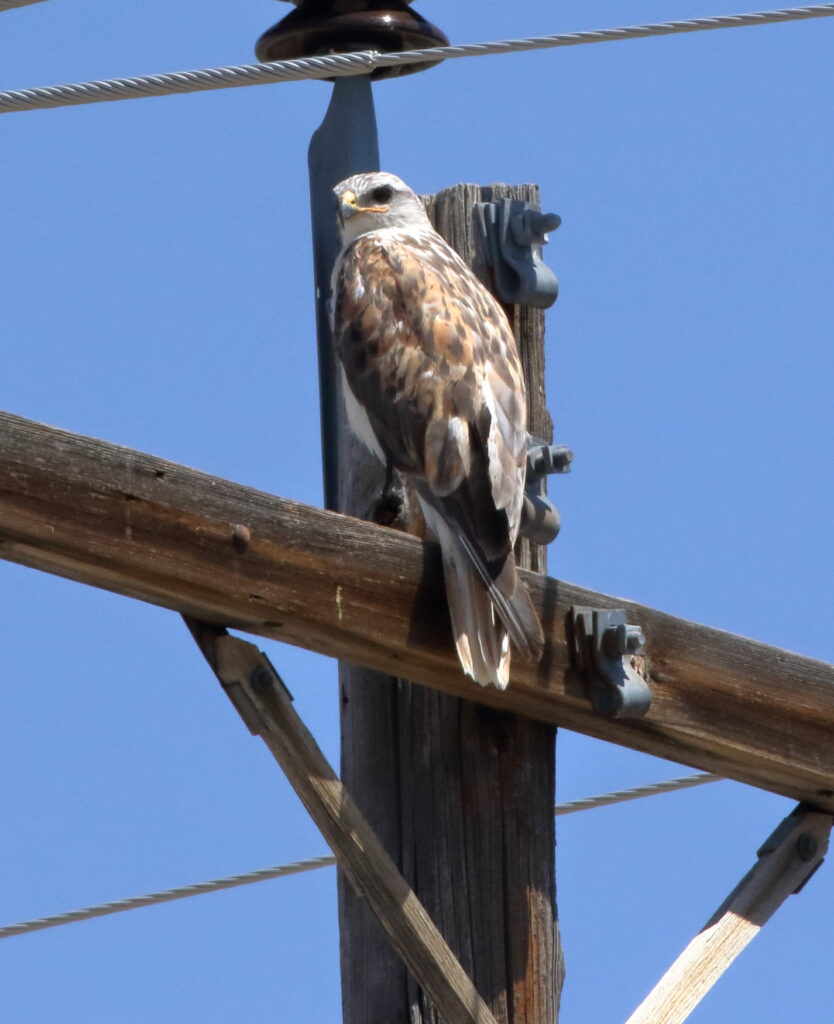
My best look yet at a stunning Ferruginous Hawk proved a delightful bonus to my day near Bannack.

You may recall my unsuccessful June trip down to Beaverhead County (see post In Search of the Green-tailed Towhee) to visit with biologist Jeff Marks, founder of the nonprofit scientific research group Montana Bird Advocacy.  There, Jeff and colleague Paul Hendricks are performing a long-term study on one of Montana’s little-known birds, the Gray Flycatcher. When I visited, Paul wasn’t there, but I also got to meet biologist and research assistant Nate Kohler, who has been playing a pivotal role in the study.

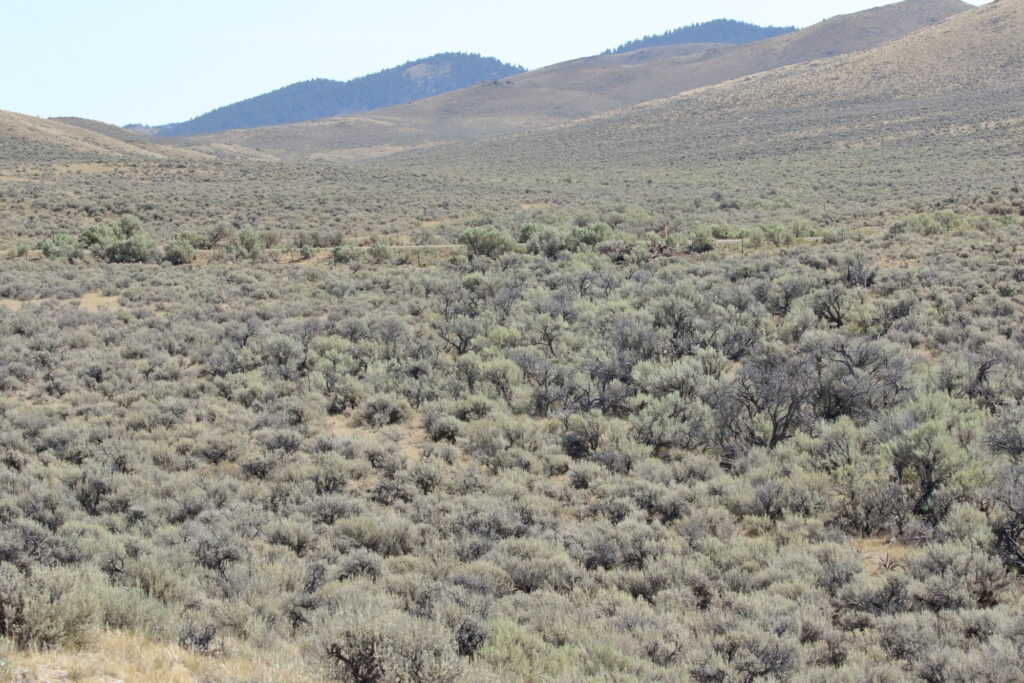
The word “gulch” conjured up a much more verdant image to my mind, but as you can see it takes some pretty special adaptations to survive in this rugged country.

Although my June trip allowed me to see many wonderful birds and interview Jeff and Nate, my intention to see the Gray Flycatchers got squashed by a freak winter storm. Worse, the storm wiped out a whole crop of nestling Gray Flycatchers. The good news? The adults had laid second clutches of eggs, and the babies were getting ready to fledge as I again headed down there the last week of July. This time, the weather would be ideal for seeing them.

Jeff and I headed out at 8:00 a.m. and made our way up Bannack Bench Road, which borders the study area. This was the third season of the study, and its purpose is to figure out some of the basic biology of a bird that scientists know very little about. To do that, Jeff, Paul, and Nate have been banding adult flycatchers with color bands that allow field identification and observation of individual birds.  The birds have been a challenge to catch, but the biologists have managed to band about a dozen each year—and with fascinating results. I won’t reveal too much about those results here since I’m also writing an article for Montana Outdoors magazine that will be out next year. However, I will tell you that seeing where these birds nest and what they are doing was a thrill.

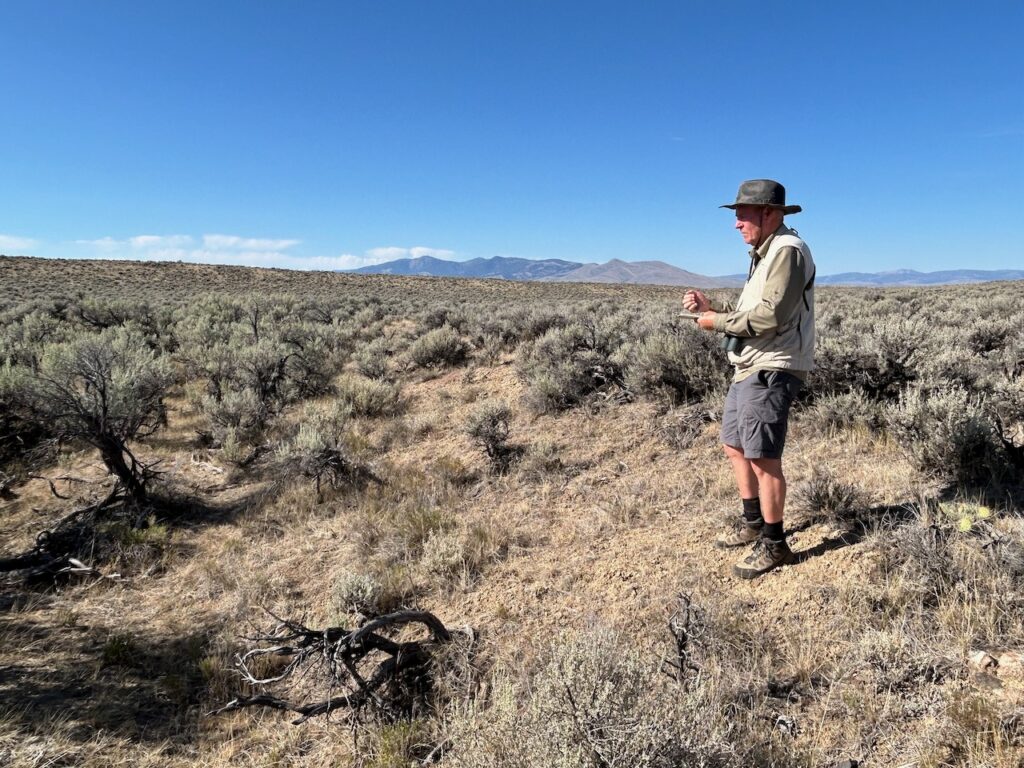
Biologist Jeff Marks takes notes on a Gray Flycatcher nest in his Beaverhead County study area.

When Jeff first told me they were working in a place called Sheep Corral Gulch, I imagined sagebrush plants bordering some kind of verdant riparian zone, perhaps lined with aspens or junipers. Imagine my surprise to see nothing but sagebrush in every direction! Gray Flycatchers breed throughout the Great Basin, but one of the fascinating things about them is that they choose different habitats in different places. In other states, they nest in juniper, pinyon pine, and even ponderosa pine, but in this part of Montana the birds breed almost exclusively in sagebrush plants along dry washes. One thing that these places share in common is that they have open ground for foraging.

Color-banded adults allow Jeff and the Montana Bird Advocacy team to make detailed observations about mating and behavior of these little-known birds.

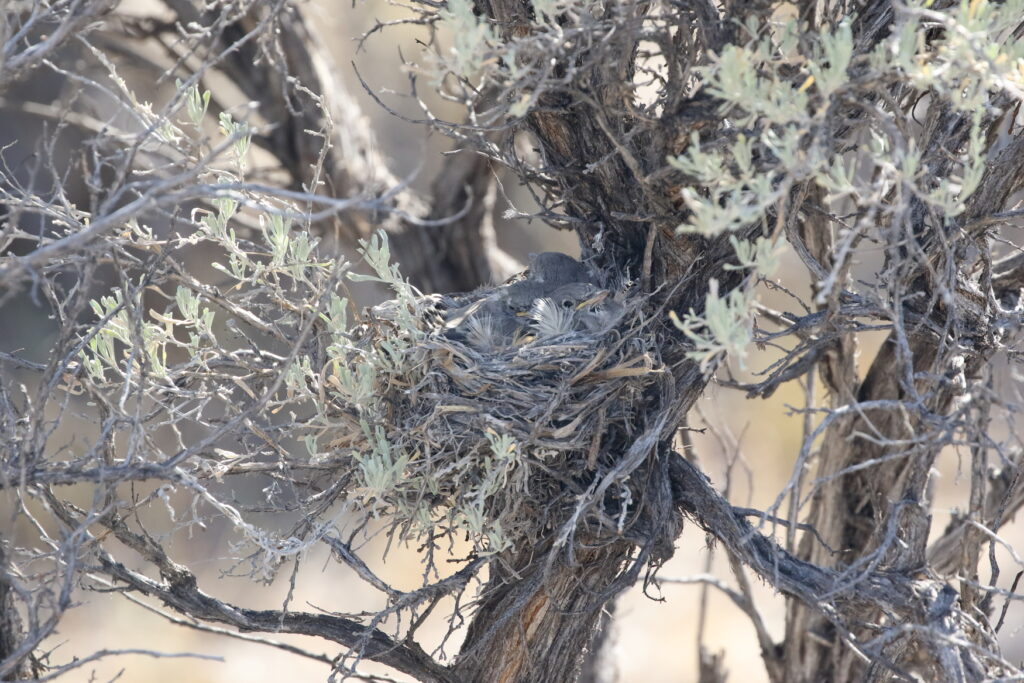
In Beaverhead County, though, not just any sagebrush will do. The birds nest only in taller plants four to eight feet high—plants that can mainly be found growing in the (usually) dry main stream channels of gulches. This year, Jeff and his colleagues located about a dozen nests, one to two hundred meters apart, and as Jeff and I began hiking, it wasn’t long before we spotted an adult bird up ahead. Using GPS coordinates, it took only minutes for Jeff to locate the bird’s nest—a nest with babies!

“They will fledge any day now,” Jeff told me, “and it looks like both parents are feeding them.” Having two involved parents gives the nestlings a huge survival advantage, and as we watched, we saw a parent deliver a juicy grasshopper to its ravenous chicks.

Most of the Gray Flycatcher nests were bursting with babies itching to head out on their own—after a few more meals from Mom and Dad!

For the next three hours, I followed Jeff as we visited one nest after another, and most were jam-packed with two or three babies champing at the bit to head out on their own. We, of course, made sure to stay well back so as not to spook them out of the nests before they were ready.

An unbanded adult Gray Flycatcher keeps watch on us as we move through its territory: “Move on. Nothing to see here, folks.”

I thought we would see a lot of other birds as we hiked, but especially this time of year, the birds stayed out of sight. We saw a couple of Brewer’s and Vesper sparrows, and a single Sage Thrasher and Northern Harrier. What a contrast from a month earlier when I spotted Sage Thrashers and Brewer’s Sparrows almost everywhere I looked! Nonetheless, I couldn’t have been more thrilled to get these up-close-and-personal looks at one of Montana’s most uncommon species.

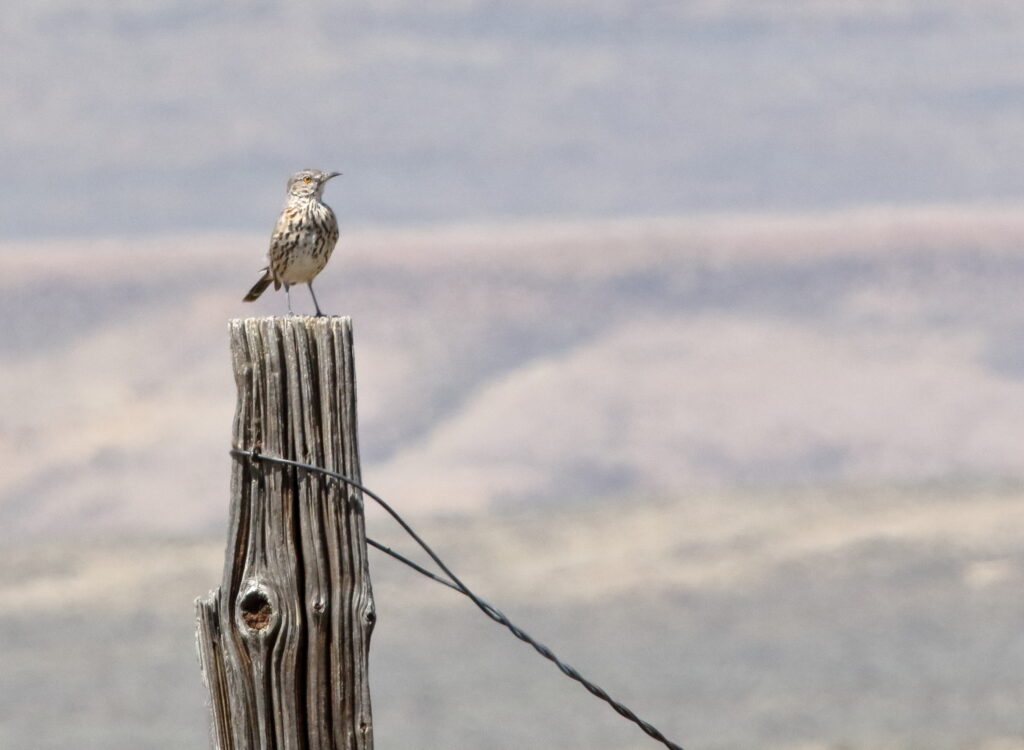
Sage Thrashers were noticeably more elusive than only a month earlier, but this one did pose nicely on a fencepost along Bannack Bench Road.

You may be wondering just where Gray Flycatchers can be found in Montana. That itself is a fascinating story, because they apparently arrived in our state only recently. The first official record occurred in 1999, and Jeff believes that the birds may only have reached the Treasure State as part of an expansion northward from the Great Basin that occurred in the 1970s. Their Montana strongholds are in Beaverhead and Carbon counties (see post Bear Canyon—Montana’s “Tropical Birding” Paradise), but it takes careful observation and listening to distinguish the birds from almost identical-looking Dusky Flycatchers. The fact that the birds are so restricted here in Montana, though, points out how important it is that we protect our fragile sagebrush communities. It also underscores the great value of the work that Montana Bird Advocacy is conducting, because only by understanding the biology of the Gray Flycatcher and other sagebrush species can we know how to protect them.

Please consider supporting the ongoing work of MBA by clicking here and making a donation. The flycatchers will thank you—as will generations of future birders!

While getting ready for the next day at the study site, MBA’s rental cabin offered an idyllic view of pastureland, complete with deer, coyotes, and gobs of Common Nighthawks. Donate to Montana Bird Advocacy by clicking on this picture.

Campsite #512: Algonquin Provincial Park, Canada (Maine to Montana, Part 4)

Today, we continue Braden’s epic birding trip from Maine to Montana with an astonishing visit to a place few people get to experience: Algonquin Provincial Park. Enjoy this latest installment, and if you’d like to support FatherSonBirding and independent journalism, please consider buying one of Sneed’s books shown to the right. Oh, and please share this post!

Twelve hours west of the Maine border, I spotted the giant sign reading “Welcome to Algonquin Provincial Park.” When many birders think of Canada, they imagine huge tracts of boreal conifer forest filled with the birds of the north: Canada Jays, Yellow-bellied Flycatchers, crossbills and, of course, Black-backed Woodpeckers and Spruce Grouse. Much of my drive from western Maine towards Ontario did not give that impression at all. In fact, the part of Canada that includes Montreal and Ottawa (both cities that I drove through) is lower altitude than western New England, and much of it lies in the St. Lawrence River Valley, a warmer, more humid region filled with deciduous forests, agriculture and suburbs. The area reminded me more of central Pennsylvania or New Jersey than of western New England, despite being at a similar latitude.

But Algonquin Provincial Park was noticeably different from the St. Lawrence River Valley. Three hours west of Ottawa, this large preserve sat at a higher elevation than the valley. The soil was rockier and because of that, far more conifers grew here, especially around the various lakes and bogs scattered through the park. Finally, I felt like I was back in good boreal habitat.

Algonquin Provincial Park represented a significant departure from lower altitude St. Lawrence River Valley only a few hours away.

I wasn’t allowed to camp in the park without paying a hefty fine, so I pitched my tent on a dirt road right outside it, in what appeared to be a site for keeping horses on the shore of a large lake. As dusk fell, I heard the twitter of an American Woodcock displaying high above. I’d seemingly settled in the middle of his territory, and he kept me company all night as I dreamed of what birds I’d see the next day.

My impromptu campsite outside of the park rewarded me with an American Woodcock that serenaded me to sleep.

After a short walk around my campsite at dawn, during which I detected a few Cape May Warblers, I headed into the park. My first location: the Spruce Bog Boardwalk. Spruce bogs, which I’d gotten to know during my time in Maine and the Northeast, are strange, almost other-worldly habitats scattered across the northern United States. Generally consisting of an outer area dominated by spruce trees with a core of peat moss floating atop water, they are home to a variety of unique species including carnivorous plants like pitcher plants and sundews. Because of their unique habitat structures, spruce bogs are also havens for a variety of boreal bird species that are otherwise less common in more southern parts of their range. So, as I set foot on the boardwalk, I found myself once again searching for Spruce Grouse and Black-backed Woodpecker—species I find myself looking for frequently.

Extensive searching brought no luck, although I did find more boreal warblers, including several Cape May Warblers and another great look at a Bay-breasted. I also heard a Lincoln’s Sparrow, my first of the year, singing from the wet back half of the bog. I had much of the day to bird Algonquin Park, so after striking out on my main targets at the boardwalk, I decided to take a short stop at the visitor center. 

I had hoped for both Black-backed Woodpeckers and Spruce Grouse in this spruce bog, but struck out with both species.

Within ten seconds of pulling out onto the road my Toyota RAV4 screeched to a halt. There, ten feet away, staring me down, stood a huge female moose. The animal had to be at least five feet tall, though from my seat in the car it seemed a lot taller! After we shared several seconds of each other’s presence, the moose trotted off into the woods. I didn’t end up seeing any of my bird targets at the visitor center and the center itself was closed, but I was now filled with adrenaline—I’d just scored my most wanted mammal of the trip!

Next, I hit Rock Lake Road. While I hadn’t seen many reports of my target boreal birds here, I figured that this road—a dirt track winding past marshes and through patches of spruce and budding Paper Birch—was as good a spot to try as any! Over the next hour and a half I drove slowly with my head out the window. Again, no woodpecker and no grouse, but I ended up tallying 40 species, 15 of which were warblers! Nashville and Magnolia were the most abundant, along with a smattering of Black-throated Blue, Blackburnian, Canada and others. Near the beginning of the road I also heard several Wood Thrushes singing, a surprise this far north. Along my drive I was also accompanied by the near-constant drumming of Ruffed Grouse, and the loud, piercing whistles of a pair of Broad-winged Hawks.

Though I continued to strike out on BBWOs and SPGRs, Algonquin presented a nice assortment of warblers including Nashvilles, always a favorite!

At this point I admit that I was feeling a bit ungrateful. I’d been birding for three or four hours and had not so much as glimpsed either of my targets—birds that were supposed to be somewhat regular within the park, and had compelled me to drive through Canada in the first place. Sure, I’d seen some great birds and a moose. But if I went the whole day without getting a Black-backed or a Spruce Grouse, I was going to be a bit salty. I jumped on eBird to check on any recent reports of either of them nearby and elected to visit, as my last stop of the morning, Pog Lake Campground. A Black-backed Woodpecker had been seen there only a few days before, and I figured it would be my best chance before continuing my journey west. I parked the car and began walking toward Pog Lake, keeping my ears and eyes peeled for my target species. One of the first birds I heard was a Tennessee Warbler, another boreal species with an electric song, singing loudly from a campsite nearby. I recorded it and continued onwards.

Then, I came across Campsite #512. Surrounded by gorgeous coniferous trees, it at first seemed just like any other campsite in Pog Lake Campground. The first thing that made Campsite #512 stick out, though, was the Ruffed Grouse drumming in the bushes nearby. Now, I’ve heard plenty of Ruffed Grouse drumming in my life—and had heard dozens on this trip already. Seeing one in action was a different story. I’d tried to sneak up on them before, but was always unsuccessful—the birds would flush from under my feet. However, this particular bird sounded incredibly close so I shelved my other goals and went into full stealth mode, sneaking towards the campsite to see if I could watch the grouse in action. After about ten minutes of tiptoeing around, I heard the beating of its wings—and that’s when I spotted it. Through ten feet of dense foliage, there the grouse stood, its wings striking its chest to make the sound that you feel more than hear.

I promptly sat down and spent the next thirty minutes with that grouse. Every five minutes or so, it would stand upright on its mossy log and begin its display. Bom-bom-bom-bom-bom-bom-bom. I watched it drum five or six times—with and without binoculars, and filmed it on my phone’s camera. It was magical. (Click the above image to watch my short clip.)

After twenty minutes, I also heard honking overhead. At first, I couldn’t see any birds above me, but I figured it was just a flyover flock of Canada Geese, though the calls sounded a bit strange. Then, in the gap above Campsite #512, I spotted several flocks of two hundred or so geese—and quickly realized that these were not Canadas. Between a bad view I got through my binoculars and listening to their sounds on Merlin, I realized I’d just seen a massive flock of Brant migrating over me, headed for the Arctic! I’d never seen these birds away from the ocean and never in such numbers! Sure enough, though, Algonquin Park lies right in the middle of Brant’s narrow migration route across Canada, and I’d just happened to be in the right place at the right time.

The Brant disappeared into the distance and the grouse drummed again, and I decided that, even though I hadn’t found my targets, I felt more than satisfied with my experience with Pog Lake Campground. But Campsite #512 hadn’t finished with me. 

As I slowly stood, taking care not to startle the grouse, I heard strange, frantic calls coming from the woods on the other side of the campsite. I quickly recognized them as calls I’d been listening for all morning, and suddenly, a male Black-backed, decked out in sleek black feathers with a yellow cap, flew into the campsite. It landed on a downed log near me, and proceeded to hop along the ground, getting closer and closer to until it stood only five feet away! It either didn’t notice me or didn’t care, poking for insects in the roots of the nearby spruce trees. After a minute or two, the woodpecker flew away, leaving me debating if I should EVER leave Campsite #512.

My best-ever look at a Black-backed Woodpecker will forever embed Campsite 512 in my birding heart.

As you can probably guess, I did continue on my journey, but knew that my visit to Campsite #512 would become one of my most memorable birding mornings ever, one that would be etched in my brain for a long, long time.

In Search of the Green-tailed Towhee

Please support our efforts at FatherSonBirding by buying a *New* copy of Birding for Boomers or one of Sneed’s other books shown to the right—and by donating to Montana Bird Advocacy, a wonderful grassroots scientific organization doing novel and unique research on Montana birds.

Confession: Despite the title of this blog, the the main purpose of last weekend was not to find Green-tailed Towhees; it was to learn about a wonderful study of Gray Flycatchers with biologists Jeff Marks and Nate Kohler. However, as I set out Saturday morning, defiant of the grim weather forecast for the next day, I did have a secondary mission in mind—to find and visit with some of the birds in the arid southwest corner of the state. Over the years, these sagebrush areas, from Bear Canyon (see Bear Canyon—Montana’s “Tropical Birding” Paradise) all the way west to Beaverhead County, had become some of my favorite parts of Montana. I credit that partly to my own childhood living in the dry chaparral country of southern California, but I also just love the ecosystems and birds in this part of Montana. I’d have trouble calling myself a real birder if I didn’t get down there at least once each year.

Since you’re pressing me on the issue, I also had a third objective for this trip—to move closer to breaking my all-time one-year species record. The record belonged to 2017, when our family traveled to Ecuador and Peru and I recorded a total of 527 species for the year. This year, thanks to last-minute invitations to Colombia (see THIS POST) and Texas (see THAT POST) I unexpectedly found myself at 498 species—perilously close to setting a new record. That task loomed more difficult than it might appear since once spring migration has passed and breeding season gets underway, it becomes much more difficult to find new species. Still, a trip to the southwest part of Montana promised to nudge me closer to this new goal, and my first target was one of the state’s coolest birds: Green-tailed Towhee.

On Braden’s advice, my first real birding stops of the trip were along the Jefferson River before Lewis & Clark Caverns.

Green-tailed Towhees winter in the American Southwest and Mexico, but generally breed in the the Great Basin region of the West, including southern Montana. Though the birds are not strictly rare, I could count the number of times I had ever seen one, and I felt eager for another GTTO encounter. To find this bizarre, poorly understood beauty, I hit I-90 at dawn and steered toward Lewis and Clark Caverns, two-and-a-half hours to the east. To entertain me along the way, I had checked out an audio version of Eat, Pray, Love, a book that invites all kinds of snarky comments but, I found, actually proved moderately amusing. On Braden’s advice, I pulled over alongside the road leading to the caverns and was rewarded with a wonderful assortment of river and cliff birds including Rock Wren, Lazuli Buntings, and White-throated Swifts. Once inside Lewis and Clark Caverns State Park itself, I focused on finding Green-tailed Towhees.

I struck out. I spent a good hour and a half checking along the road, up around the main parking area, and in the campground. Merlin’s Sound ID picked up a putative GTTO song at one point, but I neither heard nor saw a trace of the bird.

I have to admit that this made me feel like a total failure. I mean, here was my first target bird of the trip, and one that shouldn’t be that hard to find, and I totally “whiffed” on it, as Braden might say. I didn’t plunge into despair exactly, but it definitely put a damper on my mood as I began questioning just what I thought I was doing out here pretending to be a birder! Well, I thought, maybe I’ll have better luck at my next destination.

Which happened to be Birch Creek Road north of Dillon in Beaverhead County. Several years before, Braden and I had found our lifer Thick-billed (formerly McCown’s) Longspur on this road, and once again, the road delivered. I’d driven only a mile before I saw a suspicious dark shape on a fence. I actually didn’t think it was a Thick-billed, but my binoculars revealed otherwise. “Yay!” I exclaimed, feeling the weight of my earlier “whiff” lifting slightly. A few minutes later, I was examining another TBLO when I noticed a large shape sitting in a field about one hundred yards away. “Clearly a hawk,” I thought, “but what kind?” The answer: the best kind, at least for my goals for the trip—a ferruginous hawk. This was another bird I needed for the year and one that isn’t always easy to find in the state.

Digging out the peanut butter sandwich I’d made earlier, I tooled down I-15 for my next destination, Clark Canyon Reservoir. Braden and I had only ever birded here once before, and as near as I recall, we hadn’t found much, so I kept my expectations low. I stopped at one overlook and was surprised to see a Common Loon on the water below, along with a Double-crested Cormorant and a couple of Ring-billed Gulls. Violet-green swallows swirled around me and, as always, they brought a smile.

Snaking around the reservoir, I approached a sign for Horse Prairie Campground and spontaneously swerved left onto a dirt access road. The reason? Tall, healthy-looking sagebrush! Hm, this just might have one of my other target birds for the day. Almost immediately, I saw a really cool bird that had not been on my target list—a Common Nighthawk peacefully chillin’ on the split-rail fence. The bird barely blinked as I fired away with my camera through the car window from only thirty feet away.

The first of three Common Nighthawks I spotted chilling on the wooden fence leading down to Horse Prairie Campground.

Creeping slowly forward, I heard a song I didn’t recognize—which was no great surprise in itself, but I did have a guess of what it was. Sound ID confirmed it: Brewer’s Sparrow! This bird loves healthy sagebrush and makes up for the world’s dullest plumage with a vigorous song that bewitches any birdwatcher who hears it. A few moments later, one even sat still long enough for a decent photo. Check. Another target bird—but not the one I expected to find here!

One of Montana’s drabbest birds, the Brewer’s Sparrow has an enchanting song.

I kept driving slowly toward the campground and spotted a medium-sized, slender bird up ahead. Wishfully, I thought it might be a Say’s Phoebe—another bird I happened to need for my year list—but it flew off before I got close. As I pulled into the campground, though, two brownish birds were chasing each other around. I assumed they were robins, but when one landed on a “Day Use Only” sign, I realized with a start that it was exactly the bird I had hoped to find here—a Sage Thrasher!

Sage Thrashers are so flighty that seeing one on a sign was about the last thing I expected!

Braden and I have never met a thrasher we didn’t like, but Sage Thrashers hold a special place in our birding hearts. For one, they’re the world’s smallest thrashers—which is why I mistook them for robins or phoebes. For another, they are charismatic songsters and often are the most common bird you see in sage country. As I sat in the car, in fact, I counted three more Sage Thrashers around me. Whoo-Hoo!

One of our favorite Montana birds, Sage Thrashers seemed to be everywhere I looked this afternoon.

Later, on the road where I was to meet up with Jeff Marks and Nate Kohler, I encountered seven more Sage Thrashers! It was a veritable thrasher party—by far the best experience I had ever had with these good-looking birds.

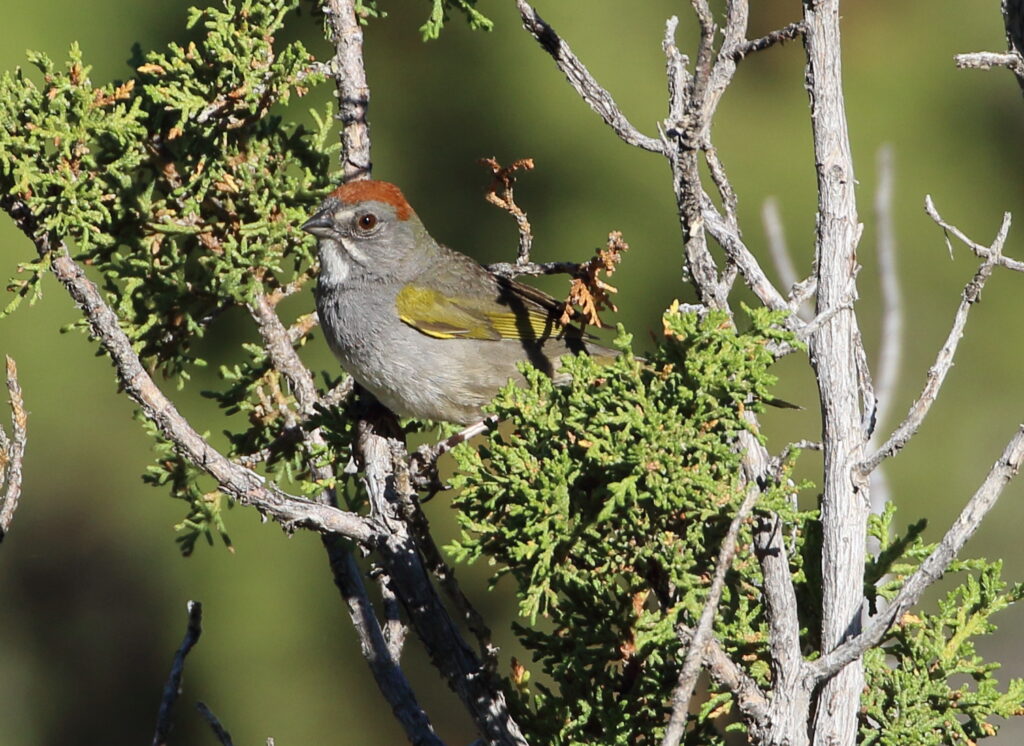
Unfortunately, the next morning, heavy rain and spitting snow kept me from seeing Gray Flycatchers with Jeff and Nate. More on that in another post. Almost as bad, I began the drive home without a Green-tailed Towhee under my belt and no expectations of seeing one. But bless Nate Kohler’s heart. He told me about a canyon I should check out on the way home. It was still raining when I got there, but I drove slowly and stopped frequently, listening and watching. Lazuli Buntings chattered everywhere and I saw a good variety of birds—but no towhee. Finally, I put on my raincoat, got out of the car and played a Green-tailed Towhee song. Almost immediately, a small shape darted up out of the sagebrush—the bird I was looking for! Not only that, it held still long enough for a photo—but the story hadn’t quite finished.

I worked hard for this Green-tailed Towhee—only to find that it wasn’t a year bird after all!

Once I got home and posted all of my checklists for the trip, I was surprised that eBird hadn’t added GTTO to my year list. What’s going on? I thought, and did a quick search to see if I had somehow seen one down in Texas and forgotten about it. Nope. What I did forget was the rare vagrant GTTO I had seen in Victoria, BC during Amy’s and my January trip (see Birding Victoria, BC)! So this one was not a year bird after all, but still a lot of fun to see. Meanwhile, my year list swelled to 503 species thanks to the Thick-billed Longspur, Ferruginous Hawk, Brewer’s Sparrow, Sage Thrasher, and a Prairie Falcon I had spotted the afternoon before. Not exactly the trip I expected, but one I already cherished.

Target Birds and a Shocking Surprise in the Texas Hill Country (Texas 2025 Part 3)

After spending two glorious birding days along the east Texas & Louisiana coasts (see “Peveto Woods, Louisiana: Spring Migration Hotspot.”), I returned to San Antonio for my four minutes—yes, you read that right—four minutes of work to promote my book Birding for Boomers. While there, I reprised my now-sort-of-famous birding route along San Antonio’s Riverwalk (see our post “Birding San Antonio’s Riverwalk—Are You Nuts?”). Once again, I found birds—but not enough to write another blog about it. As soon as I finished my speaking gig, though, I headed west into the Texas hill country. Why? To try to find two birds Braden and I had talked about our entire birding careers.

Leaving San Antonio, I drove two hours to the hot, fairly flat town of Uvalde and booked myself into a Hampton Inn. That afternoon, I picked up a few nice birds in the town’s Memorial Park including another Yellow-throated Vireo and my first—and only—Green Jay of the trip. I also grabbed an excellent Tex-Mex meal at El Herradero de Jalisco restaurant. The next morning, I hit the road before dawn.

One bonus to birding is that we birders invariably get to see spectacular sunrises and sunsets. As I headed north, I witnessed an unforgettable sizzling orange sunrise on one side of the car while an equally spectacular orange full moon set in the west. It boded well for what would be arguably the most important—and most demanding—birding day of my trip: my quest to find Black-capped Vireos and Golden-cheeked Warblers.

Anyone who has been birding for more than a couple of years has probably heard of these two Texas specialties. Of the near-threatened Black-capped Vireo, Braden simply says, “It’s the best vireo.” Quite a statement considering how cool other vireos are! The bird winters in Mexico, and its primary breeding range lies in central Texas—though it technically extends from far northern Mexico to southern Kansas. The endangered Golden-cheeked Warbler winters in Central America and far southern Mexico, but breeds exclusively in central Texas.

According to eBird lists, Lost Maples State Natural Area is one of the most reliable places to find both Black-capped Vireos and Golden-cheeked Warblers.

As usual, I felt a bit skeptical of my ability to find these birds. Call it psychological protection against failure. Nonetheless, I did have a plan. After scouring eBird hotspots, bar charts, and birding lists before the trip, I settled on Lost Maples State Natural Area as the most reliable location to find both species. Indeed, when I pulled into the parking lot, I met a couple who had staked out a bush where they had seen a Black-capped Vireo the previous day. “We saw Golden-cheeked Warblers in that tree about fifteen minutes ago,” the woman added, motioning to a nearby oak tree. I briefly pondered waiting around for either species, but the canyon before me beckoned and I reasoned I could hang around the parking lot later if need be.

I immediately loved Lost Maples, especially since its habitat reminded me of the chaparral and oak woodland I’d grown up with in Southern California.

I headed up the park’s East Trail and immediately felt at home in the scenic canyon’s xeric landscape full of oaks, junipers, mesquite, and other classic Western vegetation. I also realized that I had tackled some tough birding! Birdsong rang out all around me, but I got few glimpses of actual birds. Thank god for Merlin’s Sound ID, which I ran multiple times to get an idea of what might be around me: an impressive list that included Canyon and Carolina Wrens, Olive Sparrows, Yellow-breasted Chats, and at least four (other) kinds of vireos. Finally, however, “Black-capped Vireo” popped up on Sound ID and I stopped to seriously scour the nearby vegetation. Over the next five minutes, I got a brief glimpse of a Blue-headed Vireo and good looks at a White-eyed Vireo.

I had to work hard for actual bird sightings at Lost Maples, but managed a great look at a White-eyed Vireo—one of five vireos on my checklist for the day.

Finally, I saw the distinctive black head and white spectacles of the bird I most hoped to see: a Black-capped Vireo! Soon, I saw another. The birds definitely did not want to strike a pose and I followed them as they flitted almost frantically from bush to tree and tree to bush. I finally managed a couple of ID photos, and then just tried to relax and observe them. It was a good moment, and I felt glad I hadn’t just waited around the parking lot hoping for one to appear.

I was so glad that I hadn’t waited around the parking lot to find my Lifer Black-capped Vireos!

That left the Golden-cheeked Warbler. Sound ID had picked it up a couple of times as I hiked the canyon, but it wasn’t until I was back in the park next to my car that I began to figure out the bird’s song. With my imperfect hearing, it sounded like a high-pitched buzzing trill—a lot like an insect, but distinct from any other bird calls around me. Soon, I found myself standing for five minutes directly in front of an oak tree as a Golden-cheeked sang repeatedly.

I never saw it.

This frustrating experience repeated itself several times. I eventually added the bird to my eBird list (“Heard only”), but I was not a happy camper and I thought I might remove it later. As shy as they were, the Black-capped Vireos had been publicity hogs compared to the Golden-cheekeds! Knowing when I was beaten, I headed off to some bird feeders set up in the park about a mile away. There, I tried to console myself with leisurely views of Woodhouse’s Scrub-Jays and Scott’s Orioles. I also told the bird hostess about my lack of success actually seeing a Golden-cheeked Warbler. “Any suggestions?” I asked.

While pondering my next moves, I spent a pleasant half-hour watching Woodhouse’s Scrub-Jays and Scott’s Orioles at the Lost Maples bird feeders.

“Well,” she said, “I’d head up the East-West Trail right here until you come to the ponds about a mile on. Just keep scanning the trees as you walk.”

By now, the heat had built into the low 80s. Another hike did not sit high on my priority list, but darn it, I hadn’t come all the way to the Texas hill country for nothing! Slinging my camera and new Vortex Viper 8X42s over my shoulders I resolutely started marching.

Fortunately, a number of beautiful oak trees provided shade to parts of the trail. I kept stopping frequently and soon enough began hearing more Golden-cheeked Warblers. Again, they absolutely refused to be seen, even when I seemed to be standing right in front of them! As I was scouring one oak tree, though, I detected movement and a flash of yellow. My excitement rose . . . but something didn’t look quite right. Finally, I got my binoculars on the bird and I realized what it was. This wasn’t a Golden-cheeked Warbler. For me, it was even better: my lifer Yellow-throated Warbler!
My Bird of the Day wasn’t actually the Black-capped Vireos or Golden-cheeked Warblers I’d set out to find. It ended up being my Lifer Yellow-throated Warbler—a complete surprise!

I couldn’t have been more thrilled. On other trips, I had hoped to see one of these birds multiple times without success, but today, it hadn’t even been on my radar! The bird was every bit as beautiful as a Golden-cheeked, and a quick look at the Merlin app confirmed that I was indeed within its breeding range—but just barely. According to Cornell’s Birds of the World, it has a relatively small, disjunct breeding range in central Texas separate from its more extensive breeding range across the Southeast. While fortunately not endangered or threatened, this bird had assumed an almost mythical status in my mind and to see it now . . . well, it felt exhilarating.

I felt both grateful and relieved to finally see a single Golden-cheeked after multiple GCWAs had taunted me all day!

Long story short: I finally spotted a single Golden-cheeked Warbler after spending almost an hour standing in front of trees where one or another GCWA sat singing and taunting me. While I had hoped to add just the Black-capped Vireo and Golden-cheeked Warbler to my life list during my entire Texas week, I had now seen an amazing seven lifers. Even better, having tracked down the BCVI and GCWA, I now had the entire next day to pursue one more. Check out the next post for details!

Shopping for a great new pair of binoculars that are reasonably priced? Be sure to check out our recent (unpaid!) review of Vortex Viper HDs by clicking here!

Owl’s Watch Ecolodge (Colombia Birding Part 2)

As light spread across the sky, I slipped on my flip-flops and ventured out onto the porch of our cabin at Owl’s Watch Ecolodge in the department (county) of Caldas, Colombia. Misty clouds clung to the Andean peaks surrounding us. Far below rose the high-rise apartments and businesses of Manizales, a city of almost half a million. Unidentified bird calls rang across the vegetation surrounding us and a couple of flocks of Eared Doves flew by on a morning commute. Suddenly, I saw a shape that stirred familiarity. It landed in a distant tree, but thanks to my amazing new binoculars, I was able to focus in on it. Even though I knew very little about Colombian birds, the way it clung to the side of the tree made me  think, “Woodpecker.” Then, I caught a reddish hue on its nape and back, and my excitement rose. When it turned its head, it revealed a large white face patch that clinched the ID. I couldn’t believe it. In my first moments of serious birding in Colombia, I had found one of the birds I most wanted to see: a Crimson-mantled Woodpecker!

It’s risky to post such a crummy photo of a Crimson-mantled Woodpecker as the post’s very first bird shot, but it highlights how difficult it often is to photograph birds in tropical forests—a topic I’ll discuss in a forthcoming post.

As mentioned in my last post, “Layover Birding in Bogota, Colombia”, I had traveled to South America at the last-minute invitation of my friend and FSB contributor, Roger Kohn. Now, only two weeks later, I felt in awe of the fact that we were actually here, about to launch into our first Colombian day of birding together.

One of the two luxurious cabins at Owl’s Watch, with great views of the surrounding landscape. As popularity of the lodge blossoms, Dennis is considering adding additional cabins.

Roger had planned our entire itinerary, which included booking our first four nights here at Owl’s Watch, a comfortable new lodge with two modern cabins perched at the edge of a large, protected watershed that ensured a dependable water supply for the city of Manizales below. The lodge had been built by American expat Dennis Bailey and his Colombian wife, Adriana. Interested in restoring land that had been cleared for agricultural activities, they had purchased a farm, or finca, that was an inholding of the nearby protected area. As they worked to revegetate the land and allow it to heal itself, they decided to build Owl’s Watch for nature lovers—especially birders.

The following day, we would be heading out with a guide, but today Roger had wisely allocated time for us to bird and explore on our own—a day to get familiar with some of the local birds and rest up from our two-day journeys from the States. I’m more of an early riser than Roger, but to my surprise, he soon joined me on the porch, eager to get started.

One of the amazing things about Owl’s Watch is that you are able to gaze down on Manizales, a city of almost half a million people, while being surrounded by nature.

We decided to begin by climbing the long steep “driveway” that headed up from the lodge to the road above. Almost immediately we saw large turkey-like birds that, from taking eBird quizzes, I recognized as Sickle-winged Guans. Moments later, I glimpsed a furtive shape fly across an opening and dive into a bush—a White-naped Brushfinch.

At the top of the drive, we reached a small parking area bristling with even more activity. In the trees surrounding the area, we quickly identified the orange head of a Blackburnian Warbler, and then got super excited to see a pair of equally small birds with bold, sunburst golden throats and breasts—Golden-fronted Redstarts!

Golden-fronted Redstarts, a New World warbler, were one of our exciting finds from our first day of birding at Owl’s Watch.

As I chased these around, Roger used Sound ID to get onto a bird I never thought we would see, Azara’s Spinetail. Its call sounded like “bis-QUICK! bis-Quick!” and while we never got great looks at it, we were thrilled to get a glimpse of this handsome, skulky species.

From the parking area, we headed down a pleasant trail that would wind its way back to the to the main lodge building, dubbed “the Social.” Soon, a covered viewing platform came into sight and we paused to check out hummingbirds at the feeders and flowering bushes surrounding the spot. Someday, I’ll write about my ambivalence about hummingbirds, but I gotta say, they were spectacular to watch. What got me most excited was seeing a White-sided Flowerpiercer. I’d seen my very first flowerpiercer only the day before in Bogota, and here I was, looking at a second species the very next day!

Though not as colorful as many other tropical birds, I was especially excited to discover this White-sided Flowerpiercer. Notice the hook at the end of the bill? That’s a key to picking out flowerpiercers from other small tropical birds.

We continued hiking down the trail, past the Secret Garden, another great birdwatching spot Dennis had set up. Along the way, I spotted a rather plain brown bird that I quickly recognized as a Swainson’s Thrush. As I indicated in my last post, it’s a special thrill to see a bird from “back home” in its alternative, wintering environment. I also took a photo of a nondescript bird that turned out to be a Mountain Elaenia, a kind of tyrant flycatcher.

Don’t get me wrong. I am NOT an expert at identifying flycatchers, but a guide and the Merlin app helped me figure out this Mountain Elaenia.

Soon, we found ourselves back at the Social. David, the fabulous Owl’s Watch cook, fixed us a scrumptious breakfast and we dined while enjoying yet more hummingbirds—at least nine species—along with more flowerpiercers, Rufous-collared Sparrows, and Great Thrushes.

Along with the hummingbird feeders, Dennis’s crew had set up a fruit feeder off to the side, and there we beheld one of the most spectacular of the area’s birds, Blue-winged Mountain Tanagers.

Blue-winged Mountain Tanagers were definitely one of the “best-dressed” birds of our first day birding at Owl’s Watch.

After we got our fill of hummingbirds (if that’s even possible), we took another path that wound around to our cabin. Before our trip, Braden had encouraged me to listen for weird noises, and now I did indeed hear a very bizarre, almost plaintive, series of falling notes. As we rounded a corner, we met the source of these calls—a Masked Trogon! Trogons are some of those birds you always hope to see in the tropics, but when you finally do, you’re left wondering if the bird is really perched there in front of you, or if you’re just imagining it! Fortunately, this was no mirage, and even better, it sat cooperatively while Roger and I did our best to capture decent photos of it against the backlit sky. How did we do? You will have to judge for yourself:

Even this so-so photo reveals what stunning birds Masked Trogons are. While this was our best look at this species of the trip, other trogons would soon follow!

Note: This blog post—and all others on FatherSonBirding—are written by REAL PEOPLE! No compensation or gratuities were provided to us in connection with this post. If you’d like to support FSB, please consider buying one—or ten—of Sneed’s books and contributing to a bird conservation organization of your choice. Thank you!