
Category Archives: Songbirds

Braden’s Tales from the High Sierras, Episode 7: The Yosemite Bighorn Sheep Survey

As Braden’s sensational Sierran summer begins to wind down, he has continued to have remarkable experiences, both avian and mammalian. In Episode 7, he recounts his hardest hike ever in an attempt to locate some of Yosemite’s most interesting and elusive mammals.

Despite being the nearest gas station, restaurant and convenience store to the eastern entrance of Yosemite National Park, the Mobil station was fairly empty when our red Nissan pulled into the parking lot at seven in the morning. We gathered around a table, breakfast burritos in hand, as we waited for the Bighorn Sheep biologists to arrive from their various lodgings. As we would learn later, sheep biologists sleep in because the sheep sleep in, which differs quite a bit from us bird biologists. At 7:30, we noticed a crowd gathering outside, and donned our identical Institute for Bird Populations baseball caps, heading out to meet them.

Among the scientists we met outside were Dr. Lacey Greene and Dr. John Wehausen, the latter of whom had worked with sheep his entire life and had apparently drafted most of the recovery plan for the Sierra Nevada Bighorn Sheep. As Wehausen joined the group, he struck up a conversation with Greene.

“537 had a lamb yesterday when we went out. 522, didn’t though. I’ve only seen a few lambs so far this year.”

Apparently, every single Bighorn Sheep in Yosemite National Park has a number assigned to it, and as I would learn, a radio collar frequency. The reason these surveys were being conducted in the first place was because the Sierra Nevada subspecies of Bighorn Sheep was not doing well. Due to threats that included diseases spread by domestic sheep, the entire population of Bighorn Sheep in the Sierra had declined to around 100 individuals in the 1990s, spurring the federal government to list them under the Endangered Species Act. Thanks in part to Wehausen’s recovery plan, as well as the hard work of dozens of other sheep scientists, the herd had now increased to roughly 600 sheep, both inside and outside of the park. 

Dr. Greene introduced all of the biologists that would be hiking various parts of eastern Yosemite to look for sheep, and we approached her, asking which biologist we should go with for a medium-level route since we had work tomorrow and did not want to exert ourselves too much. We also requested a route that maximized our chances of seeing White-tailed Ptarmigan, a bird Sam needed for his life list. Interestingly, ptarmigan are not native to the Sierras and were introduced to the area in the 1970s, although we still hoped to run into some in the alpine zone we would be hiking. Dr. Greene pointed towards Seth, a graduate student from the University of Wyoming studying the carrying capacity of the Sierras for sheep, who would be doing a route called “Mt. Gibbs”. 

“Should be a medium route with good chances of ptarmigan,” Dr. Greene said, and we took her word for it. Perhaps we shouldn’t have.

Our “medium route” began pleasantly enough—but we had no idea what awaited us.

After introducing ourselves to Seth, we all piled into the Nissan (which has adopted the name “the company car”) and joined the caravan of biologists and volunteers headed towards Tioga Pass. I quickly learned from Miles that we likely wouldn’t see many of the National Park’s main attractions, including Yosemite Valley and Half Dome, but soon realized that this did not mean we would be short on scenery. The road soon led us out of the sagebrush and juniper dominating the hills of the eastern Sierra and into subalpine forest. Carved peaks and ridges topped with snow rose around us, and in the distance I marveled at views rivaling Glacier National Park. After entering the park, we soon arrived at the Mono Pass Trailhead and set off through Lodgepole Pine forest with two dozen bighorn sheep biologists.

Several months ago, I’d had no idea what part of California held Yosemite, and now here I was, crossing another one of the United States’ most beautiful places off of my bucket list. The trail crossed wet meadows and creeks, filled with the songs of Lincoln’s and White-crowned Sparrows, and as we gained elevation, Miles pointed out the peaks around us. 

My co-worker, Miles Carlile, tromping through the some of the world’s most spectacular scenery.

“To our left is Mt. Dana, the second-tallest peak in the park at 13,000 feet,” he said excitedly, “And at some point we should be able to see the tallest, Mt. Lyell, to the right along with the Lyell Glacier below it.”

I’d had no idea that any glaciers existed in California, and later learned that the Lyell Glacier was one of only two left in the park. And despite the wilderness-feeling that Yosemite produced as we hiked through it, glaciers weren’t the only thing missing from this once-intact ecosystem. Every time my dad and I visited Glacier, we would try to see the Big Four, what we considered to be the largest (and most obvious) wildlife in the park. Bighorn Sheep were the only one of those species that existed here. Moose and Mountain Goats had never lived in the Sierras, and Grizzly Bears had been extirpated a century ago. So while Yosemite may have rivaled Glacier in terms of scenic vistas, it did not deliver in terms of wildlife.

After about a mile, the rest of the group bid us farewell as Seth led us off the trail…directly uphill. We hiked straight up a ridge, through the Lodgepole, for about five minutes before realizing that a sheep biologist’s definition of a “medium hike” differed quite a bit from our own. In fact, it was the hardest hiking I’ve ever done. Following Seth, we left the treeline behind as we realized what we were up against: Mt. Gibbs was only three hundred feet shorter than neighboring Mt. Dana, at 12,700 feet. That was something Yosemite could hold over Glacier—the mountains were taller. Granite Peak, Montana’s tallest, rose only to 12,800 feet. Thankfully, Seth allowed us to take as many breaks as we needed as we scrambled over boulders and scree, heading straight for the summit.

The life in the alpine zone is certainly some of the most magical on earth—and some of the most imperiled by climate change.

We did not see any ptarmigan. Nor did we spot any of the alpine raptors, like Prairie Falcon or Golden Eagle, that I’d hoped to glimpse. That isn’t to say that the alpine zone of Mt. Gibbs was devoid of life. Tufts of small grass, brilliant purple and white flowers, and splashes of lime green and blood orange lichen led us all the way to the summit. Insects, too, seemed to live here in abundance, and I spotted species of grasshoppers, spiders, ants and butterflies I’d never seen before. One bird seemed to thrive up here: Gray-crowned Rosy-finches, one of the most extreme bird species on the planet. Rosy-finches flitted past us over the scree, and one particularly cooperative flock picked seeds off of a lingering snowpack near the top of the mountain. These birds breed only in these alpine areas, beyond the reach of almost any other bird species and the trees themselves.

Not only did we see one of my favorite birds, Gray-crowned Rosy-Finches, atop Mt. Gibbs, they were some of the most approachable birds I’ve ever encountered.

On our ascent, we stopped about every five hundred meters so that Seth could remove a strange device from his backpack. On one end was a sort of radio which displayed primitive numbers and figures, and on the other was an H-shaped receiver. This revealed how the biologists expected to locate the sheep on these seemingly-endless ridges: radio telemetry. The third time we stopped, Seth let me try out the system, and explained to me how it worked. Apparently, every single collared sheep in the Sierras has their own frequency, like the frequency of a radio station. Thus, if you want to locate an individual, you punch its frequency into the radio. Turning a knob increases the volume, and then the H-shaped part of the device comes into play. I held the “H” above me, facing the sky, and slowly rotated it, searching for a signal. Once I began to hear a faint beep, I turned the “H” towards it, trying to locate exactly which direction that beep was coming from. The louder the beep, the more accurate the direction. And in this case, the beep corresponded to a single ram hiding just beyond a ridge in front of us.

A Bearded Big Horn Sheep? No, that’s me sporting my new “field biologist look” while using telemetry for the first time! Note Mono Lake a couple of inches to the left of my head!

Eventually we struggled to the top of Mt. Gibbs, having climbed more than three thousand vertical feet in less than two hours, with no trace of a trail to follow. At the top, we huddled in a small rock shelter someone had constructed, and I signed my name in the “Mountain Registry”, a small notebook housed in a worn, metal box. While I’d like to say that we spent the next hour scanning for sheep, the four of us IBP employees just lounged on the rocks, recovering while Seth did most of the work. Apparently, this was an “easy” day for him—sheep biologists spend most of the summer on five- to ten-day backpacking trips trying to find herds. After recovering a bit and having some snacks, I spent a good amount of time photographing the rosy-finches feeding on the snow around us.

Then it was time to descend. This proved just as difficult as the ascent, as we slowly slid down a scree field for almost an hour before hitting the first trees again. Although we still hadn’t spotted any sheep, we opted to return to the cars. We had work tomorrow and still needed to drive the two and a half hours back to Mi-wuk Village. eBird claimed we had logged nine and a half miles, which meant we had probably hiked closer to twelve, much of that up and down incredibly steep terrain. The survey as a whole, however, was quite productive. The other biologists found at least 32 sheep, including plenty of rams. 

While our crew failed to see any Bighorn Sheep, the other biologists located 32 of these dynamic wild “woolies”. Photo disclosure: these are sheep in Glacier National Park (I think).

Once we got back to the parking lot, legs aching, we thanked Seth for everything and hopped back in the company car. I said goodbye to Yosemite, unsure of when I would return, and after a quick stop at the Mobil station for tacos, we headed home.

Braden’s Tales from the High Sierras, Episode 6: Thrashing Through the Rain Shadow

When he first learned about his job in the Sierras, Braden never expected that it would provide him with a great opportunity to observe hard-to-find sagebrush species—including some of our top Nemesis Birds! It also helped move him closer to his revised Big Year goal of 500 species and the coveted 1,000 species mark on his Life List!

A concept my dad and I have perfected over the years is that of putting in a certain number of hours to locate every bird species. Unfortunately (or perhaps, fortunately), not every bird will just be sitting there in the parking lot when you arrive in a place to look for it, and it is not uncommon to completely miss a highly sought-after species. After a certain number of misses, in fact, that species becomes a nemesis bird. Every birder has or has had a nemesis bird, and that led me to think about the fact that for every single person, the number of hours “required” to see each species is unique. To get a Blue Jay, for example, a birder in the Western United States may have to search for more than ten hours, performing multiple searches at multiple locations to add this bird to his life list, while a beginning birder in Massachusetts may only have to put in five minutes or thirty seconds. Even in less extreme geographical situations, the number of hours people put in for a bird varies. My dad and I invested double-digit hours into finding an American Bittern, whereas other Montana birders just seemed to stumble onto them.

On June 25th, as my co-worker Sam Darmstadt and I crossed Sonora Pass, heading for the dry lands of the eastern side of the Sierras, we had many target birds in mind that I had already logged many hours trying to see. The first was one my dad and I had looked for at least four times, designating it as a nemesis bird, and apparently, I had finally put in enough hours for it, because as soon as we hopped out of the car on a dirt road near Mono Lake, there it was: a Sagebrush Sparrow, posing in perfect view for us on top of its namesake plant. 

One of our most handsome sparrows, Sagebrush Sparrow was a nemesis bird my dad and I had searched for multiple times in recent years.

“Was it too easy?” asked Sam, as I snapped photos of this lifer. The open sagebrush plains we stood in appeared to be perfect habitat for the species, and we spotted several more as we continued down the road. In fact, it was one of the only birds in this habitat, along with Sage Thrasher and Brewer’s Sparrow, which also gave us great looks. I glanced at the strange tufa columns (calcium precipitations) rising up from Mono Lake in the distance before getting back in the car on the way to our next target for the day. This was another sage bird, one I’d only seen once and Sam had never seen: Greater Sage-Grouse.

Again, my dad and I (sometimes with Nick in tow) had looked for this species multiple times across the various Eastern Montana locales it frequented, but with very limited success. It had been five years since we’d seen our lifers, a mother with two chicks on Bentonite Road, the same road where everyone in Montana goes to get their Mountain Plovers for the year. Where Sam and I were now, at Lake Crowley, was about as different a place from Bentonite Road as possible while still supporting expansive sagebrush habitat. Ponderosa (or Jeffrey’s) Pines rose in the distance, a symbol of our high elevation despite having left the Sierras. And speaking of the Sierras, there they towered in front of us, their craggy slopes rising towards sharpened peaks sprinkled with lingering snow patches.

The Sierras aren’t just stunning to behold, they have profoundly shaped Western ecosystems and bird species—including some of our top targets to search for.

We slowly drove the dusty road through the sagebrush towards the lake, flushing Horned Larks, Brewer’s Sparrows and yet more Sagebrush Sparrows off the road in front of us. Despite squinting as we scanned for grouse heads, we did not find any. Upon reaching the lake, we added a few water birds to our list, including American Avocet, Long-billed Curlew, Eared Grebe and Ruddy Duck. Then we slowly began making our way back.

The Sierras are an incredibly diverse ecosystem and help make California a biodiversity hotspot, and we experienced that for ourselves on our drive through the sagebrush. Over the mountains above us, dark gray clouds loomed, dumping rain on the rocky peaks. Sam and I both flinched as lightning bolts struck the highest points, the thunder echoing across the valley. However, while many of the clouds drifted over our heads, the rain barely reached us. The Western Sierra had a day full of rain, while over here, we got a few drops at most. This rain shadow, created by the tallest mountains in the Lower 48, allowed sagebrush to flourish here while oak savannah covered the western foothills only twenty miles away. And the mountains didn’t just block storms. They blocked birds, too. Many of California’s famous specialty birds, including Wrentit, California Thrasher and Yellow-billed Magpie, simply could not make it over these mountains. Without the Sierras blocking their paths, these endemic or near-endemic birds probably wouldn’t have evolved into their own species in the first place.

Meanwhile, here on the east side of the mountains, a familiar Black-billed Magpie flew over the car as we turned down one last road in an effort to find grouse. After about a mile, I turned to look over my shoulder just as three giant ground birds erupted from right next to the car, landing a short distance away.

“Grouse!” I shouted, “Get out! Get out!”

This was only the second time I’d ever seen a Greater Sage-Grouse—and was a lifer for Sam!

We soon spotted one of them: a female Greater Sage-Grouse wandering through brush rising up to its shoulders. We high-fived, relishing the moment as we watched the rare bird move away from us.

Farther south, we stopped briefly at a canyon for an unsuccessful try at Black Swift, and filled up at the least expensive gas station we could find in Bishop, California. Continuing down Hwy 395, the mountains grew yet higher, and we soon found ourselves almost under the shadow of Mt. Whitney, the tallest mountain in the Lower 48. We couldn’t see Whitney, but could see many of the other 14,000-footers looming above us, their sides even more devoid of vegetation than the mountains we’d seen farther north. The sage quickly evaporated around us, giving way to desert brush as we left the Great Basin and entered the Mojave. Why had we come so far?

One reason: LeConte’s Thrasher.

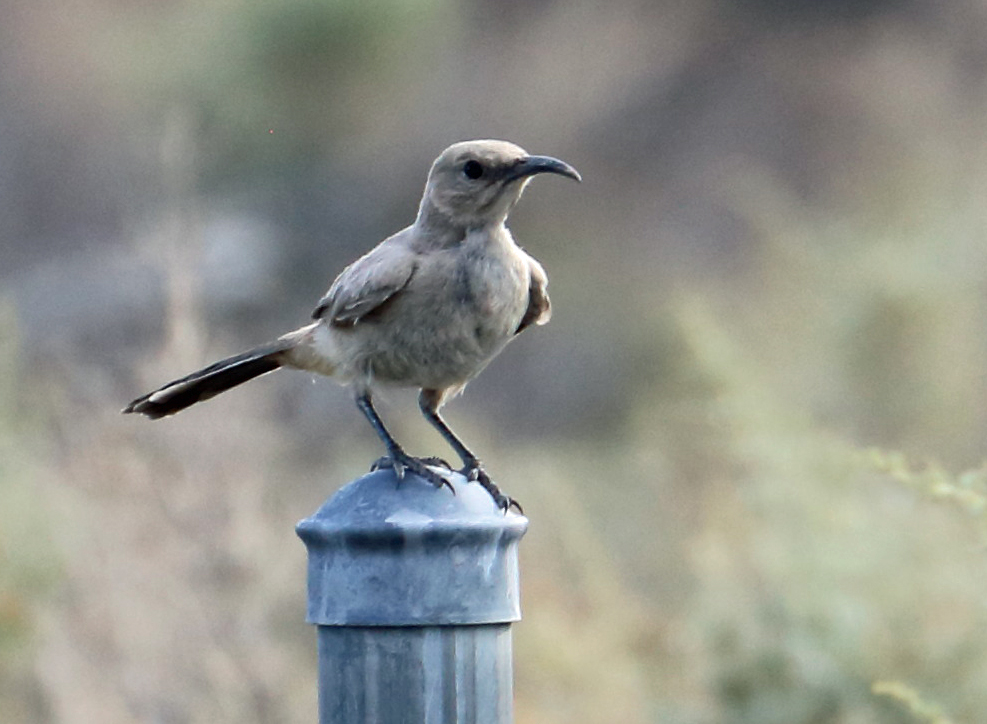
This enigmatic thrasher makes its home in some of the most desolate habitats in North America, inspiring Sam’s non-honorific name for it, the Desolation Thrasher. It’s a species my dad and I had already put in several hours searching for, as we explored a barren salt desert on our way from Southeast Arizona to San Diego. This gorgeous, understated bird matches its habitat, its sandy feathers accented by a slightly peach-colored vent. It’s dark eye, a feature it does not share with the rest of the desert thrashers, matches the black color of its extremely curved bill. Almost nothing else lives in the sparse habitats this bird occupies, and needless to say, I had been obsessed with the species since missing it in Arizona a month before.

Our previous plan had been to camp in some nearby hills that night, then look for the thrasher in the morning. However, with time to spare, we decided to head towards a spot that had produced a few reports in previous years.

“Let’s start putting in the hours,” I said as we made the decision, trying to maximize our chances of seeing my number one target for the trip.

While the road wasn’t as desolate as the salt desert my dad and I had searched in Arizona, it certainly was barren. Dry, orange brush rose from the sandy ground, and as we piled out of the car to begin playing for the thrasher, it became clear that birds here were few and far between.

At every stop we made, I played the songs of both LeConte’s Thrasher and Black-chinned Sparrow, the latter another bird we hoped to find. I also pished vigorously at the brush, hoping that these enigmatic birds would respond. After one round of doing this, the situation looked bleak. The only birds we saw were distant ravens on a telephone pole, and temperatures pushed ninety degrees at 5 pm, a radical change from the seventies weather we’d been experiencing only an hour north in sagebrush country. It would have been hotter if not for the storm clouds dumping rain that would never reach us. Another point against us was that the thrashers, and all the desert birds, were significantly less active now that it was almost July. In the desert, spring starts early, and most of the reports on this road had been from March and April. 

At the second spot, we added Turkey Vulture to the list, though still couldn’t find any birds actively using the desert habitat. I switched up my playback strategy at the third spot, pishing first then playing the thrasher and sparrow songs. Just as the Black-chinned Sparrow recording stopped, I spotted a bird hop up on a fence to our right. Turning my head, I saw the sandy feathers and curved bill—and freaked out.

“Sam!” I whisper-shouted, “It’s there! It’s there! Do you see it??”

“Oh my god!” was the reply.

I slowly reached for my camera, never taking my eyes off the thrasher. The bird’s tail raised and lowered, and the bird looked around, trying to spot the enemy thrasher that had invaded its territory. After I snapped some surprisingly good photographs, it flew over to another bush. The smiles on our faces could not have been erased by anything, and they remained plastered to our faces for another half an hour. We’d just seen one of North America’s rarest breeding birds—after completely expecting to miss it!

As plain as it first appears, LeConte’s Thrasher was a bird I’d put many hours into finding, and it immediately rocketed into contention for Bird of the Year honors!

The thrasher, the grouse and the sparrow had all been birds I’d looked for before, and June 25th, 2022 had been the day to cash in my hours searching for all three species. Even as I write this now, I am still in shock at the looks this desert shadow provided us with, after only looking for it twice! I’d expected to return home without the thrasher and even more determination to see one, and instead, I’d been given an experience I’d never forget. Within a few minutes, LeConte’s Thrasher was already a contender for my Bird of the Year.

The rest of the trip, driving north the next day, went well and included birding an Ancient Bristlecone Pine Forest! Ironically, we found none of our other target species. They were all birds I’d never looked for before: Virginia’s Warbler, Black-chinned Sparrow and Gray Vireo. I guess that means I haven’t yet put in the hours!

Braden’s Statistics Through This Report

ABA Species for 2022 (goal 500): 438 species

Life List Count: 996 species

Golf and Birding

Welcome to our new subscribers! We appreciate your interest in our adventures and experiences, and hope you feel free to share this post with others. If you’d like to support FatherSonBirding, feel free to order some of Sneed’s books from online stores or, better yet, by through your local independent bookstore. Thanks, and have a great weekend! Next week: more of Braden’s High Sierra adventures!

Did you ever stop to think that the words “golf” and “bird” both have the same number of letters in them? No? Good. It’s a stupid lead to a blog. Plus, golf is a sensitive subject for me. In my mid-thirties, I began playing with friends and found I quite enjoyed it. Sort of. In between the tears and swearing and bouts of hopelessness and low self-esteem. After my golf swing betrayed me once and for all, in fact, I tossed my clubs into the basement to collect dust for the better part of a decade. Foolishness springs eternal, however, and a few years ago I began a ritual of golfing once a year with a buddy—only to discover an aspect of golf I had never before recognized: Birds.

Many golf courses’ locations adjacent to wetlands and other natural habitats give them a wide range of opportunity for the golfing birder!

When I golfed in earlier years, Braden and I hadn’t yet become birders. Imagine my surprise, then, when I got back onto the links to discover that birds abounded—at least at Linda Vista Golf Course, my favorite course in the area (and one that happens to have a great cafe). I realized, in fact, that this course could actually be one of the best birding spots in Missoula. The problem? It is challenging to golf and record birds at the same time, and I have to thread a fine line so that my buddy doesn’t brain me with a 4-iron while I’m trying to figure out which kinds of swallows are circling around us. This dilemma, however, gave me an idea—one that I finally carried out last week: to get permission to bird the course sans clubs one morning before the golfers showed up.

Even with the distractions of actually playing a round of golf, I had managed to record 25 species of birds a couple of days earlier. These had included surprises such as Cinnamon Teal and Red-naped Sapsucker. I wonder what I’ll find with more time to study my surroundings? I asked myself as I again headed out two days later.

Almost immediately, it became evident that there were greater numbers of birds than I had noticed before. The Yellow Warblers were particularly insane with a new one spouting off every twenty or thirty yards—about the distance of a short pitching wedge. This made sense because part of what made this course such a great birding spot is that it was shoe-horned between river and wetlands on two sides and farm/pasture on another. Along with the Yellow Warblers I noted an abundance of Red-winged Blackbirds and Gray Catbirds—but was also surprised by an absence of Common Yellowthroats and dearth of Song Sparrows. Hm . . . maybe they were just quieting down for the season?

Spotted Sandpipers are always a welcome sight—though I’m not sure the plastic sheeting around this pond made it a great choice for this bird.

Continuing around to the third hole, I came across several open ponds where I was pleased to see at least seven Wood Ducks, Killdeer, a Spotted Sandpiper, and a pair of Ring-necked Ducks, an unlikely find for the time of year. One of the delights of birding a place that doesn’t get much attention is the frequency of red “unreported” dots that appear on the eBird checklist. The Killdeer were unreported and while I was logging species on eBird, another unreported species, Double-crested Cormorant, flew by. I devoted a good ten minutes to figuring out swallows and quickly noted Tree and Northern Rough-winged. As my binoculars pin-balled back and forth, however, I made another great discovery: Bank Swallows! Braden and I love finding these because they always seem to pop up when we least expect it, and this morning they followed tradition!

Double-crested Cormorants were one of several species that earned me a coveted red “Unreported” dot on eBird!

The rest of my birding round yielded nothing that will upend the scientific community, but proved mightily enjoyable nonetheless. While talking to the lone golfer out this early in the day, I spotted a gorgeous male Western Tanager. A Bullock’s Oriole also flew by. Over on the pasture side of the course, Eastern Kingbirds abounded and Cliff Swallows replaced the Bank Swallows zooming around me. I finished the day with 33 species—not dramatically more than I had found while actually golfing, but I had savored every tee, fairway, and green.

One of the fun things about my round of birding was the number of juveniles about—including this young Eastern Kingbird waiting to be fed by a nearby parent.

Speaking of golfing, I did notice an odd phenomenon while doing the round with my buddy two days earlier. I actually played better than I had in recent memory. It may have been that I had forgotten my bad habits, but I think that the birds actually helped. One of my problems with golf is that I overthink everything. Instead of just hitting the ball, I am telling myself Remember to tuck in your hip as you draw back or Keep that left foot planted and your elbow straight. With half of my mind on birds, I didn’t have time to do that—and hit some of my best shots in years. The lesson? There isn’t one. Just get out there and keep birding, wherever you happen to be.

Note: if you would like to bird your local course, be sure to ask permission—and it obviously wouldn’t hurt if you already golf that course yourself. With the manager, discuss the best time to go out and stay polite even if she/he/they says no. After all, golf courses generally are money-making ventures and they have real customers to take care of. But speaking of that, I can’t help wondering if any particularly birdy courses have considered charging a modest fee to people who would like to bird them? Especially for courses that adopt green practices such as using less water, pesticides, and fertilizers, it might be a great way to earn a bit of extra income while promoting sustainability. Just a thought.

Billings’ Riverfront Park: Montana’s Premier Songbird Hotspot?

Thanks to your enthusiasm FatherSonBirding has garnered more than 1,000 views for the month of June—our best viewership ever! In fact, it’s been very gratifying to watch more and more people get involved in birding, and Braden and I want to let you know how much we appreciate all of you, whether you are a beginning birder or advanced, whether you work to protect birds or simply cultivate an appreciation for them. Whatever you do, keep it up and we will keep sharing our own experiences. As always, feel free to share these posts and encourage others to subscribe. Sneed & Braden

I have to admit that without Braden, birding isn’t quite as much fun. I also don’t see as many birds without his better skills and ears. Still, sacrifices must be made and I continue to seek out birding opportunities wherever and whenever they present themselves. Just such an opportunity arose a couple of weeks ago when I traveled to Billings to be the closing speaker for their first annual Kid Lit Festival. “A-ha,” I thought. “This sounds like a birding opportunity!” So instead of one night, I scheduled the trip for three—with an ambitious birding schedule in the mix. Just for fun, I set a goal of seeing 100 species for the trip, a number I hoped to easily surpass. Friday morning, June 10th, I set out toward Billings, making several stops along the way, and arrived at the trip’s first real birding destination, Shiloh Conservation Area, mid-afternoon. Though it has been engineered by humans, I’ve always loved Shiloh and have seen many interesting birds there from dowitchers to my Lifer Swamp Sparrow. Today, the surprises included a female Bullock’s Oriole, male Western Tanager, and a Wilson’ Phalarope that didn’t seem to know quite what she was doing there!

This lone, befuddled Wilson’s Phalarope at Shiloh seemed to be wondering where all the other phalaropes had gone!

I was even more excited to get up early the next morning and visit Billings’ Riverfront Park, a place Braden and I had birded only once before, but that had netted a rich harvest of songbirds including our first state Ovenbirds and Plumbeous Vireos. I wondered Could it possibly be as good this time? As soon as I climbed out of the car, I got my first indication when I saw my first of 26 Yellow Warblers and 6 American Redstarts, and heard multiple Common Yellowthroats and Yellow-breasted Chats.

With their weird calls and stunning good looks, Yellow-breasted Chats are always a delight to observe—even if they are no longer warblers!

That’s not to say that the birding was easy. With the thick riparian canopy, the situation mostly called for ear-birding and with my lousy ears, my skills were put to the test. Nonetheless, using Merlin’s Sound ID to help alert me to what to look for and to help confirm calls that I thought I recognized, I slowly assembled a picture of the birds around me. Thankfully, most of the birds also put in an appearance for visual confirmation, but I’m still sure that I grossly underreported the numbers around me and probably missed one or two species as well.

That didn’t keep me from fully appreciating the diversity and abundance of songbirds, however. I felt especially thrilled to see so many warblers, with large numbers of Yellow Warblers, American Redstarts, Ovenbirds, and Common Yellowthroats.

On our previous visit to Riverfront Park, Braden and I had gotten only poor, brief glimpses of Ovenbirds, but today multiple Ovenbirds not only sang but popped out for an appearance.

Merlin also picked up huge numbers of Warbling and Red-eyed Vireos—the latter a lot easier for me to recognize by ear than the former—and eventually I saw both species. I had hoped for Plumbeous Vireo as well, but struck out on that one. I also saw only one Black-headed Grosbeak, though I’m sure many more were around. All in all, I found 34 species and came away thinking that Riverfront just might be the best spring riparian birding hotspot in the state, and I vowed to return every year if possible. Even better, I still had two full days of birding ahead of me as the next day I planned to drive to Bowdoin NWR and then to Great Falls for a visit to Benton Lake.

My Riverfront Park List

I was surprised to see only one Black-headed Grosbeak at Riverfront, but at least this one posed nicely—if from a great distance.

Arizona 2022, Part 4: To Patagonia Lake, Madera Canyon and Beyond!

This is the last installment of our four-part Arizona adventure. We’ve had a great response to these posts and want to thank you for all of your enthusiasm! Keep birding and supporting birds however you can, and we will share more adventures soon!

We departed our Nogales hotel the next morning to find a gorgeous Vermillion Flycatcher sitting on a bench outside the front door. It boded well for the day as we headed to our first destination, Patagonia Lake State Park, a place featured in the movie The Big Year, though undoubtedly not filmed there. Patagonia indeed upheld its reputation as a great birding spot, and we checked off two more Life Birds—Northern Beardless Tyrannulet and Bell’s Vireo. We also saw Summer Tanagers and got our best experience ever watching Phainopeplas, which sport the ultimate in cool with their silky black suits and blazing red eyes. Alas, we missed Braden’s top target, Varied Bunting—but picked it up at a small rest area just up the road!

Although we missed Varied Buntings at Patagonia Lake, we got good looks at them at several more sites, including this one at Madera Canyon.

Our Patagonia Lake checklist!

We had seen Phainopeplas before, but got to spend about fifteen minutes watching them flycatch at Patagonia State Park—an experience that made us even more impressed with them!

We had debated what to do with the rest of the day and had considered going for Whiskered Screech Owl in the rugged mountains west of Nogales, but with serious heat and the prospect of rough mountain roads to negotiate, we decided for the more comfortable alternative of Madera Canyon, a place we had both adored on our Big Year visit in 2016. We felt grateful for our decision after we staked out a campsite and availed ourselves of the marvelous bird feeders at Santa Rita Lodge. There we picked up Rivoli’s Hummingbird and Arizona Woodpecker for Braden’s Big Year list, and had much better looks at Varied Buntings, Hepatic Tanagers, and more.

We feared we had missed Arizona Woodpecker for the trip, but Madera Canyon delivered. We just love the unique, brown motif of this Arizona specialty.

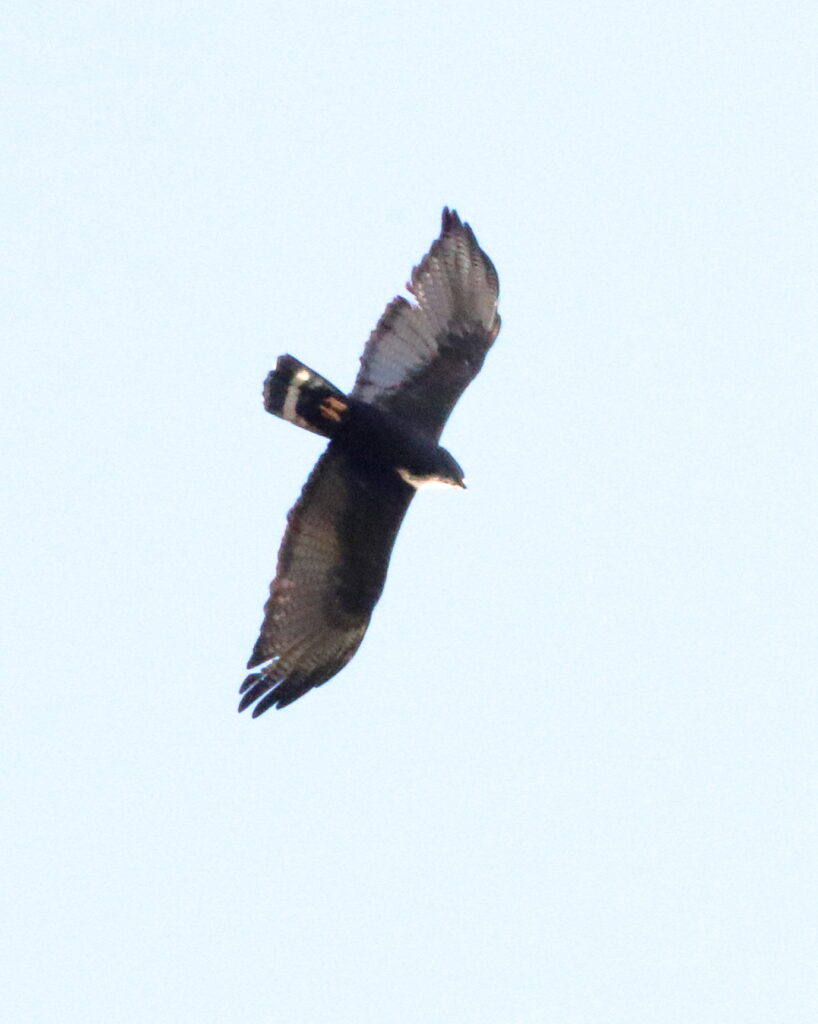
As we were watching a group of Turkey Vultures, I suddenly saw one make a quick move that didn’t look right. “Braden, look at that!” We both got eyes on it and Braden shouted, “Zone-tailed Hawk!” We had seen one before, but had no idea of their close association with Turkey Vultures. In fact, it looked so much like a Turkey Vulture that it left no doubt that some kind of mimicry or convergent evolution had shaped it. Some speculate that potential prey (birds, reptiles, mammals) feel safe with Turkey Vultures overhead—giving a sneaky Zone-tailed a chance for a surprise attack!

The “Turkey Vulture Hawk”, Zone-tailed Hawk, looks so much like a Turkey Vulture, we only ID’ed it after several double-takes.

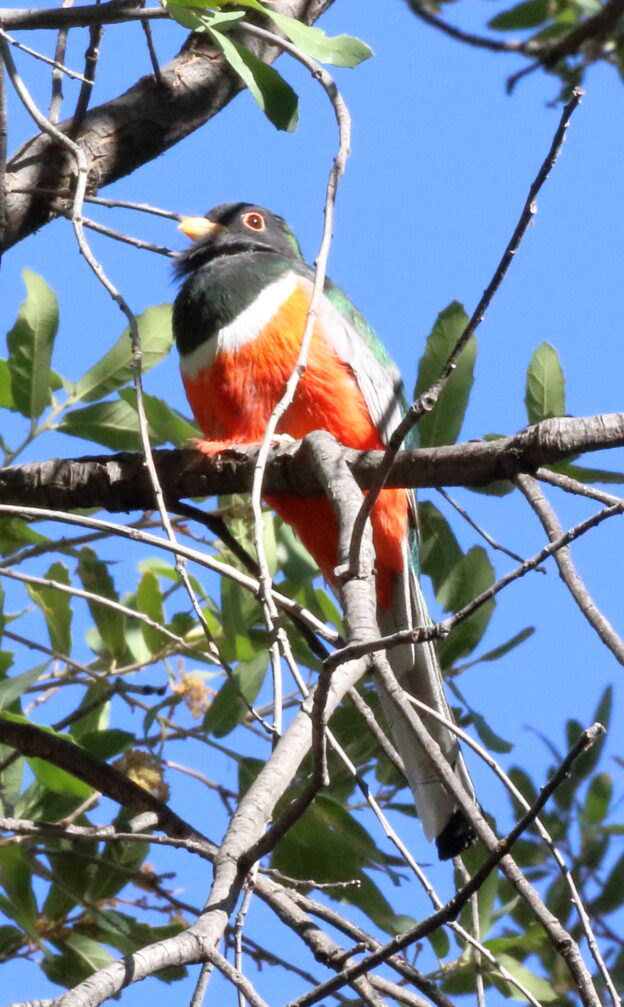
That afternoon we also enjoyed the company of multiple Mexican Jays and Painted Redstarts at our campsite and, later, heard the calls from the same trio of night birds we had enjoyed two nights before in Portal—along with our year’s first Common Poorwills! Oh, and did I mention Braden’s ears also scanned in the calls of Sulphur-bellied Flycatchers and Elegant Trogons? “Again,” Forrest Gump might groan.

This curious Mexican Jay kept us company as Braden and I read aloud to each other at our campsite during the peak of the afternoon heat.

The next morning, before aiming toward California, we had one more task. After rolling up camp, Braden guided us to a place called Montosa Canyon in the same range as Madera. Why? To find a recently-sighted, highly-coveted Five-striped Sparrow. I really didn’t know what our chances might be, but it took about thirty seconds for Braden to locate it, a handsome bird similar to Black-throated Sparrow. As an added bonus, Braden said, “Daddy, look over there.” I focused on a hummingbird and immediately recognized a species I’d read about countless times—a male Costa’s Hummingbird! The Costa’s was superb and we did a little dance, thinking it was Braden’s 400th bird for his Big Year—the goal he had set for himself in January! We later learned, however, that we had inadvertently seen a juvenile Costa’s at Madera the day before, so 400 would have to wait for California Scrub-jay later that afternoon.

Our Montosa Canyon checklist!

Many more birding adventures would unfold in the coming days as we made our way to San Diego to visit our cousin Laura, and then drove up to the Sierras to deliver Braden to his job monitoring Northern Goshawks for the summer. Sadly, from there I would continue home alone, hitting Modoc National Wildlife Refuge in Alturas and spending a fun three days with my friend and college roommate—not to mention avid reader of FatherSonBirding—yes, you guessed it, Roger Kohn. Roger showed me some of his favorite hotspots around his new home of Bend—and spotted a bird I especially wanted to see, White-headed Woodpecker. He also showed me the delights of Bend’s many brew pubs, but that, unfortunately, concludes this tale. Stay tuned for many more adventures including my recent fabulous birding in Billings and beyond, and Braden’s report(s) from the High Sierras. Who knows, I might even do some more truck birding this summer! Also stay tuned for more progress on Braden’s Big Year. After he hit 400 on our trip, I pushed him to reluctantly lift his target to 450—but between you and me, I think 500 has a much nicer sound to it. Will he go for it? I think he just might!

Braden’s Big Year total when I dropped him off near Sonora, California: 411 (New Goal: 450)

On my way home to Montana, my good friend Roger Kohn and I went in search of—and found—a White-headed Woodpecker. Don’t you love this critter?