We continue our spring birding blog blitz by picking up on our New York City trip last week and the nail-biting account of our Central Park birding adventure. If you’re afraid you will get TOO excited while reading this, I suggest you ask someone to hold your hand. And don’t forget to tune in tomorrow for our next post “Birding Brooklyn”!
On Monday, Tessa and I left Amy to continue recovering and rode the Hudson Line up to see our good friends, fellow author Larry Pringle and his delightful wife Susan. After taking a great walk at Nyack Beach State Park and eating a nice lunch, we returned to Manhattan in time to meet Braden at Penn Station after his first year as a college student! Bright and early the next morning, though, he and I jumped on the C train to do something we’d dreamed about since we began birding eight years ago: bird Central Park during spring migration! (Well, after a stop at Liberty Bagels on 35th St., that is.)
People often ask us the key to successful birding. Our trip to New York provided the definitive answer: bagels.
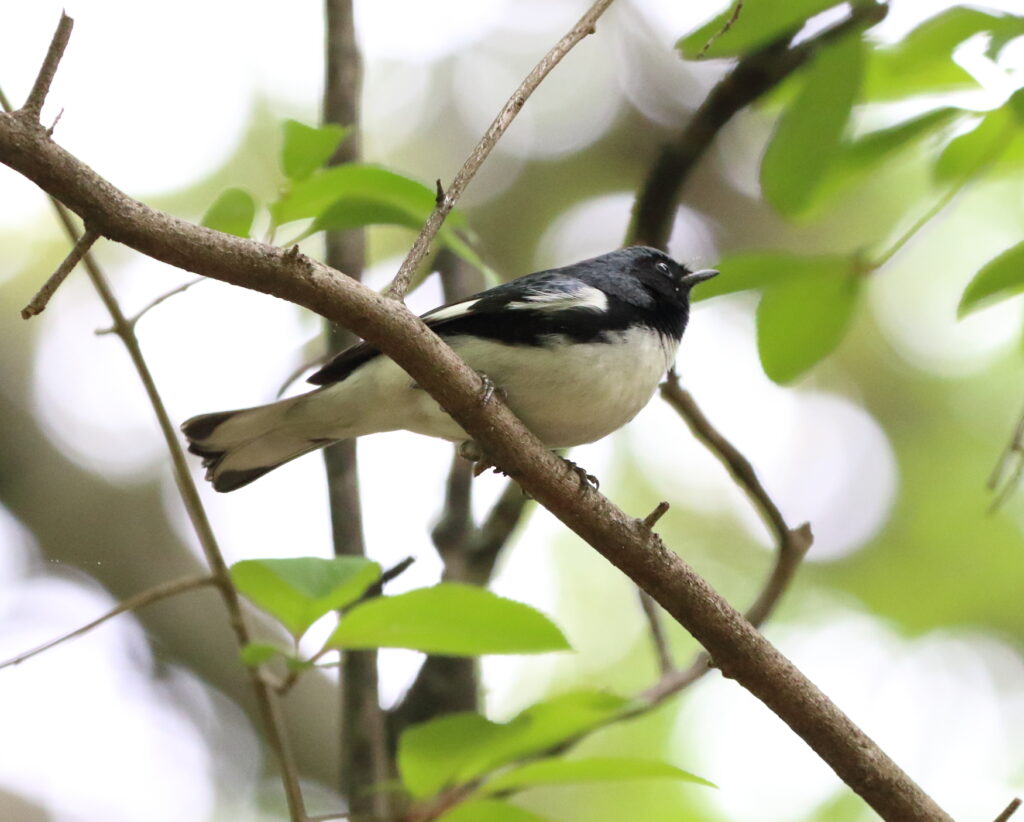
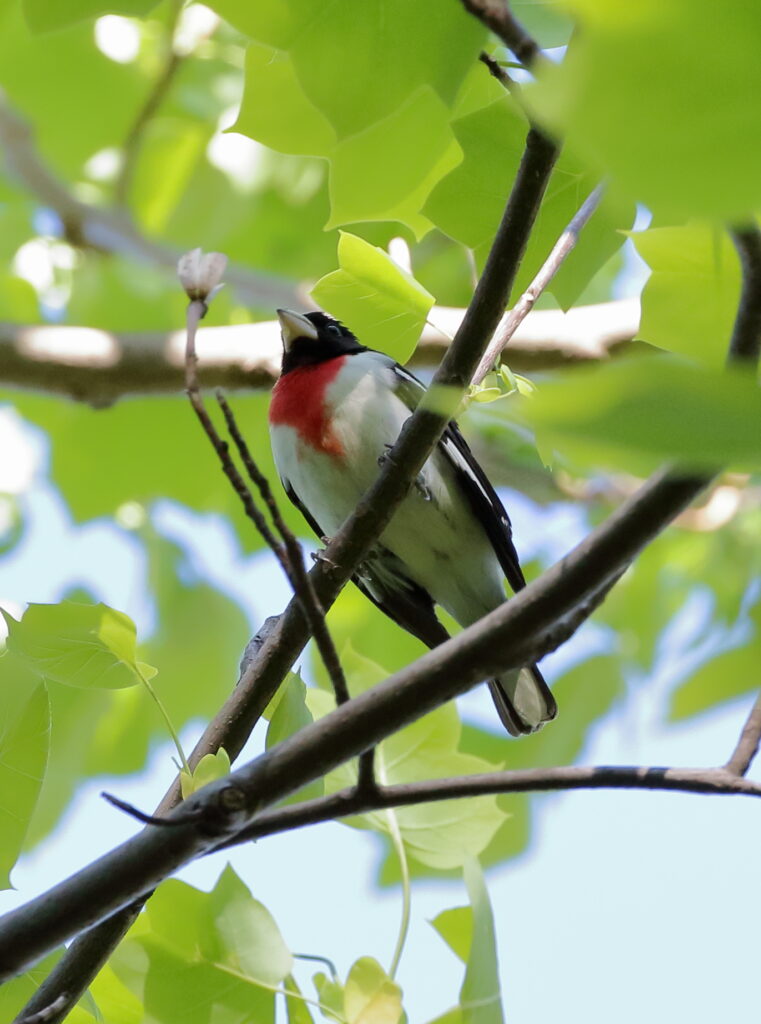
Just as Tessa and I had done two days earlier, we jumped off at 81st St. and immediately crossed over into Central Park, entering a particularly birdy area known as The Ramble. As mentioned in our last post, I worried that the birds might have left NYC already. Most migrating passerines only appear in the park during brief windows ranging from a few days to 2-4 weeks. They also come in waves that one can easily miss. Within a few minutes, however, the birds put my fears to rest when Braden called out a Black-throated Blue Warbler, a Life Bird for me and one of the most stunning of all warblers. Over the next hour and a half, a veritable songbird hit parade followed with sightings of Worm-eating Warbler, Nashville Warblers, Northern Parulas, Northern Waterthrushes, American Redstarts, Swainson’s and Hermit Thrushes, Magnolia Warbler and much more, including a male Rose-breasted Grosbeak high in the trees.
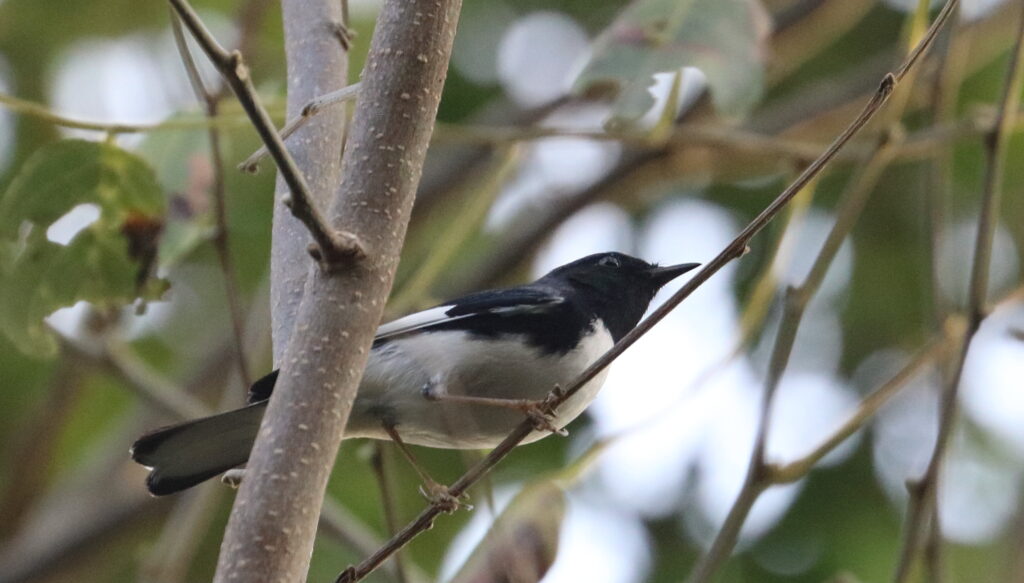
Black-throated Blue Warbler landed at Number 502 on my ABA (American Birding Association) Area Life List—and what an entry it was!
Not the best view, but this was our first male Rose-breasted Grosbeak since we’d hit High Island, Texas during our 2016 Big Year—so we took it!
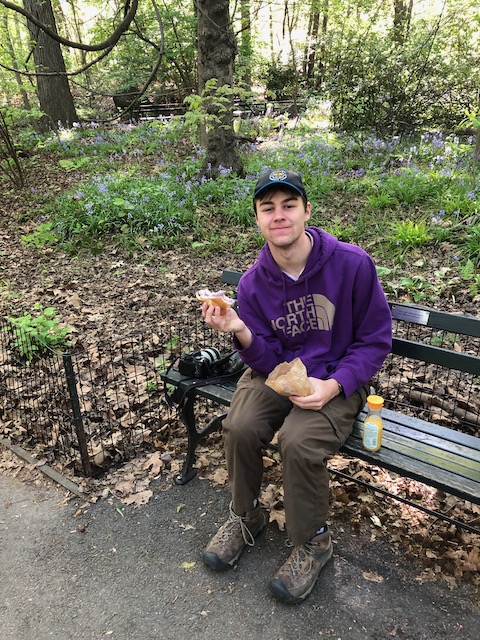
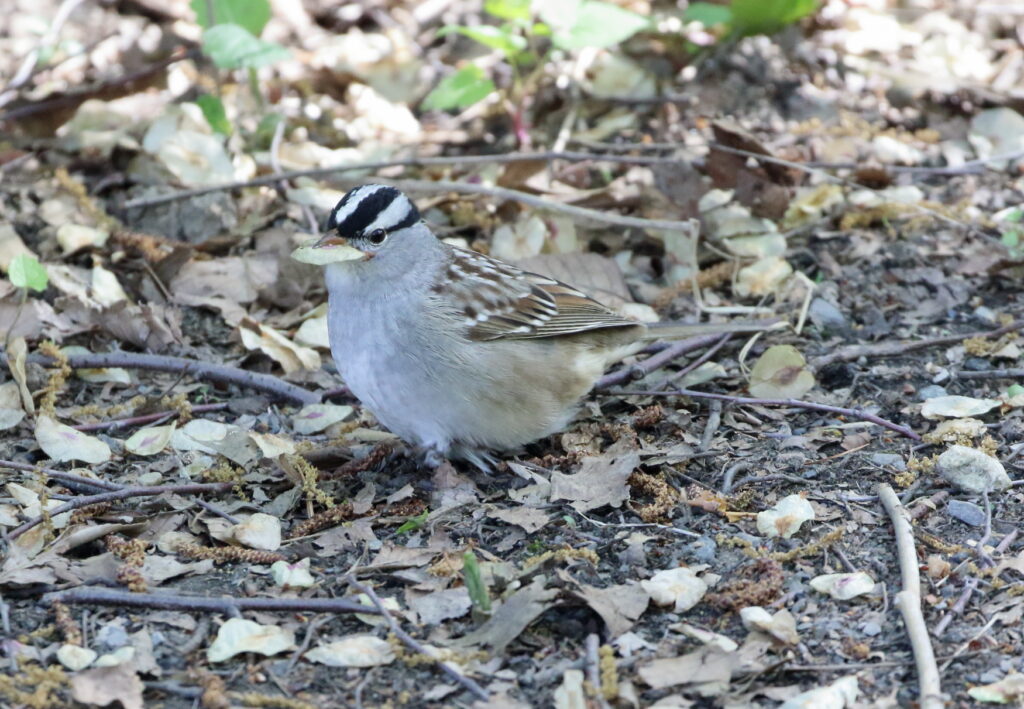
Among birders, it’s a well-known fact that seeing a lot of birds can generate an enormous appetite, so Braden and I were forced to sit down and attack our bagels. Mmmm . . . lox shmear . . . Partly satiated and with cream cheese smearing our faces, we again rose and made our way to our second birdy destination—an area of Central Park called North Woods. Along the way, we passed multiple landmarks familiar to anyone who has ever watched movies or Seinfeld including Belvedere Castle, the Jacqueline Kennedy Onassis Reservoir (where Dustin Hoffman jogged just before getting his teeth ripped out without anesthetic by a sadistic dentist), and the Central Park Tennis Center. We also made more bird discoveries such as a large group of White-crowned Sparrows.
Surprisingly, large numbers of White-crowned Sparrows are rare in Central Park. We were lucky to run across a group of five on our walk up to the North Woods section of the park.
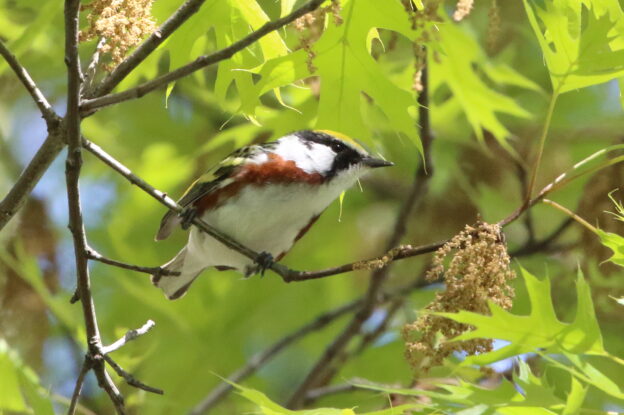
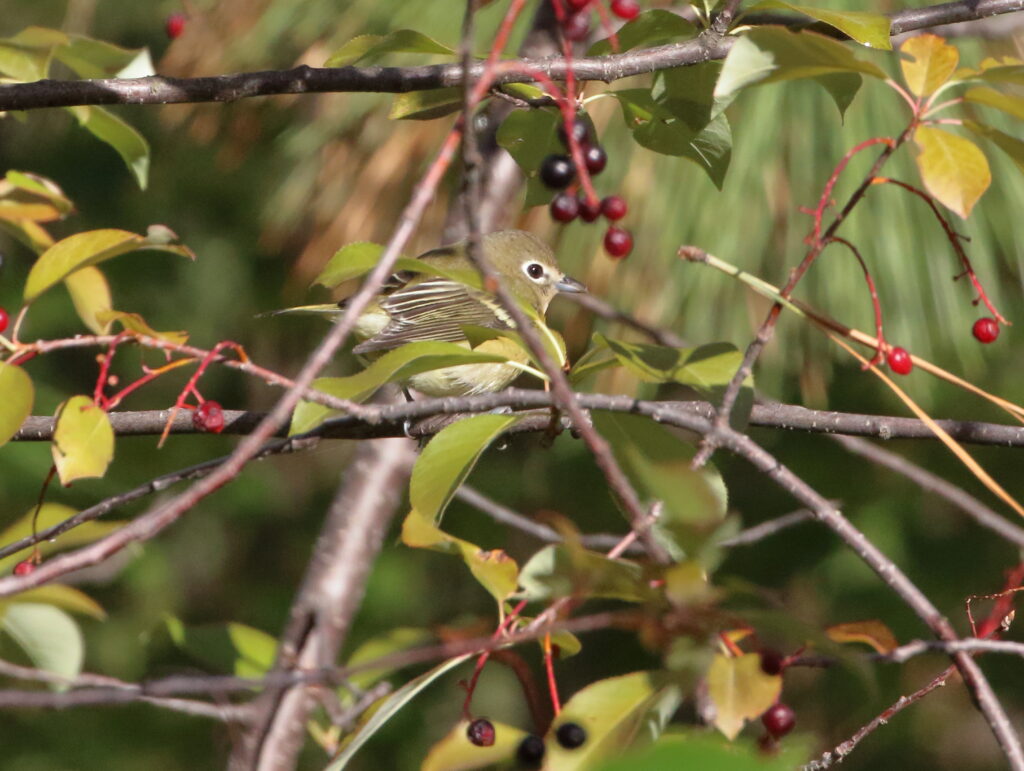
To be honest, however, we didn’t think the North Woods could possibly match The Ramble for birds, but we soon learned that . . . it CAN! Two targets, a Yellow-breasted Chat and a Red-headed Woodpecker had created a buzz in that section of the park, and we (ahem) chatted with several birders about them, but it was the other birds that grabbed our attention. These included incredibly cooperative Black-and-White Warblers, glorious Chestnut-sided Warblers, a Veery and Blue-headed Vireo. We struck out on the chat, but making our way east, we followed the creek through an area called The Loch and continued to rack up amazing sightings. These included a quick glimpse at the now-famous Red-headed Woodpecker, several Red-bellied Woodpeckers, a Yellow-throated Vireo, a Great Egret flying overhead, and a bird I especially wanted to see, Swamp Sparrow.
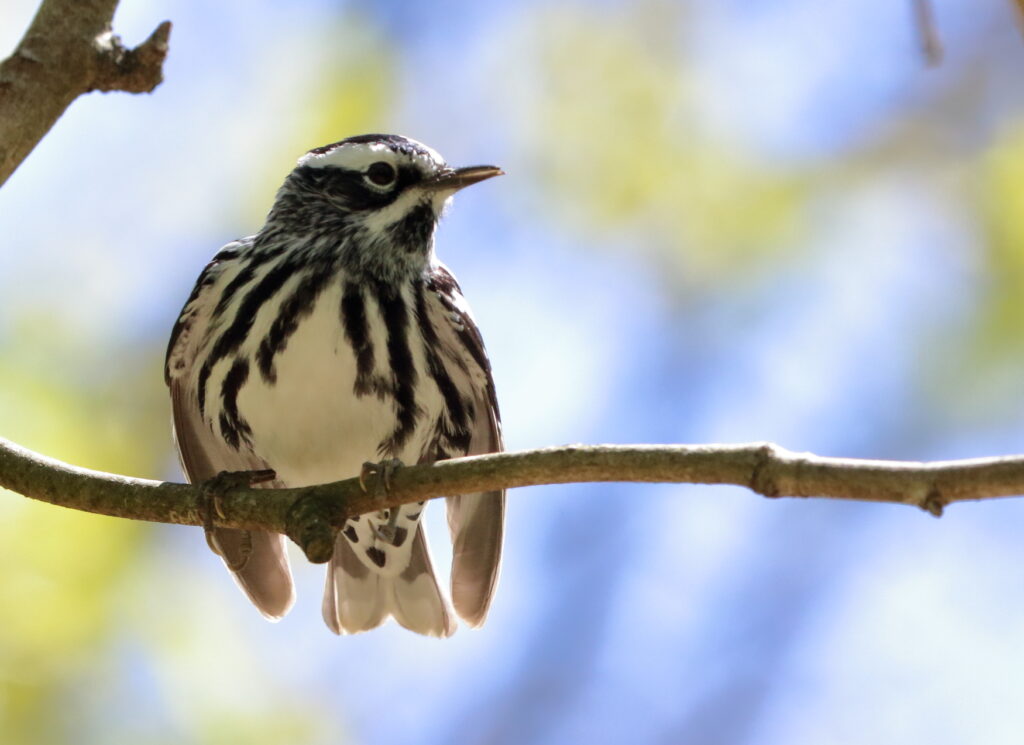
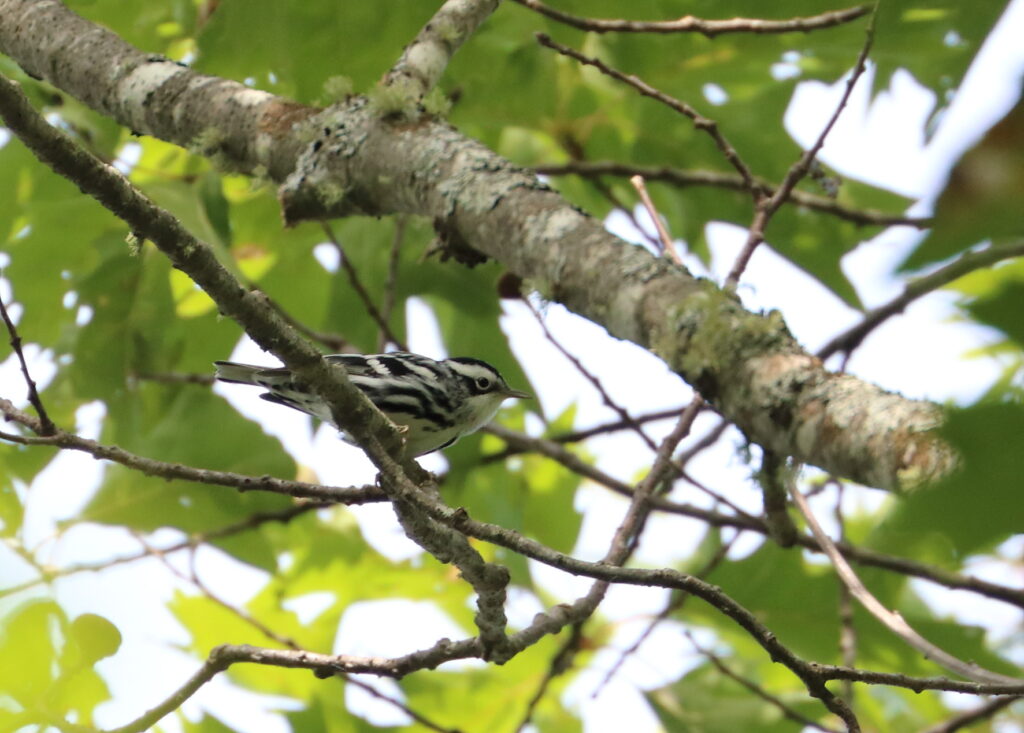
You wouldn’t think an animal that is just black and white could be so stunning, but Braden and I savor each encounter with Black-and-White Warblers.
By now we had birded for five straight hours and our energy was starting to flag, so we reluctantly dragged ourselves to the 103rd St. subway station and caught a ride back downtown. We learned later that we might have picked up Cape May and Blackburnian Warblers if we had hit a part of the Ramble called the Point, but did we mind? Only a little. In fact, our day had exceeded all of our expectations for birding Central Park. During our long morning, we had logged a remarkable 57 species including an amazing 13 kinds of warblers—as many as we could hope to find during a whole year in Montana!
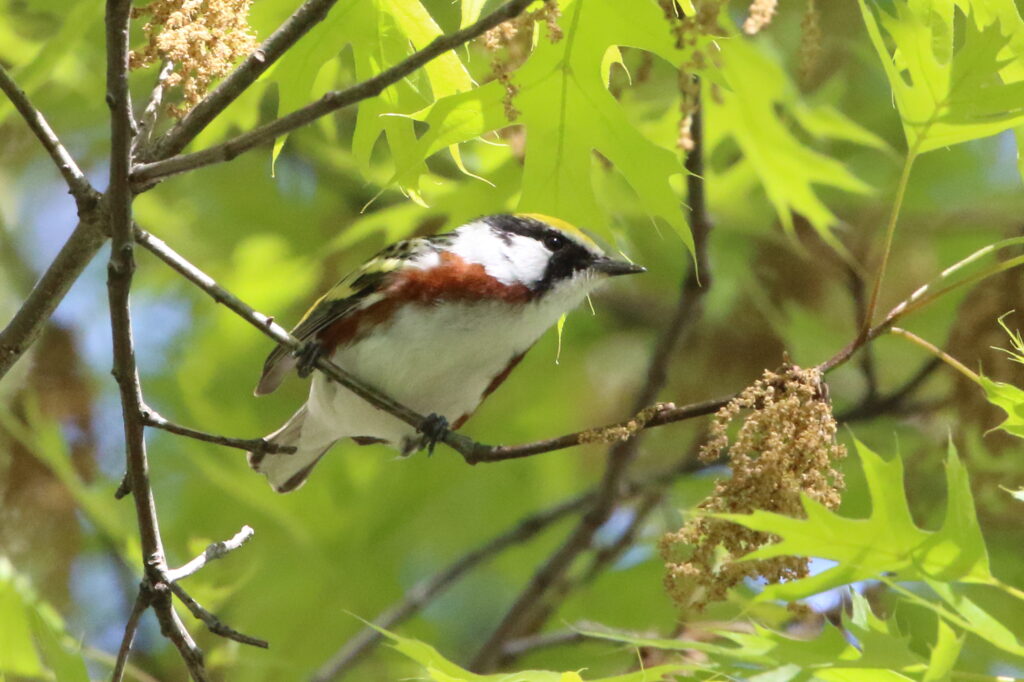
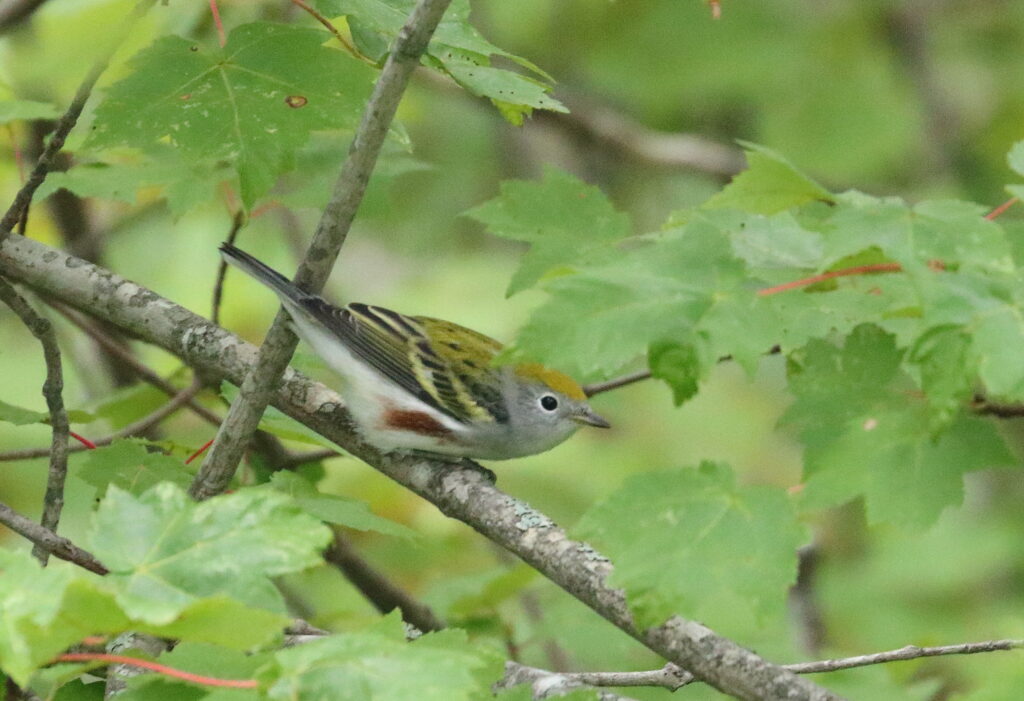
Though I’d seen Chestnut-sided Warblers when taking Braden back to college in Maine last fall, this was my first technicolor, breeding male!
Even better, when we returned to our hotel, Amy was feeling much better and had spent the day with Tessa at Ellis Island and the Statue of Liberty, so we all went out to a nice meal at Kung Fu Kitchen. Can you spell pork soup dumplings???? Then, while Braden and Tessa strolled Times Square, Amy and I set off to see The Book of Mormon, a musical we were supposed to see in Seattle when covid struck. But lest you think Braden’s and my Big Apple birding adventures had concluded, stay tuned for our next post . . .
Welcome to Blog 4 of Braden’s series about his and Nick Ramsey’s remarkable birding excursion through Florida. Nowhere in the U.S. do things get more biologically bizarre than in South Florida, and especially in the Keys. Enjoy and, as always, please feel free to share this post.
A Great Horned Owl, the second owl species of our trip so far, greeted us as a silhouette on a power pole as we raced south from the Everglades at dawn. After waking to the sound of more Chuck-wills-widows, we’d packed up the car, and now were on our way towards the southernmost point in Florida. We crossed a small bridge overlooking the slowly-brightening shallow waters of south Florida, and suddenly, we were there: the Florida Keys.
If you need convincing about how invasive species are impacting the planet, go no further than Florida!
Our first stop, like many of our stops today, had one major target: Mangrove Cuckoo. This species, one of North America’s most elusive, had consistent records only from the very southernmost part of the state, barring a few reliable spots farther up the Gulf side. The habitat looked right—the part of Key Largo we’d just entered was absolutely coated in Red and Black Mangroves, and as we pulled into a dirt parking lot, we were greeted with the songs of White-eyed Vireos, a species I had not expected to breed in the mangroves. This area, especially later in the season, could be stellar for vireos, with Red-eyed, White-eyed, Blue-headed, Yellow-throated, Black-whiskered, Thick-billed, Yellow-green and even Mangrove all possible. Unfortunately, we were still a bit early for many of these birds, and we saw and heard only White-eyed throughout the day.
The first stop was not particularly productive, and we realized that we were in the wrong habitat for the cuckoo. Despite having driven through mangroves to get here, the road wound its way through almost-subtropical deciduous forest rather than the water-submerged trees we needed to find a cuckoo. Dagny Johnson Key Largo Hammock Botanical State Park(say that three times), just down the road, proved considerably better, and as we got out of the car Nick got on a warbler almost immediately.
“Black-throated Blue!”
I was thrilled to add this Black-throated Blue warbler to my Life List—one of the last wood warblers I had yet to see.
“Really?” I said, jogging up to where he was standing. Sure enough, a darker, blue and black warbler hopped into view a few feet above us in a tree, and began responding as we played Blue-headed Vireo calls. It was one of my last Eastern wood-warbler needs, and one of the best of them at that. Soon, several parulas and vireos came to the playback as well, and we found ourselves in a miniature mixed winter flock, something we had been hoping to encounter. Continuing down the path, another lifer appeared.
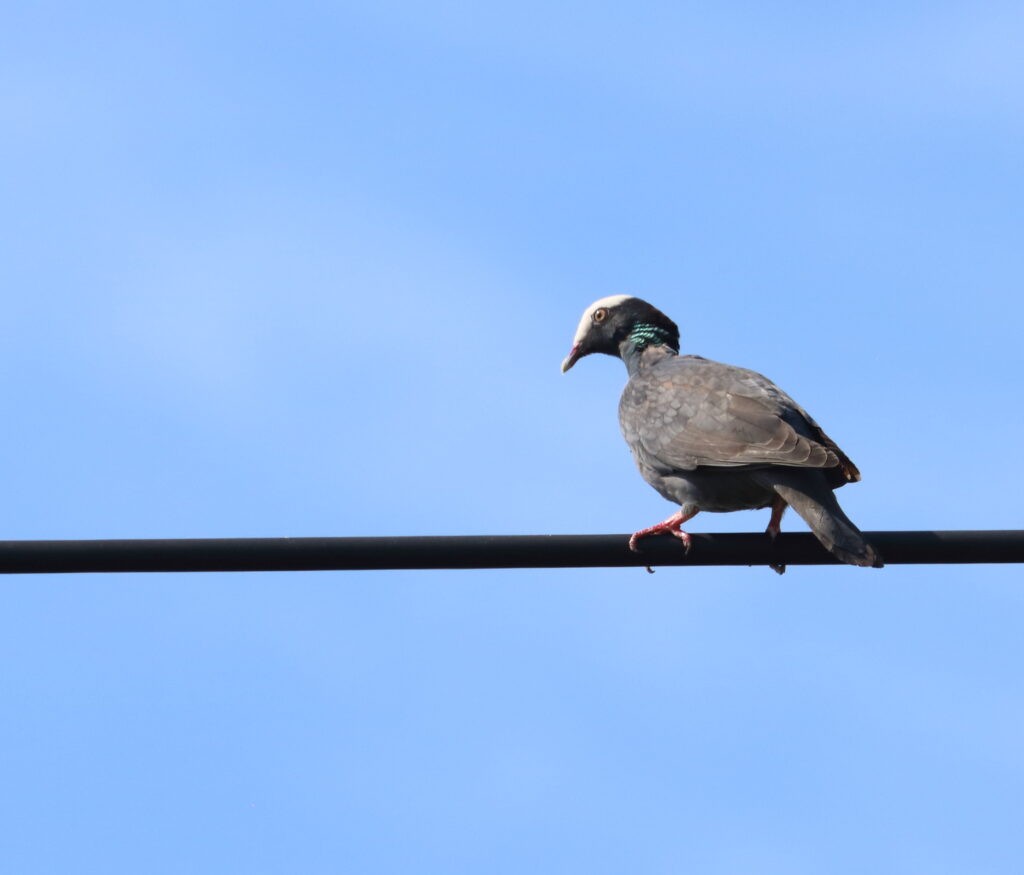
Two dark pigeons flew over, landing in a snag barely lit by the morning sun, and I raised my binoculars, confirming what I’d suspected. While I could make out few other features aside from the dark gray color, the one feature I saw nailed the identification.
“White-crowned Pigeons!”
White-crowned Pigeons, another Lifer for me, was but one of six members of the pigeon/dove family to greet us in South Florida.
This species, a Caribbean mangrove specialist like the cuckoo, also had a very restricted U.S. range, but where it did occur—specifically here—they were supposedly quite abundant, something we confirmed as we drove farther south. They weren’t the only member of Columbidae present, though. We tallied an astounding six species including Eurasian Collared, Mourning, Common Ground and White-winged Doves plus Rock and White-crowned Pigeons. Who knew that the Keys would be so good for this seemingly random family!
Every key differed, if only slightly, from the last. Resorts and restaurants covered the larger Keys, like Key Largo, and I was surprised to see how much land existed on them. I’d assumed many of these islands would be completely mangrove, but I had assumed wrong, as everywhere we looked we saw dirt, whether put there by humans or not. The smaller keys were the really neat ones though—sometimes only a couple of hundreds of meters wide, the Overseas Highway divided what little land each had. We stopped on many of these small keys to play for Mangrove Cuckoos, with no success, but we did make other cool discoveries. Shorebirds coated the beaches and lagoons, and Magnificent Frigatebirds circled above as commonly as Red-tailed Hawks in Montana. The two most abundant passerines were Prairie Warblers and White-eyed Vireos, both of which appeared to have distinct breeding populations found in the mangroves. The water itself was a stunning blue-green, and I could see why hotels and resorts were so popular here.
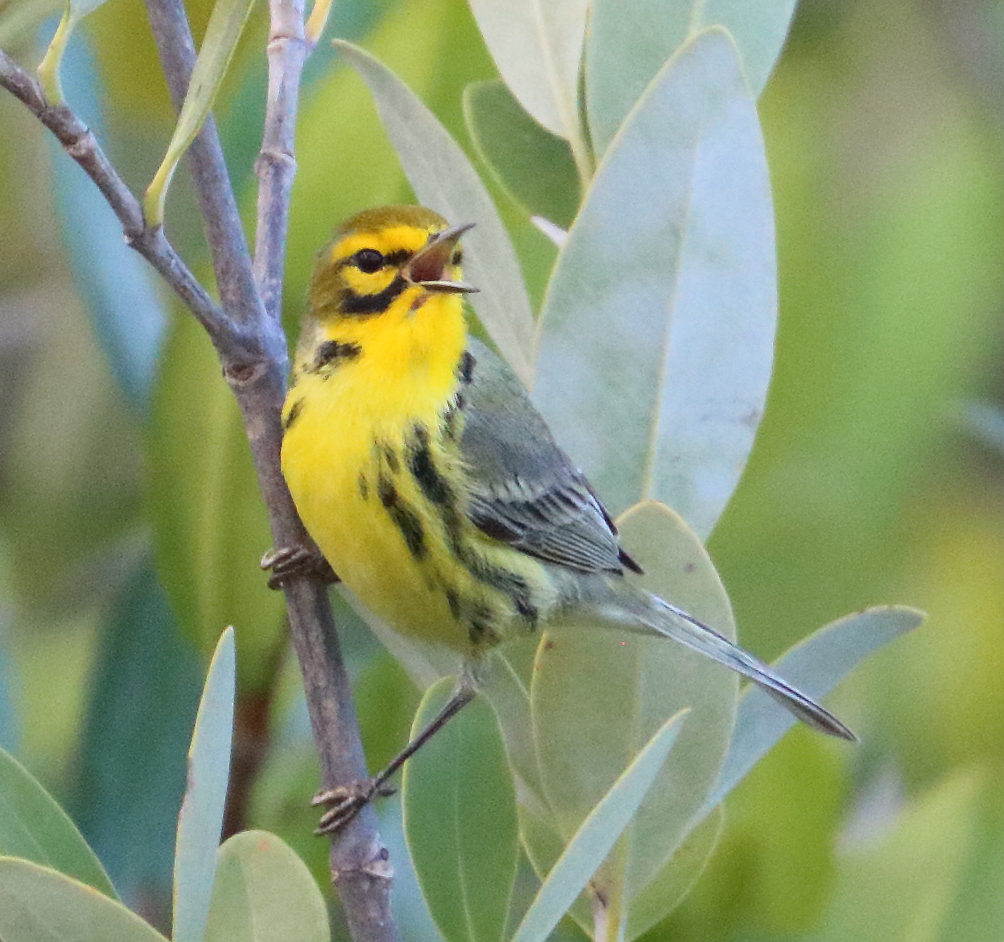
After adding Prairie Warbler to my Life List early in the trip, I was astonished to find that they and White-eyed Vireos practically dripped from every bush in the Keys.
While we drove, I kept an eye on the sky. While we’d gotten our trip Swallow-tailed Kite a few days before (and also happened to get one in the Keys), we were still missing another Florida specialty: Short-tailed Hawk. This raptor had a very small population in the United States, and could be told from other Buteos by its often-dark wings, barred tail and small size. On our drive down, however, we didn’t spot any, growing a bit concerned that we might miss them for the trip.
After driving over water for a while, we soon arrived at Big Pine Key, one of the largest islands, not to mention being one of the farthest south. This island was unique, hosting a rare habitat known as Caribbean Pine Rockland, and this new habitat brought a new endemic subspecies: Key Deer. This deer, a miniature version of a White-tailed Deer, only lived on this cluster of islands, and did not occur on Key West, farther south, or on any of the keys farther north. Several other strange species lived here, including Indian Peacock, which had been introduced and established itself on this island. Indian Peacock, despite being found all over the United States as escapees, was only actually countable in this one place in the entire country!
We spent the day so far in mangroves, but at the Blue Hole nature walk we felt transported back to the Pineywoods section of the state. This habitat, like the Pineywoods, was actually fire-dependent, although I had a hard time imagining how, given the tiny geographic area it occupied in the middle of the ocean. We soon arrived at a small wooden platform overlooking a large, mostly clear pond: the Blue Hole. A slightly obnoxious woman welcomed us, pointing out an alligator lying right below the platform, its entire, scaled body visible in the water below us. Further out in the pond, a large silver fish floated aimlessly.
“Tarpon,” said the woman, “Usually a fish only found in saltwater. These guys got deposited by the last hurricane. You see that?” She pointed at a mark on the platform at about the height of my knees. “That’s how high the water was, all over this damn island.”
Nick and I continued, finding ourselves on a large dirt road. “If we walk down this, we should see some deer,” said Nick, who’d been here before. Sure enough, after a few dozen meters, we came across a few feeding in the yard of a vacation home. While they weren’t mind-bogglingly small, they were smaller than any of the White-taileds I’d seen in Montana or Maine, or even northern Florida for that matter. We kept Dixie on a leash as she stared intently at the Key Deer, which were fairly unimpressed by our presence. Before leaving, we also managed to hear an Indian Peacock from somewhere in the pines—another lifer for me.
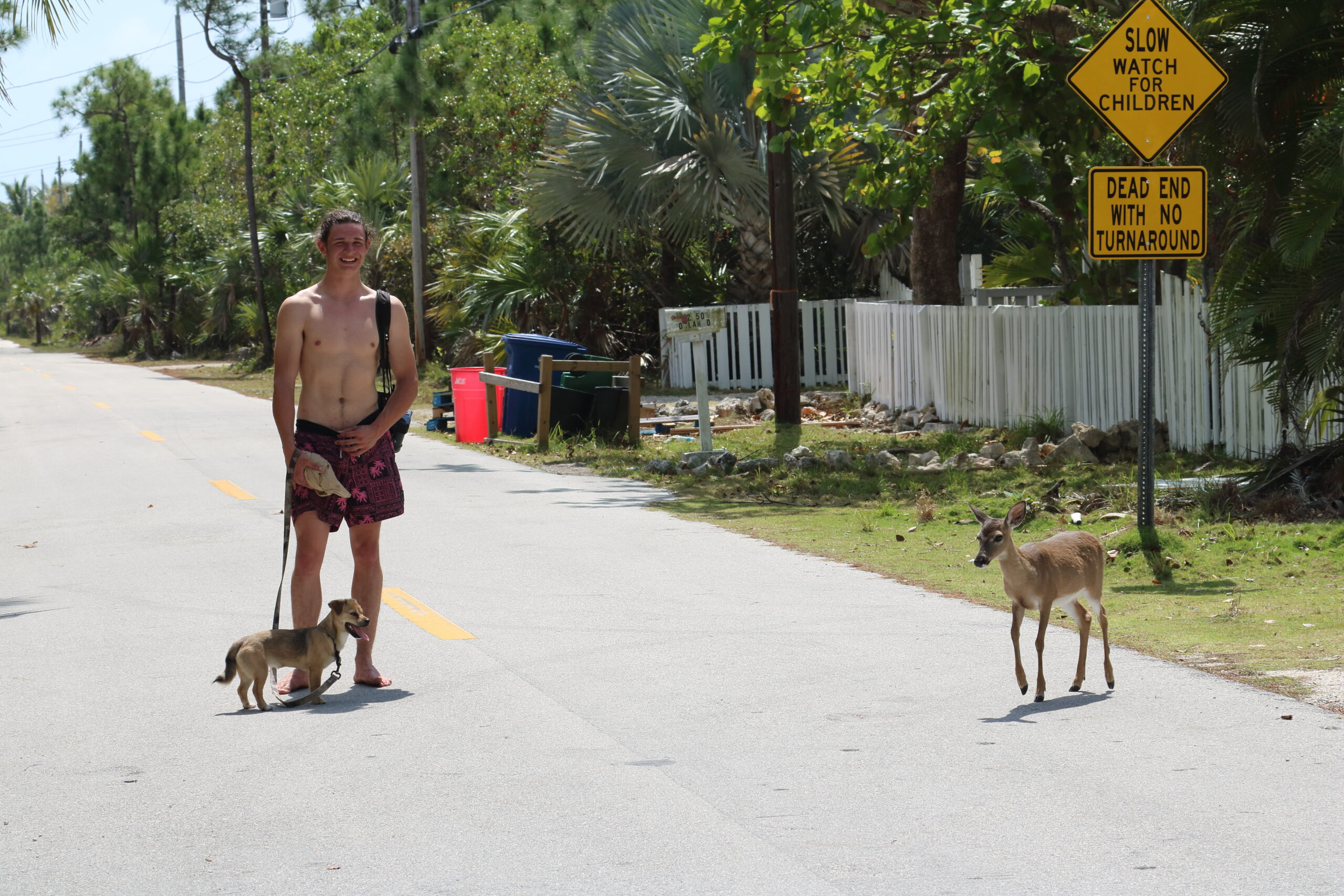
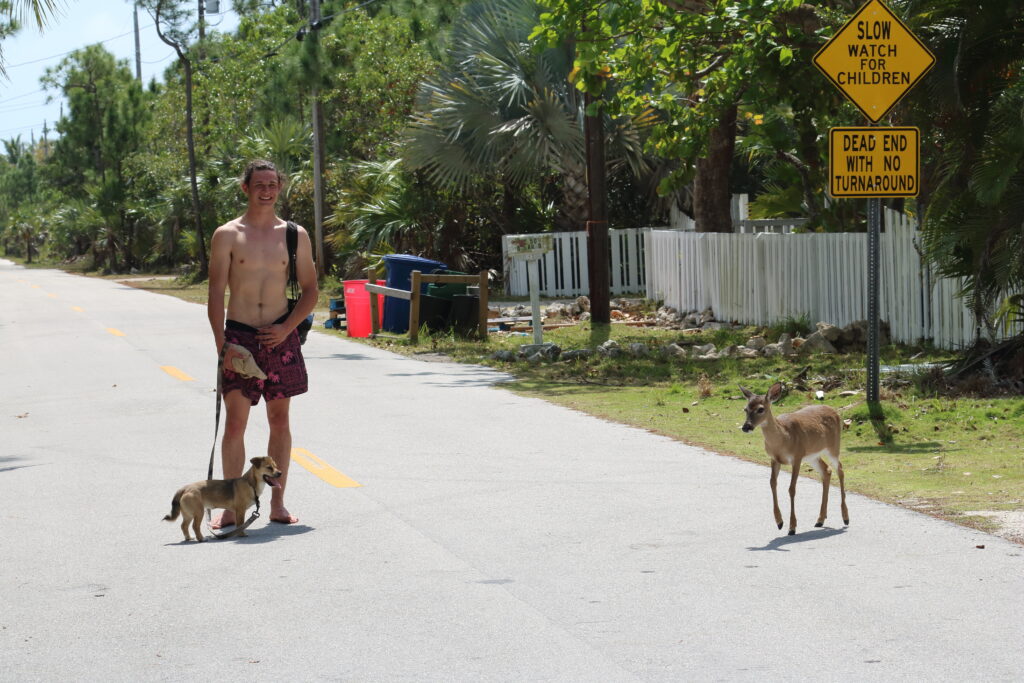
Wait for it . . . finally, a photo of Nick and Dixie! Oh yeah, and a Florida Key Deer on Big Pine Key.
After finding an early Gray Kingbird (see my post “When Montana Birders Collide“), we continued down to Key West, pulling into the parking lot for the Key West Botanical Gardens. It was only forty minutes before closing time and we cursed ourselves, having hoped to get more time at what was surely one of the best spots to bird in the keys. We split up, heading off into the forest of foreign plants to try to tally as many species as possible. After twenty minutes with almost nothing besides a cooperative Black-and-white Warbler, Nick called me. “I’ve got a mixed flock! Get over here!”
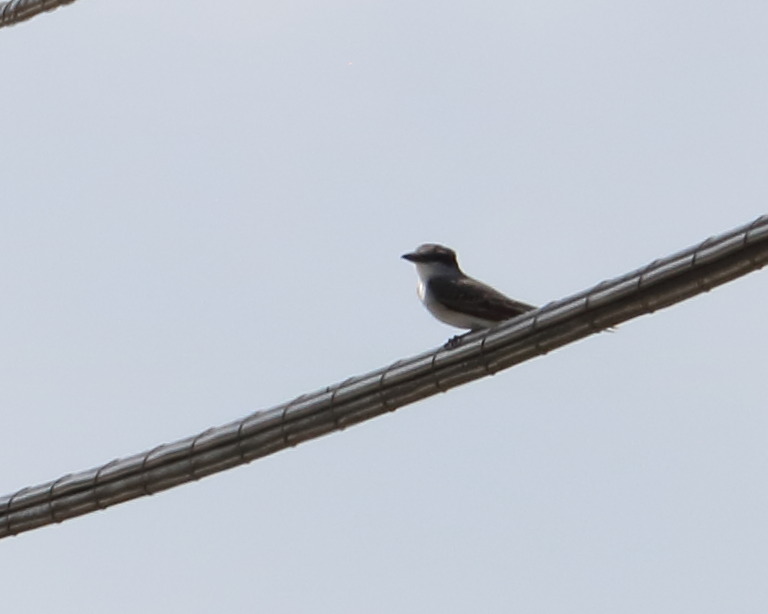
It was odd to see a Gray Kingbird in its natural habitat after seeing a vagrant GRKI in Maine just a couple of months ago.
I was on the other side of the gardens, and took back off the way I’d come, eventually finding him on the other side of a manmade lake. He played his mixed flock playback, and the birds poured in: Prairie, Yellow-throated and Palm Warblers, accompanied by a squadron of catbirds. Two splotchy Summer Tanagers joined the fray, and Nick pointed out a Ruby-throated Hummingbird as it zipped by. I was disappointed in my inability to find anything like this on my own, but was happy that we’d finally found one of the mixed flocks the Keys were known for.
Our last major stop of the day was Fort Zachary Taylor Historic State Park, a manicured tourist destination that had been hosting a Black-faced Grassquit for several months now. Birders were unsure as to whether this grassquit was wild or not, given that they were a popular cage bird, but a wild population did exist on the Bahamas, not all that far from here. Regardless, it was one of the less exciting rarity chases we’d ever done. We pulled up to the spot it had been reported in, following coordinates others had posted, and located the bird deep in a bush, its ashy head poking out every once in a while, and that’s where it stayed. After getting another birder on it, we continued walking around the park, scanning trees for more warbler flocks and brush piles for rarities. A Merlin flew over, spooking the established Red Junglefowl as they strutted around the lawns, but we found nothing spectacular, and were soon back on the road north. The Keys had been some of what we’d hoped them to be. I’d gotten several lifers, and we’d found a rare—
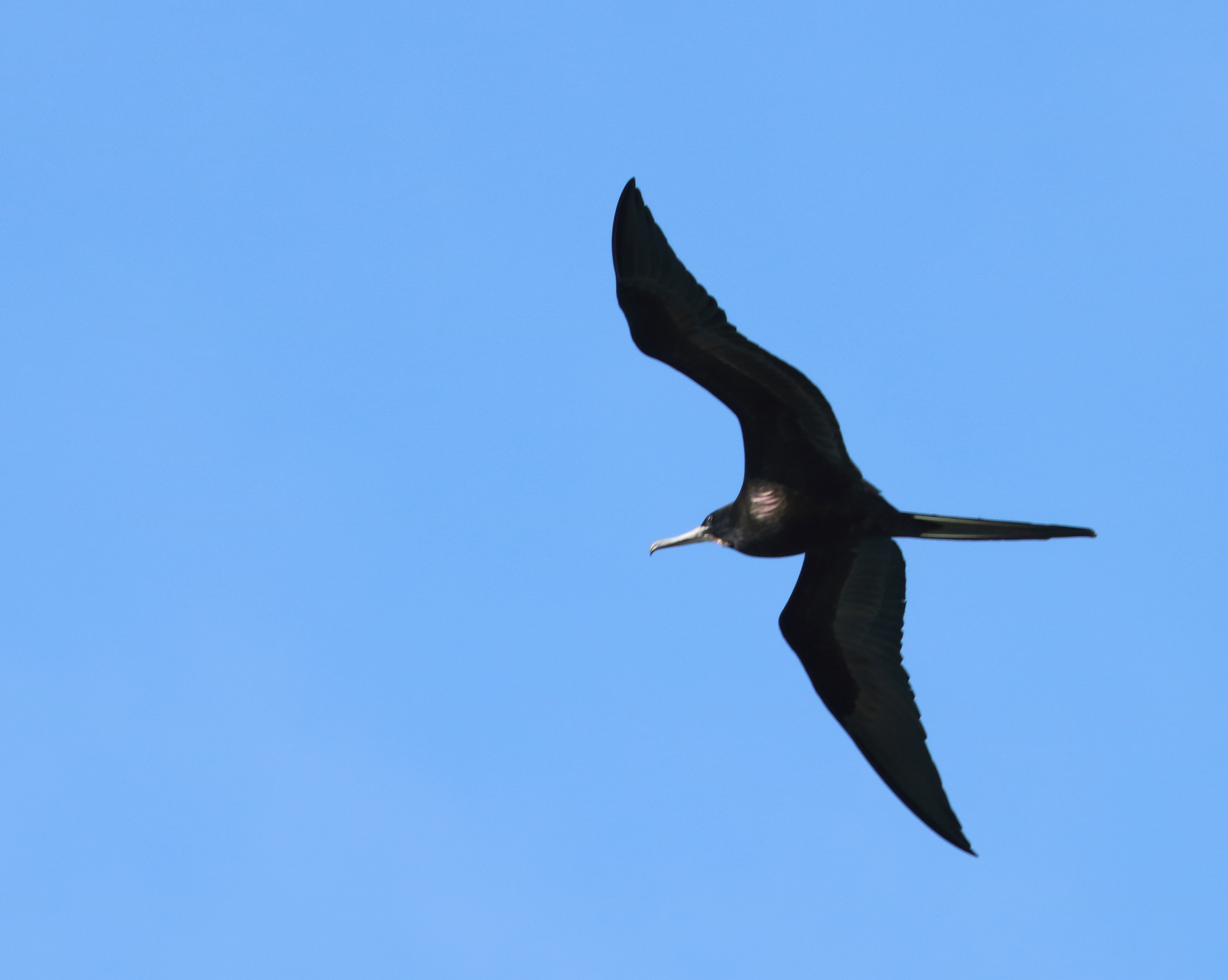
No, this is not the Short-tailed Hawk we saw, but the Magnificent Frigatebirds that frequently flew over us should convince anyone that the Chicxulub meteor did not wipe out all the dinosaurs at the end of the Cretaceous!
“Wait!” I yelled as we headed north from Key West. “Hawk!”
Nick and I peered through the windshield. Above us, at the very top of a flock of vultures, soared a small, dark-winged buteo with a striped tail and pointed wings.
“Is it Short-tailed?” I asked, trying to think what else it could be.
“There aren’t Red-taileds here,” said Nick, “And dark morph Broad-winged are incredibly rare in the east, if not unreported. That’s a Short-tailed!” “Woohoo!” I yelled, rolling down the window to get better looks as our car zoomed a hundred meters underneath my last, and best lifer of the day. Okay, so maybe the Keys hadn’t been that bad! We’d missed Mangrove Cuckoo, of course, but Nick and I had a plan for that. A place by the name of Ding Darling National Wildlife Refuge . . .
My dad and I were hungry. Not for food; we’d already eaten at a fabulous breakfast place in Bar Harbor following the cancellation of our whale-watching trip (which we weren’t all that disappointed by). No, my dad and I wanted warblers.
Earlier that week we’d gotten a taste of the eastern warblers we’d heard so much about, nabbing Common Yellowthroat, Yellow, and a nice Black-and-White Warbler in Massachusetts. The day before today we’d gone to Taylor Bait Farm, a well-known hotspot in Orono, Maine, where the University of Maine (my new home for the next few years) was located. The farm was fairly productive, nabbing us a few cool county birds like Solitary Sandpiper and some Great Egrets. The best part about Taylor Bait Farm, however, was the warblers—specifically, a bright, nonbreeding male Chestnut-sided Warbler that posed for us below eye level for thirty seconds before diving back into the bushes! It was a first lifer warbler in several years, and probably the best-looking one in terms of nonbreeding plumage. During our whole outing at Taylor Bait Farm, we saw a few more Chestnut-sided Warblers and Northern Parulas, and got a really poor look at a Palm Warbler, another lifer, in a tree above us.
Chestnut-sided Warbler proved our Bird of the Day when my dad and I visited the Taylor Bait Farm in Orono.
But it wasn’t enough. Furthermore, we had ended up at Acadia National Park, which was known for its beautiful views and seabirds, not its warblers. My dad and I started driving around the main park loop, stopping at parking lots to try to pick up some of the eastern seabirds that we needed. After a few stops with nothing but eiders and Great Black-backed Gulls, we finally got our dose of Atlantic birds with a few Black Guillemots floating offshore and a distant Northern Gannet flying through the sea fog, both lifers for my dad. Unfortunately, it looked like that very fog was going to limit our chances of seeing things like shearwaters and storm-petrels from shore.
At the third parking lot, as we piled out to scope the beach, I happened to look up at a tree just beginning to turn yellow and I spotted a small yellow bird foraging in it. I brought my binoculars to my eyes and yelled, “Daddy! There’s a Blackburnian Warbler above you!” As he looked up, I started to see that the Blackburnian Warbler, a species we hadn’t seen since 2016, was not the only bird above us. There were passerines flying between and feeding in trees all around us.
We started calling out names as we followed the mixed flock.
“Red-eyed Vireo! Black-and-White Warbler! American Redstart!”
One of our favorite songbirds, Black-and-White Warblers have become almost commonplace for me since moving East.
As the flock moved into a group of conifers I glimpsed one of our target species for the trip feeding on the left side of a spruce. “Magnolia Warbler, get your eyes on it!”
We left the parking lot (and the people wondering what we were gawking at) and walked into the woods, continuing to see if we could pull more warblers out of the already insane mixed flock. I spotted several “Baypoll” warblers at one point, a group that includes Blackpoll and Bay-breasted Warblers that look notoriously similar in fall. Finally, I watched one long enough to see a hint of a bay-colored side, identifying it as a Bay-breasted. The mixed flock, in total, had 14 species including 8 species of warblers—more than we’d ever seen in any flock in Montana!
Unfortunately my dad had to fly home a few days later, but the warblers weren’t done with me yet. September, the best birding month in much of the east, had just begun, and the University of Maine campus happened to be located next to some perfect habitat for warblers during fall migration. I began birding a trail near my dorm, called the Cornfield Loop, several times a week to search for my other eastern target species: Canada Warbler, Cape May Warbler and Philadelphia Vireo.
The hits came fast. After about a week of scoping the area out, I started seeing large mixed flocks of migrating warblers coming through and in one spot had both of my first two targets within a few trees of one another! My reaction for both of them was the same: I can’t believe this bird actually exists! Warblers became the norm, and I got used to listening for chickadees in order to tell me if there might be something else nearby. Red-eyed and Blue-headed Vireos, Northern Parulas, American Redstarts and Common Yellowthroats popped out of every piece of plant life available, and one marsh yielded huge flocks of sparrows every time I walked through it. Seeing familiar warblers was also a treat: I found both Nashville and Wilson’s during my walks, the latter of which isn’t the easiest to find in the east. Here is one of my lists:
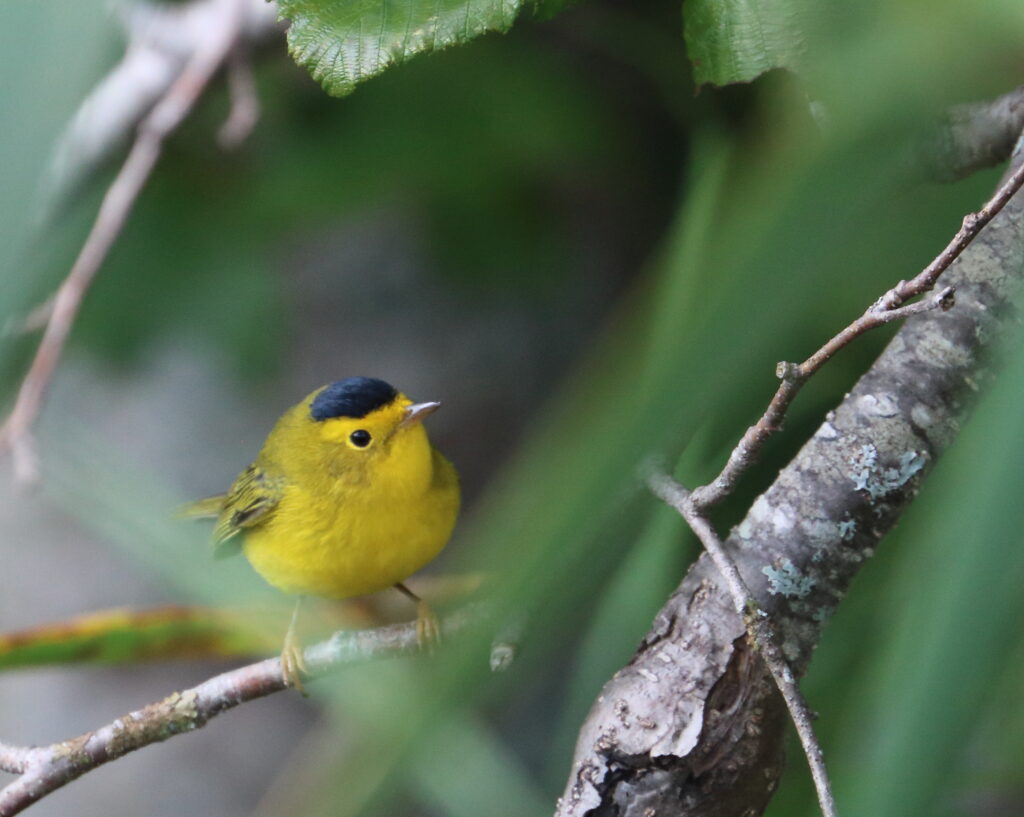
It is odd seeing warblers, such as this Wilson’s Warbler that my dad and I see fairly frequently in Montana, back here in Maine—especially since they are more difficult to see here.
It wasn’t just the Cornfield Loop that had warblers; campus was covered in them. Several mornings I left my dorm for breakfast to be greeted by Black-throated Green Warblers foraging in my face. One night as I walked back from a movie with friends, I began to wonder what all of the high-pitched chips I was hearing were. Could they be sleeping chickadees? No, that doesn’t sound right…and then it hit me. The east was known for its nocturnal migration, and the University of Maine sat right in the middle of the Atlantic Flyway. This meant that the chips I was hearing were the nocturnal flight calls of hundreds, maybe thousands of birds passing over in the dark on their way south to Texas, Florida and beyond! I stared up at the stars, hoping to catch a glimpse of a silhouette as one of these migrating champions flew over.
I got my Philadelphia Vireo by mid-September, pointed out to me by a non-birder friend.
“Hey,” he asked, “What kind of warbler’s that?”
Before I even had my binoculars up I could see the yellow breast, dark eyeline and cute demeanor of a species I’d been dreaming about finding in Montana ever since my friend Nick first alerted me to it. “Philadelphia Vireo, nice find!”
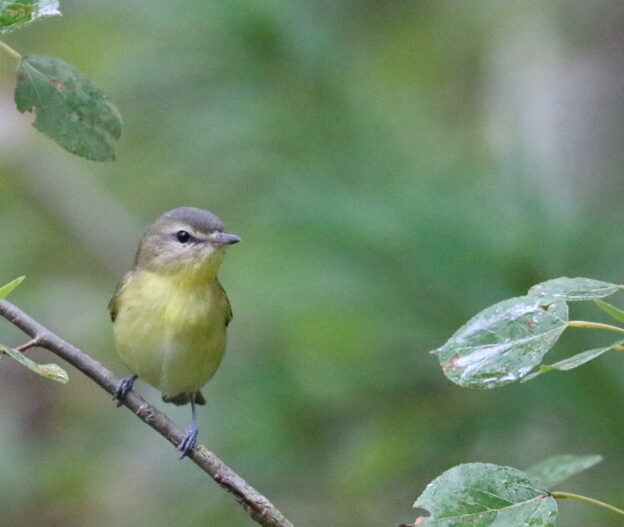
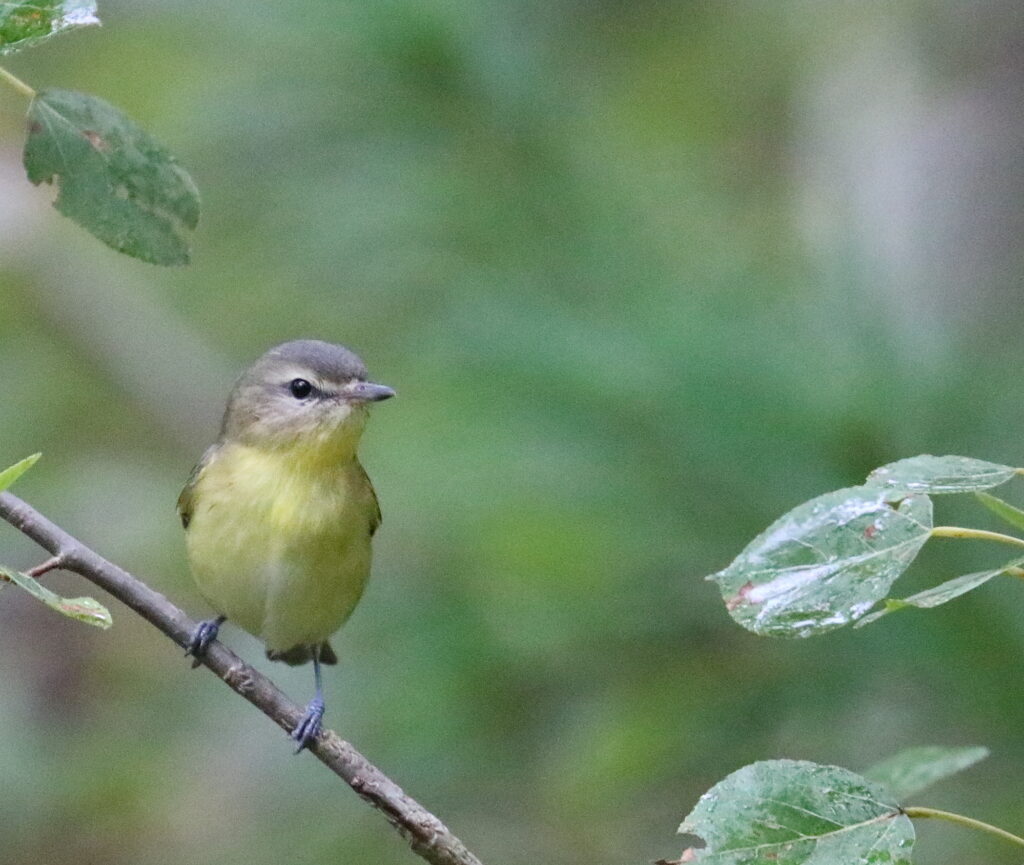
Philadelphia Vireo has definitely been one of my favorite new eastern birds, and I’ve seen them multiple times right on the Cornfield Loop right across from my dorm!
On one walk about a week ago, I was running through the options in my head as to what warblers I still needed for Maine. I had not yet found a Tennessee or Blackpoll Warbler, which was kind of funny considering those were two species my dad and I have found the last few springs in eastern Montana. I was also somehow missing Black-throated Blue, a supposedly common bird that I still needed for my life list.
Suddenly, I spotted a skulky, heavyset passerine fly into a bush near me, making heavy calls. It was acting a lot like a Common Yellowthroat, by far the most common warbler on campus, but I continued to watch it just in case it was one of the rarer species. Sure enough, it briefly popped into view before flying over the trail and out of sight. It flashed me a very dark chest spot contrasting with a complete gray hood as it flew, what I would have called a MacGillivray’s out west. That meant that I’d just scored a Mourning Warbler—MacGillivray’s eastern counterpart and a supposedly much more difficult bird to find. No way!! While Mourning had been on my radar, I hadn’t expected to get it or any of the rarer warblers given that I’d just gotten to Maine less than a month before and was still very content with the common birds.
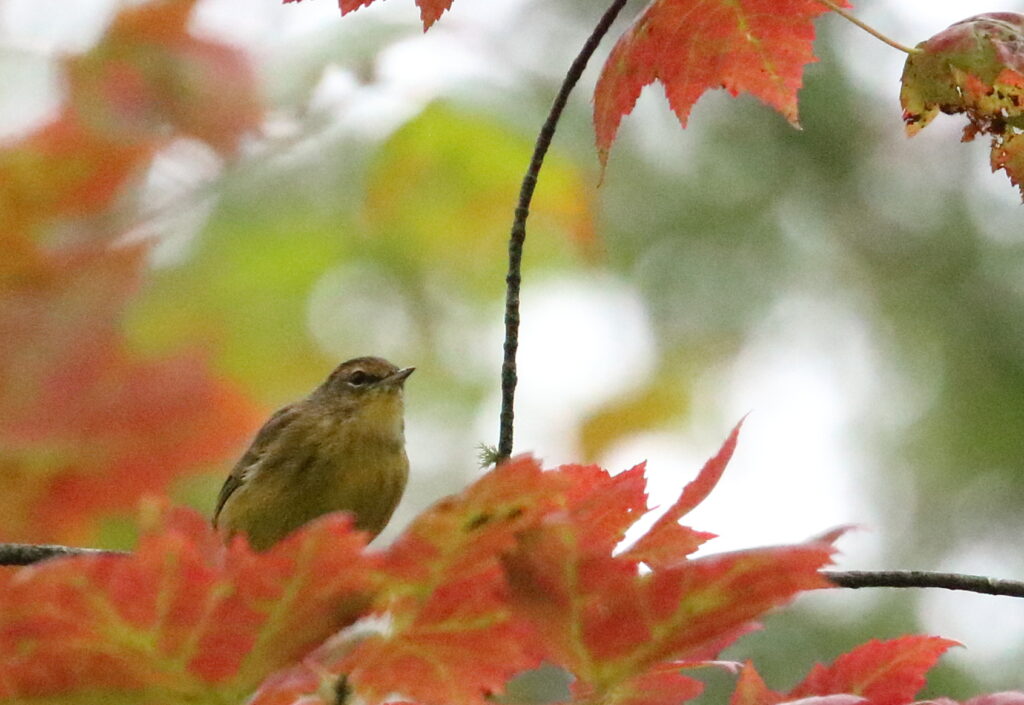
Though not as flashy as many other species, Palm Warbler surprised me and my dad, and was a welcome addition to our Life Lists.
This past week I’ve gotten both Blackpoll and Tennessee Warbler on the Cornfield Loop, bringing the total number of warbler species of seen in Maine to 20, all of which I’d seen in a month compared to the sixteen species of warblers I’d seen in Montana across seven years of birding. I still don’t have Black-throated Blue (though it is definitely still possible), but unfortunately warbler migration is beginning to die down here. Just yesterday eBird marked my report of American Redstart as rare, meaning that a few species are beginning to leave for good. The warblers are now moving through much of the southern United States, including Texas, which you may get to hear about soon from my dad!
As you, our loyal readers, know, I (Sneed) have set a 100-species challenge for myself while undertaking my new temporary job driving truck for the Missoula Fire Cache (which vehemently regrets all association with me and will deny knowing me in any way if asked). As you’ll recall, 100 species may not sound like a lot, but in August—arguably one of the year’s worst birding months—and given the limitations of where I can go, it’s actually quite a lofty ambition pour moi. After all, my birding must be limited to what I can see while driving or during quick rest breaks just off my routes. As of two weeks ago (see Birding by 5-Ton Truck: a 100-Bird Quest), I had reached 59 species, but had picked off most of my easy targets and was desperately in need of large numbers of “watery” birds if I even dreamed of getting close to 100. It didn’t seem likely, but Lo! I have recently happened into some luck!
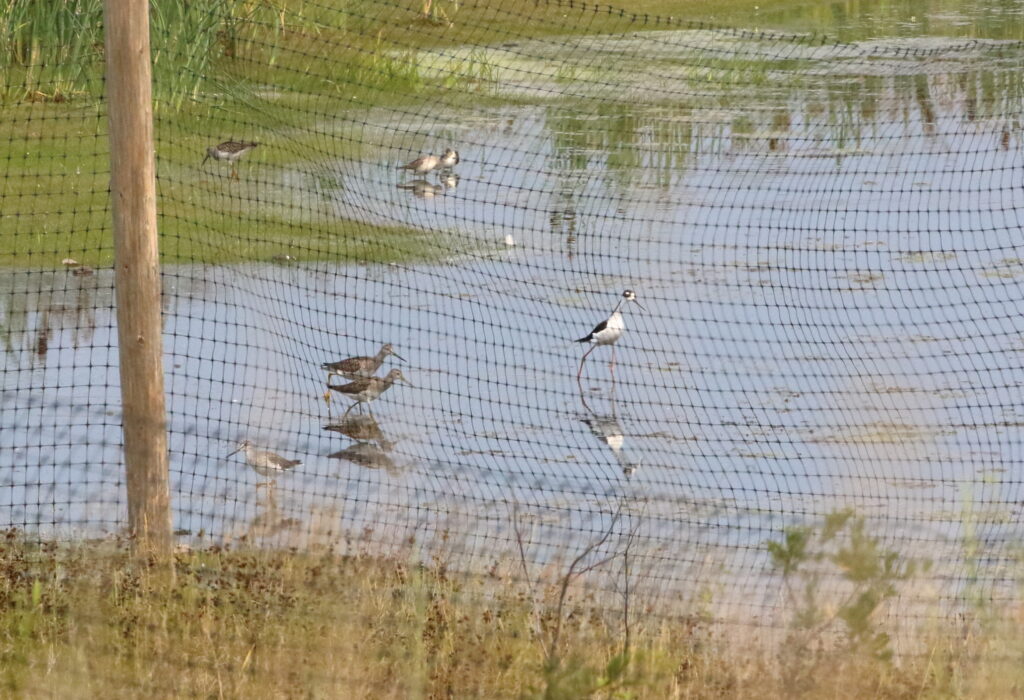
One happy circumstance is that I have been sent to several locations that take me by Warm Springs, one of Montana’s most famous birding locales. I can’t explore much of it during a quick break, but one nice pond sits just off the interstate offramp and I’ve been checking it out. The pond has yielded consistent Wilson’s Phalaropes, but also a few nice ducks such as Wood Ducks and Common Goldeneyes. On my last trip, though, I decided to forgo Warm Springs and instead try Racetrack Pond just up the road. The place often doesn’t yield a lot of birds, but at the far, northern end I pulled over and was delighted to find some suspicious wading birds—Greater Yellowlegs! Yeah! Then, a Black-necked Stilt flew in! Searching harder, I found more than twenty of this unreported species. Shorebird season has begun!
I was totally delighted to find not only Greater Yellowlegs, but Black-necked Stilts at this seldom-birded pond near Warm Springs.
This week, I ran a delivery to the Wenatchee (Washington) fire cache. Having scoured eBird ahead of time for possible quick bird stops, I pulled over at a place called Reardan Ponds north of Spokane. I quickly added Eared Grebes and American Coots to my 100-bird list, but was a bit underwhelmed by other birds. On a whim, I crossed the road to discover a little mudflat—and even better, some kind of shorebird in it! Unfortunately, it quickly scooted into the reeds before I could identify it. Argh!
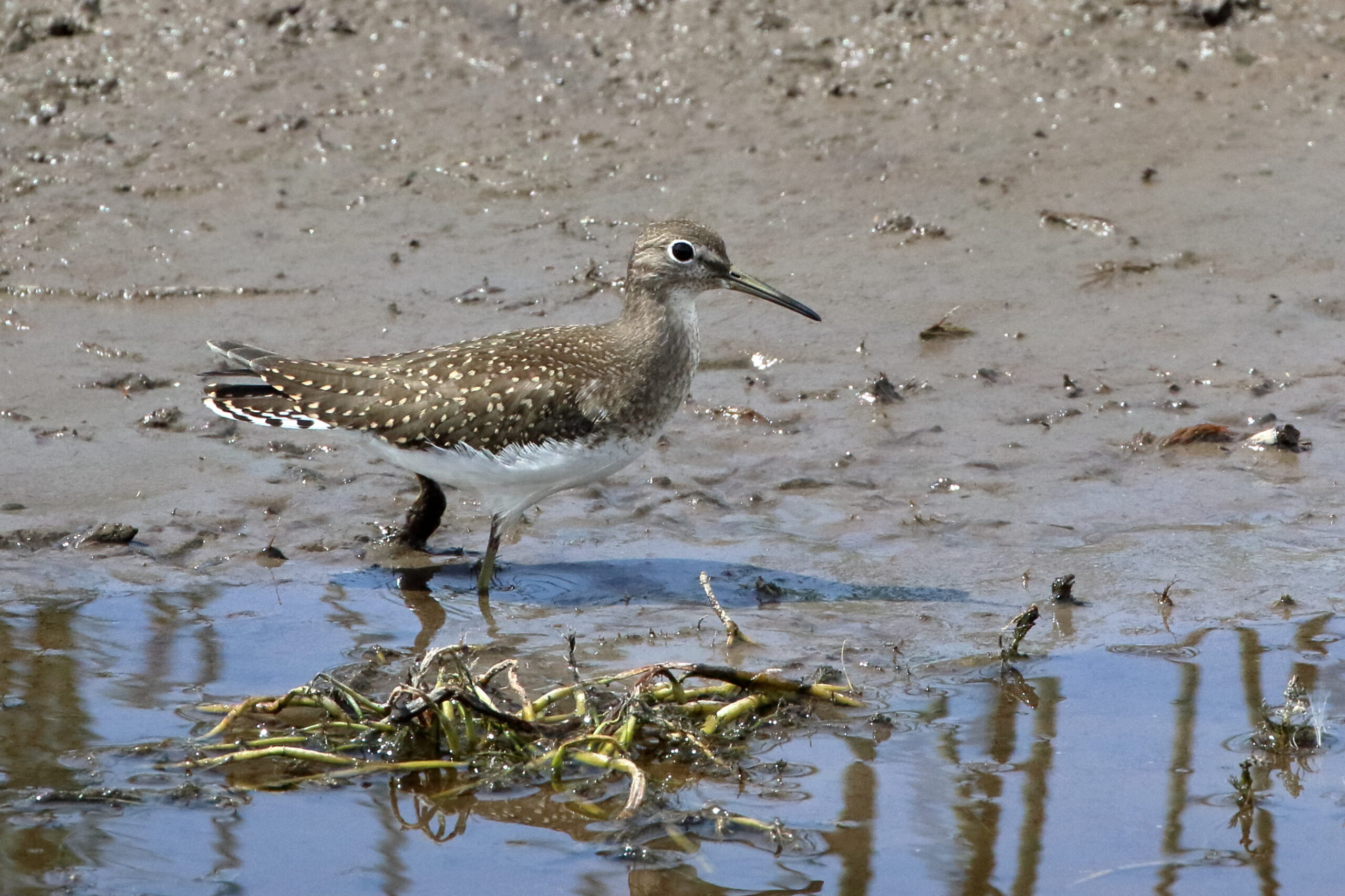
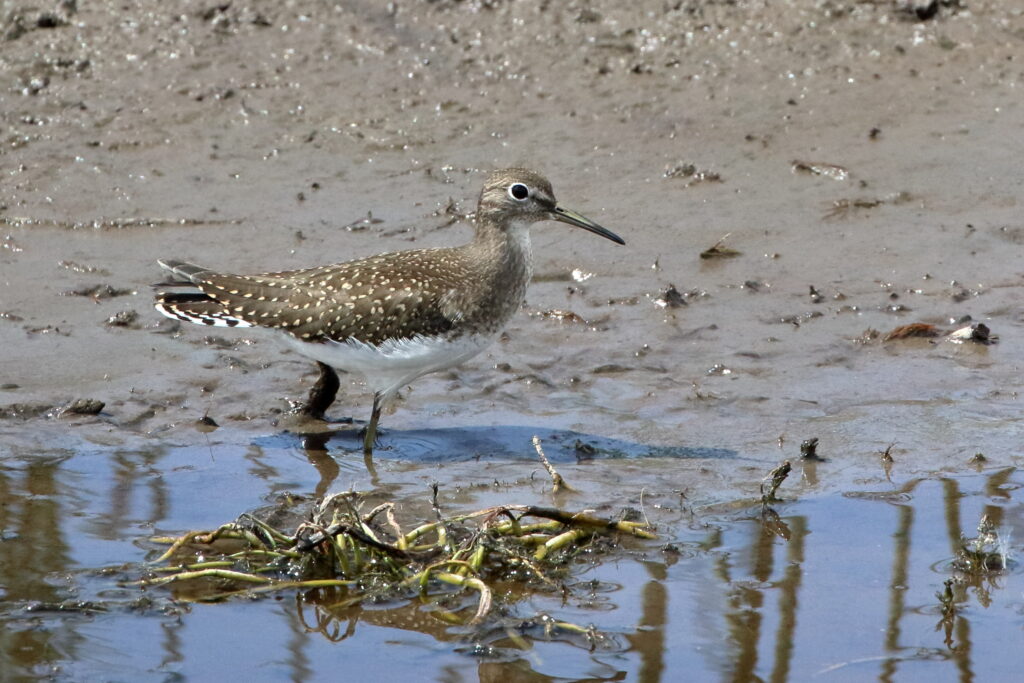
Patience can pay off, as this great look at a Solitary Sandpiper proved.
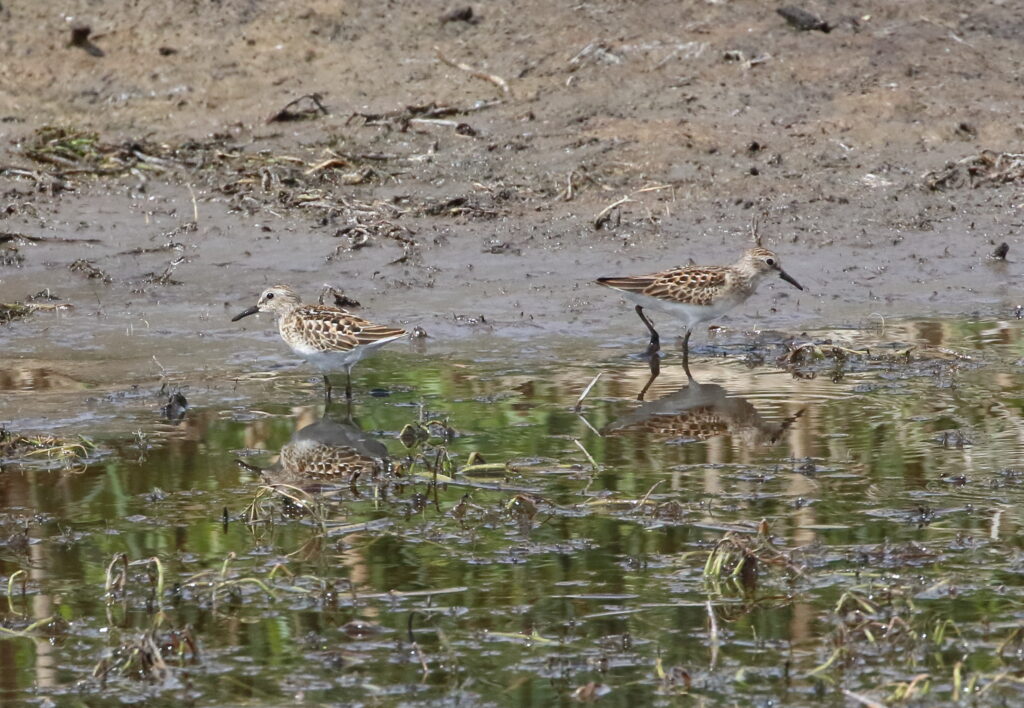
I decided to give it five minutes, and to my delight a Solitary Sandpiper suddenly appeared in front of me—perhaps the best look ever I’ve had of these awesome birds. “But that’s not what I saw earlier, was it?” I asked myself. Then, I spotted not one, but two, small birds in the “peeps” category—small sandpipers of several different varieties. Peeps are very hard to ID, but these two gave me a nice long look, and even more important, some good photos. Later that night, I determined that they were Semipalmated Sandpipers! Not only a GREAT bird for my list, but a Year Bird to boot! However, still not sure of my ID, I posted a photo to the Montana Bird Discussioin Group and talked it over with Braden. Turns out, they weren’t Semis at all, but Least Sandpipers, with mud on their legs covering up their diagnostic yellow colors. I tell you, those peeps are tough, but I was still delighted with the discovery—and learned a lot to boot! UPDATE: So, this still isn’t 100% resolved. Another highly-respected MT birder makes some good points that the birds below are Semis after all! What do YOU think?
Peeps are notoriously difficult to ID, but thanks to some decent photos and help from other birders, I eventually determined that these were Least Sandpipers—or maybe not! Other experts are weighing in that my original ID of Semipalmated Sandpipers may be correct after all!
As a bonus, the next day, returning to Missoula, I added several new songbirds—a category I’d about given up on for my goal. At a little park in St. Regis, I not only got Cordilleran Flycatcher, but Red Crossbills, and a Red-eyed Vireo, a bird I hadn’t dared hope for. So where does that leave me? Well, as of today, I have reached exactly 80, count ‘em, EIGHTY species! Will I make it to 100? It’s still going to be tough. Not only am I running out of likely birds, I won’t be able to drive for the next couple of weeks, and the season may be over when I get back. Never fear, though, I will let you, our loyal readers, know of any further success! Keep on birding!
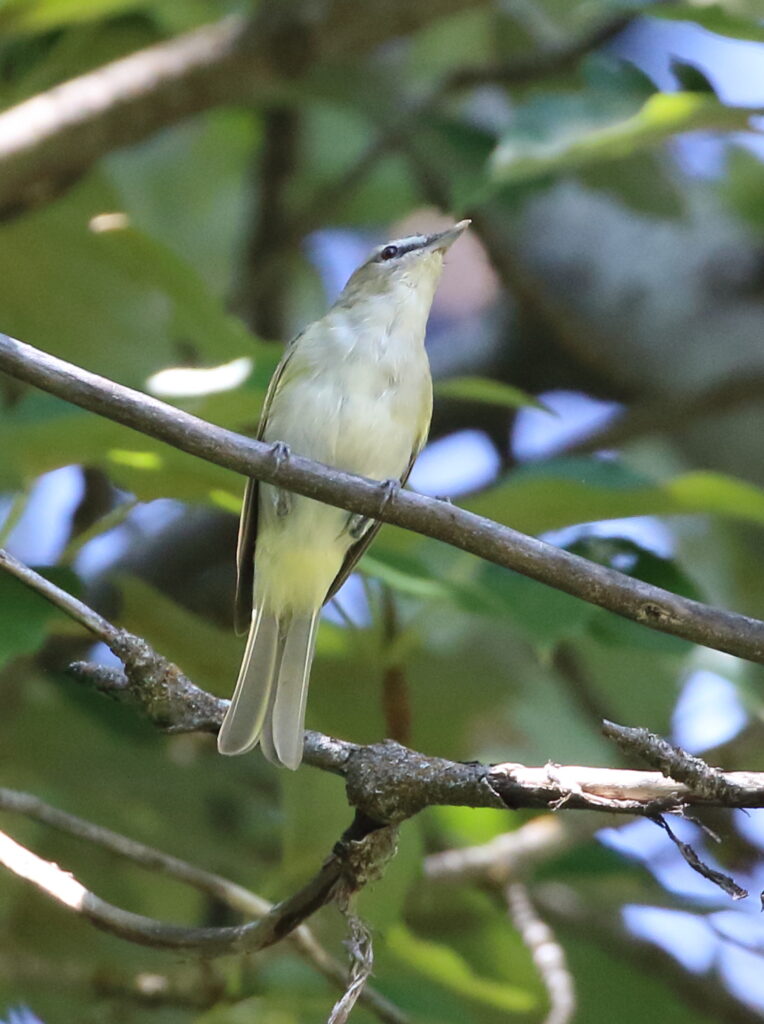
Red-eyed Vireos have become one of our favorite songbirds, but seeing one takes some persistence and, it seems, the presence of cottonwood trees.
After a couple of slightly disappointing birding outings in a row, Braden and I were feeling a little down, especially because we felt like we’d missed our chances to see some uncommon fall migrants as they make their all-too-brief passages through Montana. Nonetheless, I continued taking my binoculars with me on my morning dog walks just to keep an eye on things and learn more about how fall birds behave. Early last Sunday, I decided to take Lola on one of our Top Secret routes—places we can’t tell you about or we’d have to kill you—and had just started down a street near Pineview Park when I saw activity in weird poplar-type trees up ahead. I unslung my binocs and focused.
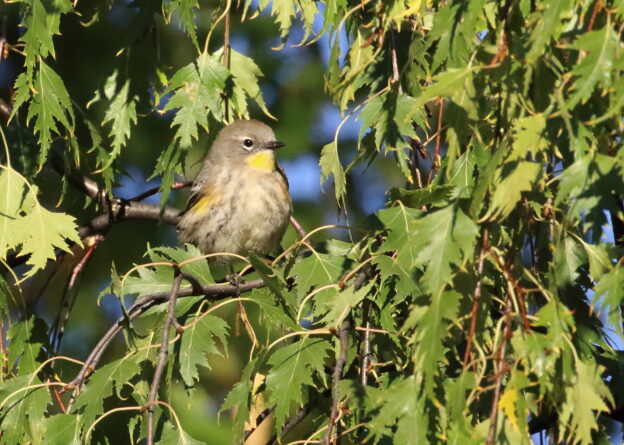
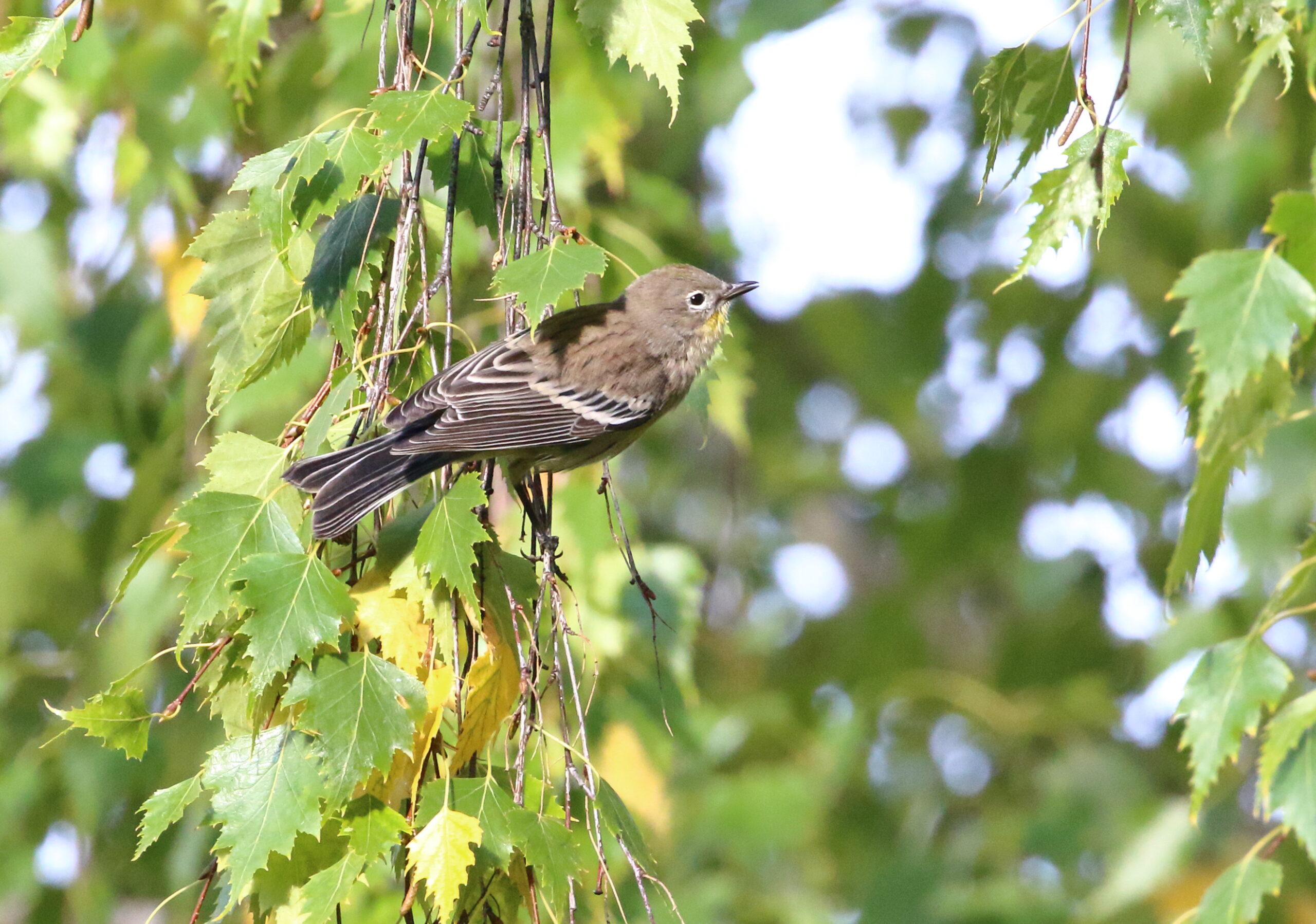
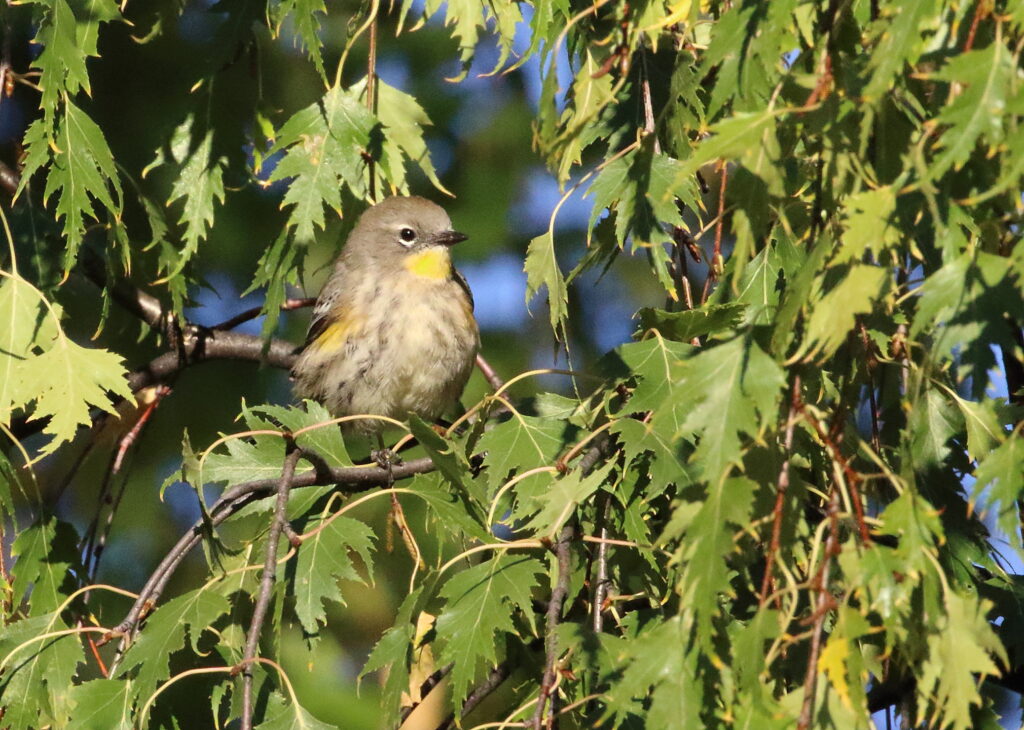
You Californians are probably used to this, but sixty Yellow-rumped Warblers in Montana? Almost unheard of!
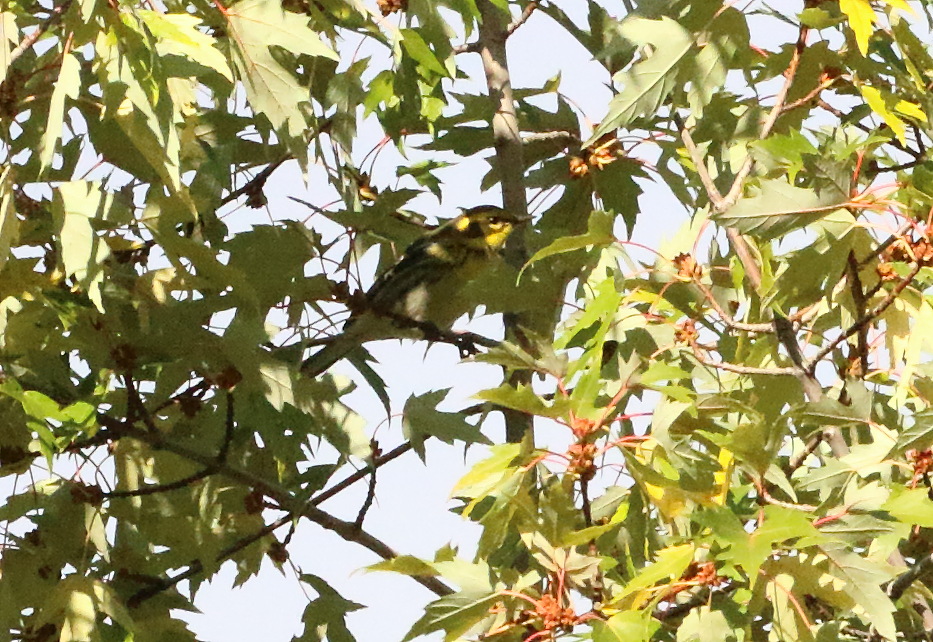
I saw about eight or ten little birds, and the first two I identified happened to be Ruby-crowned Kinglets, so I at first assumed they were all kinglets. Rookie mistake. Upon further study, I realized that many of them were Yellow-rumped Warblers (Banding Code: YRWA). What’s more, many more birds filled the surrounding trees. “Hm . . . This could be serious,” I thought and settled in for a better look. For the next twenty minutes, I did my best to identify the frantically-moving targets, finding Red-breasted Nuthatches, Black-capped Chickadees, Evening Grosbeaks—and about twenty Yellow-rumped Warblers. As I was looking at the top of a spruce tree, however, a shocking black-and-yellow face suddenly popped up: a Townsend’s Warbler! By now, TOWAs were supposed to be long gone and when I punched it into eBird, well, the app flagged it as RARE.
Anyone know what this tree is? Whatever it is, it apparently hosted a lot of insects because the birds loved it!
Lola and I hurried home and woke Braden. “You don’t have to come,” I told him, “but there’s an amazing mixed-species flock down by Pineview, including a Townsend’s Warbler.” Five minutes later, cameras and binoculars in hand, we zoomed down there in our ’86 4-Runner. To our relief, the birds hadn’t left, and we spent the next seventy minutes following them. My major goal was for Braden to see the Townsend’s, but together, we soon began making other discoveries. For one thing, there weren’t just twenty YRWAs. There were at least sixty of them, along with at least ten Ruby-crowned Kinglets. It wasn’t long before Braden found a Wilson’s Warbler and we both began detecting an occasional Orange-crowned in the crowd. Thanks to Braden’s ears, we also heard Pine Siskins, Red Crossbills, a Song Sparrow—even a pair of Sandhill Cranes in the distance!
Full Disclosure: I still confuse Cassin’s Vireos with Ruby-crowned Kinglets. The white “spectacles” are the key to IDing the Cassin’s.
Not to be outdone, vireos made an appearance. Braden spotted a pair of one of our favorite songbirds, Cassin’s Vireo, while I saw another surprise bird face, that of a Warbling Vireo—also flagged as RARE for this time of year.
The species kept piling up with Hairy Woodpecker, flickers, and another surprise, Red-naped Sapsucker. But where was that sneaky Townsend’s Warbler? Had I been imagining it? Had it struck out on its own? Finally, after almost an hour, Braden shouted, “I’ve got the Townsend’s!” I hurried over and sure enough, there it was. I even managed a poor, but unmistakable, photo of it. As the flock made its way slowly down Rattlesnake Creek, Braden and I climbed back into the 4-Runner. “Wow,” I said, “I think that’s the best mixed-species flock we’ve ever seen in Montana!” After some thought, Braden agreed. It hadn’t provided us any Year Birds or Lifers, but had been something we would never forget—and almost in our back yard. Birding doesn’t get better than that.