Tag Archives: corvids

Are you ready for . . . the QUACH?

My dad walked back to the car, frowning. “Well, unfortunately it looks like we’re gonna have to go birding somewhere else today.”

I sighed, frustrated. We’d been trying to bird Swiftcurrent, in east Glacier National Park, for years, and we’d still never gotten a normal birding session there. Most years it had been closed, like it was today, because of COVID-19 or construction. The year we had gotten to bird, it had been pouring down rain, and while we scored an incredible experience with a pair of Harlequin Ducks in Lake Swiftcurrent, those were basically the only birds was saw. Now, not birding Swiftcurrent drastically decreased our chances at Boreal Chickadee, a bird we’d been wanting to find for as long as I could remember. 

Reviewing our options, we could just immediately head south and hope to bird Two Medicine, and possibly arrive in West Glacier earlier than expected to look for Black Swift and Harlequin Duck. I wanted to go somewhere new, however, so we headed north towards the closed Canadian border crossing. Hopefully we could find some cool habitat, possibly with Boreal Chickadees, though that species had rarely been reported from that area of the park. Along with it being a cool bird, the main reason my dad and I wanted the chickadee so badly is because in terms of Montana lifers we’d been completely skunked during the rest of our trip, missing American Golden-Plover, Broad-winged Hawk, Magnolia Warbler and more. We’d gotten cool birds, like Sprague’s Pipit, but none of them had been new species for us.
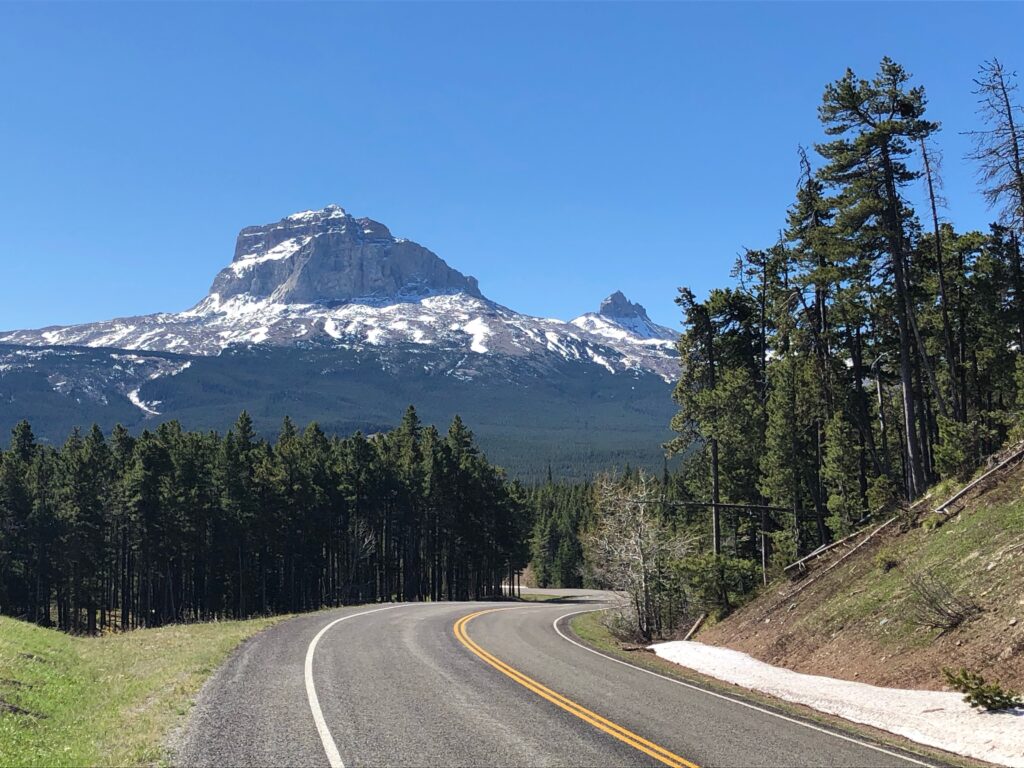
As we learned in Glacier National Park this summer, birding the road less traveled almost always leads to great surprises.

After taking a short loop through the most desolate plains we’d seen yet in Montana, we turned towards Glacier’s mountains again. As we drove, the habitat shifted, first to stunted aspen forest and then tall, dense spruce-fir forest. It was a habitat I’d never seen in the state, if at all: the southernmost reaches of the vast boreal forest that stretched across Canada. As we crossed back into the national park, my dad spotted what was probably a robin, but we pulled over anyway—I was excited to see what birds were singing from this new habitat.

A Northern Waterthrush echoed from the side of the car as we got out, and several Brown-headed Cowbirds whistled from the tops of trees. Every single bird was a surprise to us, since we really had no idea what to expect. And despite the fact that we hadn’t truly entered the mountains yet, my dad’s altitude app told us that we were at more than 5000 feet!

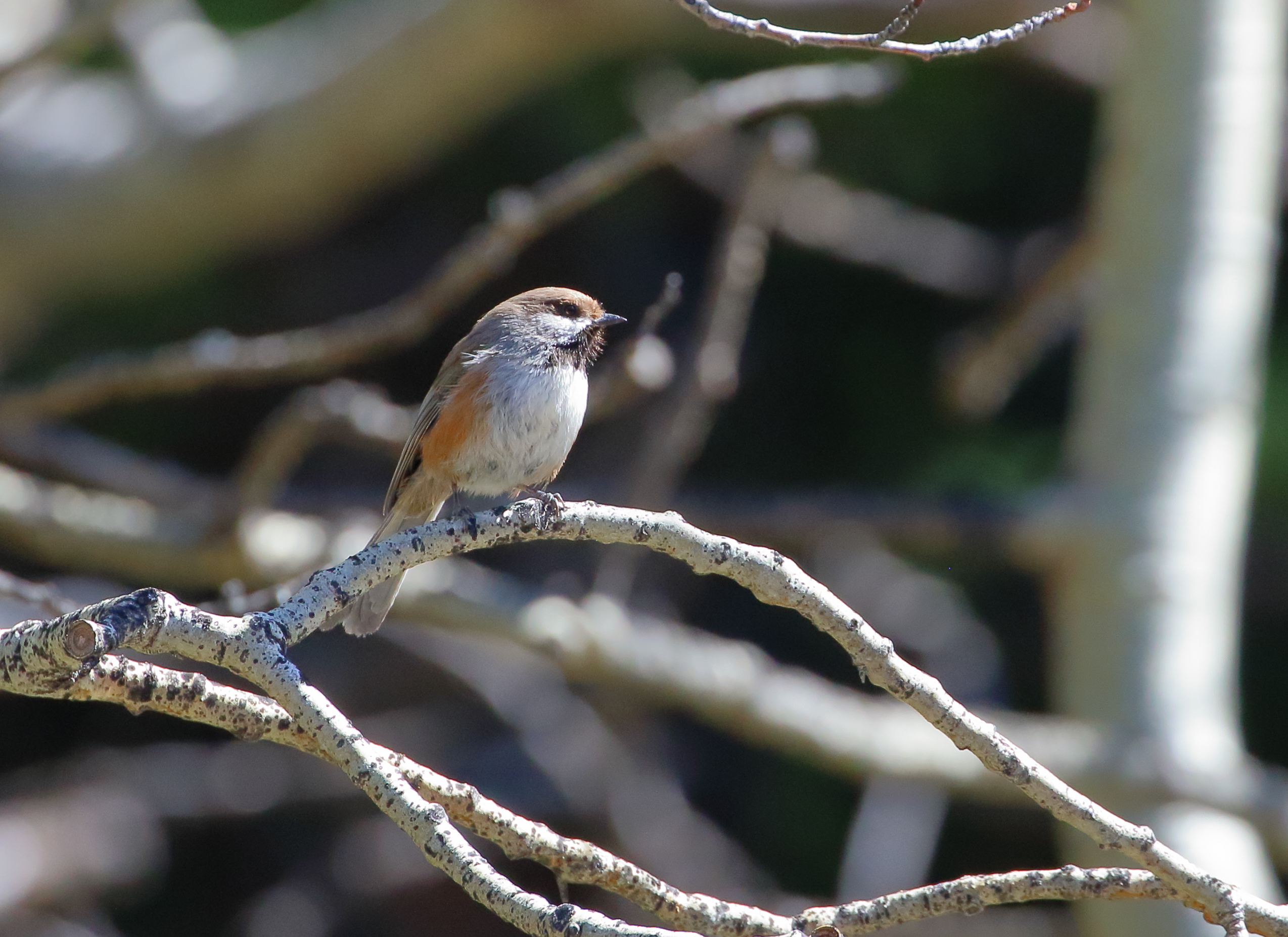
Suddenly my dad turned around. “I just heard a chickadee.” I spotted something flit to the top of a tall spruce about fifty feet away, and raised my binoculars. While it was still too far to tell what kind, I was definitely staring at a chickadee, so I grabbed my camera from the car and hurried over to where there appeared to be a pair of them. Once we drew closer, I raised my binoculars, registering salmon flanks and a brown cap.
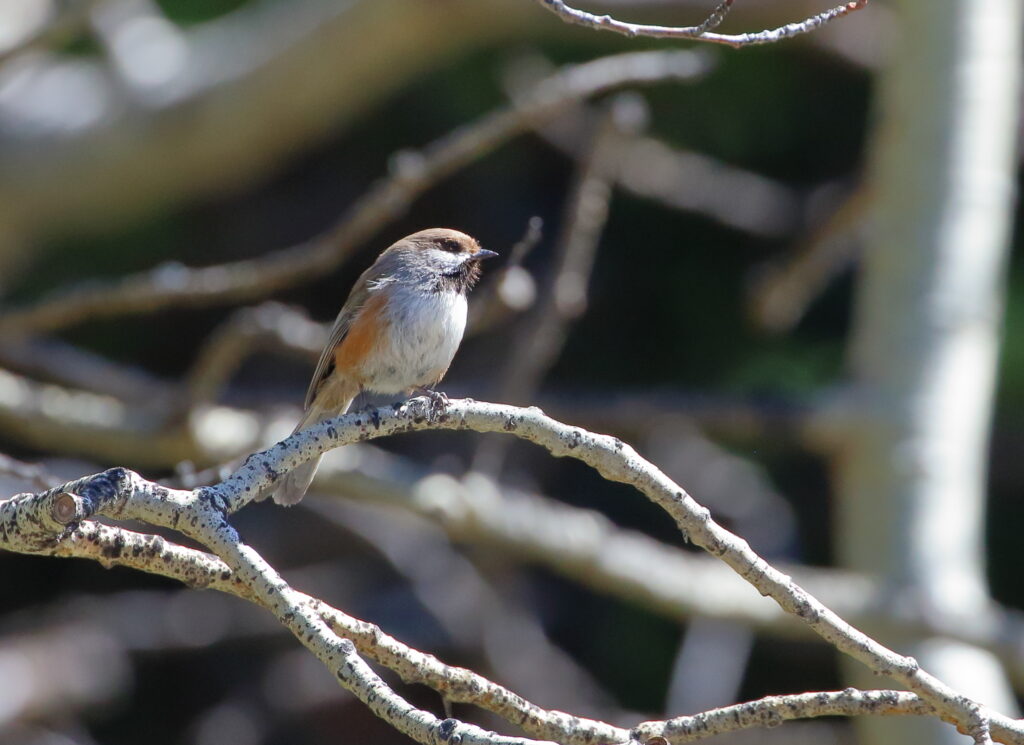
Finding not one, but half a dozen Boreal Chickadees in a place we never expected not only checked off a long-held goal, but laid the crucial foundation for the QUACH!

It was one of if not the first time I’d ever said the F-word in front of my dad! It was like my brain had exploded, I’m not sure whether from the fact that the birds were Boreal Chickadees or from the fact that we’d managed to find a new Montana species at last on this trip. The chickadees bounced around the spruces for a while, then disappeared. 

After recovering from the shock, my dad and I hugged and got back in the car, intent on seeing what else we could find along this paved-yet-empty road. Starting at the closed Canadian border crossing, we drove south doing five-minute point counts along the road like we’d done searching for Sprague’s Pipit the day before.
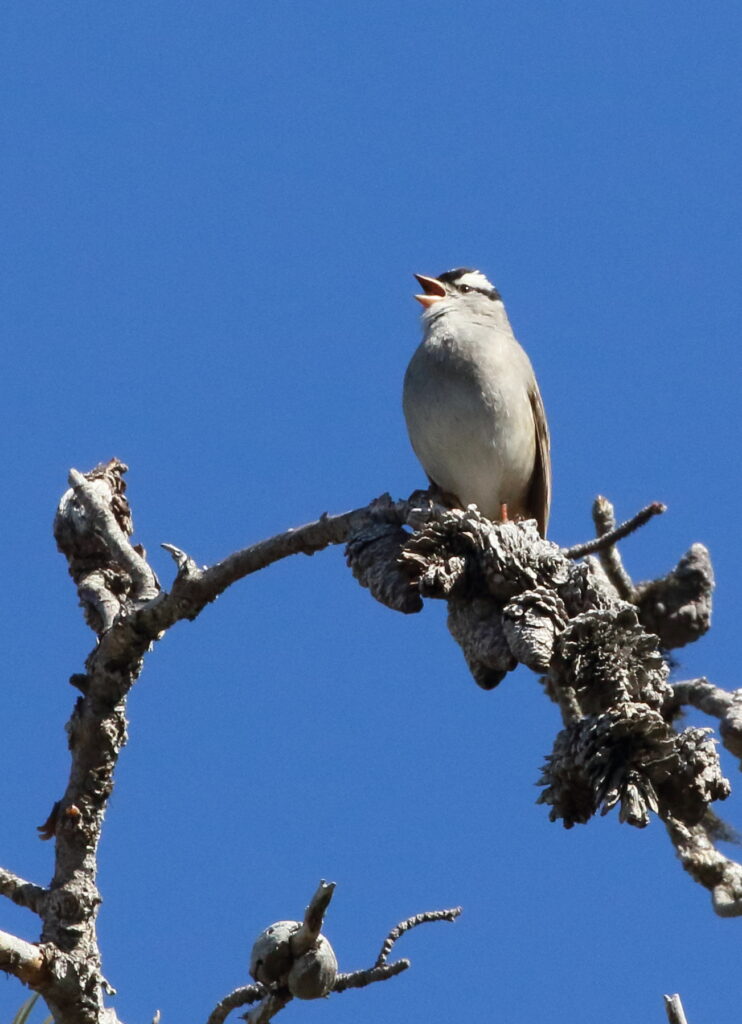
Seeing a White-crowned Sparrow on its alpine breeding grounds gave us new appreciation for this relatively common species.

The most common sparrows were White-crowned Sparrows belting confusing songs from every level of the trees, and while Yellow and Yellow-rumped Warblers were present, they were at least equalled in number by Wilson’s Warblers and Northern Waterthrushes, neither of which were common in Missoula. Amazingly, we picked up Boreal Chickadee at two more points, getting much better looks and photos of three more pairs. They were one of the more common species here, too, and were by far the most common chickadee, though we also picked up a lone Mountain and a possible Black-capped, the latter from a lower altitude aspen area. Canada Jay was the most common corvid, though we also saw a single Steller’s. Another treat were two boisterous Olive-sided Flycatchers, well-known boreal forest breeders, calling and posing for us.

In the wetter areas we found Fox and Lincoln’s Sparrows, Tree Swallows and Warbling Vireos. Red-breasted Nuthatches, Ruby-crowned Kinglets, Pine Siskins and Chipping Sparrows greeted us at most stops. We also got a Varied Thrush, which was a surprise as we were probably about two miles from the easternmost limit of its breeding range.
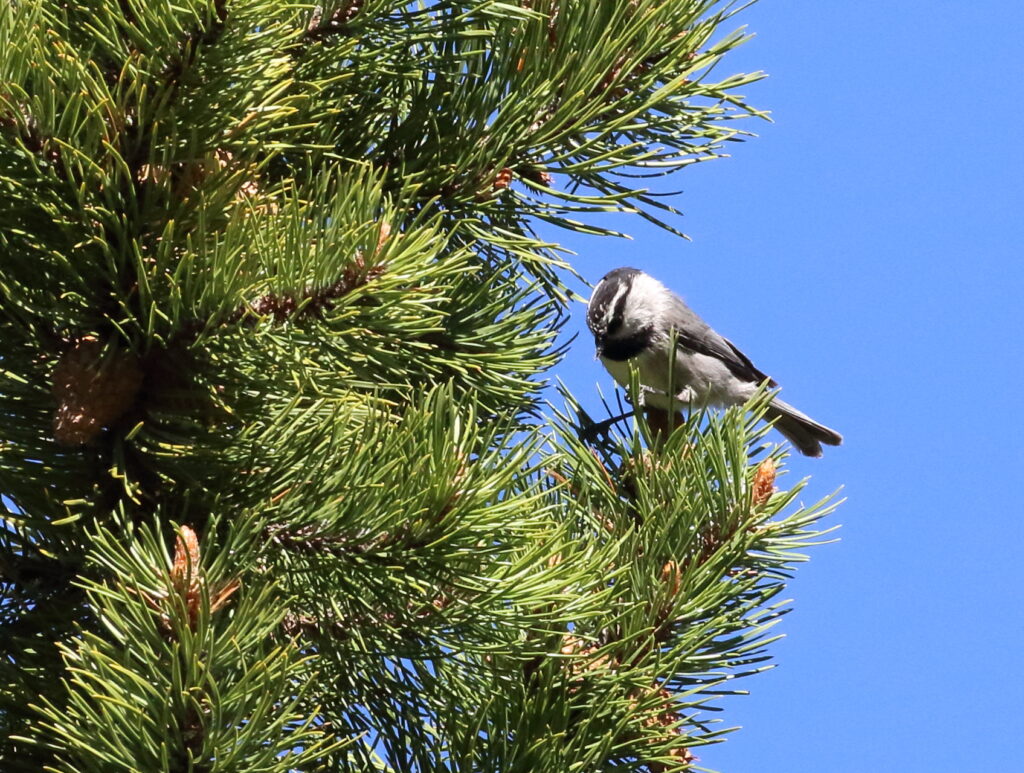
What? A Mountain Chickadee near a Boreal Chickadee? What was this songbird madness???

I’d recently read a book about the lack of birds in the boreal forest, and while there definitely was lower diversity than say, the wet second-growth of West Glacier, it was not as if there weren’t any birds. At most stops we picked up at least three or four species singing or calling.

After drinking our fill of the boreal forest and saying goodbye to the chickadees, we headed south along the eastern edge of Glacier National Park. We stopped at a good-looking, alder-filled riparian area for lunch, picking up new species for the day like Black-headed Grosbeak, Lazuli Bunting and our first-of-year MacGillivray’s Warbler, then got onto Highway 2 again, back in familiar territory.

When we reached West Glacier, though, we discovered something tragic—you had to have a permit to enter the park, a new rule they’d employed to counter the insane surges of tourists they’d had the past few years! Thankfully, we could enter without a permit after 5 p.m., but still it was sad that the days of entering Glacier easily may be over.
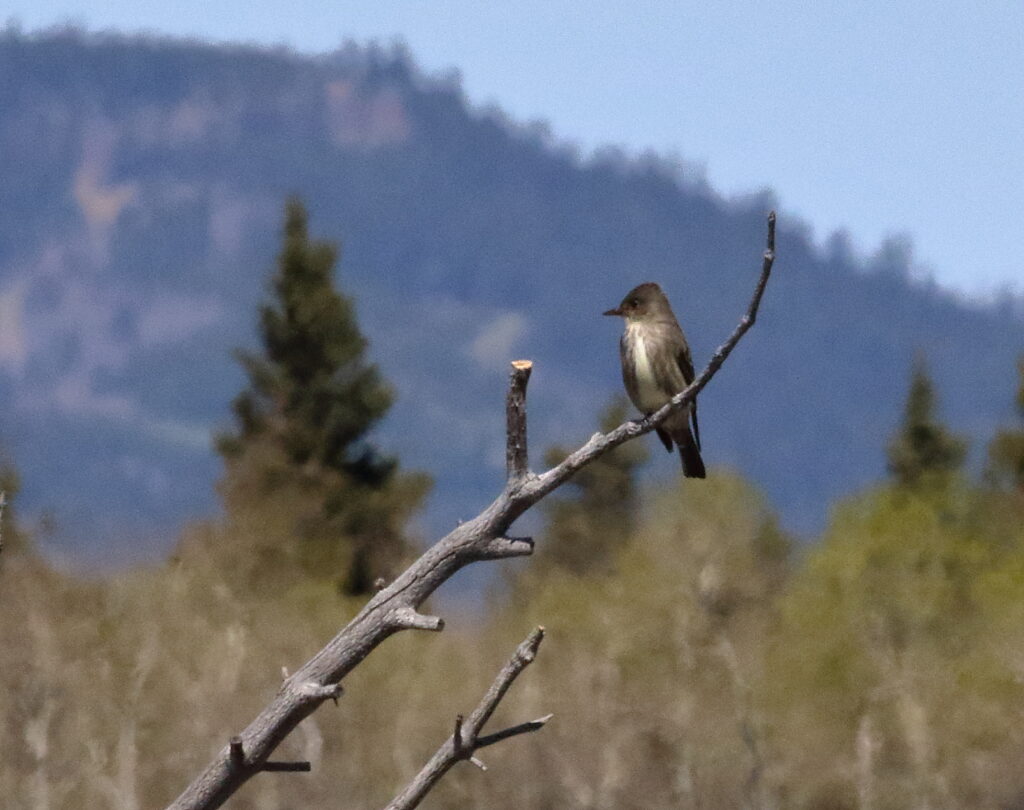
Since we know them mostly from burn areas, this Olive-sided Flycatcher at a roadside pullout proved a special delight!

We parked by the old park entrance to wait until five o’ clock, and while my dad took a nap I wandered around the healthy mountain-riparian forest along the milk-blue Middle Fork of the Flathead River. As I hiked, I suddenly heard more chickadees calling, and in a dense patch of Lodgepole Pine I found them: Chestnut-backed Chickadees! 

Earlier in the day, after seeing the Boreal Chickadees, I’d mentioned to my dad: “Just you wait. We’ll somehow manage to see three of the four chickadee species and have trouble finding a Black-capped.” Black-capped, of course, is well-known for being not only the most common chickadee in Montana but also one of the most common birds here, period. 

Suddenly, my fear had come true: I’d seen the three most difficult chickadees in one day, but had not yet seen a Black-capped (while again, we’d possibly heard one up by the Canadian border, it had not been a positive identification so we hadn’t counted it). I rushed back to the car to wake my dad.

 “Let’s go find some cottonwoods. I need to see a Black-capped Chickadee.”

As we drove around West Glacier (the town; the park hadn’t opened yet), I rolled down my windows, straining to hear any piece of a chickadee call. We pulled into a fishing access parking lot surrounded by cottonwoods and began walking, though the birds were fairly quiet. Four in the afternoon was about as bad a time as you could go birding, yet here we were, trying to find one that we saw in our backyard every single day. I promised to myself that if we found a Black-capped, I would memorize its scientific name, Poecile Atricapillus. 

After admiring a gorgeous male Rufous Hummingbird that posed for us, I heard a chickadee call from behind me. Then, a sharp-looking Black-capped flew towards us, landing mere inches from us on a branch! I’d done it! I restrained myself from hugging the chickadee and instead gave my dad a high-five in celebration of the Quad-Chickadee Day I’d had—or, as my dad officially christened it, “the Quach.”

Note: “Quach” is a registered trademark of FatherSonBirding, legally protected throughout the solar system. Anyone using it will be subject to massive fines and stern looks. Not really. But you heard it here first!
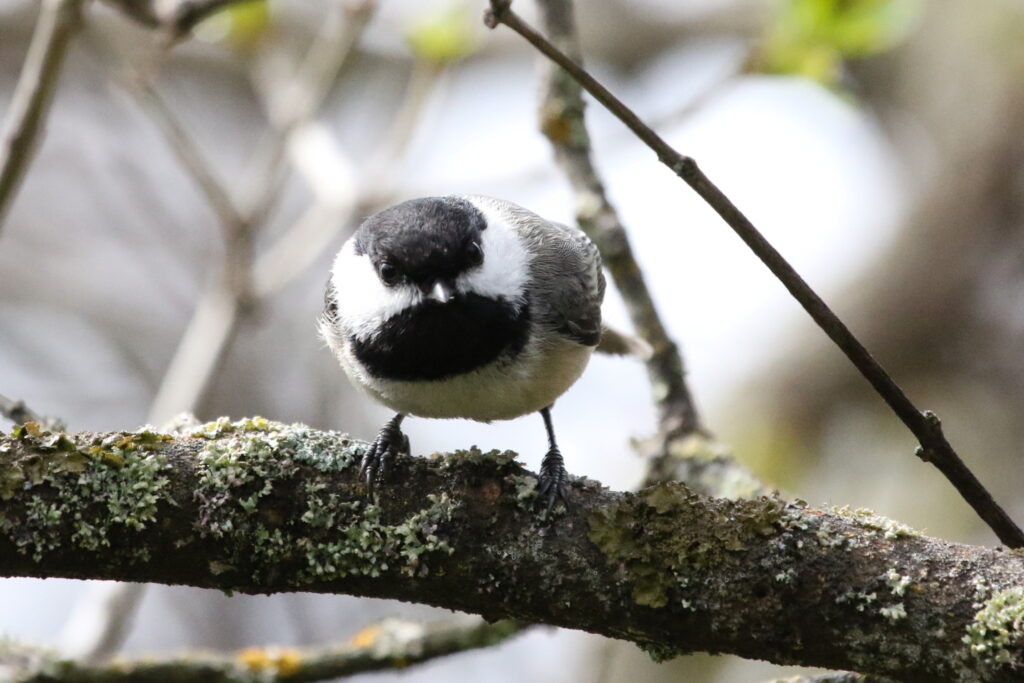
Who would have thunk a common Black-capped Chickadee would prove the key to Braden’s epic QUACH? Only the wily chickadee, of course!

Winter Birding in Israel, Part 1: Neighborhood Birding

Alert: the hackers are back. We’ve had a number of suspicious sign ups recently so if you really have subscribed in the last three months, please shoot Sneed a confirmation email at collard@bigsky.net and I will make sure that you stay subscribed. Meanwhile, feel free to share this post with all the wonderful birders in your lives. Thanks!

If you are an avid fan of FatherSonBirding—and let’s face it, who isn’t?—you’ll know that Braden and I recently had an adventure of a lifetime in Israel and Jordan. Over the next few posts, we’d like to share that adventure, starting with ordinary neighborhood birding, and what any casual visitor might expect to see in Israel in January.

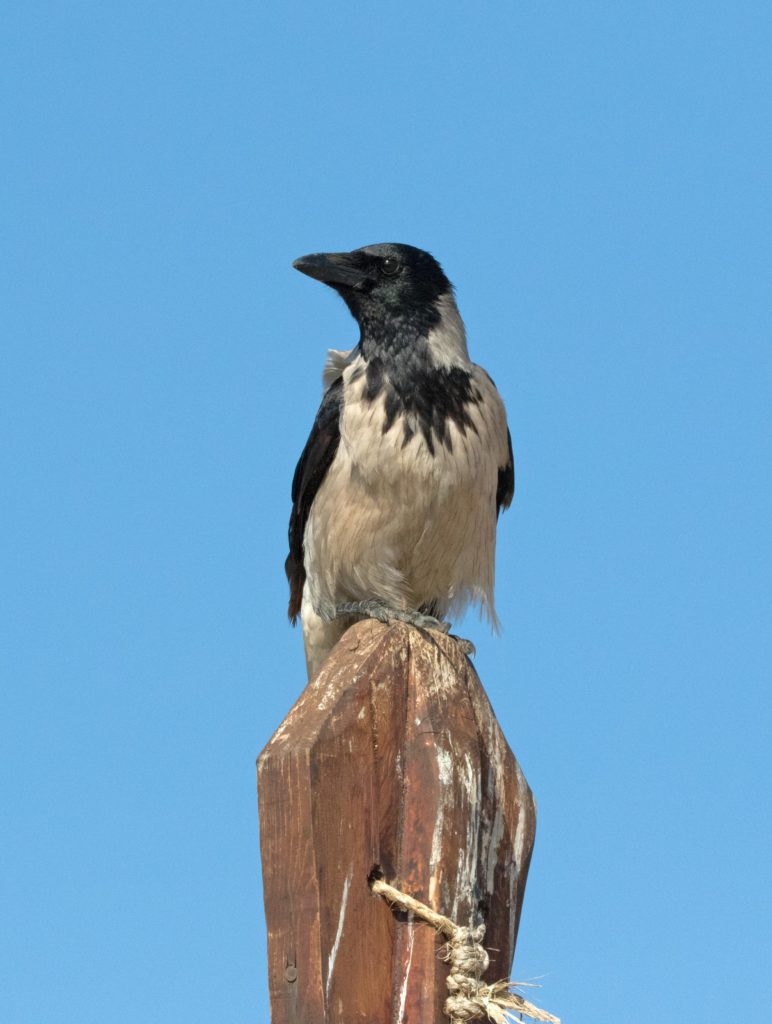
The Hooded Crow not only was our first Israeli bird, it was one that would provide constant entertainment and companionship throughout our trip.

Before flying to the Holy Land, Braden and I had already learned the value of studying up on birds of a new area, so when our flight touched down in Tel Aviv at 2 a.m., we hit the ground running. Well, sort of. First, we got on a train and traveled to our friends’ house in the pleasant coastal town of Binyamina. As soon as we’d showered and eaten breakfast, our hosts’ 14-year-old son, Noam, led us out on a tour of the neighborhood.

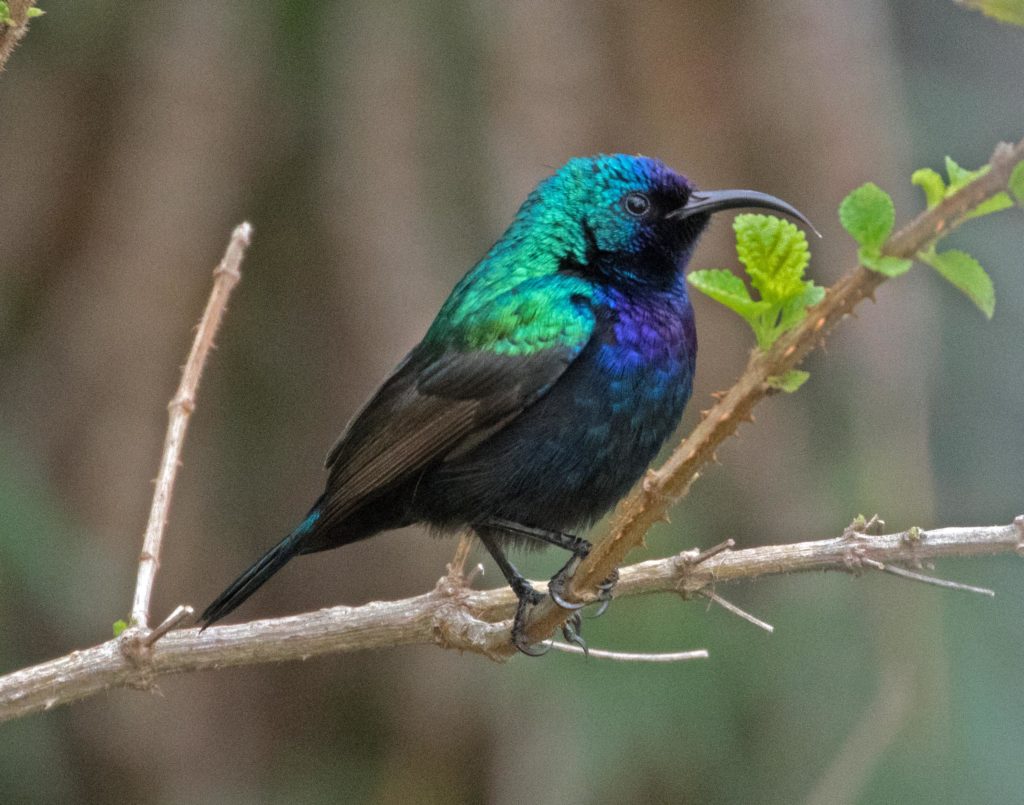
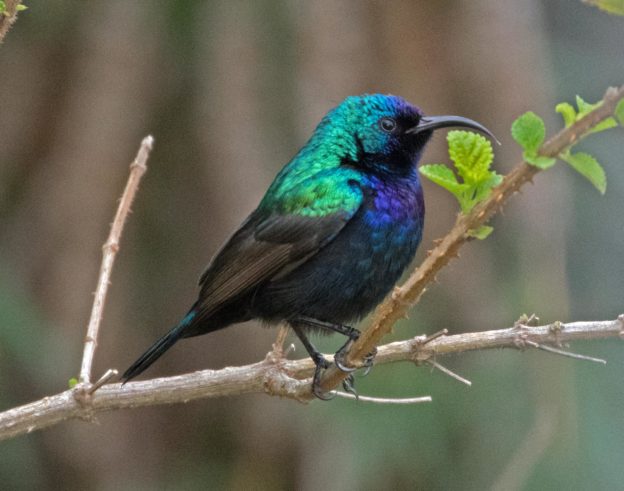
Now, I have to preface this by saying that Israel is the only place I know where if you go out birding, you not only have a chance of encountering some amazing historic site, you are almost guaranteed it. Only a block from his house, Noam led us to a remarkable Ottoman well that was 400-plus years old. Braden and I would have been more in awe if we weren’t already mesmerized by the variety of birds we were seeing! Our first Israeli bird? Hooded Crow, a handsome and charismatic corvid that would become a regular companion on our trip. This was soon followed by other delights including Great Tits, White-spectacled Bulbuls, Graceful Prinias, and Common Chiffchaffs, none of which we really expected to see! The most “crowd-pleasing?” The Palestinian Sunbird, an analog to American hummingbirds. We saw several, in fact, hovering to slurp up the nectar of some bright red flowers.

The Middle East’s “hummingbird”, the Palestinian Sunbird. The convergence of both habits and appearance of these guys with our own hummers is remarkable.

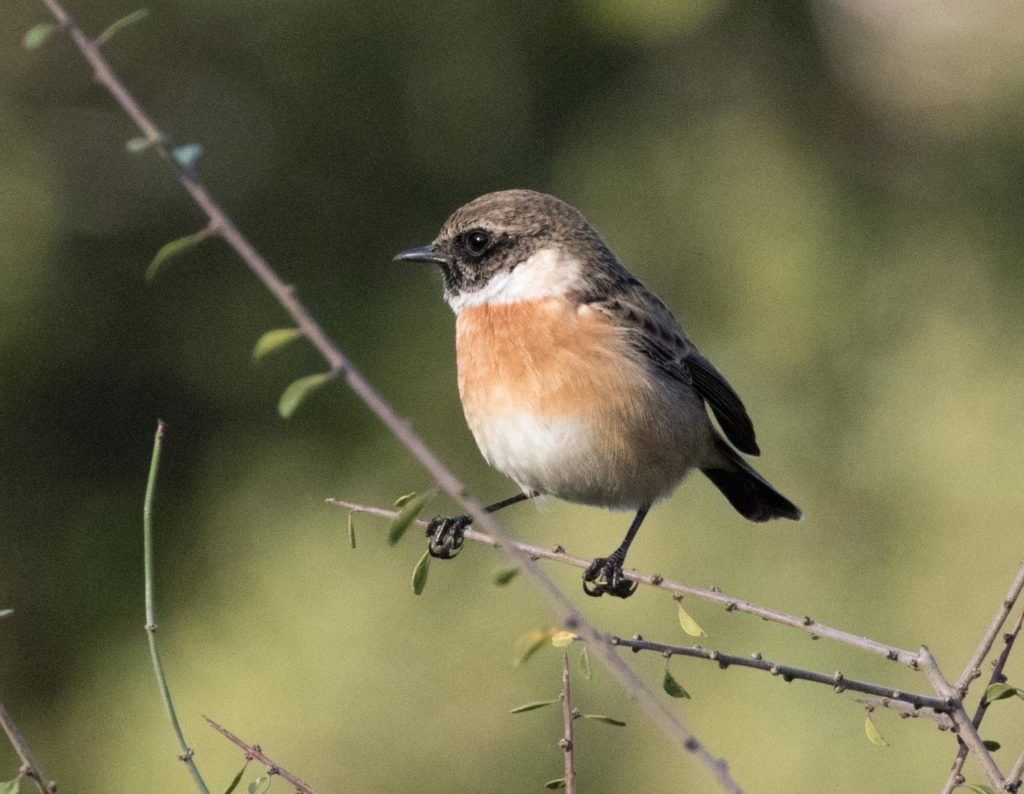
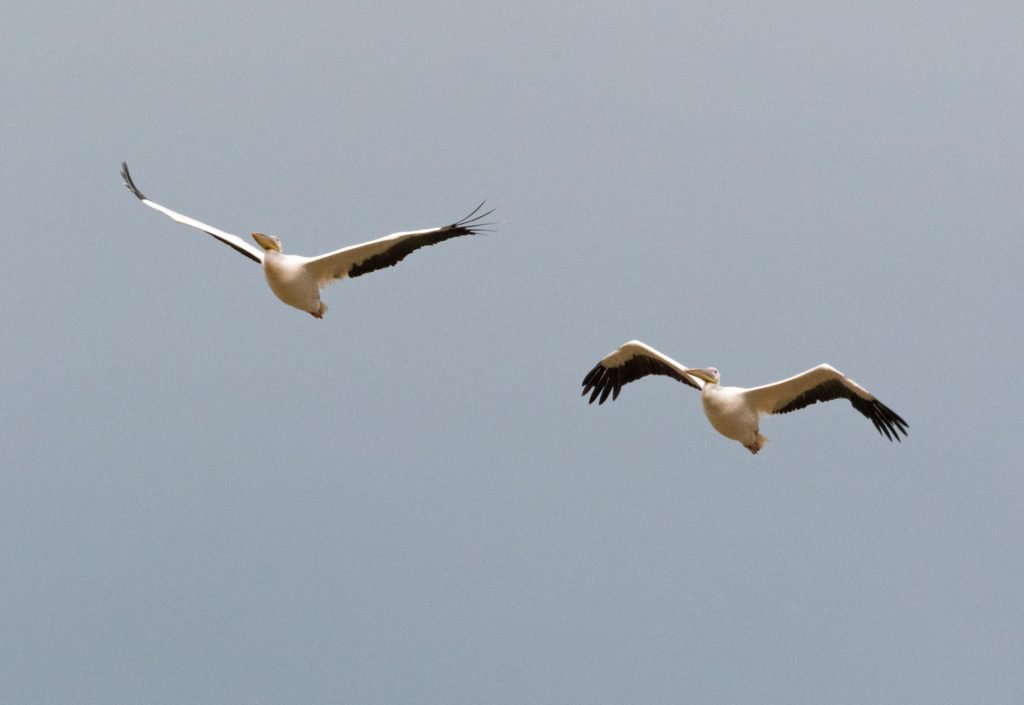
Once we passed the Ottoman well, we headed out to open farmland where we encountered a totally different suite of birds, starting with the same Rose-ringed Parakeets we’d seen in Amsterdam literally hours before (see our post “Layover Birding in Amsterdam”). Here we also encountered a charming little flycatcher called the European Stonechat—another frequent companion for our next two weeks. In the distance, we saw our first Black-winged Kite and Common Buzzard—Europe’s “Red-tailed Hawk.” Near a pond, we spotted several Glossy Ibis in flight and then came the punctuation of our first birding experience: a flight of four Great White Pelicans that flew right over us.

Besides having a great name, the European Stonechat is a great behavioral study as it behaves very similarly to American flycatchers.

Our first bird list totaled a satisfying twenty-one species, many of which we wouldn’t have recognized if we hadn’t done our homework ahead of time. Best of all, there was much, much more to come! Stay tuned . . .

The appearance of pelicans overhead both floored and delighted us!

Our 50th Post—Philmont Scout Ranch, New Mexico!

Braden celebrates our “Half-Century” post with a lively recount of our two-week backpacking adventure in New Mexico. Why not celebrate with us by subscribing using the box on the right below? As always, feel free to share this with other birders, bloggers, Scouts—anyone you wish!

My dad and I recently got back from a two-week backpacking adventure on the Philmont Scout Ranch, a 220-square-mile swath of wilderness in northern New Mexico. The ranch is the largest of the Boy Scouts of America’s High Adventure Bases, and is jam-packed full of wildlife, history, culture and breathtaking experiences. Our trek, which we did with twelve other scouts and adults from our troop in Missoula, covered 74 miles. During this time, we hiked through canyons, and summited mountains, including the Ranch’s highest peak, Mount Baldy, at 12,441 ft. We also were exposed to and learned a wide variety of new skills at staffed camps we visited, including how to pack and unpack a burro, how to build a railroad, how to blacksmith, how to lasso, how to shoot Old West-style guns and black powder rifles and more.

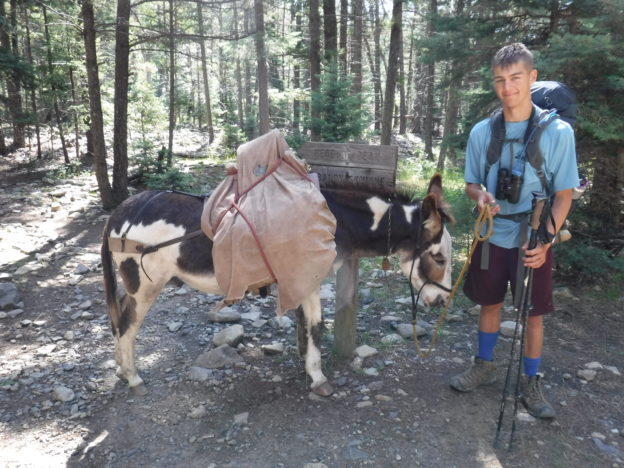
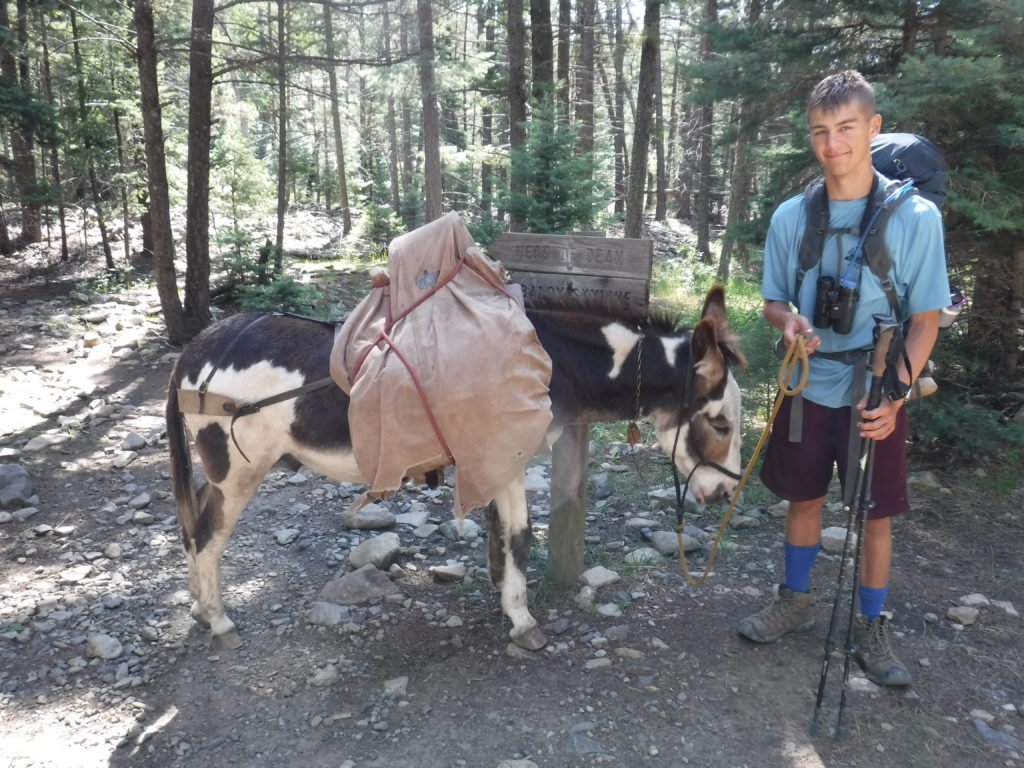
Braden with our trusty Burro, “Nigel”—named because, when necessary, he could turn it up to “11”! We were lucky to have Nigel’s company for two days of our trek.

The trek also exposed us to a wide variety of diverse habitats. We travelled through Ponderosa Pine savannah and forest, valley riparian, desert scrub, spruce-fir forest, alpine meadow, aspen forest, subalpine forest and alpine tundra. We saw many different species of animals throughout our journey, including Monarch and other kinds of butterflies, pronghorn, mule deer, a rattlesnake, bats, and a praying mantis, not to mention evidence of elk. And then, of course, were the birds.

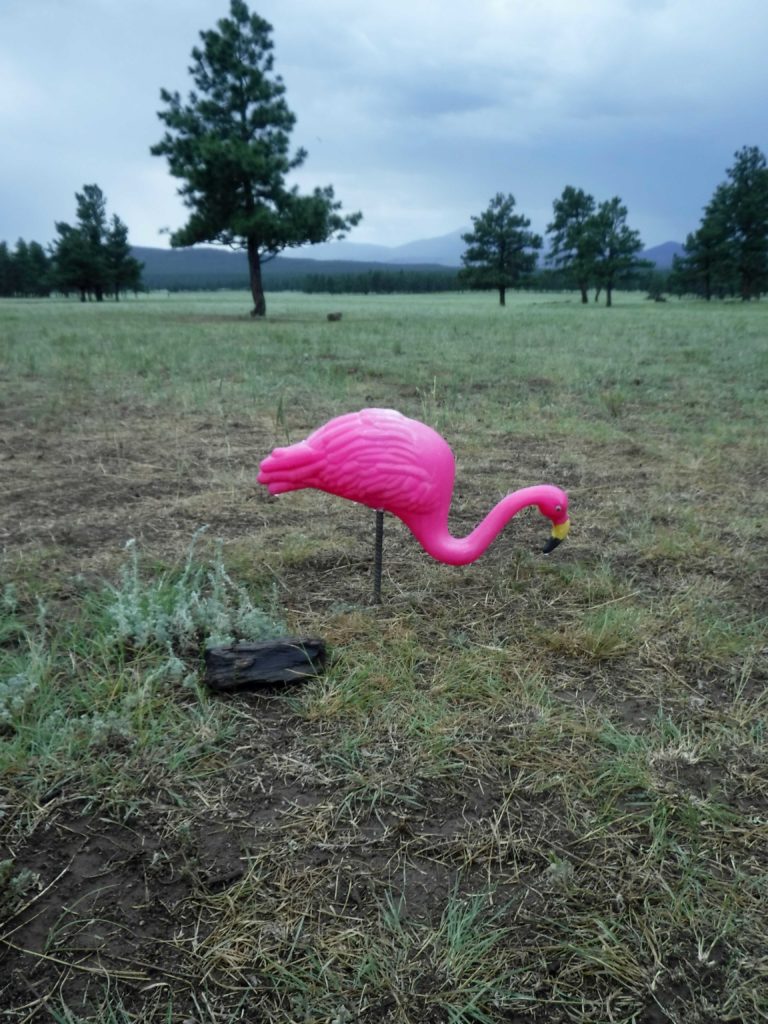
Because we didn’t haul our five-pound cameras with us, this was by far our best bird photo from the trip. Flamingoes in New Mexico? Who knew?

My dad and I together tallied a total of 84 species throughout the trip, including the birds we spotted in the desert on the drive from Albuquerque to the Ranch. The most common species we saw were Spotted Towhee, Cordilleran Flycatcher, Western Wood-Pewee and Common Nighthawk, which we saw almost every day. These four birds had adapted to almost every habitat on the ranch, especially the Cordilleran Flycatcher, which we tallied everywhere, from lowland riparian to subalpine forest, missing it only in the Ranch’s Base Camp. Other common birds included Pine Siskin, Red Crossbill, Rufous and Broad-tailed Hummingbird, Western Bluebird, American Robin, Pygmy and White-breasted Nuthatch, Mountain Chickadee, Chipping Sparrow, Black-headed Grosbeak and Western Tanager. What was especially interesting was the abundance of Black-headed Grosbeaks in most of the habitats we visited; while they seem to be much more riparian-based in Montana, we saw them in scrub, second-growth, aspen and spruce-fir forest.

We were surprised to commonly encounter White-breasted and Pygmy Nuthatches—but rarely Red-breasted—on our twelve-day trek.

Lesser Goldfinches were also quite common, though were much more exclusive to riparian areas. The subspecies here was different from the west coast—they had more solidly black backs, though still kept the same green necks. The main subspecies of Dark-eyed Junco at Philmont was also interesting, it being the Gray-headed rather than the Oregon we were used to. These juncos were slate gray with red backs and dark spectacles. More common Montana birds like Red-breasted Nuthatch, and both kinglets only occurred at very high altitudes.

Braden’s keen eyes and ears allowed us to pick up Clark’s Nutcrackers and most of Philmont’s other resident corvid species, though good looks were hard to come by!

While at Philmont we spotted six of the seven reported corvids (Steller’s Jay, Common Raven, Clark’s Nutcracker, Pinyon Jay, Gray Jay, Woodhouse’s Scrub-Jay), missing only the rare desert-specific Chihuahuan Raven. We also managed to get three lifers during the trip, those being the beautiful pine-loving Grace’s Warbler, the by-ear-only Common Poorwill and the previously mentioned Woodhouse’s Scrub-Jay. Other highlights include a family of Dusky Grouse, a small flock of Band-tailed Pigeons, a nesting pair of Williamson’s Sapsuckers and the hordes of migrating hummingbirds attacking the feeders at Base Camp, where we saw four species including with Black-chinned and Calliope. Overall, it was a great trip!

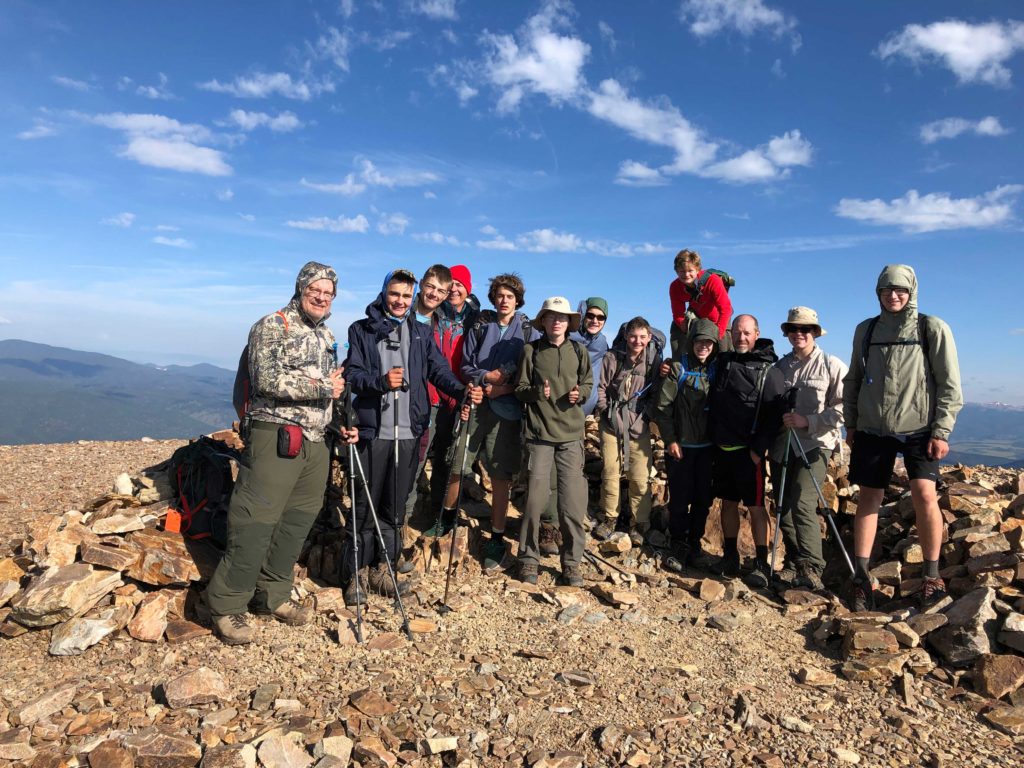
The (non-birding) highlight of the trip was our group’s ascent of 12,400-foot Mount Baldy on our second-to-last day of hiking. Braden and Sneed are third and fourth from the left. We thought we might catch some Andean Condors up there, but no such luck!

Need Winter Birds? Go Skiing!

To Subscribe to FatherSonBirding—and nothing else—please fill in your email address in the box down in the column to your right. Thanks!

At 6:50 a.m. on January 4, my family awoke and piled into our minivan, looking forward to the white slopes of Discovery Ski Resort near Philipsburg. After picking up my friend Eli, we took off, driving southeast towards the resort and Georgetown Lake, which coincidentally abounded with rare and spectacular birds in winter. During the CBC the week before, Gary Swant informed us that he had spotted both Great Gray Owls and Boreal Owls in the area. So, of course, before we quite arrived at Discovery, we took a short drive along a logging road running through the pine forest above the frozen lake.

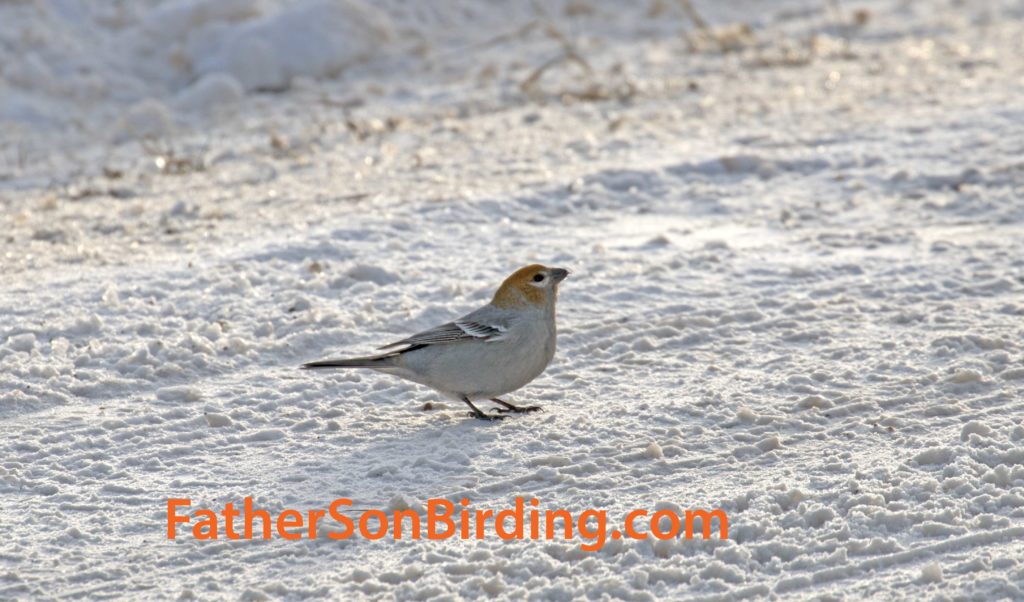
Five minutes in, my dad saw birds perched on the road ahead of us, and hit the brakes. We guessed they had to be something interesting. The first two, which turned out to be Mountain Chickadees, flew away as soon as I got out of the car, but the third, a bigger passerine with a heftier beak stayed and allowed us good looks—it was a Pine Grosbeak! In the past week we had ticked off countless nemesis birds (including a Merlin in downtown Missoula on the 3rd) and this bird proved no exception!

We arrived at Discovery, where no line awaited us, and proceeded to tackle the slopes. The fact that we lived in Montana did not mean we excelled at skiing, so we mostly stuck to the green circle (easy) and blue square (intermediate) runs, though Eli, Tessa and I did try out a very short black diamond (advanced).

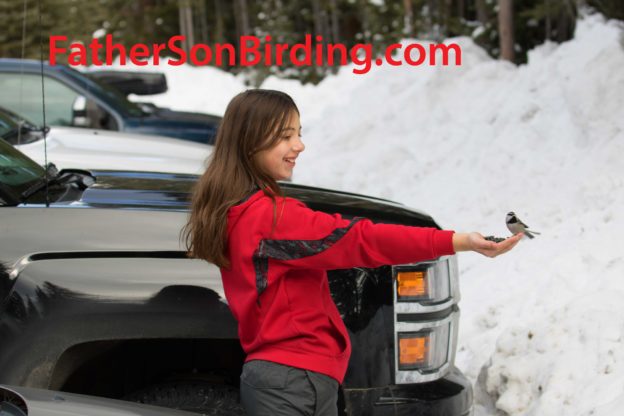
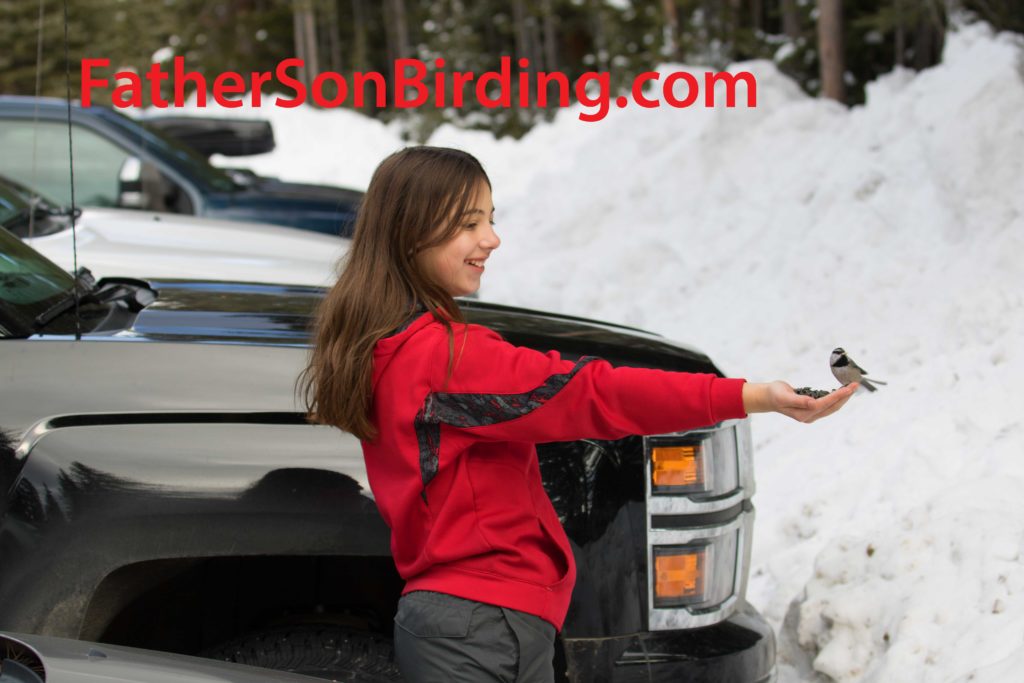
At about one o’ clock, we scarfed down a quick lunch, then ran outside equipped with my camera, binoculars, lunch rolls and a bag of birdseed. Two years ago, we learned that the birds around the ski area took full nutritional advantage of their human visitors, and that the resident Mountain Chickadees actually had been trained to feed out of people’s hands! We cast bits of bread on the ground, then took turns holding birdseed out towards the stands of trees around the parking lot. Sure enough, the birds found us, and we each got to feel the tiny, reptilian-esque feet of the chickadees as they alighted on our fingers and snatched up sunflower seeds.

Nothing helps one understand the nature of “being bird” quite like having a Mountain Chickadee land on your fingertips!

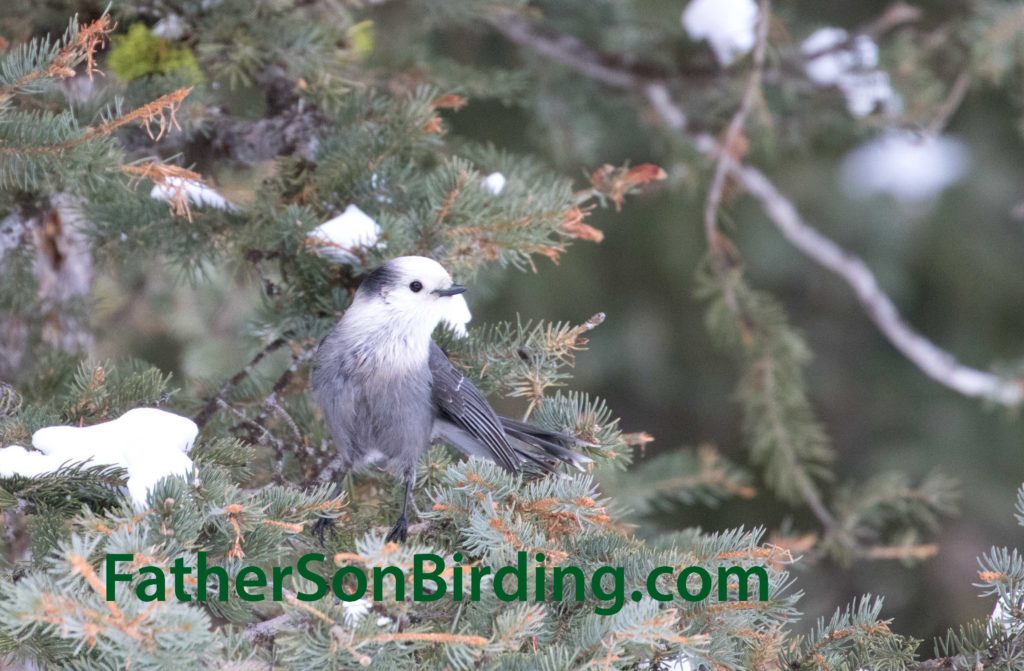
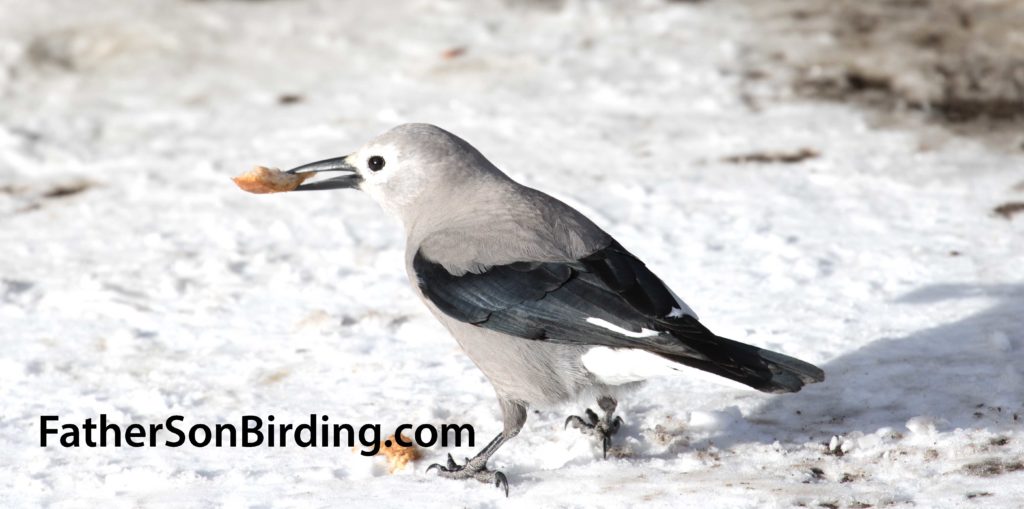
Meanwhile, Gray Jays (now known as Canada Jays), Clark’s Nutcrackers and Steller’s Jays pounced on the rolls we purchased from the lodge, the braver ones landing within a meter of our feet. To top that off, we even discovered a big flock of Pine Grosbeaks flying around above us, the males’ robin-like songs weaving through the air.

Alas, this trip prioritized skiing over birding, so we had to leave the feeding fest behind. After racing down a few more runs, we packed up and drove home, with great photos and a new Life Bird under our belts, and more importantly, an unforgettable memory.

We tried to feed these guys some legitimate bird food, but the ski area corvids—including this Clark’s Nutcracker—had developed a fondness for Discovery’s baked goods.