After speaking at the inaugural Billings Kid Lit Festival (see Billing’s Riverfront Park: Montana’s Premier Songbird Hotspot?), I awoke at 4:30 the next morning and hit the road by 5:15. My plan was to book it to Bowdoin National Wildlife Refuge and start driving around the lake by 8:30. The problem? I kept passing ponds with birds in them—and I, of course, had to stop to find out what they were! My efforts were rewarded with a variety of ducks, Wilson’s Phalaropes, American White Pelicans, Sandhill Cranes and more, but delayed my arrival at Bowdoin until 9:30. Then, even greater disaster struck: I ran into way more birds than I expected at the Bowdoin visitor’s center—including both male and female Baltimore Orioles!
Bowdoin NWR lies at the eastern edge of the Baltimore Oriole’s range, but Braden and I have seen them often enough that it seems certain they breed there. Oh, and seeing both the male and this female offers an added clue!
Finally entering the first five-mile stretch of the loop, I was shocked by how much of the lake had been sucked dry by eastern Montana’s multi-year drought. This really was a disaster and I wondered if I would even find any place conducive to water birds. Meanwhile, I encountered great grassland birds including Long-billed Curlews, Loggerhead Shrike, Chestnut-collared Longspurs, Lark Buntings, and Grasshopper, Vesper, Clay-colored, and Savannah Sparrows. Finally, near the end of the lake, I found water but at pathetically low levels. A much-vaunted Cassin’s Sparrow (discovered by Joshua Covill, I believe) had been observed repeatedly at about Mile 7 of the loop and I ran into Robin Wolcott and her husband who had driven over from Big Fork to see it. While we stood there, Robin did hear the sparrow, but with my crummy ears I couldn’t be sure so didn’t count it. I also had many miles to drive so I kept on truckin’, driving the three hours to Great Falls.
Chestnut-collared LongspurGrasshopper Sparrow
The next morning I again woke early, loaded up the car and arrived at Benton Lake NWR as dawn filtered over the prairie. After the dry conditions at Bowdoin, I fretted about Benton Lake—but my worries were hijacked by what may have been the most astonishing grassland birding experience I’ve ever had. It began with a sighting of a Long-billed Curlew in flight, always a welcome bird. Then, I saw other large shorebirds and stopped to behold the incredible courtship displays of Willets, flying madly around emitting their haunting, looping calls over the prairie. Other curlews joined in and a Marbled Godwit briefly gave chase to a Willet. Meanwhile, meadowlarks sang and a pack of coyotes unleashed their insane yelping cacophony across the landscape—all in the dawn light.
Most birders take Willets for granted, but watching and listening to them display over the prairie where they breed will forever make them a favorite bird ‘o mine.
Suddenly, I spotted a small bird rising high into the sky in an obviously courtship display. “No way,” I excitedly muttered, struggling to focus my camera on the small black dot. My thought? That it could be one of the prairie’s most magical creatures, a Sprague’s Pipit! Alas, Nick Ramsey studied my photos later and suggested it was actually a Horned Lark, and after further study, I agree. Still, it was no less incredible—especially because I didn’t even know that Horned Larks make such displays!
This “Sprague’s Pipit” got me uber-excited, but I learned later that it was almost surely a Horned Lark performing a similar high-altitude display. Thank you, Nick Ramsey, for setting me straight!
Passing the visitor center, I thought that I would finally make my way to the lake and start looking for water birds. Guess again. As soon as I turned right, down the dirt road, I stopped to look at juvenile Horned Larks and saw more Willets and curlews. Then, I spotted one of my top target birds: Upland Sandpipers! I had barely had a chance to look at them, when I saw another top target bird—a Short-eared Owl! As I was snapping some blurry photos of the owl, eight Sharp-tailed Grouse flew low across the road 100 meters in front of me and zoomed like cruise missiles across the prairie—something Braden and I had never seen at Benton Lake. But the best was yet to come . . .
Upland Sandpipers are one of our favorite grassland species—and they undertake one of Earth’s most incredible migrations, traveling from our prairies to southern South America in a matter of weeks each year!
As I was watching the Short-eared Owl, I noticed a white spot perhaps a quarter-mile away. At first I thought it was some man-made structure, but then it moved. I drove closer and raised my binoculars to see a sight I had never in my life observed—a male Sharp-tailed Grouse in full “impress mode” trying to woo a nearby female! Fumbling for my camera, I was so excited that my hands actually shook, and I watched this chase-and-pursue courtship for the next ten minutes. Like so many birds recently, a displaying male grouse was something I never thought I would see, and yet here it was when I was least expecting it!
A hopeful male Sharp-tailed Grouse tries to woo a mildly interested female (left). Sound familiar, gents?
My heart still racing, I finally moved on, and was relieved to see water filling the two main ponds—along with thousands of avocets, ducks, Eared Grebes, Yellow-headed Blackbirds, phalaropes, Forster’s Terns, Franklin’s Gulls, White-faced Ibises and just about everything else I had hoped to see. Water levels looked good to me, but refuge manager Bob Johnson later told me that they struggled to keep the ponds filled. They had the water rights, he said, but it cost so much—think hundreds of thousands of dollars—to pump the water up to the refuge that they had run out of money. That makes it more imperative than ever to support increased funding for our refuges and other wild lands by calling or emailing U.S. Senator Daines and our other representatives.
It’s hard not to love ibises, and I was delighted to see at least nine White-faced during my circumnavigation of Benton Lake.
I had planned to continue on to Freezeout Lake, but after four breathless hours at Benton, I wasn’t sure my sensory systems could handle it. As I said, it was my most incredible grassland birding day ever, and certainly my best at Benton Lake, not just for the species I saw, but for the intimate observations of their natural behaviors as they repeated their ancient life cycles. What’s more, I didn’t see a soul the entire time I was on the driving loop. It gave me a real, reverent feel for what the prairies must have been like before we plowed, grazed, and harnessed the vast majority of them. My wish is that we continue to protect Benton Lake and other vital refuges—and that all of you reading this get to visit there on a summer sunrise of your own.
The only thing better than experiencing the beauty of the prairie is to do it in the company of an Upland Sandpiper and Long-billed Curlew. Can you find them?
This is the last installment of our four-part Arizona adventure. We’ve had a great response to these posts and want to thank you for all of your enthusiasm! Keep birding and supporting birds however you can, and we will share more adventures soon!
We departed our Nogales hotel the next morning to find a gorgeous Vermillion Flycatcher sitting on a bench outside the front door. It boded well for the day as we headed to our first destination, Patagonia Lake State Park, a place featured in the movie The Big Year, though undoubtedly not filmed there. Patagonia indeed upheld its reputation as a great birding spot, and we checked off two more Life Birds—Northern Beardless Tyrannulet and Bell’s Vireo. We also saw Summer Tanagers and got our best experience ever watching Phainopeplas, which sport the ultimate in cool with their silky black suits and blazing red eyes. Alas, we missed Braden’s top target, Varied Bunting—but picked it up at a small rest area just up the road!
Although we missed Varied Buntings at Patagonia Lake, we got good looks at them at several more sites, including this one at Madera Canyon.
We had seen Phainopeplas before, but got to spend about fifteen minutes watching them flycatch at Patagonia State Park—an experience that made us even more impressed with them!
We had debated what to do with the rest of the day and had considered going for Whiskered Screech Owl in the rugged mountains west of Nogales, but with serious heat and the prospect of rough mountain roads to negotiate, we decided for the more comfortable alternative of Madera Canyon, a place we had both adored on our Big Year visit in 2016. We felt grateful for our decision after we staked out a campsite and availed ourselves of the marvelous bird feeders at Santa Rita Lodge. There we picked up Rivoli’s Hummingbird and Arizona Woodpecker for Braden’s Big Year list, and had much better looks at Varied Buntings, Hepatic Tanagers, and more.
We feared we had missed Arizona Woodpecker for the trip, but Madera Canyon delivered. We just love the unique, brown motif of this Arizona specialty.
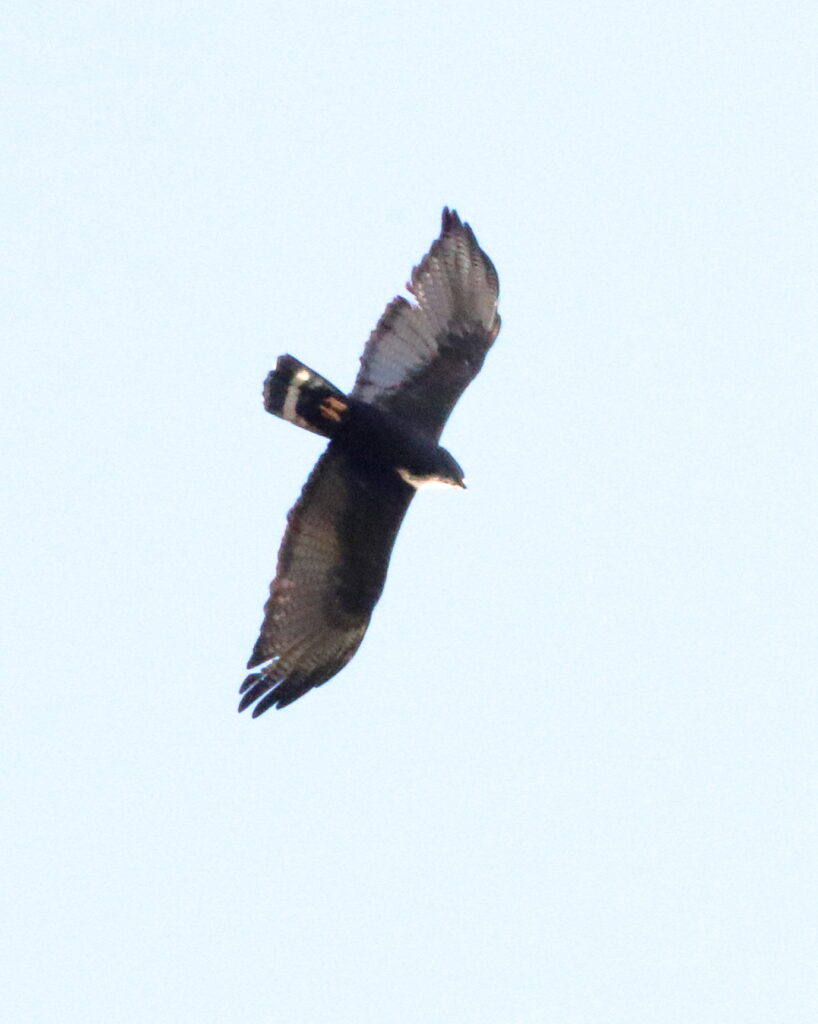
As we were watching a group of Turkey Vultures, I suddenly saw one make a quick move that didn’t look right. “Braden, look at that!” We both got eyes on it and Braden shouted, “Zone-tailed Hawk!” We had seen one before, but had no idea of their close association with Turkey Vultures. In fact, it looked so much like a Turkey Vulture that it left no doubt that some kind of mimicry or convergent evolution had shaped it. Some speculate that potential prey (birds, reptiles, mammals) feel safe with Turkey Vultures overhead—giving a sneaky Zone-tailed a chance for a surprise attack!
The “Turkey Vulture Hawk”, Zone-tailed Hawk, looks so much like a Turkey Vulture, we only ID’ed it after several double-takes.
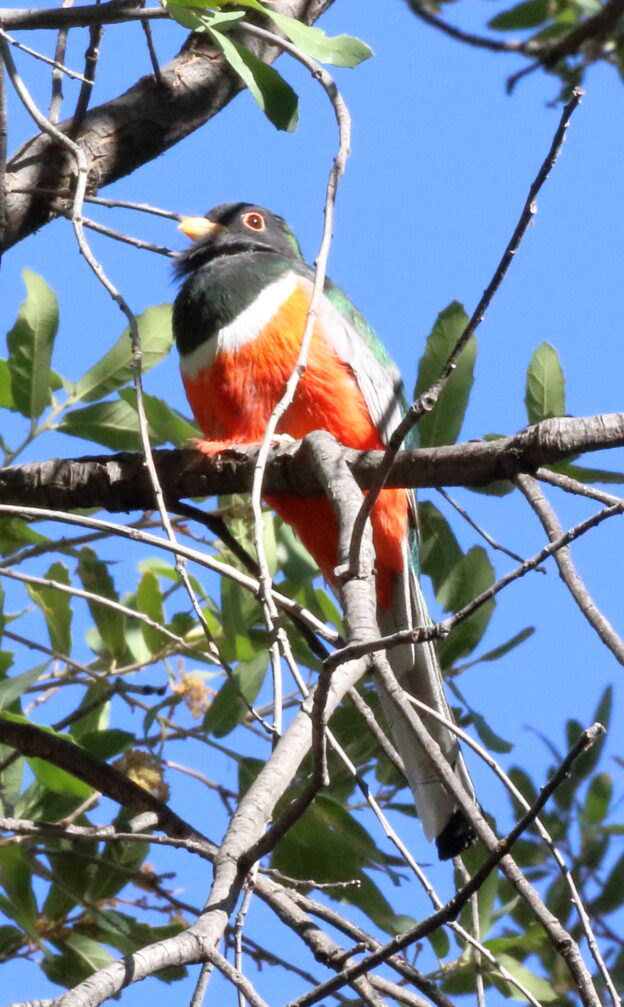
That afternoon we also enjoyed the company of multiple Mexican Jays and Painted Redstarts at our campsite and, later, heard the calls from the same trio of night birds we had enjoyed two nights before in Portal—along with our year’s first Common Poorwills! Oh, and did I mention Braden’s ears also scanned in the calls of Sulphur-bellied Flycatchers and Elegant Trogons? “Again,” Forrest Gump might groan.
This curious Mexican Jay kept us company as Braden and I read aloud to each other at our campsite during the peak of the afternoon heat.
The next morning, before aiming toward California, we had one more task. After rolling up camp, Braden guided us to a place called Montosa Canyon in the same range as Madera. Why? To find a recently-sighted, highly-coveted Five-striped Sparrow. I really didn’t know what our chances might be, but it took about thirty seconds for Braden to locate it, a handsome bird similar to Black-throated Sparrow. As an added bonus, Braden said, “Daddy, look over there.” I focused on a hummingbird and immediately recognized a species I’d read about countless times—a male Costa’s Hummingbird! The Costa’s was superb and we did a little dance, thinking it was Braden’s 400th bird for his Big Year—the goal he had set for himself in January! We later learned, however, that we had inadvertently seen a juvenile Costa’s at Madera the day before, so 400 would have to wait for California Scrub-jay later that afternoon.
Our first adult male Costa’s Hummingbird!Five-striped Sparrow—#399 for Braden’s Big Year!
Many more birding adventures would unfold in the coming days as we made our way to San Diego to visit our cousin Laura, and then drove up to the Sierras to deliver Braden to his job monitoring Northern Goshawks for the summer. Sadly, from there I would continue home alone, hitting Modoc National Wildlife Refuge in Alturas and spending a fun three days with my friend and college roommate—not to mention avid reader of FatherSonBirding—yes, you guessed it, Roger Kohn. Roger showed me some of his favorite hotspots around his new home of Bend—and spotted a bird I especially wanted to see, White-headed Woodpecker. He also showed me the delights of Bend’s many brew pubs, but that, unfortunately, concludes this tale. Stay tuned for many more adventures including my recent fabulous birding in Billings and beyond, and Braden’s report(s) from the High Sierras. Who knows, I might even do some more truck birding this summer! Also stay tuned for more progress on Braden’s Big Year. After he hit 400 on our trip, I pushed him to reluctantly lift his target to 450—but between you and me, I think 500 has a much nicer sound to it. Will he go for it? I think he just might!
Braden’s Big Year total when I dropped him off near Sonora, California: 411 (New Goal: 450)
On my way home to Montana, my good friend Roger Kohn and I went in search of—and found—a White-headed Woodpecker. Don’t you love this critter?
In this post, we continue our account of our return to southern Arizona while on a quest to get Braden to his Big Year goal of 400 bird species. To read the first part of our journey, click here. As always, we appreciate you sharing this post, and if you haven’t already done so, subscribing by filling out the box below and to the right. Enjoy!
After our close encounter with bedbugs, we set off from Safford early the next morning and were pulling into our trip’s first Major Destination by 8:45 a.m. When we had contemplated visiting Portal, Arizona during our 2016 Big Year, we had considered it as “a place to see hummingbirds.” Six years later, we still wanted hummingbirds, but harbored a long list of other targets—including a slew of Lifers and Year Birds that would propel Braden closer to his Big Year goal of 400 species. Driving into town, we blundered into our first. I had pulled over so Braden could get a look at some Phainopeplas (see next post) when I noticed a large-ish bird over in a sage plant. Getting my eyes on it, I saw right away that it was some kind of kingbird—and that it had an extraordinarily large bill! Turns out it was a Thick-billed Kingbird that had been reported around town recently! This Code 2 rarity created great momentum for the day—one that would not diminish until we were snug in our sleeping bags 12 hours later.
Thanks to Braden’s patient mentoring, I have grown a much greater appreciation for flycatchers, including this Lifer, a Dusky-capped.
But back to those hummingbirds, it’s true that Portal does have hummingbirds thanks to the many kind people who put up bird feeders, but of equal avian importance is that the town sits at the mouth of a canyon of the Chiricahua Mountains. One of Arizona’s famed “sky island” mountain ranges, the Chiricahuas attract a host of birds from Mexico that are uncommon in the US, from Mexican Chickadees and Yellow-eyed Juncos to Sulphur-bellied Flycatchers and everyone’s Number One target, Elegant Trogons. After grabbing a campsite at Sunny Flat campground, Braden and I set up our tents and, as the day was already warming, decided to drive to high altitudes for our first proper birding session. We had a couple of specific destinations in mind, but as we wound our way slowly up the dirt road, we decided to pull over at a small stream crossing—and are so glad we did! Almost immediately, one of our favorite birds—Painted Redstart—perched over our heads. This was followed by a veritable bird parade that included Hepatic & Western Tanagers, Hutton’s Vireos, Bridled Titmice, Grace’s Warblers, and Dusky-capped and Cordilleran Flycatchers—all birds we had especially wanted to see or hear!
Painted Redstart was our Bird of the Trip during our first visit to Arizona in 2016. Seeing it again, we agreed it had been an excellent choice!
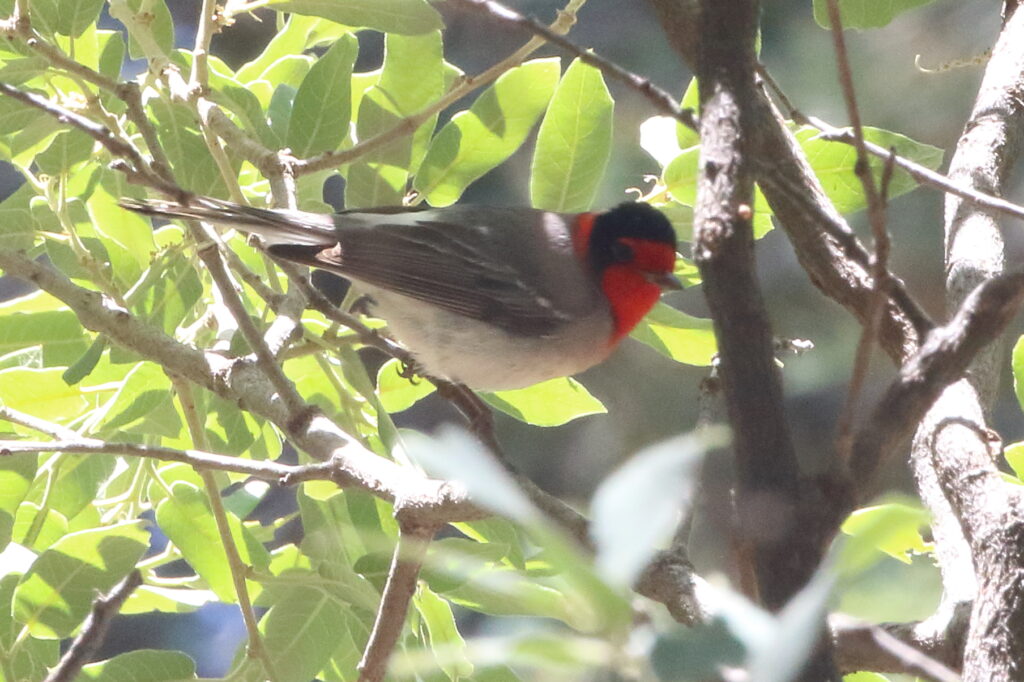
After a few more miles, we reached a loose collection of canyon campsites strung out along the road. The canyon held a wonderful mix of conifers and oaks, and in five minutes, we saw two Life Birds: Yellow-eyed Junco and Red-faced Warbler. The Red-faced Warbler is one of those birds that you learn about, but don’t really believe exists until you see it perched in front of you. Not to be out-done, the junco put on a great show for us, often collecting nesting materials at our feet as we burned gigabytes of camera storage photographing it! One bird we searched for and didn’t find was Mexican variety Spotted Owl. “That’s okay,” I reasoned. “I never really expected to see one of those in my lifetime, anyway.”
Yellow-eyed JuncoRed-faced Warbler
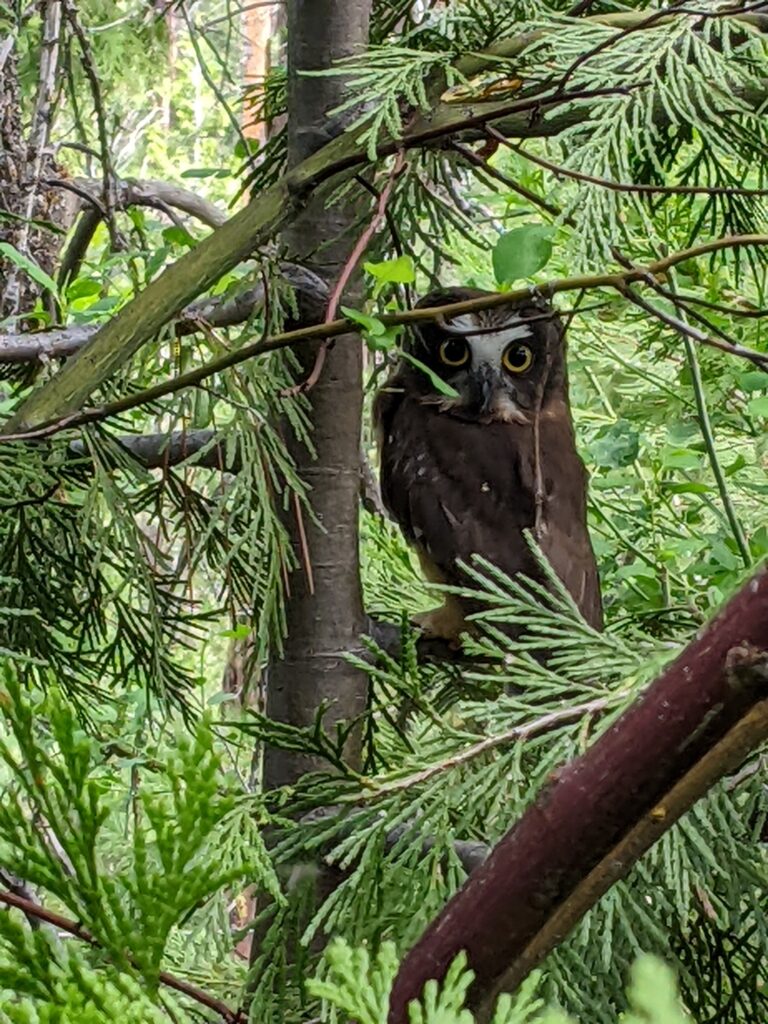
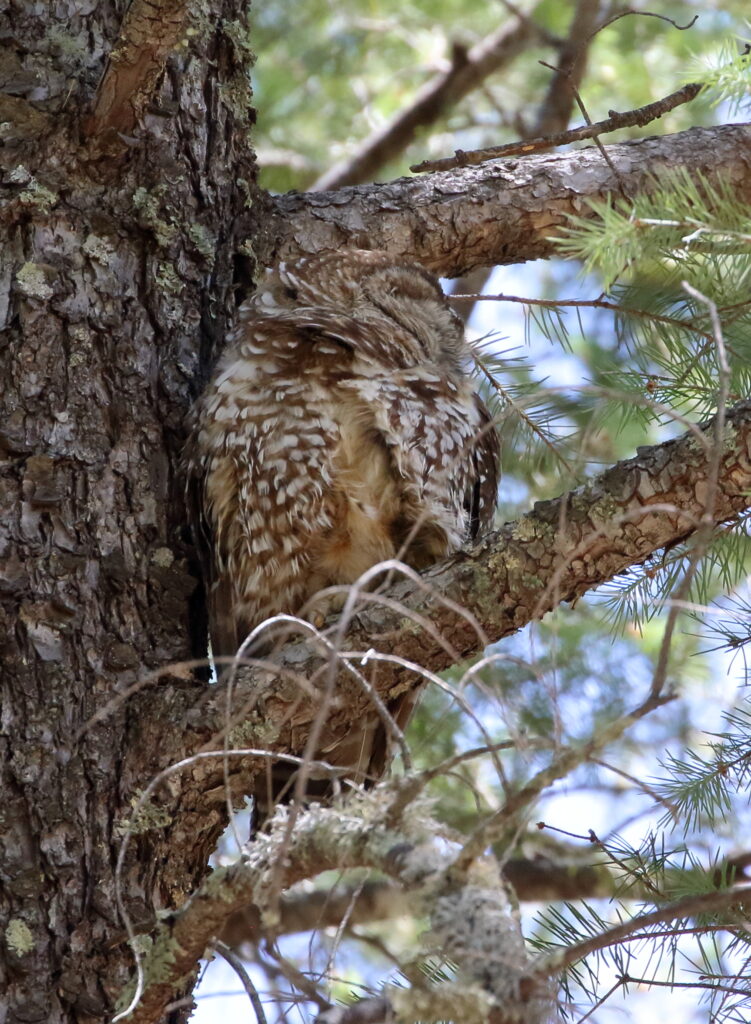
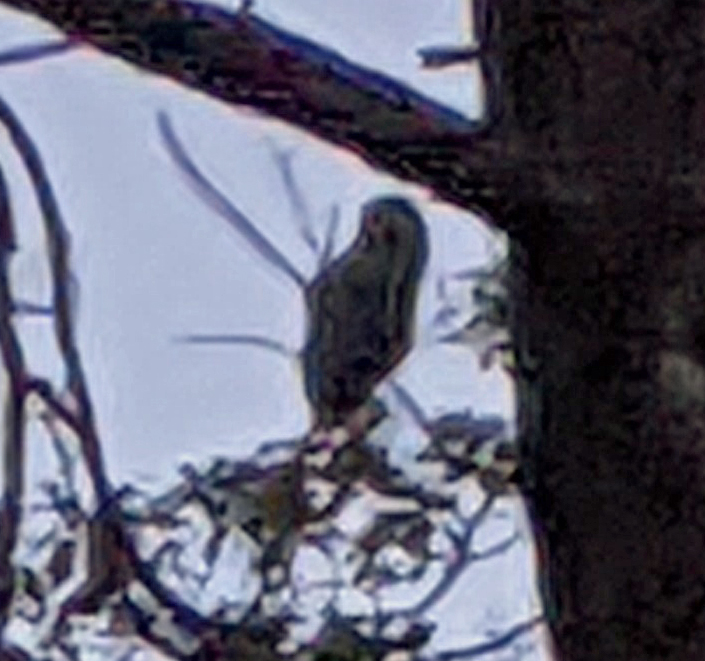
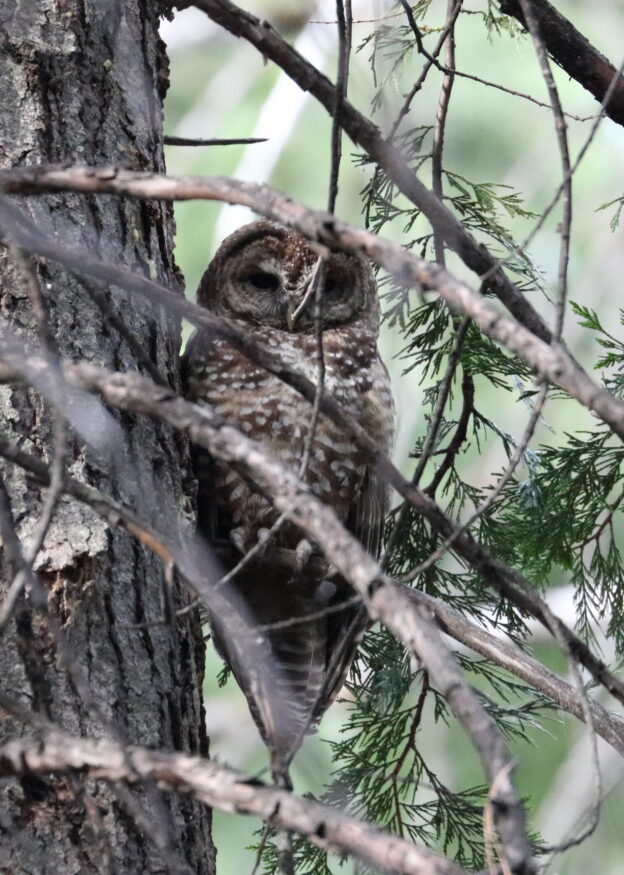
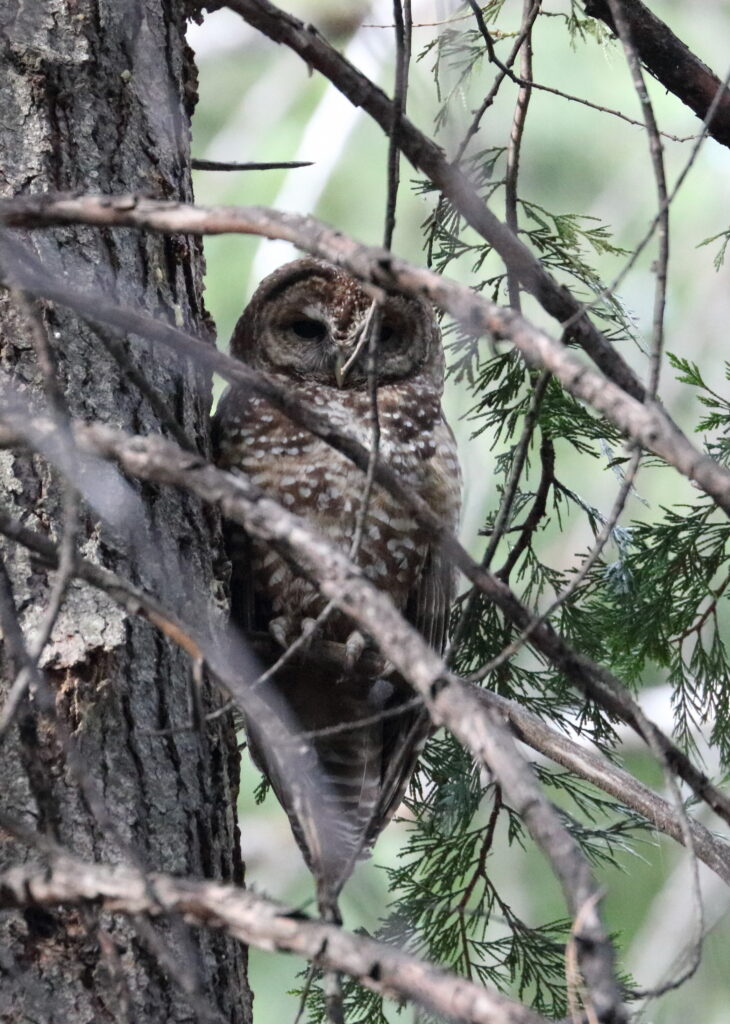
It was such a beautiful spot that we decided to have a picnic lunch there before moving back to higher elevation, but before we did, we took one last look around for an owl. Braden was trying to photograph a couple of Verdin when I turned and glanced up in a tree—only to be greeted by the unmistakable silhouette of an owl. Braden was saying, “I guess we’re not going to find the owl,” when I casually remarked, “Except that I just found it.” He thought I was kidding, but I pointed up into the tree, and we both fell into a silent reverie that lasted a full fifteen minutes.
Like so many birds Braden and I have encountered together, this Spotted Owl is one I thought I’d never see.
If we’d seen nothing else on the trip, that owl would have made the entire journey worthwhile. Nonetheless, we bid it adieu and headed up to a place called Rustler Park. Here, thanks to Braden’s hard work and determination, we found two more Lifers: Mexican Chickadee and Olive Warbler—the bird that isn’t really a warbler, but inhabits its own strange group of birds. Remarkably, our day still had a long way to run.
If it looks like a warbler, and acts like a warbler . . . well, sometimes it isn’t. This Olive Warbler belongs to its own family of birds, the Peucedramidae.
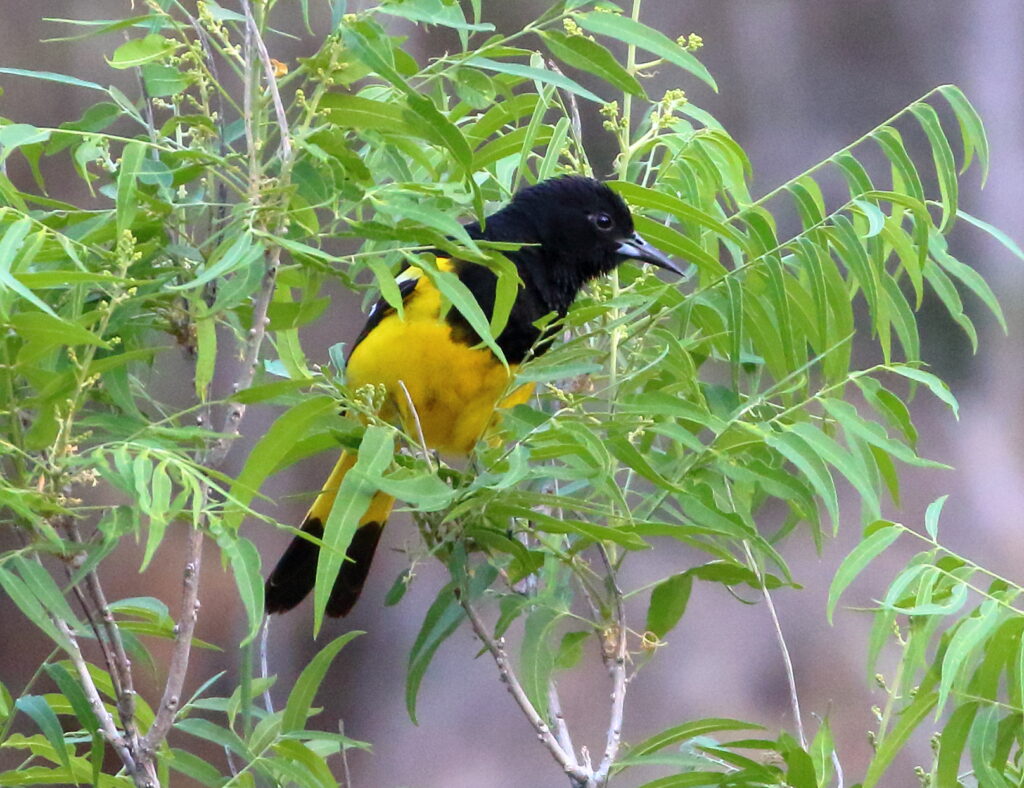
Back in Portal, we scoured the bird feeders, and even hung our own feeder in our campsite, netting yet more Lifers: Scott’s Oriole, a bird at the top of my “to see” list, and Blue-throated Mountain Gem, a gorgeous hummer that came right to our camp feeder! As the shadows deepened over Cave Creek Canyon, however, we had one more very special treat in store for us. Grabbing our flashlights, we set off in darkness down Cave Creek Road, listening intently for a trio of nighttime denizens. We heard the haunting call of the Mexican Whip-poor-will, followed quickly by Whiskered Screech Owl, and finally the “bark” of Elf Owls! Standing together, listening to these magical sounds truly was one of our most memorable birding experiences ever and one that we will both cherish as long as we draw breath. The same can be said for the entire day.
Even better, two full days of Arizona birding remained. Would they include, say, an Elegant Trogon? Stay tuned . . .
I couldn’t write about Portal without including at least one hummer, even though this Blue-throated Mountain Gem declined to give us a full “sun shot”.
It’s been a while since we posted, and that’s no accident. When Braden landed a field job monitoring Northern Goshawks in California’s Sierras for the summer, I impulsively offered to drive him there—via Arizona and Southern California. We had wanted to return to Arizona since falling in love with the state during our Big Year in 2016. The fact that Braden was out to smash his own Big Year record with a goal of 400 species made the argument even stronger, especially after he and Nick Ramsey had ransacked the state of Florida only weeks before, followed by our amazing time birding New York City. So on May 22, rashly ignoring the price of gasoline, Braden and I made a beeline down Interstate 15, pulling over to pick up Thick-billed Longspurs near Dillon, Sage Thrashers and Rock Wrens in southern Idaho, and Burrowing Owls and phalaropes at Antelope Island near Salt Lake City. After a short, peaceful night in Kanab and a stop to ogle the rapidly disappearing Lake Powell, we rolled into Phoenix for our first major Arizona stop of the trip: Prospector Park, east of Phoenix.
We found Rock Wrens at a delightful I-15 rest area of lava called Hell’s Half Acre in southern Idaho. Don’t pass it up!
As usual, Braden ferreted out our hotspots for the trip and Prospector Park blew away all expectations. An unlikely-looking suburban park with playing fields and lots of lawn, we tumbled out of the car and began racking up Life Birds before we could utter “Holy Bird, Batman!” As soon as he raised his binoculars to his eyes, Braden called out “Abert’s Towhee!” Five minutes later, “Gilded Flicker”—the last ABA woodpecker I needed for my Life List. This was not to mention the gobs of Year Birds Braden needed to advance toward his magic 400 number. In fact, one of the great things about Arizona is that for Montanans, almost every bird we see is likely to be a Year Bird. Verdin, Ladder-backed and Gila Woodpeckers, Vermillion Flycatcher, Lucy’s Warbler, Gambel’s Quail, Curved-billed Thrasher—and another Lifer, Bendire’s Thrasher. For a birder, Arizona truly is a pot ‘o gold.
Gilded Flicker was a species I had needed for several years to complete my ABA woodpecker list. Okay, I admit it—not the most exciting critter, but we both enjoyed seeing it nonetheless.
Not for the first time, one of our most fun finds turned out not to be a native species, but an exotic. We were completing our circuit around the park when we noticed a group of (I think) Mennonite birders staring at something in the grass. We couldn’t tell what they were until green shapes flew over to another patch of grass. “Rosy-faced Lovebirds!” Braden called with delight. It was a species he had especially hoped to see—and another Lifer for both of us. We spent a satisfying fifteen minutes just watching these little guys as they gathered grass seed heads—presumably to eat, but perhaps also for nesting material.
Introduced parrots such as these Rosy-faced Lovebirds always stir conflicting emotions in Braden and me. I mean, they definitely don’t belong here, but dang it, why do they have to be so darned cute?
But we had miles to go before we slept, so we reluctantly climbed back in the car for that night’s destination, Safford, where we checked into a cheap motel—only to find bed bugs hiding under the mattress. After quickly getting a refund, we headed to a pricier, bed-bug free place down the street (and yes, we checked the mattresses there, too!) for a welcome, but short night’s sleep. Our two-day, 1270-mile drive had already netted us five Life Birds and raised Braden’s Big Year total from 322 to 345 species—and we hadn’t even reached our first real destination. Would we be able to get Braden to 400? Things were looking good, but in birding as in life, nothing is certain . . .
While not nearly as showy as her mate (right), female Vermillion Flycatchers have a subtle beauty we’ve come to appreciate—especially when they pose so nicely!
Braden and Nick are close to the finish line! This penultimate day of their epic Florida adventure would bring revelation, frustration, traffic jams, and finally, the realization of a key (no pun intended) target species of the trip. They also happened to be nearing their goal of 200 species for their expedition—as well as moving Braden significantly along in his quest to see 400 species during his 2022 Big Year. Read on to find out what happens . . .
Unfortunately, sleep was not in our immediate future after leaving the Keys that night. We pulled back into the Everglades, passing the campsite I’d enjoyed the night before, Chuck-will’s-widow calls sailing through our rolled-down windows. As we drove south in the dark towards Flamingo, the “town” at the bottom of the glades, we scanned the roads looking for our targets: snakes. Soon enough, Nick spotted one, and we pulled off the road, turning on our emergency lights so oncoming cars wouldn’t run us, or the snake, over as we walked down the road towards it. We left Dixie in the car, given that this snake was a Florida Cottonmouth, and probably could have killed Dixie if she got too close. The snake coiled on the warm road, its mouth open, and we showed another group of people that pulled over to see what we were photographing. Our spirits high, we headed back to the car—only to discover that Dixie had peed all over both seats. The smell infiltrated our noses, and we wiped up the mess with various towels and toilet paper that would be going in the next garbage can we came across.
Half an hour later, we rolled into the dark parking lot of a wooded trail near Flamingo. We set off in the dark, using a stick to brush spiderwebs out of the way and looking back frequently to make sure we wouldn’t get lost. Eventually, the trees gave way to a massive field of saltbush, slightly silver in the moonlight. This was the winter home of another incredibly elusive species, the Black Rail. This bird, a member of a group of birds already known to be difficult to find, was the size of a mouse and completely nocturnal. If Mangrove Cuckoo wasn’t the hardest regularly-occurring species to see in North America, it was definitely Black Rail. While hearing them was slightly easier, they didn’t seem to know that as we played for them in the dark, and we walked back to the car, our legs covered in scratches from the saltbushes, after forty fruitless minutes of searching. Nick fell asleep immediately as I took the wheel, just trying to get a little further north before crashing so the driving would not be as terrible during the next few days. I didn’t get far, however, and pulled into another parking lot. Between the smell of urine and the oppressive humidity, I didn’t get very much sleep that night.
Birds such as this juvenile Black-crowned Night Heron helped compensate for a terrible night’s sleep and Dixie’s, ahem, perfuming of the car seats!
At seven, Nick drove us to our next spot, a place called the L31W Canal, a little northeast of the Everglades. Struggling against my fatigue, I stepped out of the car in the brightening sky, and we began trudging along a straight road bordered by brambles on one side and grassy pine forest on the other. We had several goals here, the primary one being a Smooth-billed Ani that had been hanging out for a while. After doing some digging on eBird, I discovered that the ani was a ways down the dusty road, and I sighed, preparing for a long, hot, uneventful hike. Fortunately, I was quickly proven wrong.
We passed another pair of birders, one of them guiding the other. Nick pointed out the calls of Northern Bobwhites, quail I hadn’t seen since South Texas and had never before heard, and all of a sudden, an orange blur caught my eye. I looked to the right, where a beautiful Barn Owl had just alighted on top of a tall, branchless snag.
This was the best photo I could manage of my first really good look at a Barn Owl.
“Holy cow, look!” I said, pointing as all four of us birders turned towards it and raised our various devices (camera, binoculars, and in the guide’s case, a scope). The bird had dark eyes and a grayish, circular face peering at us in the morning fog. It took off before I was able to secure any good pictures, its flight reminiscent of a bounding rabbit. We watched the Barn Owl, a species I had only seen the butt of before, our eyes transfixed on the vibrant orange of its wings as it floated around for a while and then disappeared. It was almost like the birds had seen my poor mood and responded accordingly, putting the smile back on my face—and they were just getting started. In fact, the best birding of the entire trip unfolded before us.
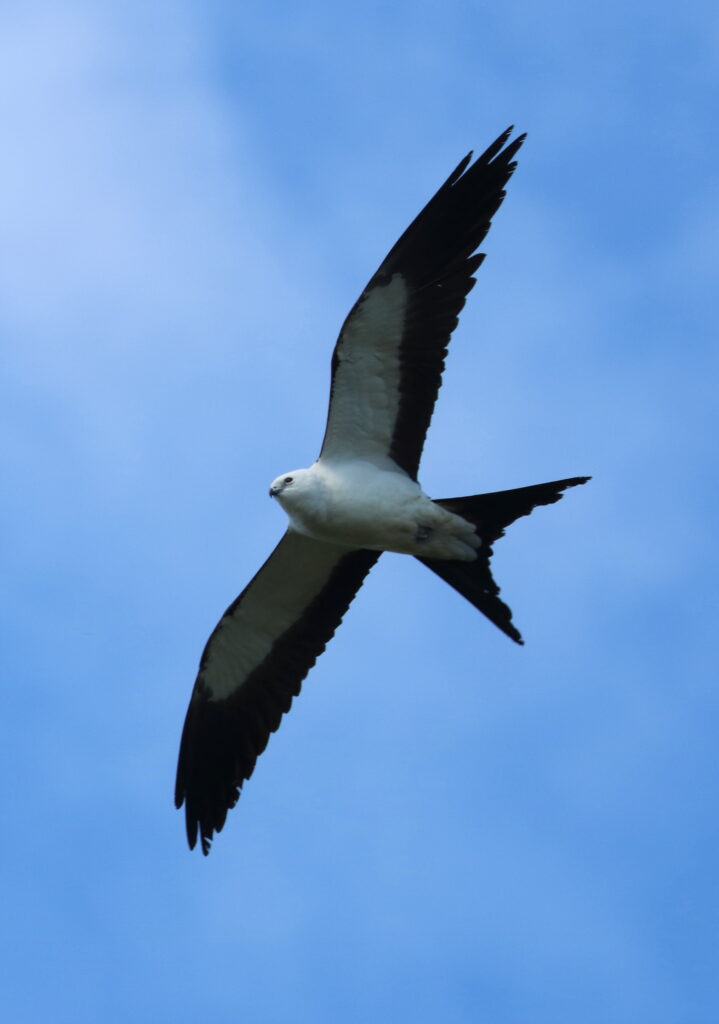
As we scanned the pine savannah to our right, searching for White-tailed Kites, Nick pointed out Eastern Meadowlarks, a bird I somehow hadn’t seen until now. Pishing in agricultural parts of the walk yielded a variety of sparrows, including Savannah and, surprisingly, a Grasshopper Sparrow, a bird I associated with the shortgrass prairie of Eastern Montana rather than the humid scrubland of south Florida. More Swallow-tailed Kites appeared above us, circling above the pineywoods as if cheering us on. At one point, a bright red bird zoomed across my path, briefly perching up in a low bush—a male Painted Bunting! The bird was even more stunning than I’d expected, with its deep blue head, green back and brilliant crimson belly lit up in the sun.
The L31W Canal continued to deliver great birds with my first ever Eastern Meadowlark and a spectacular male Painted Bunting.
While we didn’t find the ani, the other birders pointed out other rare species to us. This place seemed to be a rarity hotspot, which became apparent with a kingbird flock we found. Western Kingbirds were regular winter residents in this area, but this flock also included both a Cassin’s Kingbird (a Western species) and a Tropical Kingbird (a tropical species), and I learned the difference between the three as we watched them fly around us. As much as Nick and I wanted to stay longer, we had miles to cover and Mangrove Cuckoos to find, so we said goodbye to the other birders and began the drive through the glades towards the Gulf Coast.
This was my first time getting to directly observe the differences between Tropical (shown above), Cassin’s, and Western Kingbirds in the field.
Yet again, we drove through prime Snail Kite habitat, and yet again, we found no Snail Kites. The sawgrass marshes gave way to densely forested glades as we drove along the Tamiami Trail, and we pulled into the visitor center for Big Cypress National Preserve for a quick glance around the center grounds. While we did see a fair number of birds along the drive and at the visitor center, the main attractions were the aquatic creatures. Amazingly, we spotted a pair of porpoises in the canal as well as a Brown Pelican, both an unusually far distance inland. That meant that somehow, this canal must have had some saltwater. What’s more, at the visitor center we found large schools of fish, including mean-looking Florida Gar. In front of our eyes, a Softshell Turtle snagged one of them and was promptly ambushed by several more. However, the most mind-blowing animals were the alligators. Dozens sulked in the canal, and at the visitor center alone I counted thirty or so, all within several feet of the humans peering at them from the safety of the boardwalk.
Eventually, the scenery changed as we left Snail Kite habitat and entered the habitat of the snowbirds, people who migrated south from the northern United States to their homes in the warmth of Florida. More specifically, we were in Cape Coral, a hot, concrete-covered town known for its tourists as well as another species that I’d only seen previously in the prairies of Montana: the Burrowing Owl. A threatened, urban owl population existed in this part of Florida, surviving in parks, yards and abandoned lots here only because of the protection the city provided. As we pulled up to the Cape Coral Public Library, we saw the fencing and stakes marking their burrows, although no birds were to be found. The heat of the day seemed to be keeping them down, so we headed west, towards our last chance at Mangrove Cuckoo: Ding Darling National Wildlife Refuge on Sanibel Island.
Fish Crows entertained us in many of South Florida’s habitats, including mangroves.
Again, this refuge caught me off guard. I’d expected large marshes and ponds, similar to Montana’s refuges. Instead, we were met with thick, tall, healthy mangroves. The trees were larger and denser than what we’d seen in the Keys, and more accessible too. We drove the main refuge loop, stopping at various trails to play for the cuckoo. One boardwalk in particular displayed the complexity of the Red Mangrove ecosystem, giving us great looks at the trees’ prop roots as they plunged into the shallow, salt-covered mud, and the crabs scampering up their trunks. Fish leapt from the water of the mangrove-encased bays, and we spotted a few shorebirds and waders wherever land showed itself. Here, again, the primary songs we heard were those of Prairie Warblers, singing from all around us in this perfect breeding habitat. And yet again, more Swallow-tailed Kites flew over us, reminding us of the excitement we’d felt when we’d first seen them at Merritt Island.
As we left Ding Darling, cuckoo-less, we discovered what else the area was known for: traffic—the worst traffic I’d ever been in, hood-to-bumper cars stretching for miles as people tried to get off the island. We probably could have gotten off Sanibel faster if we’d been as we covered three or so miles in roughly an hour. Eventually, though, we made our escape, and headed to a nearby baseball field in a last ditch attempt for Burrowing Owls. Again, though, after half an hour of walking around, they evaded us, frustration rising inside us. While the day had been great, we’d missed every single target—no ani, no cuckoo, no kites and no Burrowing Owls, not to mention the uncomfortable night spent looking for nonexistent Black Rails. As the sun began to set, a baseball game started next to us. I stared as the young Little League players hit line drives over each others’ heads. A single ball flew into the outfield, and then I saw it: yellow fencing, located just beyond the baseball diamond. I raised my binoculars, revealing two brown lumps perched on the chain link fence within the yellow caution tape.
“I’ve got em!” I said, and Nick and I began running, Dixie leading the way. As we got close, we put Dixie on a leash, lying down to photograph what we’d found: two incredibly cooperative Burrowing Owls perched in front of us, one on the lawn and one on the fence above the first. They stared at us, their mottled brown-and-white pattern complementing their intense, unmoving eyes. Nick and I moved a little further to take a selfie. Finally, we’d found something we were looking for!
Finally, after an afternoon-long search complete with horrendous South Florida traffic, we were rewarded with a great look at Burrowing Owls in Cape Coral.
We ended our day at a campsite just south of Gainesville at roughly eleven o’clock, a surprisingly earlier bedtime compared to the rest of the trip. While my goal was sleep, Nick went off in search of Eastern Whip-poor-wills. I lay there, in the back of Nick’s truck, thinking about where we’d been. After spending the day in the glades and the mangroves, we were back in the Pineywoods, hoping for another chance at their birds tomorrow before heading back to New Orleans. While we’d gotten several of my target birds for the trip so far, we’d missed an unfortunate number, and I’d hoped that tomorrow would go better. Would it? Or would we miss everything yet again, to return to Louisiana only with a few of the birds we’d set out to find? Stay tuned to find out!