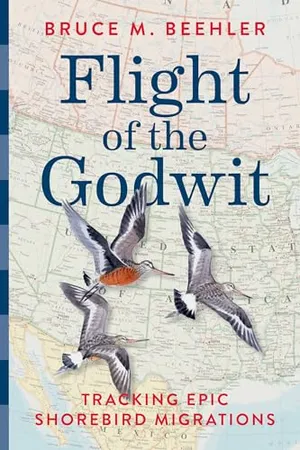
Bruce M. Beehler’s Flight of the Godwit: Tracking Epic Shorebird Migrations (Smithsonian Books, 2025)
Any birder who has aspired to learn about shorebirds will find a welcome companion in Bruce M. Beehler’s new book, Flight of the Godwit: Tracking Epic Shorebird Migrations. Shorebirds, after all, can be considered somewhat mythical, mysterious beings. Not only do many of them make remarkable annual migrations covering tens of thousands of kilometers, quite a few are notoriously difficult to identify. Certainly, Braden and I realized we had entered a more advanced stage of learning when we started to search out and try to identify shorebirds and, in fact, we both often still struggle with figuring out some of the more difficult shorebird species. Yet the more we encounter and learn about these birds, the more we love them—and that same kind of passion radiates from Beehler’s words as he sets out on his own journeys to observe and learn more about these birds.
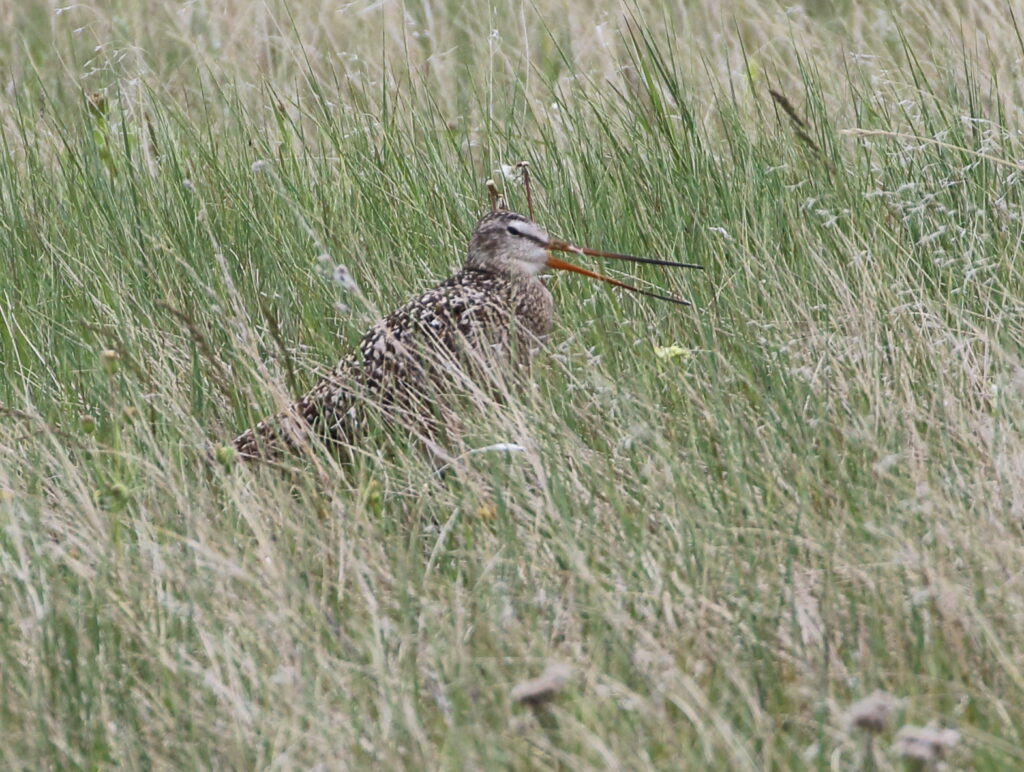
In Montana, we are lucky to host three of the “Magnificent Seven” shorebirds as breeders—including Marbled Godwits, one of the focal birds of Beehler’s new book.
In Flight of the Godwit, Beehler recounts a series of recent adventures across the US and Canada to follow and observe shorebirds as they migrate north, stop over at resting and staging sites, settle on breeding grounds, and then head south again for their long non-breeding seasons. Although Beehler discusses all of our North American shorebirds at some point, he clearly targets what he calls the Magnificent Seven: Hudsonian Godwit, Marbled Godwit, Bar-tailed Godwit, Long-billed Curlew, Whimbrel, Bristle-thighed Curlew, and Upland Sandpiper. As he shares his encounters, he sprinkles in liberal amounts of natural history and personal experiences about these birds to make the book much more than a birder’s travelogue.
This Marbled Godwit checked us out as we were scoping shorebirds in Westby last summer.
That said, the travelogue aspects of the book are a big part of what fascinated me about this tale. Even after eleven years of birding, my shorebird experiences have been much more limited than I would like. Although my home in Montana is fortunate to host a number of breeding shorebirds—including three of the Magnificent Seven—for most shorebirds, we get only brief glimpses of them as they pass through in spring and fall. Partly because of this, Braden and I have especially sought out shorebirds on our out-of-state travels to Texas, New England, and the West Coast. Sigh. It is never enough.
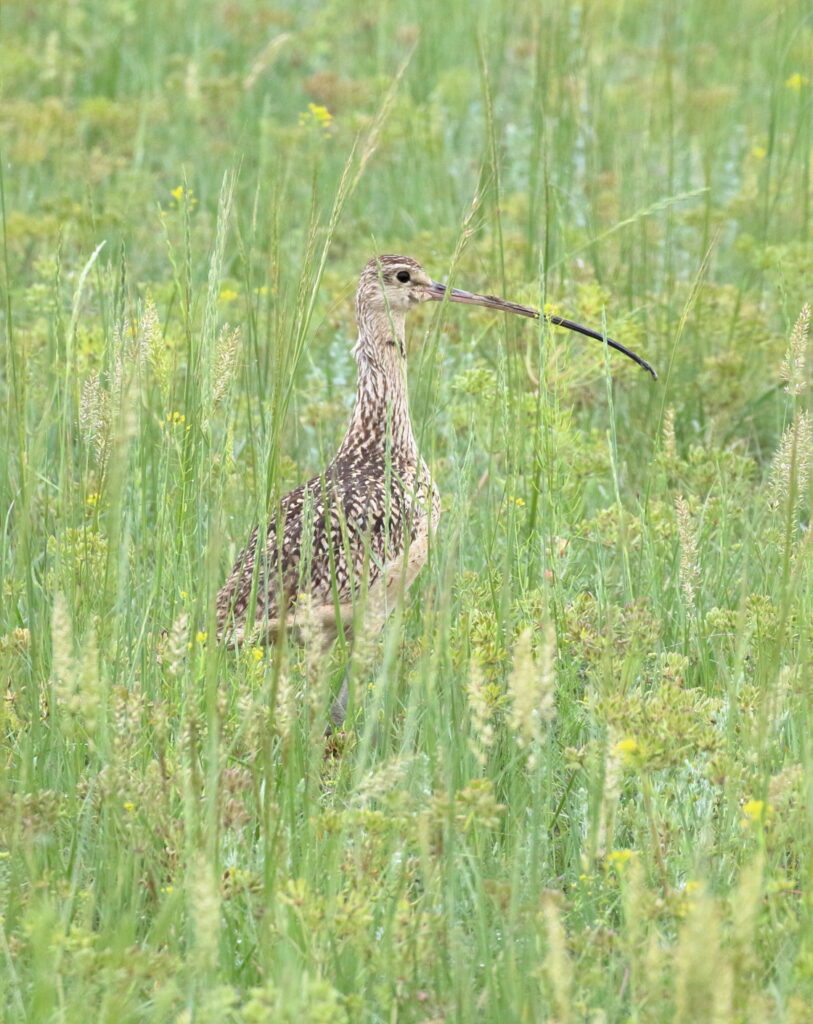
It always surprises new birders that some of our largest shorebirds actually breed in grasslands—including Long-billed Curlews.
As I followed Beehler up through the Midwest during spring migration and around Alaska during breeding season, his experiences filled in giant gaps in my own experience with these remarkable birds. I got a better sense of where the birds stop to refuel and rest, and my vague impressions of their nesting territories and habits were sharpened by Beehler’s actual observations and descriptions. Many times, I found myself nodding my head thinking, Yeah, I know what he’s talking about or Oh, so that’s what they’re doing. All of this felt especially satisfying since there’s a good chance I will never experience many of Beehler’s destinations for myself.
As much time as I try to spend with shorebirds, it is never enough. Flight of the Godwit helped fill in many of the experiences I probably will never have for myself.
Those who will appreciate Flight of the Godwit the most probably are birders who have already spent time observing shorebirds and struggling over their identifications. Those with limited shorebird experience may find themselves getting a bit lost as Beehler throws out bird names that may seem a bit abstract without solid brain images to connect them to. Still, there’s a good chance that even beginning “shorbers” will find that Beehler’s tales of adventure excite them to plunge more deeply into this remarkable set of birds. As for intermediate and advanced birders—especially those who may never get to Alaska or follow spring migration through the Midwest—I highly recommend this intriguing book that is not only a valuable educational document, but a labor of love with which many of us can relate.
You can order Flight of the Godwit from almost any outlet that sells books—but why not visit your local independent bookstore and order it there? Another easy way to do this is through the online website Bookshop.org.
Need a good book to read? Birding for Boomers recently racked up its fifth award of the year and has been a hit at indie bookstores throughout the West. Why not help support our efforts at FatherSonBirding by picking up a new copy of “Boomers” or one of Sneed’s other books? Just click on one of the images to the right.
After a slow start, August saw the Collard family shift into hyperdrive as Braden drove to Southern California to take a job as a nature guide and camp counselor, and Amy and I saddled up the minivan to drive Tessa to her freshman year of college at Cal State Chico. Braden left a few days early so that he could bird the summer heat of Arizona before arriving at his job. It seemed like a (heat) rash thing to do, but his efforts paid off as he saw 201 species and scored 9, count ‘em, NINE Lifers! These included Montezuma and Scaled Quail, Lucifer Hummingbird, Buff-breasted Flycatcher, Gray Vireo, Cassia Crossbill, and Rufous-winged, Botteri’s, and Cassin’s Sparrow. Just listing the above stats, in fact, makes me hesitant to bring up my own relatively modest birding luck driving to California—but let’s back up a second.
Our drive to California—complete with a stop in Ashland, Oregon—promised to prove crucial to my quest to break my own one-year species record of 527 species. (Sadly, I did not pick up any Year Birds while watching this Shakespeare play!)
As mentioned in previous posts, both of us Collards are having record-breaking years. Braden’s World Species total for 2025 sits at an astonishing 833 species, thanks not only to trips to Mexico and Costa Rica, but his cross-country drives to Montana from Maine and his recent journey to California via Arizona. As for moi, when last I reported (see our post “Swift-ecta!”), I needed twenty birds to break my all-time one-year World Species total of 527. The thing is, twenty species this late in the year was looking a bit dicey. While it might be possible to pick up twenty more species here in Montana, I was counting on the drive to California to put a major dent in that number. Nonetheless, I birded hard before our departure and by the time we hit the road, my year total had crept upward to 512, leaving only sixteen species to break my record.
Normally, I would have thought, “Piece of cake,” especially since I hadn’t visited any West Coast states so far in 2025. But not so fast. Remember that little winter trip Amy planned for us last January (see post “Birding Victoria, BC”)? Well, believe it or not, in Victoria I had already nabbed Bushtits, Anna’s Hummingbirds, and Chestnut-backed Chickadees, removing three potential gimmes from the California trip. Even my Colombia trip with Roger (see post “Antpittas and Tody-Flycatchers”) had allowed me to pick up Acorn Woodpecker and Lesser Goldfinch, removing those bird potentials as well.
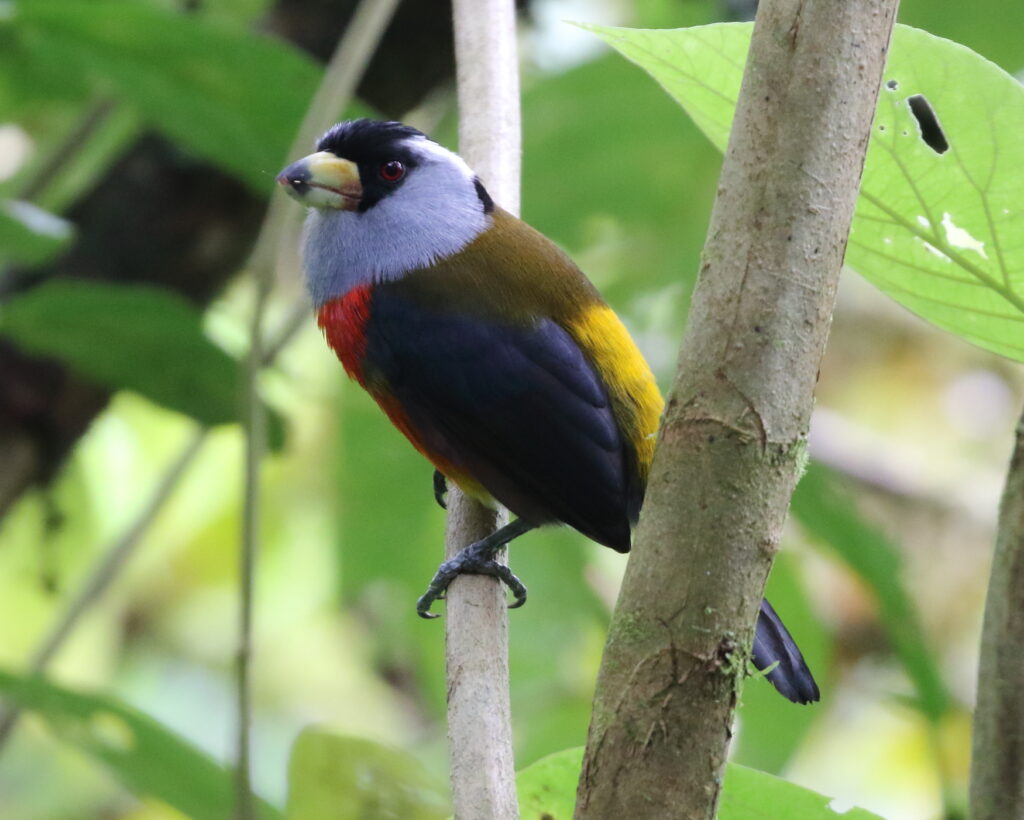
The birds of Colombia, including this stunning Toucan Barbet, seen on Roger’s and my trip, are one reason my single year species record has crept tantalizingly to within reach.
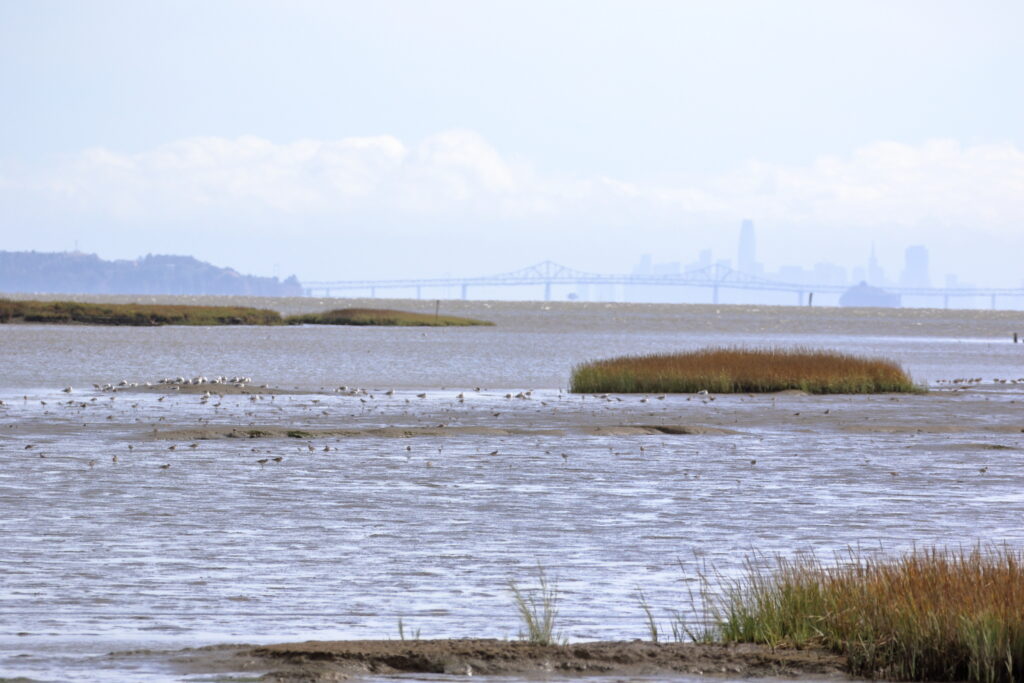
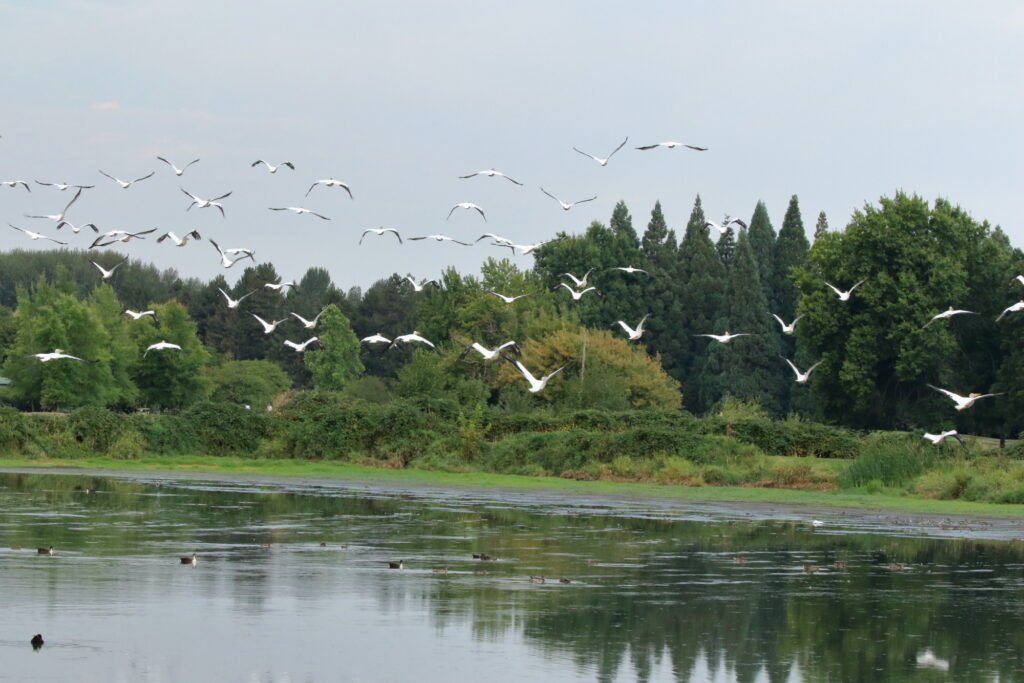
Nonetheless, I remained cautiously optimistic as Amy, Tessa, and I hit I-90 for our first stop of the trip, Portland, Oregon. We would spend only two nights there, but I wasted no time, getting up early the first morning to hit Broughton Beach along the Columbia River. My goal was to find cool shorebirds, and I did find both Least and Western Sandpipers—but no Year Birds. While there, though, I met a very nice birder named Ted who told me about another cool spot, Force Lake, and I decided to head over there. I was rewarded by Long-billed Dowitchers and Red-necked Phalaropes—but again, no Year Birds. In fact, the only Year Birds I nabbed in Portland were California Scrub-Jay in the backyard of my in-laws and Black Phoebe at another new spot I visited, Whitaker Ponds Nature Park. As we rolled out of Portland, I hoped that the rest of the trip would prove more productive.
I got turned on to Force Lake by another Portland area birder. It’s a place I’ll return to often, as it offers the best shorebird habitat I’ve found in Portland. Alas, it yielded no Year Birds on our recent trip.
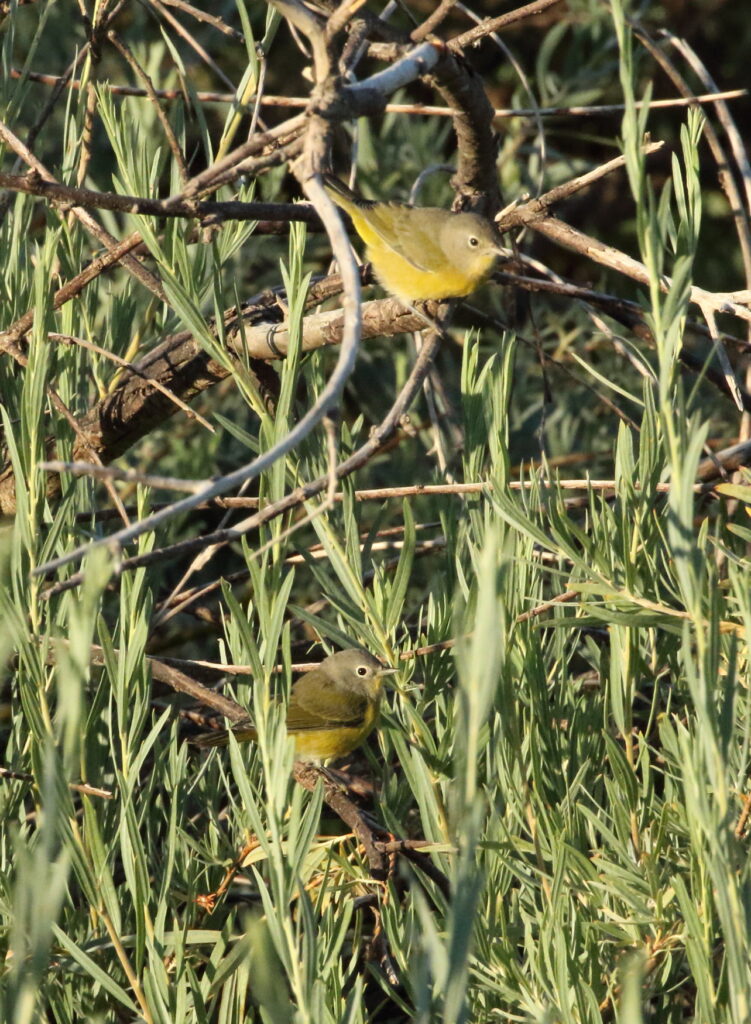
Our next stop was Ashland, Oregon, where Amy had bought us tickets for the Shakespeare play The Merry Wives of Windsor and the musical Into the Woods. Both were excellent productions, but I felt so sleepy I barely made it through them without crashing to floor. Our first morning there, though, I hit another new birding spot, Emigrant Lake (South Shore). Here, I managed to nab three more Year Birds: Oak Titmouse, Bewick’s Wren, and California Towhee. My biggest surprise were a pair of Nashville Warblers. In fact, it’s been a great year for learning about these birds as I saw them migrating through Texas last April and now, making the return migration through California. (Though I must point out that this species has an unusual “bifurcated” distribution so the birds in Texas and California probably came from separate, distinct populations.)
Finding Nashville Warblers along the shore of Emigrant Lake was one of the day’s best surprises.
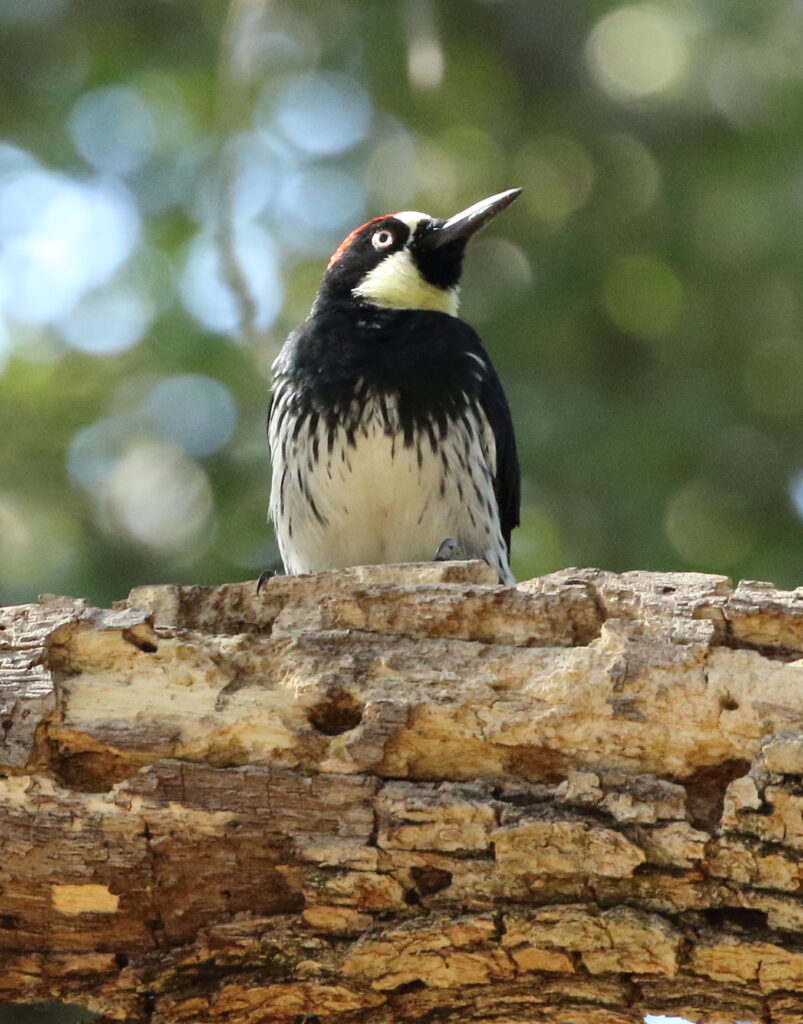
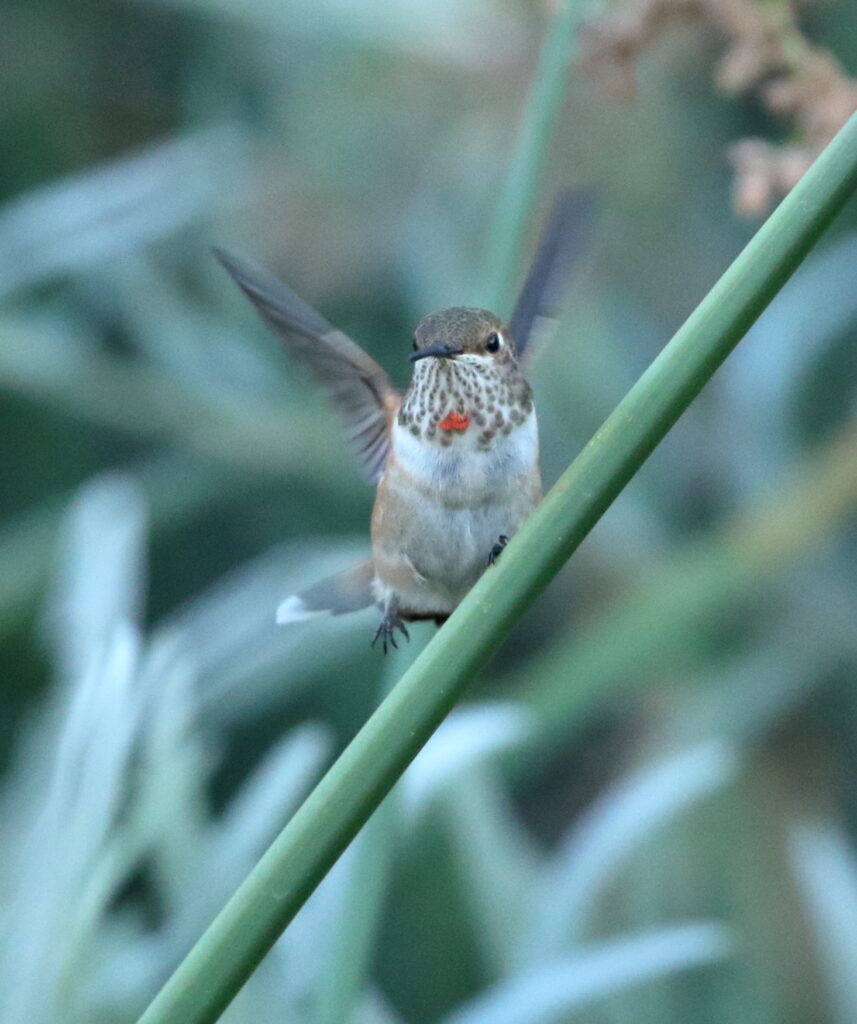
Chico greeted us with 104-degree temperatures, less than ideal for birding. Our major goal here, of course, was to get Tessa settled into university housing, but you know me. My first morning, I was up at dawn to explore Hooker Oak Park, a great city park I’d discovered when first bringing Tessa to check out Chico (see post “College Search Birding in California”) in 2024. This morning, the park did not disappoint. One of my favorite birds, Acorn Woodpeckers, were flying everywhere and I had a wonderful encounter with Anna’s and Rufous Hummingbirds, who put on a real show for me in a dry riverbed. As far as Year Birds go, however, my only score was a bird that happened to earn Bird of the Trip honors.
I recorded more than two dozen Acorn Woodpeckers in Chico’s Hook Oak Park. Good thing they are one of my favorite birds!
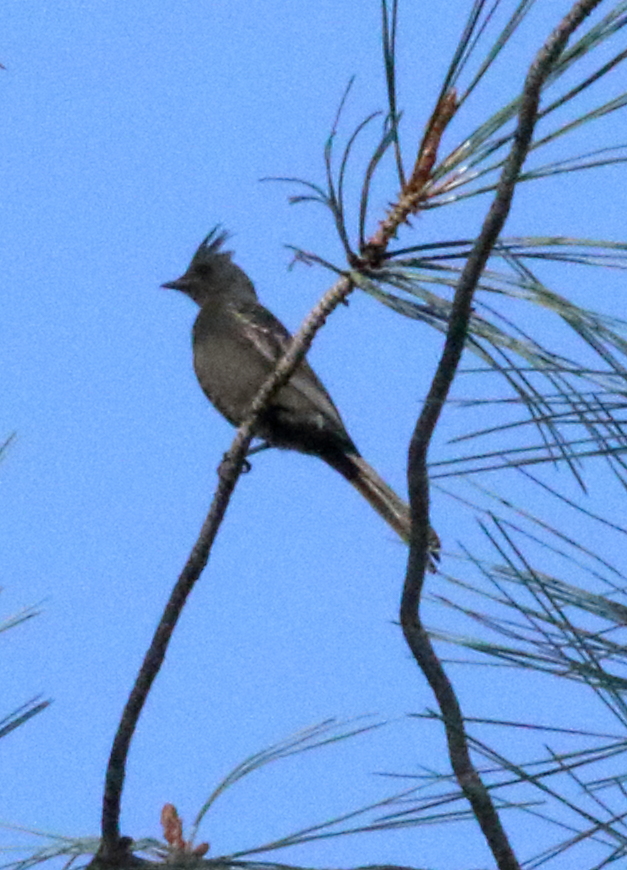
As I was leaving the hummingbirds and walking back down the dry wash, I glanced up at a medium-sized black bird landing high in the top of a pine tree. The bird showed a distinctive, tall peak on its head like it had styled its feathers with pomade, and at first I thought, “Is that a Stellar’s Jay?” Though I knew STJAs were common in the adjacent mountains, it didn’t seem likely that they’d be here on California’s Central Valley floor. However, as I stared at the bird—and three others that joined it—a wave of delight crept over me. I was looking at Phainopeplas!
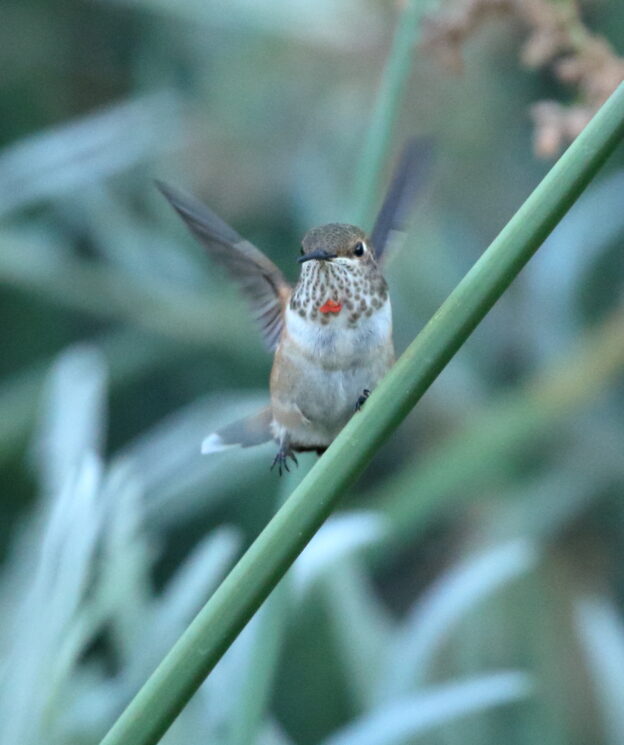
I love that the orange throat patch of this Rufous Hummingbird looks like an upside-down heart! Several of the birds were aggressively chasing each other—and a few Anna’s that were around.
At first I didn’t believe it. While I knew that Phainopeplas lived in Southern California, I’d only ever seen the birds in Arizona and here in Chico they seemed wonderfully out of place. Quickly calling up Merlin on my phone, however, the range map showed a tiny, seasonal finger stretching up the Central Valley—and stopping almost exactly where I was standing!
With their surprise appearance in Chico, Phainopeplas easily nabbed Bird of the Trip honors for our sojourn to Chico.
These, of course, are the moments a birder lives for—amazing surprises in new places—and the encounter put a bounce in my step as I returned to the hotel for a day of getting Tessa ready for college. Alas, the PHAIs were the last Year Bird I managed to find on the trip. I returned to Montana at 520 species for my Year List. Since then, I’ve managed to add Clark’s Grebe to my list, but that still falls seven short of breaking my record.
Will I make it? Do I have any surprise opportunities up my sleeve to put me over the top? And what of Braden? Could he reach that magical 1,000 number for the year? Well, you know the answer: you’ll just have to keep reading to find out!
A fun visit to Emigrant Lake south of Ashland, Oregon helped nudge me closer to breaking my all-time one-year species count record—but not close enough!
Today, we are pleased to offer the third in Braden’s series about his adventures driving across the country from Maine to Montana. Already, it’s been an incredible birding journey—and he’s not even out of Maine! Sneed is also pleased to announce that two of his books, Birding for Boomers and Like No Other, have been named finalists for the High Plains International Book Awards. We hope some of you Montana residents will join Sneed for the celebration and to crown the winners at the awards ceremony in Billings on October 4th!
I had never seen so many American Redstarts. The birches and maples standing on the northern tip of Sears Island, at times, had more warblers on their branches than leaves. According to Wesley Hutchins, this was the norm for Sears Island during spring, and part of the reason why he’d been wanting to bring me here since we’d become friends four years ago.
I’d met Wes a month or two after arriving at the University of Maine, and thanks to the hours and days we’d spent together exploring the forests and coasts of the state, I now considered him one of my closest friends. Wes and I kept in close contact during the summers when we worked out-of-state (California and Pennsylvania for me, New York for him), keeping each other updated on all of the awesome birds we were seeing around the country. He’d graduated a year before me, but still visited UMaine every week to spend time with me and his other friends there. I had never visited his hometown of Belfast, however, despite it being only an hour away from the campus where I’d gone to college. This week, I was bent on changing that, and now here I was birding the spots that he’d fallen in love with over the last few years.
Selfie of me and Wes at one of his favorite birding spots, Sears Island, Maine.
“It’s really weird seeing you here—in the good way!” Wes admitted, and I nodded. I’m sure I would feel the same way once I finally convinced him to visit me in Montana.
We’d spent the previous evening walking around Belfast Harbor, a pleasant little cove tucked away into the side of Maine’s midcoast region and another one of Wes’s favorite birding spots. This morning, however, he’d taken me to Sears Island, Waldo County’s best birding hotspot and a prime location to see migrating warblers. Upon setting foot on the island, I began to notice warblers—redstarts, a Chestnut-sided, a Northern Waterthrush—but nothing out of the ordinary. I’d been seeing warblers like this all week. We wandered a bit, down into the forested center of the island, but things stayed eerily quiet. After about twenty minutes, Wes turned to me and said, “We should go back to the northern point. That’s usually where all the action is.”
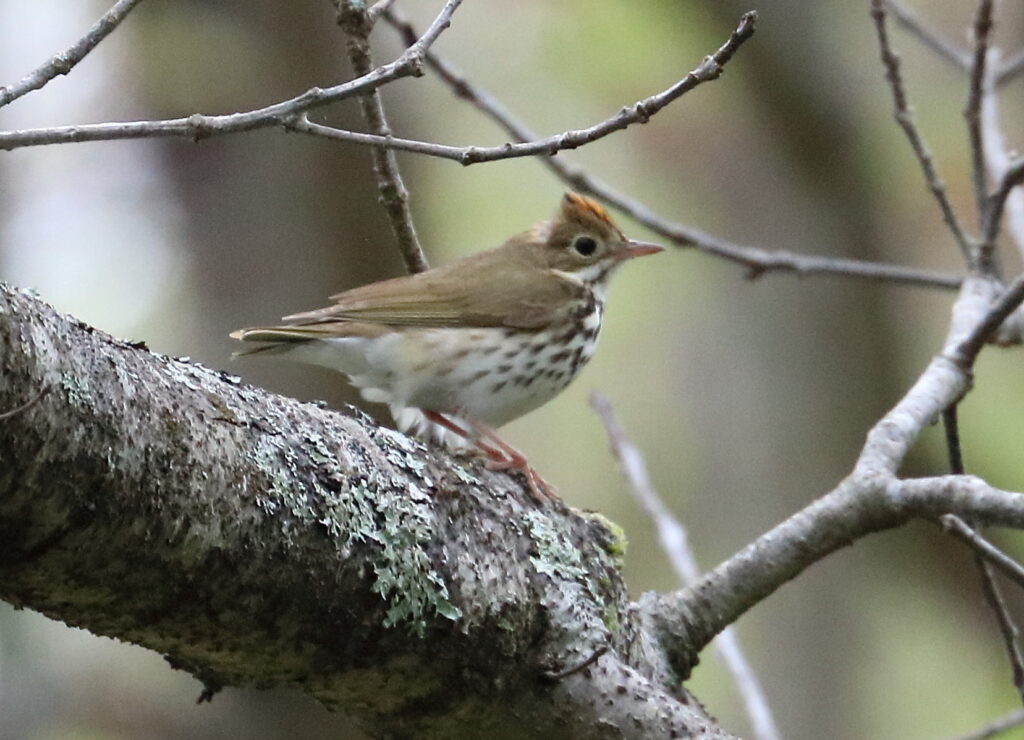
Unlike the other warblers, Sears Island’s Ovenbirds were keeping pretty quiet on the day Wes and I visited.
I felt skeptical. I much prefer walking around to staying in one spot to bird, but Wes had the local knowledge so I followed his lead. We walked back and we immediately began to see birds we hadn’t seen just twenty minutes ago—a Blackburnian Warbler and a couple of Magnolias. Then, I looked up.
In the sky above us floated dozens of warblers, all seeping and chipping as they struggled to combat the winds rushing over the island. Many of the birds faced north, while others zoomed in from the north, landing in the trees directly to our right and left. We stationed ourselves directly in front of a flowering apple tree that seemed to be overflowing the warblers and began calling things out.
“I’ve got two Magnolias on the same branch.”
“Is that a Tenness—no, it’s just a REVI.”
“Here’s our third Wilson’s of the day, a nice male!”
“Six redstarts in this one tree alone. Scratch that, seven.”
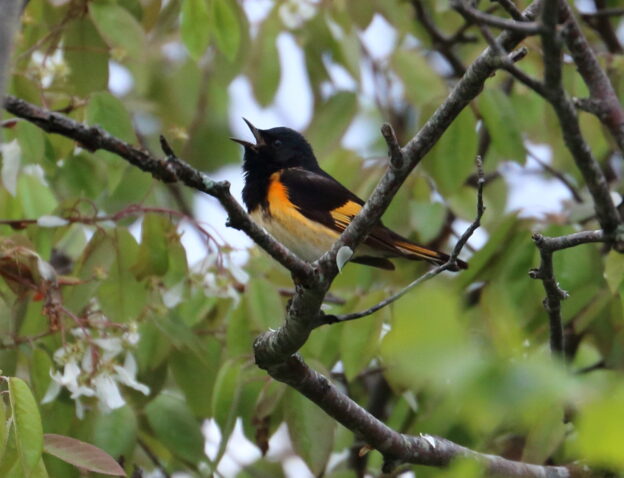
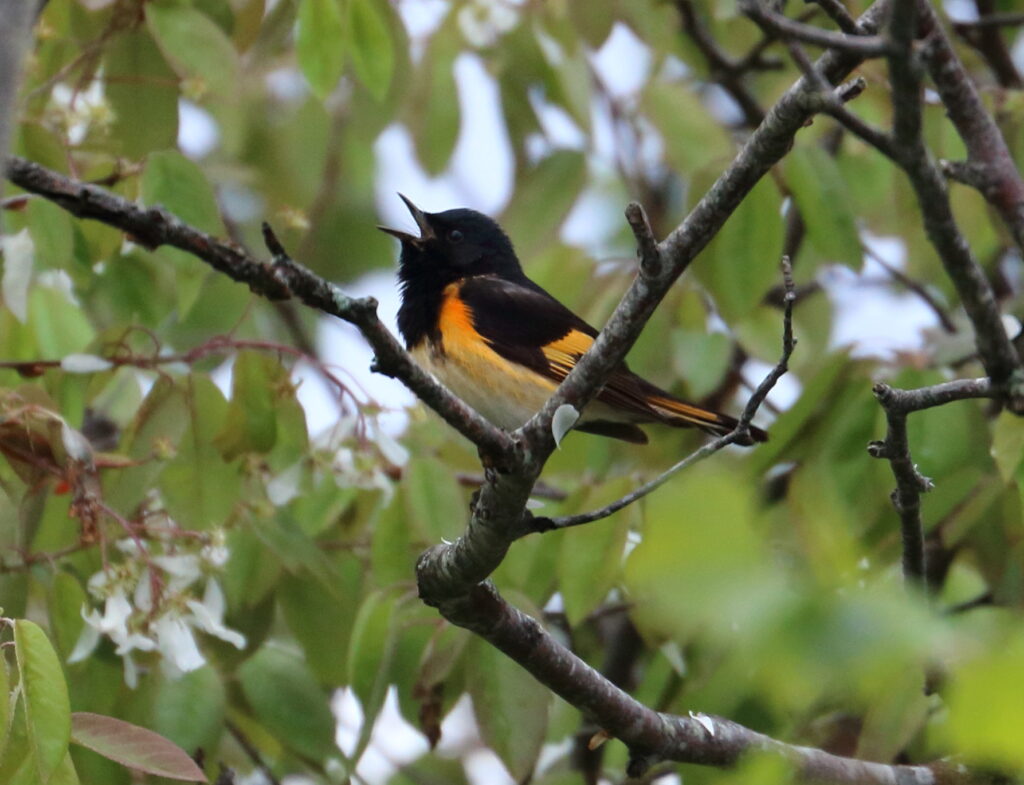
One of approximately one hundred American Redstarts we counted at Sears Island.
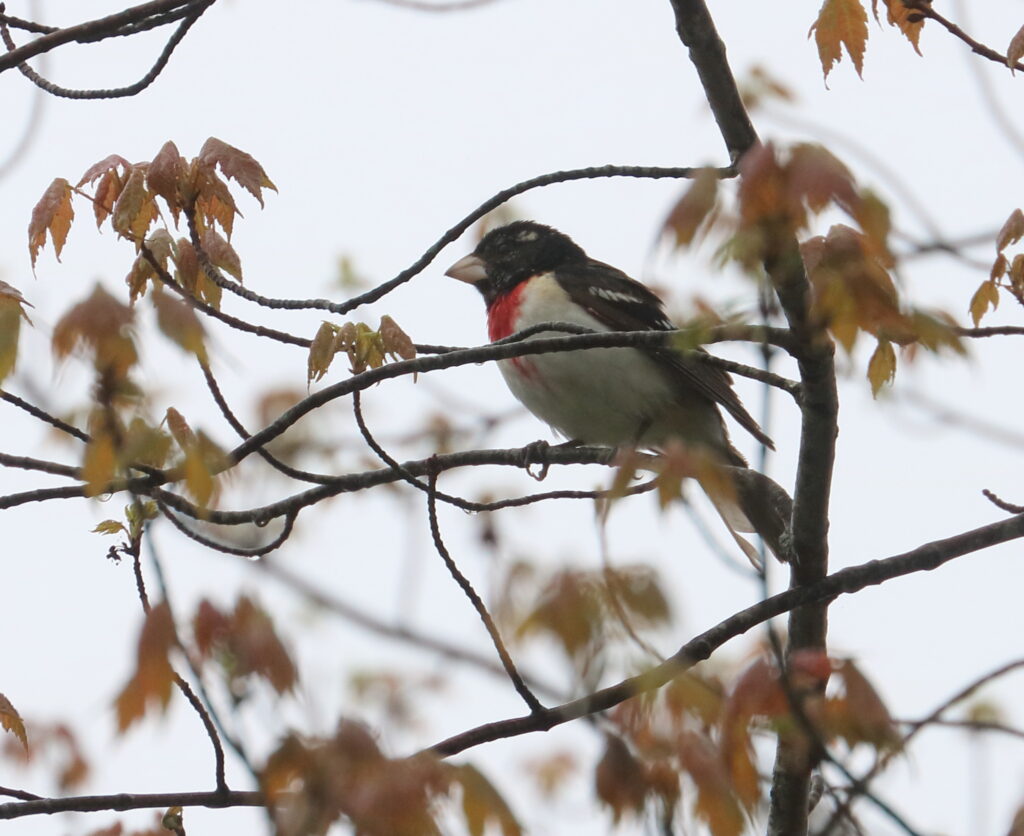
What we were experiencing was a river of warblers. Every three minutes or so, the birds we’d been staring at would vacate and be replaced by new birds dropping in from above, all slowly making their way toward the causeway that connected Sears Island to the mainland. One in every three warblers was an American Redstart, and there were easily hundreds of warblers. Mixed in with the warblers were small numbers of other species: vireos, flycatchers, a couple Rose-breasted Grosbeaks. It was exactly the experience I’d hoped to have when I’d signed up to go to school on the east coast. The West doesn’t do songbird migration like the East does, especially when it comes to warblers. Montana has fourteen regularly-occurring species of warblers. On Sears Island, we’d seen fourteen species in a matter of minutes.
Rose-breasted Grosbeaks added further spice to an incredible wave of warblers migrating in!
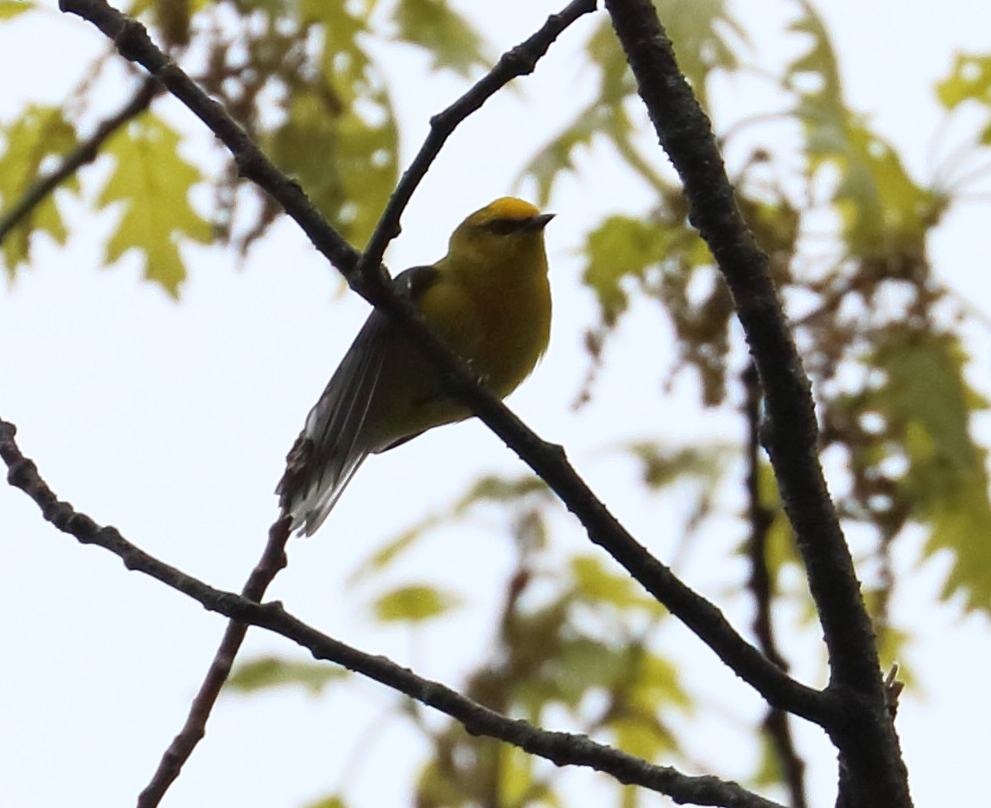
My focus had been warblers the whole week, in fact, with the notable exception of the Acadia Puffin Cruise (see our recent post, Puffin Party). Just a day or two earlier, I’d spent two nights in Portland, Maine, with my good friend Hayden Page. We’d birded hard, visiting many of Maine’s famous birding hotspots like Scarborough Marsh, Laudholm Farm and Portland’s urban Capisic Park. The morning we’d hit Laudholm Farm had been incredible, with 81 species at the preserve including seventeen warbler species and a White-eyed Vireo, a rarity this far north. At an airport in Brunswick, Main, we’d also chased a Blue-winged Warbler—another southerner not supposed to be here. In the coming decades it wasn’t hard to imagine both the vireo and the warbler showing up more and more frequently in Maine thanks to warming temperatures and changes in habitat.
A Blue-winged Warbler—an unusual migrant that may become much more common in Maine as global temperatures warm.
The week had also exposed me to the diversity of Maine’s habitats. Living in Bangor during the colder months, my impressions of the state had mostly been of woods. And it is true that Maine has woods—it’s the most forested state in the country. But southern Maine, especially, holds its fair share of unique ecosystems. Kennebunk Plains Preserve, which I’d visited twice this spring, is a patch of grassland with Vesper and Grasshopper Sparrows and Eastern Meadowlarks. It is regularly burned to keep shrubs and trees from encroaching on it. Grassland used to be far more common in the state, following the intensive logging of the 1800 and 1900s, but now that the forest had grown back Kennebunk Plains was one of the only spots for certain species to be found.
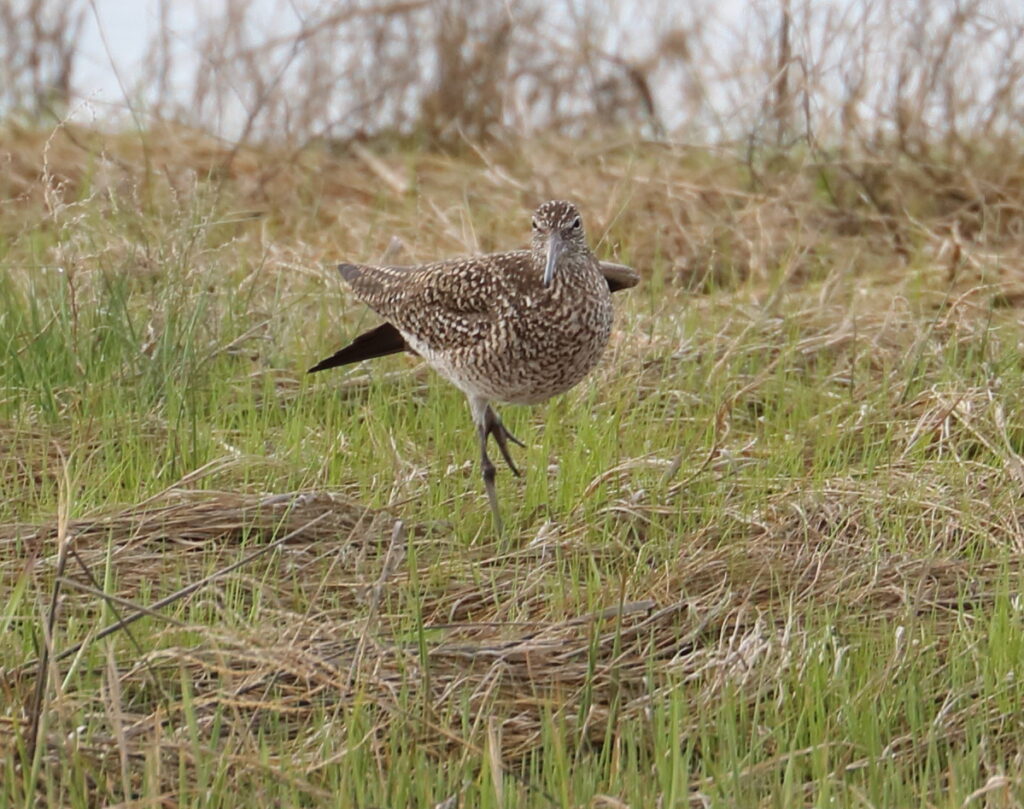
Scarborough Marsh, which my dad and I had visited when we’d come out to Maine in fall of 2021 (see this post), held the largest chunk of salt marsh in the state. This habitat, which looks like a savannah floating on the edge of the sea, is also threatened, both in the state and worldwide, thanks to rising sea levels. The birds that live here include Willets and Saltmarsh Sparrows, the latter of which was the focus of my Honors Thesis Project and is one of North America’s most endangered birds.
A Willet, one of our most common large shorebirds, at Scarborough Marsh.
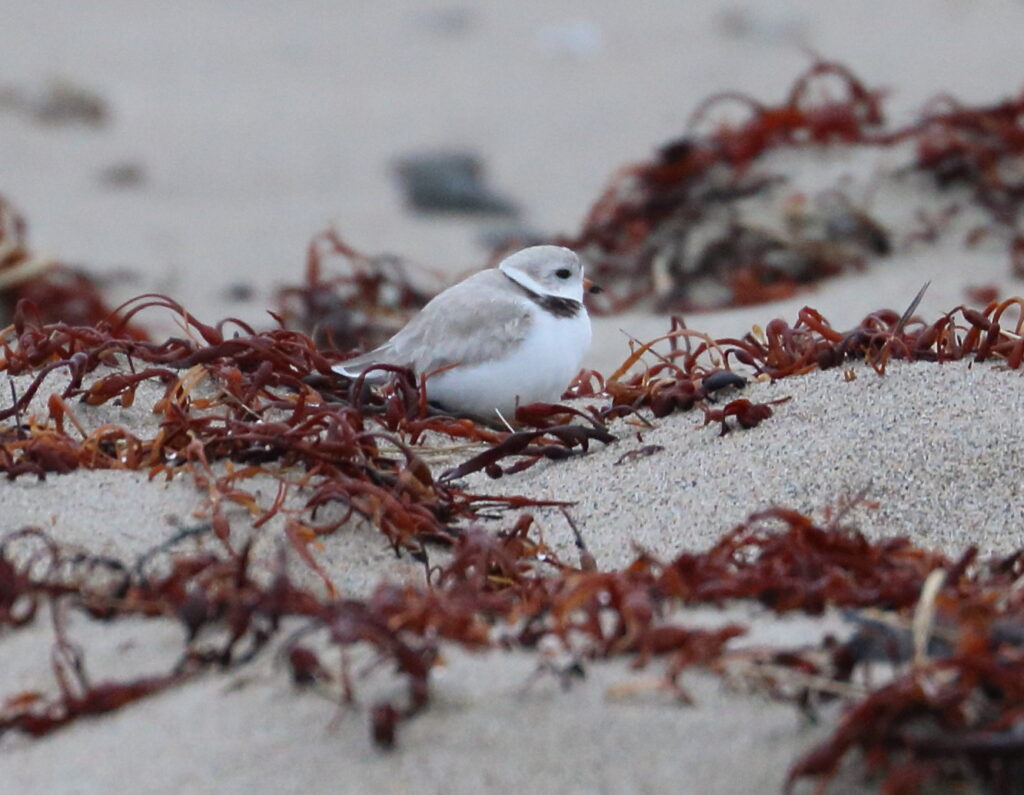
Southern Maine is also a prime location for sandy beaches, and both the birds and the tourists know it. Maine’s coastal towns go from sleepy and affordable in winter to bustling and expensive during the summer, when Americans from all over flock to them to enjoy the summer. This has created problems with the wildlife that depend on sandy beaches as their homes, namely the Piping Plover and Least Tern, two species who spend their days hunting for invertebrates along the coastline and breed in the grassy dunes just upland of the beach. Thankfully, the state of Maine has put in a lot of work to close off these dunes to tourists and their destructive dogs, allowing the birds to nest in a fragile security. At Pine Point, just five minutes from Scarborough Marsh, Hayden and I got to watch a trio of Piping Plovers chasing each other around the beach at close range. It was also at Pine Point that I got to see my lifer Roseate Terns, along with the more common Least and Commons.
Keeping Piping Plover populations going requires careful monitoring and protection from the swarms of people and dogs crowding East Coast beaches each summer.
Though I’d always joked about the cold weather, lack of mountains, and isolation of Maine, I was certainly going to miss the state I’d spent four years getting to know. The places AND the people. This was especially present in my mind after giving Wes a hug goodbye and driving away from Belfast, from the University, and from some of the best friends I’d ever made. I would make sure to see them again, though it would never quite be the same. Thankfully, I had one more night to spend in Maine before leaving, though it wouldn’t be in the comfort of a friend’s air mattress. No, I was headed for the last county I’d never visited in the state: Franklin County, the land of wind, mountains and moose.
Recently, my brother joined us to celebrate our youngest child’s graduation from high school. We had some extra time, so naturally we went to look for birds, an activity he has steadily been getting more interested in. He didn’t bring binoculars, so I loaned him a pair of Vortex Bantam HDs I have been testing out. The problem? When he departed, he didn’t want to give them back!
Although created and marketed for kids, the Bantam HD has terrific selling points for adults as well. But let’s start with the kids. Quite a few companies have been selling binoculars for kids lately, and that’s a no-brainer. As more and more adults get into birding, they naturally encourage their children to enjoy the activity, too. But most adult binoculars are too heavy and sometimes too complicated to use for the average kid, so it makes sense to seek out optics specifically designed for young people.
The Bantam HDs are lightweight, easy to use, and offer excellent light transmission and sharpness.
Unfortunately, many “kid binoculars” look and feel cheap—and often break almost immediately. Others come with high price tags (think $500 or more). I don’t know about you, but as a parent I can think of better places to put those extra few hundred bucks—at least until your child has shown an unquenchable passion for birds. And that’s where the Bantam’s first big selling point comes in: it can be purchased for only about $70.
More important, Bantams feel like real binoculars in your hands. They have sturdy construction, a comfortable grip, long eye-relief tubes for those with glasses, and a diopter ring to accommodate different vision between eyes. Oh, and did I mention they are waterproof, fogproof, and shockproof? Beyond all this, the clarity of the image they present is impressive. I hate to say this, but I found the focal sharpness to be better than the more expensive Triumphs we reviewed earlier in the year (see our review).
Though marketed for kids, the Bantams are an excellent choice for travelers as well.
The Bantam HDs do come with some trade-offs. While the optics are excellent, the rating 6.5X32 means that the magnification (6.5 power) is not as great as you find on most adult binoculars (including the Triumphs mentioned above). Also, minimum focal distance is a fairly lengthy 12 feet. This won’t be an issue for most users, but could come into play when looking at butterflies or other insects—or just screwing around, which of course most kids are wont to do when having a cool new toy in their hands. However, the Bantam HD’s light weight and ease-of-use more than compensate for these disadvantages.
Oh yeah, the weight, you may be thinking. I haven’t mentioned that yet, but here it is: these binoculars weigh a mere 14.4 ounces—less than a pound. In other words, they are light enough for almost all kids to carry them around for hours without complaint. And that means that they also are mighty attractive to adults as well.
On several recent birding trips that I led, I let adults use my pair of Bantams. The coordinator from our local natural history center immediately ordered half a dozen pairs!
In fact, almost everything about the Bantam HDs screams TRAVEL BINOCULARS! Even if you’re not going on a dedicated birding trip, all birders understand that it is essential to take along a pair of binoculars on every adventure. But on a casual trip a regular pair of binocs, with its awkward size and weighing a couple of pounds, can make a person hesitate to stuff it into a carry-on. Years before trying out the Bantams, I bought myself a pair of Vortex Vanquish 8X26s for backpacking, travel, and to keep in our trusty minivan for “emergency birding.” They worked just fine for this—but despite their greater magnification and slightly lighter weight, I like the Bantams better. Why?
For travel, I found the Bantams to be a better choice than the more expensive Vortex Vanquish 8X26 (pictured here)—despite the greater magnification of the latter.
* The Bantam’s optics are just as good, if not better.
* Because the Bantam uses a roof prism system instead of a Porro (side-by-side) prism arrangement, I find the Bantams more comfortable to hold. According to Vortex, they also are more durable. (See this article for a comparison of roof versus Porro prism binoculars.)
* The Bantams are actually cheaper to buy.
You can probably tell that I’m unusually enthusiastic about the Bantams, and their low price makes them an almost risk-free investment—especially given that, like all Vortex products, they come with an unbelievably generous lifetime warranty. Whether you’ve got a promising young naturalist in your life or need a pair of handy travel birding binoculars, you won’t be sorry you checked these out.
Oh, and you might be wondering, Did my brother ever give my Bantams back before he left? The answer is yes—but he looked so forlorn about it I immediately ordered him his own pair!
The state of Maine can be simplified to four things: lobster, moose, blueberries, and puffins (with Dunkin Donuts as a runner-up). During the four years I’d spent going to school in the state, I’d eaten lobster rolls, visited blueberry bogs, and tried my hardest to find a moose, a quest that would continue later this week. Through no fault of my own, I had never even tried to see a puffin and the reason was simple—my school year did not overlap with the Atlantic Puffin school year. This year, however, was different. I was actually still in the state of Maine as puffins were arriving at their breeding colonies, and was not going to miss my last chance to see these iconic seabirds. So, on May 14th, I boarded a large boat in Bar Harbor and took my seat in the cabin, binoculars and camera ready.
Unlike previous boat rides I’d taken to see birds, this cruise was relaxed and family-friendly. About two hundred people crowded the deck, many of whom were just as interested in the Bald Eagles and American Herring Gulls circling above the harbor as the prospect of seeing any alcids (Alcidae is the family of birds that includes puffins, murres, auks, and guillemots). Over the intercom, a very knowledgeable guide spouted off a non-stop stream of facts about the islands, lighthouses, and wildlife of the area as we headed for Egg Rock, a sparse strip of land just barely visible to tourists standing onshore in Bar Harbor. With the coastline of Acadia National Park to our right, we slowed as we approached the island.
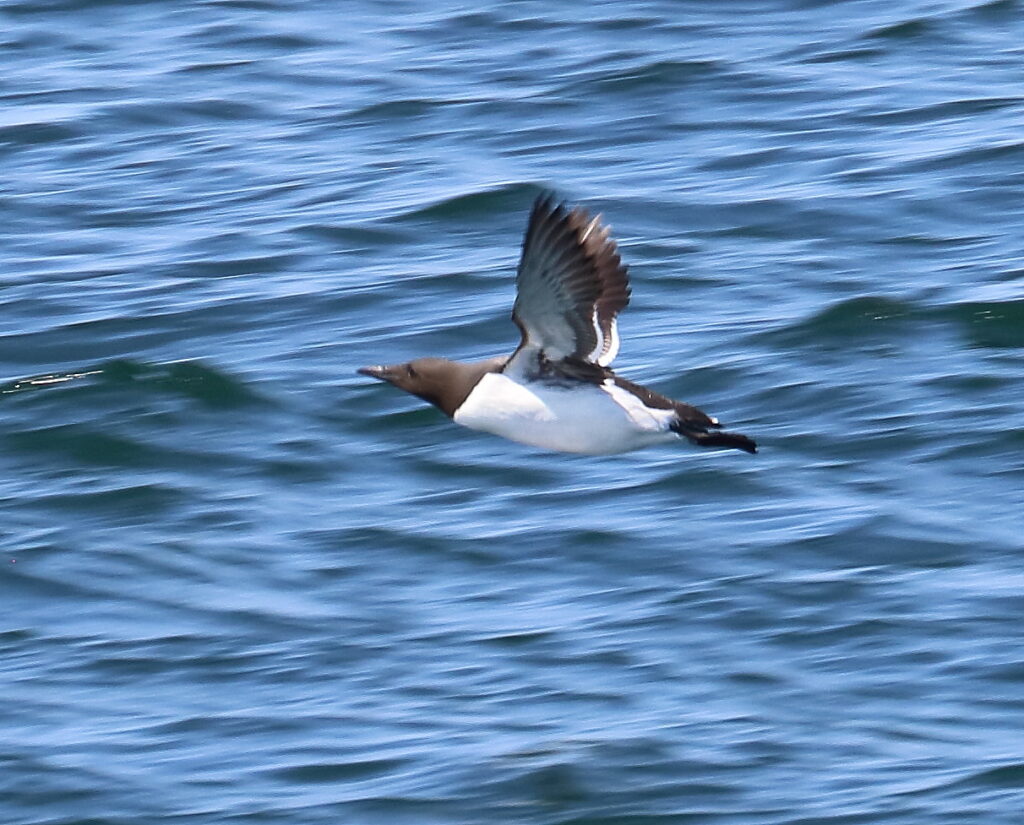
This Common Murre was the only one I saw the whole boat ride. While this species hasn’t yet started nesting at Petit Manan, the ornithologists are hopeful that they will soon!
Egg Rock did not have a puffin colony—it was too close to shore for that. What it did have were colonies of several other species of seabirds. Gulls dominated the island, mostly Herring with scattered numbers of Great Black-backed Gulls mixed in, their charcoal backs sticking out amongst the sea of gray. Cormorants patrolled the southern side of the island, standing tall like gargoyles on the rocks. And in the waters lapping up against the side of the island I saw my first alcids—Black Guillemots! Although guillemots, which are black with white wing patches in the summer and white with black wing patches in the winter, are in the same bird family as Atlantic Puffins, they are far easier to see in Maine. Not only do they breed right on the coast during the warm months, they also stay for the winter—something that the puffins do not do. That’s one of the reasons why I’d never seen puffins here during my time at the University of Maine: From August to April, these birds stay as far from shore as possible, floating around somewhere in the North Atlantic.
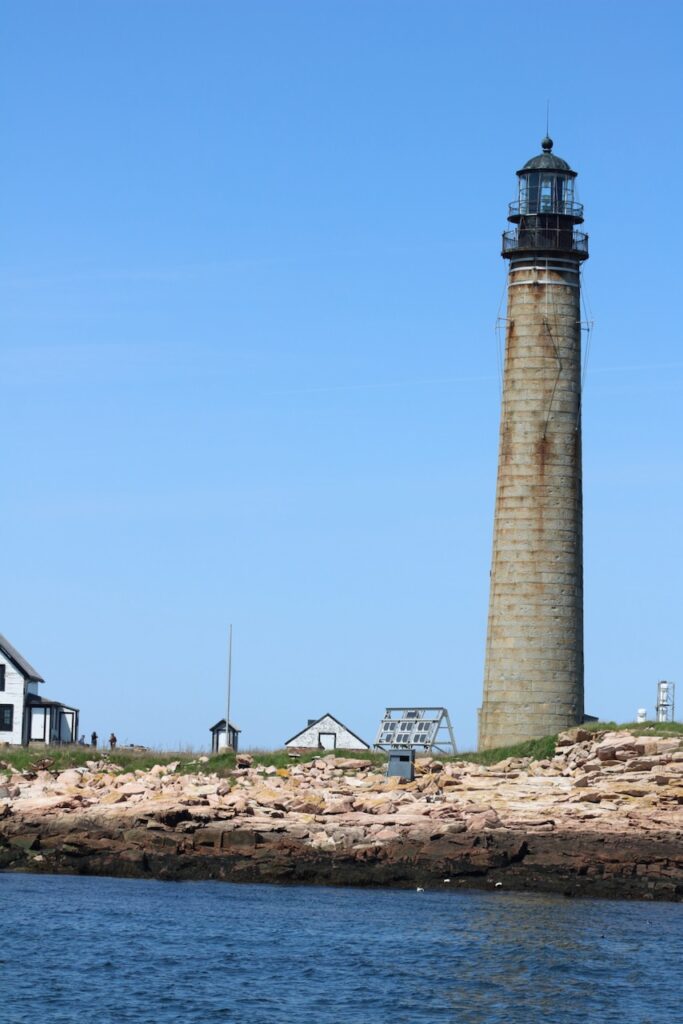
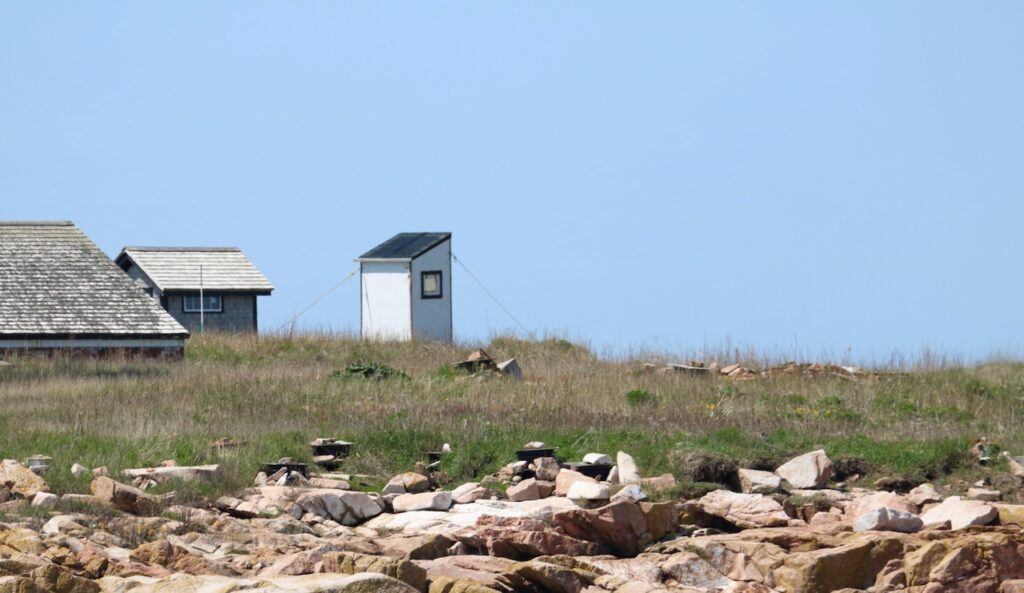
After circling Egg Rock to look at the seabird colonies, as well as the dozens of Harbor and Gray Seals lounging on the rocks, the boat picked up speed and headed out to sea. While we never lost sight of the coastline, it grew hazier and hazier until eventually, a new island appeared on the horizon: Petit Manan. The first thing I noticed about Petit Manan were the buildings. Many islands off the coast of Maine had lighthouses, built during centuries past to help steer ships into harbors. As recently as the late 1900s, lighthouse keepers and their families lived on the islands and maintained the lighthouses, although by now many of the keepers had left, likely because boats had better forms of navigation at their disposal. The houses they left behind had been taken over by people working a very different type of job.
The Lighthouse on Petit Manan Island.
Both Egg Rock and Petit Manan are part of a large reserve known as Maine Coastal Islands National Wildlife Refuge. Every summer, dozens of wildlife technicians head out to these islands to spend weeks and months working with the birds that live there. On some islands, like Petit Manan, this work includes Atlantic Puffins, but it also includes monitoring and conservation of other species like Common, Arctic, and Roseate Terns, Common Murres, Black Guillemots, Razorbills, Common Eiders, and Leach’s Storm-petrels. Several of my peers at the University of Maine worked for Maine Coastal Islands and would be heading out to their assigned locations within the next few weeks.
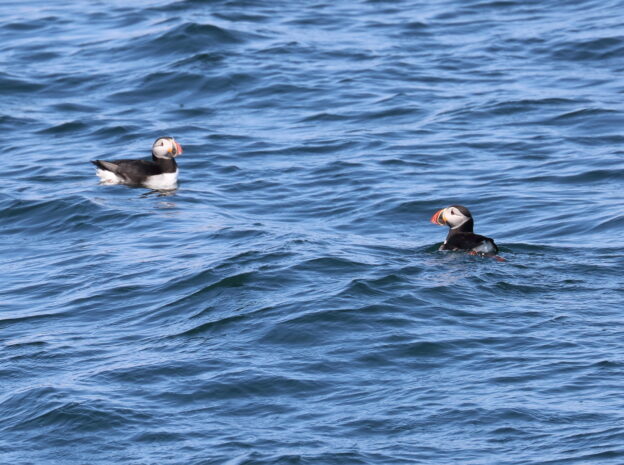
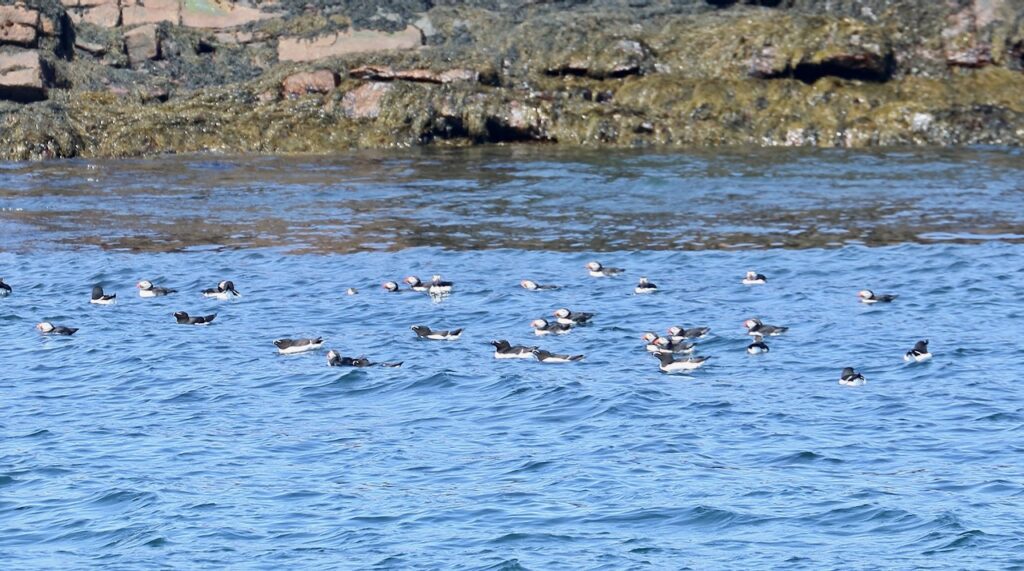
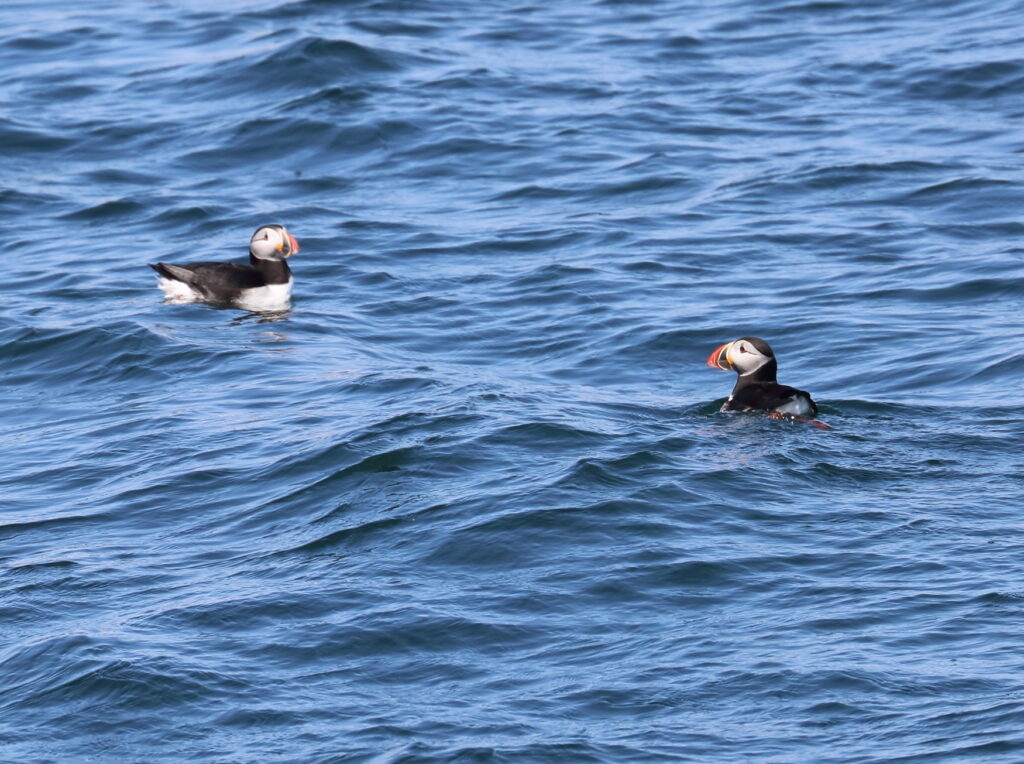
I began to make out large rafts of birds next to the island as our boat approached, and was delighted to spot football-sized alcids with rainbow bills taking off in front of us. I raised my binoculars and smiled—these were the first Atlantic Puffins I’d seen in seven years, since 2018 when I’d been lucky enough to visit Iceland with my grandparents (see my post “All About Alcids”). The birds lounged in the water close to the rocks, and our guide told us that many of them had likely just returned for the summer from their mysterious marine wintering grounds. I counted ninety or so during our half hour stay at Petit Manan.
A raft of Atlantic Puffins and Razorbills!
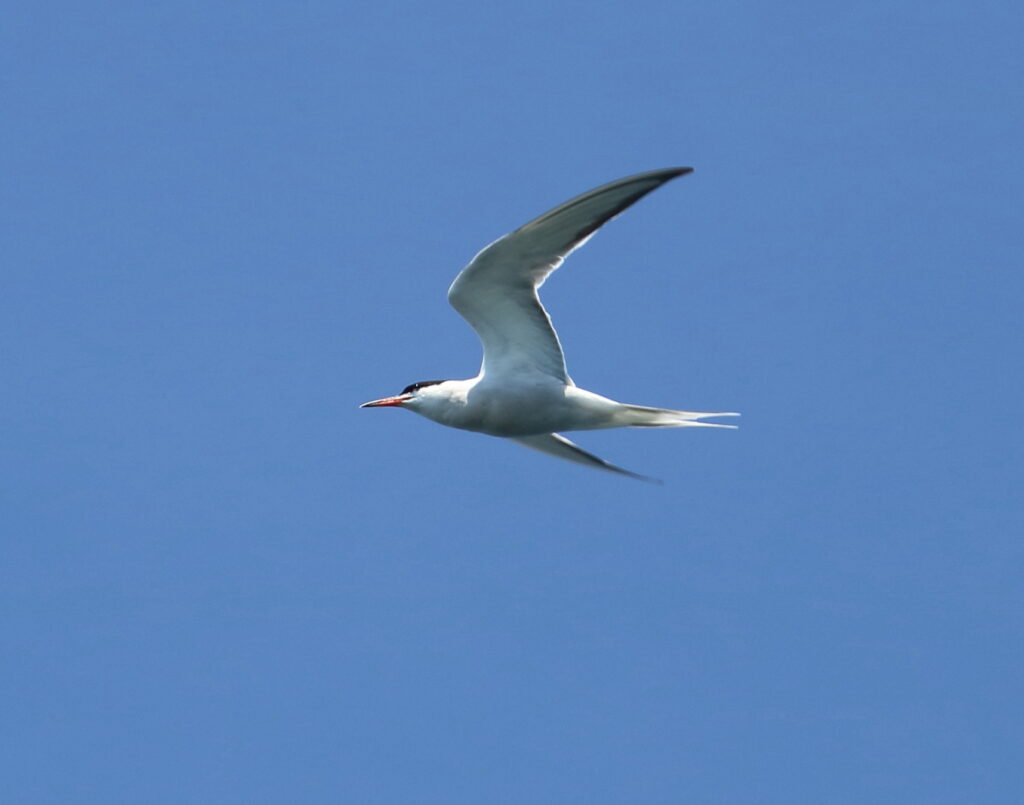
The puffins weren’t alone. Black Guillemots were here, too, as were a couple dozen Razorbills, another gorgeous black-and-white alcid named after the unique shape and decoration of its beak. I spotted a single Common Murre amongst their ranks, my fourth alcid of the day and a species that had not yet attempted to nest at Petit Manan—but scientists were optimistic! A dozen or so Common Terns circled the island loftily, letting out loud “kyeeeer” calls to notify everyone who was really in charge here. In a few weeks, the numbers of terns would swell into the hundreds, and include Arctic as well as Common. Terns were the aggressive defenders of islands, and would dive-bomb anything they perceived as a threat, including people. I remembered one walk in Iceland when we were asked to hold a tall, wooden stick so the Arctic Terns there would target that instead of our heads!
These birds are the reason that so many alcids nest at Petit Manan. The huge tern colony on this and other islands provide safety for the puffins from predators like gulls and Peregrine Falcons that might otherwise raid their nests. Of course, the biologists working for Maine Coastal Islands NWR were also there to aid these species and chase predators off the island. It hadn’t always been that way, unfortunately.
Common Terns nest in huge, aggressive colonies along the Maine coast!
A hundred years ago, feathered hats were all the rage in cities across the east coast of North America. The demand for white feathers meant that large numbers of terns, gulls, and egrets were harvested—to the extent that these species declined dramatically across much of the country. With no terns to protect them, puffins nesting in Maine were faced with higher predation, but not just from other birds. Rampant collection of eggs and puffin meat also plagued many of Maine’s islands, leading to a dramatic decrease in this species down to just two tiny colonies. Sadly, it was looking like the Atlantic Puffin would join the ranks of the Great Auk and Labrador Duck in Maine’s list of extinct birds.
Thankfully, ornithologists and bird-lovers alike noticed how much environmental damage was being caused by these practices and stepped in. Groups like Audubon formed and began lobbying for the protection of birds, eventually leading to the passing of the Migratory Bird Treaty Act of 1918. And in 1973, Audubon launched Project Puffin. Scientists were sent out to islands equipped with broadcasting equipment and decoys, as well as a small number of puffin chicks donated from colonies in Canada. Step one was the rearing of chicks on islands that had previously been occupied by puffin colonies; step two meant attracting terns back to the islands. Finally, with their defenders back in place, Atlantic Puffins began returning to many of the islands they’d previously been extirpated from. They now occupy six colonies in Maine.
Today, Atlantic Puffins are doing well, but are still being monitored very carefully. Puffins feed on fish that thrive in deep, cold water. That’s why the species only nests on the outermost islands in Maine. Our guide told us, “Puffins would lay their eggs in the ocean if they could.” Unfortunately, the Gulf of Maine is warming faster than any other body of water in the world, and this means that puffins are having to travel farther and farther out to sea to obtain their prey items of choice. During particularly warm years, puffins have switched their selected prey entirely to other species. Many of these other species of fish, which are brought back to their chicks on Petit Manan and other islands, differ in their size and the toughness of their skin. Often puffin chicks cannot eat them, and will starve even when food is sitting right there.
The man-made burrows where puffins nest on Petit Manan!
The good news is that there are many, many people keeping an eye on these birds, doing their best to keep their numbers high. Last year was an especially good year for the species, so optimism is in the air. I felt cautiously hopeful for the future of this species as the Bar Harbor Puffin Tour headed back to shore, content with the pictures and new memories I’d experienced with this iconic Maine species.