Category Archives: Ducks and Geese

Dynamic Spring Birding in Deer Lodge

Are you enjoying our posts? If so, we’d love it if you subscribe to FatherSonBirding by filling out the box down in the right-hand column—and urge your friends to sign up too :)!

When life hands you an opportunity—especially a birding opportunity—you’d better take it. We learned that the easy way last weekend when Phil Ramsey, dad of our birding buddy Nick, offered us a two-night stay at the Clark Fork Coalition’s amazing Dry Cottonwood Creek Ranch. Phil couldn’t join us, but on Friday Nick picked Braden and me up in his truck, and off we went.

Thanks to Montana’s abundant spring daylight, we reached Deer Lodge with plenty of time to bird and after a quick dinner at 4Bs, explored the back roads leading south from the prison. Nick’s top target for the weekend was a long-shot, Greater White-fronted Goose, while Braden especially wanted to see his first Golden Eagle of the year. Me? I had my own goal: Long-billed Curlews, a species Braden and I had seen only once before in Montana. Altogether, Braden figured that for the weekend we might pick up eight new year birds while I predicted ten.

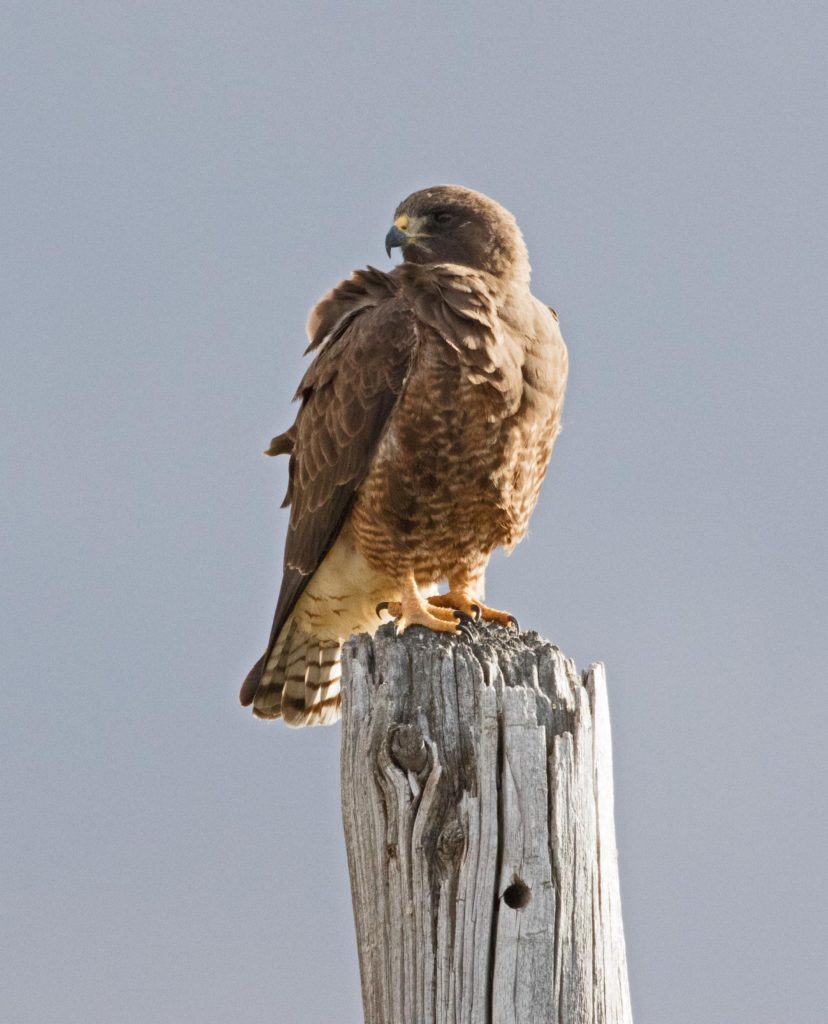
This was Braden’s and my first good look at an (intermediate morph?) Swainson’s Hawk and the bird cooperated beautifully, sitting on this post for a full five minutes.

As we drove, we spotted a number of nice, albeit expected, birds: Mountain Bluebirds, American Kestrel, and a scattering of ducks. We also got to observe a beautiful Swainson’s Hawk on a telephone pole—the first real surprise of the weekend. As we turned right, down a dirt road, however, I suddenly shouted “Look out there!” Sure enough, three Long-billed Curlews hunted insects under beautiful evening light. Before the evening was out, we would tally 20 more of these graceful bizarre-looking birds, a number of them dancing out their courtship rituals.

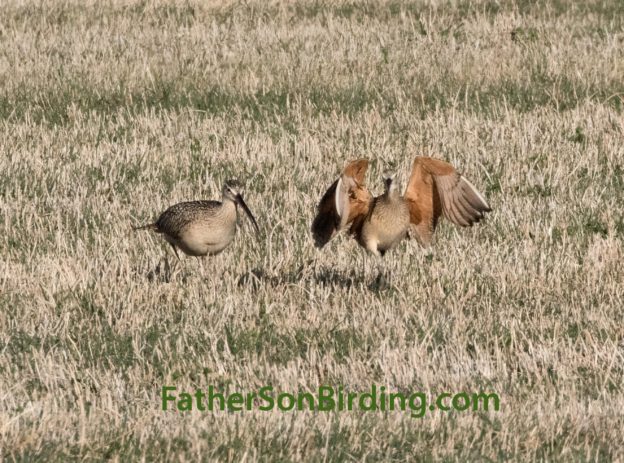
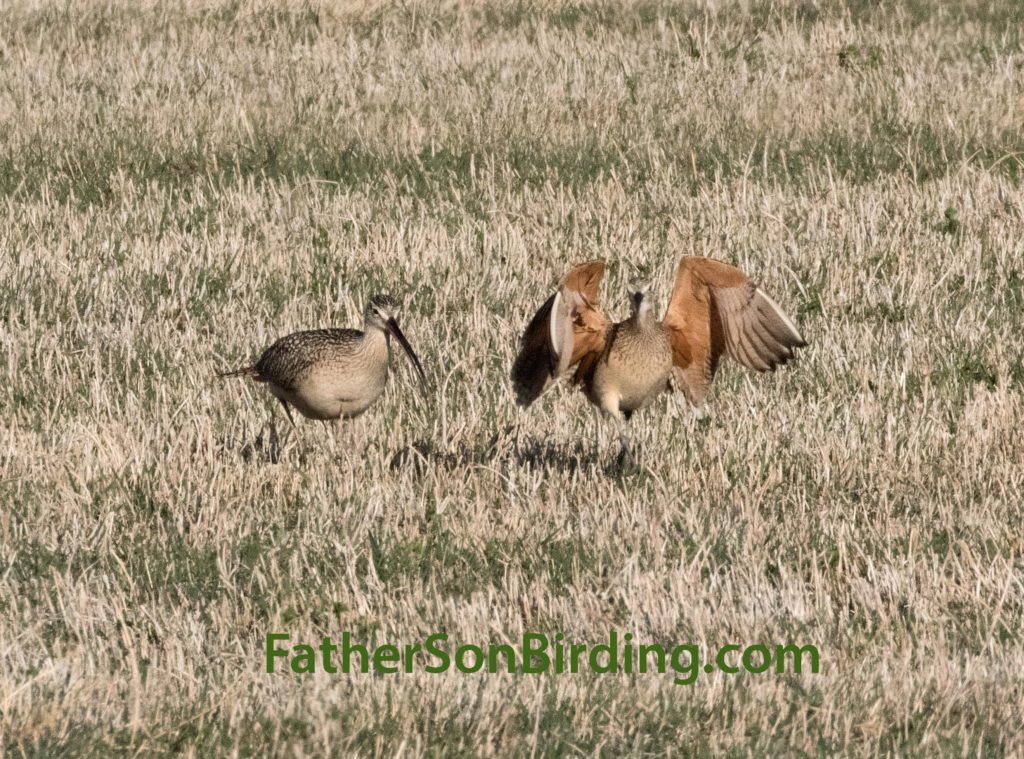
Several pairs of curlews were feeling especially frisky but the females seemed a bit antagonized by the attention. Maybe the males should have opted for dinner and a movie?

Part of the weekend package was a personalized tour of the ARCO superfund ponds with Gary Swant (see post “For Birders, Every Year is a Big Year”). Nick, Braden, and I had been lucky enough to bird with Gary the last Christmas Bird Count, but we were eager to see how spring species differed from the area’s winter visitors. As expected, waterfowl were out in full force—including Eared, Horned, Western, and Red-necked Grebes. We enjoyed Red-breasted Mergansers and Nick spotted a Sora, but the real surprise was the number of loons—eight, all told. “That’s easily the most we’ve ever seen together,” Braden exulted.

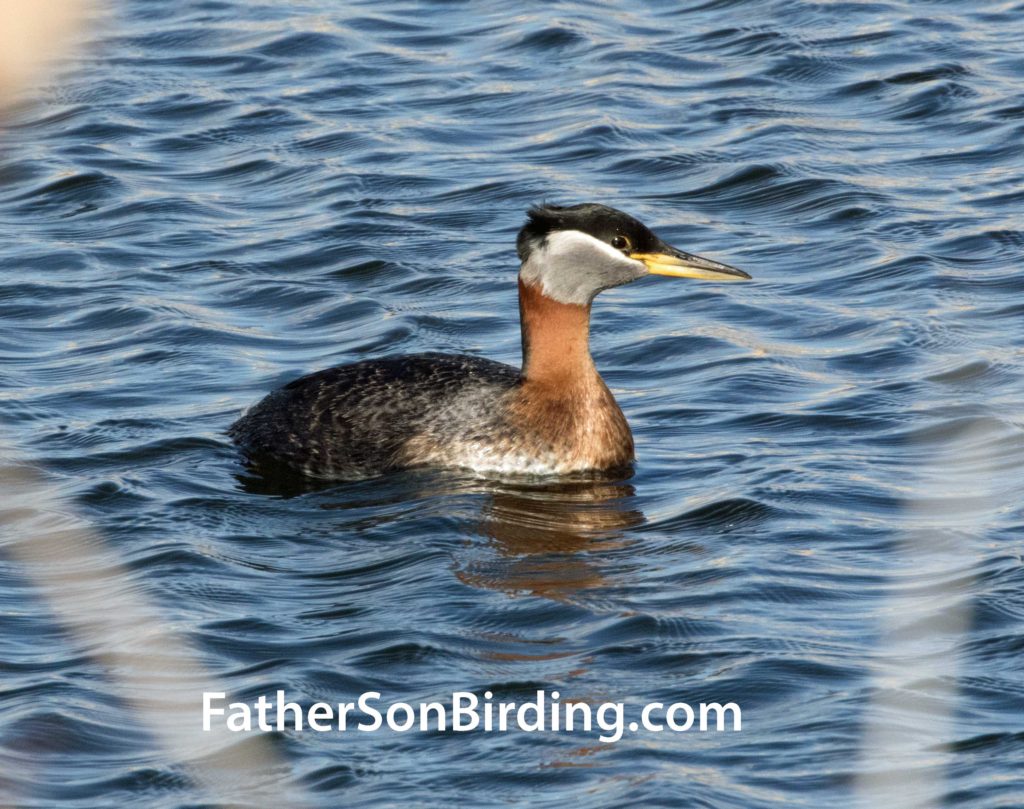
We saw at least twenty Red-necked Grebes during our day with Gary—and enjoyed every single one of them! It’s easy to see why.

Leaving the ponds, Gary took us to a place near Anaconda that we’d never birded: Dutchman’s Slough where, within minutes, Braden nabbed his top weekend target, Golden Eagle. Then we noticed three wading birds in the distance and assumed they must be more Long-billed Curlews. One of them was, but the other two were something we’d never seen: Marbled Godwits in the middle of a grassy field! After bidding a fond farewell to Gary, we rounded out the day with one more great score—Solitary Sandpiper in a large puddle on the south edge of Deer Lodge.

We were sad to be leaving the next morning, but an unseasonal snow storm urged us home. On the drive, however, we decided to stop at Rock Creek, the site of Braden’s Eagle Project (see post “Five Valleys, Many Birds”). Almost as soon as we got out of the car, we spotted three more stunning year birds: Chipping Sparrow, Hermit Thrush, and shockingly, Lark Sparrow. The latter two were most likely just migrating through and we felt lucky to nab them as they often prove difficult to find in Montana.

The Clark Fork Coalition’s Dry Cottonwood Creek Ranch proved the perfect HQ for birding the spectacular Deer Lodge Valley.

So how did we do for the weekend? Well, we shattered our estimates for how many new year birds we might see, adding more than twenty to each of our lists. More important, the trip drove home a lesson for every birder: during spring migration, anything can show up—and does! Well, except for the elusive Greater White-fronted Goose! Sorry, Nick.

Big Day Mentality

This is the Big Day Mentality: Every species, no matter how rare, is worth one tally. During a 24-hour period, a team of birders try to collect as many tallies as possible; the end total is the sum of every single bird species seen or heard during the day by at least two members of the team. At the San Diego Birding Festival, my dad and I were invited to be “first lieutenants” on two Big Day field trips.

We co-led our first outing under the expert leadership of veteran birder Phil Pryde, a local San Diegoan who had an ambitious schedule planned out for the day, in order to maximize the amount of species we saw. From dawn to dusk we scoured San Diego county, which is larger than Delaware and Rhode Island combined; a bird only counted if one of the leaders and one of the participants identified it. By the end of the day we had arrived at a total of 113 species, and my dad and I at just over a hundred individually. The number wasn’t bad, and the day had given us a rough idea of how many birds to expect for the next Big Day. Overall, though, the day hadn’t been very “birdy”—we had missed quite a few common species.

At Lindo Lake we spotted several pairs of the most photogenic Wood Ducks we had ever encountered!

On our next Big Day, under the guidance of our good-natured chief, Eitan Altman, we were determined to break this record. Unfortunately, the conditions didn’t look good—a low, wet mist had rolled over the area. Thanks to the rain, we didn’t have to rush inland to get early-morning songbirds (they were probably huddled in their warm, dry nests with no intent on warbling at the weather), so we birded along the coast at a relaxed pace. While doing this, we saw an unexpectedly high number of species, including Common Loon, Surf Scoter and Brant, which had not been a guarantee, a huge flock of Black Skimmers, and rarities such as Glaucous-winged Gull and the well-known Reddish Egret which hung out in the San Diego River Estuary. The eccentric bird’s gait reminded me of Kramer from the TV show Seinfeld.

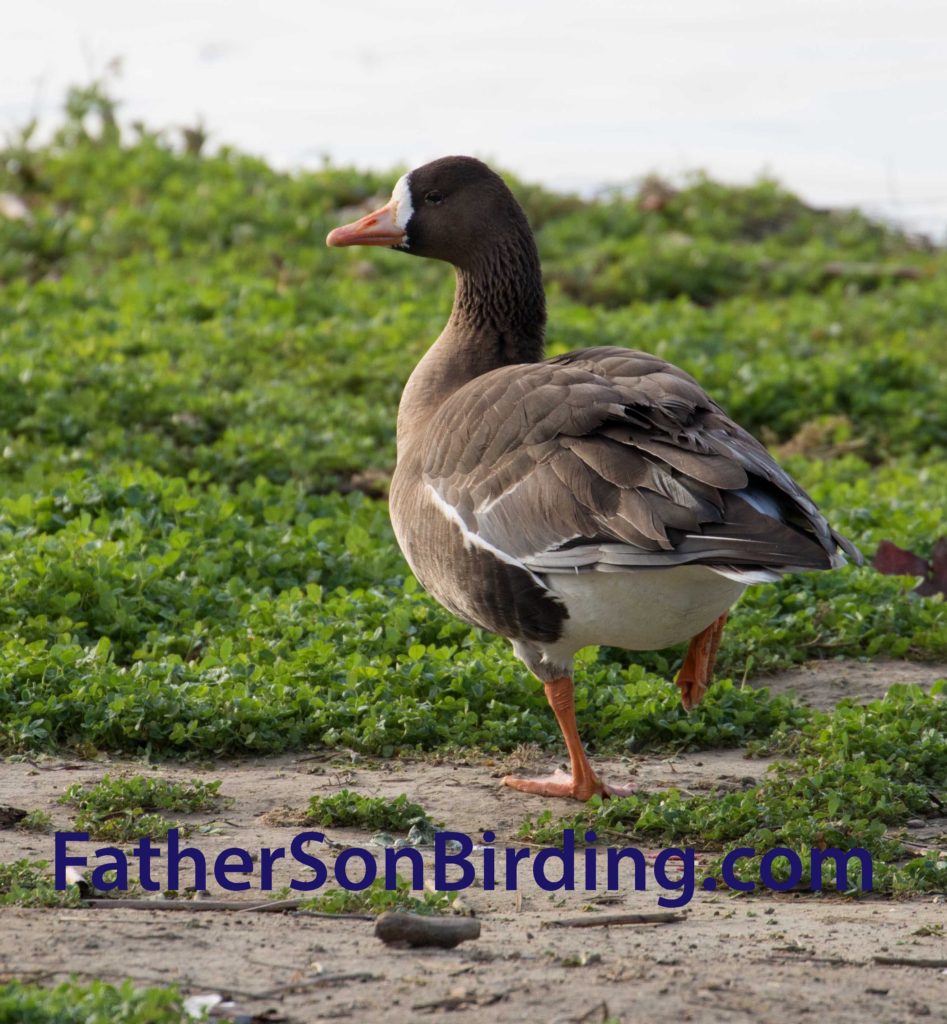
This Greater White-fronted Goose is a regular at Lindo Lake.

Finally, around nine in the morning, we headed inland to Lindo Lake, the place which had yielded the highest number of species to us on the previous Big Day. We tallied high numbers of waterfowl, woodpeckers and more, including some more rarities: the resident Greater White-fronted Goose hanging out with a flock of domestic geese, not one but two Yellow-bellied Sapsuckers, and a Bonaparte’s Gull that had somehow wound its way inland.

We continued hitting different habitats to nab species, and by three in the afternoon our total sat at 120 species, the most recent being an altitudinally-challenged Band-tailed Pigeon, a calling Canyon Wren and the ever-rare American Robin. As soon as I confirmed our total, Eitan began thinking of other species we could pick up, now determined to beat his personal record of 128. On our way back to the coast we stopped at places to grab specific birds, including White-tailed Kite and Greater Roadrunner. The tide was out now, and at the San Diego River Estuary we grabbed another six species, though unfortunately none of the rarities being reported there (Tricolored Heron, Mew Gull, Eurasian Wigeon) except the spunky Reddish Egret and a beautiful double rainbow.

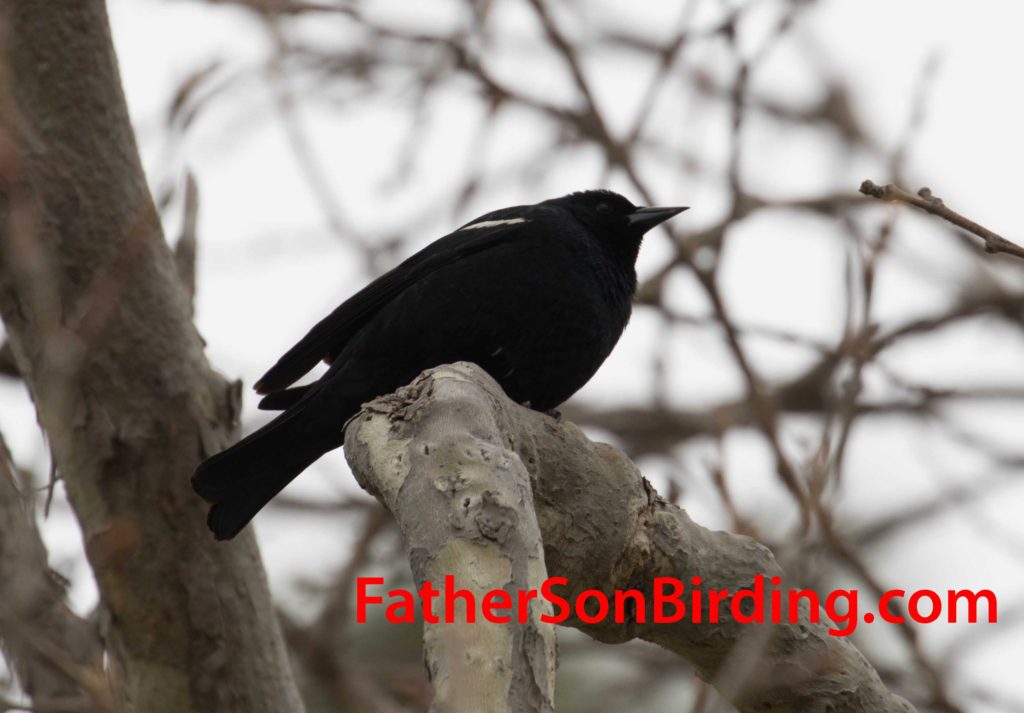
We spotted a wintering flock of blackbirds at Lindo Lake, including many Tricolored Blackbirds, a California endemic.

As the day grew closer to our deadline of five o’clock, we opted to try and get a few last birds at a place called Fiesta Island, arguing over possible birds:

“Was that a Northern Harrier?”

“I don’t think so.”

“Are you sure?.”

And finally, right at the entrance to the island we hit 130 with a Spotted Sanspiper bobbing along the rocks of the coastline. A pair of American Kestrels on the actual island sealed the deal.

We finished the trip, said our goodbyes, then responded appropriately to our biggest day ever by collapsing into bed.

Birding the Mexican Border

Due to the continuing onslaught of Russian hackers (aka jerks), we’re experimenting with how best to handle new subscriptions. If you’d like to make sure you get subscribed please shoot us an email at collard@bigsky.net with your name and email address and we’ll put you on. You can also use the subscription box down in the right-hand column. Thank you for following us—and for your patience with this crazy world!

Listen to our interview with Sarah Aronson on Montana NPR’s “The Write Question” which aired Thursday, March 7!

Last week, Braden and I had the opportunity to attend the San Diego Bird Festival and do some of the most intense—and fun—birding of our lives. The festival will undoubtedly fill several posts, but before it began, we wanted to do something we’d been thinking about for at least a year—bird the California/Mexico border.

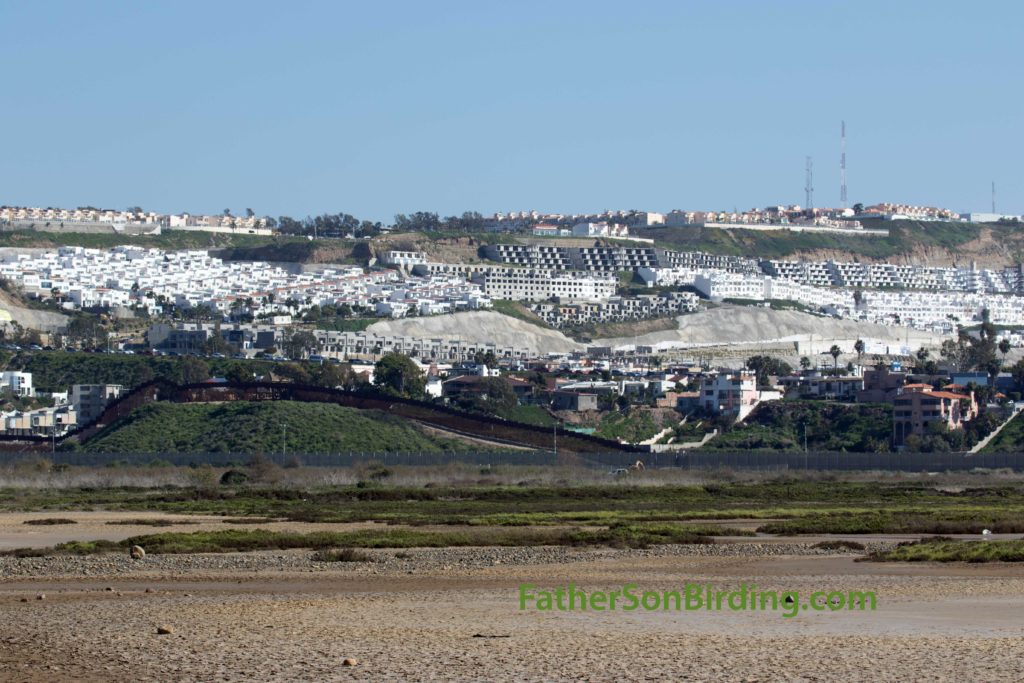
The border couldn’t have provided a greater contrast between the open wetlands and scrub on the U.S. side and the bustling city of Tijuana right across “la frontera.”

Because of a missed connection, we didn’t reach San Diego until 1 p.m., but we picked up our rental car and made a beeline down I-5 toward Tijuana. Our destination was the actual spot where the border meets the Pacific Ocean, and we weren’t sure how close we could drive. We ended up in a parking lot about a mile east and north of our destination and began trekking along a dirt road heading toward the ocean. It was a surreal experience as helicopters circled overhead—Navy fliers, evidently, training for duty—and the city of Tijuana pulsed just beyond the formidable border wall a mile to the south. Around us, though, stretched intertidal wetlands and fields, where we picked up Savannah Sparrows and meadowlarks and collected a number of duck species and a lone Eared Grebe.

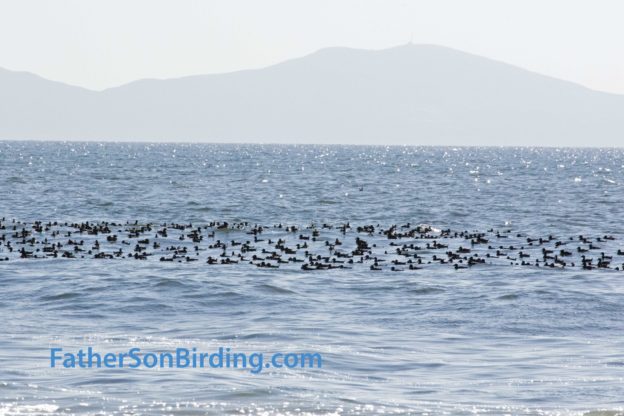
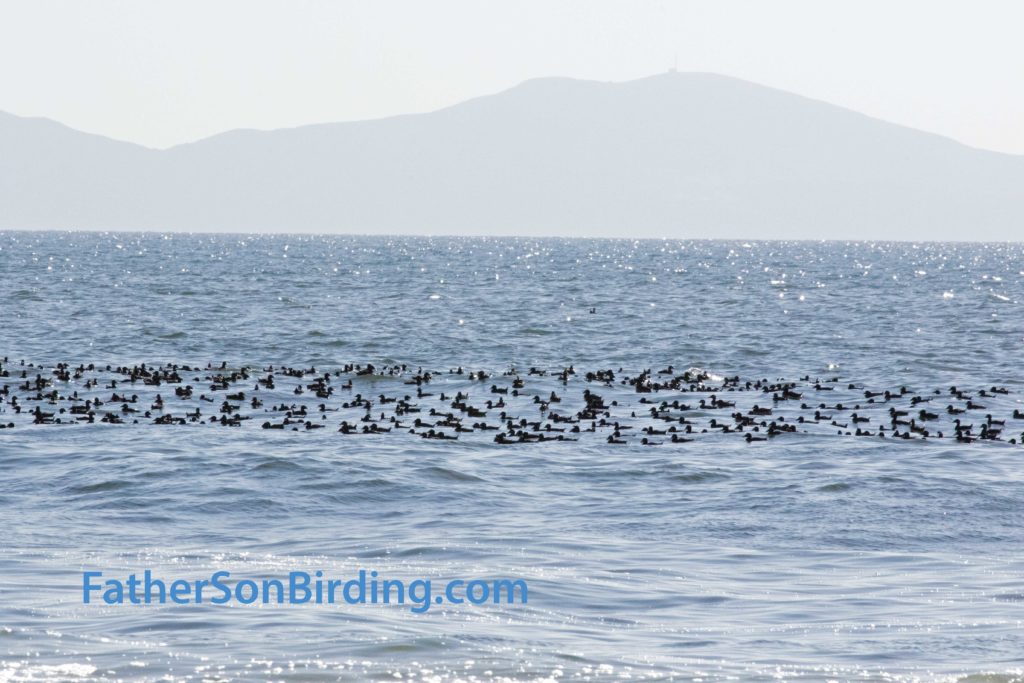
This group of 500 Surf Scoters delighted us—especially when Braden identified a Black Scoter among them! Note Mexico’s Coronado Islands in the background—an important nesting site for Scripps’s Murrelets.

After hitting the beach, we headed south, the border fence looming in the distance. Almost immediately, we got a great surprise—a group of 500 or so Surf Scoters floating just offshore. For we Montana boys, this was a true delight—made even more so when Braden discovered a Black Scoter in one of his photos! We were hoping to go all the way to the fence and talk to some folks on the Mexico side, but a stoic Border Patrol agent shooed us back.

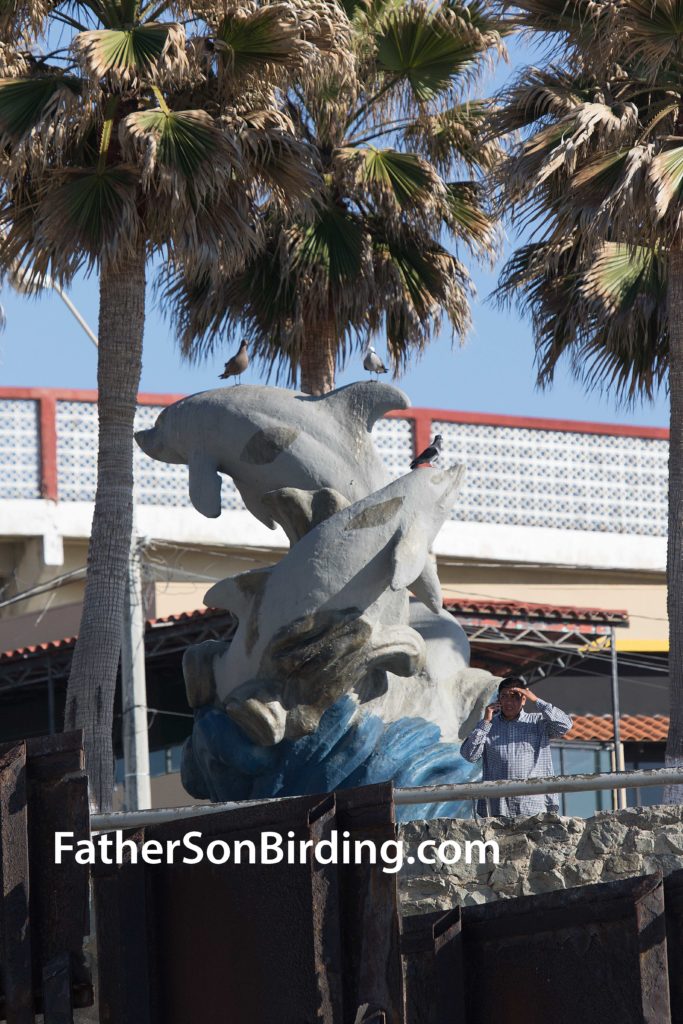
The two Heermann’s Gulls on top of these dolphins were vaunted additions to our Mexico list!

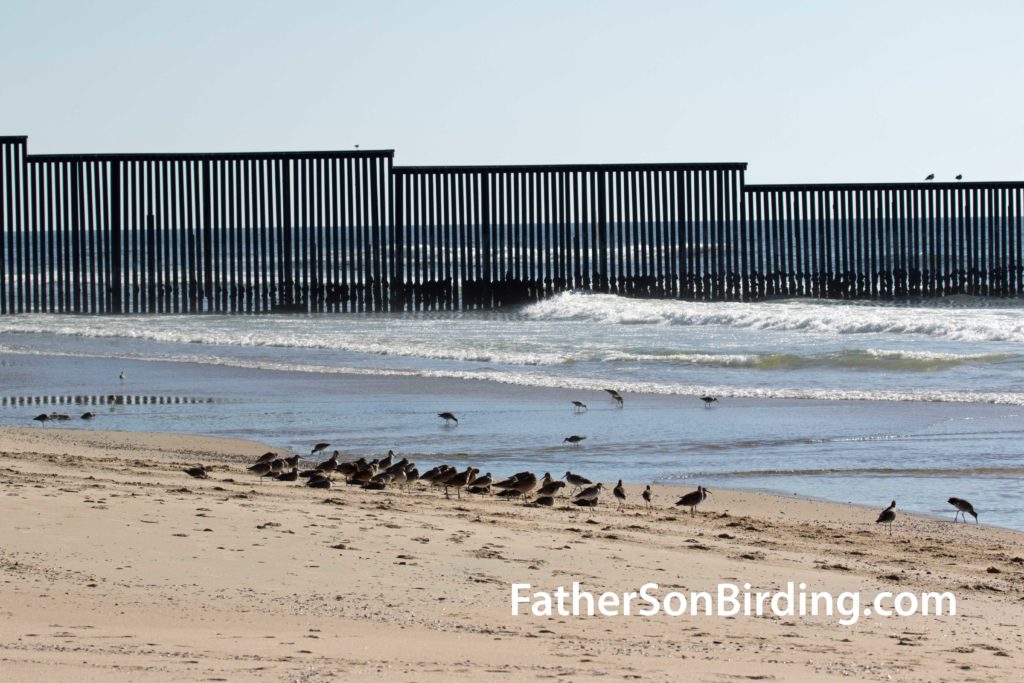
Undaunted, Braden said, “Let’s start a Mexico list,” so we spent half an hour watching birds perching on the border fence and flying between nations—without passports! President Trump would have been furious. In all, we tallied seven Mexico species: Rock Pigeon, Willet, Heermann’s Gull, Western Gull, Ring-billed Gull, European Starling, and a lone Willet sitting on the fence. Oh yeah, and a group of twenty Surf Scoters who had drifted across the border without a care in the world!

Next Up: San Diego Big Day #1!

These Willets weren’t the only birds who totally ignored our artificial geopolitical boundary. Go Willets!

Birding San Antonio’s River Walk? Are You Nuts?

To Subscribe to FatherSonBirding—and nothing else—please fill in your email address in the box down in the column to your right. Thanks!

If you’ve ever visited the downtown River Walk area of San Antonio, you’d be forgiven if you viewed it as less than a premier birding destination. Grackles, starlings, pigeons, and freakazoid hybrid ducks that grew up too close to Chernobyl overrun the place. Still, as a birder, I felt obligated to give it a legitimate chance, so on my work trip last weekend, I determined to explore the River Walk’s distant outposts.

From our recent trips to Texas and Georgia, we are learning just how well Red-shouldered Hawks adapt to an urban lifestyle. A big thank you to my daughter for letting me steal her point-and-shoot camera for the trip!
How many margarita-wielding tourists do you suppose notice this Red-shouldered nest?

Day 1: Even before leaving the main tequila-drenched tourist loop, I caught a surprising shape flashing above the river and landing in a nearby tree. I hurried to the top of a bridge for a closer look and, sure enough, IDed a Red-shouldered Hawk surveying potential prey (tourists?) below. Its mate soon swooped by and I located their nest in a tall palm near the junction of Commerce Street. “Whoa! Good start,” I thought to myself, but more surprises awaited me.

In the nearby Villita market area, I picked up Blue Jays, White-winged Doves, mockingbirds, and an unanticipated Orange-crowned Warbler diving into a drainage grate. Then, joining the main river, I began working my way downstream to meet a trio of Double-crested Cormorants near a small dam. “What the heck are they doing here?” I asked, astonished—but then found seven Neotropic Cormorants nearby! Before hurrying back to my conference, I rounded out my three-mile expedition by picking up Yellow-rumped Warblers, Ruby-crowned Kinglets, Northern Cardinals and my biggest prize of the day, a Lincoln’s Sparrow co-mingling with some House Sparrow hoi polloi.

Even though I saw them on the eBird checklist, the presence of cormorants on the uber-engineered San Antonio River caught me by surprise.

Day 2: After delivering a keynote address at the wonderful TCTELA conference, I had nervous energy to burn so decided to skip lunch and head directly upstream. As on the previous day, the farther I got from downtown, the better the habitat, and the better the birds. I saw some of the same species as the day before, but was delighted to flush six Inca Doves and a Yellow-rumped on the grounds of the San Antonio Museum of Art while two Black Vultures circled overhead.

I hadn’t intended to hike all the way to Brackenridge Park (about three miles each way), but am glad I did. In oaks along the trail, a Rufous Hummingbird landed next to me and I spotted an elusive songbird of some sort moving through the trees. I spent five minutes trying to get a clear view, and then . . . Blue-headed Vireo! Only my second one ever! In the marsh at the south end of Brackenridge, I added a lone Egyptian Goose, an Eastern Phoebe, and a Great Egret to my growing list. Then, I saw a startling splash of red fly to a nearby branch. Vermillion Flycatcher!

Okay, I admit it. When I saw this Egyptian Goose, I at first thought it was a Black-bellied Whistling Duck. In my defense, it was only the second time I’d seen these guys!

The lesson? Once again, that birding never fails to surprise and please, and can turn any trip into an adventure. After returning to the main tourist area, I decided to reward myself for my exploits with cheese enchiladas and a Corona, all the while gazing up at the flights of grackles and starlings above me.

Up next: my report on my first Uber ride and San Antonio’s Botanical Gardens—if Braden doesn’t come up with something even better!

Winter Birding at Brazos

It was Saturday, November 17 and I have to admit I was feeling a bit down on myself. Before my work trip to Houston, Braden had set a goal for me of 100 species, something I thought I could easily achieve. My visits to Anahuac and Bolivar Flats, however, had left me only at 75 confirmed species—well short of my goal. With only one free half-day left of my trip, I searched the eBird hotspot map and asked myself, “Where could I score big and still get back to my last book signing on time?” My eyes landed on Brazos Bend State Park.

Alligators seem to be the main attractions at Brazos Bend, but the birds are far more interesting!

The official motto of Brazos State Park is “Come for the gators, stay for the birds.” Okay, I’m making that up—but it should be the motto because the birds are far more interesting. On the recommendation of the park attendant, I kicked off my visit with a counterclockwise circumambulation of 40 Acre Lake. The lake surface held far fewer species than I had predicted: coots, Common Gallinules, Pied-billed Grebes, and only two duck species—Blue-winged Teal and Black-bellied Whistling Ducks. Herons, Anhingas, Cormorants, and other water birds abounded, however, and as I walked, I started picking up some prized forest birds as well.

I first saw a Pine Warbler on Braden’s and my Texas trip in January, so seeing one again was like seeing an old friend.

Before my trip, I had hoped to see all three wintering warblers in the area: Yellow-rumped, Pine, and Orange-crowned but had only spotted the Yellow-rumped earlier. Within fifteen minutes, though, I happened upon a great mixed flock where I picked up my missing two warblers—and Golden-crowned Kinglets to boot! A little while later, I saw a pair of Vermillion Flycatchers—my first ever in Texas. It was a good start, but I wanted more!

Vermillion Flycatchers were a real surprise at Brazos, but I guess they shouldn’t have been.

Driving to Elm Lake, I decided to bushwack through some promising forest across from the parking lot. I could hear a variety of birds there, but needed to see them for the IDs. The birds made me work for them! First, I found the noisiest birds—a pair of Carolina Wrens. Then, I happened to see a Blue-gray Gnatcatcher. I could see something else, but dang it, the bird just kept flitting out of my vision. I thrashed through the brush until I finally managed a decent ID shot with my camera. Slather me in BBQ sauce! It was a Lifer: Blue-headed Vireo! I was elated, and minutes later I scored a Year Bird, Yellow-bellied Sapsucker!

I was tickled to ID this Blue-headed Vireo myself. I didn’t even realize it was a Lifer until Braden later pointed it out to me! Number 778!

Afterward, I hiked the two miles around Elm Lake, but except for some impressive gators, it was fairly unproductive. I didn’t mind. I was thrilled with my “birdservations” for the day. Which I’m sure is leaving you all wondering: did I reach my 100-bird goal? Alas, no. Five species short. But I had discovered a wonderful new birding location, a place I was sure to return.