Author Archives: admin

Owl Opportunity

See Sneed read from his book Woodpeckers and Warblers at River Oaks Books in Houston, November 17 at 3 p.m. and at The Well-Read Moose in Coeur d’Alene (Idaho) on November 23 at 6 p.m.

On Thursday, November 8th, my friend Eli and I were in the middle of a heated game of “Cup of Bluff” when my phone began going off. I saw that it was Nick and answered it.

“What’s going on?”

“Shh!” He was whispering.

“What?”

“I am at the Gravel Quarry standing, like, ten feet from a Saw-whet right now! Get your dad and get down here!”

He hung up and texted me his exact location. I raced upstairs and into my dad’s dark bedroom, abruptly waking him up from a nap. I told him the news. He yawned, and said, “Well, get your stuff! Let’s go!”

We rolled out of the house 10 minutes later, when Eli started his piano lesson with my mom. Nick was waiting for us at the Quarry, and as we pondered which routes would get us there the fastest, he sent us constant updates. According to him, it seemed like every bird at the Quarry was trying to make us miss the owl:

“A shrike just flew in and scared the owl, but it’s still in the same bush.”

“A mob of chickadees is trying to attack it! No!”

“Don’t let the Merlin distract you on the way in—go straight to the owl.”
This last thing was going to be particularly hard, as my dad still did not have Merlin for the year. Fortunately (and a little unfortunately), when we finally arrived, the Merlin was nowhere to be seen. We tiptoed down the hill into the forest section, and spotted Nick and his mom staring at a tree.
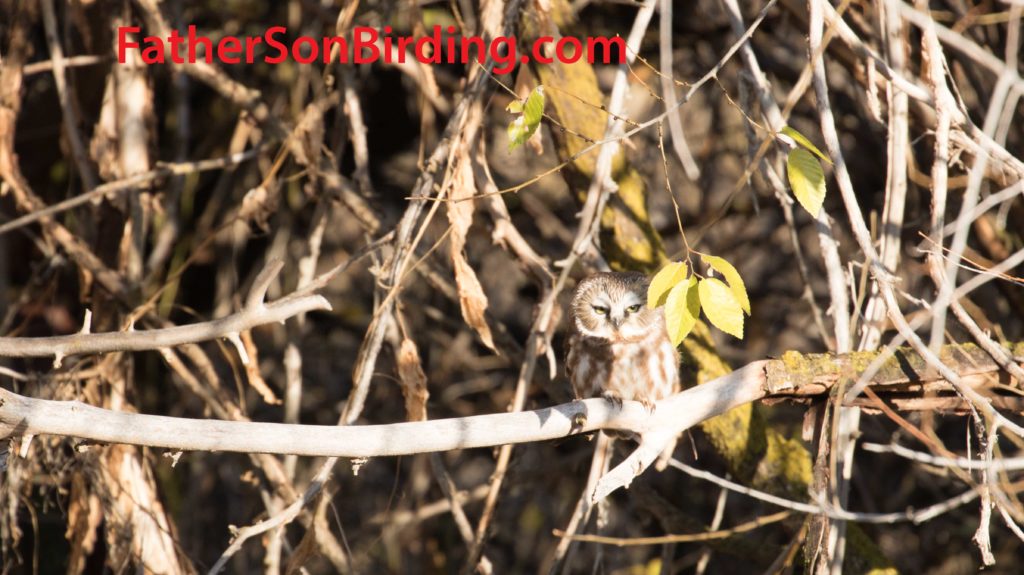
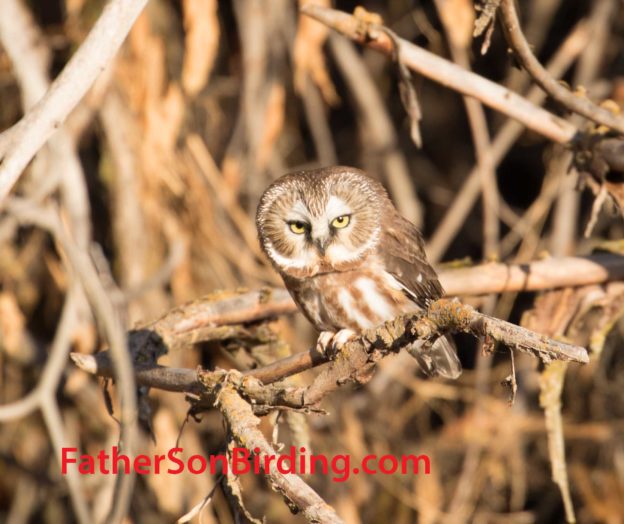
Though bored-looking, this Saw-whet was actually one of the most active owls we’ve ever seen!

“Look,” he said pointing straight into the tangle of branches, “See that puffball? That’s the bird.”

We looked right through and saw what Nick was calling the Northern Saw-whet Owl. It was looking away from us, but we could still sort of identify it. The view disappointed us, though, and my dad went around back of the tree to attempt some photos.

After about five minutes, the owl suddenly cocked its head and flew closer to my dad. We quietly joined him, and saw that the owl was now wide awake and perched in full sunlight.

“This is what he was doing when I first saw him,” whispered Nick.

“Look, there must be a mouse under there,” I said.

The Saw-whet’s eyes was intently following the rustle of leaves beneath him. Suddenly, he dove and retreated back to his previous spot within the bush. He hadn’t gotten the mouse, though, and eventually came back out into full view, his warm brown streaks and adorable golden eyes highlighted by the light of the sunset.

After about a half hour of photographing and staring at this new lifer, we left him alone.

The Gravel Quarry had scored again.
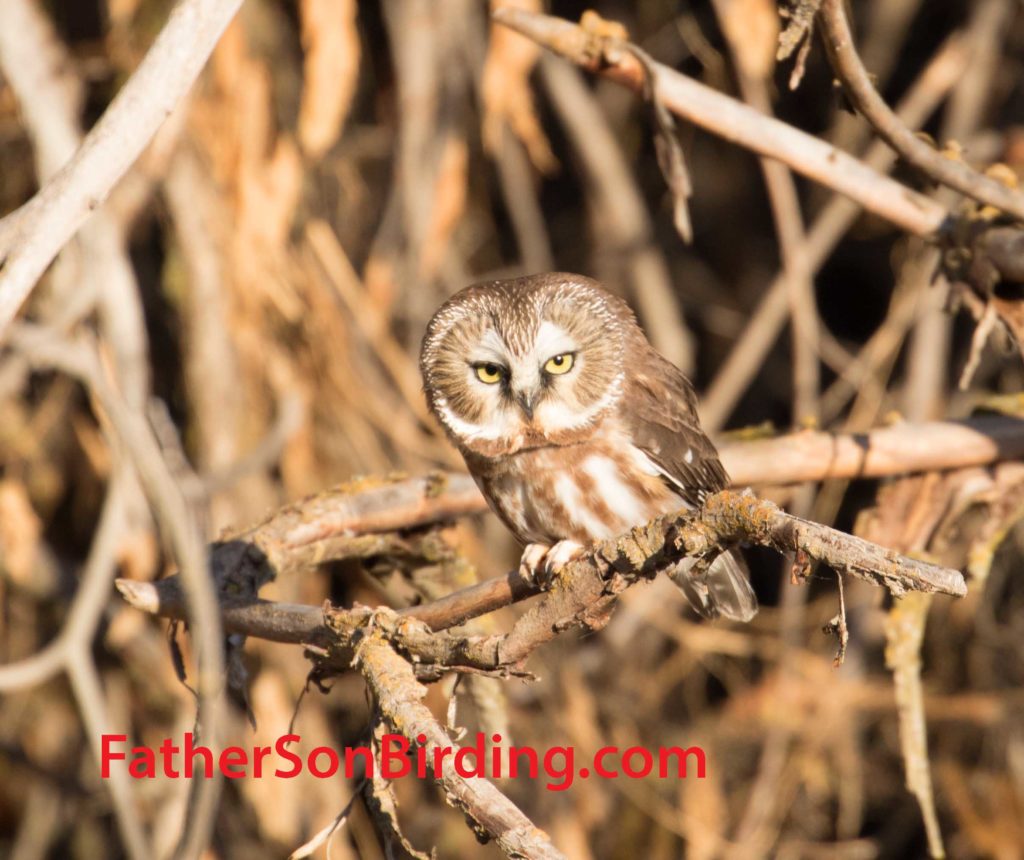
Northern Saw-whet Owl–another nemesis ticked off, and another great experience!
 

Fall Surprises

Fall birding can be tough—at least in Montana.

I just completed a five-day return trip from Missoula to Billings, mainly to promote my new book Warblers & Woodpeckers, and I have only question: Where were the birds? Sure, I found some, but with much lower abundance and diversity than I expected. Even at places I’d seen a lot of fall species before, my best lists barely cracked a dozen. I would have notched more if I’d been better at identifying LBBs—Little Brown Birds. For instance, I took photos of a sparrow at Shiloh Conservation Area in Billings and glimpsed another intriguing group at Two Moons Park, but couldn’t ID any of them.

Lousy, no-good rotten sparrows.

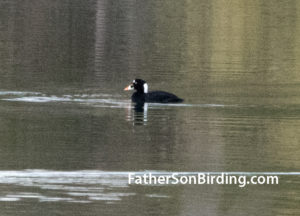
Our first-ever Montana Surf Scoter—to be followed by a second one (a female) a few days later.

I shouldn’t really complain since Braden and I have seen some wonderful birds the past few weeks. About two weeks ago, we saw our very first Montana Surf Scoter at one of our favorite birding spots, the gravel quarry. The bird was a stunning black male and just what such an ocean-loving bird was doing in Montana is a matter for debate. Since we started birding five years ago, however, scoters seem to be rare but reliable visitors.

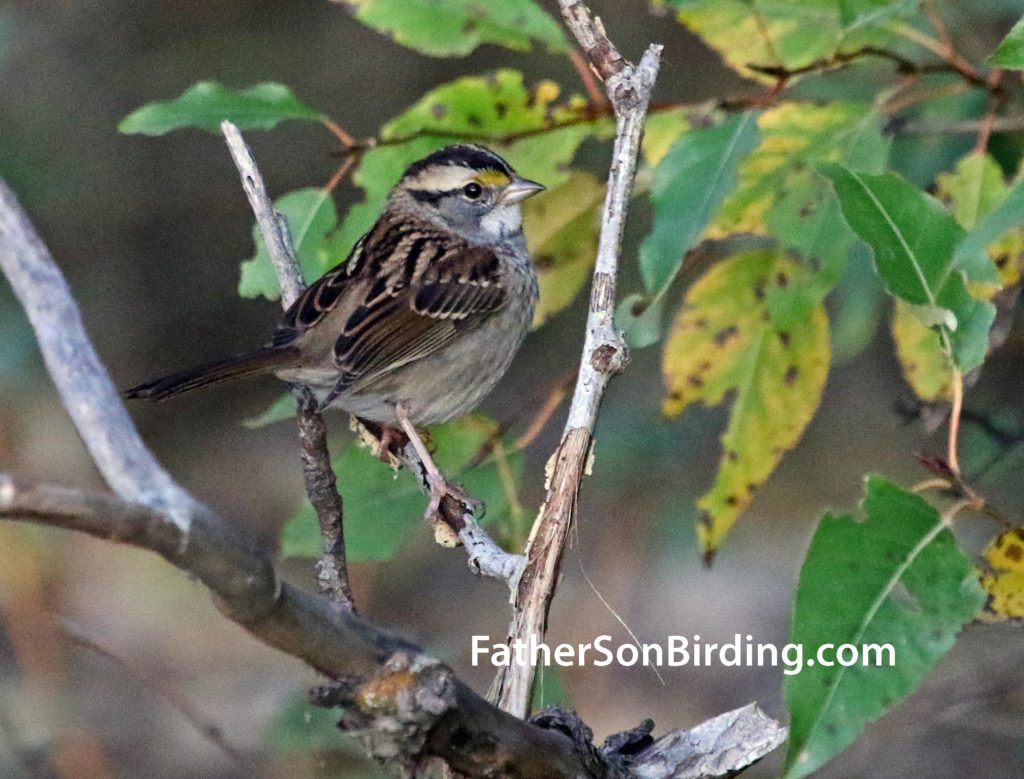
A few days later, I was giving Braden a driving lesson in the parking lot of the Rocky Mountain Elk Foundation. After practicing parking thirty or forty times, I said, “C’mon. Let’s grab our gear and go see if any birds are around.” Not five minutes later, Braden spotted not one, but two White-throated Sparrows. Normally Eastern birds, these are real finds for Missoula and can only be spotted with diligent effort—and a lot of luck—during fall migration.

This was only our second location seeing White-throated Sparrows in Montana. A delightful surprise!

Alas, we’ve seen fewer warblers and other fall migrants than last fall, and that was reinforced on my trip across the state. I saw a smattering of good ducks (Redheads, Barrow’s Goldeneyes, and Ruddy Ducks) at Warm Springs, Three Forks ponds, and Lake Elmo State Park. I also spotted a Common Loon at Three Forks, and a nice variety of Western, Horned, Eared, and Pied-billed Grebes in most places I looked. But songbirds? They seemed to totally shun me on the trip.

When I returned home, I shared my photos with Braden. As we flipped through them, he nodded and politely murmured, “Nice. Uh-huh. Good one.”

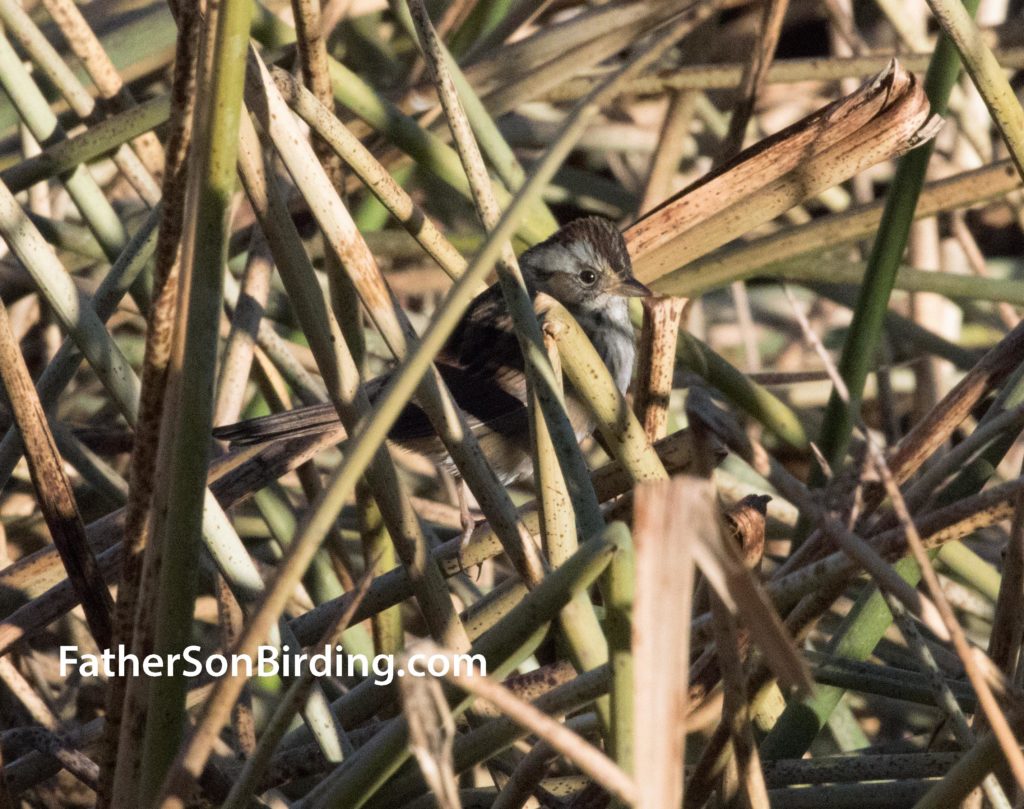
Until I came to that mystery sparrow from Shiloh.

“Whoa. Wait a minute!” he exclaimed, opening Sibley’s. “Now I’m excited.”

“Why? What do you think it is?” I asked.

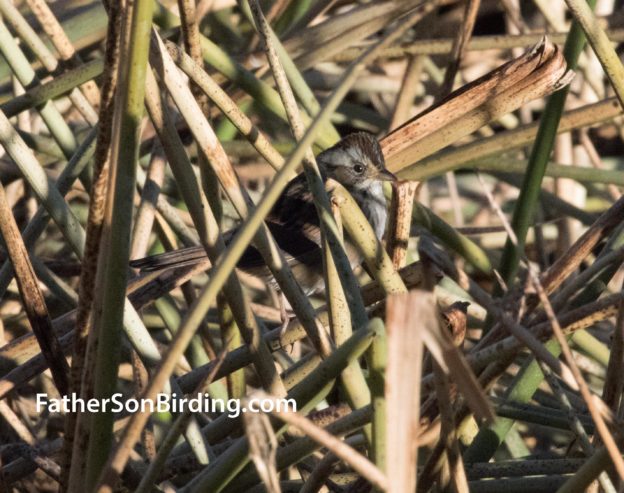
There are only about fifty records of Swamp Sparrows in Montana. Lucky me, this one decided to say hello!

“What do you think it is?” he countered.

“I couldn’t decide,” I said. “It looks kind of like a Song Sparrow, but doesn’t have the stripes. I thought maybe Lincoln’s, but it doesn’t have the orange colorings.”

Braden handed me Sibley’s. “I’m pretty sure it’s a Swamp Sparrow. They’re like, Code 4 for Montana.”

Now, my adrenaline was pumping too. “Really?”

We pored through the descriptions and compared it with my photos. Not only did the bird look identical to its description and illustration, I had found it in just the kind of habitat that Swamp Sparrows love.

Maybe fall birding in Montana isn’t so bad after all!

A Book About Our Big Year

Catch Sneed’s upcoming book events (also see list to the right)


Nov. 17: River Oaks Books, Houston, TX 3-5 p.m.
Nov. 23: The Well-Read Moose, Coeur d’Alene, ID 6-7:30 p.m.


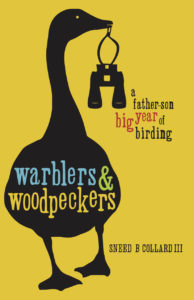
I am happy to announce the release of my very first adult book, Warblers and Woodpeckers: A Father-Son Big Year of Birding from Seattle-based Mountaineers Books. “But wait a minute!” some of you might be asking, “What the heck is a Big Year?” As most avid birders can tell you, a Big Year is a birder’s attempt to see as many species as possible in a calendar year in a specified area—usually the ABA Region which, with the recent addition of Hawai’i, is now defined as the fifty U.S. states and Canada.

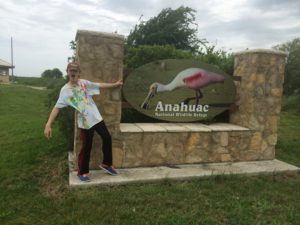
Braden at Anahuac NWR during our epic Big Year trip to Texas.

My new book documents Braden’s and my Big Year of 2016, a year which saw the ABA Big Year record shattered. No, we didn’t shatter the record. While semi-professional birders criss-crossed the country in pursuit of more than 780 bird species, Braden and I set much more modest goals. We simply wanted to see as many birds as we could on our very limited budget. Still, our year was filled with adventure, humor, terror, and yes, birds. Here’s what the recent book review in Kirkus magazine has to say:

“What makes this big-year book different is the father-son bonding element. A proficient storyteller, Collard writes with style about their travels together in 2016 around Montana, where the author lives (Missoula), and to Arizona, Texas, and California…”

Some of the highlights of our Big Year included seeing extreme rarities such as a Tufted Flycatcher and California Condors; getting attacked by killer bees in Arizona; surviving a hundred-year flood in Texas; and meeting other birders everywhere we went.

Seeing California Condors flying free was a moment of a lifetime and one of the highlights of our Big Year adventure.

How many species did we see? Well, you’ll have to read the book to find out, but doing a Big Year is something Braden and I highly recommend to beginning and advanced birders alike. Not only does it teach you to be a much better birder, but you discover spectacular nooks and crannies of our nation that you might never ever visit if it weren’t for the pursuit of birds.

Meanwhile, I hope that some of you can catch me at my signing events in the next two months. A complete schedule is listed to the right. Thanks for reading, and keep birding!

Order Warblers and Woodpeckers now!

The Land of 10,000 Birds—and Deep-fried Snickers Bars

This year my daughter Tessa and I decided that for our daddy-daughter trip we should take Amtrak to the Land of 10,000 lakes. You got it. Minnesota! Our primary purpose was to visit my brother, his wife, and their two-year-old son, but we also timed our visit for an event I’d always wanted to see: the Minnesota State Fair.

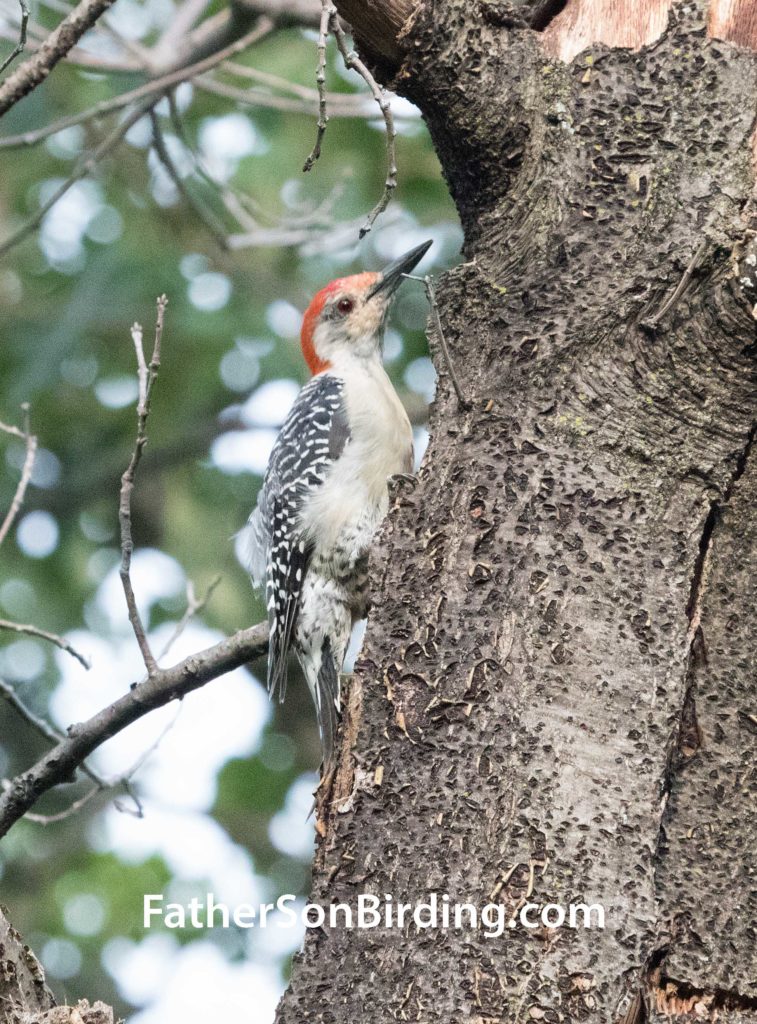
For us Westerners, Red-bellied Woodpeckers are always a treat and I was glad to see a few during my week in Minnesota. (Photo by Sneed B. Collard III)

I must be clear: this was not a birding trip, but as always, birding opportunities presented themselves and I came prepared. Especially since it was fall migration, I arrived in Minneapolis hoping to see a slew of warblers and other songbirds not easily found in Montana. My first morning there, while Tessa slept in, I stole my brother’s car and headed to a promising eBird hotspot, Westwood Hills Nature Center. I arrived optimistically, a feeling that blossomed when I encountered a group of birders who reported that they’d just seen more than half a dozen warbler species including Chestnut-sided, Black-and-White, Bay-breasted and American Redstart. Unfortunately, as soon as I arrived, the warblers vanished. Argh! I did find a Northern Waterthrush skulking in an overgrown pond and managed a Lifer, Philadelphia Vireo, but departed asking myself what could have been.

Sharks, not birds, were the highlight of the Minnesota State Fair!

Still, we had the fair to look forward to, and despite an incredible thunderstorm, made the most of it. We devoured the most delicious cheese curds ever, along with an entire bucket of cookies. My daughter also won a giant four-ton stuffed shark that we would have to drag back home on the train. And that deep-fried Snickers? Well, I wish I hadn’t done that.

My birding adventures weren’t over, however. My brother and his family happened to live only two blocks from the Mississippi River and on a whim I headed over there early the next morning. There, I ran into yet another terrific group of birders. Again, all the best birds deserted as soon as I arrived. “What the heck is going on?” I grumbled.

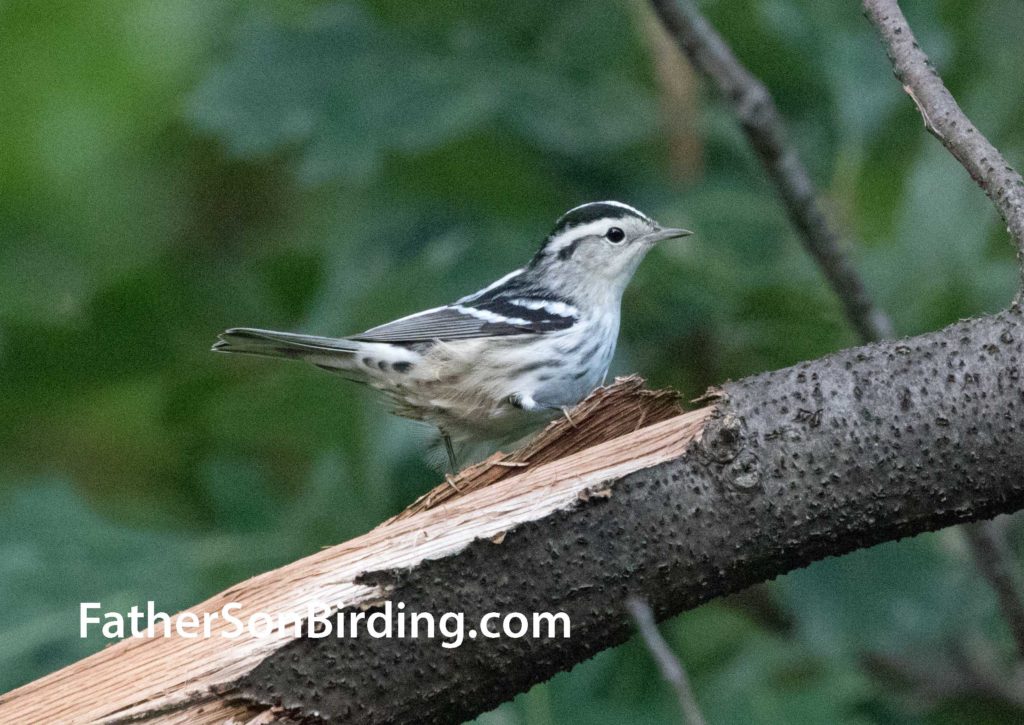
This was only my third time seeing diminutive, but spectacular, Black-and-White Warblers, and they alone satisfied my bird cravings for the trip. (Photo by Sneed B. Collard III)

Undeterred, I returned to the same spot the next morning, and this time my birding stars aligned. Right away, I found a flock of chickadees and settled in to watch them. Soon, I made a thrilling discovery: a Black-and-White Warbler gleaning insects in an oak tree! Downy and Red-bellied Woodpeckers arrived along with Ruby-throated Hummingbirds, and Red-eyed and Yellow-throated Vireos. Even better, I saw three more warbler species: American Redstart, Nashville, and Wilson’s. As I was leaving, I also happened to take a photo of a weird-looking sparrow, but didn’t think much of it. That night, I boarded the train, happy both with our daddy-daughter experiences and my birding observations.

And guess what? When I got home, I showed Braden that weird-looking sparrow.

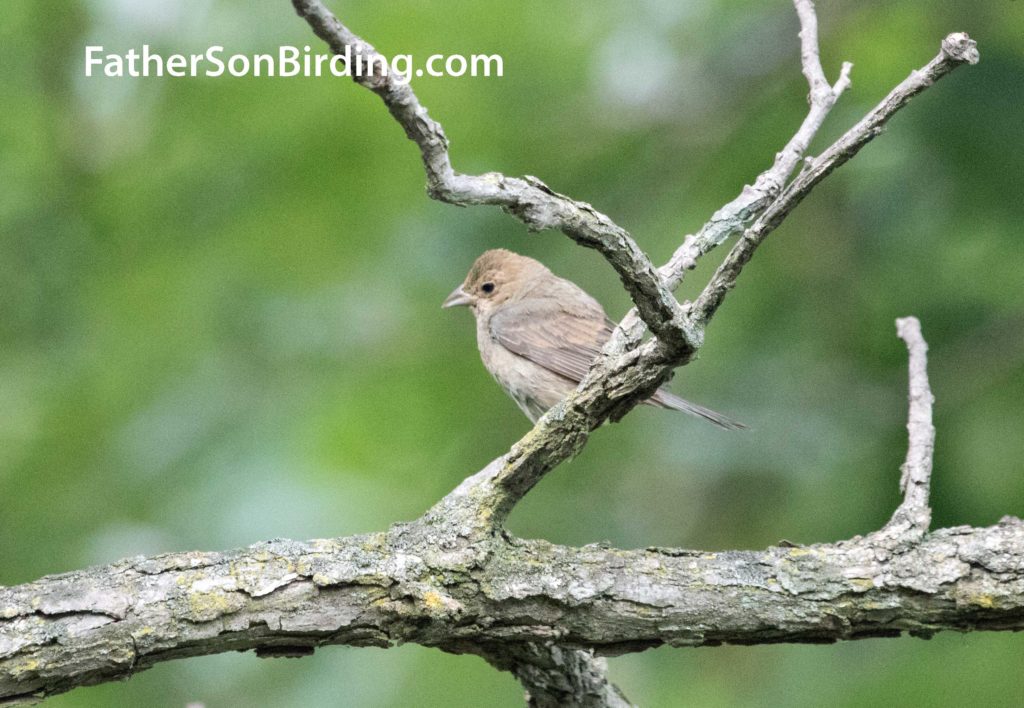
“Daddy,” he said. “That’s an Indigo Bunting!”

Uff-da! Minnesota, we’ll be back!

This surprise, drab Indigo Bunting provided an exclamation mark to my Minnesota birding outings. (Photo by Sneed B. Collard III)

All About Alcids

Braden here.

“Pigeon Guillem-wait, no that’s just a pigeon,” my dad said as we stood underneath the ferry dock in Anacortes, Washington, “I must have guillemots on the brain or something.”

Just then, a football-shaped bird shot out from underneath the platform we were on. It was jet black, with white wing patches and strawberry-red feet—an actual Pigeon Guillemot!

“Awesome!” I said as we high-fived, “It appeared just as you said it! Wait a minute…Marbled Murrelet.”

Unfortunately for us, a Marbled Murrelet did not shoot out from under the dock like the guillemot had, but we weren’t that disappointed. My dad hadn’t seen a guillemot since the year we started birding!


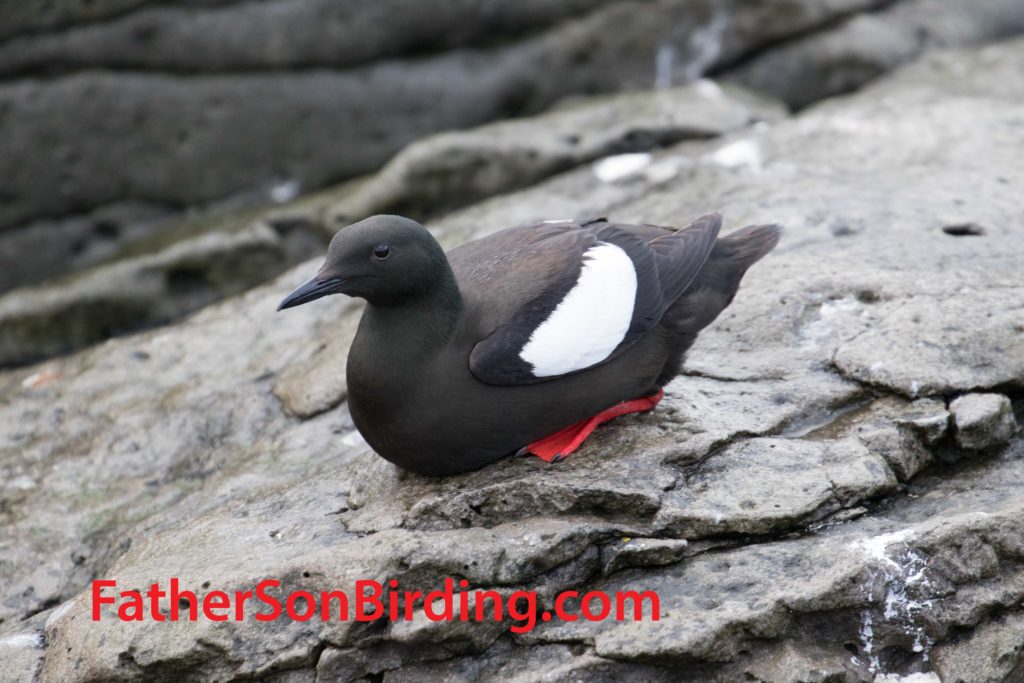
A Black Guillemot, identified from a Pigeon Guillemot by the lack of the black stripe across the wing patch.

The Pigeon Guillemot is a seabird belonging to a family of birds called Alcidae, or alcids. Alcids are the penguins of the north, and share many similarities: they both are much better in water than on land, they both(for the most part) live in the colder parts of oceans, and they even share the same coloring! Once upon a time, there was even an alcid that couldn’t fly, the Great Auk. Sadly, it went extinct in 1844 thanks to hunting and invasive species. Guess where the last individual lived? Iceland.

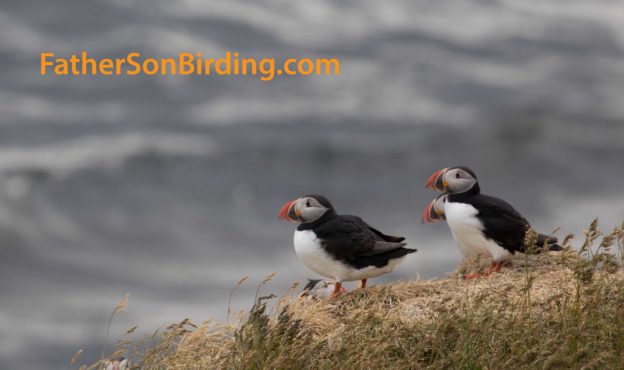
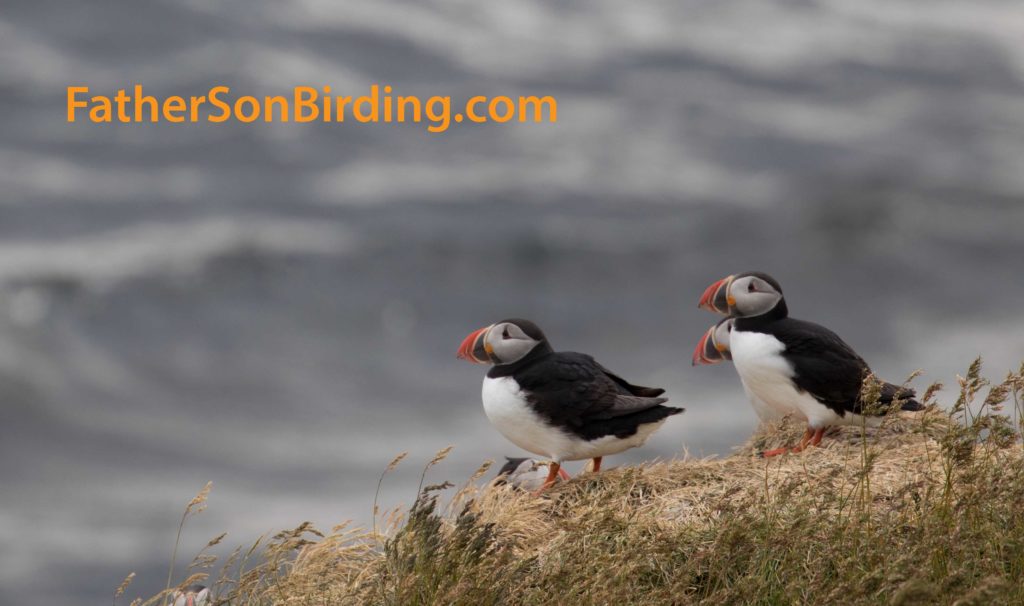
Iceland is a great place to start learning alcids. It has at least six fairly-regularly ocurring species: the Atlantic Puffin, Common Murre, Thick-billed Murre, Razorbill, Dovekie, and Black Guillemot, the last of which is the Arctic-dwelling cousin of the Pigeon Guillemots we saw in Washington.

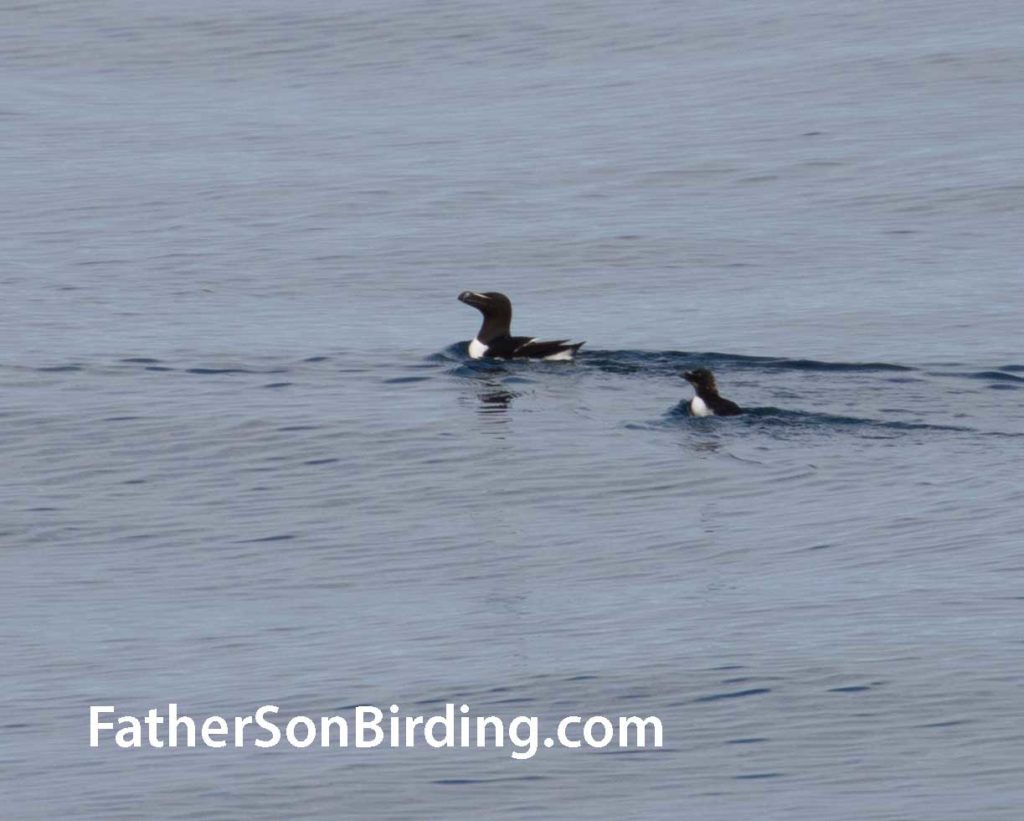
When I was in Iceland, I saw all of these except the Dovekie, which, during the breeding season, only inhabits the pack ice of the high Arctic. Each one was under slightly different conditions. When it came to colonies, Puffins were the weakest of the bunch, digging burrows in dirt, while Razorbills nested in cracks and ledges on sheer rock cliffs. Unlike most birds, Razorbills actually lay lopsided eggs so that they will roll in a circle and not off the cliff. If not for seasickness and an angry ocean, I would’ve gotten to see Latrabjarg cliffs as we passed it, a huge expanse of rock in western Iceland home to 40% of the world’s nesting Razorbill population!

Razorbills are named for the white stripe that crosses their beaks.

We also saw Razorbills farther away from shore than the other alcids, some accompanying flightless chicks. Once the chicks are ready to leave the nest, one naturalist told me, it would jump straight off the cliff! The parent, and sometimes parents would then join it and undergo catastrophic molt—molting all of their feathers at the same time, meaning that for a few weeks, neither the adults or the chicks would be able to fly!

Not all alcids are as devoted parents, though. After a while, Atlantic Puffins just stop bringing food to the nest, forcing the starving chick to leave and fend for its own. And while this may be for many reasons, it is not for lack of food—using the spines on their bills, puffins can carry up to 20 fish at a time, unlike other alcids. The record for one bird is 80 fish!

Atlantic Puffins are declining in southern Iceland, as their main food supply, the sand eels, moves north. This also is affecting Arctic Terns.

Some alcids live all over the Northern Hemisphere, while others are much more localized For instance, while I saw Common Murres in both Iceland and Washington, every other species was unique to one of the locations. If you are looking for alcids, I suggest you start in Alaska, which is home to 17 species alone!