Monthly Archives: June 2025

In Search of the Green-tailed Towhee

Please support our efforts at FatherSonBirding by buying a *New* copy of Birding for Boomers or one of Sneed’s other books shown to the right—and by donating to Montana Bird Advocacy, a wonderful grassroots scientific organization doing novel and unique research on Montana birds.

Confession: Despite the title of this blog, the the main purpose of last weekend was not to find Green-tailed Towhees; it was to learn about a wonderful study of Gray Flycatchers with biologists Jeff Marks and Nate Kohler. However, as I set out Saturday morning, defiant of the grim weather forecast for the next day, I did have a secondary mission in mind—to find and visit with some of the birds in the arid southwest corner of the state. Over the years, these sagebrush areas, from Bear Canyon (see Bear Canyon—Montana’s “Tropical Birding” Paradise) all the way west to Beaverhead County, had become some of my favorite parts of Montana. I credit that partly to my own childhood living in the dry chaparral country of southern California, but I also just love the ecosystems and birds in this part of Montana. I’d have trouble calling myself a real birder if I didn’t get down there at least once each year.

Since you’re pressing me on the issue, I also had a third objective for this trip—to move closer to breaking my all-time one-year species record. The record belonged to 2017, when our family traveled to Ecuador and Peru and I recorded a total of 527 species for the year. This year, thanks to last-minute invitations to Colombia (see THIS POST) and Texas (see THAT POST) I unexpectedly found myself at 498 species—perilously close to setting a new record. That task loomed more difficult than it might appear since once spring migration has passed and breeding season gets underway, it becomes much more difficult to find new species. Still, a trip to the southwest part of Montana promised to nudge me closer to this new goal, and my first target was one of the state’s coolest birds: Green-tailed Towhee.

On Braden’s advice, my first real birding stops of the trip were along the Jefferson River before Lewis & Clark Caverns.

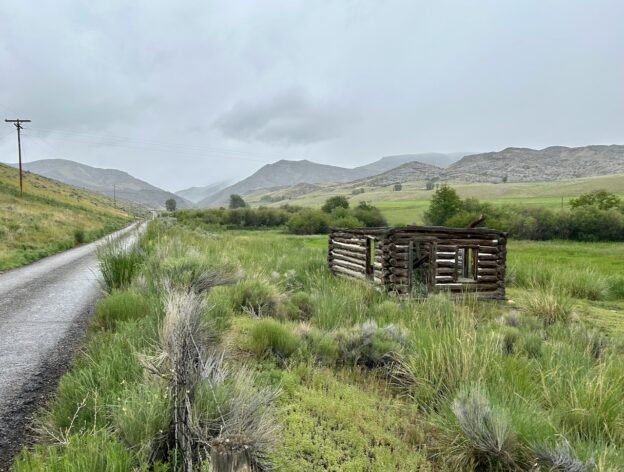
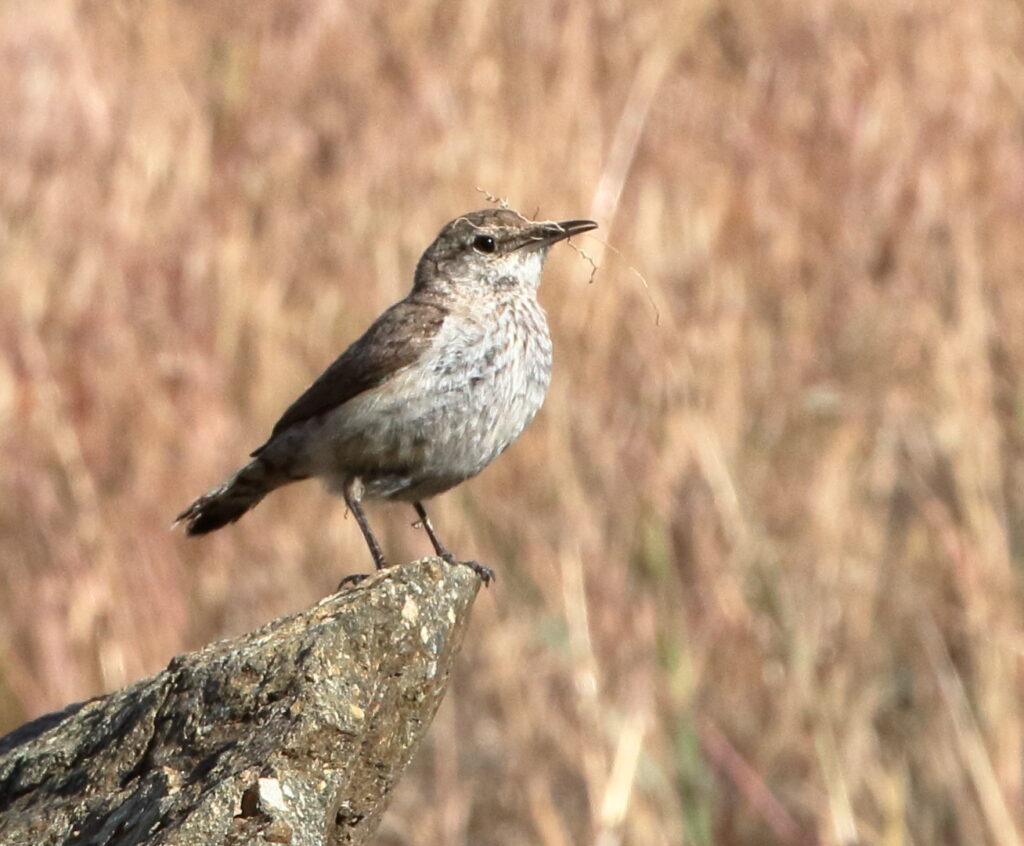
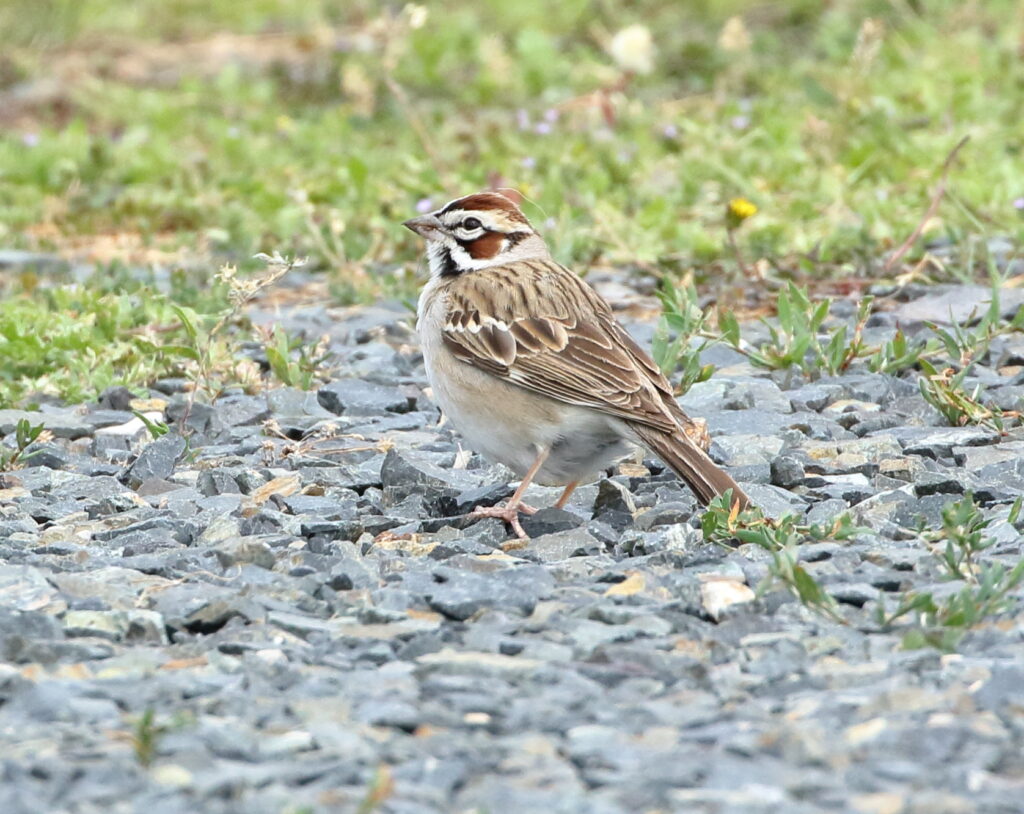
Green-tailed Towhees winter in the American Southwest and Mexico, but generally breed in the the Great Basin region of the West, including southern Montana. Though the birds are not strictly rare, I could count the number of times I had ever seen one, and I felt eager for another GTTO encounter. To find this bizarre, poorly understood beauty, I hit I-90 at dawn and steered toward Lewis and Clark Caverns, two-and-a-half hours to the east. To entertain me along the way, I had checked out an audio version of Eat, Pray, Love, a book that invites all kinds of snarky comments but, I found, actually proved moderately amusing. On Braden’s advice, I pulled over alongside the road leading to the caverns and was rewarded with a wonderful assortment of river and cliff birds including Rock Wren, Lazuli Buntings, and White-throated Swifts. Once inside Lewis and Clark Caverns State Park itself, I focused on finding Green-tailed Towhees.
I struck out. I spent a good hour and a half checking along the road, up around the main parking area, and in the campground. Merlin’s Sound ID picked up a putative GTTO song at one point, but I neither heard nor saw a trace of the bird.

I have to admit that this made me feel like a total failure. I mean, here was my first target bird of the trip, and one that shouldn’t be that hard to find, and I totally “whiffed” on it, as Braden might say. I didn’t plunge into despair exactly, but it definitely put a damper on my mood as I began questioning just what I thought I was doing out here pretending to be a birder! Well, I thought, maybe I’ll have better luck at my next destination.

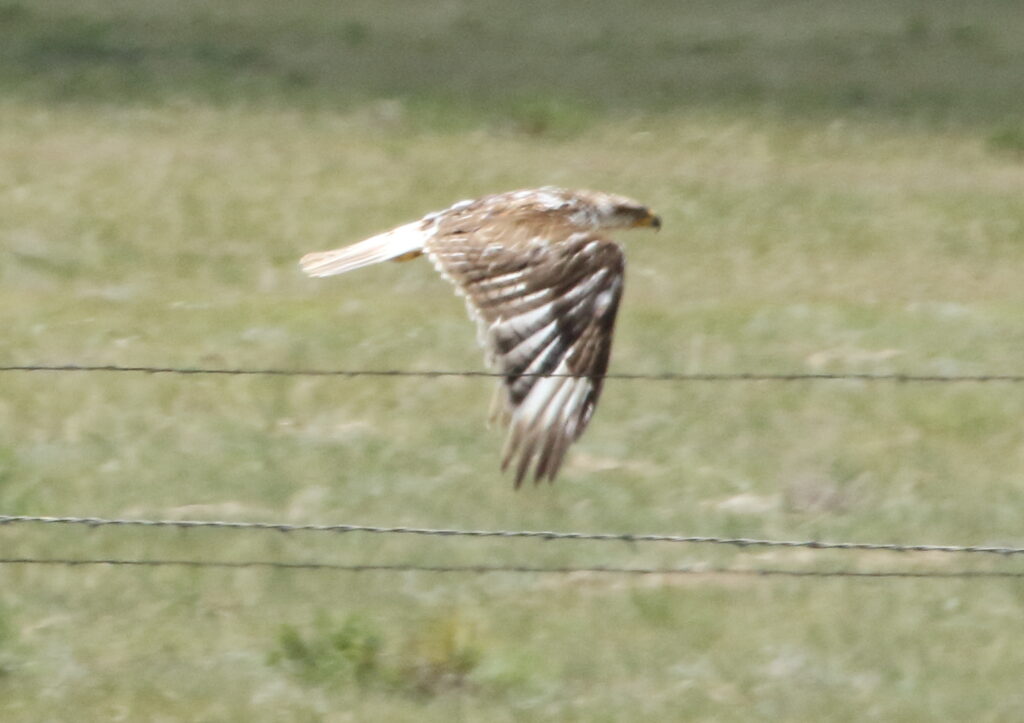
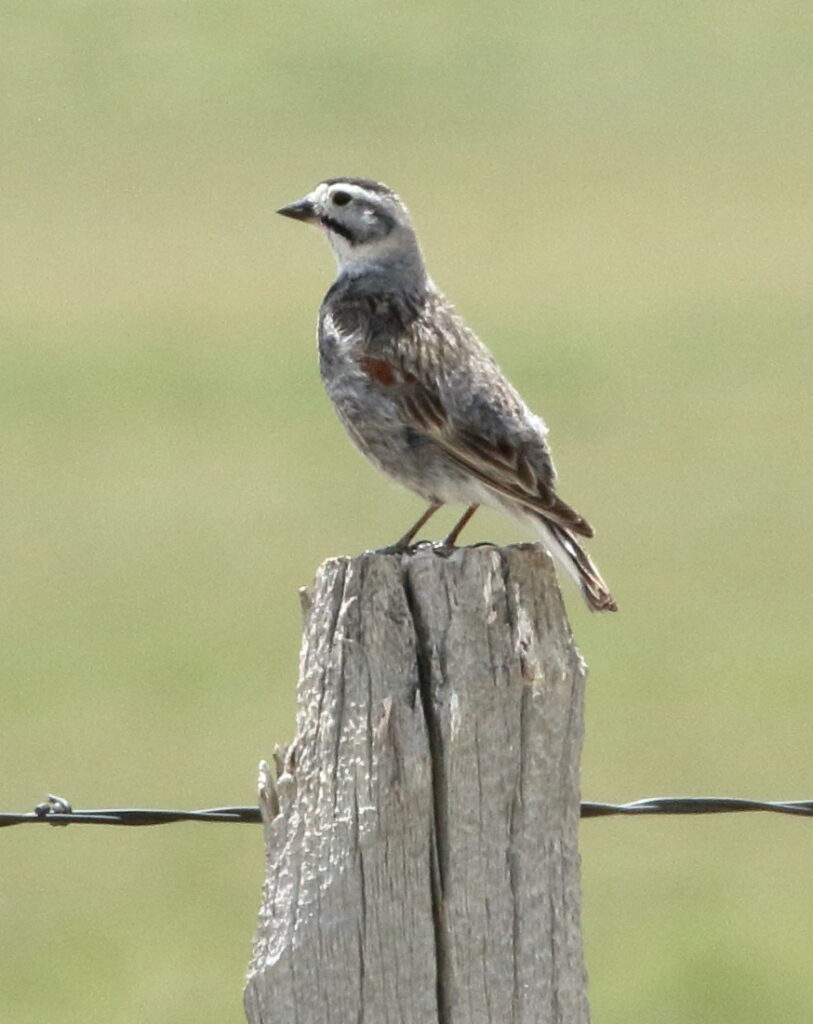
Which happened to be Birch Creek Road north of Dillon in Beaverhead County. Several years before, Braden and I had found our lifer Thick-billed (formerly McCown’s) Longspur on this road, and once again, the road delivered. I’d driven only a mile before I saw a suspicious dark shape on a fence. I actually didn’t think it was a Thick-billed, but my binoculars revealed otherwise. “Yay!” I exclaimed, feeling the weight of my earlier “whiff” lifting slightly. A few minutes later, I was examining another TBLO when I noticed a large shape sitting in a field about one hundred yards away. “Clearly a hawk,” I thought, “but what kind?” The answer: the best kind, at least for my goals for the trip—a ferruginous hawk. This was another bird I needed for the year and one that isn’t always easy to find in the state.
Digging out the peanut butter sandwich I’d made earlier, I tooled down I-15 for my next destination, Clark Canyon Reservoir. Braden and I had only ever birded here once before, and as near as I recall, we hadn’t found much, so I kept my expectations low. I stopped at one overlook and was surprised to see a Common Loon on the water below, along with a Double-crested Cormorant and a couple of Ring-billed Gulls. Violet-green swallows swirled around me and, as always, they brought a smile.

Snaking around the reservoir, I approached a sign for Horse Prairie Campground and spontaneously swerved left onto a dirt access road. The reason? Tall, healthy-looking sagebrush! Hm, this just might have one of my other target birds for the day. Almost immediately, I saw a really cool bird that had not been on my target list—a Common Nighthawk peacefully chillin’ on the split-rail fence. The bird barely blinked as I fired away with my camera through the car window from only thirty feet away.
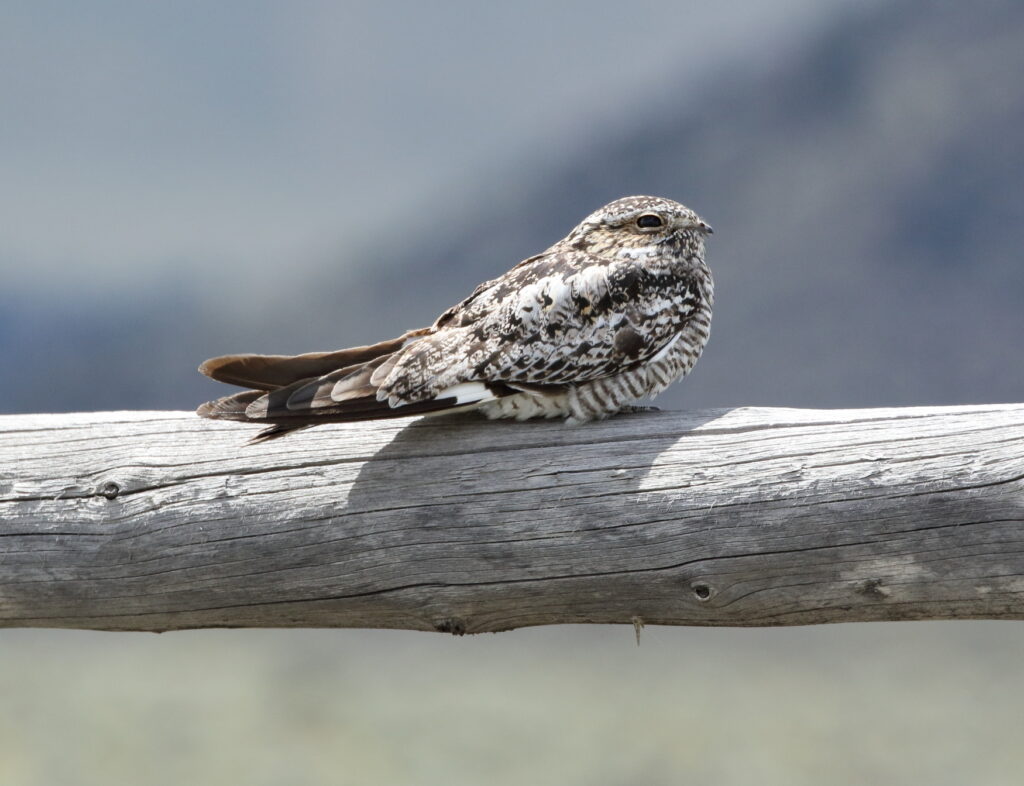
The first of three Common Nighthawks I spotted chilling on the wooden fence leading down to Horse Prairie Campground.

Creeping slowly forward, I heard a song I didn’t recognize—which was no great surprise in itself, but I did have a guess of what it was. Sound ID confirmed it: Brewer’s Sparrow! This bird loves healthy sagebrush and makes up for the world’s dullest plumage with a vigorous song that bewitches any birdwatcher who hears it. A few moments later, one even sat still long enough for a decent photo. Check. Another target bird—but not the one I expected to find here!
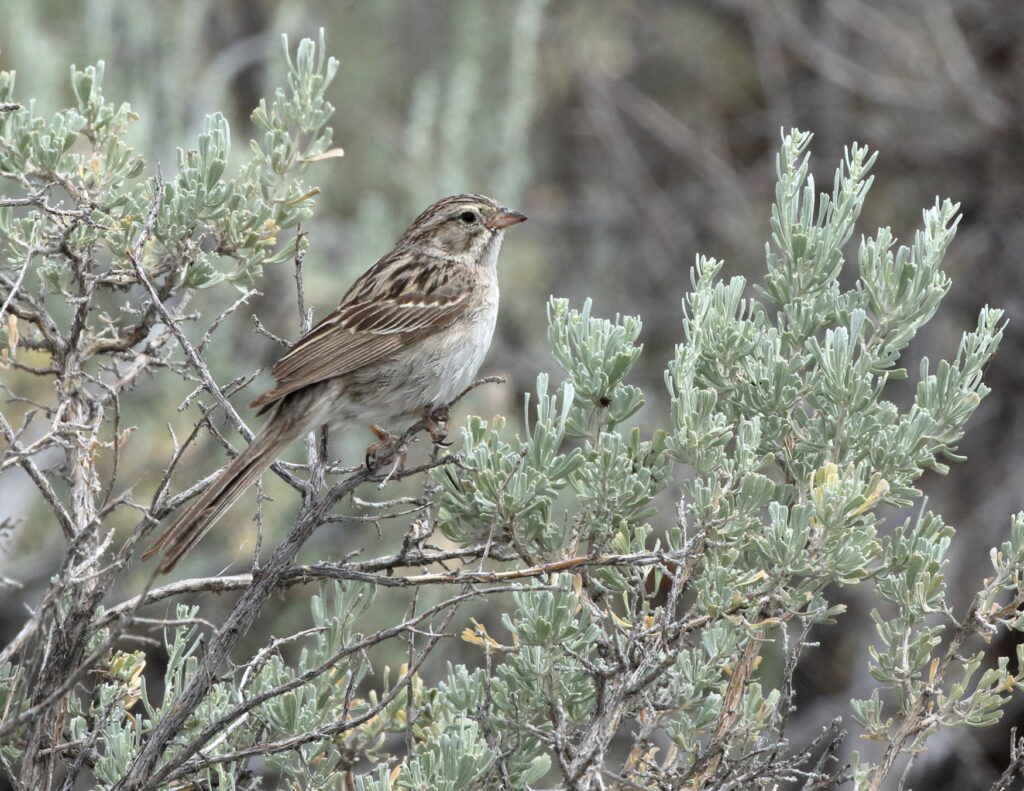
One of Montana’s drabbest birds, the Brewer’s Sparrow has an enchanting song.

I kept driving slowly toward the campground and spotted a medium-sized, slender bird up ahead. Wishfully, I thought it might be a Say’s Phoebe—another bird I happened to need for my year list—but it flew off before I got close. As I pulled into the campground, though, two brownish birds were chasing each other around. I assumed they were robins, but when one landed on a “Day Use Only” sign, I realized with a start that it was exactly the bird I had hoped to find here—a Sage Thrasher!
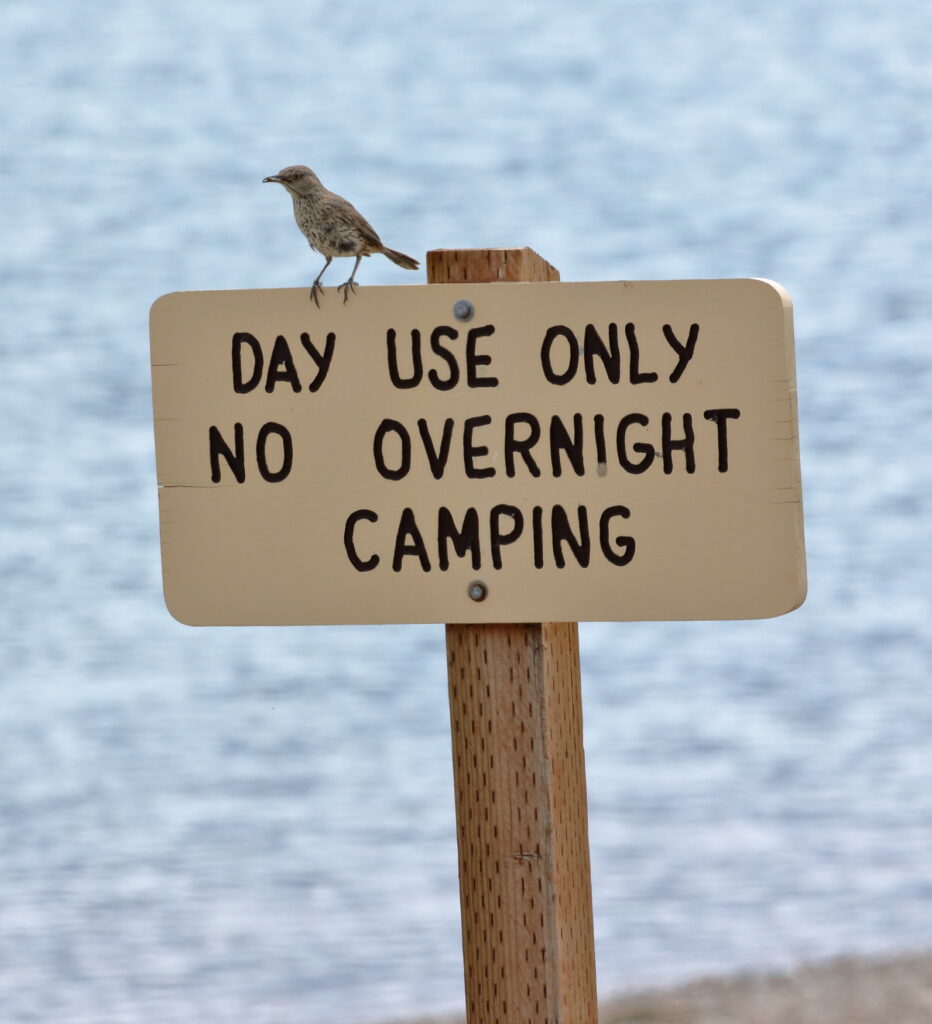
Sage Thrashers are so flighty that seeing one on a sign was about the last thing I expected!

Braden and I have never met a thrasher we didn’t like, but Sage Thrashers hold a special place in our birding hearts. For one, they’re the world’s smallest thrashers—which is why I mistook them for robins or phoebes. For another, they are charismatic songsters and often are the most common bird you see in sage country. As I sat in the car, in fact, I counted three more Sage Thrashers around me. Whoo-Hoo!
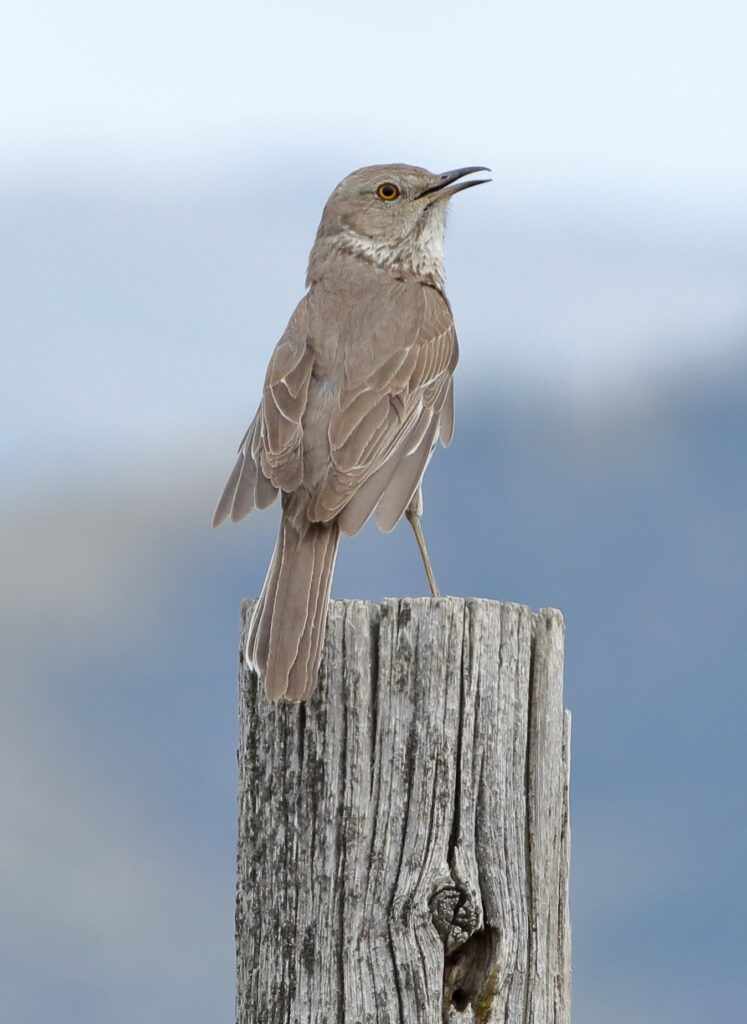
One of our favorite Montana birds, Sage Thrashers seemed to be everywhere I looked this afternoon.

Later, on the road where I was to meet up with Jeff Marks and Nate Kohler, I encountered seven more Sage Thrashers! It was a veritable thrasher party—by far the best experience I had ever had with these good-looking birds.

Unfortunately, the next morning, heavy rain and spitting snow kept me from seeing Gray Flycatchers with Jeff and Nate. More on that in another post. Almost as bad, I began the drive home without a Green-tailed Towhee under my belt and no expectations of seeing one. But bless Nate Kohler’s heart. He told me about a canyon I should check out on the way home. It was still raining when I got there, but I drove slowly and stopped frequently, listening and watching. Lazuli Buntings chattered everywhere and I saw a good variety of birds—but no towhee. Finally, I put on my raincoat, got out of the car and played a Green-tailed Towhee song. Almost immediately, a small shape darted up out of the sagebrush—the bird I was looking for! Not only that, it held still long enough for a photo—but the story hadn’t quite finished.
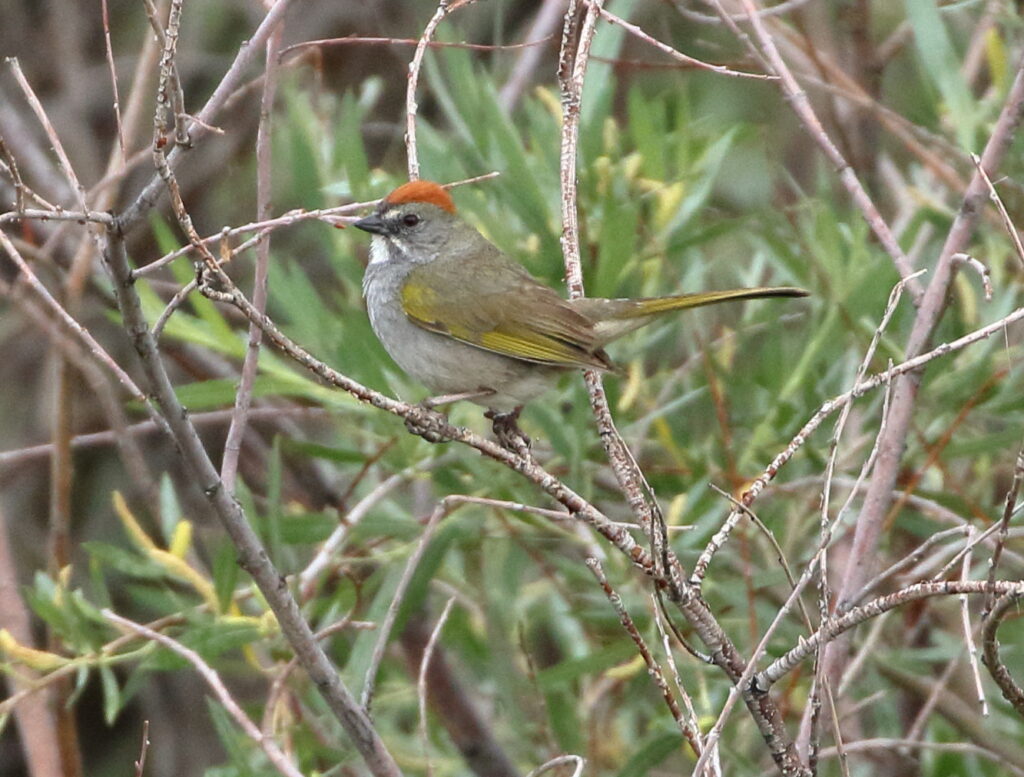
I worked hard for this Green-tailed Towhee—only to find that it wasn’t a year bird after all!

Once I got home and posted all of my checklists for the trip, I was surprised that eBird hadn’t added GTTO to my year list. What’s going on? I thought, and did a quick search to see if I had somehow seen one down in Texas and forgotten about it. Nope. What I did forget was the rare vagrant GTTO I had seen in Victoria, BC during Amy’s and my January trip (see Birding Victoria, BC)! So this one was not a year bird after all, but still a lot of fun to see. Meanwhile, my year list swelled to 503 species thanks to the Thick-billed Longspur, Ferruginous Hawk, Brewer’s Sparrow, Sage Thrasher, and a Prairie Falcon I had spotted the afternoon before. Not exactly the trip I expected, but one I already cherished.

Vortex Bantam HD 6.5X32s: Binocs for Kids and Travelers (FSB Equipment Review)

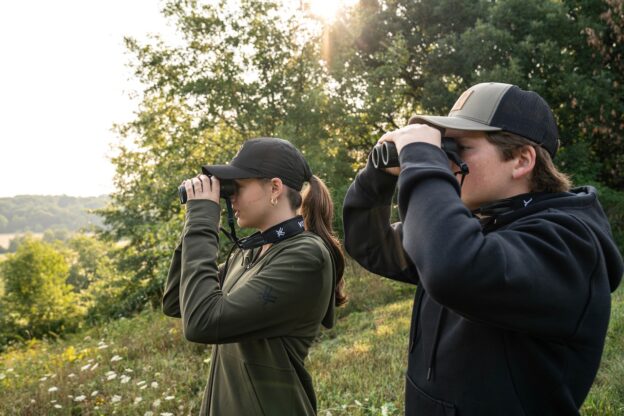
Recently, my brother joined us to celebrate our youngest child’s graduation from high school. We had some extra time, so naturally we went to look for birds, an activity he has steadily been getting more interested in. He didn’t bring binoculars, so I loaned him a pair of Vortex Bantam HDs I have been testing out. The problem? When he departed, he didn’t want to give them back!

Although created and marketed for kids, the Bantam HD has terrific selling points for adults as well. But let’s start with the kids. Quite a few companies have been selling binoculars for kids lately, and that’s a no-brainer. As more and more adults get into birding, they naturally encourage their children to enjoy the activity, too. But most adult binoculars are too heavy and sometimes too complicated to use for the average kid, so it makes sense to seek out optics specifically designed for young people.

The Bantam HDs are lightweight, easy to use, and offer excellent light transmission and sharpness.

Unfortunately, many “kid binoculars” look and feel cheap—and often break almost immediately. Others come with high price tags (think $500 or more). I don’t know about you, but as a parent I can think of better places to put those extra few hundred bucks—at least until your child has shown an unquenchable passion for birds. And that’s where the Bantam’s first big selling point comes in: it can be purchased for only about $70.

More important, Bantams feel like real binoculars in your hands. They have sturdy construction, a comfortable grip, long eye-relief tubes for those with glasses, and a diopter ring to accommodate different vision between eyes. Oh, and did I mention they are waterproof, fogproof, and shockproof? Beyond all this, the clarity of the image they present is impressive. I hate to say this, but I found the focal sharpness to be better than the more expensive Triumphs we reviewed earlier in the year (see our review).

Though marketed for kids, the Bantams are an excellent choice for travelers as well.

The Bantam HDs do come with some trade-offs. While the optics are excellent, the rating 6.5X32 means that the magnification (6.5 power) is not as great as you find on most adult binoculars (including the Triumphs mentioned above). Also, minimum focal distance is a fairly lengthy 12 feet. This won’t be an issue for most users, but could come into play when looking at butterflies or other insects—or just screwing around, which of course most kids are wont to do when having a cool new toy in their hands. However, the Bantam HD’s light weight and ease-of-use more than compensate for these disadvantages.

Oh yeah, the weight, you may be thinking. I haven’t mentioned that yet, but here it is: these binoculars weigh a mere 14.4 ounces—less than a pound. In other words, they are light enough for almost all kids to carry them around for hours without complaint. And that means that they also are mighty attractive to adults as well.

On several recent birding trips that I led, I let adults use my pair of Bantams. The coordinator from our local natural history center immediately ordered half a dozen pairs!

In fact, almost everything about the Bantam HDs screams TRAVEL BINOCULARS! Even if you’re not going on a dedicated birding trip, all birders understand that it is essential to take along a pair of binoculars on every adventure. But on a casual trip a regular pair of binocs, with its awkward size and weighing a couple of pounds, can make a person hesitate to stuff it into a carry-on. Years before trying out the Bantams, I bought myself a pair of Vortex Vanquish 8X26s for backpacking, travel, and to keep in our trusty minivan for “emergency birding.” They worked just fine for this—but despite their greater magnification and slightly lighter weight, I like the Bantams better. Why?

For travel, I found the Bantams to be a better choice than the more expensive Vortex Vanquish 8X26 (pictured here)—despite the greater magnification of the latter.

* The Bantam’s optics are just as good, if not better.

* Because the Bantam uses a roof prism system instead of a Porro (side-by-side) prism arrangement, I find the Bantams more comfortable to hold. According to Vortex, they also are more durable. (See this article for a comparison of roof versus Porro prism binoculars.)

* The Bantams are actually cheaper to buy.

You can probably tell that I’m unusually enthusiastic about the Bantams, and their low price makes them an almost risk-free investment—especially given that, like all Vortex products, they come with an unbelievably generous lifetime warranty. Whether you’ve got a promising young naturalist in your life or need a pair of handy travel birding binoculars, you won’t be sorry you checked these out.

Oh, and you might be wondering, Did my brother ever give my Bantams back before he left? The answer is yes—but he looked so forlorn about it I immediately ordered him his own pair!

Puffin Party! (Maine to Montana, Part 2)

The state of Maine can be simplified to four things: lobster, moose, blueberries, and puffins (with Dunkin Donuts as a runner-up). During the four years I’d spent going to school in the state, I’d eaten lobster rolls, visited blueberry bogs, and tried my hardest to find a moose, a quest that would continue later this week. Through no fault of my own, I had never even tried to see a puffin and the reason was simple—my school year did not overlap with the Atlantic Puffin school year. This year, however, was different. I was actually still in the state of Maine as puffins were arriving at their breeding colonies, and was not going to miss my last chance to see these iconic seabirds. So, on May 14th, I boarded a large boat in Bar Harbor and took my seat in the cabin, binoculars and camera ready.

Unlike previous boat rides I’d taken to see birds, this cruise was relaxed and family-friendly. About two hundred people crowded the deck, many of whom were just as interested in the Bald Eagles and American Herring Gulls circling above the harbor as the prospect of seeing any alcids (Alcidae is the family of birds that includes puffins, murres, auks, and guillemots). Over the intercom, a very knowledgeable guide spouted off a non-stop stream of facts about the islands, lighthouses, and wildlife of the area as we headed for Egg Rock, a sparse strip of land just barely visible to tourists standing onshore in Bar Harbor. With the coastline of Acadia National Park to our right, we slowed as we approached the island.

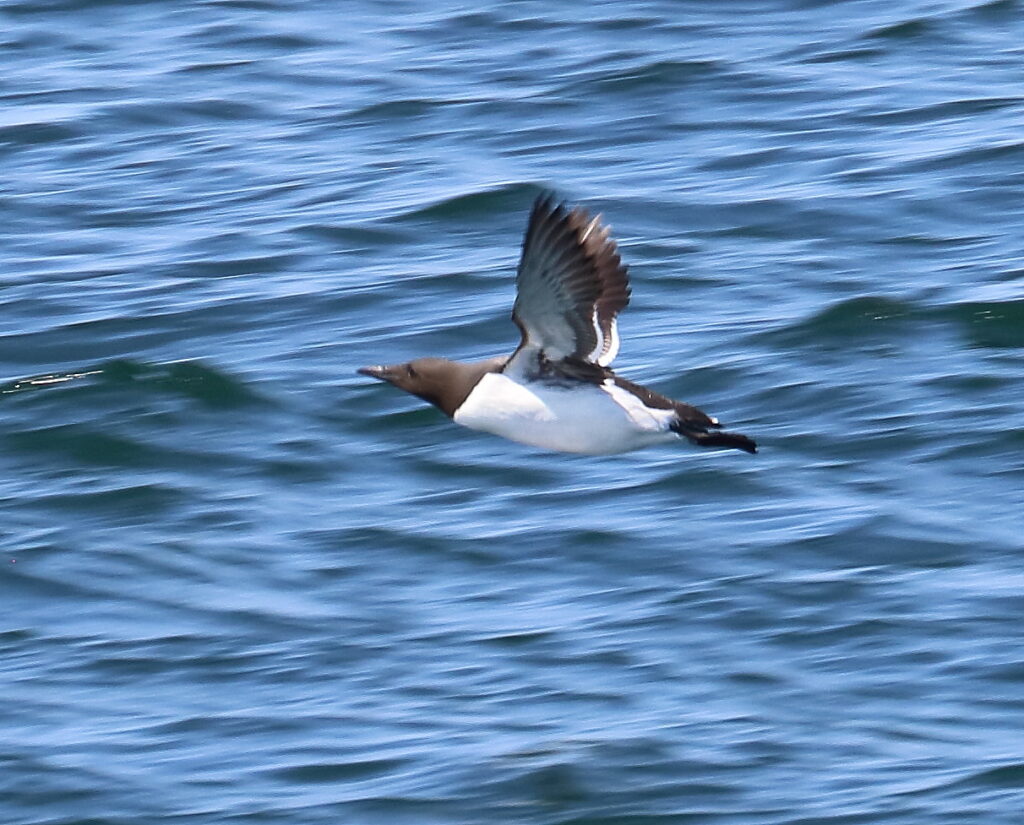
This Common Murre was the only one I saw the whole boat ride. While this species hasn’t yet started nesting at Petit Manan, the ornithologists are hopeful that they will soon!

Egg Rock did not have a puffin colony—it was too close to shore for that. What it did have were colonies of several other species of seabirds. Gulls dominated the island, mostly Herring with scattered numbers of Great Black-backed Gulls mixed in, their charcoal backs sticking out amongst the sea of gray. Cormorants patrolled the southern side of the island, standing tall like gargoyles on the rocks. And in the waters lapping up against the side of the island I saw my first alcids—Black Guillemots! Although guillemots, which are black with white wing patches in the summer and white with black wing patches in the winter, are in the same bird family as Atlantic Puffins, they are far easier to see in Maine. Not only do they breed right on the coast during the warm months, they also stay for the winter—something that the puffins do not do. That’s one of the reasons why I’d never seen puffins here during my time at the University of Maine: From August to April, these birds stay as far from shore as possible, floating around somewhere in the North Atlantic.

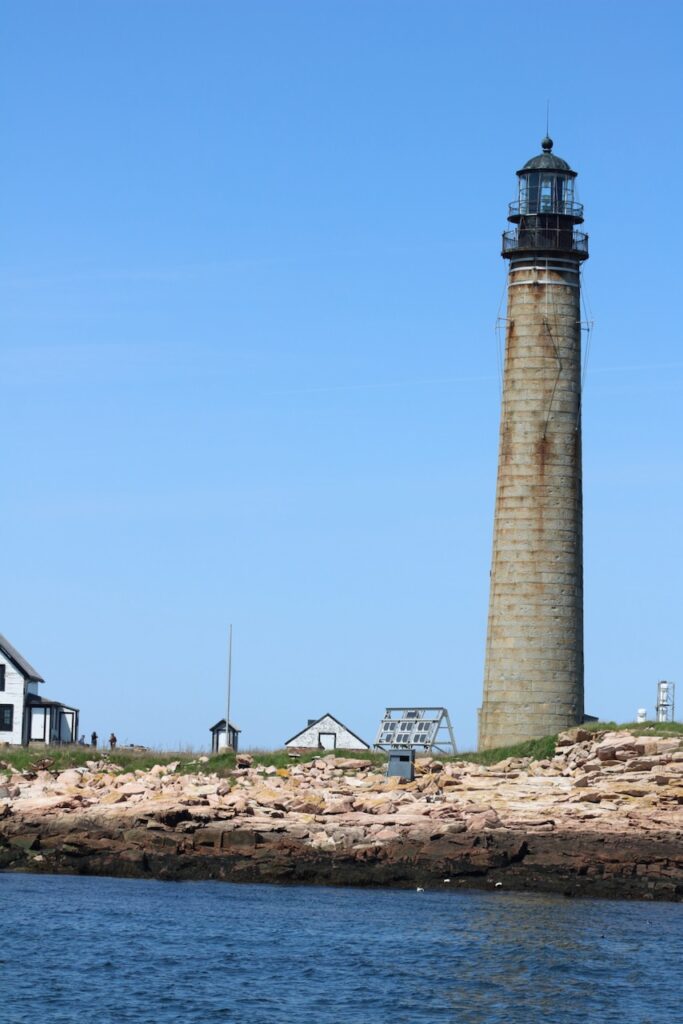
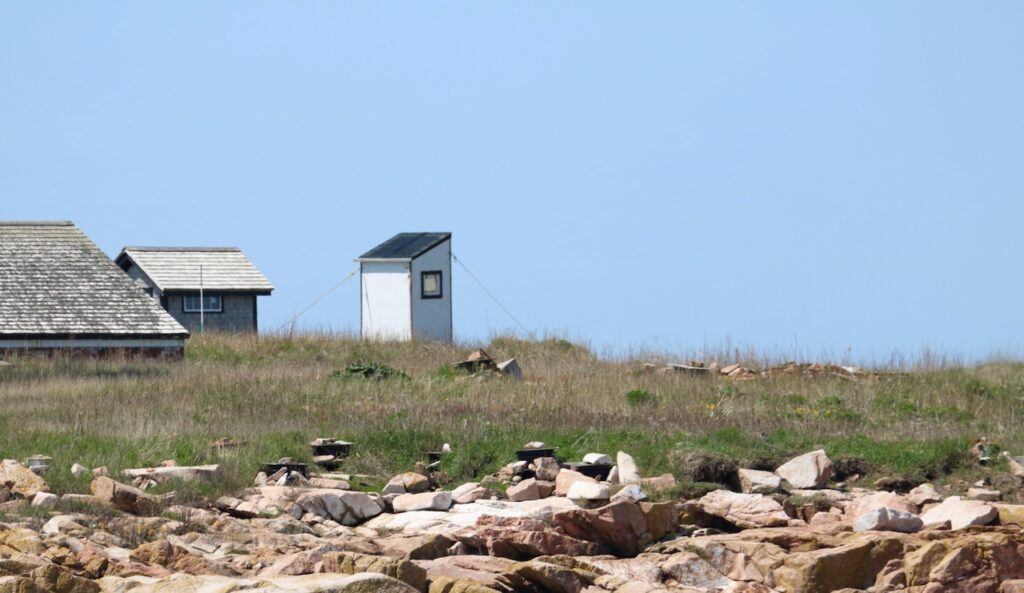
After circling Egg Rock to look at the seabird colonies, as well as the dozens of Harbor and Gray Seals lounging on the rocks, the boat picked up speed and headed out to sea. While we never lost sight of the coastline, it grew hazier and hazier until eventually, a new island appeared on the horizon: Petit Manan. The first thing I noticed about Petit Manan were the buildings. Many islands off the coast of Maine had lighthouses, built during centuries past to help steer ships into harbors. As recently as the late 1900s, lighthouse keepers and their families lived on the islands and maintained the lighthouses, although by now many of the keepers had left, likely because boats had better forms of navigation at their disposal. The houses they left behind had been taken over by people working a very different type of job.

The Lighthouse on Petit Manan Island.

Both Egg Rock and Petit Manan are part of a large reserve known as Maine Coastal Islands National Wildlife Refuge. Every summer, dozens of wildlife technicians head out to these islands to spend weeks and months working with the birds that live there. On some islands, like Petit Manan, this work includes Atlantic Puffins, but it also includes monitoring and conservation of other species like Common, Arctic, and Roseate Terns, Common Murres, Black Guillemots, Razorbills, Common Eiders, and Leach’s Storm-petrels. Several of my peers at the University of Maine worked for Maine Coastal Islands and would be heading out to their assigned locations within the next few weeks.

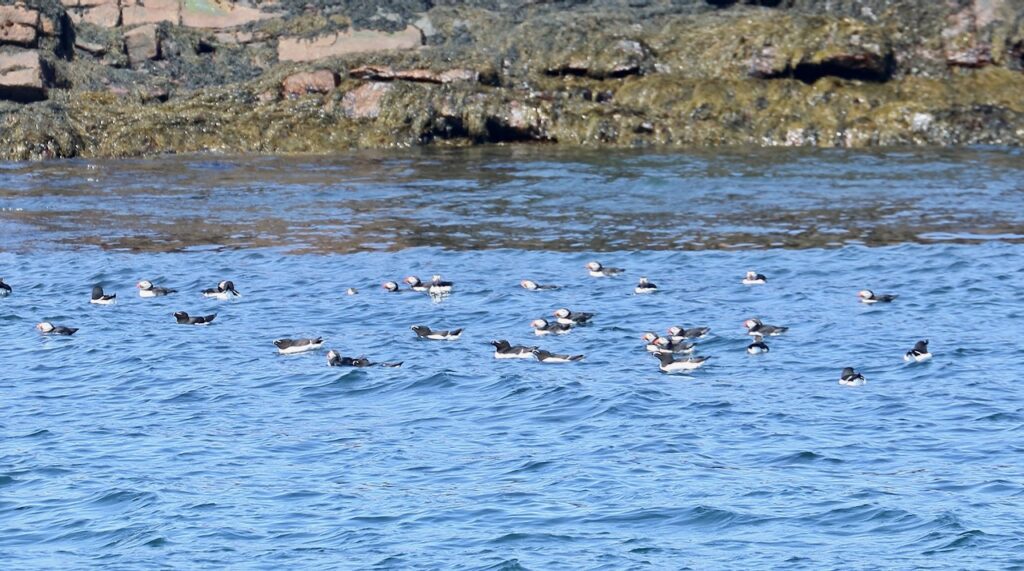
I began to make out large rafts of birds next to the island as our boat approached, and was delighted to spot football-sized alcids with rainbow bills taking off in front of us. I raised my binoculars and smiled—these were the first Atlantic Puffins I’d seen in seven years, since 2018 when I’d been lucky enough to visit Iceland with my grandparents (see my post “All About Alcids”). The birds lounged in the water close to the rocks, and our guide told us that many of them had likely just returned for the summer from their mysterious marine wintering grounds. I counted ninety or so during our half hour stay at Petit Manan.

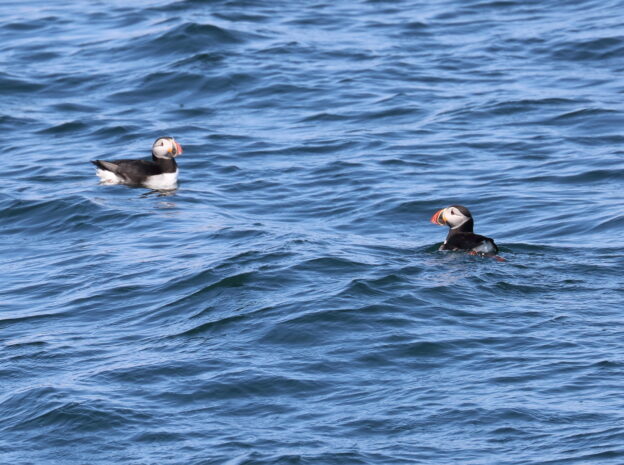
A raft of Atlantic Puffins and Razorbills!

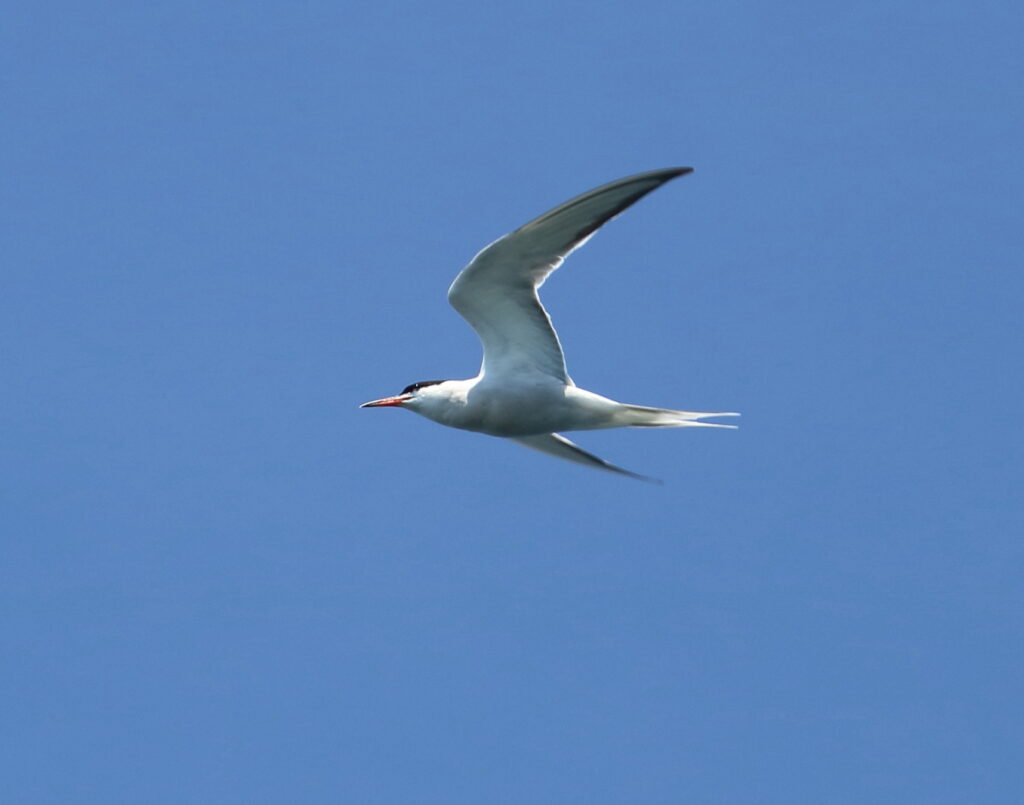
The puffins weren’t alone. Black Guillemots were here, too, as were a couple dozen Razorbills, another gorgeous black-and-white alcid named after the unique shape and decoration of its beak. I spotted a single Common Murre amongst their ranks, my fourth alcid of the day and a species that had not yet attempted to nest at Petit Manan—but scientists were optimistic! A dozen or so Common Terns circled the island loftily, letting out loud “kyeeeer” calls to notify everyone who was really in charge here. In a few weeks, the numbers of terns would swell into the hundreds, and include Arctic as well as Common. Terns were the aggressive defenders of islands, and would dive-bomb anything they perceived as a threat, including people. I remembered one walk in Iceland when we were asked to hold a tall, wooden stick so the Arctic Terns there would target that instead of our heads!

These birds are the reason that so many alcids nest at Petit Manan. The huge tern colony on this and other islands provide safety for the puffins from predators like gulls and Peregrine Falcons that might otherwise raid their nests. Of course, the biologists working for Maine Coastal Islands NWR were also there to aid these species and chase predators off the island. It hadn’t always been that way, unfortunately.

Common Terns nest in huge, aggressive colonies along the Maine coast!

A hundred years ago, feathered hats were all the rage in cities across the east coast of North America. The demand for white feathers meant that large numbers of terns, gulls, and egrets were harvested—to the extent that these species declined dramatically across much of the country. With no terns to protect them, puffins nesting in Maine were faced with higher predation, but not just from other birds. Rampant collection of eggs and puffin meat also plagued many of Maine’s islands, leading to a dramatic decrease in this species down to just two tiny colonies. Sadly, it was looking like the Atlantic Puffin would join the ranks of the Great Auk and Labrador Duck in Maine’s list of extinct birds.

Thankfully, ornithologists and bird-lovers alike noticed how much environmental damage was being caused by these practices and stepped in. Groups like Audubon formed and began lobbying for the protection of birds, eventually leading to the passing of the Migratory Bird Treaty Act of 1918. And in 1973, Audubon launched Project Puffin. Scientists were sent out to islands equipped with broadcasting equipment and decoys, as well as a small number of puffin chicks donated from colonies in Canada. Step one was the rearing of chicks on islands that had previously been occupied by puffin colonies; step two meant attracting terns back to the islands. Finally, with their defenders back in place, Atlantic Puffins began returning to many of the islands they’d previously been extirpated from. They now occupy six colonies in Maine.

Today, Atlantic Puffins are doing well, but are still being monitored very carefully. Puffins feed on fish that thrive in deep, cold water. That’s why the species only nests on the outermost islands in Maine. Our guide told us, “Puffins would lay their eggs in the ocean if they could.” Unfortunately, the Gulf of Maine is warming faster than any other body of water in the world, and this means that puffins are having to travel farther and farther out to sea to obtain their prey items of choice. During particularly warm years, puffins have switched their selected prey entirely to other species. Many of these other species of fish, which are brought back to their chicks on Petit Manan and other islands, differ in their size and the toughness of their skin. Often puffin chicks cannot eat them, and will starve even when food is sitting right there.

The man-made burrows where puffins nest on Petit Manan!

The good news is that there are many, many people keeping an eye on these birds, doing their best to keep their numbers high. Last year was an especially good year for the species, so optimism is in the air. I felt cautiously hopeful for the future of this species as the Bar Harbor Puffin Tour headed back to shore, content with the pictures and new memories I’d experienced with this iconic Maine species.

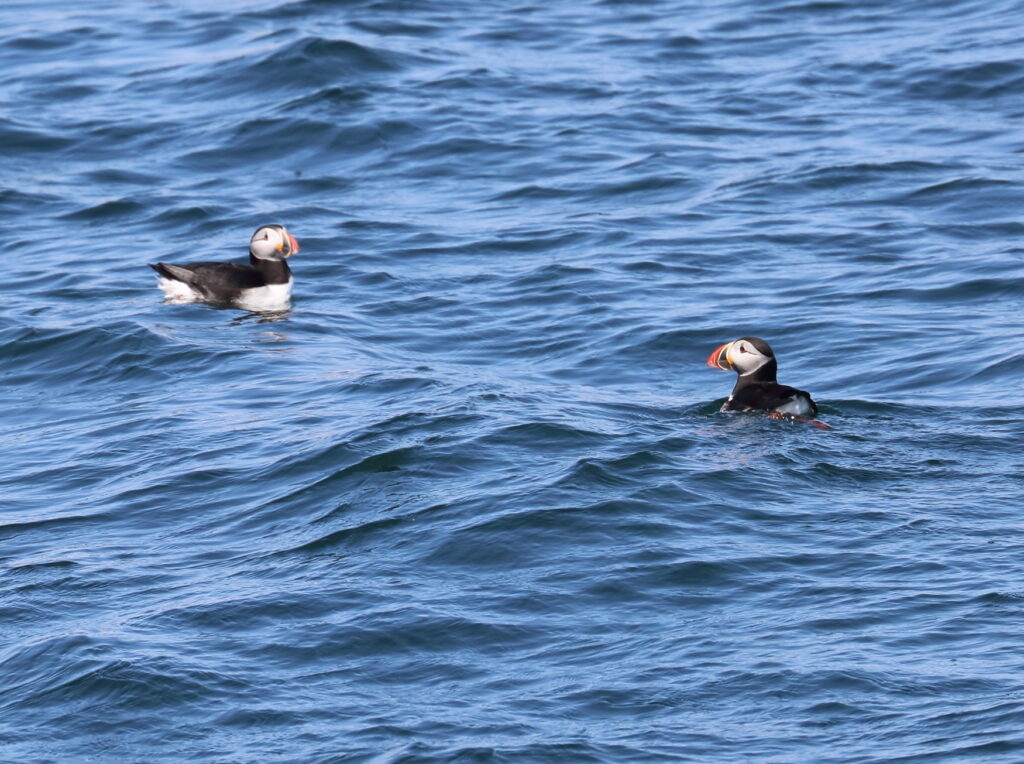
A pair of Atlantic Puffins!

Braden’s Maine to Montana Birdventure, Part 1: A Day in “The County”

Today, FSB kicks off Braden’s accounts of his truly remarkable spring birding trip from Maine to Montana. This adventure would take him to an astonishing variety of habitats most of us never get to experience. Along the way, he would drive 5,000 miles, visit nine states and provinces, and record 264 bird species, seven of them lifers. He begins this series with a visit to Maine’s arguably wildest and most inaccessible county: Aroostook.

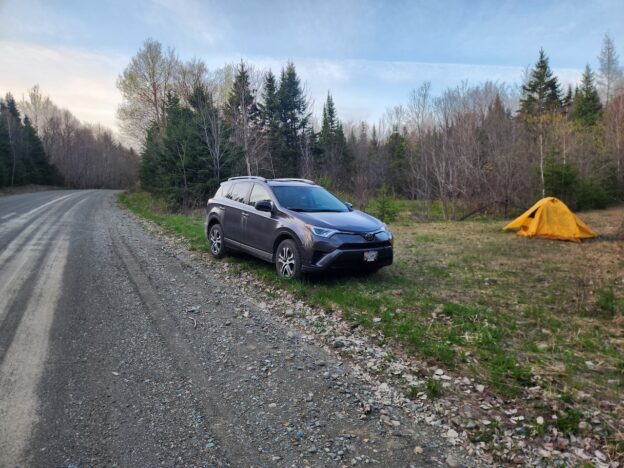
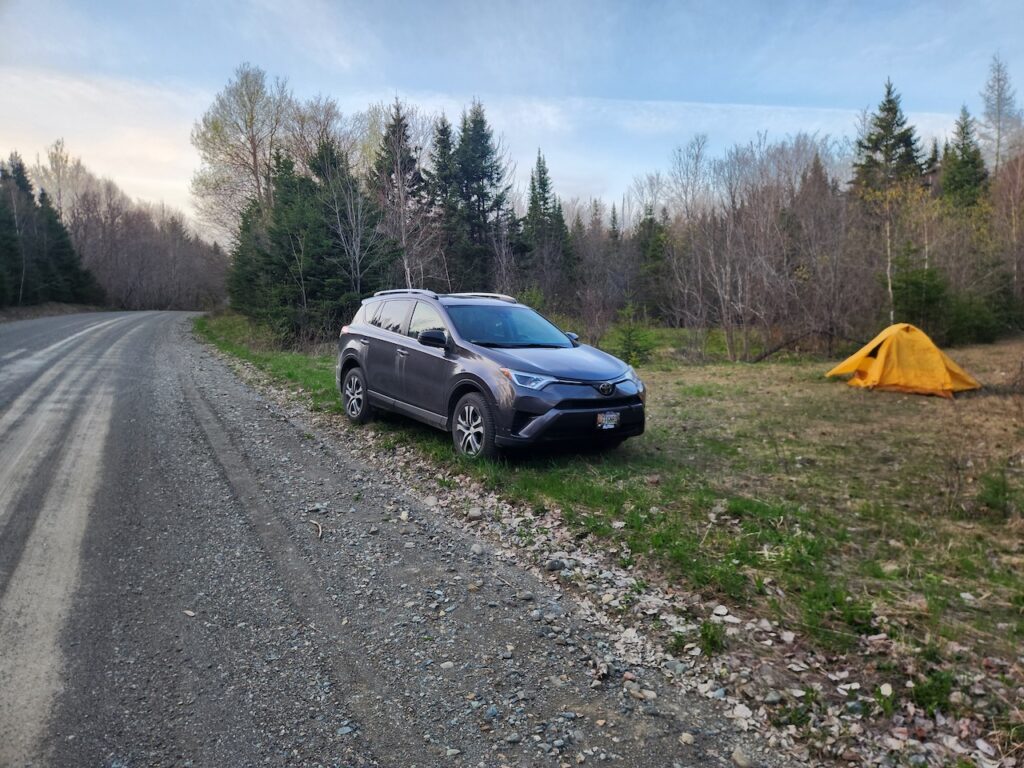
Twenty-four hours after walking across the stage of the Cross Insurance Center in Bangor and receiving my college diploma, I was alone in a tent in Northern Maine. I’d gone to school in the state for four years, but never experienced it in the summertime, those three months when Maine is at its best. Now, with an abundance of time, I could leisurely make my way back to Montana instead of the six-day dash I’d done across the country last August. Because of this distant deadline, I’d arranged to spend a week in Maine birding and exploring following my graduation, and there was no better place to start than with one of the two counties I’d never visited: Aroostook County.

A Cedar Bog up in Aroostook County! This one shimmied with Palm and Magnolia Warblers.

Known simply as “The County” to locals, Aroostook is by far the largest and least populated part of Maine. The County contains a large portion of the state’s agriculture, mostly located on its eastern flank, whereas the rest is coniferous forest. Aroostook’s high latitude and cooler climate create a haven for many boreal species of birds that have receded from their more southerly haunts because of warming and excessive logging that promotes regrowth of a different, unsuitable habitat. This northern conifer forest is also a hotspot for the primary topic of my dad’s previous post: warblers.

Warblers, in fact, were a major factor in my decision about where to go to school. I wanted to go to college somewhere where I could see as many warblers as possible, and Maine fit that bill perfectly. With almost thirty species of breeding warblers (nearly triple what Montana, a state twice the size, has) there is no better place to be, and that is especially true of Aroostook County, where most of them could be found. Lying in bed the night of Monday, May 12th, I felt nervous. It was still fairly early as far as migration goes. What if the birds weren’t here yet?

This was my camping spot in Aroostook County, on a backroad in northern Maine!

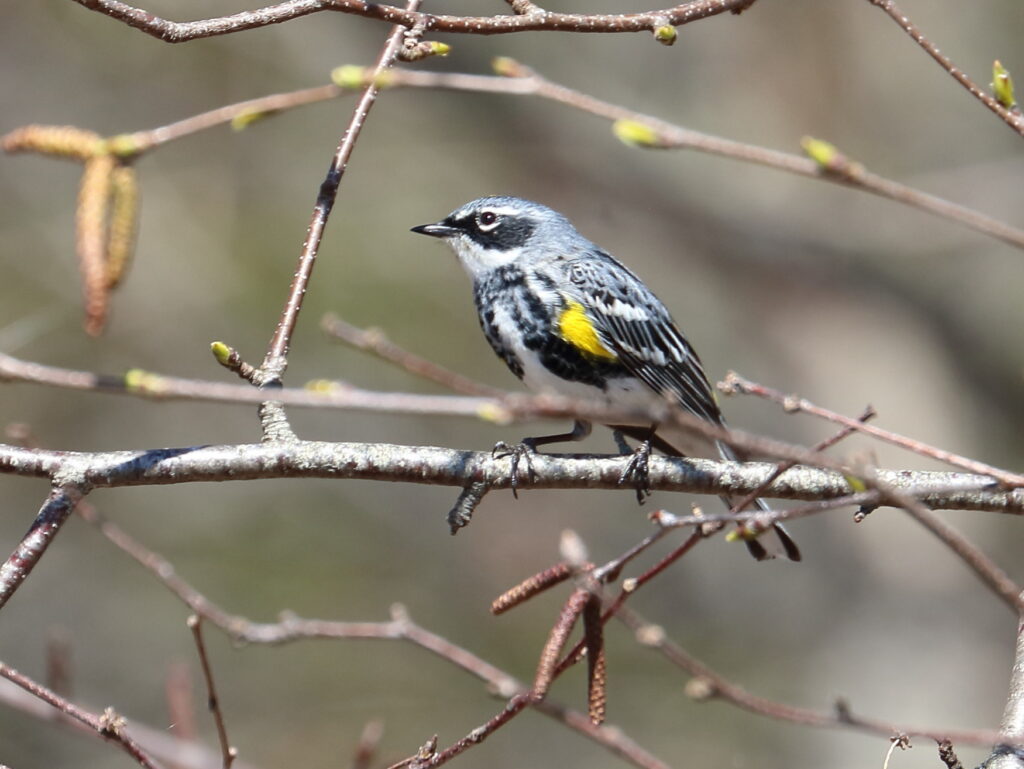
On Tuesday, May 13th, my worries were settled when I woke up to the sound of a Nashville Warbler singing above my tent. I dressed as quickly as I could and set off down the logging road I’d driven in on, my ears receptive to any and all of the birds sounding off in the surrounding woods. Every level of the forest had songsters belting out their tunes: Ovenbirds from the ground, Black-and-white Warblers from spruce trunks, Magnolia Warblers from ten-year-old firs and Yellow-rumped Warblers from high in the canopy. Present in lower numbers were species like Blackburnian Warblers, Black-throated Blue Warblers, and American Redstarts, all likely early representatives of their species, most of which were still farther south, booking it north.

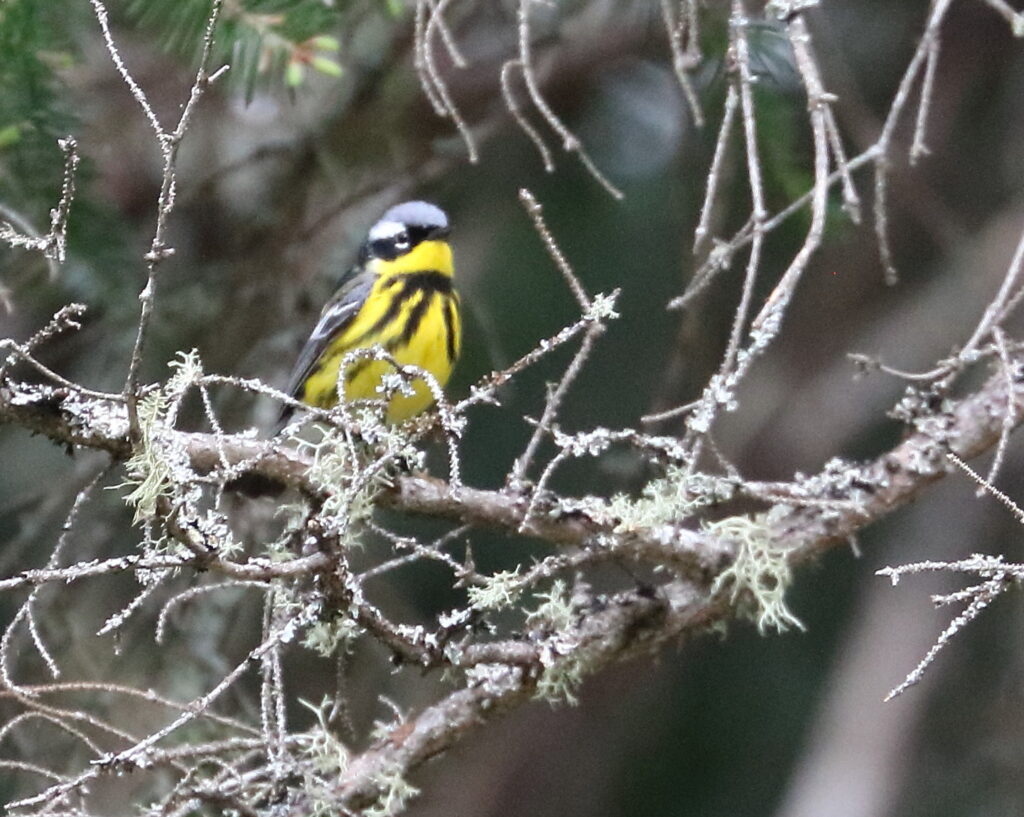
Magnolia Warbler in a spruce tree.

I was especially excited about the two Cape May Warblers. While I’d seen a fair number of Cape Mays before, I’d rarely seen them in their breeding colors and I’d never heard them sing before. This is because of their distributions. While I’d encountered many of the East Coast warblers on their breeding grounds during my time in Pennsylvania, I was hundreds of miles too far south for Cape Mays, which use contiguous spruce-fir forest and are mostly confined to Canada. These warblers (which are named after Cape May, New Jersey, where they neither breed nor spend the winter) are particularly dependent on an insect known as spruce budworm. Budworms are spruce parasites, and their populations are cyclical. During outbreak years the insect infects and ravages thousands of acres of spruce trees before the population crashes. Cape May Warblers, Bay-breasted Warblers, and Evening Grosbeaks, therefore, all have populations that rise and fall with the populations of this insect.

A “Myrtle” Yellow-rumped Warbler, which is the subspecies that lives on the East Coast!

Besides agriculture, the main industry in Aroostook County is logging, and understandably, the logging industry is not the biggest fan of an insect that defoliates thousands of acres of their crop. Unfortunately, the industry’s historical response to spruce budworm outbreaks (which, remember, are ecologically “normal” and important for the birds dependent on them) has been to clear-cut hundreds of hectares of infected forest. Spruce-fir forest is a mature ecosystem that takes centuries to develop, however, and the forest that grows back after these clearcuts is not coniferous but deciduous. This is a major reason why many spruce budworm-specialists, like Cape May Warbler, and many other birds found in boreal forests, like Canada Jays and Black-backed Woodpeckers, have retreated from much of southern Maine in the last hundred or so years. Their habitat has simply disappeared.

I saw evidence of this as I birded The County. Sure, there was a lot of seemingly healthy spruce habitat. There were also massive empty lots, covered in nothing but slash and debris. The forests were filled with birds, while the lots had almost none. It almost seemed apocalyptic. At least the empty lots provided good views of Mt. Katahdin, Maine’s highest peak, rising in the distance.

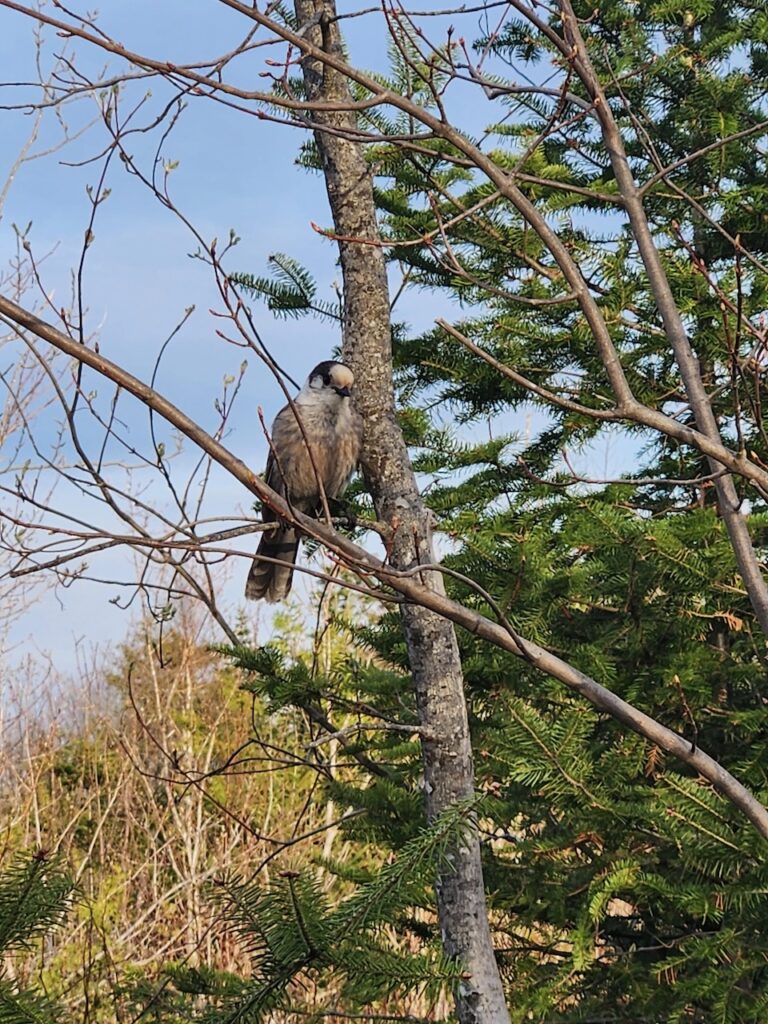
Again, though, the forests DID have birds, and not just warblers. Many migrants had not yet arrived (namely the flycatchers, of which I saw very few), but I recorded dozens of Ruby- and Golden-crowned Kinglets, Blue-headed Vireos, and Winter Wrens. Ruffed Grouse drummed from wet thickets, Hermit Thrushes foraged in the road, and I even got to see an American Goshawk bomb overhead at a million miles per hour, chasing something or perhaps just trying to give me as least satisfying a look as possible. In the evening, a walk along a side road yielded incredible, up-close views of Canada Jays, or “Whiskeyjacks” as they are known colloquially. These subtle, white-and-gray corvids landed in the trees less than five feet from me, curiously searching for insects while paying me no mind.

A photo of a Canada Jay that I took with my phone!

After a night and a day spent in The County, I headed back south to investigate the other corners of Maine I had yet to explore. Stay tuned!

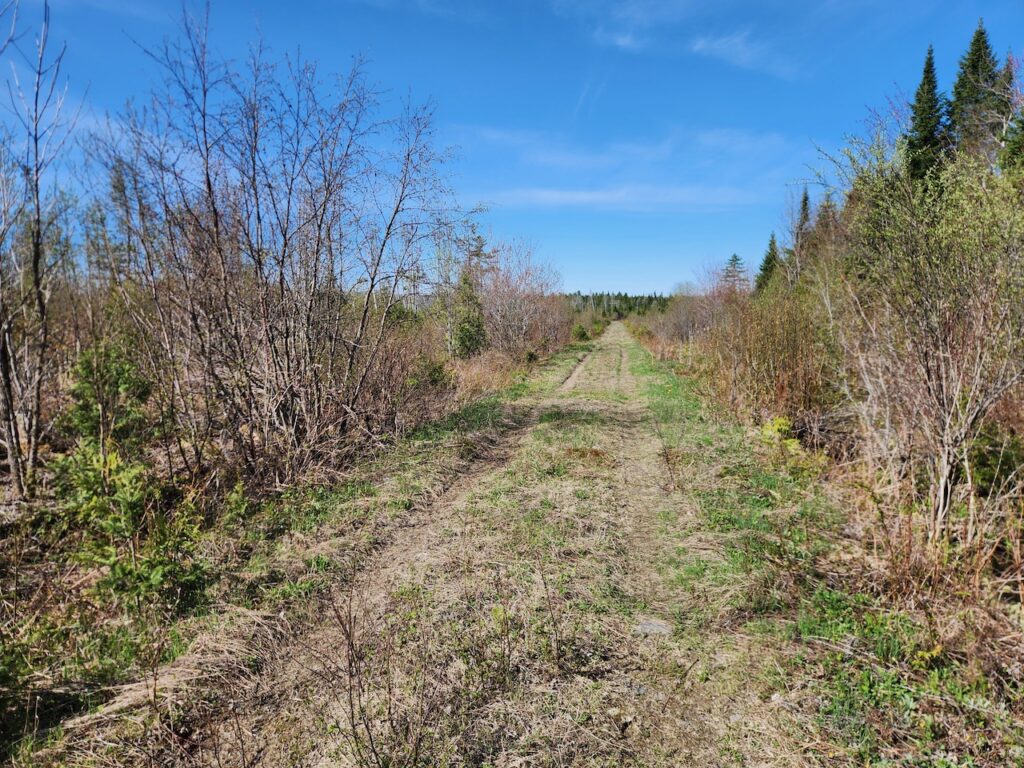
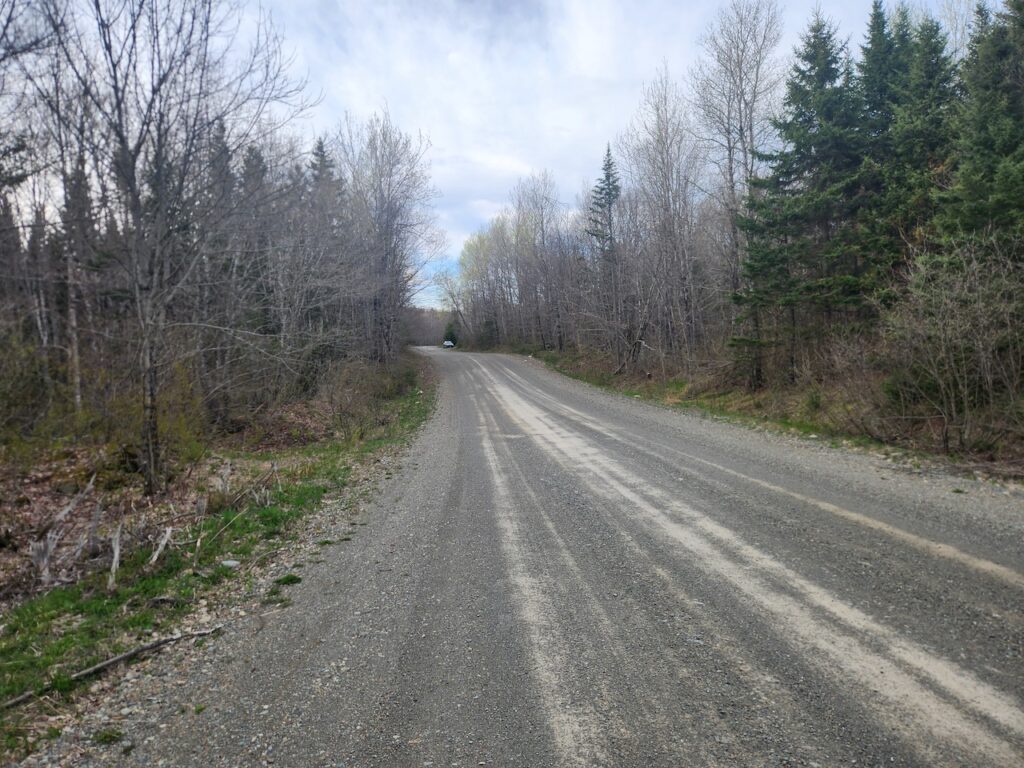
What the forest looked like in Aroostook!

Birding the Burn 2025

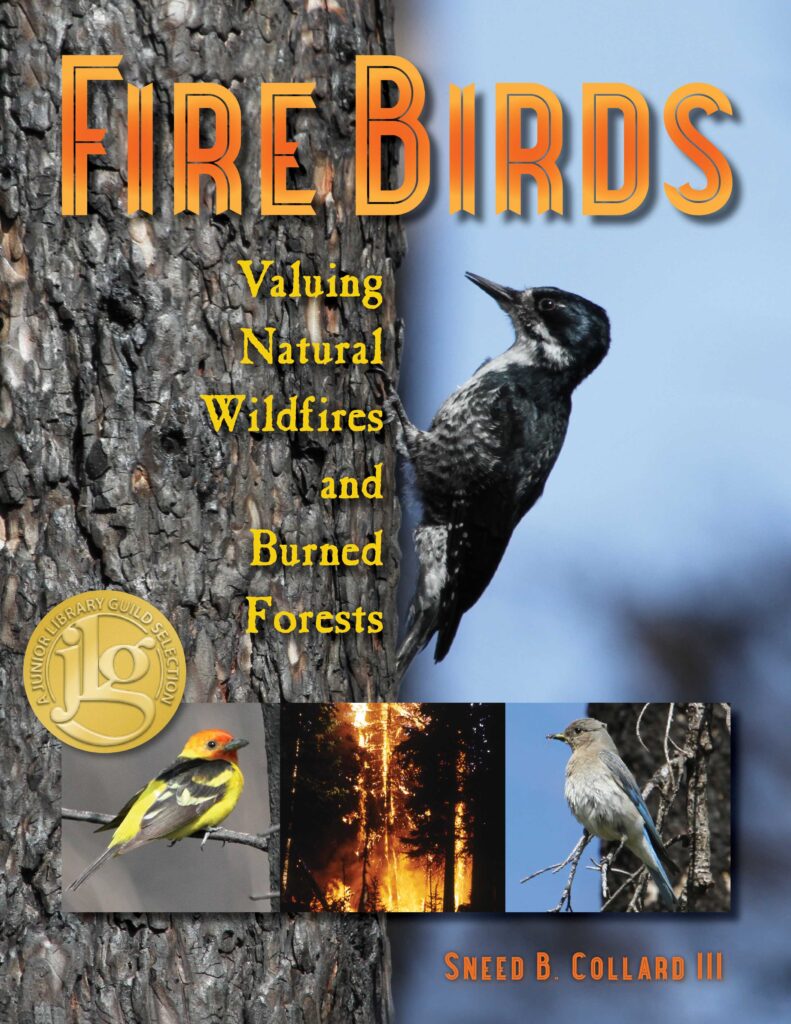
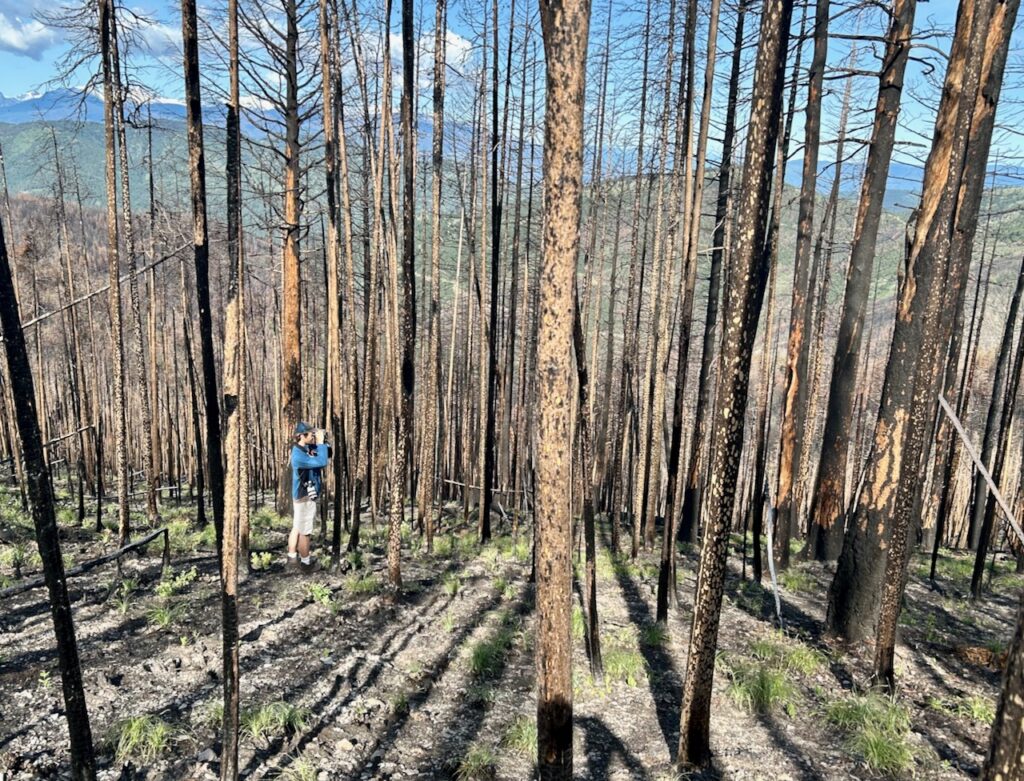
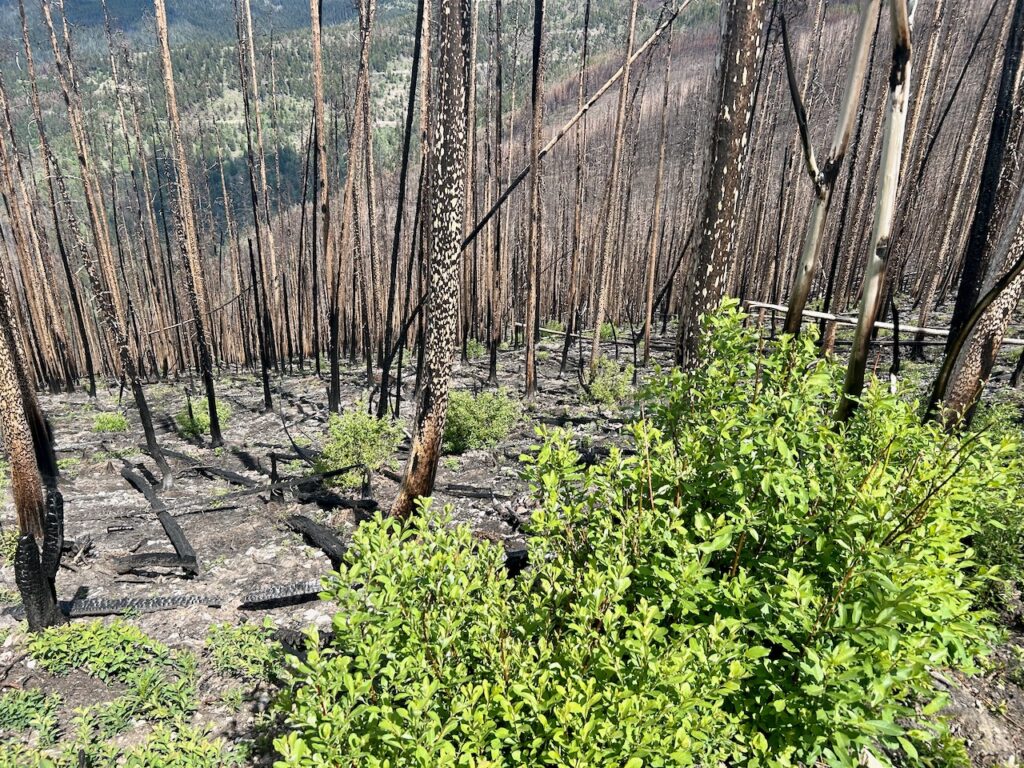
In many ways, my own birding journey began with my book Fire Birds: Valuing Natural Wildfires and Burned Forests. That’s when my birding mentor, UM Professor Dick Hutto, showed me the critical importance of burned forests and the spectacular birds that colonize them. It’s also when Braden and I began birding avidly. Since then, we have explored burned forests many times and they have become some of our favorite places to bird. Last week, we were excited to check out one of our area’s newest burns, last year’s Miller Creek fire area, about an hour from our house. To reach it, we headed all the way out Miller Creek and then wound our way up dirt roads until we reached the burn at Holloman Saddle. On the drive, we passed through terrific riparian and conifer habitat, and Braden could pick out Yellow and Orange-crowned Warblers, Swainson’s Thrushes, and Willow Flycatchers through the car window. At about 6,300 feet elevation, we reached the burn, parked, and began exploring.

Researching and writing Fire Birds: Valuing Natural Wildfires and Burned Forests set me firmly on my birding journey—and propelled Braden and me to start birding burned forests. The multiple award-winning book is a great primer for kids and adults on many little-known aspects of forest ecology. To order a copy, click anywhere on this block!

Thanks to Dick’s tutoring, I had some experience sizing up burns and at first, this one didn’t seem ideal. Three birds essential to “opening up” a burned forest are Black-backed, American Three-toed, and Hairy Woodpeckers. These birds hunt wood-boring beetle grubs in the newly-charred forest and along the way, drill out cavities essential for other cavity-nesting birds. But Dick’s research had shown that Black-backed Woodpeckers need larger-diameter trees to nest in, and the forest that greeted us now mainly seemed full of smaller-diameter trees. I also saw stumps where larger trees had already been removed—another huge problem in human (mis)management of burns.

Braden trying to locate a promising bird call in the Miller Creek Burn.

Through decades of well-intentioned Smokey Bear messaging, we have all been taught that all fires are bad, bad, bad. Even when a natural fire does occur, the forestry Powers That Be have taught us that humans must somehow “save” a burn by salvage logging it. For those unfamiliar with it, salvage logging involves going into a burn and removing trees that retain commercial value. The problem? These trees are exactly the larger-diameter trees that woodpeckers need to drill out their homes and, in the process, provide homes for dozens of other animal species. Salvage logging also often severely compacts forest soils and removes the seed sources (cones of burned trees) needed for the forest to regrow. This means that we now have to pay people to replant the burn site—when the forest was already perfectly equipped to replant itself.

Left to their own devices—i.e. without “salvage logging”—most burned forests recover quickly—and with a much greater variety of plant and animal life than before.

Nonetheless, shortly after Braden and I began walking, we heard the distinctive drumming of either an American Three-toed or Black-backed Woodpecker. These can be distinguished from other woodpeckers because the drumming noticeably slows at the end. To find out which bird was drumming now, we began making our way down a steep hillside toward some larger trees, but the burned ground proved very crunchy and we may have spooked our quarry before we got eyes on it. Disappointed, we climbed back up to the road, and continued walking. Fortunately, the forest around us sang and flitted with bird life.

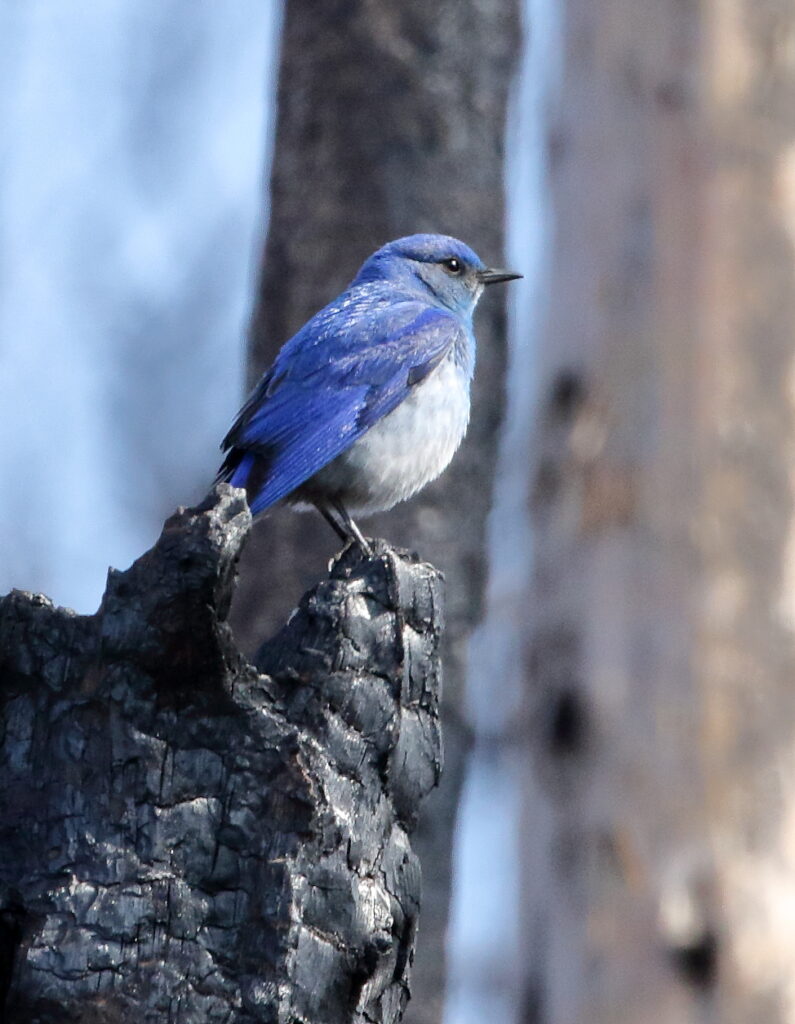
Almost immediately, we began seeing Mountain Bluebirds, one of Montana’s most spectacular species. MOBLs are well-known “fire birds” and their vivid blue plumage looks especially striking against the blackened trunks of a burned forest. Today, we saw these birds everywhere. During our three-mile walk, Braden recorded seven of them, but we both agreed we probably undercounted.

By popular consensus, Mountain Bluebirds are the most stunning “fire birds” you’ll find in burned forests. However, another common fire bird, Western Tanager, might challenge that opinion. Did you know that bluebirds are thrushes? They are relatives of at least four other popular Montana thrushes: American Robin, Swainson’s Thrush, Varied Thrush, and Townsend’s Solitaire.

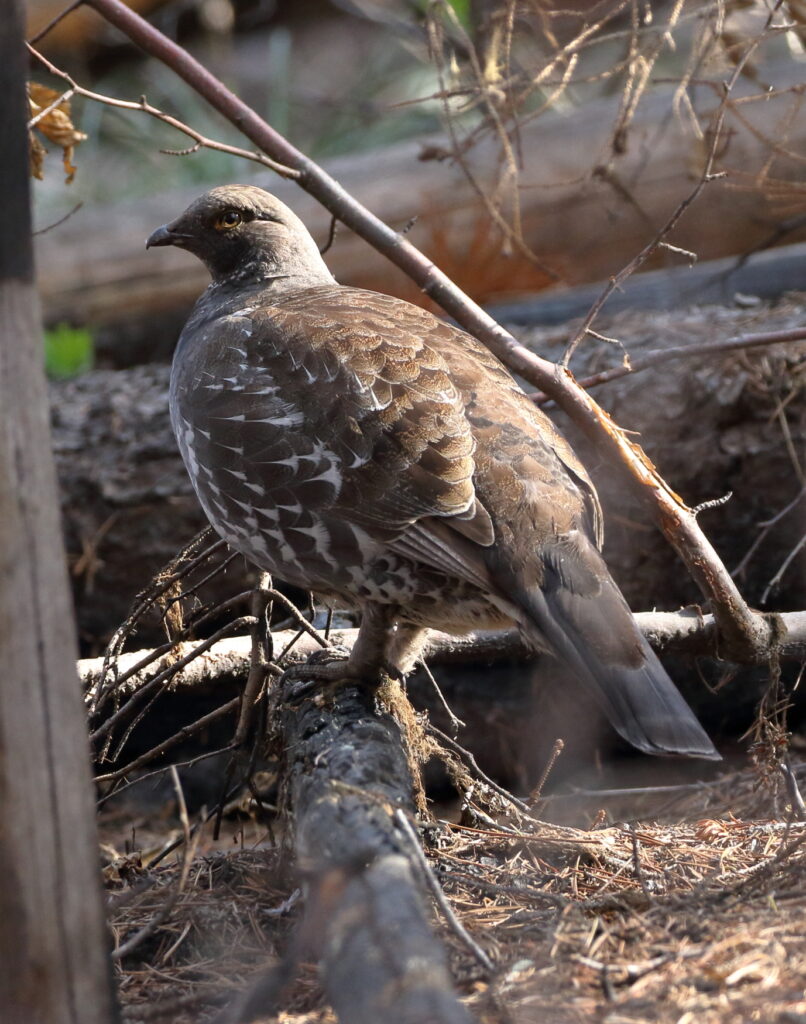
Suddenly, a large shape took off from beside the road and spread its wings as it glided down into the woods. “Dusky Grouse!” Braden exclaimed. It was one of the birds he most wanted to see since arriving back in Montana the previous week. Hoping for a better look, we crept down after the bird and, sure enough, espied it sitting quietly in the shadows. We enjoyed it through our binoculars for five minutes and then slipped away, leaving it in peace.

Before heading out, Braden told me, “I really want to see a Dusky Grouse.” This one obliged perfectly—and it was the first we’d ever seen in a burned forest.

Except for the mystery woodpecker that had drummed earlier, we had not heard a trace of other woodpeckers, but what we did hear was astonishing: wood-boring beetle larvae actually munching away inside of the dead tree trunks! I’d been told that one could hear these, but with my crummy hearing, I didn’t believe that I ever would. Sure enough, in several places, we listened to these big juicy grubs take noisy bites out of the wood!

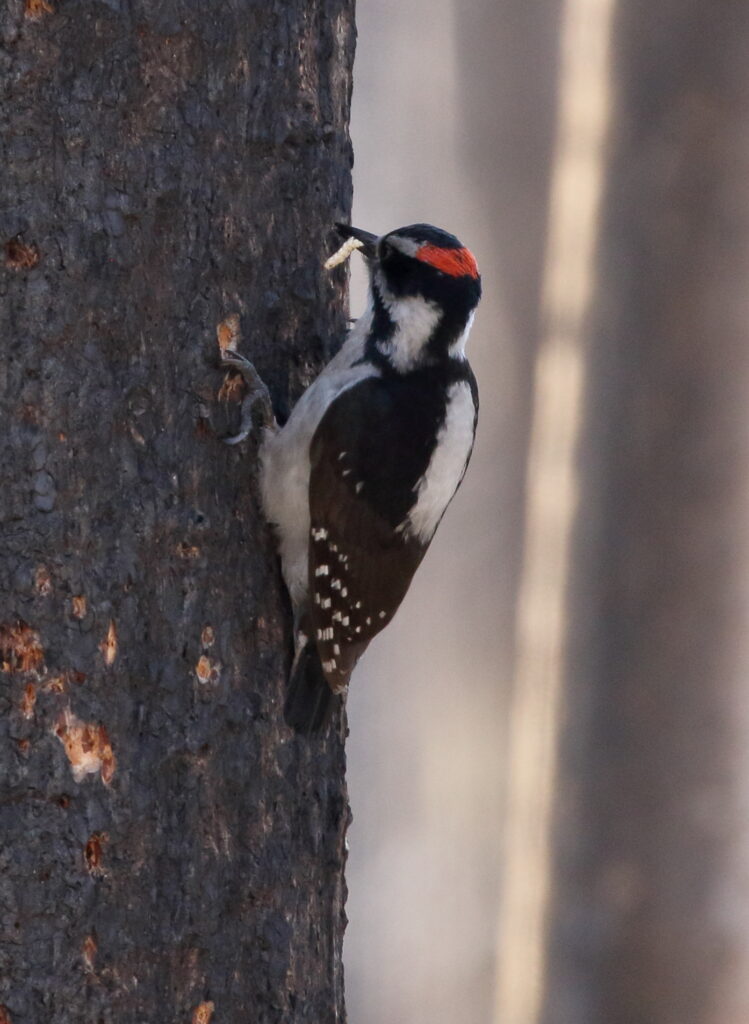
Score! While we watched, this Hairy Woodpecker extracted a juicy beetle grub from a dead tree.

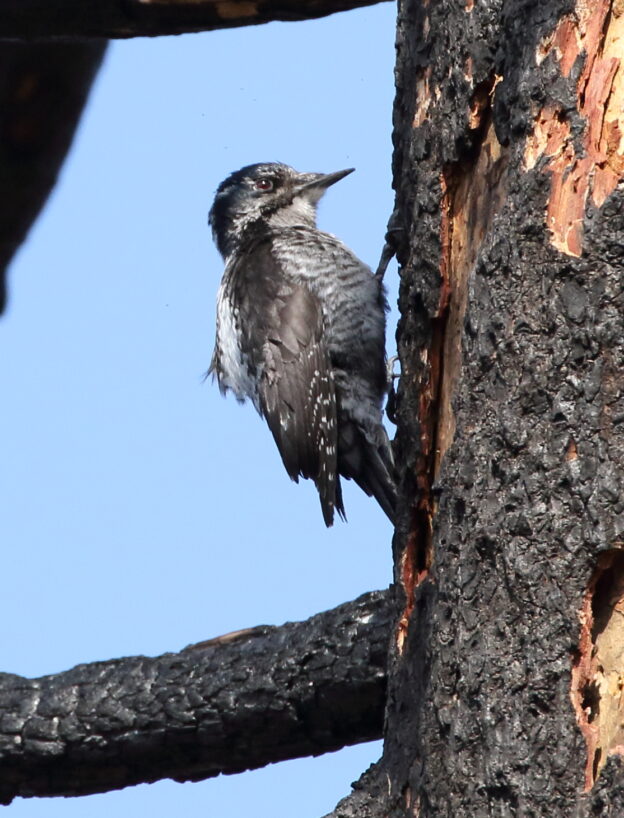
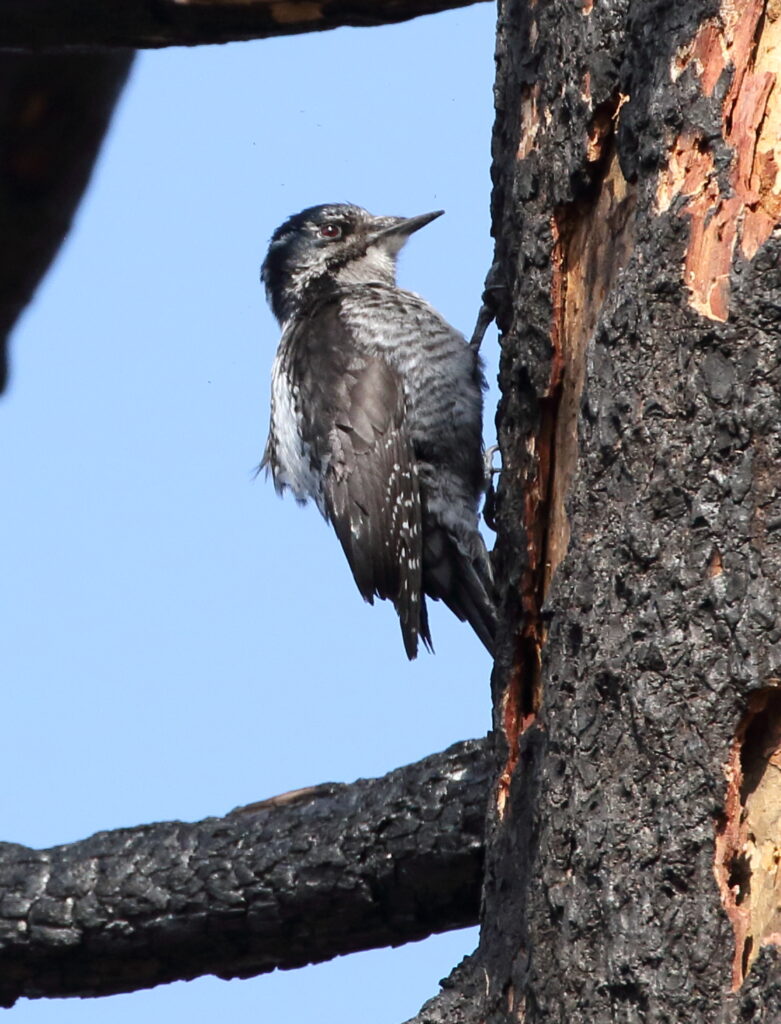
Finally, we also heard tapping on a large tree ahead. Braden got his eyes on it first. “It’s an American Three-toed,” he exulted. We could tell it was a female by the lack of a yellow crown, and we settled in to watch this amazing bird. It was working its way down the trunk, flaking away burned bark, presumably to check for insects hiding underneath. Once in a while, it stopped and really began pounding away after a beetle deeper inside the wood. It sounded like someone driving nails into cement!

Even female American Three-toed Woodpeckers can be distinguished from Black-backed Woodpeckers by having some streaky white on their backs—though not as much as on Hairy Woodpeckers (compare with previous photo).

As we continued our walk, we also saw Hairy Woodpeckers and another three-toed, this one a male. Woodpeckers, though, were just some of the birds making use of the burn. We got great looks at Townsend’s Solitaires, Red Crossbills, American Robins, Dark-eyed Juncos, Yellow-rumped Warblers, and Chipping Sparrows, and heard both Red- and White-breasted Nuthatches. Most of these are classic “burn birds” and we felt exhilarated to see them.

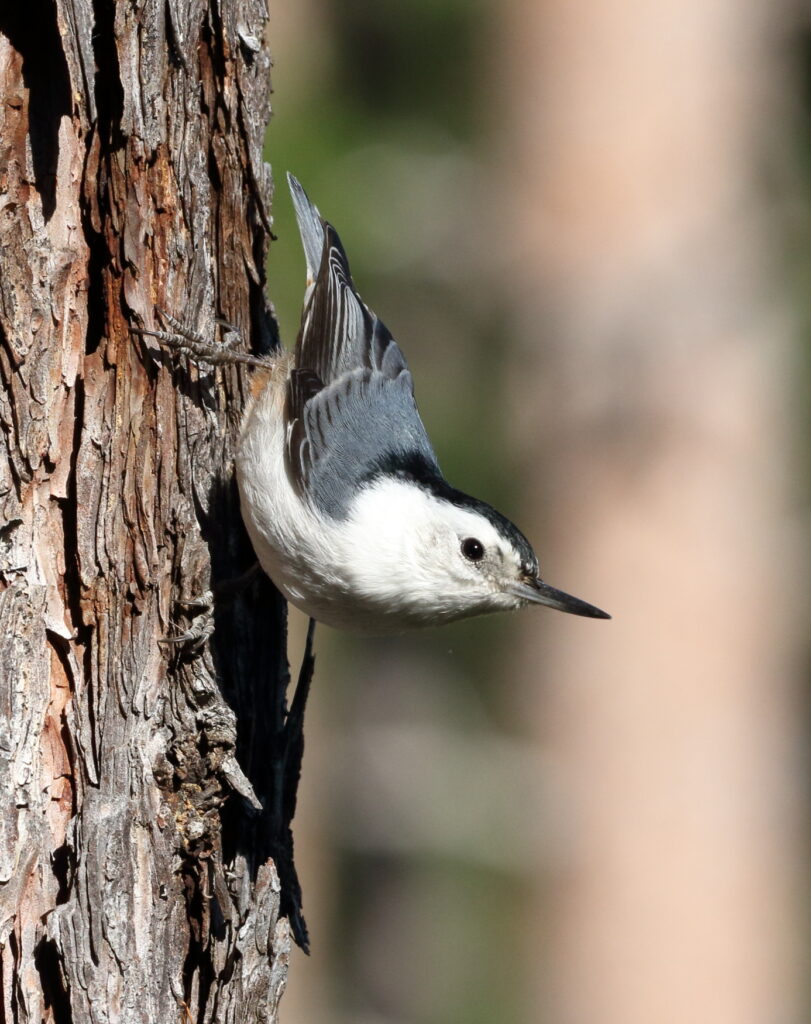
Though we didn’t get eyes on one in the burn, we did hear a White-breasted Nuthatch—and saw this one the day before up nearby Pattee Canyon.

At a couple of places, unburned green scrubby areas abutted the fire boundary, and it was fun to see birds dash from these green protected areas into the burn for quick meals or nesting materials before dashing back to safety. Many birds, in fact, love to “set up shop” at the boundaries of such two contrasting habitats.

We never did find a Black-backed Woodpecker, but that did little to detract from yet another great birding outing. We vowed to return to this spot the next few years, hoping that no one would move in to “save” this precious forest that didn’t need saving. On the drive down, we also stopped at some of the lower riparian areas for great “listens” at MacGillivray’s, Orange-crowned, and Yellow Warblers along with our favorite empid species, Willow Flycatchers. Amid the current chaos of the world, our burn bird outing offered a fun, revitalizing—and yes, inspiring—break. If you’re lucky enough to have a burned forest near you, we hope you’ll check it out.

We can’t prove it, but it seems to be a really good year for Orange-crowned Warblers—not always the easiest birds to see in Montana.