
Category Archives: Canada

Birding 2025: It’s a Wrap

As always, we encourage you to share and link to this post. We absolutely do not give permission to use it to train AI models or for other purposes without permission. Happy New Year, Everyone!

As 2025 rapidly winds up, Braden and I want to thank you for your continuing interest in FatherSonBirding and all that you do for birds. We can’t believe that it’s been almost EIGHT YEARS since we published our very first post, A Quest for Snowy Owls! We certainly wouldn’t have kept at it without your interest and support.

We’re thrilled to report that 2025 has been FSB’s biggest year yet. We published a record 49 posts this year, including our 250th post, “Binoculars and Scopes for the Happy Holiday Birder”. Speaking of that, we also launched FSB equipment reviews—articles we do NOT get paid for, but which have attracted a ton of viewer interest.
FSB received a record 20,000 views in 2025, greatly helped by our equipment and travel reviews!

And speaking of viewers, our site attracted 20,000 views this year, shattering last year’s record of 14,000—with the caveat that about a thousand of those views were likely from AI bots stealing our content without permission (Grrrr…). Still, the vast majority of those extra visitors were legitimate—and from an astounding variety of places. More than 15,000 viewers from 104 countries visited our site this year! Huge gracias, arigatos, mercis, and many more thank yous to our international visitors!

By now, we can hear you pleading, “But please, Sneed and Braden, tell us your Top 5 most popular posts!” Astoundingly, four of our five top posts were equipment review posts:

1) Vortex Triumph 10X42 Binoculars: Entry Level Excellence with 1,425 views. (View post here!)

2) Nikon Monarch HG Binoculars: FSB’s First Equipment Review with 950 views (View post here!)

3) Vortex Razor HD 13-39X56 spotting scope with Mountain Pass tripod: A Perfect Travel Combo? With 580 views (View post here!)

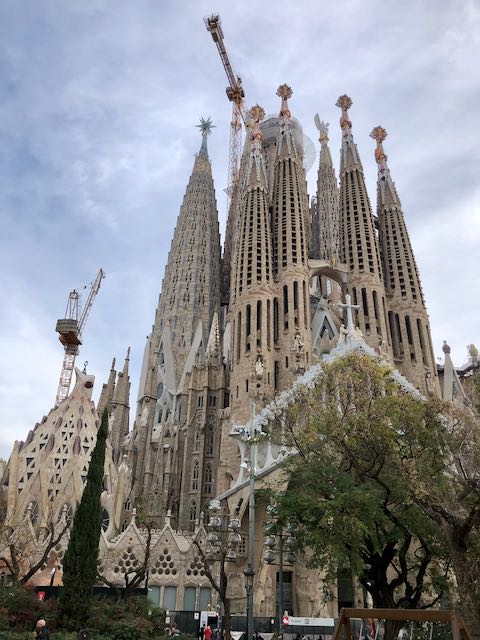
4) Birding Barcelona, Part 1: The Urban Core with 510 views (View post here!)

5) Vortex Viper HD Binoculars (Equipment Review, and/or Texas 2025 Part 2-½) with 480 views (View post here!)

Our 2024 blog about birding downtown Barcelona snuck into the Top 5 for 2025—with several of our Japan and Costa Rica posts close behind!
The numbers reveal some clear trends: with rare exceptions, our most popular posts have been our equipment reviews and reports from travel destinations. Our posts from Japan, Spain, Colombia, Mexico, and Costa Rica have been especially popular—as have posts about very birdy domestic locales such as Texas and San Diego. Our book reviews also have done well, but a decline in America’s literacy rate is clearly evident, as our statistics reveal that many more viewers are interested in buying gear than in reading books.

On a personal level, Braden and I are grateful for the many wonderful birding experiences we got to share, both together and separately. Braden was fortunate to visit both Mexico and Costa Rica in 2025 as well as take an epic cross-continent trip from Maine to Montana following his graduation from the University of Maine. He also birded the heck out of Arizona while on his way to his current job in California, where he’s racking up all kinds of new birding experiences.

As for Sneed, I kicked off the year with a trip to Victoria, Canada, thanks to my wife, Amy—and, honestly, the year never seemed to slow down. As soon as we returned, my buddy Roger Kohn invited me on an epic last-minute trip to Colombia. There followed journeys to Texas, Maine, eastern Montana, California (twice!), and most recently, Georgia and Oregon. Most of the latter were not planned as birding trips, but you won’t be surprised to learn that we saw a ton ‘o birds along the way.
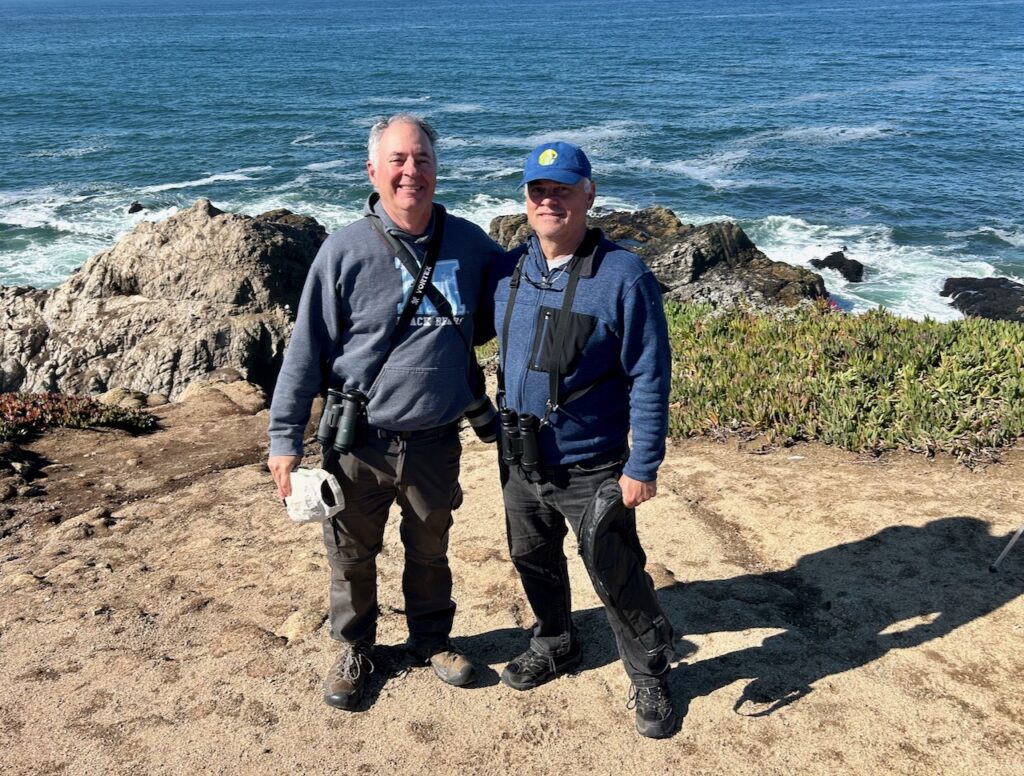
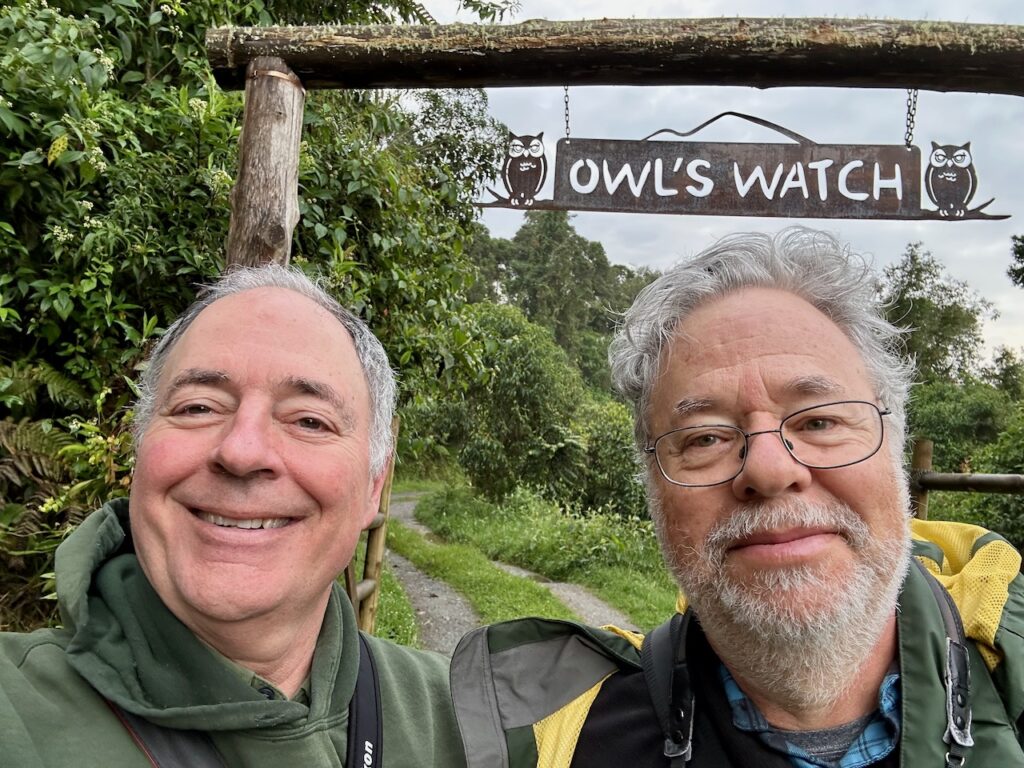
You also won’t be surprised to learn that, quite unintentionally, Braden and I shattered most of our own birding records. Braden finished out his birding year with a remarkable 867 species while I smashed my own previous record with 551 species!

One of the low points for the year was having to say goodbye to our wonderful “birding dog” Lola. She left us far too soon and we still miss her terribly. (See this post.)

Besides finding birds, Lola proved adept at finding marine mammals such as this whale. We miss you Lola!

Moving forward, we hope to continue to publish a wide variety of posts for your reading pleasure, including those about everyday birding experiences that are at the heart of a birder’s joy and wonder. Just a few adventures that we have lined up for 2026 include trips to Costa Rica and Germany, along with visits to birding festivals in Colorado, Arizona, and Montana. Meanwhile, it is our sincerest wish that the next year brings you all good things, including many incredible birding experiences and a brighter outlook for birders, birds, and the planet we all share.

For some ideas about how to help birds this coming year, please visit our last post, Giving Back to Birds—with Great Breaking News! As always, if you would like to help support FatherSonBirding, consider buying new copies of some of Sneed’s books by clicking on the book jackets to the right.

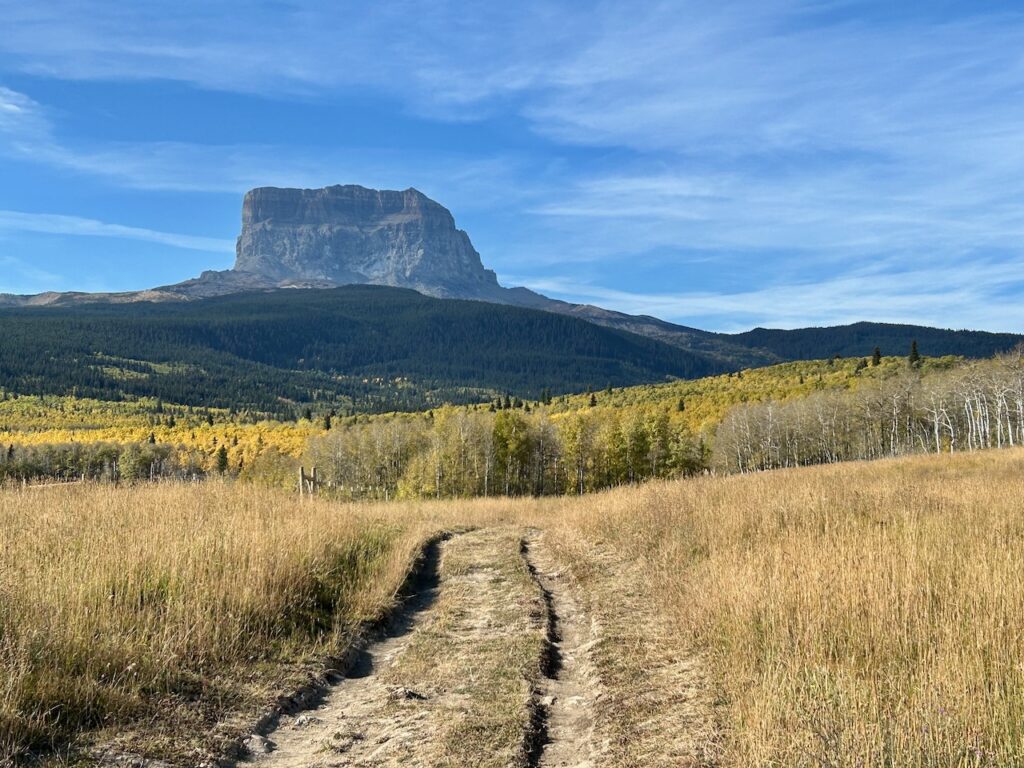
Birding Glacier National Park in the Hot Dry Fall of 2025

FatherSonBirding is a labor of love and Braden and I keep it advertising-free. If you’d like to support our efforts at independent journalism, please consider sharing our posts with others and purchasing one or more new copies of Sneed’s books by clicking on the book jackets to the right. Thanks for reading and keep working for birds. We will!
Not quite two years ago, I posted “Birding Glacier National Park in the Long Hot Winter of 2024.” The blog resulted from an invitation I received to speak to school kids in Browning, Montana, and I took the opportunity for some rare winter birding at my favorite park. The post has received a lot of views, either because people love Glacier or they are interested in the impacts of climate change or both. A couple of weeks ago, I was fortunate enough to be invited back to Browning. This time, I came a day early and my hosts were gracious enough to provide me with a place to stay for the extra night. My last post narrated my drive up, especially the devastating state of the drought along the Rocky Mountain Front. With my extra day to bird, though, I planned to return to Glacier and I wondered, “Would the park be as hot and dry as before?”

My destination for the day was the road (not THIS one, fortunately) leading past iconic Chief Mountain to the US-Canada border.

I woke in my East Glacier lodging well before dawn and about seven a.m. set off for my first destination, the Chief Mountain road that leads up to Waterton Lakes in Canada. As I drove toward Browning before turning north, a spectacular orange fireball rose on the eastern horizon. I’ve seen lots of sunrises in my life, but nothing matches a sunrise over the northern Great Plains. As a bonus, a red fox and young bull moose greeted me from the side of the road!

My route took me to Saint Mary and up past the one-bar town of Babb before I turned left toward Canada at about 8:30. I sadly didn’t plan to visit our northern neighbor. Today, much as I had on my last visit here, I had a particular quarry in mind: Boreal Chickadees.

As their name implies, Boreal Chickadees live mainly in northern spruce & fir forests and as such, their range barely dips into the US in a few places along our northern border. Lucky for Braden and me, Montana happens to be one of those places. We had found our first BOCHs almost by accident during covid, when Glacier had been closed and we decided to try our luck along the Chief Mountain road. To our delight, we found the little birds. Stunningly cute, their brown heads and other features closely ally them with both the Chestnut-backed and Gray-headed Chickadees, the latter now thought to be extinct in Alaska, their only known home in the US. In any case, on my visit to Browning two years ago, I had relocated BOCHs on the Chief Mountain Road, and it was my aim to do so again today.

For my first try, I stopped at the pull-out right next to the Glacier National Park sign. I walked the road for a few minutes and managed to grab the attention of three Red-breasted Nuthatches while Sound ID picked up the calls of Golden-crowned Kinglets (which due to my ears, I have never been able to hear), but no chickadees.

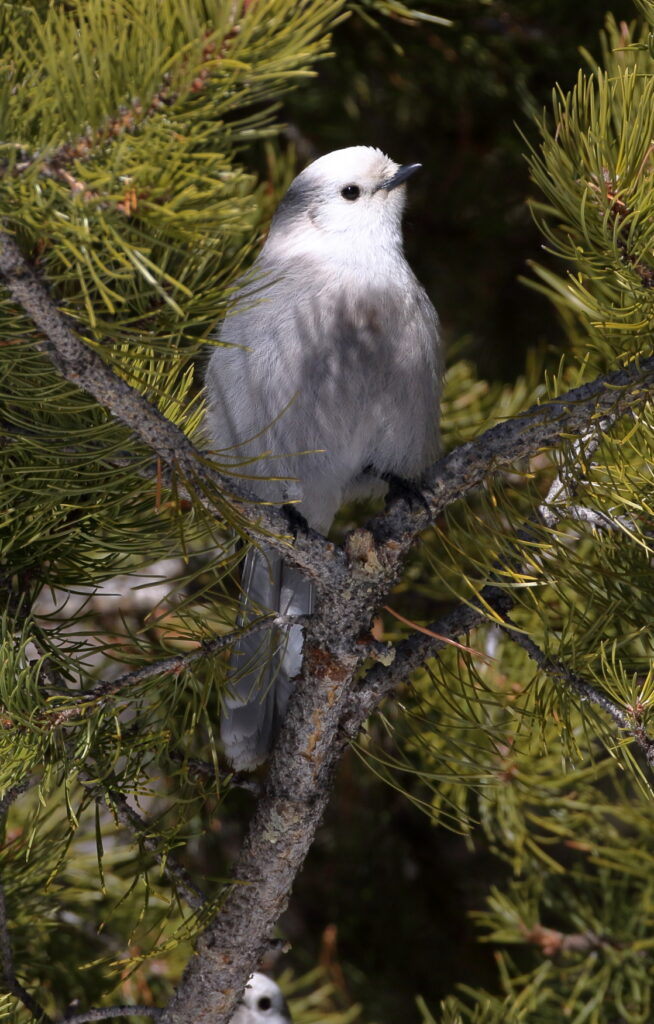
I repeated this routine five more times along the road between the Glacier NP sign and the Canadian border. I got really excited at one point when I saw a flurry of bird activity from my car. I leaped out, binoculars and camera in hand, and saw robins, more nuthatches, and a Hairy Woodpecker. A foursome of Canada Jays, perhaps the most refined members of the corvid family, swung by to check me out. No chickadees.

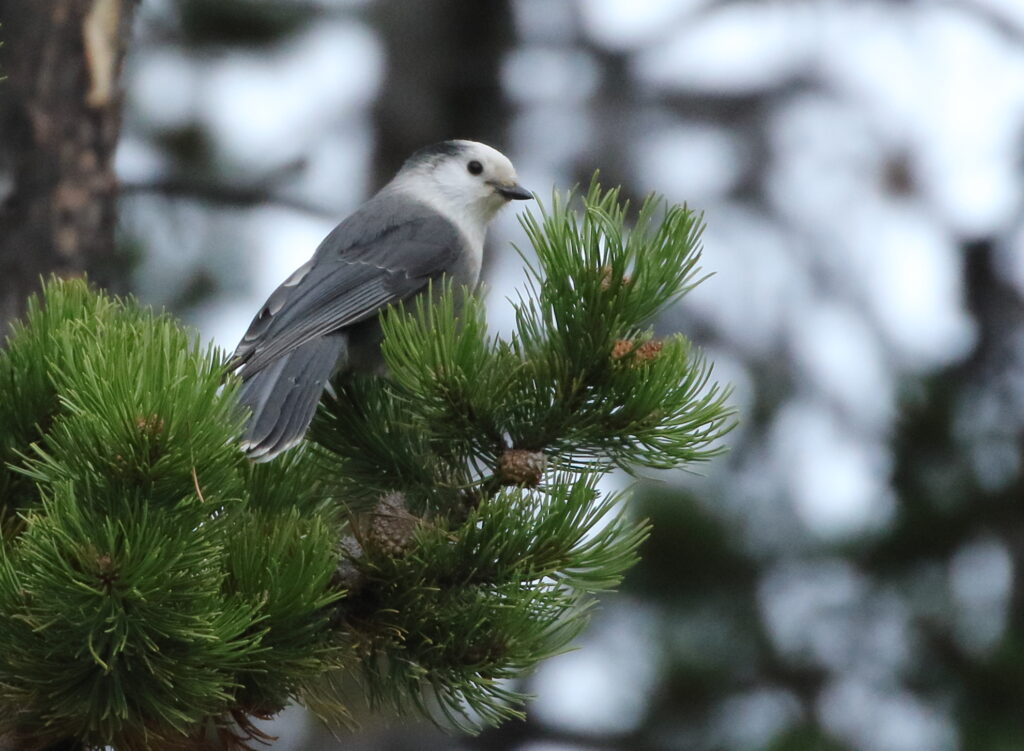
As my prospects for finding Boreal Chickadees dimmed, I focused on enjoying another of my favorite birds, Canada Jays—though why Canada gets to claim these gorgeous critters remains a mystery!

As I searched, I especially looked for densely-packed spruce trees along the road, but I realized that lodgepole pine actually dominated many areas. “Hm. Maybe this isn’t a preferred location after all,” I thought. “Maybe we just got lucky the past couple of visits.”

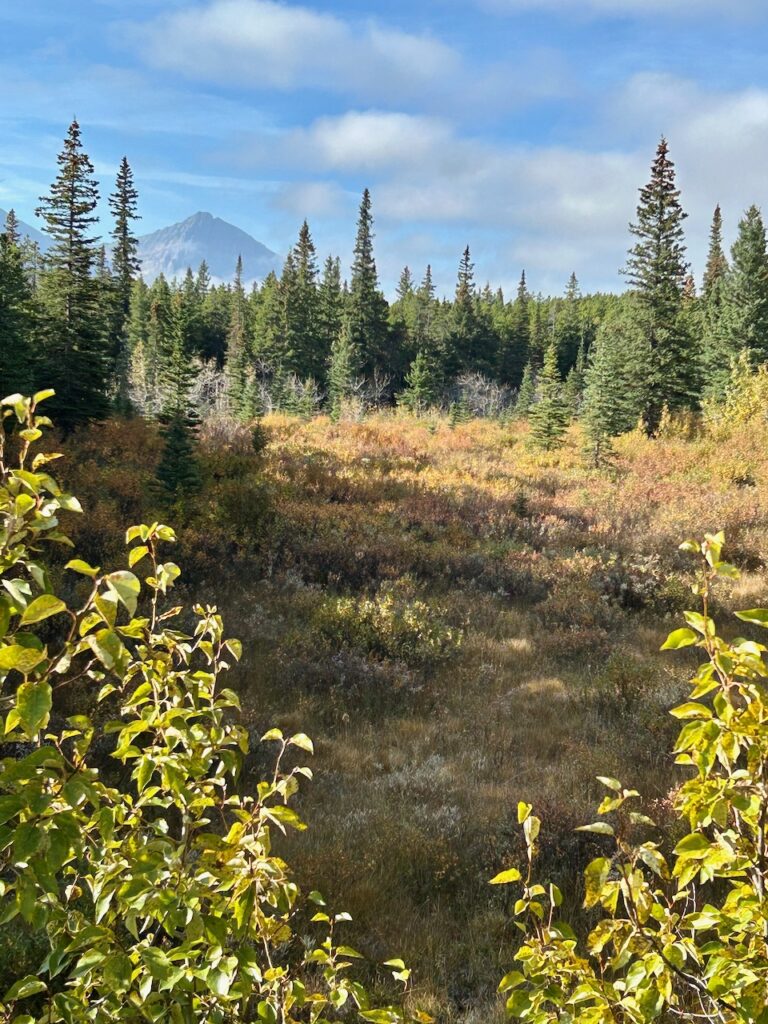
I had started to get that “I guess I’m not going to find them” feeling when I noticed a little area that seemed to have more spruce. There was no pull-out here so I just parked as far off the road as I could and walked back to where a brushy meadow pushed westward into the forest. The meadow was lined with more spruce than anything else, and as if to lure me in, two more Canada Jays landed to be admired. “Might as well give this a try,” I thought.

This meadow intrusion into the woods seemed like my last best chance to find Boreal Chickadees on this unseasonably warm fall day.

I followed what appeared to be an overgrown path through waist-high shrubs. It occured to me that if berries grew nearby this would be an ideal place to get ambushed by a grizzly bear, but I cautiously pressed forward. My hopes shot up when two small birds rose out of the brush and landed in a tree. I got only a brief glimpse and still have no idea what they were, though I’m guessing some kind of sparrow.

I was approaching the end of the meadow when I saw more birds flitting around up ahead. I spotted another Red-breasted Nuthatch and Sound ID picked up White-crowned Sparrows, Golden-crowned Kinglets, and Dark-eyed Juncos. Then, suddenly, I heard chickadees—and they definitely were not Black-cappeds!

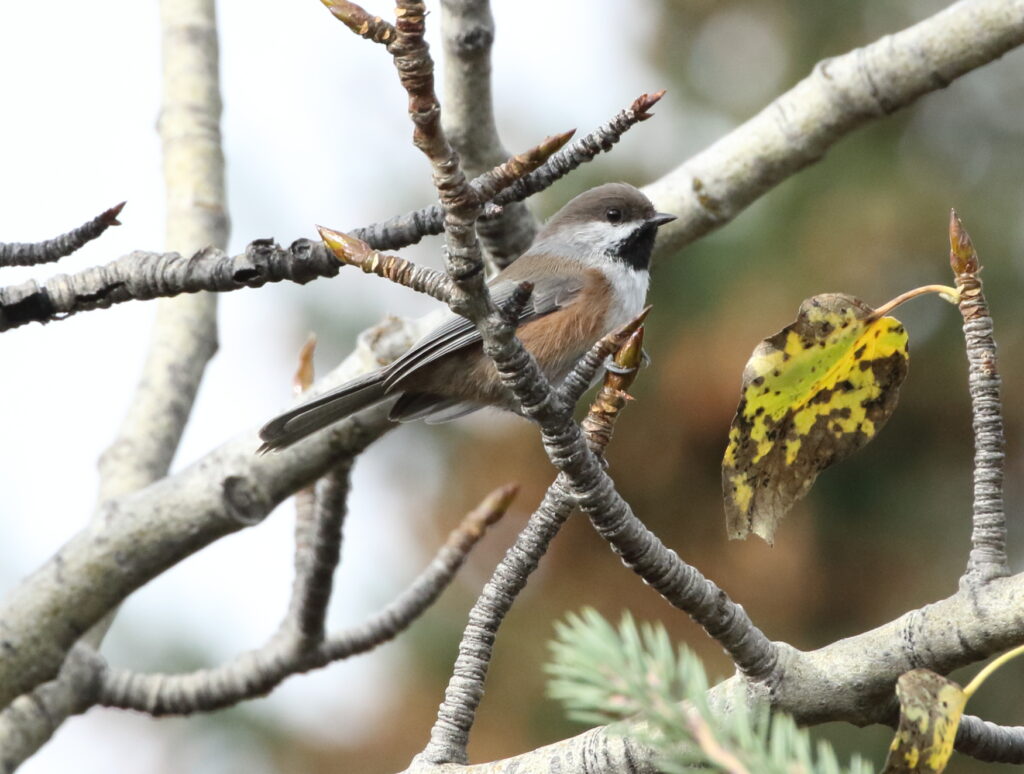
Within moments several tiny birds landed in the trees before me. It took a few tries to get eyes on one and to my joy, it was a Boreal! There were four of them altogether and wow, did they have a lot of energy! Not only were they checking me out, they were checking out every other bird, too—including a Ruby-crowned Kinglet keeping company. I managed a couple of good photos. Then, within minutes, all the birds departed—even the White-crowned Sparrows with their loud contact calls. Smiling, I traipsed back to the car. The sun had a special warmth to it and Chief Mountain rising above the forest added magic to the moment. Little did I know, however, that this wouldn’t be my last “moment” of the day.

While most visitors to Glacier focus on seeing grizzlies and mountain goats, nothing says wilderness to me more than Boreal Chickadees.

The glow of seeing Boreal Chickadees still with me, I made my way back to Babb and turned right, up the road to the Many Glacier Valley. A large flashing sign warned that there was no general admission parking there, but I love this drive and decided to go as far as I could. I passed through groves of aspen glowing gold with fall foliage and relished the views of Mt. Wilbur and other familiar peaks ahead.

At the Lake Sherburne dam, I stopped and got out for a look at the reservoir. In keeping with my observations from my last post, it was as low as I’d ever seen it, a giant “bathtub ring” leading from the forest edge down to what water remained. I’d also noticed that Swiftcurrent Creek was incredibly low—mere rivulets flowing between a pavement of exposed rocks.

Lake Sherburne—a reservoir, actually—stood as low as I’d ever seen it, additional evidence of the long-term drought impacting this part of the world.

I still had plenty of time and wanted to do some kind of hike in the park, so I returned to St. Mary and found myself on a little trail for the Beaver Pond Loop. In all my visits to Glacier, I’d never before done any hiking or walking near St. Mary so I set out on this path with some excitement. It wasn’t the most dramatic hike, hugging the south side of St. Mary Lake, but it offered terrific views up the valley and the blue sky and warm (too warm) conditions made for pleasant hiking.

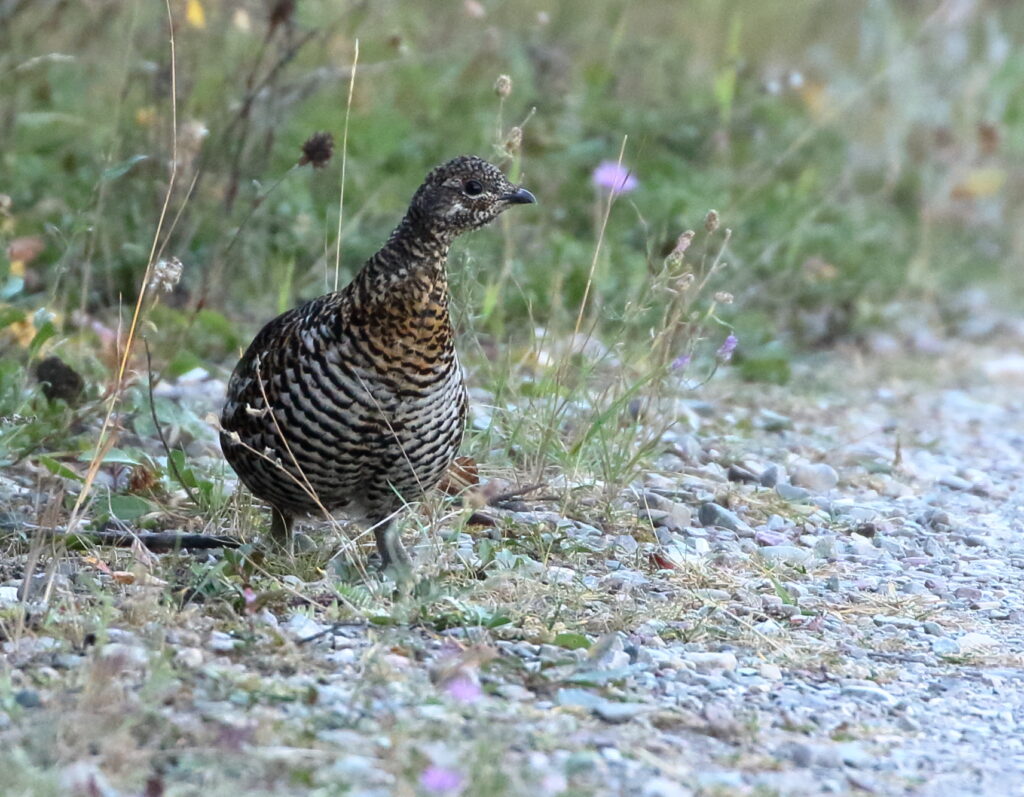
I’d walked maybe a quarter mile when I rounded a bend to see a dark object ahead next to the trail. At first I thought it might be a hare or other mammal. When I raised my binoculars, I realized with astonishment that it was a grouse. Not only that, I felt pretty sure it was a Spruce Grouse!

My accidental Spruce Grouse sighting was evidence that I had put in enough time searching for these guys to break my “grouse curse.” Notably, the grouse brought my year species total to 527 birds—exactly tied with my previous record. Which bird will put me over the top? Stay tuned to FSB to find out!

If you’ve followed FatherSonBirding, you’ll know that I’ve seen SPGR only twice (see posts “Gambling on a Grouse-fecta” and “August: It’s Just Weird”), and had gone to great effort to do so. To have one just show up unexpectedly, well, that pretty much blew my mind. Still, I didn’t feel 100% sure on the ID, so I snapped some quick photos to send to Braden. Then, the grouse started walking toward me. “Whaaaaat?” I wondered.

That’s when I realized that another hiker stood on the other side of the bird and had herded it my way. Finally, the grouse wandered off into the forest, leaving me both astonished and gratified. I guess I had put in enough grouse effort to finally be rewarded by such encounters!

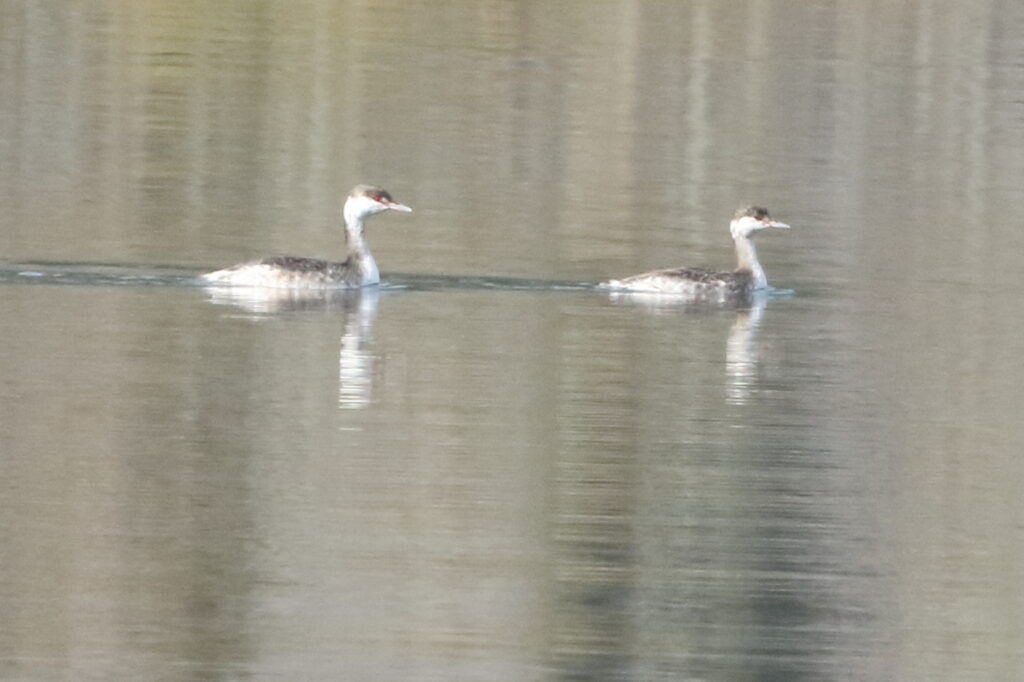
I continued onto a nice rocky beach on St. Mary Lake and found a perfect rock for sitting. Two pairs of Horned Grebes played and fished out on the water—my best look at this species all year—and I relished a few moments in one of earth’s most spectacular places.

Two pairs of Horned Grebes kept me company as I took a few moments to soak up the beauty of Glacier National Park before heading to my week of work in Browning.

Glacier, though, doesn’t exist by accident. It’s here because forward-thinking people planned for the future long ago. As the epically dry conditions of this part of the world attest, we need to keep thinking forward if we want our children and their descendants to have such places to cherish. As I said in my last post, all of us need to fight the disinformation and greed of climate deniers however we can. Whether that’s by making a donation to an environmental or legal group battling the horrible policies of the current administration or making changes to lower your own carbon footprints, every effort matters. Now, more than ever, is the time.

The Great Auk (Book Review)

If you are a fan of entertaining tales that blend bird biology, history, and human eccentricity, Tim Birkhead’s new work The Great Auk (Bloomsbury, 2025) will find a welcome place on your night stand. I have to confess that this is the first Birkhead book I have read, but the title suggested a fascinating story about a topic I knew very little about, so right away I requested a review copy from the publisher. My efforts did not disappoint.

The Great Auk by Tim Birkhead (Bloomsbury, 2025)

For me, the first question that needed answering was, “What the heck was a Great Auk?” I had, of course, heard of Great Auks during my twelve years observing, researching, and writing about birds but I hazily lumped them in with the totally unrelated Dodo and elephant birds. Why?  Probably because all of these birds had been large and flightless—and all had gone extinct. Other than that, I knew almost nothing about Great Auks.

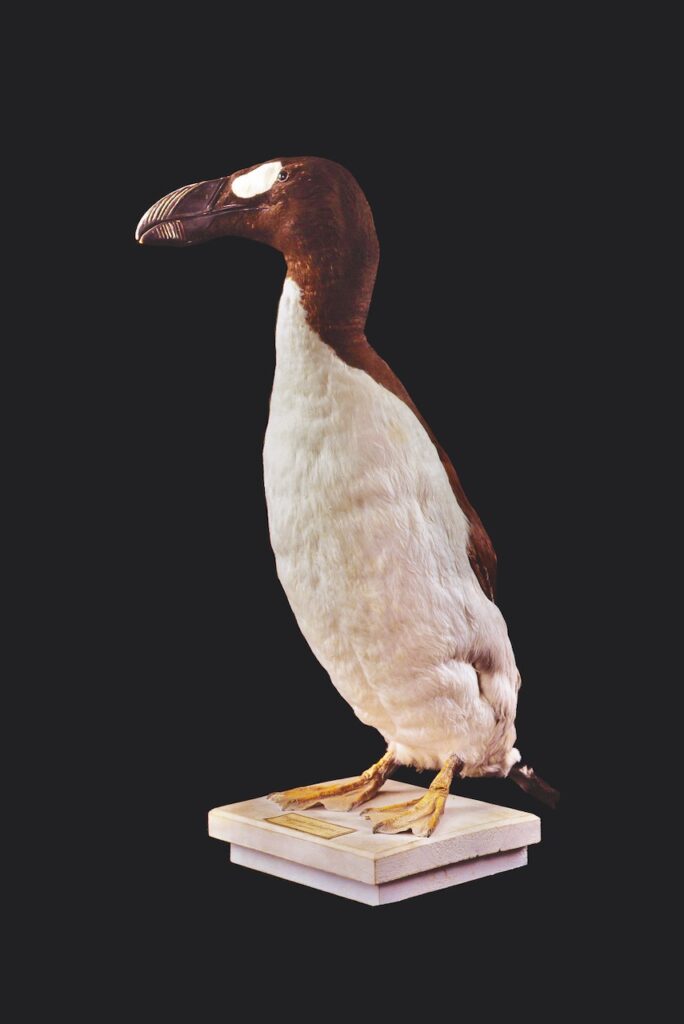
Great Auks were the original penguins, conferred the genus name Pinguinus. The origin of the name penguin is uncertain but may refer to the bird’s white head or white eye patch. In any case, the name was later applied to flightless birds of the Southern Hemisphere, even though they bear no close relationship to the Great Auk. (Photo copyright Errol Fuller)

Upon opening Birkhead’s book it was therefore a great relief to learn, “Oh, yeah. Great Auks are actually auks—seabirds!” I mean, duh, right? Members of the Alcid family, their closest living relatives appear to be Razorbills, something I found delightful since Braden showed me my first Razorbills only last Thanksgiving when our family had the chance to visit Cape Cod (see post Birding Race Point). Birkhead is quick to point out, however, that surprisingly little is known about Great Auk biology, much of it speculation from the relatively scant specimen material that has survived.

Seeing one of the Great Auk’s closest relatives, Razorbills, provided a living link to the tragedy of the Great Auk’s extinction.

Which, of course, brings us to the tragic fact that Great Auks were quickly and efficiently wiped out almost as soon as seafaring Europeans on their way to North America figured out where the birds nested. That happened to be remote islands in the North Atlantic, and in historical times, there probably never were more than a handful of breeding sites for the birds. In early chapters, Birkhead especially focuses on what was clearly the most important site, Funk Island. Here, tens—perhaps hundreds—of thousands of Great Auks gathered every year. Couples would each lay their single, exceedingly large egg and work together to feed the resultant, rapidly-growing chicks from the abundant fish schools nearby.

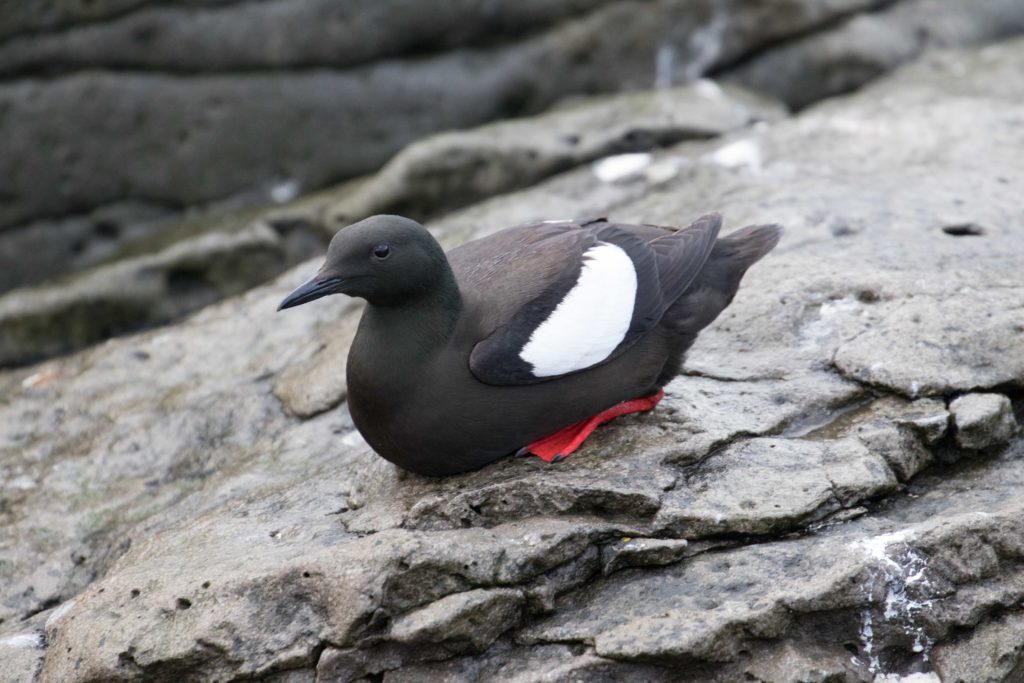
Like Razorbills, puffins, murres, and murrelets, guillemots such as this Black Guillemot are members of the Alcid family, and close relatives of the Great Auk.

When Europeans did discover the auk bounty to be had, the slaughter began. Ships heading to what is now northeast Canada stopped over to feast on the auks and preserve them for food. Later, egg, skin, and feather collectors helped finish them off. Birkhead especially documents the brutal habits of egg collectors. Not wanting to obtain eggs with well-developed embryos inside, the collectors would intentionally crush every egg that they found. Returning a few days later, they could be assured that the embryo inside of any new egg had not yet developed, and its contents could be easily removed through a tiny hole made in the shell. Officially, the last two auks were killed in 1844, though it is likely that a few isolated individuals survived into the following couple of decades.

Birkhead neatly divides The Great Auk into two parts. The first focuses mainly on the history of the bird, its demise, and what can be constructed of its biology from historical accounts, surviving specimens, and extant relatives. Part 2 focuses mainly on some of the more rabid egg and skin collectors, especially Vivian Hewitt, who somehow managed to acquire thirteen Great Auk eggs for his vast collection of approximately half a million bird eggs.

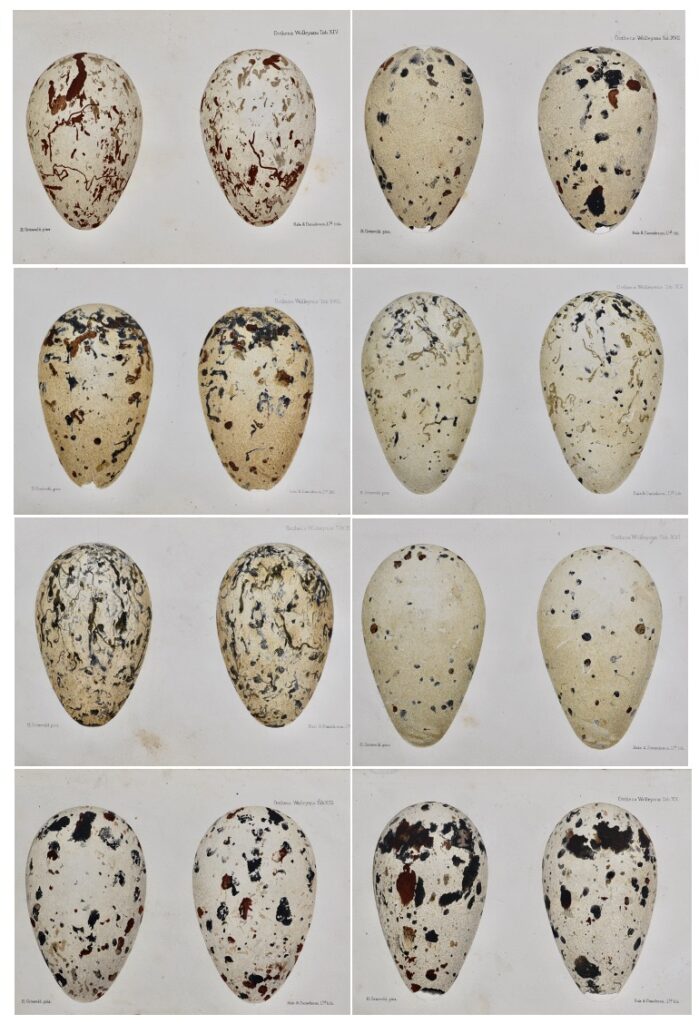
A selection of known surviving Great Auk eggs shows their great variety, which may have helped parents identify them in the crowded breeding colony. This variety also partly explains why they were so attractive to collectors. (Illustration by Henrik Grønvold, 1907)

I have to say that I enjoyed Part 2 just as much as Part 1. Few of us realize this today, but oologist—a term coined for egg collectors that attempted to confer scientific legitimacy upon a practice that we now consider despicable—was all the rage in the early 1900s. It was practiced much as stamp and coin collecting were when I was a kid—and with little thought about the consequences for birds. Collectors routinely not only gathered an egg of a species, but entire clutches of eggs and even hundreds from the same species, searching for variety, fame, and fortune.

As perhaps the wealthiest participant in the field, Hewitt spent a small fortune both obtaining individual eggs and opportunistically snapping up entire collections of other egg collectors when their fortunes turned for the worst. Most prized of Hewitts acquisitions were the eggs and mounted specimens of the Great Auk that he managed to obtain, each of which has a story—and many of which Birkhead traces to fascinating effect. I won’t say more about this fine book, but if you enjoyed Christopher Skaife’s The Ravenmaster and Joshua Hammer’s The Falcon Thief, you are almost guaranteed to love The Great Auk, too. And if you do, why not help prevent the extinction of other bird species by donating to the American Bird Conservancy, the National Audubon Society, or another group working to protect our precious surviving species? Thousands of bird species are in trouble and the need is great.

Author Tim Birkhead. (Photo by K. Nigge)

Campsite #512: Algonquin Provincial Park, Canada (Maine to Montana, Part 4)

Today, we continue Braden’s epic birding trip from Maine to Montana with an astonishing visit to a place few people get to experience: Algonquin Provincial Park. Enjoy this latest installment, and if you’d like to support FatherSonBirding and independent journalism, please consider buying one of Sneed’s books shown to the right. Oh, and please share this post!
Twelve hours west of the Maine border, I spotted the giant sign reading “Welcome to Algonquin Provincial Park.” When many birders think of Canada, they imagine huge tracts of boreal conifer forest filled with the birds of the north: Canada Jays, Yellow-bellied Flycatchers, crossbills and, of course, Black-backed Woodpeckers and Spruce Grouse. Much of my drive from western Maine towards Ontario did not give that impression at all. In fact, the part of Canada that includes Montreal and Ottawa (both cities that I drove through) is lower altitude than western New England, and much of it lies in the St. Lawrence River Valley, a warmer, more humid region filled with deciduous forests, agriculture and suburbs. The area reminded me more of central Pennsylvania or New Jersey than of western New England, despite being at a similar latitude.

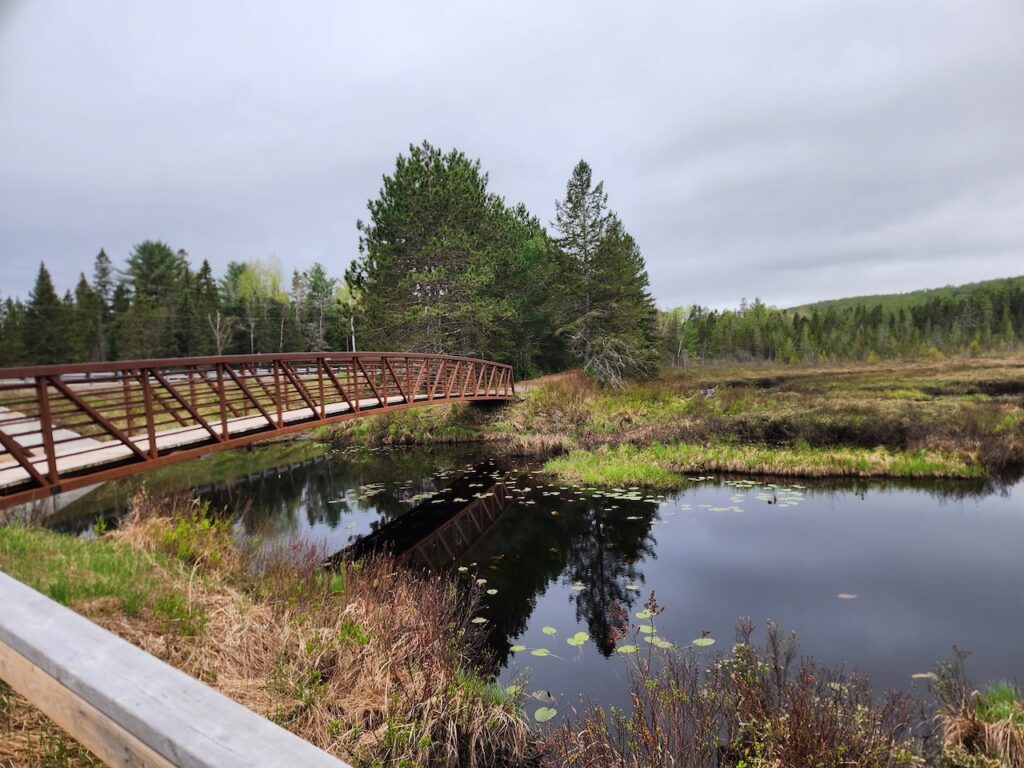
But Algonquin Provincial Park was noticeably different from the St. Lawrence River Valley. Three hours west of Ottawa, this large preserve sat at a higher elevation than the valley. The soil was rockier and because of that, far more conifers grew here, especially around the various lakes and bogs scattered through the park. Finally, I felt like I was back in good boreal habitat.

Algonquin Provincial Park represented a significant departure from lower altitude St. Lawrence River Valley only a few hours away.

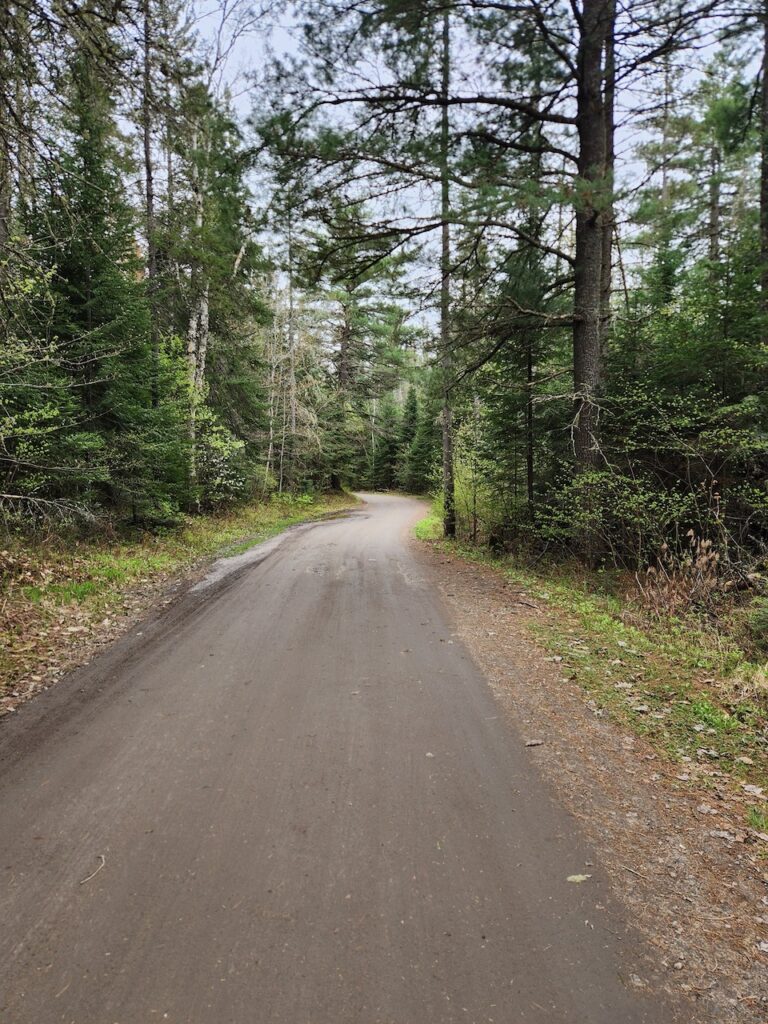
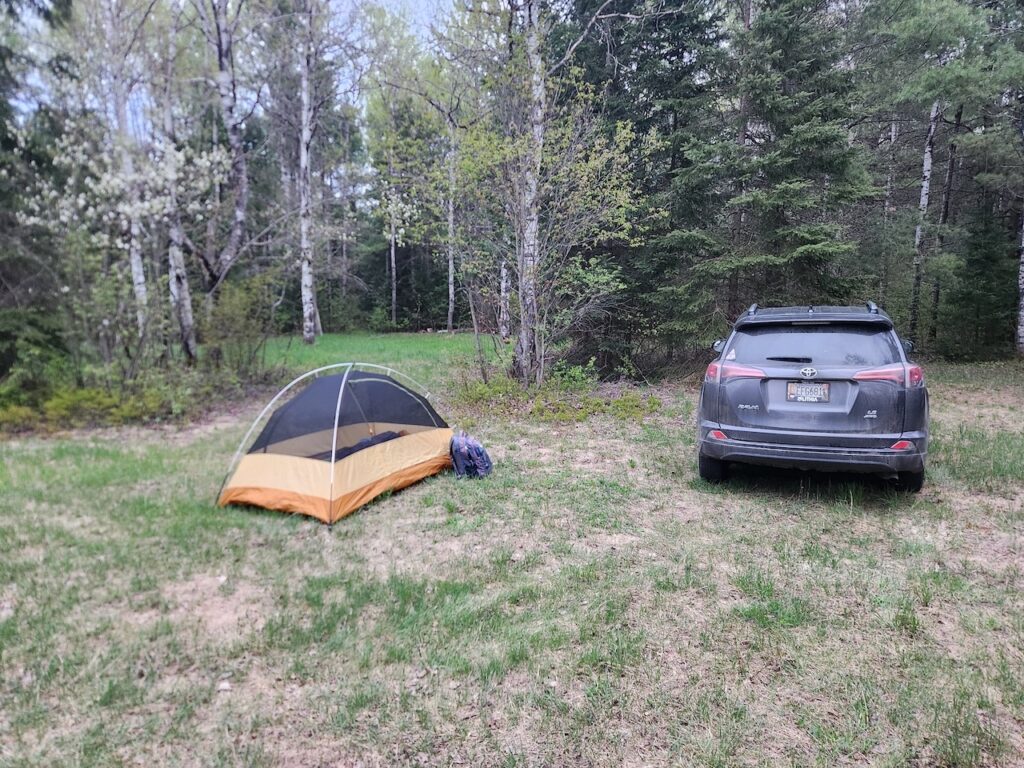
I wasn’t allowed to camp in the park without paying a hefty fine, so I pitched my tent on a dirt road right outside it, in what appeared to be a site for keeping horses on the shore of a large lake. As dusk fell, I heard the twitter of an American Woodcock displaying high above. I’d seemingly settled in the middle of his territory, and he kept me company all night as I dreamed of what birds I’d see the next day.

My impromptu campsite outside of the park rewarded me with an American Woodcock that serenaded me to sleep.

After a short walk around my campsite at dawn, during which I detected a few Cape May Warblers, I headed into the park. My first location: the Spruce Bog Boardwalk. Spruce bogs, which I’d gotten to know during my time in Maine and the Northeast, are strange, almost other-worldly habitats scattered across the northern United States. Generally consisting of an outer area dominated by spruce trees with a core of peat moss floating atop water, they are home to a variety of unique species including carnivorous plants like pitcher plants and sundews. Because of their unique habitat structures, spruce bogs are also havens for a variety of boreal bird species that are otherwise less common in more southern parts of their range. So, as I set foot on the boardwalk, I found myself once again searching for Spruce Grouse and Black-backed Woodpecker—species I find myself looking for frequently.

Extensive searching brought no luck, although I did find more boreal warblers, including several Cape May Warblers and another great look at a Bay-breasted. I also heard a Lincoln’s Sparrow, my first of the year, singing from the wet back half of the bog. I had much of the day to bird Algonquin Park, so after striking out on my main targets at the boardwalk, I decided to take a short stop at the visitor center. 

I had hoped for both Black-backed Woodpeckers and Spruce Grouse in this spruce bog, but struck out with both species.

Within ten seconds of pulling out onto the road my Toyota RAV4 screeched to a halt. There, ten feet away, staring me down, stood a huge female moose. The animal had to be at least five feet tall, though from my seat in the car it seemed a lot taller! After we shared several seconds of each other’s presence, the moose trotted off into the woods. I didn’t end up seeing any of my bird targets at the visitor center and the center itself was closed, but I was now filled with adrenaline—I’d just scored my most wanted mammal of the trip!

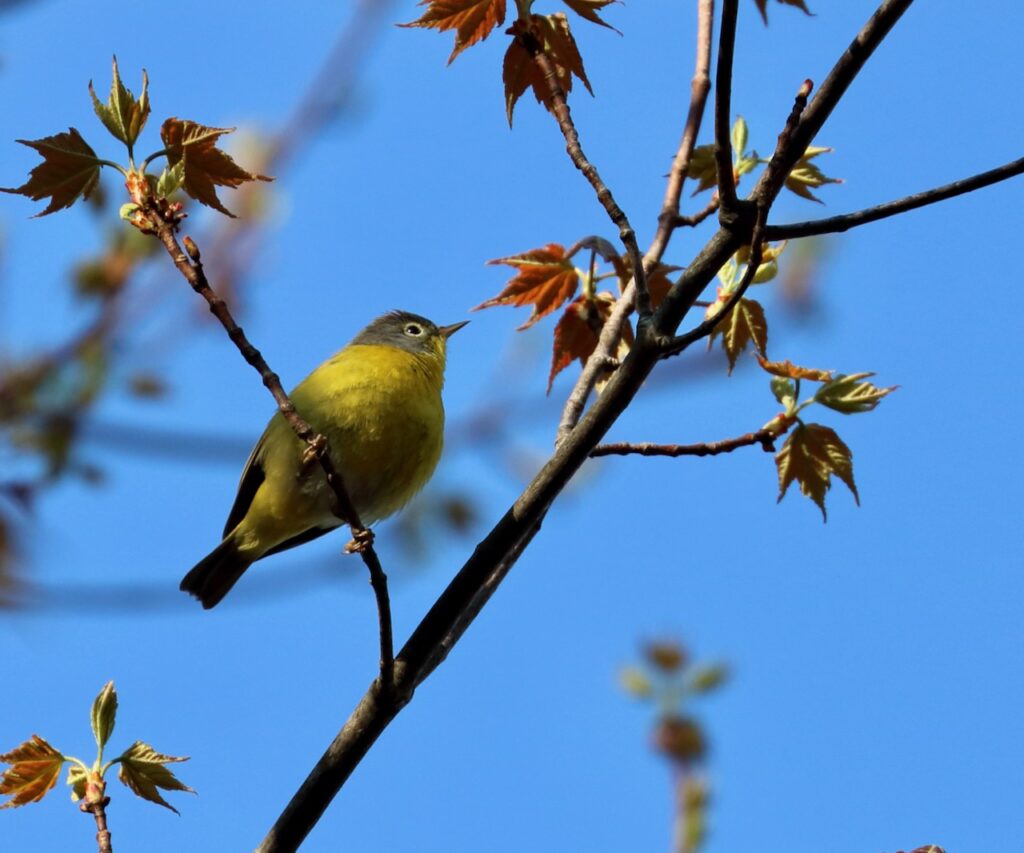
Next, I hit Rock Lake Road. While I hadn’t seen many reports of my target boreal birds here, I figured that this road—a dirt track winding past marshes and through patches of spruce and budding Paper Birch—was as good a spot to try as any! Over the next hour and a half I drove slowly with my head out the window. Again, no woodpecker and no grouse, but I ended up tallying 40 species, 15 of which were warblers! Nashville and Magnolia were the most abundant, along with a smattering of Black-throated Blue, Blackburnian, Canada and others. Near the beginning of the road I also heard several Wood Thrushes singing, a surprise this far north. Along my drive I was also accompanied by the near-constant drumming of Ruffed Grouse, and the loud, piercing whistles of a pair of Broad-winged Hawks.

Though I continued to strike out on BBWOs and SPGRs, Algonquin presented a nice assortment of warblers including Nashvilles, always a favorite!

At this point I admit that I was feeling a bit ungrateful. I’d been birding for three or four hours and had not so much as glimpsed either of my targets—birds that were supposed to be somewhat regular within the park, and had compelled me to drive through Canada in the first place. Sure, I’d seen some great birds and a moose. But if I went the whole day without getting a Black-backed or a Spruce Grouse, I was going to be a bit salty. I jumped on eBird to check on any recent reports of either of them nearby and elected to visit, as my last stop of the morning, Pog Lake Campground. A Black-backed Woodpecker had been seen there only a few days before, and I figured it would be my best chance before continuing my journey west. I parked the car and began walking toward Pog Lake, keeping my ears and eyes peeled for my target species. One of the first birds I heard was a Tennessee Warbler, another boreal species with an electric song, singing loudly from a campsite nearby. I recorded it and continued onwards.

Then, I came across Campsite #512. Surrounded by gorgeous coniferous trees, it at first seemed just like any other campsite in Pog Lake Campground. The first thing that made Campsite #512 stick out, though, was the Ruffed Grouse drumming in the bushes nearby. Now, I’ve heard plenty of Ruffed Grouse drumming in my life—and had heard dozens on this trip already. Seeing one in action was a different story. I’d tried to sneak up on them before, but was always unsuccessful—the birds would flush from under my feet. However, this particular bird sounded incredibly close so I shelved my other goals and went into full stealth mode, sneaking towards the campsite to see if I could watch the grouse in action. After about ten minutes of tiptoeing around, I heard the beating of its wings—and that’s when I spotted it. Through ten feet of dense foliage, there the grouse stood, its wings striking its chest to make the sound that you feel more than hear.

I promptly sat down and spent the next thirty minutes with that grouse. Every five minutes or so, it would stand upright on its mossy log and begin its display. Bom-bom-bom-bom-bom-bom-bom. I watched it drum five or six times—with and without binoculars, and filmed it on my phone’s camera. It was magical. (Click the above image to watch my short clip.)

After twenty minutes, I also heard honking overhead. At first, I couldn’t see any birds above me, but I figured it was just a flyover flock of Canada Geese, though the calls sounded a bit strange. Then, in the gap above Campsite #512, I spotted several flocks of two hundred or so geese—and quickly realized that these were not Canadas. Between a bad view I got through my binoculars and listening to their sounds on Merlin, I realized I’d just seen a massive flock of Brant migrating over me, headed for the Arctic! I’d never seen these birds away from the ocean and never in such numbers! Sure enough, though, Algonquin Park lies right in the middle of Brant’s narrow migration route across Canada, and I’d just happened to be in the right place at the right time.

The Brant disappeared into the distance and the grouse drummed again, and I decided that, even though I hadn’t found my targets, I felt more than satisfied with my experience with Pog Lake Campground. But Campsite #512 hadn’t finished with me. 

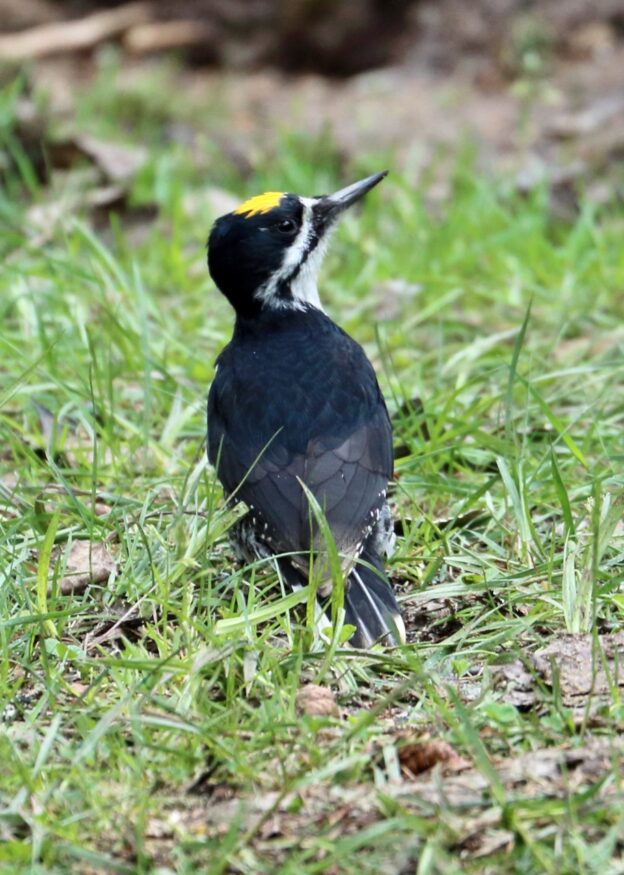
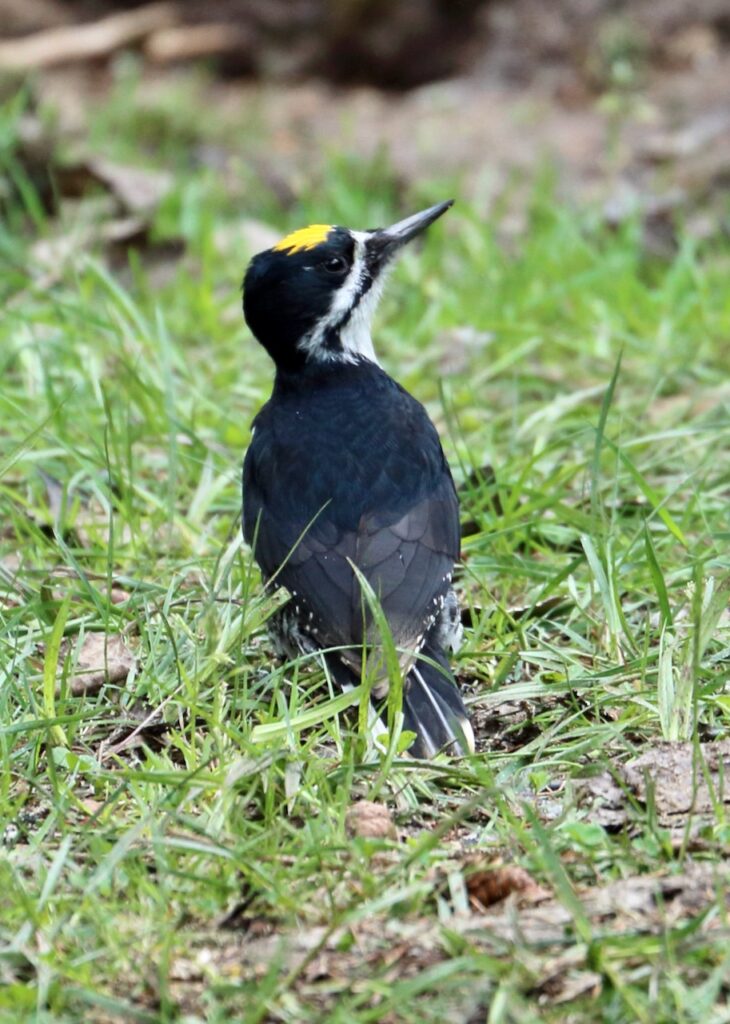
As I slowly stood, taking care not to startle the grouse, I heard strange, frantic calls coming from the woods on the other side of the campsite. I quickly recognized them as calls I’d been listening for all morning, and suddenly, a male Black-backed, decked out in sleek black feathers with a yellow cap, flew into the campsite. It landed on a downed log near me, and proceeded to hop along the ground, getting closer and closer to until it stood only five feet away! It either didn’t notice me or didn’t care, poking for insects in the roots of the nearby spruce trees. After a minute or two, the woodpecker flew away, leaving me debating if I should EVER leave Campsite #512.

My best-ever look at a Black-backed Woodpecker will forever embed Campsite 512 in my birding heart.

As you can probably guess, I did continue on my journey, but knew that my visit to Campsite #512 would become one of my most memorable birding mornings ever, one that would be etched in my brain for a long, long time.

My Big Silly January

Setting and surpassing goals plays a big role for many of us birders. Big Years, Big Months, Big Days, State Big Years, Bicycle Big Days, Global Big Days—the list of ways we challenge ourselves are endless. And while I’m no longer a big fan of Big Years that require burning up a ton of fossil fuels, Braden and I still partake in local challenges, or those that unfold seemingly on their own. Such was the situation I found myself in late January.

Thanks mainly to a vigorous day of birding with Braden on January 2nd, in which I found 47 species here in western Montana, and the surprise trip to Victoria that Amy planned for my 65th birthday (38 more species), by January 20th I found that I had seen 88 bird species for the month. They were awesome birds, too, ranging from Short-eared Owls and Golden Eagles here in Montana to Pacific Loons, Harlequin Ducks, and a Marbled Murrelet in Canada (click here). Interestingly, I realized that with ten days to go, I needed to see only four more species to make this my best January of birding ever! Even so, I had a lot of writing to catch up on and I wasn’t sure that I wanted to intentionally make the effort. A couple of things convinced me to go for it.

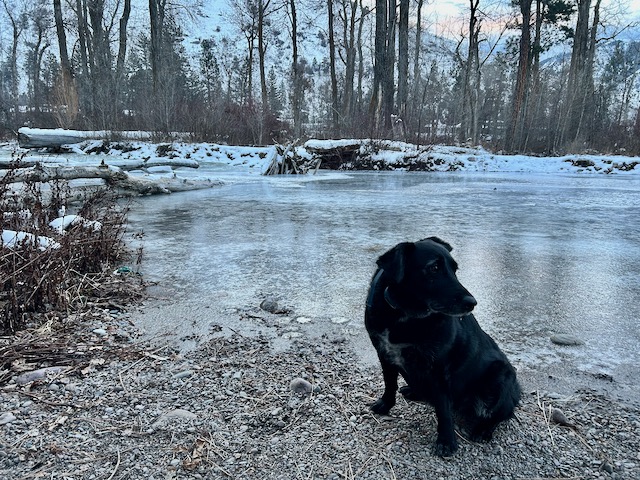
Lola played an instrumental role in advancing my Big January goals!

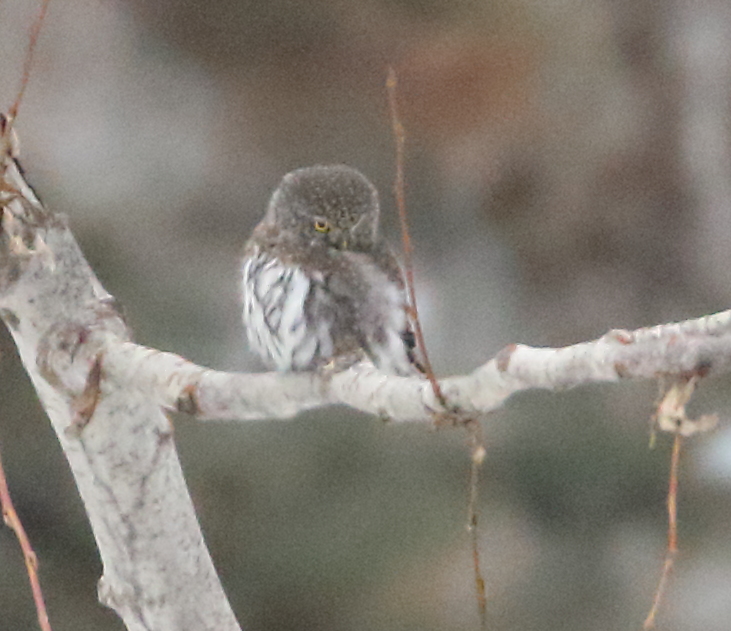
The first was that while walking our dog Lola in the neighborhood, I found my first Northern Pygmy-Owl of the year—a delightful little guy soaking up the last rays of sun high in a Ponderosa Pine. The next day—also while walking Lola, through Greenough Park—I espied my first American Dippers of the year. Three days after that, the year’s first White-breasted Nuthatch visited our backyard feeder, the first I’d seen there in a couple of years. Suddenly, just like that, I was one bird away from breaking my record. What, oh what, to do? Too much sittin’ on my butt and a forecast for a beautiful winter day answered the question. I called our friend Susan, who has been getting into birding more and more the past couple of years. I told her, “You know, there’s a Rusty Blackbird over near Deer Lodge, and we may be able to find some Snow Buntings. Do you want to go see if we can find them?” She also needed a birding break, so the next morning, we headed east.

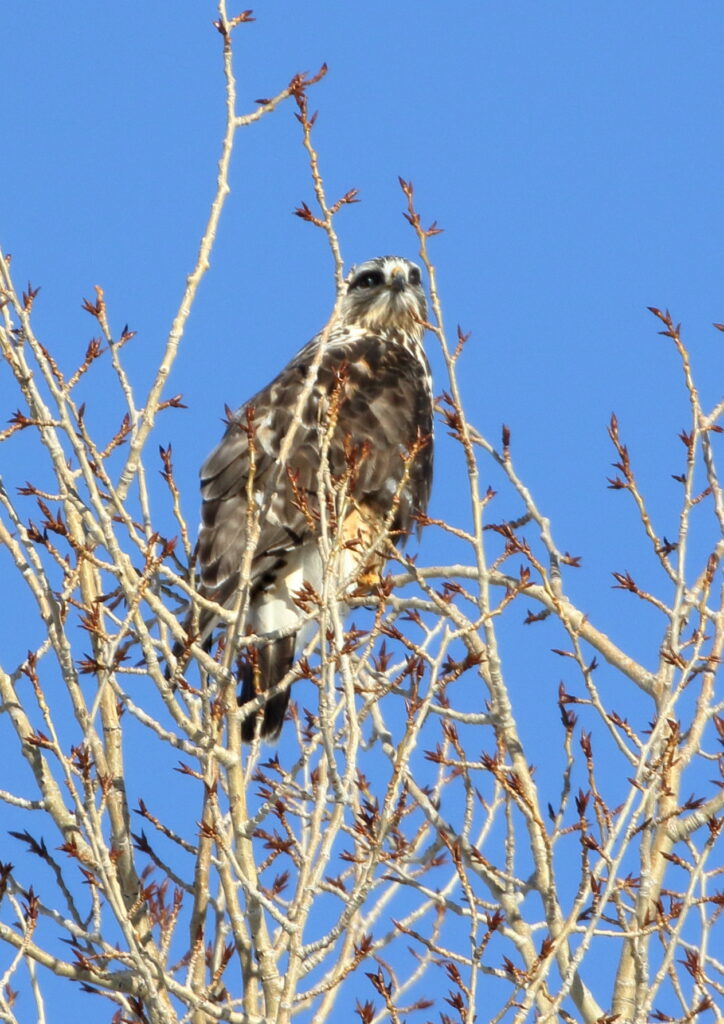
Though we didn’t find Snow Buntings or the Rusty Blackbird, Susan was especially excited to get to know Rough-legged Hawks better.

We spent a delightful morning driving the roads between Deer Lodge and Anaconda. We may have seen a Snow Bunting, but it flew away before we could make a definite ID. We also saw the Rusty Blackbird—right as a couple of other birders scared it away. Since we couldn’t ID it ourselves, we didn’t put it on the list, either. Fortunately, in the parking lot that led to the Rusty Blackbird, we found four Horned Larks! Yay! I had it! A new January record!

Susan and I failed to get an ID-able look at a rare Rusty Blackbird. But note the famous Anaconda smelter stack in the distance!

But here’s the problem. Once you break one record, and realize that you are perilously close to another landmark—in this case, 100 birds for the month—it’s virtually impossible not to go for it. By now, I had revealed my January ambitions to Susan, and not only did she get as excited as I did about them, she was all in on getting me to 100 species for the month. As we pulled away from the Horned Larks, I said, “Are you up for driving by Discovery Ski Area on the way home?” “Let’s do it.”

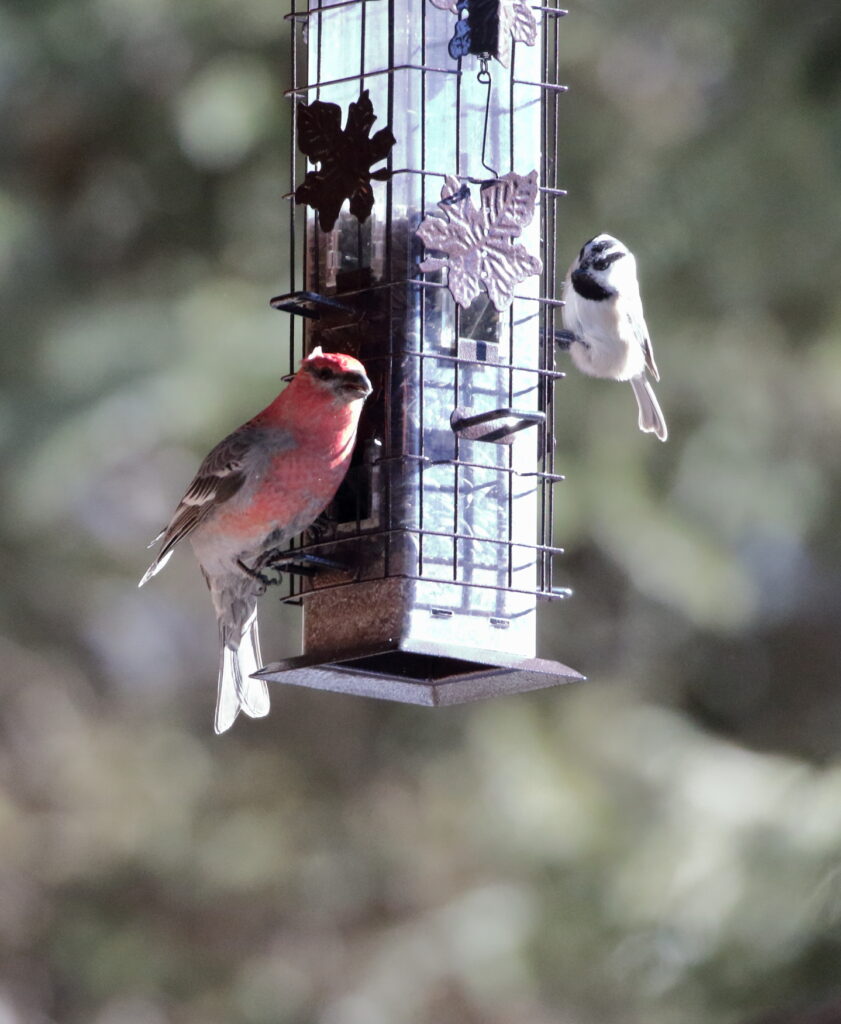
Employees at Discovery kindly put out bird feeders that keep Pine Grosbeaks, Mountain Chickadees, and other higher-altitude birds nurtured during cold winter days.

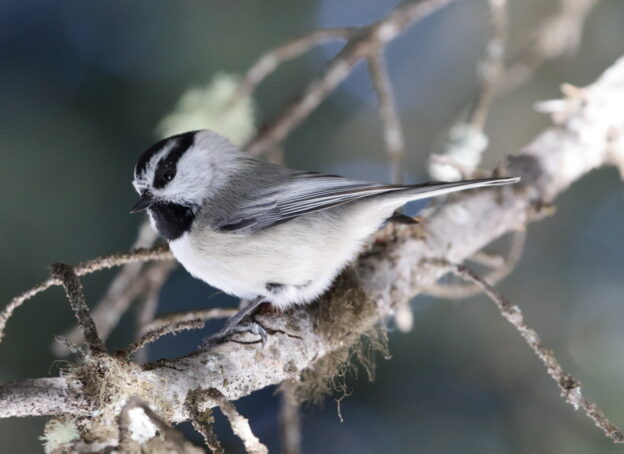
Loyal readers of FatherSonBirding will recognize that in years past, Discovery Ski Area has been a go-to place for Braden and me to pick up several challenging species, and as Susan and I approached the parking area, we saw our first of these: Canada Jay. After parking, we visited the bird feeders and had a fun time picking up two others: Mountain Chickadee and Pine Grosbeak. Clark’s Nutcracker was the only bird that didn’t cooperate with my 100-species plans, but still, I left the ski area with 96 species. Could I really get four more species before the month ran out? Did I want to? No, I decided. I didn’t need to drive around burning up gas just trying to break a silly record. However, the Universe seemed to have other plans.

Portrait of a Canada Jay. See them while you can. Canada has announced that it will no longer allow these birds to be in the US if President Trump does indeed impose tariffs on our northern neighbor.

The afternoon of January 29th, I was again walking Lola in the neighborhood when I saw two more birds I needed for the month and year: Hairy Woodpecker and Cedar Waxwing, both of which I thought I’d already seen! Then, a Greater White-fronted Goose was sighted out beyond the Missoula Airport. I had never seen one of these birds in Montana, and it was a rare opportunity to do so, so on January 31st, I loaded my spotting scope and camera into the car and headed out to the site. My January and Year lists now stood at 98 species.

Long-story short: I did not find the Greater White-fronted Goose among the Canada Geese that were out there. As I was watching other CAGOs fly in, however, I was stunned to see a white goose flying with them! Stupidly, I did not try to gauge the size of this surprising arrival. If it were a bit larger it would be a Snow Goose; a bit smaller, Ross’s Goose. Either one would get me to 99 species—but not if I couldn’t identify it! Sighing and simply putting down “white goose” on my list, I resigned myself to not breaking that magical 100 number.

Since I was out there, however, I decided to swing by Council Grove State Park for a look around. The number of birds out there in the dead of winter surprised me. I was delighted to hear a Belted Kingfisher and spot Green-winged Teals and a Great Blue Heron. Then, two Killdeer flew by. As I was following a trail back around to the parking lot, however, I espied a small, soft lump on a branch out of the corner of my eye. “No way,” I muttered, and trained my new binoculars on it. It was another Northern Pygmy-Owl—the first I’d ever found all on my own. Even though it wouldn’t help with my goal of 100 birds, I was totally psyched by this find and spent ten minutes watching it before it winged away at hyper-speed.

Even though it didn’t help me with my 100-bird goal, seeing this Northern Pygmy-Owl was an awesome way to finish out an awesome January of birding.

So, no 100 birds. No century mark.

Or so I thought.

That evening, when I happened to glance at my bird list for the month, I was surprised to see that it stood not at 98 species as I expected, but at 99! The Killdeer I saw at Council Grove, it turned out, were also a new species for me for 2025! And then, several other birders confirmed that the white goose that I saw was indeed a Snow Goose! Ka-ching!

I’ll admit that getting to 100 wasn’t pretty, but like I said, the Universe seemed to want me to get there and, well, I’ll take it. It just shows you that a lot of great things can happen in birding—even setting silly records!

Partial FSB Reveal: We won’t be posting near the end of February and early March, but if all goes as planned, we should have some truly stunning posts for you then. Stay tuned!