Category Archives: Adventure

Braden’s Costa Rica Report #4: Osa Peninsula Adventure

Braden and I write FatherSonBirding in the hopes of sharing the wonders of birds and birding, and the urgency to protect them. We do not accept advertising or donations, but if you’d like to support our work, please consider buying *NEW* copies of some of Sneed’s books—First-Time Japan, for instance, or my recent Orbis Pictus Award winner, Border Crossings. We appreciate your interest and hope you will keep reading!

A low growl emanated from the dense jungle up the hillside from the highway, stopping me in my tracks. The sun hadn’t even thought about rising yet, since I’d woken up before 5 a.m., but some animals were awake, including the Crested Owl I’d just heard call from the rainforest. I laughed in disbelief as I stood on the side of the highway, looking up the hill. While I could not see the animal, Crested Owl was one of the country’s largest owl species and one I’d been hoping for but not expecting to get during my time here. And yet here one was, singing for me as I began my trek from El Chontal (my hostel) to the Río Rincon Bridge in extreme southwestern Costa Rica.

The walk from the hostel to the bridge was about an hour, and as I plodded along the highway, I could hear and feel the forest waking up. Little Tinamous and Great Curassows called in the dark, and about half an hour before dawn many other species of birds started up. Immense roars echoed from high in trees as male Mantled Howler Monkeys welcomed the sun into the sky, and I eventually arrived at my destination, the bridge spanning the Río Rincón. Nearly every birder visiting the Osa Peninsula stopped here, albeit usually with a vehicle and not on foot. The bridge offered great views of mangroves to the east and rainforest to the west, as well as a wide open vista from which to watch parrots of many species leave their roosts in search of food. The primary reason birders stopped here, however, was for a specific, critically-endangered bird species: the Yellow-billed Cotinga. 
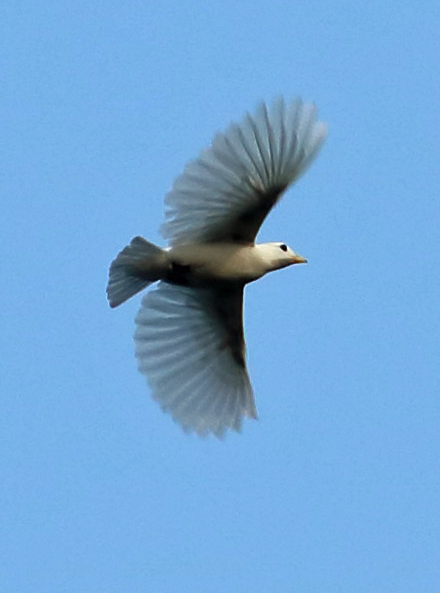
My early morning walk rewarded me with multiple looks at Yellow-billed Cotingas, rare and beautiful birds endemic to southwest Costa Rica.

Cotingas are a strange, remarkable and hilarious group of birds. These plump birds feed primarily on fruit and come in a wide variety of shapes and colors, including tangerine orange, like the Andean Cock-of-the-rock, shadow black, like the Bare-necked Umbrellabird, or electric blue, like the Turquoise Cotinga. The family features some of the world’s weirdest species, like the monk-like Capuchinbird, and the loudest birds in the world, the bellbirds, one of which resides in Costa Rica (and will be my target for my final weekend trip in this country, so stay tuned!). 

Yellow-billed Cotingas are angelic white, and are endemic to southwestern Costa Rica and extreme western Panama. They live in extensive lowland rainforest and mangroves, and thanks to habitat decimation, are largely restricted to the Osa Peninsula, one of the country’s wildest remaining areas. This species was one of the primary reasons that I had requested to skip classes this week and visit this far-away peninsula, and the Río Rincón Bridge was the most reliable place to see them.

By the time I arrived, barely before dawn, the birds were already active. Hordes of parrots, from the pint-sized Orange-chinned Parakeets to the chunky Red-lored Parrots to the spectacular Scarlet Macaws, flew over me towards distant locations. A Bare-throated Tiger-Heron hunted for fish in the river, and another one, a juvenile covered in its namesake black and orange stripes, watched from a nearby tree. The sandy river island hosted several Spotted Sandpipers, a Willet and a Northern Jacana—the first I’d ever seen. Jacanas have massive feet which they use to walk atop lily pads, although there weren’t any lily pads in sight here. Flocks of swallows and swifts wheeled overhead, and I spotted a few Fiery-billed Aracaris swooping across the river, their flame-colored bills shining in the sun.
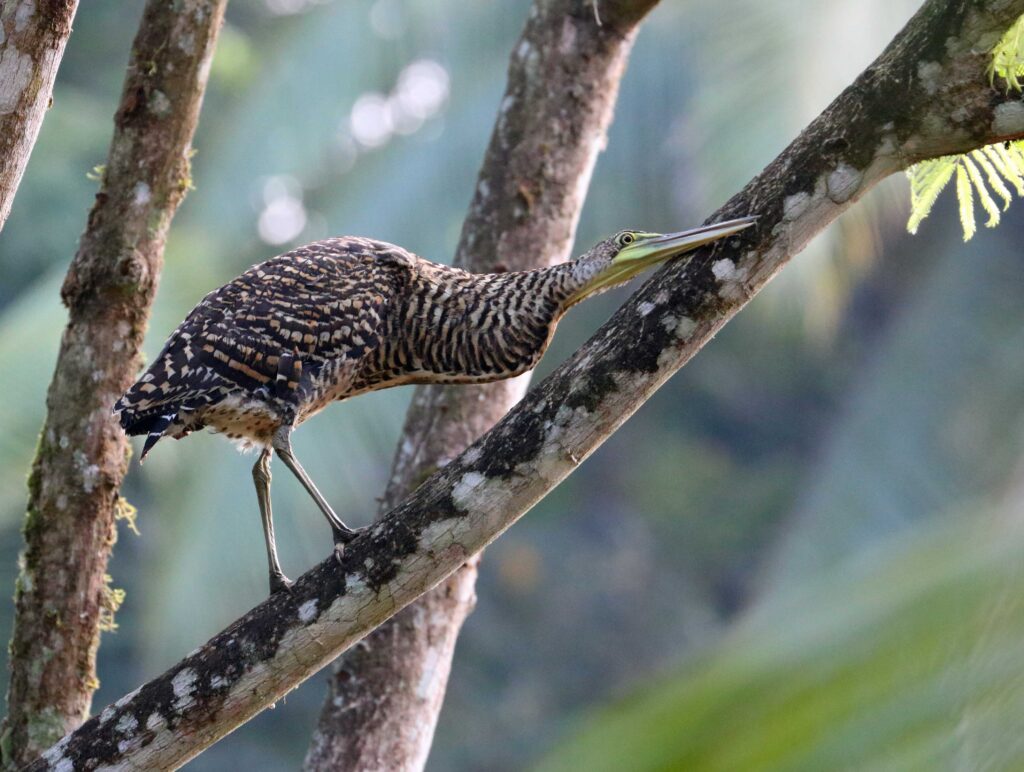
Even though I’d already seen them on the trip, I had yet to grow bored seeing a Bare-throated Tiger-Heron.

As I stood on the bridge, unsure of where to look for the cotingas, I heard a distinctive song from a nearby tree. The “bouncing-ball” call sounded exactly like a Wrentit, a bird native to the chaparral of California, which had never been recorded in Costa Rica and probably never will be. I knew exactly what it was, though, since I’d studied the song the night before and noticed the resemblance it had to a Wrentit. I walked over to the tree and whipped out my speaker, playing the call right back at the bird. Then, a large, blue and red bird flew in and landed several dozen feet above my head in clear view: Baird’s Trogon. This had also been one of my chief targets on the Osa, given that it was difficult to find nearly anywhere else in the country, and I snapped some poor photos of it before returning to my cotinga watch. After about fifteen minutes, that watch paid off, as a mottled gray female cotinga flew over, landing briefly in a tree in front of me before disappearing in the foliage. “Well, that wasn’t the view I’d hoped for,” I said to myself, a bit disappointed but still relieved that I’d seen my target species. The cotingas weren’t done yet, though. Over the next hour and a half, I spotted seven more of the birds flying over, many of them strikingly-white males. I got a decent picture of one in flight, too.
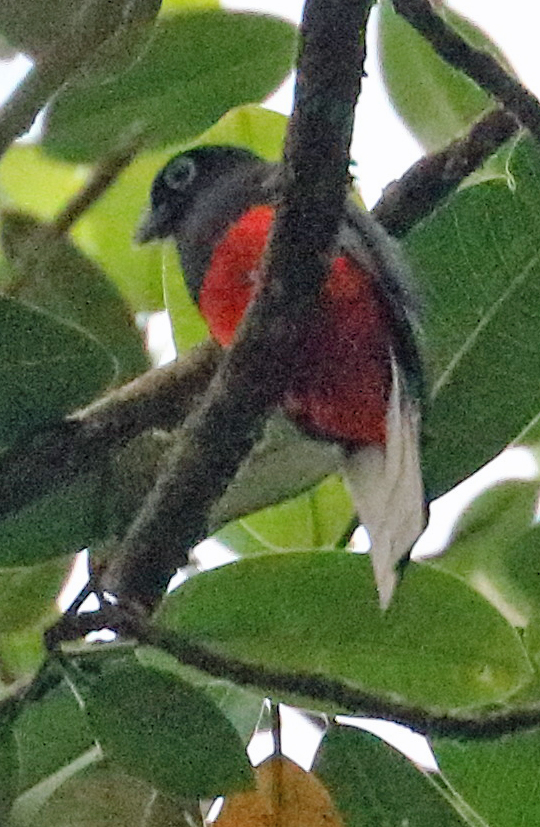
Despite the poor photo, Baird’s Trogon was one of the chief targets of my Osa Peninsula trip—and at least the sixth species of trogon I’d seen in Costa Rica!

After two hours of great birding, I walked back along the highway to my hostel. From there, I packed up and caught the bus down to Puerto Jiménez, the largest city on the Osa (which is still quite small). I found a small soda (the name for any number of small, family-owned restaurants in Costa Rica) and waited there for about an hour before a tiny, run-down van pulled up in front of it at 11. “Dos Brazos?” asked the lady driving it, and I nodded, throwing my bag in the van and climbing up after it. The interior of the van was in rough shape, although the seats were comfortable, and I taught the lady’s young son how to use my binoculars as we rattled up dirt roads towards the “town” of Dos Brazos, hidden deep in the rainforest.
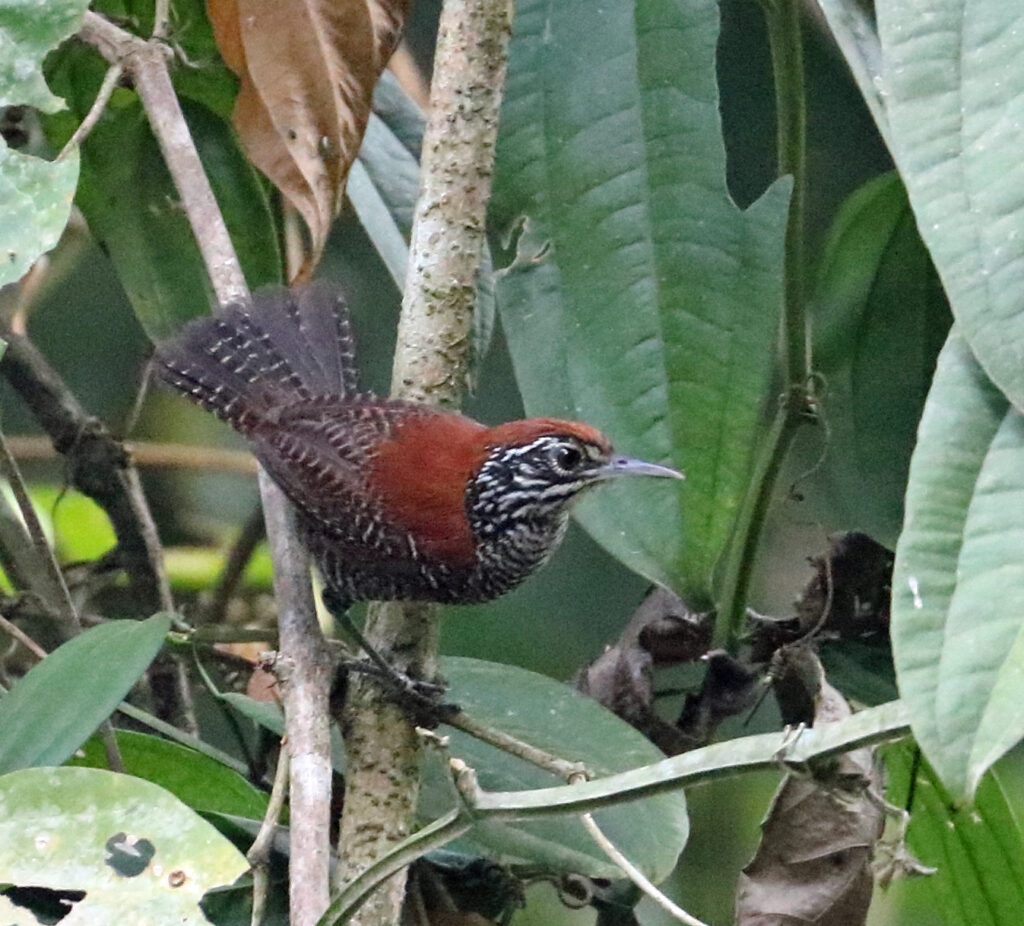
Riverside Wren—Costa Rica’s Most Stylish Wren???

The woman let me off in front of the reception house for the Bolita Rainforest Hostel, where an American greeted me. “Welcome to Bolita! The hostel is a 30-minute hike that way,” she pointed up into the jungle. So, I set off, my heavy pack on my back. I spotted a pair of Buff-rumped Warblers next to a creek I had to cross, and eventually arrived at the open-air hostel, caked in sweat. Another American and several volunteers from all over the world greeted me cheerfully, showing me to my “room”, an outdoor bed with a mosquito net over it. There was no “inside” at Bolita, except maybe the supply closet, which hosted half a dozen roosting bats on its walls. After I settled down, Pascal, an older French volunteer, noticed my binoculars.
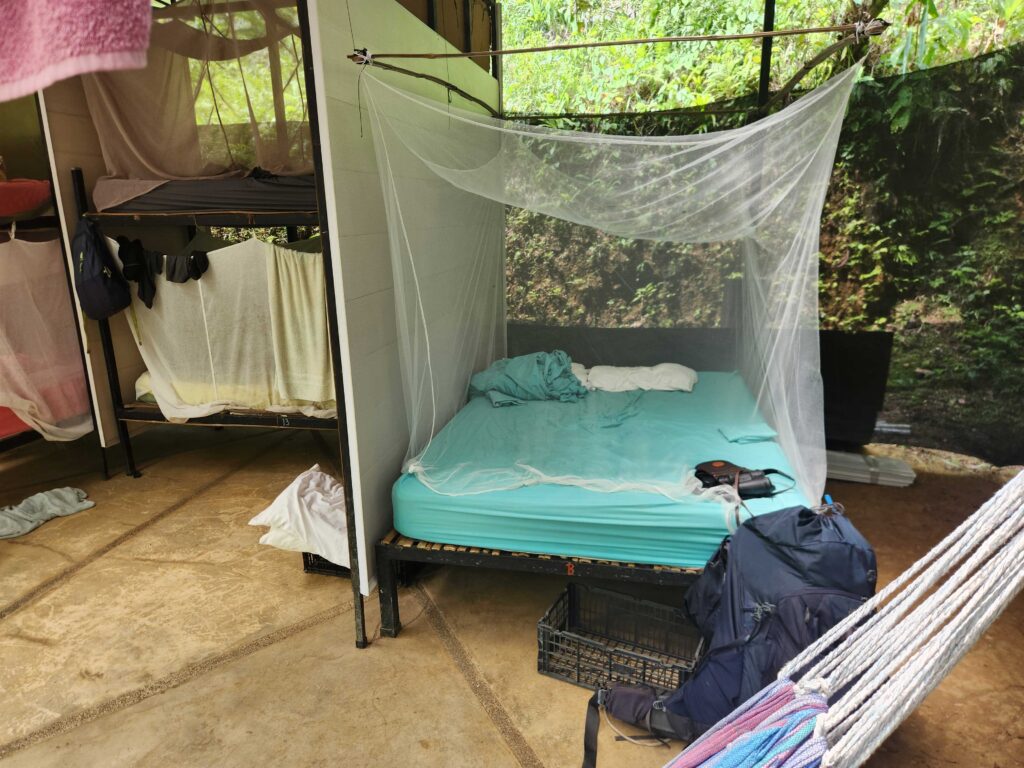
I wonder how many Hilton Honors points I’ll get for my stay at the Bolita Rainforest Hostel—a place with superb “air-conditioning!”

“Are you a birdwatcher?”

I nodded, and she proceeded to pull out a faded “Birds of Costa Rica” book, flipping it open to a page with small, colorful birds on it. She pointed to the bird that just so happened to be my number one remaining target for the entire trip: Orange-collared Manakin.

“I saw these guys here! The males all dance for the females at places called leks, and I found a lek on one of the hostel trails. I can show you if you’d like!”I nodded profusely—fate had somehow delivered to me the perfect opportunity to see the bird I wanted to see most here. Soon, Pascal led me and a few other interested guests up the “Big Banana Trail.” After twenty minutes of hiking, we rounded a corner and heard claps from the nearby trees. Pascal waded a few feet into the foliage off the trail, and pointed. There they were, tiny, football-shaped birds with sunset-colored collars and tiny black caps, like the White-collared Manakins I’d seen in Sarapiqui but with fiery rather than white throats. We enjoyed them for fifteen or minutes or so before everyone else wandered back down towards the hostel. I decided to poke around the trails a bit longer—and I’m glad I did.
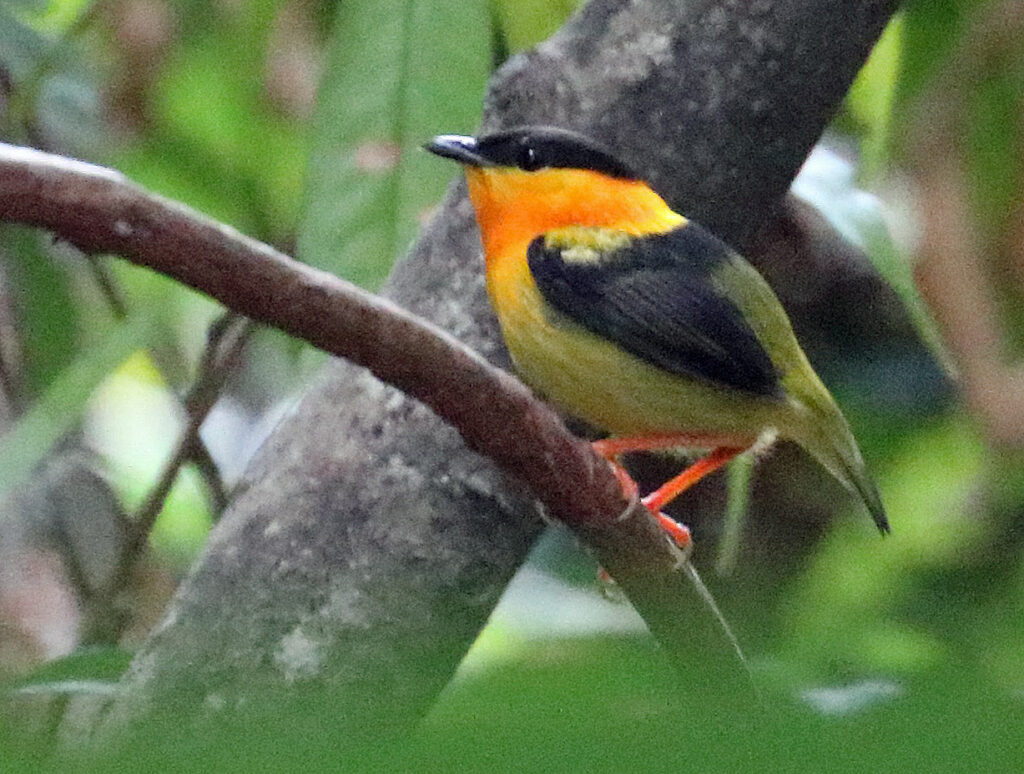
Once I arrived at the hostel, and thanks to a new friend, it took me only minutes to find my last remaining Osa Peninsula target bird, Orange-collared Manakin.

Almost immediately, I heard the loud, repeating call of a wren coming from a tangle near me, and with a little verbal coercion, I was able to spot the culprit: a Black-bellied Wren, another southwestern Costa Rica specialty bird. This wren happened to be the beginning of a large mixed flock and I spotted several more wrens as well as antshrikes, antwrens, a foliage-gleaner, and a Little Tinamou, a hard-to-see forest bird, feeding right on the trail in front of me. I stopped at one lookout and watched as the birds came to me: parrots, flycatchers, hummingbirds and more. Highlights included a female Thick-billed Seed-finch, a tiny bird with a massive bill; an Olive-sided Flycatcher, a bird that winters in South America and summers in the boreal forest of Montana and Maine; and a Purple-crowned Fairy, a flashy, usually-arboreal hummingbird that steals nectar from flowers rather than pollinating them. Extremely satisfied with this mid-day birding, I headed back to the hostel to watch the sunset.
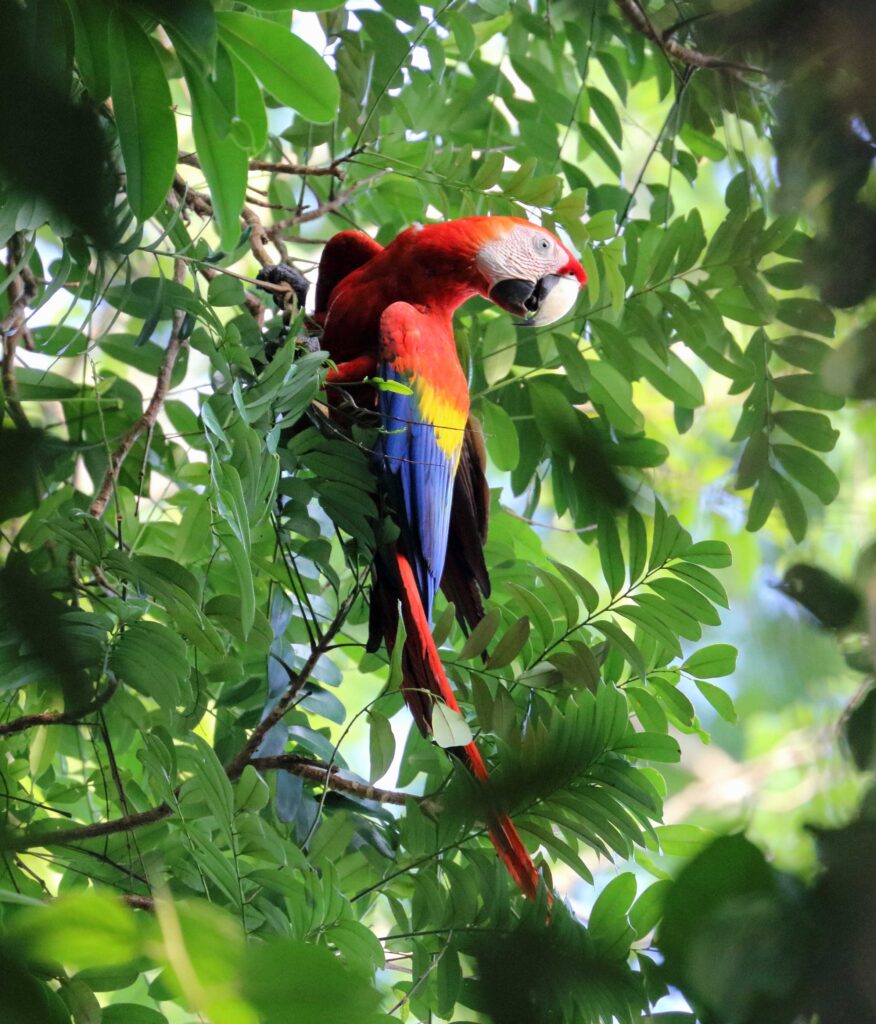
Scarlet Macaws are one of the birds most people want to see in Costa Rica, and in the Osa Peninsula, I found no shortage of these spectacular creatures.

I found a nice little bench overlooking much of the rainforest and quickly realized that even the hostel had great bird activity. Piratic Flycatchers, Scarlet-rumped Tanagers and Bananaquits flew around me, and about an hour before dusk, I spotted another bird that blew me away: another cotinga, this one the color of the sky. I’d looked for Turquoise Cotingas three days earlier and completely missed them, and yet here they were, delivered right to my doorstep in all their blue and violet glory. I had gotten, quite simply, every bird I’d wanted to see on the Osa Peninsula. And I still had one morning left!
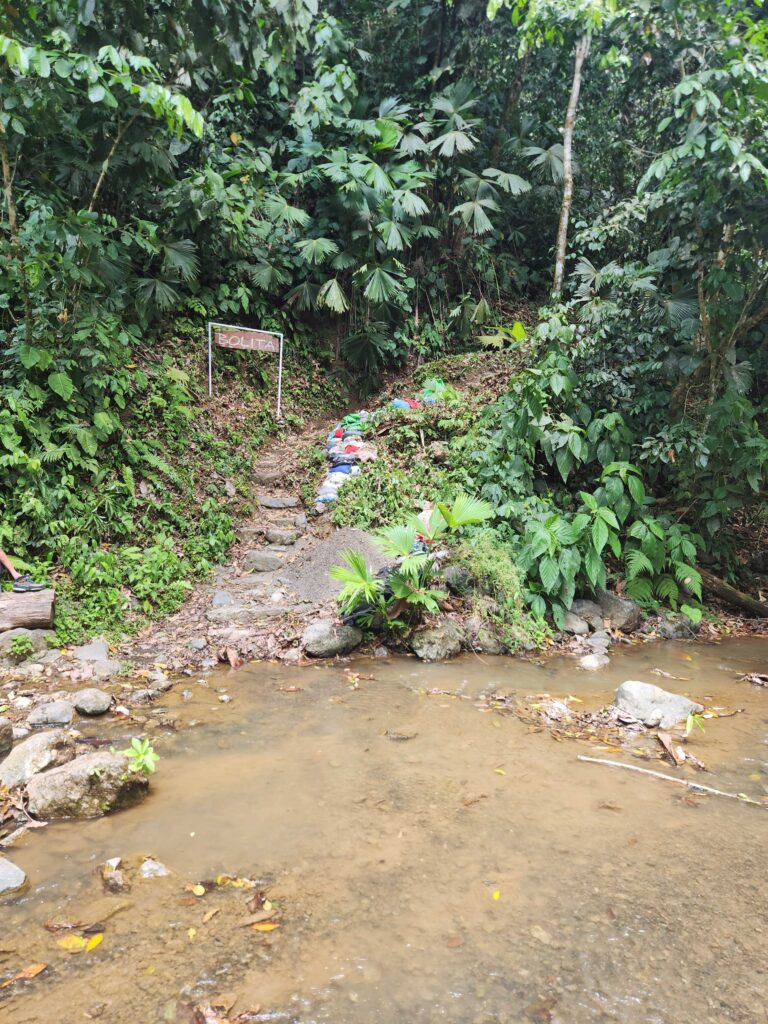
One of the trails I explored near the Bolita Rainforest Hostel.

That morning was spent exploring more of the trails behind the Bolita Rainforest Hostel. With no real targets, I just set off into the jungle, hoping to discover something unexpected, and I did! I spotted three more lifers, including Black-crowned Tityra, Black-cheeked Ant-tanager (the only species completely endemic to the Osa Peninsula) and a Northern Black-throated Trogon, which was one of four trogon species I reported on my hike. I heard dozens of antbirds, antwrens, antshrikes and antthrushes, spotted groups of Scarlet Macaws flying high above me, and watched the sunrise over the misty hills stretching all the way out to the Pacific Ocean. I’d seen some beautiful places in Costa Rica so far, but none had been so wild as here. From one vantage point, I could see no signs of human habitation—just forest and sea. Even for a country that has done so well protecting its environment, places like this are rare, and I’m so happy I got to experience it.
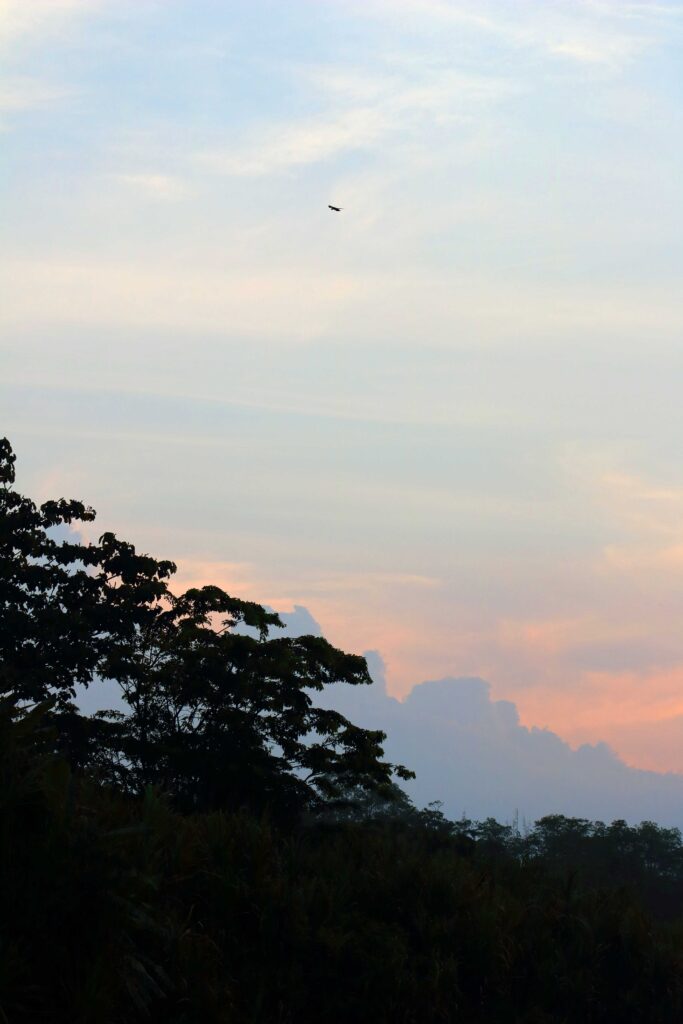
A lone Scarlet Macaw flies across the dawn sky—my last morning in the Osa Peninsula, and one I’ll never forget.

You can experience it too! Whether you want to see the jungles of Central America, like me, or the snow-capped peaks of the Alps or the Andes, the castles of Europe, the hubbub of Tokyo or the grasslands of the Serengeti, you can, with the help of the Gilman Scholarship! I’m sure I sound like a broken record, but it’s because it’s true—the Gilman can help low-income college students reach far away destinations to study abroad with just a simple application! I urge you to apply today, so you can have a life-changing, international experience during your college years, like me!

College Search Birding in California

If you’ve been following FatherSonBirding for any length of time, you know two things about us: we love to travel and we love to bird. Sometimes we plan dedicated birding trips, but whenever possible, we like to go easy on our carbon footprints and fold birding into travel that we were going to do anyway. In the past year, for instance, I’ve been able to bird in Japan and Spain while taking family vacation trips I’d been planning for years. Often, I get to bird while taking business trips to, say, Texas or Missouri. Right now, Braden is birding his butt off while doing a semester of study abroad in Costa Rica. As the parent of two young people, another potential “double-dipping” birding opportunity arose when my children began thinking about college. After all, it’s a good idea to visit a college you might want to attend, right? Unfortunately, covid kai-boshed that possibility with Braden—though we did get to bird in New England when I took him back east to start his college career at the University of Maine. With my second child, Tessa, I’ve been more fortunate. Last week she and I took a lightning trip out to California to visit a couple of potential schools she is considering. Even better, we went to places I’d never gotten to bird.

Cal State Chico put on a show for us in its best spring colors. Not surprisingly, I saw some great birds there, too, including Red-shouldered Hawks, California Scrub-Jays, and Acorn Woodpeckers—right on campus!

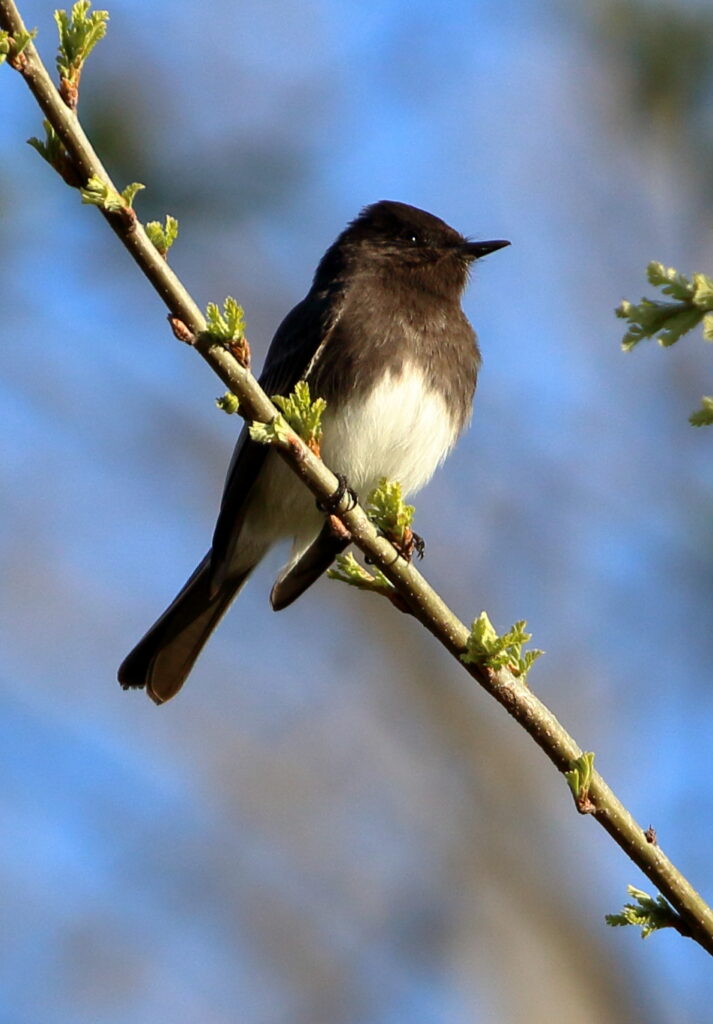
After rising at 3:30 a.m., Tessa and I landed in Sacramento at the outrageously convenient hour of 9:00 a.m. It was a glorious, sunny California morning and we made a beeline to U.C. Davis, where I’d spent my own freshman year before transferring to U.C. Berkeley to finish out my college years. Davis had changed a lot, but I still managed to find my way around—though I did drive our rental car down a dedicated bike path, much to the consternation of dozens of student bicyclists trying to get to class! After a quick tour around campus, we found a parking spot downtown and decided to have lunch at Crepeville and while waiting in line, I finally had a chance to start looking around for birds. One of the huge regrets of my life is that I’d left California before I’d become a birder because, with the possible exceptions of Texas and Alaska, there is no better state in the union to bird. To wit, within yards of Crepeville, I spotted Yellow-rumped Warblers, a Black Phoebe, and a Western Bluebird—right in downtown Davis! But my college search birding had just begun!

Just the name phoebe can’t help but melt a birder’s heart, but these Black Phoebes truly are handsome birds.

After a quick tour of Davis we headed north to our primary college destination, Cal State Chico, which boasts a musical theatre program of particular interest to Tessa. We arrived in Chico pretty pooped from our already extensive exertions and checked into our hotel for a rest. The prospect of some deeper California birding, however, did not let me tarry long, and after twenty minutes I left Tessa to recharge while I headed to the dubiously named Hooker Oak Park.

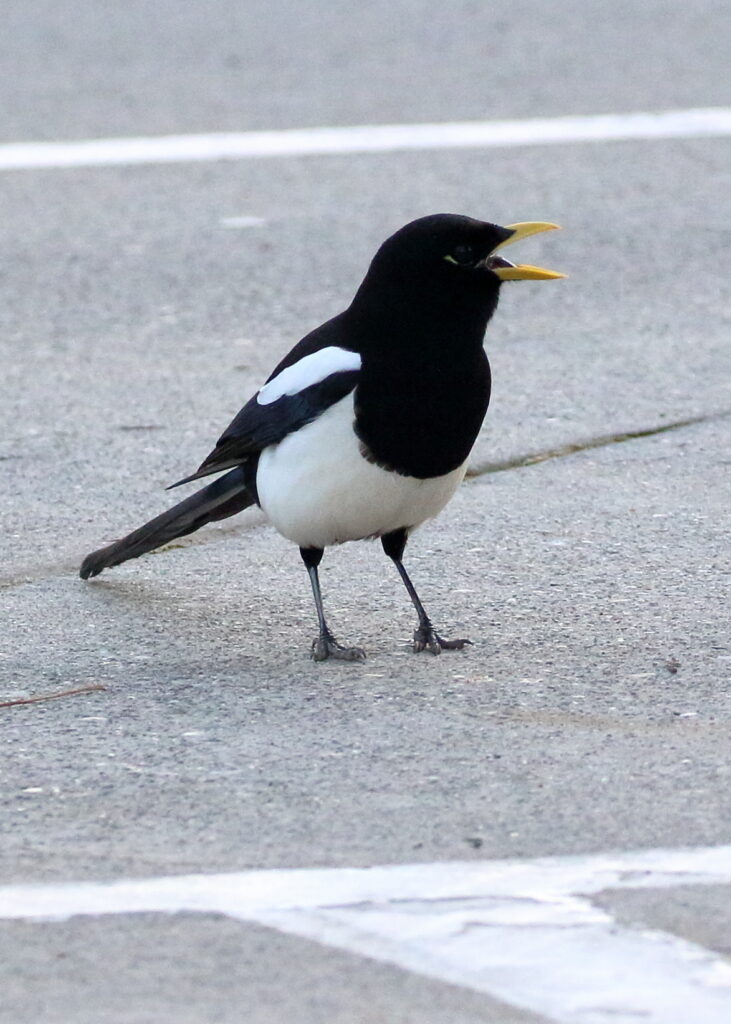
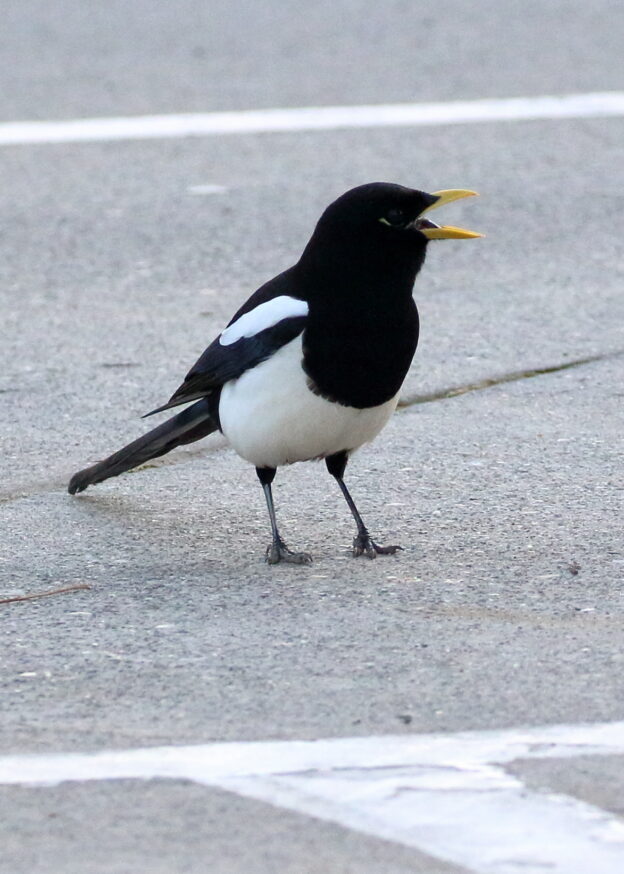
Any trip to California is a chance to see some of California’s specialty birds—including Yellow-billed Magpies, which only live in selected areas of central California. On Braden’s instruction, one morning I got up early to drive to Durham High School, and sure enough, found me a pair!

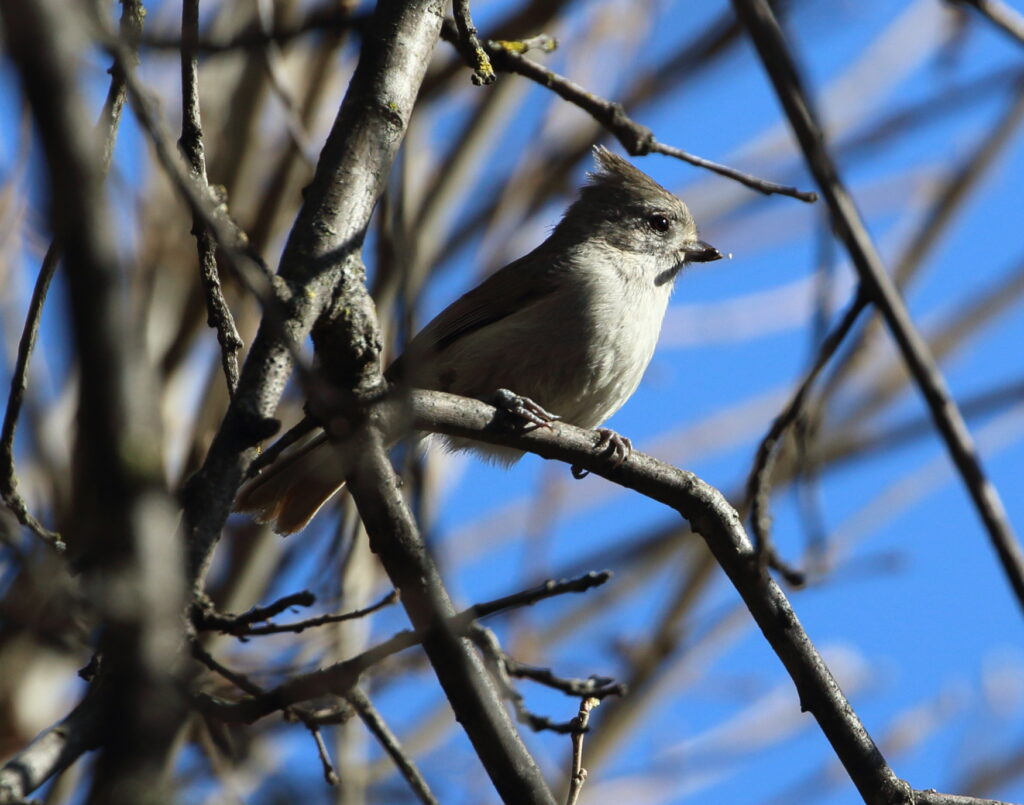
To be honest, the park looked a little over-developed and ragged, and I wondered whether I should move to some healthier-looking oak groves just down the road. Then I reminded myself that this was California and birds were likely to be anywhere. Almost immediately, this was confirmed when I sighted one of the targets of my trip, an Oak Titmouse singing in a sycamore tree.

What can I say? Oak Titmice are just plain adorable.

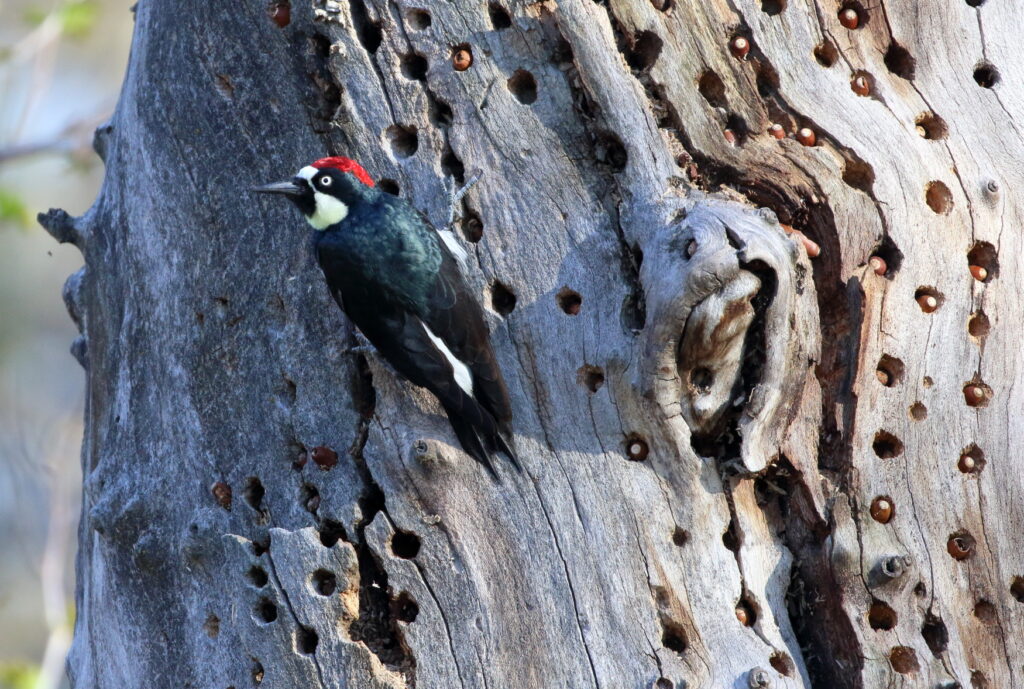
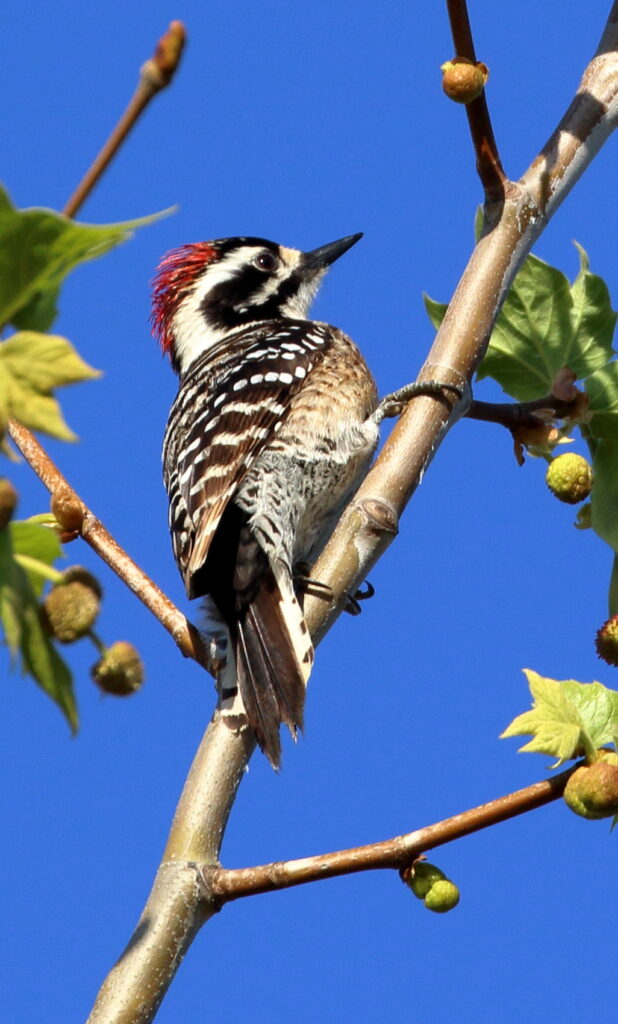
I set out to explore further and birds popped out from left and right—including most of the birds I had hoped to see. I got super excited to see an Acorn Woodpecker—only to discover that they were everywhere in this park. Not long after, I encountered a Nuttall’s Woodpecker, the other woodpecker at the top of my list.

You can’t beat an Acorn Woodpecker on one of its acorn storage trees! With their black masks, these cooperative birds look like banditos, and the way they aggressively mob other species, they apparently can act that way, too.

Exploring further, I encountered California and Spotted Towhees, Golden and White-crowned Sparrows, and White-breasted Nuthatches.

With my lousy hearing and dearth of knowledge about California bird calls, Merlin’s Sound ID feature proved especially useful and helped me find several species, including California Quail. My biggest surprise of the outing were two Hermit Thrushes, which hadn’t been on my radar at all but do winter in the Central Valley.

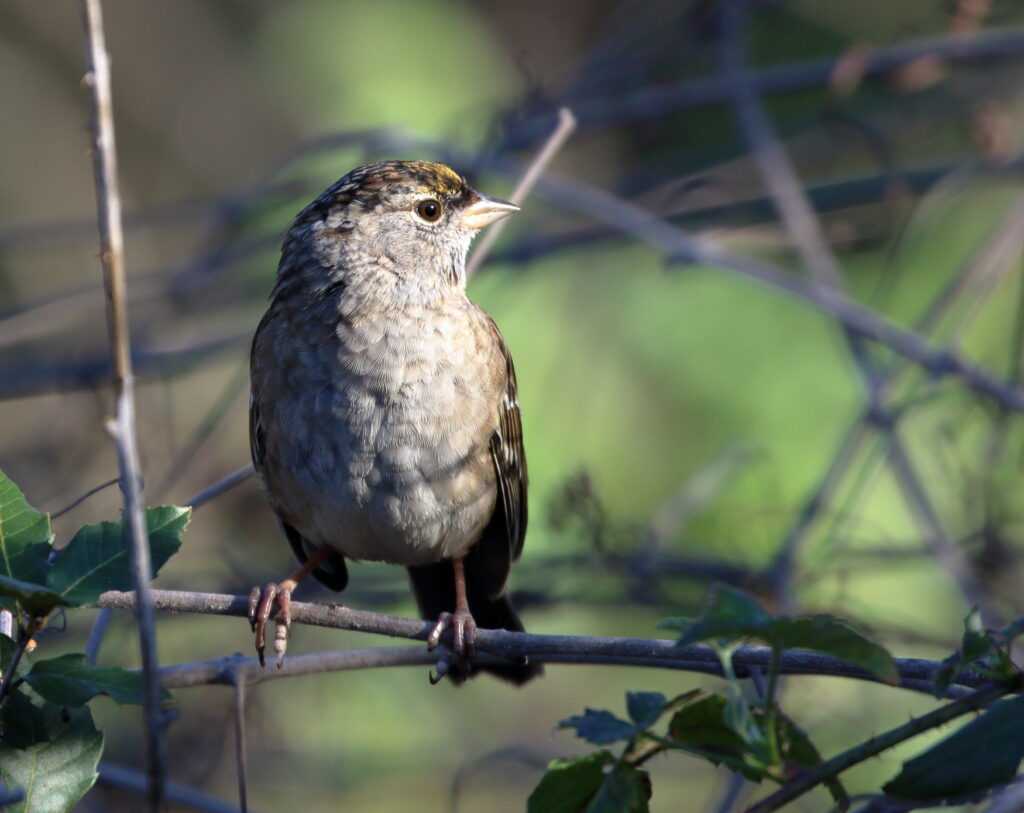
Love Golden-crowned Sparrows!

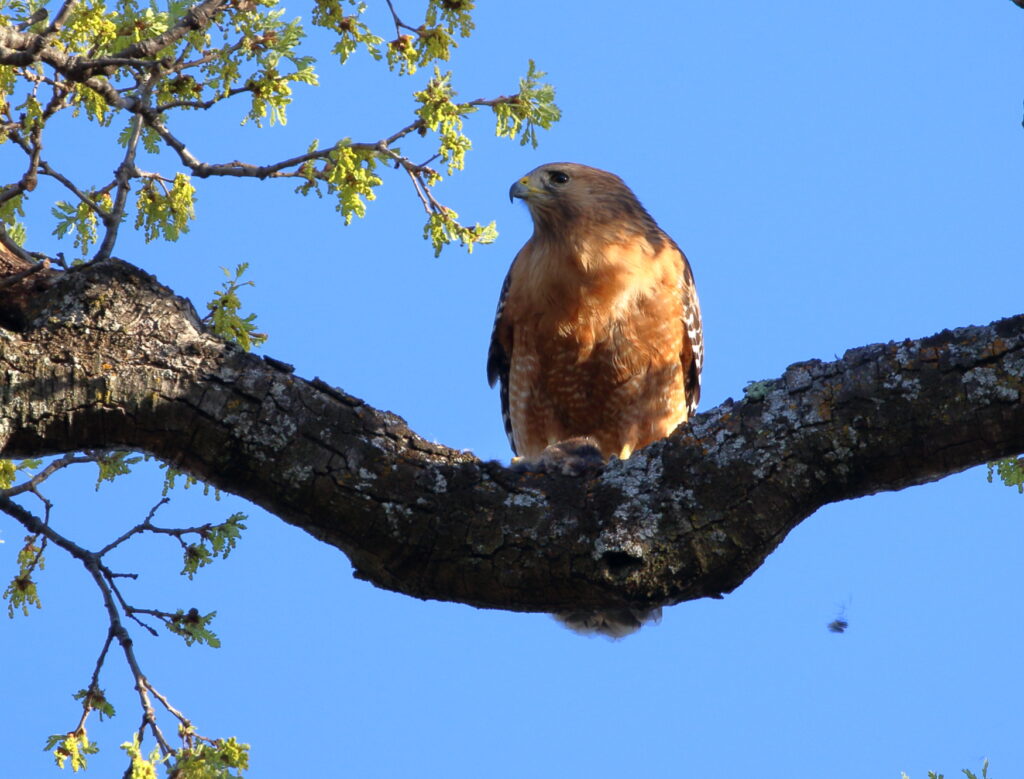
One disappointment was that I didn’t hear or see any Red-shouldered Hawks, a particularly abundant species in California. As I was about to climb back into my rental car, however, I heard a familiar “Kee-a, kee-a, kee-a, kee-a!” and spotted a large reddish bird flying straight toward me. As it passed overhead and landed on a branch, I saw that it held a tasty mammalian morsel in its talons. Almost immediately, another Red-shouldered Hawk plowed in and displaced the first one, stealing its meal. I grinned. Not only did I get to see a RSHA, I got to see hawk behavior, too!

This Red-shouldered Hawk drove another RSHA off its prey, which it now holds firmly in its grasp.

The next two days, Tessa and I visited with some of my most cherished friends, who had happened to move to Chico decades before, and, oh yeah, we took a great tour of the Chico campus. The campus, I gotta say, mightily impressed both Tessa and me. Chico is part of the WUE college exchange program, meaning that if any of you Montana parents are also contemplating schools, you can get big discounts on out-of-state tuition. But back to the birds, I continued to see awesome birds everywhere we went. I did want to get in a visit to another bona fide natural area, though, so the day of our campus tours, I woke early and drove out to Bidwell-Sacramento River State Park, about fifteen minutes out of town.

In the parking lot of Bidwell-Sacramento River State Park, I got my best looks ever at another California specialty, Nuttall’s Woodpecker.

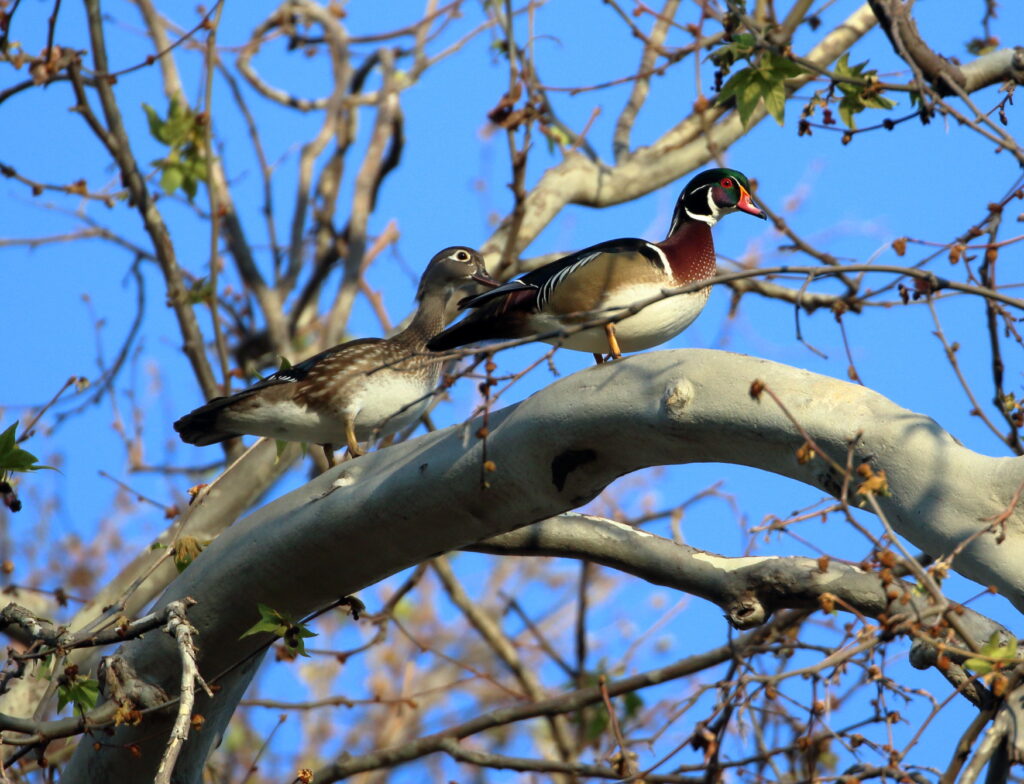
I arrived before dawn—actually a bit early for the birds—but a group of 55 Wild Turkeys greeted me, so I went ahead and set off on dew-soaked trails paralleling the river. I had set a goal of 50 bird species for this California trip and began the day at about 45—but quickly blew past that. Almost immediately, I saw Wood Ducks hanging out in the trees and spotted two pairs of kingfishers bickering over the river. As the day warmed, more species kept appearing: a Great Egret and Great Blue Herons, tons of flickers and Tree Swallows, Ruby-crowned Kinglets and White-breasted Nuthatches, a pair of Turkey Vultures trying to get their engines started.

It’s easy to forget that Wood Ducks nest in trees—something I was quickly reminded of at Bidwell-Sacramento River State Park!

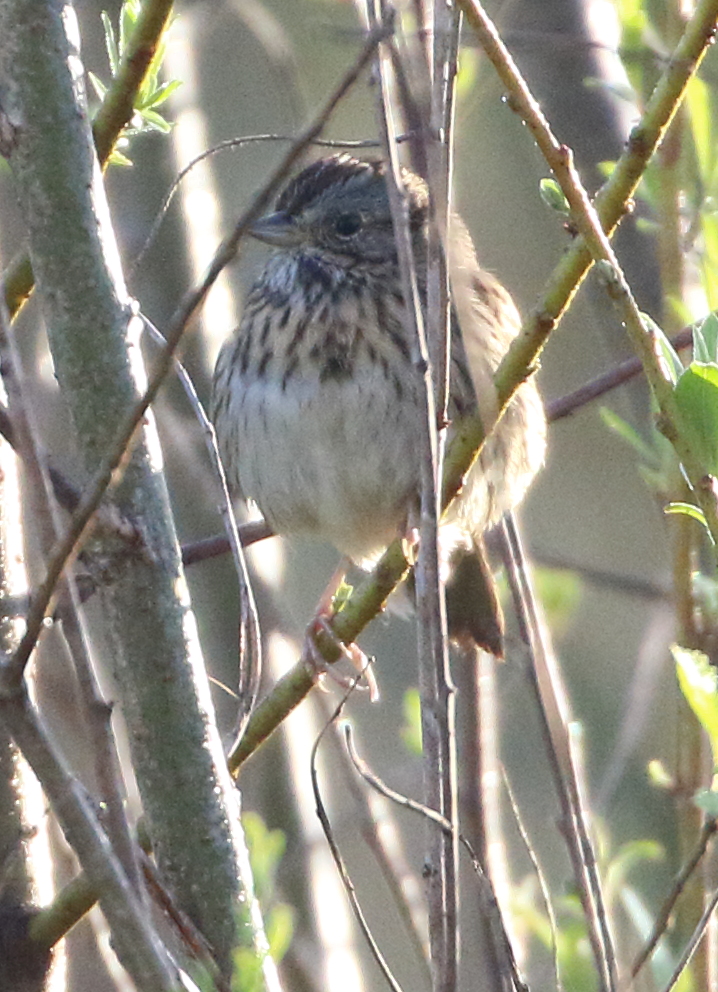
After an hour, I began making my way back to the parking lot and spotted a group of Dark-eyed Juncos and White-crowned Sparrows ahead. Then, I saw something that really got me going: a small, brownish bird with short, vertical lines at the top of its breast and a yellowish wash. Lincoln’s Sparrow! And not one, but two of them! I managed only lousy photos, but was thrilled to see one of Braden’s and my favorite Montana birds hanging out in its winter habitat—and just before migration. Is it possible I will see these exact same birds in Montana in a few short weeks???

Yay! Lincoln’s Sparrow—in its winter habitat. This, btw, was one of only two species I added to my California life list, which now stands at 226 species. The other was Common Merganser.

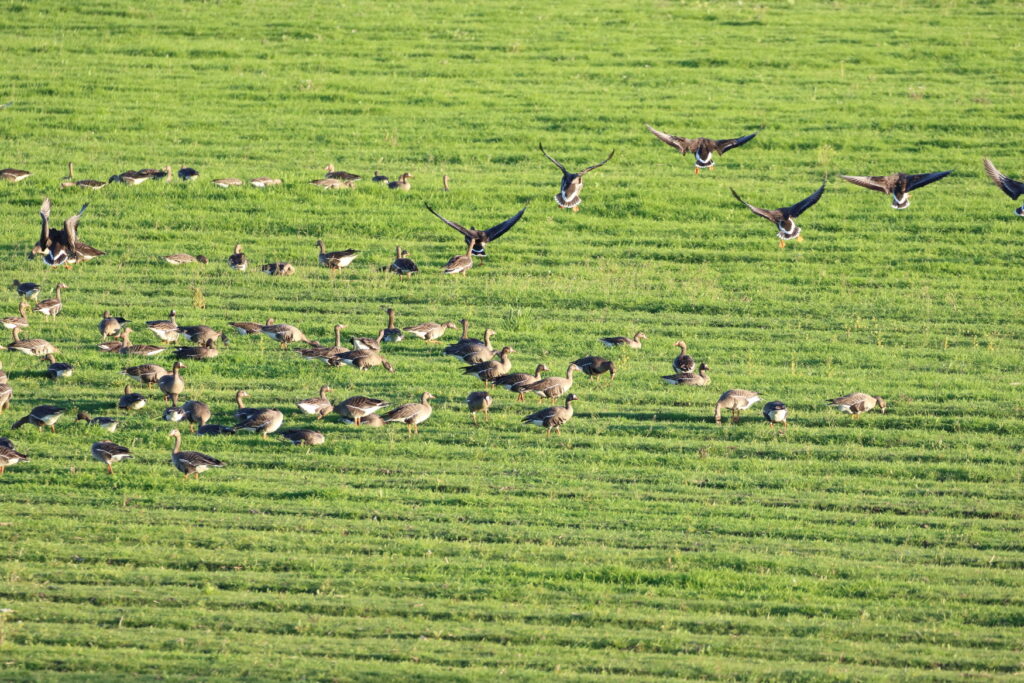
That evening, after our tour and our drive back to Sacramento, I rallied myself for one more birding mission. After checking into our hotel in Woodland, I drove about five miles to where I-5 crosses the Sacramento River. I got off on some small side roads and began scouring fields and places with standing water. I found a few Northern Shovelers and a trio of Black-necked Stilts, but not what I was looking for. Then, I parked and began walking on a path that led back toward the interstate. Almost immediately, I saw a group of about 200 geese in a verdant field. I raised my binoculars and grinned. Yes! Greater White-fronted Geese! The last species I had really hoped to see on the trip. I stood and watched them for about ten minutes, as other geese flew over, circled around, and joined the throng. It was a perfect ending for what turned out to be a perfect college—and birding—trip.
California Trip Report: https://ebird.org/tripreport/214105

My last target bird of the trip, Greater White-fronted Geese, captured just as the sun was setting on Sacramento.

Birding Barcelona, Part 2: In Search of the Greater Flamingo

Braden and I write FatherSonBirding in the hopes of sharing the wonders of birds and birding, and the urgency to protect them. We do not accept advertising or donations, but if you’d like to support our work, please consider buying *NEW* copies of some of Sneed’s books—First-Time Japan, for instance, or my recent Orbis Pictus Award winner, Border Crossings. We appreciate your interest and hope you will keep reading!
When birding big cities I’ve discovered that it often requires a bit of extra effort to reach even a highly modified natural area. That proved true last year when my daughter and I visited Japan (see “Birding Japan: Kanazawa”), and it once again proved to be the case when my wife and I recently visited Barcelona. After birding city parks and tourist sites all week, I had barely breached 30 bird species total—far short of my goal of 50 or 60 species (see “Birding Barcelona, Part 1: The Urban Core”). I had a plan to help rectify the situation—but it was going to take that extra bit of effort to realize it.

On the last full day of our trip, I rose early, wolfed down some yoghurt, and hailed a cab in front of our hotel. In my mediocre Spanish, I explained to Isabella, my driver, where I wanted to go and even showed her the place on Google Maps. She knew about the area and had even been there, so we set out toward the airport in a light drizzle.

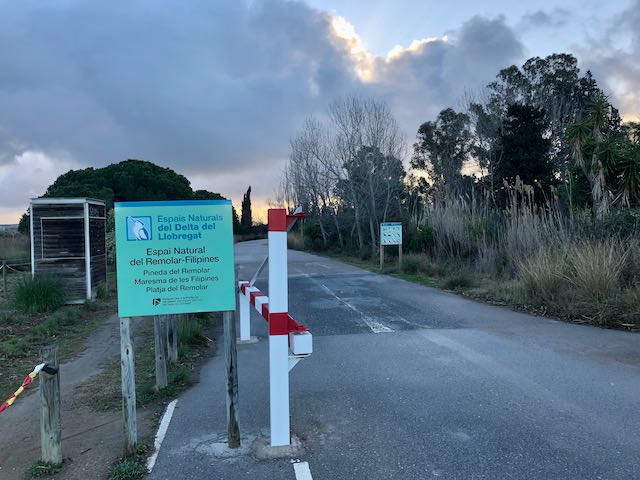
When visiting Barcelona, the best chance for a birder to enjoy some natural habitat—and an abundance of birds—is to take a taxi out to the Espais Naturals del Delta del Llobregat near the Barcelona Airport.

My destination was the “Espais Naturals del Delta del Llobregat,” which I’ll just call “Llobregat” for simplicity. Llobregat was a wetland divided into two parts, one on either side of the Barcelona airport, and the reason it existed at all was no doubt due to the fact that you can’t build huge buildings where giant aircraft can run into them. I thank the travel gods for that because these wetlands were the only orange-colored (high species count) hotspots anywhere near the city of Barcelona.

I asked Isabella to drop me off at the area on the far (western) side of the airport, and twenty minutes later found myself standing utterly alone on a road that appeared to lead into the natural area. Turns out, Isabella could have driven me another mile closer to the main action, but that error turned out to be a good thing. As I walked down the road, I began hearing all kinds of bird vocalizations and soon Merlin’s Sound ID picked up a new lifer for me, Cetti’s Warbler, calling from the thick reeds on both sides of the road. Sound ID also picked up Green Sandpiper, which got me really excited because shorebirds were at the top of my list to see on this, my sole real birding outing, of the trip. As I walked, I also saw what would be my only raptors of the trip—three Western Marsh-Harriers—and some high-flying swallow-type birds that turned out to be Eurasian Crag-Martins. I got occasional glimpses at a canal to my left, but saw only Mallards, a pair of Gadwalls, and a Gray Heron in it.

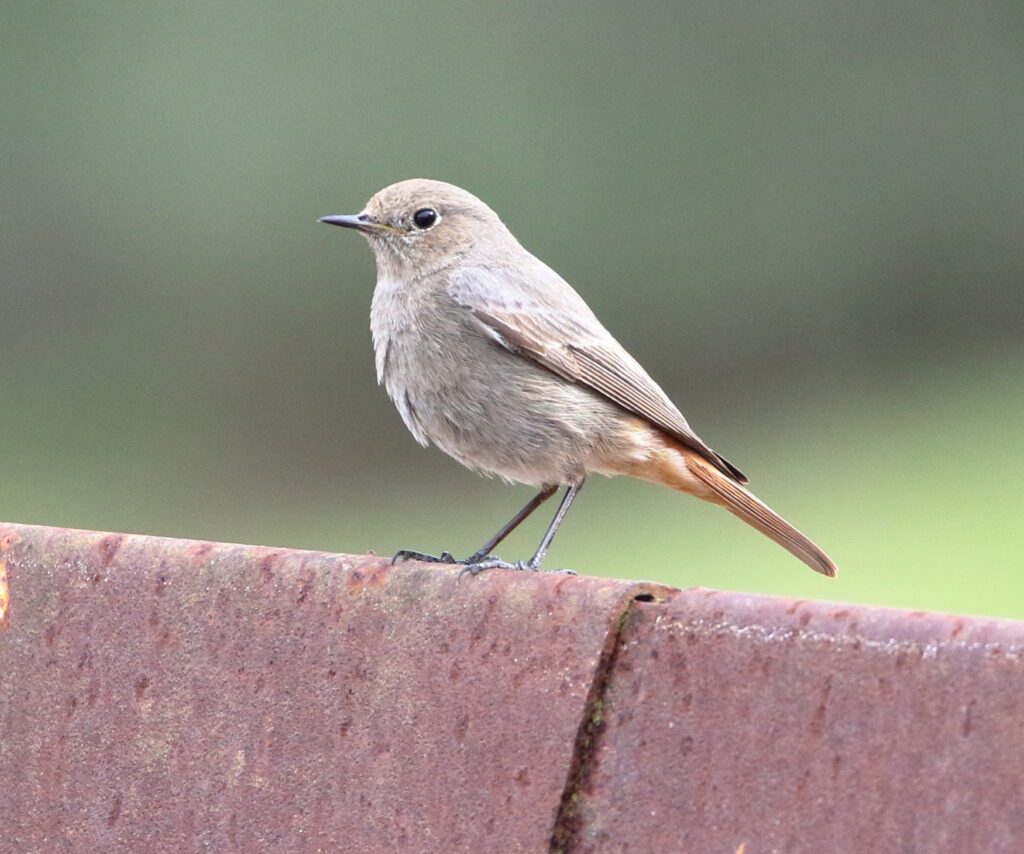
Half an hour later, I arrived at Llobregat’s official entrance and was relieved to see a series of established trails that led to various bird blinds around the reserve. As I followed the first trail, Common Chiffchaffs, Black Redstarts, European Robins, European Serins, and White Wagtails hopped and fluttered around me, but my excitement didn’t spike until I entered the first birding blind.

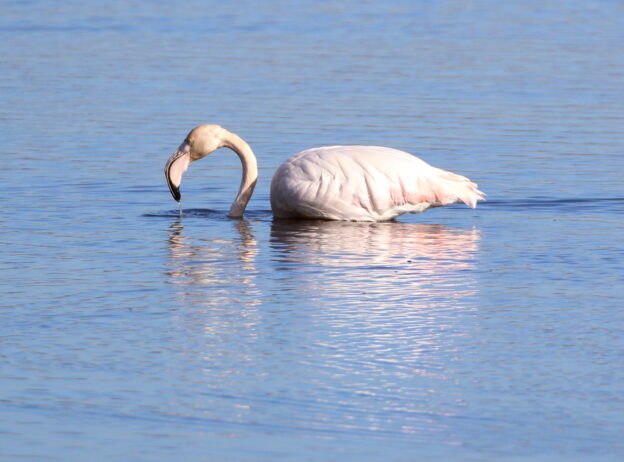
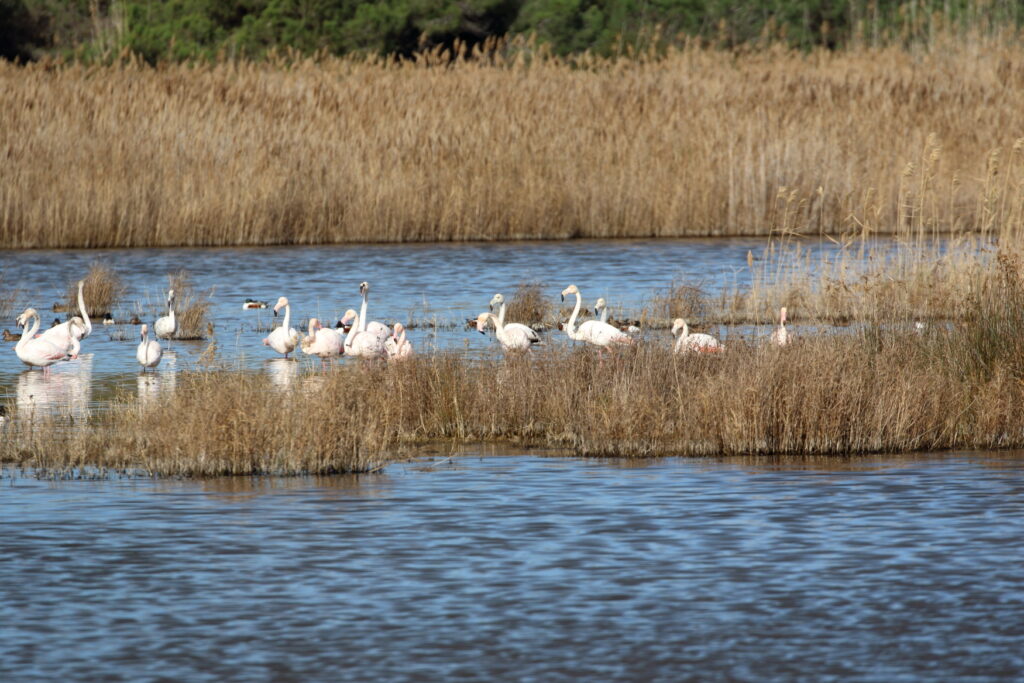
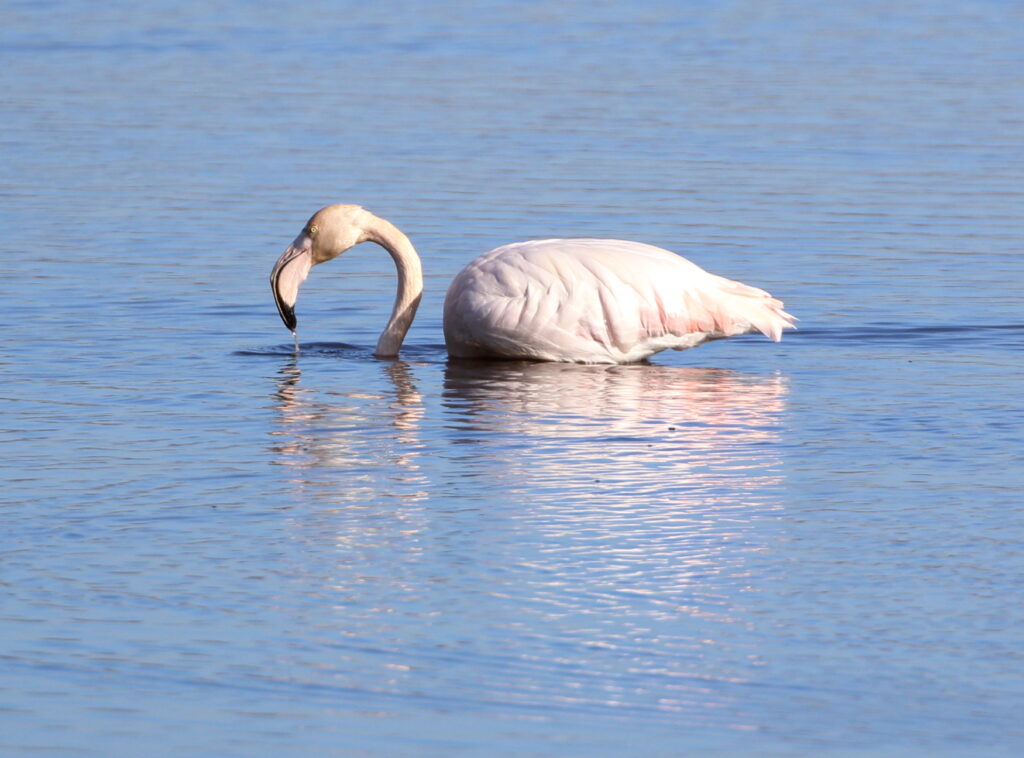
I had worried that I might miss Greater Flamingos in Spain, but a couple of dozen greeted me at Llobregat. Note how pale they are. Evidently, they are not getting enough crustaceans in their diets!

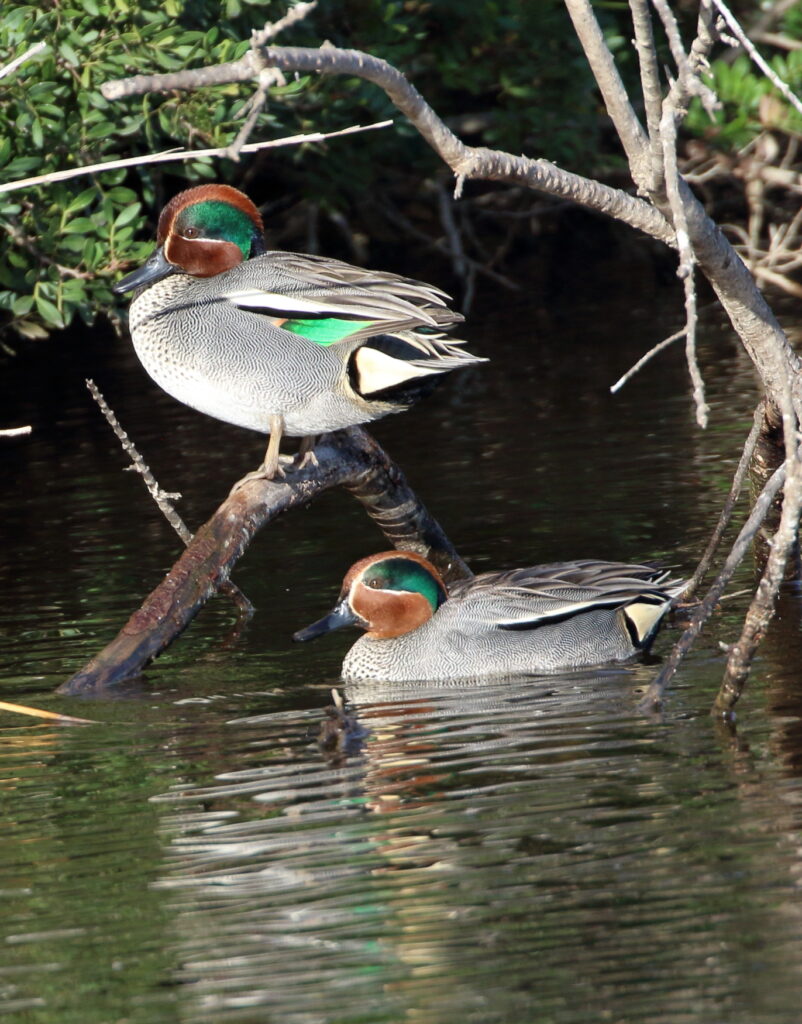
It took me about five seconds to locate the birds I most wanted to see—Greater Flamingos. But they just formed the tasty appetizer to the huge variety of waterfowl before me. This included many familiar ducks familiar from back home: Northern Shovelers, Gadwalls, Mallards, and the Eurasian variety of Green-winged Teal (which may eventually get split into a new species).

I just love the unique looks of Eurasia’s Green-winged Teals, which have a distinctively different appearance than our North American versions. I hope the taxonomic splitters pounce on them and declare them a distinct species.

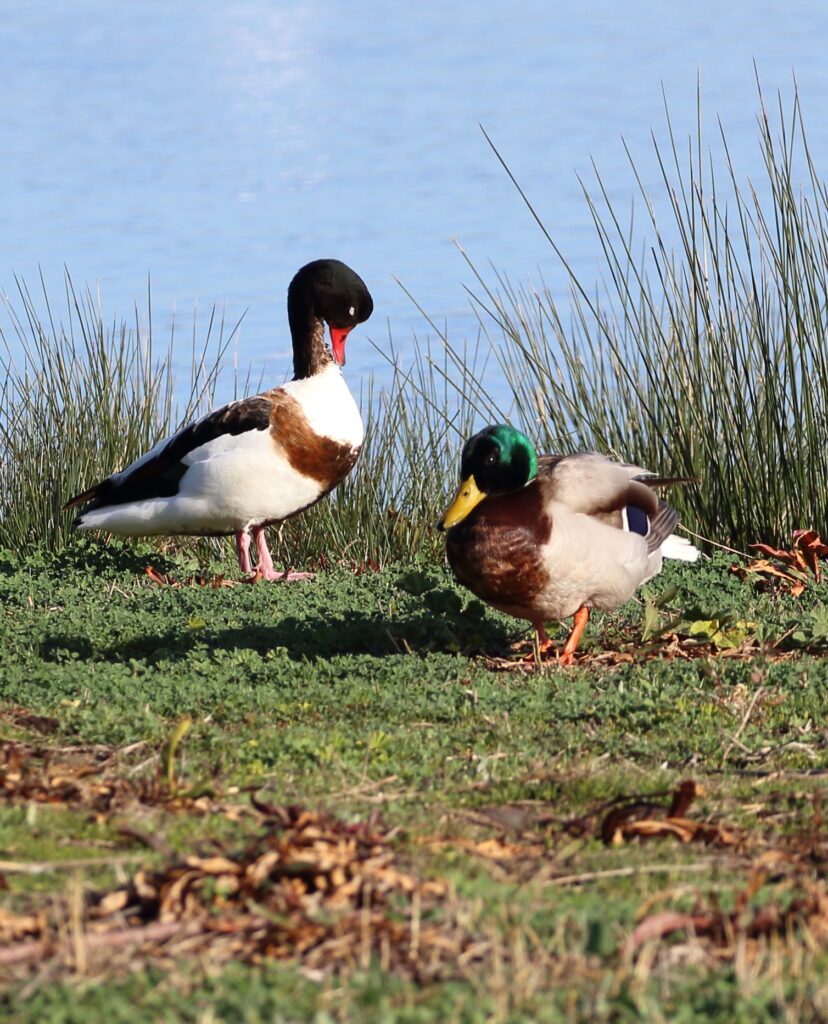
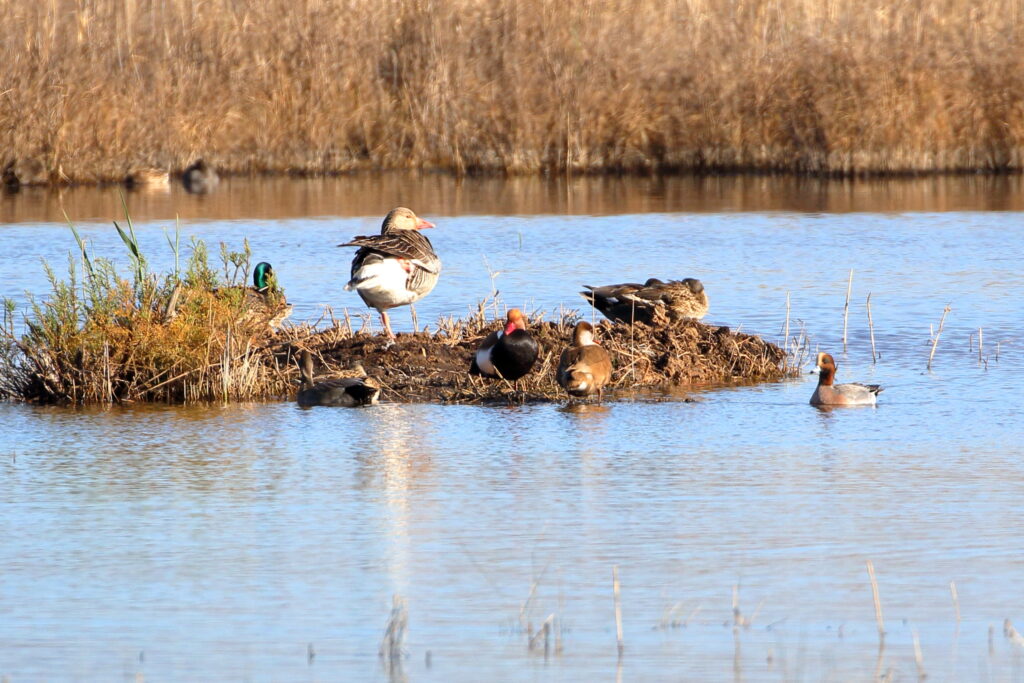
The ducks that really got me going, though, were new for my life list: Common Shelducks and a pair of Red-crested Pochards that was doing its best to avoid eye contact on a distant island! I had hoped to see both of these, but had tempered my expectations. No worries—there they were, and in company of a lone Eurasian Wigeon.

Ka-ching! Life Bird #1007! Common Shelduck in the company of a pretty fetching Mallard!

As I sat enjoying the duck show, I also noted Eurasian Coots and Moorhens, along with a delightful pair of Little Grebes, all of which I had seen in Japan almost a year earlier. As I scanned the pond, I also saw something quickly dive into the reeds at the edge of the pond. I strongly suspect that this was a Water Rail, but reacted just a moment too slow to get my binoculars on it.

If you look at this photo carefully, you will see a number of charismatic Spanish species: Graylag Goose, Eurasian Wigeon, and my lifer Red-crested Pochards. The latter two are reported infrequently this time of year.

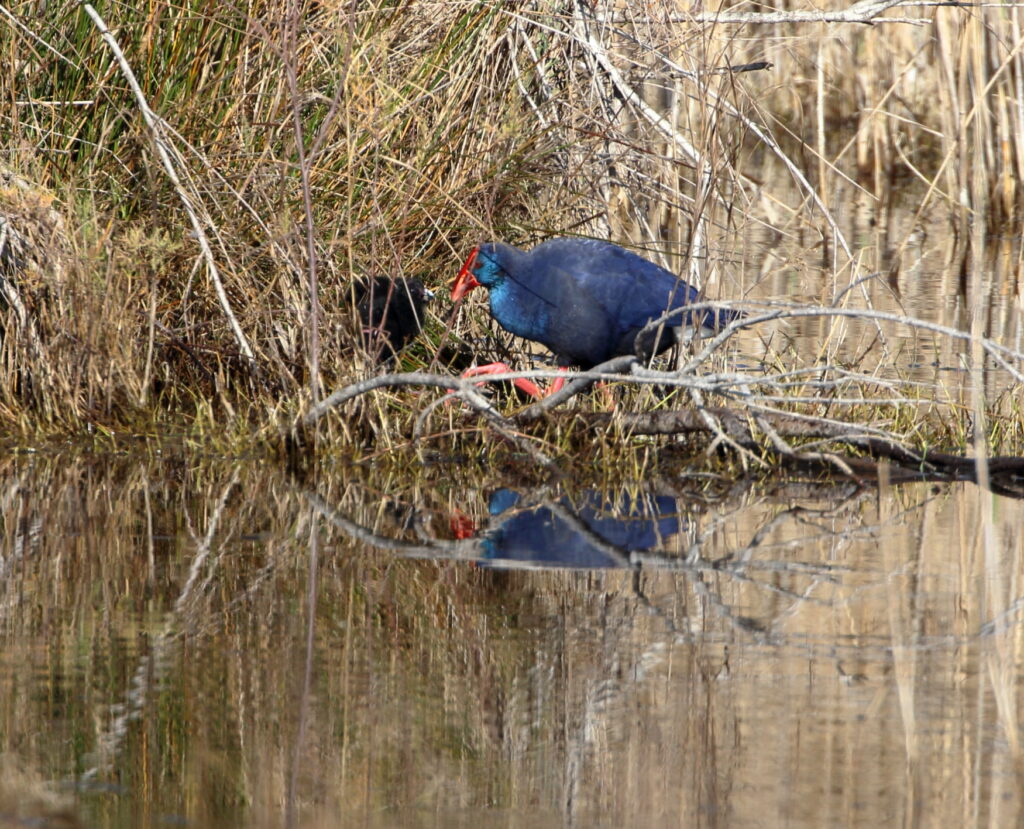
After about thirty minutes, I continued onto another viewing area. On the way, I passed a plywood wall with a few viewing windows cut into it and happened to take a quick peek. A largish purplish bird stuck out and my first thought was “Eurasian Moorhen.” Then, I did a double-take. “Hold on. Moorhens aren’t that blue—nor do they have bright red bills and legs!” The bird before me was one I had been studying on eBird quizzes, but darned if I could remember the name of it. Scrolling through eBird, I quickly found it: Western Swamphen! Even better, it had two adorable fuzzy black chicks with it!

I had not expected to see such a bird in my wildest dreams and it didn’t stay visible for long—just long enough for me to take a couple of modest photos—before disappearing into the reeds. And that, apparently, is typical for this bird, a species that rarely makes an appearance even where it might be fairly common. It immediately leaped to the top of my Trip Bird list, where it would remain for the rest of our vacation and beyond.

Earning Bird of the Trip honors, this rare sighting of a Western Swamphen put a lasting grin on my face. That black “shadow” to its left is actually one of two chicks accompanying it.

After more bird blind fun, I walked out to the beach in the hopes of seeing shorebirds. No dice. In fact, I didn’t see a single shorebird my entire morning, one of the trip’s big disappointments. I asked the interpreter about it and he confirmed that there hadn’t been many shorebirds around the entire year. Alas, I later discovered that the other section of the wetlands, on the east side of the airport, had been getting some. Nonetheless, I sat down on a jetty, breathed in the salt air of the Mediterranean, and enjoyed some bread and cheese while watching the giant jets taking off to almost every continent in the world. Then, I began making my way back down the long access road, happy with the day despite the shorebird miss.

My morning at Llobregat nabbed me 33 species—as many as I’d seen in the previous five days in Barcelona. It pushed my world life list to 1011 species. It also pushed my trip list to 49 species—one short of my goal of 50 species. “Shoot,” I thought, riding a taxi back downtown. “Where can I go near our hotel to pick up one more species?” I hadn’t a clue, and quietly resigned myself to this epic failure that would mar my reputation and confidence the rest of my life and cast shame upon my friends and family.

More Flamingo fun. These birds sat atop my list of birds I wanted to see in Barcelona and at Llobregat, they did not disappoint.

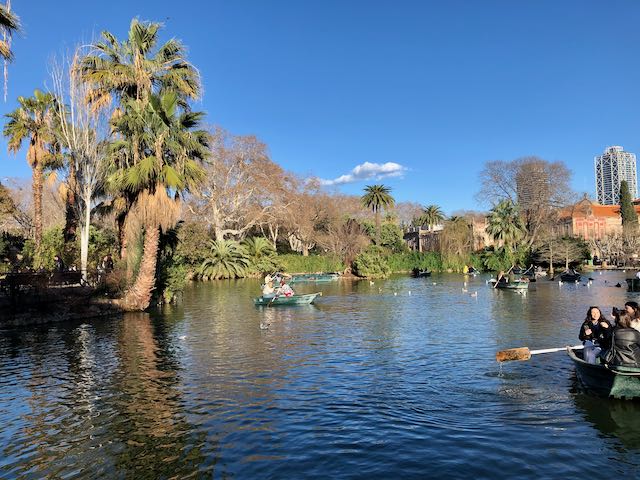
That evening, Amy—who had spent the day shopping and visiting the Picasso Museum—and I decided to take a walk before our last Barcelona supper. She hadn’t yet visited Parc de la Ciutadella (see my previous post “Birding Barcelona, Part 1: The Urban Core”), so we strolled over there. We reached the pond where they rented rowboats and decided to go for it. I handed over six Euros and we climbed in, joining a huge assortment of merry locals and tourists. Black-headed and Yellow-legged Gulls, Graylag Geese, Gray Herons, and Mallards surrounded us. Monk and Rose-ringed Parakeets squawked overhead. I smiled. This was a perfect way to wrap up the trip.

Then, I spotted a small bird sally out from the edge of the pond and return to land on a rock. From similar sightings in Taiwan, Israel, and Japan, I knew immediately what it was. “Gray Wagtail!” I exclaimed! Just as in Japan, it was the only GRWA I had seen, and it pushed my trip list to 50 species.

I swear, you can’t make this guano up.

Ciutadella’s popular rowing pond—and site of the trip’s sole Gray Wagtail.

Birding Barcelona, Part 1: The Urban Core

Since Braden and I started FatherSonBirding in 2018, I’ve posted a lot about birding in the company of Braden (of course) and my daughter, Tessa. You parents, though, may recognize that with growing kids at home it can be difficult to get one-on-one time with your actual spouse. Last week, Amy and I began to rectify this situation with our first couples vacation in seven years. Our destination was a place we had dreamed of visiting for more than a decade—Barcelona, Spain.

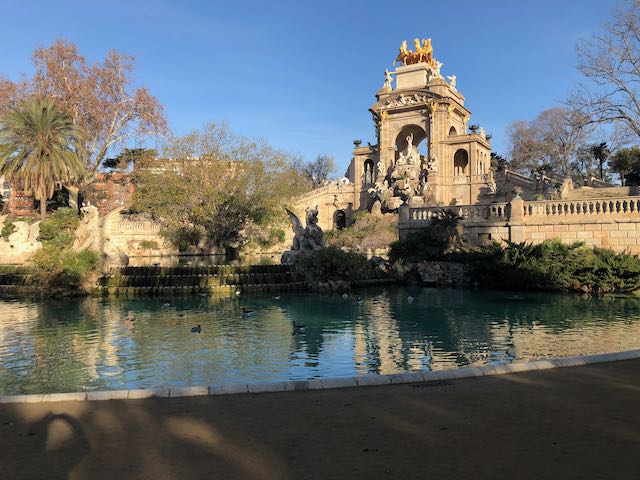
It’s no accident that I booked a hotel near what may be Barcelona’s largest urban park.

I admit that Barcelona did not draw me for its birding opportunities. The promise of stunning architecture, great tapas, and practicing my Spanish, though, outweighed any potential avian shortcomings. Nonetheless, it will come as no surprise that I felt determined to scour this remarkable European city for every bird possible. I set a goal of 50 or 60 species for the week. Even more intriguing, my life list stood at 999 species. “Which bird will put me over the top?” I wondered.

I booked us into the Park Hotel, an awesome little place in the historic El Born neighborhood near the Barceloneta Metro Station, the Estacio de Franca train station, the waterfront, and hundreds of uber cool restaurants and shops. I did not admit to Amy that I also booked the place because it sat only a block from one of the city’s largest urban parks, Parc de la Ciutadella. As soon as our plane landed, we bought 5-day Metro passes and rode the subway into town. Emerging from Barceloneta Station, I immediately saw both Rose-ringed and Monk Parakeets noisily flying overhead—and then I spotted a black bird atop a light post. I recognized it right away as my bird #1,000—a Spotless Starling!

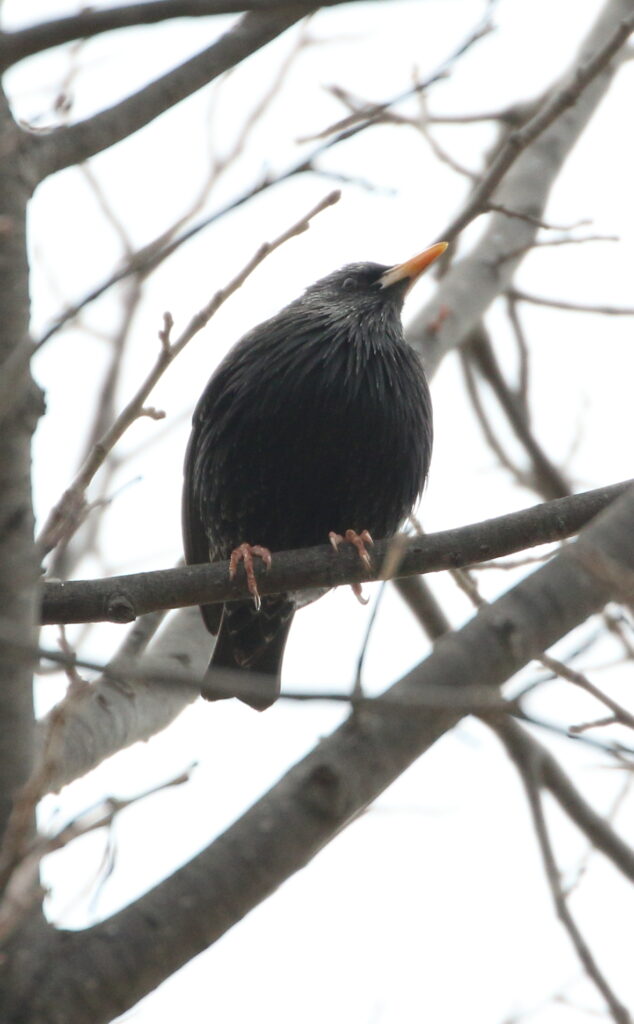
Bird 1000! A Spotless Starling! Under FatherSonBirding Rules of Full Disclosure, I am still waiting for someone to tell me that this is actually a European Starling. Apparently, they sometimes also take on this “all black” appearance. If that does turn out to be the case, Yellow-legged Gull will assume Bird #1000 honors!

It wasn’t until the next morning, though, that I seriously plunged into Barcelona birding by rising early and heading over to Ciutadella. It was a glorious, crisp morning and even before I reached the park gates, I noted a procession of parakeets, gulls, magpies, and Western Cattle Egrets flying toward the park. Like many urban parks, Ciutadella has a rather down-trodden, worked-over feel to it. Leaves have been obsessively raked, precluding the development of healthy soil layers (and the insect prey they could produce), and very little mid-sized vegetation exists. Still, I set out optimistically and almost immediately encountered Great Tits, a Eurasian Blue Tit, a European Robin, and my lifer European Serin.

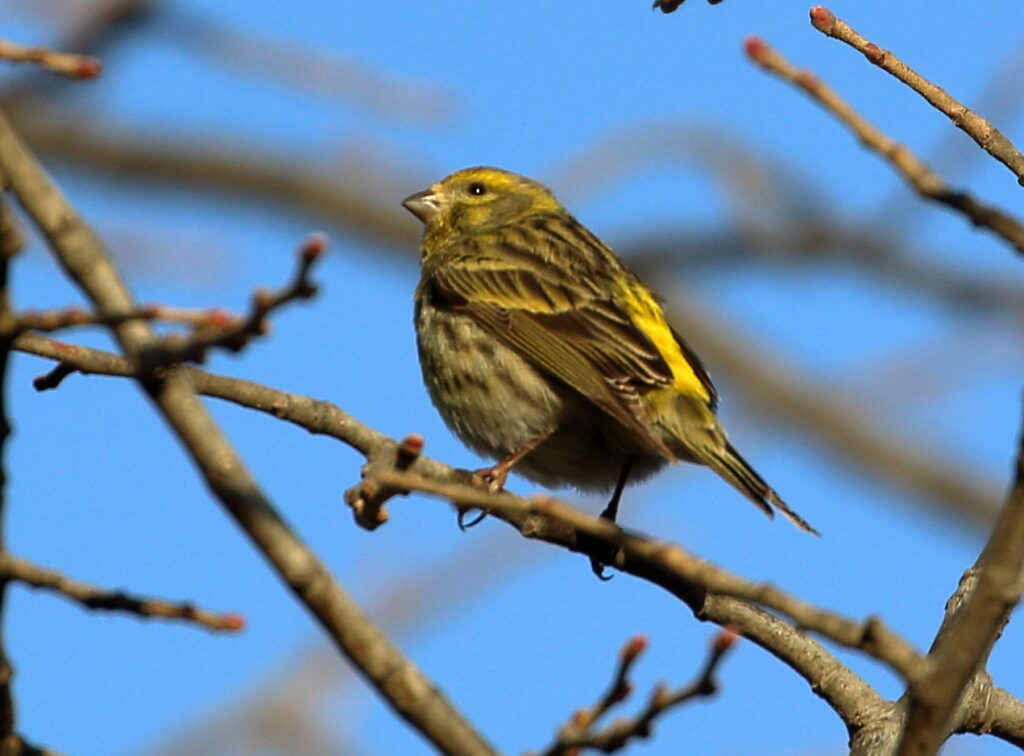
Though I never got a great photo of one, Merlin’s Sound ID picked up European Serins in multiple places I birded. I worried I wouldn’t be able to recognize these as a number of yellowish, stripy, finchy birds live in Catalonia.

Wandering haphazardly, I quickly discovered that the park was the Monk Parakeet capital of Barcelona. Not only did this introduced South American species seem to love roosting and nesting in the palms, many people actually enjoyed feeding them, even early in the morning. This included several people who had pitched their tents in the park and evidently lived there (the tents had been cleared out by the end of the week—perhaps in preparation for a giant convention that was about to descend on the city).

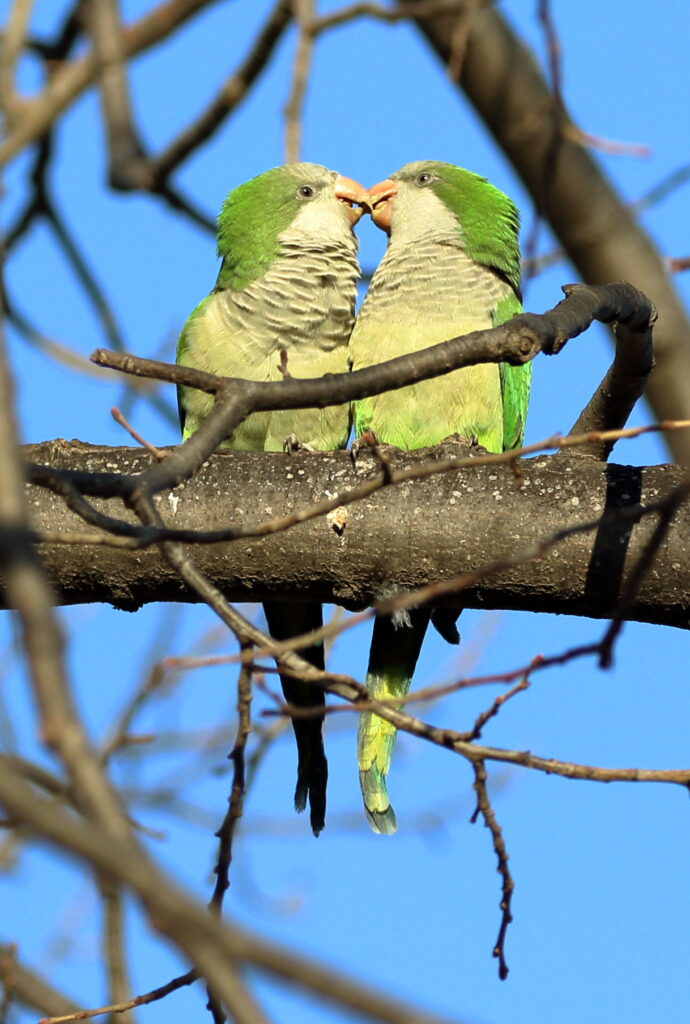
Aaaaaaw! Monk Parakeets in love. Or at least sharing food. Or perhaps trying to peck each other’s eyes out.

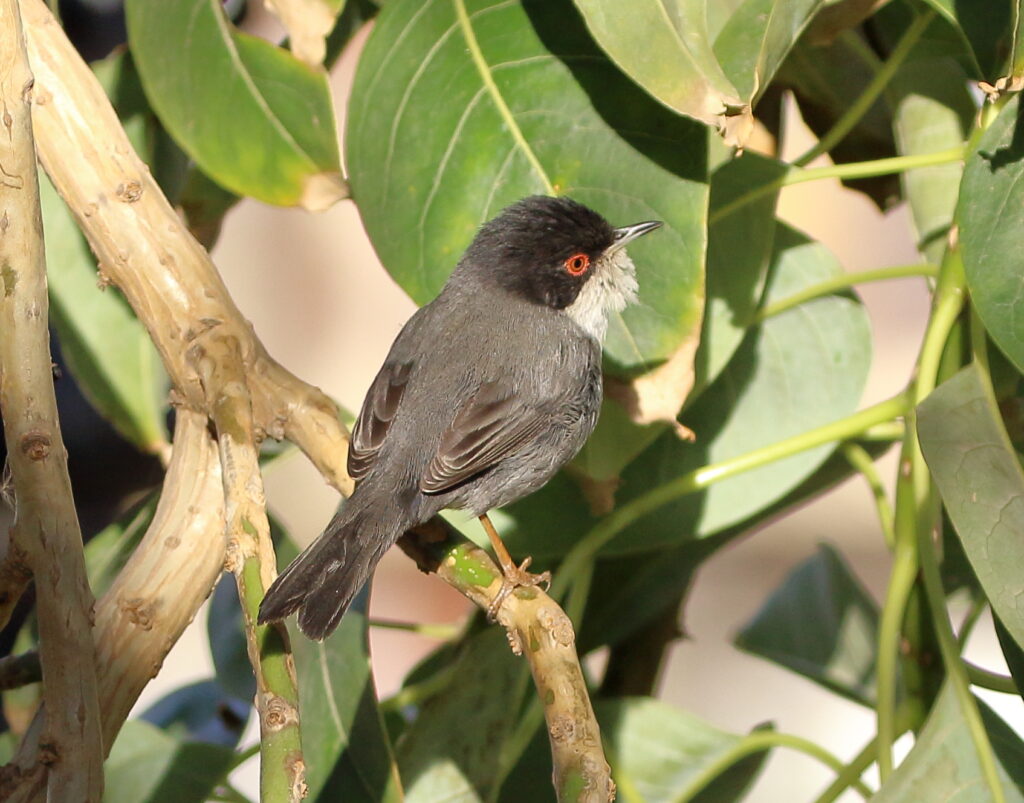
I kept picking up birds, though, including Common Chiffchaffs, Eurasian Blackbirds, Eurasian Magpies, Rose-ringed Parakeets and then, an especially exciting discovery—my lifer Sardinian Warblers!

Before the trip, I spent a lot of time learning the differences between Sardinian Warblers (shown here) and Eurasian Blackcaps. Once in the field, it was easy to tell them apart—as long as I managed to get a decent look!

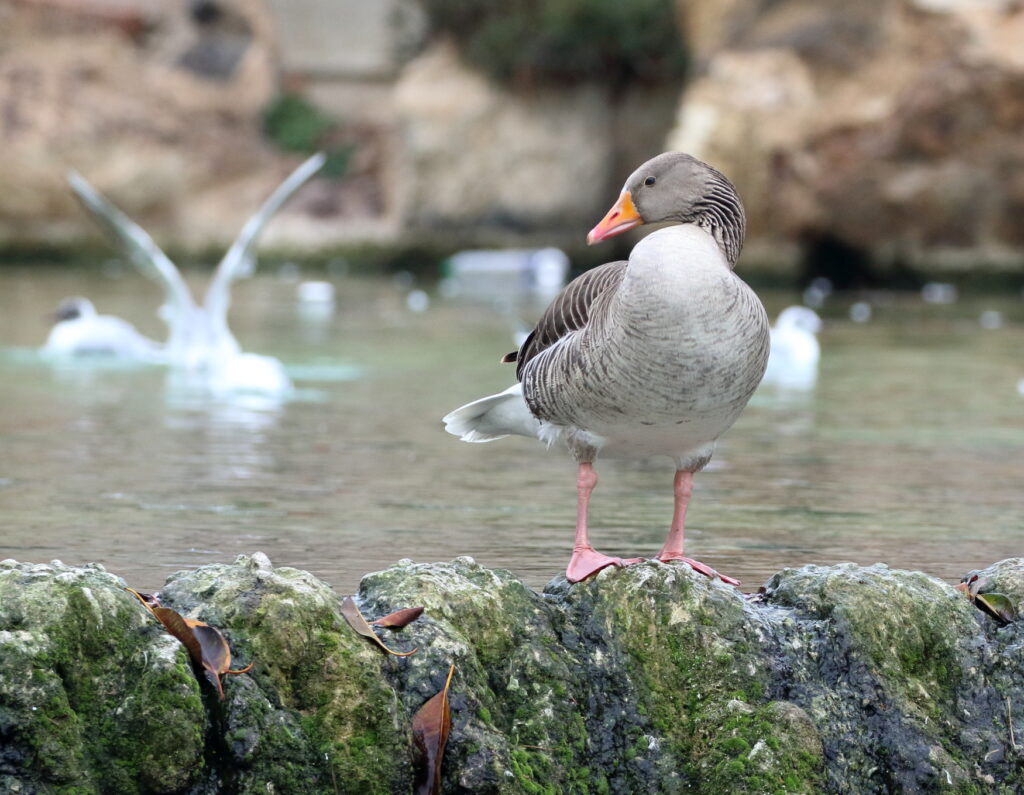
What I hadn’t seen so far were any water features, but crossing under a giant gold-plated monument (the Monòlit a la festa de l’arbre de 1899), I encountered a couple of reflecting ponds. In them, I saw a “must-see” species I had somehow never observed in all of my travels—Graylag Goose! Along with the geese, I got good looks at both Black-headed and much beefier Yellow-legged Gulls. I kept an eye out for Lesser Black-backed Gulls, but could never confirm one the entire week.

https://ebird.org/checklist/S161951923

I scored my lifer Graylag Geese right down the block from our hotel, in Ciutadella park. Note the Black-headed Gulls frolicking in the background.

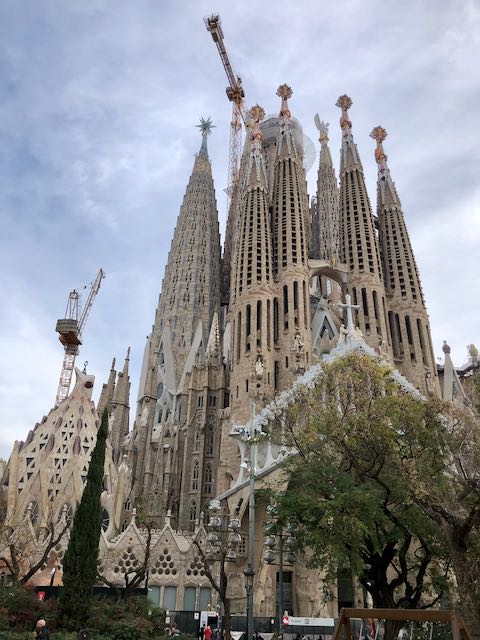
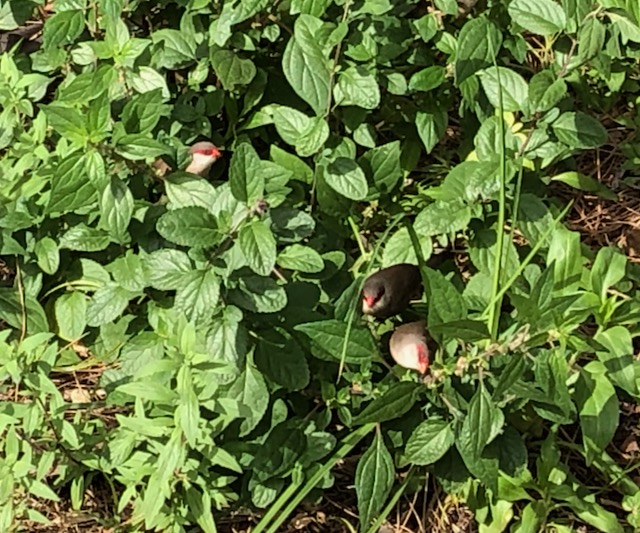
I ended my session with a surprisingly robust 23 species, but my week of birding Barcelona had just begun. During the next few days, I kept my travel binoculars slung around my neck, birding tourist-jammed city streets as well as any greenery I could find. I spotted my only Eurasian Jackdaw in a tree on the well-known avenue, Passeig de Gracia. I was delighted to discover a flock of 20 adorable introduced (and lifer) Common Waxbills in the Placa de Gaudi, right across the street from the modern wonder, Sagrada Familia. (This cathedral, designed by the brilliant Catalan architect Antoni Gaudí, is reason enough to visit Barcelona!) I finally saw the trip’s first European Greenfinches and Long-tailed Tits in the marvellous Parc Güell—one of the city’s better urban birding places and another great place to see Gaudí’s handiwork. My best urban birding opportunity, though, still lay ahead.

Though Common Waxbills are species introduced from Africa, I was thoroughly enchanted by these little “red bandits” when I encountered them across from Sagrada Familia (phone photo).

On our fourth day in Barcelona, we caught the H14 bus to the Parel-lel Metro station, but instead of boarding the Metro, we rode the funicular up the hill to Montjuïc, a prominent mini-mountain overlooking the city’s southern area. Only a couple of hundred meters away from the exit stood one of our top cultural destinations, Fundació Joan Miró, aka the Miró museum. A bit less famous than Picasso, Miró was Picasso’s contemporary, and even better, we caught a joint exhibit featuring the work of both men. After a thoroughly enjoyable hour or two there—and excellent quiche in their café—we walked up the hill heading for an even more exciting destination. Along the way—and with the help of Merlin’s Sound ID—I located my lifer Eurasian Blackcap.

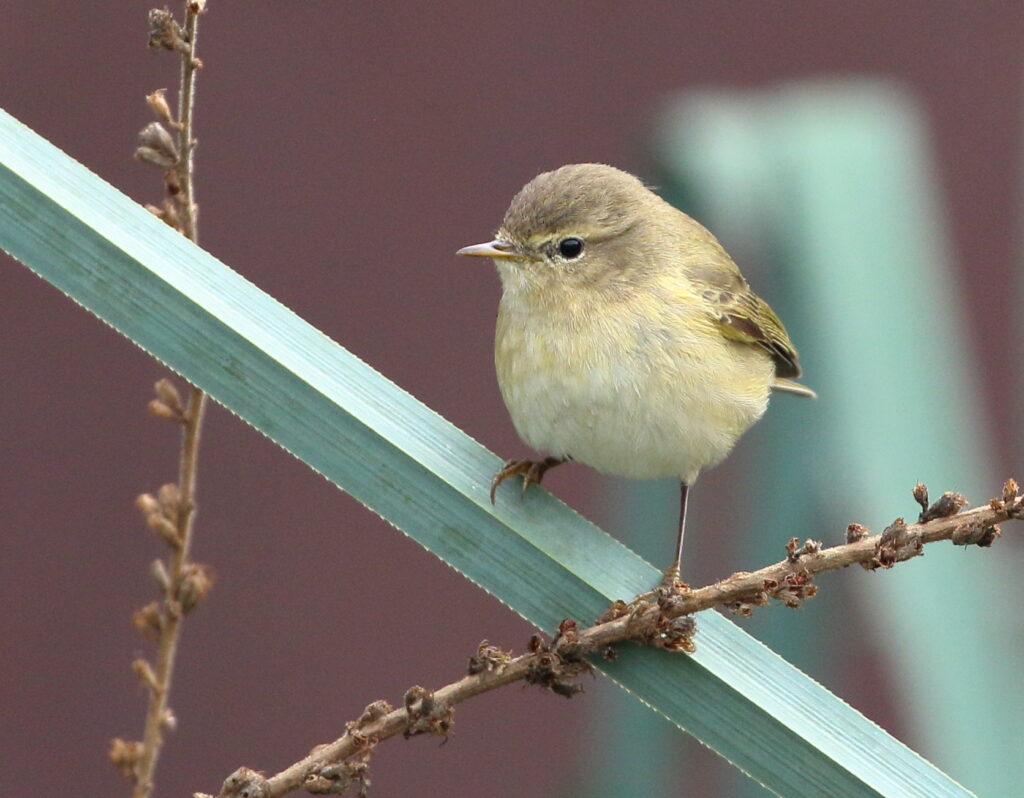
One of the most common birds I encountered in Spain, the Common Chiffchaff always brought a smile to my face, both for its name and its lively behavior. That said, I also always doubted my ID of this bird since they come in several shades of yellow and brown.

We emerged onto a road running along the top of Montjuïc and were making our way gradually downhill toward the Olympic stadium, when I spotted what looked like a prairie dog in a small field below and to our right. I had other suspicions, however, and raised my binoculars to find those suspicions confirmed: a Eurasian Hoopoe! I hadn’t seen one since Israel, but they are apparently a lot less common in Spain, and I was delighted to see its Picasso-esque crest, long curved bill, and graphic brown, white, and black color pattern. I was glad to show it to Amy, too, since we had first seen one together in Ethiopia almost 20 years before!

The first Black Redstart I saw in Spain was working over balcony planters in a densely packed neighborhood of apartment buildings in Barceloneta—a clue to how adaptable this handsome species is.

Another couple of hundred meters brought us to Jardí Bòtanic de Barcelona, and my pulse accelerated as we paid our 3-Euro entry fees and entered. Finally, I would get to bird a somewhat natural area! The only question was, what I would find?

The visit got off to a great start with sightings of Black Redstarts, European Robins, and another blackcap. Making our way around to a little pond, the excitement grew with half a dozen flycatching Common Chiffchaffs, another Black Redstart, and a pair of White-Wagtails—the fourth country I’ve now seen this bird in.

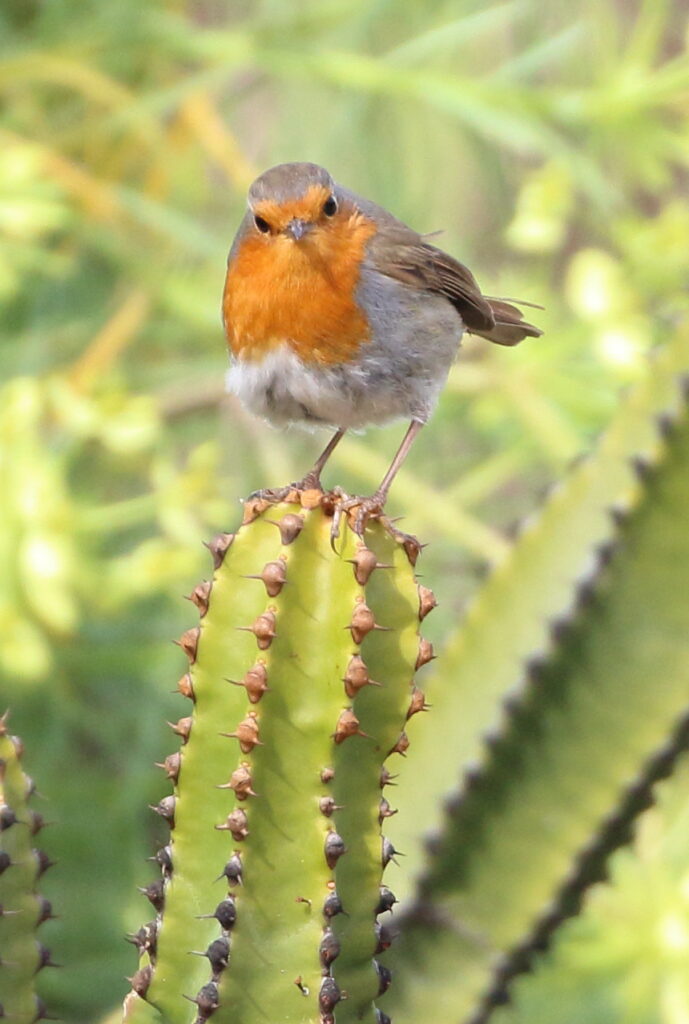
Though I’d seen European Robins in Amsterdam, Israel, and Japan, this is the first one that ever fully cooperated with my camera. Love it!

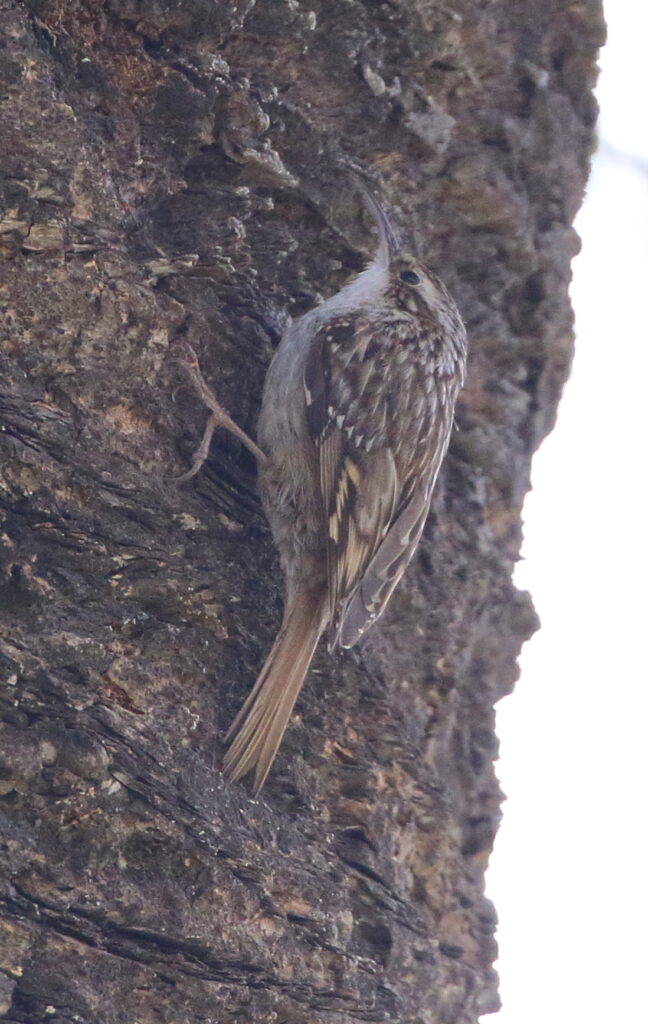
As we headed up to the higher parts of the gardens, a series of unfamiliar high notes pierced the air. I looked around and detected movement on a nearby tree trunk. It belonged to none other than a pair of Short-toed Treecreepers, a bird stunningly analogous to our Brown Creepers, and a species I never thought I’d see in Spain. Awesome!!!!

A series of high sharp notes alerted me to the presence of several Short-toed Treecreepers, a species I had only dared hope to see in Spain.

The treecreepers weren’t the last birds we saw in the gardens, but they were probably the coolest. Our 80-minute visit plus the Miró museum marked this as our most fun day so far—but I had one more major Barcelona birding adventure scheduled for the last day of the trip. Find out what it was by reading my next post. Same bird time. Same bird channel.

https://ebird.org/checklist/S162445992

Braden’s Costa Rica Report #3: El Copal

Not many of us have the resources to bird outside of our own regions, and if you are part of that large club, you’re in luck. Braden is spending the spring semester of his junior year studying abroad in Costa Rica. He has 16 full weekends to work with and it’s no surprise that birding is on the agenda for every one of them. Here is his latest report—to a place that is not only a wonderful birding destination, but a model of sustainable agriculture. Enjoy!

I arrived at La Reserva El Copal just as the sun dipped behind the rainforest-covered foothills, my clothes soaked with sweat and every part of my body tired from the four bus rides and two-hour walk it had taken to get to one of Costa Rica’s best birding locations. My weekends in Monteverde and Jaco had been eventful and fun, but I was in need of some solo birding time, and so four days earlier I had made a reservation for this inexpensive, out-of-the-way property sitting on the lower slopes of the Cordillera de Talamanca. Patricia and Beto, the couple that ran the reserve, warmly welcomed me as darkness fell, showing me to my room and then to the dining hall for a dinner by candlelight. As I stared at the photos of rare and colorful hummingbirds on the walls, I realized that I was the only guest staying here for the night. Patricia served my rice and beans and said that she and Beto usually lived in Pejibaye, the town the final bus had dropped me off in, and only came up here when guests arrived, which wasn’t particularly frequently in January and February. This surprised me, given El Copal’s location and the high number of desirable bird species reported from here.

Even a glance of the grounds explains why El Copal is one of Costa Rica’s top birding destinations.

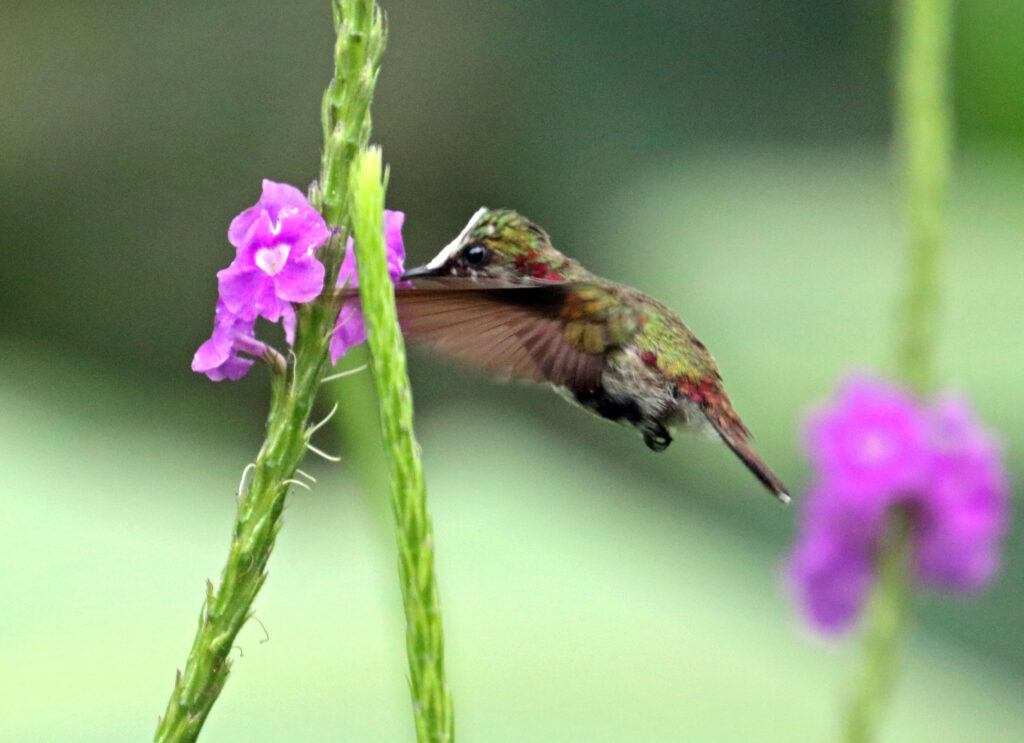
The next morning I arose at dawn, grabbed my binoculars and camera and headed off into the property as the trees began to glow with increasing sunlight. Almost immediately after stepping outside, a small, dark hummingbird buzzed by me, stopping to feed at one of the many flower bushes adorning the property. Despite the fact that it was still dark, I could clearly see the brilliant white cap for which the bird was named—Snowcap, which, in the weeks leading up to my trip to Costa Rica, had quickly risen up the ranks as one of my most-wanted birds. Rare denizens of the Caribbean slope, there were very few places in the country where these birds were reliable. El Copal was one of them, and I ended up seeing at least half a dozen of them during my stay here. The tiny, fairy-like hummingbirds eliminated any doubt I had about making this trip!

El Copal is one of the few places to reliably see Snowcap hummingbirds, and fortunately, they are there in abundance!

El Copal is full of rare birds. Back in the late 90s, the land now holding El Copal had been purchased by several families for agriculture. Instead of developing the rainforest, however, they decided to first establish a form of sustainable agriculture, then open it up for ecotourism, preserving much of the primary forest on the property. Now, some of Costa Rica’s most sought-after birds (and other animals) thrive here, thanks to the decision of those local farmers. This includes the Snowcap and a variety of other hummingbirds, as well as my #1 Target Bird for the whole country: Yellow-eared Toucanet. Of the six toucan species found in the country, this toucanet is the rarest, only found in middle elevation-rainforest on the Caribbean slope. El Copal seemed to be one of the best places to find them in the whole world, and I had my fingers crossed as I headed up the steep trails leading into the reserve.

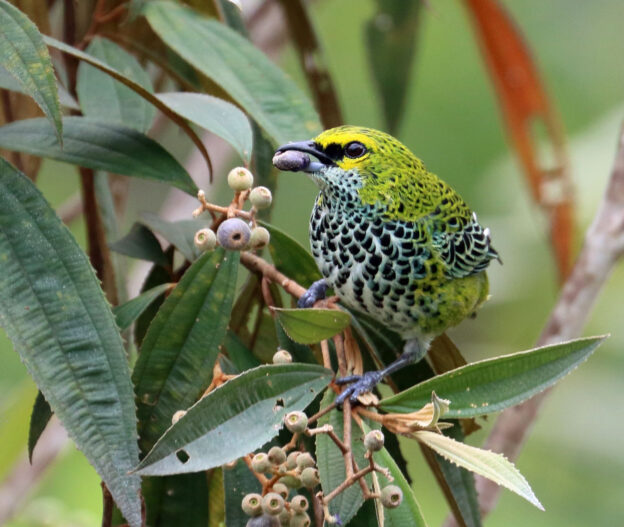
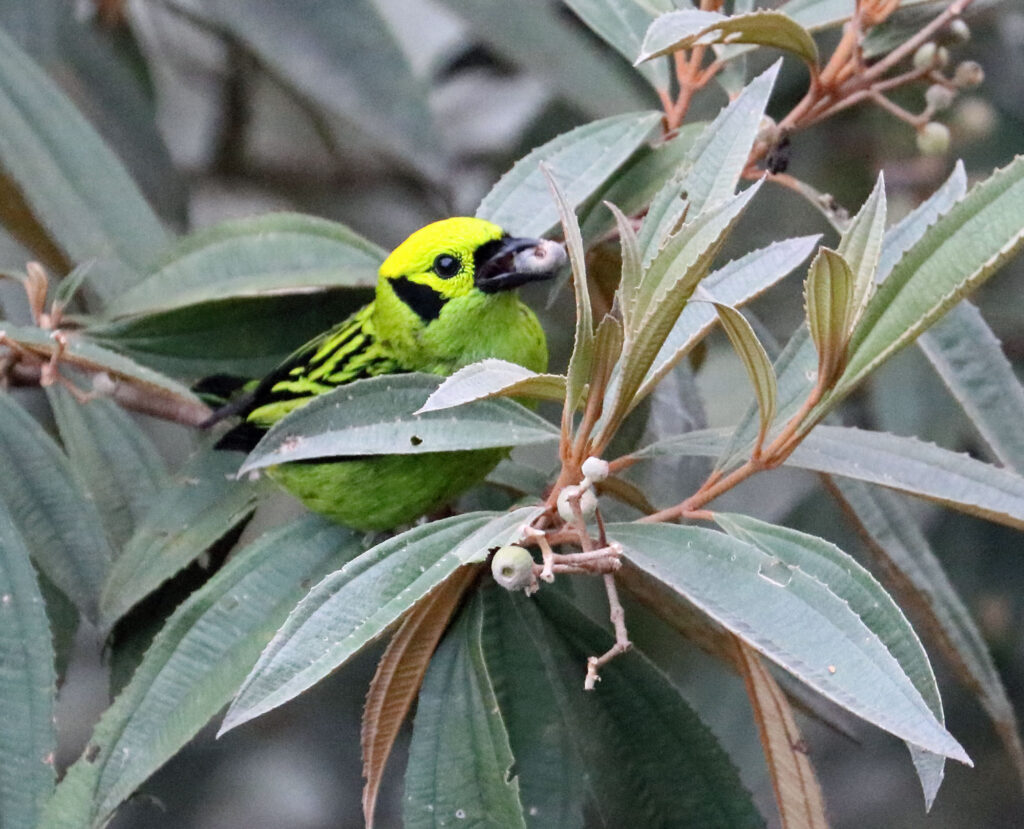
The morning was…complicated. I heard a whole lot of birdsong, but very few of the singers actually presented themselves for good looks. Merlin (the bird identification app developed by the Cornell Lab of Ornithology) was only so helpful, as there are significantly fewer recordings of Latin American species than North American species. Bird sounds that the app identified for me included Bright-rumped Attila, Broad-billed Motmot, and Northern Schiffornis, the latter of which is an entirely brown bird with one of the most entertaining whistling songs I’ve ever heard. Despite my frustration at not being able to see many of the birds hidden in the foliage, I did get eyes on a few. I spotted both a Collared Aracari and a Keel-billed Toucan, two species of toucans quite common in this type of rainforest. And I did lay eyes on several large, mixed flocks of tanagers, colorful birds that traverse the forest in search of fruit. The species I picked out at the tops of trees included Silver-throated, Emerald, Speckled, Golden-hooded, Hepatic, Summer, Scarlet-rumped, Tawny-crested, Black-and-yellow, and Bay-headed Tanagers. I also got to watch a family group of coatis quietly foraging on the trail ahead of me. They scattered when I stepped on a branch by accident.

The tanagers put on a real show around the El Copal lodge—including this spectacular Emerald Tanager.

I returned to the main property for breakfast, then headed off on a different trail, this one leading down towards a stream. I found a Buff-rumped Warbler foraging on the rocks in the water, and peered around tree ferns and buttressed trees to try and glimpse the calls I was hearing. This trail also took a left turn and then continued up the mountain, and further up I spotted Scarlet-rumped Caciques and Chestnut-headed Oropendolas, big grackle-like birds making crazy calls. As I rounded a corner, a shiny green bird with a long bill alighted on a branch in front of me. The bird’s beak was longer and thinner than that of a kingfisher, and it had a warm, orange belly complementing its shimmering, green back: a Rufous-tailed Jacamar! Few birds had given me such a good look that morning, and I stood there for several minutes, watching the bird peer down at me curiously. A few minutes later, a large Ornate Hawk-Eagle soared through a gap in the trees, and my attitude began to improve—the birds were showing themselves! On the way down, I heard a rising and falling song, signifying the presence of an antbird. I poked around a little, eventually getting eyes on a Bicolored Antbird overturning leaves! This species, like many other antbirds, are ant-following obligates, meaning that they depend on army ants to find food. As large swarms of army ants rush through the rainforest, they stir up and scare hundreds of other insects, who leap out of the way, straight into the waiting mouths of antbirds, antwrens, woodcreepers and a variety of other birds that just follow the ants around. Ground-cuckoos, one of the most enigmatic groups of birds, also belong to this ant-following group.

While I didn’t actually lay eyes on any army ants, the antbirds signified that there must have been some nearby. The leafcutter ants, meanwhile, were everywhere. Their trails ran alongside and crisscrossed the walking trails, and I always had to keep an eye on the ground so I wouldn’t step on any.

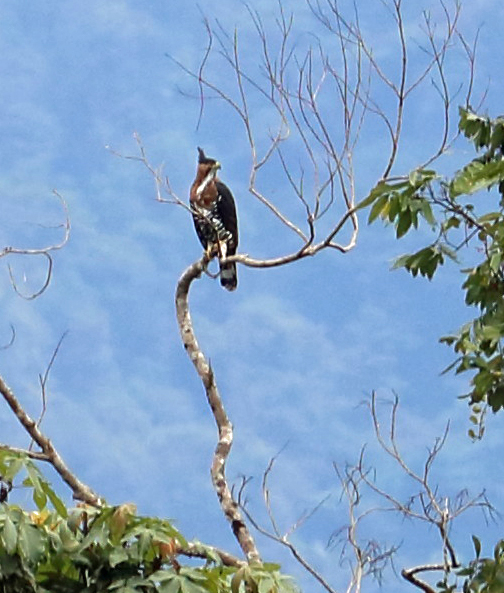
One of the best parts of my visit to El Copal was meeting Carlos, who pointed out this perched Ornate Hawk-Eagle near the lodge.

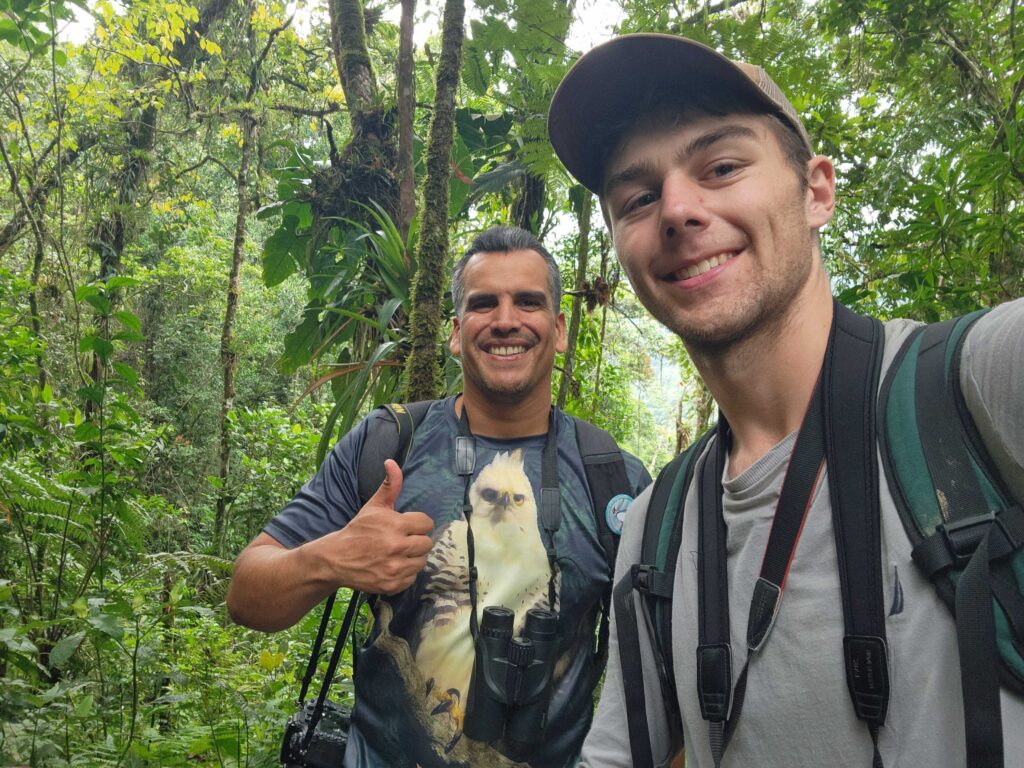
When I arrived back at the lodge for lunch, another birder who had just arrived pointed out another Ornate Hawk-Eagle, this one perched up on a distant snag. As I peered at the bird through his spotting scope, he introduced himself as Carlos, a local also living in Pejibaye. Carlos is an English teacher and regularly visits El Copal during weekends to search for the hundreds of bird species found here. I told him that I hailed from the University of Maine, and spoke of my hunt for the Yellow-eared Toucanet. He looked at his watch. “I’ve got a few more hours…do you want to hike the trails and look for the toucanet together?” So, after a quick lunch, we headed back up the mountain in search of my target.

Thanks to my chance meeting with Carlos, a teacher and Costa Rican bird expert who can identify most of the birds by sound, I got to see one of my most sought-after Costa Rican species (keep reading).

Carlos’s knowledge of the birds of the area was impressive. For one, he could identify many of the calls I’d felt hopeless about earlier, which included more species of antbirds, Collared Trogon, and several species of wrens. He also knew exactly where all the birds hung out, at one spot pointing down the side of the cliff to a White-crowned Manakin, a tiny black bird with a white cap, sitting in a bush fifty meters away. “He’s always here.”

As we gained altitude, I could begin to see the influence of cloud forest. Slightly different species lived here, and the plant composition looked different, too. One thing in particular made us realize we’d entered a higher-altitude area, however. “Toucanet!” Carlos yelled, pointing to a large, bromeliad-covered tree rising from the slope. I held my binoculars up to see, not my target bird, but an entirely green toucan: a Northern Emerald Toucanet! We tried in vain to photograph the species but neither of our cameras would cooperate, although it will be a long time before I forgot what it felt like to see that bird. This species is much more common at higher altitudes, and it was the first time Carlos had ever seen one on the property! It was, of course, a lifer (a bird I’ve never seen before) for me. As if the Emerald Toucanet wasn’t enough, as we rounded the corner, Carlos stopped me again.

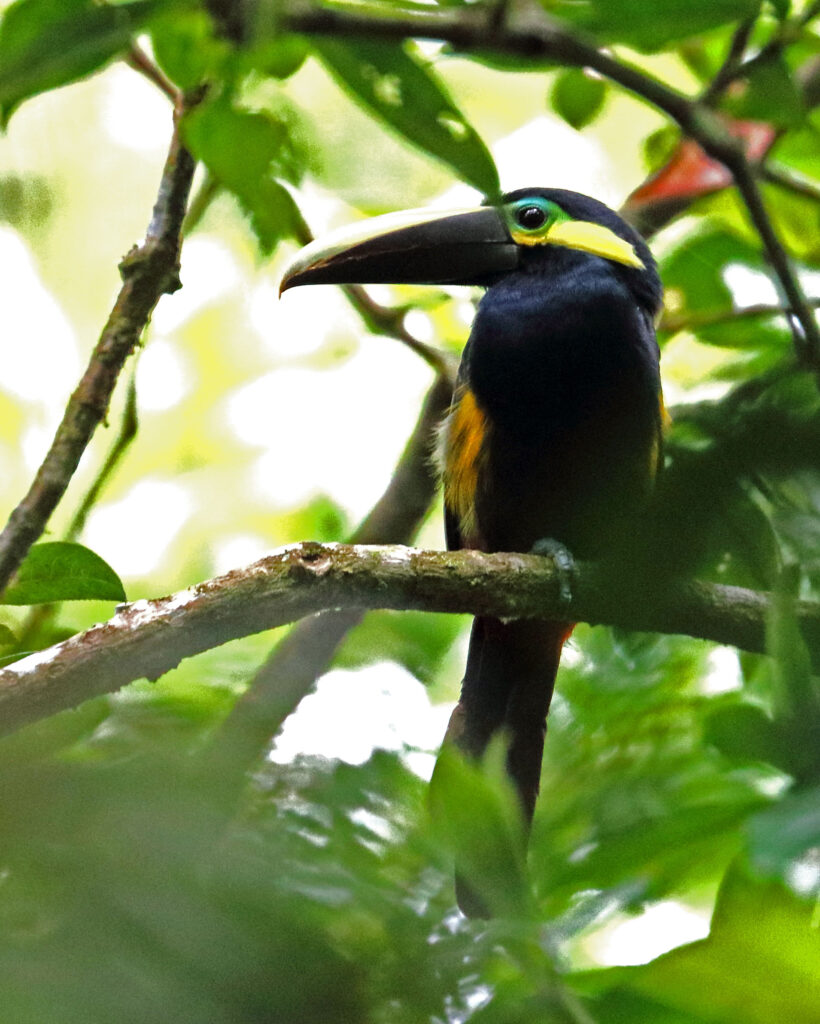
Slowly and quietly, he pointed out a large-ish bird sitting about twenty meters in front of us, up in a tree. The bird was black, with a chestnut cap complementing the blue and green skin around its eye. Its long yellow and black beak, combined with green wings, orange flanks and red rump, identified it as the bird I’d been searching for: a female (hembra in Spanish) Yellow-eared Toucanet. I just about lost my mind, holding my camera up slowly with shaky hands. Never had I actually believed I would lay eyes on one, and yet, here one was, right in front of us. Then, the male appeared, sporting that yellow ear the species was named after. 

Again thanks to Carlos, I had an unforgettable experience with the bird at the top of my “must see” list—a pair of Yellow-eared Toucanets (male shown here).

We enjoyed the birds for about ten minutes, then headed off, as Carlos had to get back home. I thanked him profusely for sharing these amazing birds with me, and we exchanged contact information. Then, I spent the rest of the evening looking at and deleting photos and enjoying the tanagers feeding in the fruiting trees in front of the rooms. Before I went to bed, I spotted several of what I believe to be bioluminescent beetles flying through the rainforest (though they may have been fireflies. I’m not good with bugs.).

No, this Speckled Tanager was not touched up by artists for my visit!

In total, I spotted 117 species at El Copal over the weekend, including a few the next morning like King Vulture, Gartered Trogon and Green Thorntail. La Reserva El Copal could be described as nothing short of magical. Are there places like this that you’ve always wanted to visit? A mountain range full of endemic plants? A reserve dedicated to protecting endangered amphibians? Perhaps your bucket list is topped with places like the Serengeti, the Great Barrier Reef, the ancient castles of Ireland? If you are, the Gilman Scholarship can help you get to these places! Studying abroad is an experience that every student should have the opportunity to have, and the Gilman helps put this philosophy into practice. The money they awarded me has helped me afford to go on adventures like this, the rain-forested foothills of Costa Rica, and they can help you too! So please, if you’re considering studying abroad (which you should be), apply to the Gilman!