
All photos and text on FatherSonBirding.com are strictly protected under copyright law. To request permission for use, contact Sneed at sbcollardiii@gmail.com. We encourage you to share these posts, but you DO NOT have permission to use these posts to train Artificial Intelligence models or make other use of them without our okay.
One of the highlights of my 2025 has been the opportunity to field test various bird-related equipment, especially binoculars and scopes from Vortex. In fact, our review of the Vortex Triumph HD 10X42 binoculars nabbed top spot among our most popular posts for the year, narrowly beating out our review of the Nikon Monarch HGs. And speaking of the Monarch HGs, this week I am pleased to offer my thoughts on binoculars that run in the same $1,000 price range as the HGs—the Vortex Razor HD 10X42s.
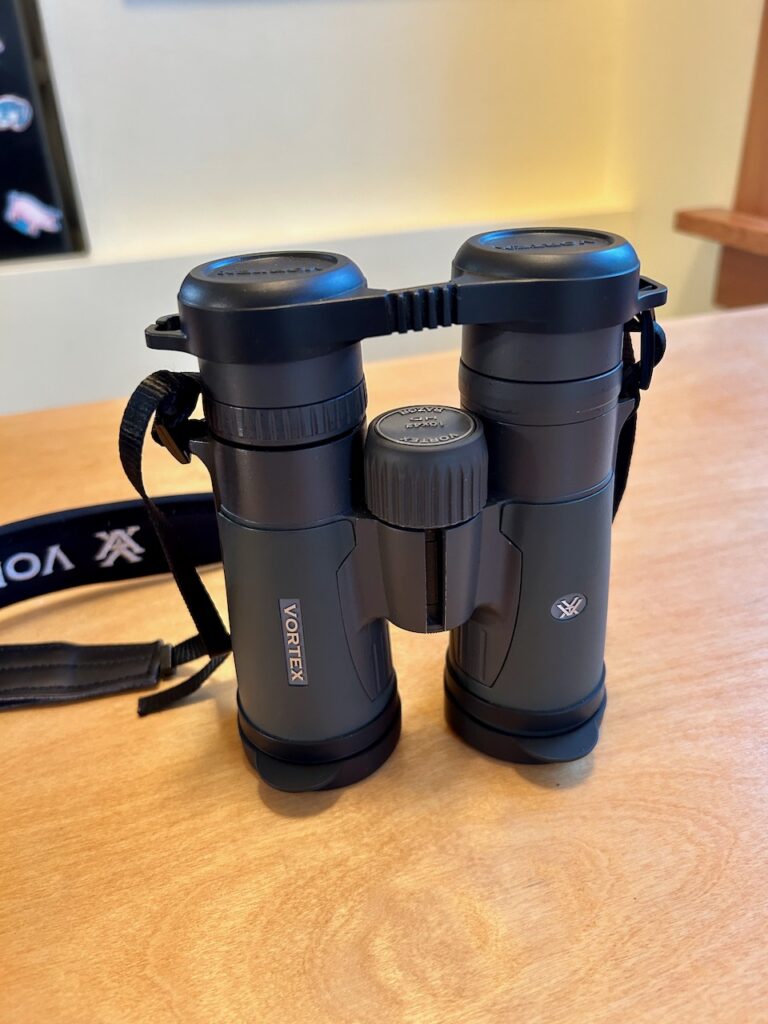
The Vortex Razor HD series is not to be confused with the Vortex Razor UHD series—Vortex’s absolute top-of-the-line binoculars that come with price tags to boot. Maybe I’ll get a chance to review one of the UHDs sometime, but for now I am focusing on binoculars that a larger swath of typical birders can enjoy and afford—and the Razor HDs fit right in with that theme.
I’ve been using the Razor HDs for the past several months—a clue to how much I like them. Perhaps the best way to analyze them is to compare them to Vortex’s next step down, the Viper HDs, which we reviewed in this post.

Right off the bat, I have to say that both the Vipers and Razors offer exceptional clarity and light transmission—to the point that I would be hard-pressed to place one above the other in a blind “binocular tasting” test. I have used both models in all kinds of situations, including dark and overcast conditions, and been thrilled with the images reaching my eyes. According to the Vortex website and my Vortex rep, however, the Razor HDs use a superior, tougher coating that provides better clarity and sharpness, and tougher protection so that the lenses are less likely to scratch.
Vortex has also gone to the trouble of using higher density glass for the Razors, as well as matching the lenses for better color matching at all wavelengths. Notably, in the Razors more of the image remains in focus at a range of 1,000 yards than is true of the Vipers. These things probably won’t be obvious to most users, but will, I predict, show up more in extreme conditions and as your own birding skills progress.
Where the differences between the Razors and Vipers really become obvious is in the build of each model. Both feel comfortable and solid to hold, but the Razor HD tubes are crafted from magnesium rather than from polymer—an upgrade you expect to find in all higher end binoculars.
Even more impressive, the central focusing knob has much better action than you find on the less expensive models. One of my few complaints about the Viper HDs was the relative stiffness of the focusing knob, and how far you have to turn it to bring an image into focus. Vortex solves both of these problems with the Razor HDs. A single revolution of the knob takes you from a ten-foot focus to a distance of a mile or more! I can’t emphasize how awesome this is when you’re out in the field and have to switch from looking at a Lincoln’s Sparrow in front of you to a mystery raptor cruising a distant skyline. Not only that, the action is so smooth on the Razors that fine adjustments are accomplished with ease.
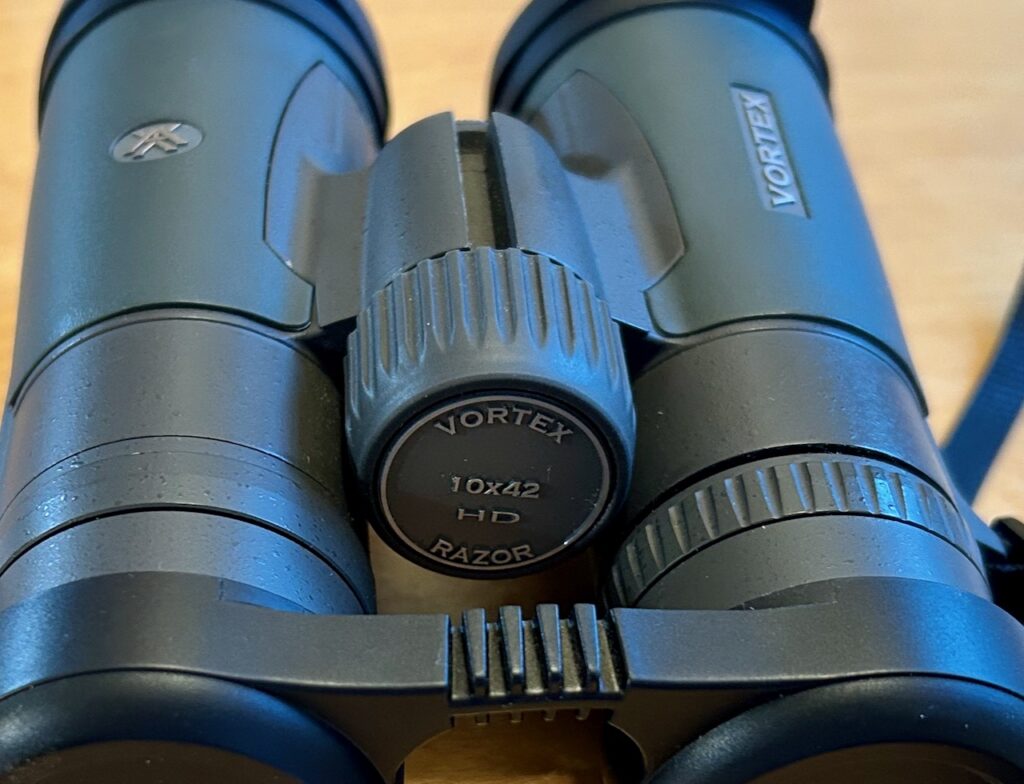
Other specs on the Razors are very similar to what is found on the Vipers. The Razor HDs have a slightly wider field of view (6.9 degrees compared to 6.5 degrees) and are also .3” longer. Both weigh just under 25 ounces, light enough for most people to haul them around all day—especially if you use the Glasspak™ harness system that comes with most Vortex binoculars.
Both also have eye relief tubes, but the Viper’s are a bit longer—17 mm versus 16.5 mm on the Razors.
As you’d expect, the Razor HDs are waterproof, fogproof, and shockproof. Like the Vipers, the Razors also have locking diopter rings—the mechanism that corrects the central focusing knob for people whose vision is different in each eye.
“But what about price?” you are undoubtedly asking—and since I’ve been comparing the Vipers with the Razors, you’re probably wondering if paying more is worth it. While the Vipers can be purchased for under $500, the Razors take a hefty jump up to about $1,000 at the time of this writing. Oh, what to do?
Let me begin by saying that if you are used to cheaper, crummy binoculars, you’ll be delighted by either one of these models. Both are covered by the amazing Vortex lifetime, no-questions-asked warranty along with excellent customer service. If the Razors simply aren’t in your budget, the Vipers are a very nice investment in your birding activities and will last you as long as you can still bird.
If, however, you’ve just sold some NVIDIA stock or have just benefited from recent changes to the tax code, I would definitely encourage you to opt for the Razors. Even if you’re not wealthy, but want to make sure you get the most pleasure out of your future birding, the Razors make a solid one-time investment that will last a lifetime. $500 extra sounds like a lot—and it is to most of us—but if you’re serious about birding, you will most likely forget about the price difference the first time you focus in on a Common Tody-Flycatcher in the mountains of Colombia, or perhaps even an Evening Grosbeak in the backyard.
So there you have it—and with Christmas coming up to boot. What a coincidence! Or . . . was it?
For more information on the Vortex Razor HDs including where to buy them, click here!

Dear Santa,
For Christmas this year I’d like a pair of Vortex Razor HD 10X42 binoculars. Oh pleaze oh pleaze oh pleeeeeaaaze! I’ve been a good boy (if you don’t count binging on bourbon barrel-aged stout!).
We are still evaluating your Naughty and Nice record for the year, Roger. Stay tuned!
The Santa Committee
Hi:
So how do the Razors compare to your Nikon HGs?
Cheers,
Hi Craig,
Thanks for your good—and tough—question. First of all, I’d have to say that you can’t go wrong with either of these binoculars, as both the Vortex Razors and Nikon HGs are excellent binoculars that should last a lifetime. They both have outstanding optics and solid build that are a clear cut above almost anything else you will encounter, so it will probably come down to how they feel in your hands. If possible, I would test both of them to see which one feels better to you. If pressed, however, I’d probably give a slight nod to the Nikon HGs. I was just super impressed using them in rainy, dark conditions of the Colombian cloud forest. Unfortunately, I broke my pair in an accident (both they and I took a really hard hit on a rock-hard surface), and since they’d been provided to me for free to evaluate, I couldn’t get them replaced. My point is that I didn’t get a chance to test their warranty service. However, Braden has returned his Nikon Monarch Vs a couple of times and received excellent service. Vortex, of course, has an incredible no-questions-asked warranty, so again I return my original statement: you can’t go wrong with either one of these.
I’ve been reading lots of reviews of the various Vortex binoculars, and I really appreciate your comprehensive reviews. As someone debating between the Viper HD and Razor HDs, you’ve really given me a lot to think about.
I do have one technical quibble with your binocular reviews – your discussion of a bincular’s eye relief. For example, in this review you stated that “Both also have eye relief tubes, but the Viper’s are a bit longer—17 mm versus 16.5 mm on the Razors.” Eye relief is not related to the eyecups (“tubes”) or their adjustability – it’s a fixed distance between the surface of your eye and the surface of the binocular’s lens. It’s particularly important for glasses wearers, who often need more distance between their eyes and the lens of their glasses (which the binoculars are pushed up against). Nikon has a good explanation on their website, which I included in the “Website” box below.
Hi Kevin! Many thanks for weighing in–and clarifying this important point about eye relief. I do claim a bit of ignorance on this issue, and know there’s a lot of confusion about it, so will look into it further!