FatherSonBirding is a totally free, non-commercial blog that Braden and I write to share our passion for birds and birding, and to help educate others about birds and bird conservation. We do not accept donations, but if you would like to support us in our endeavors, please consider purchasing *new copies* of one or more of Sneed’s books—the new picture book Border Crossings, for example. These books are widely available online or can be ordered from your local independent bookstore. Oh, and they make great holiday gifts! Thank you for your support.
Many of you have followed my woeful failure to see a Spruce Grouse since I began birding ten years ago. This has brought endless shame to my family and led me to self-medicate with copious quantities of chocolate, exploding my waistline and making it difficult to hold up my head (and pants) in the Montana birding community (see our post “Fall Birding in Glacier National Park”).
I have rendered myself such a pitiful specimen of a birder that several of you have kindly reached out with compassionate suggestions of where I might finally find a Spruce Grouse so that I could regain a shred of self-esteem. I had dutifully begun making plans to pursue these suggestions—when I saw that accomplished Lake County birder Braydon Luikart (not to be confused with my son, Braden) had sighted some SPGRs relatively close to me. I contacted Braydon to see if he might be up for a Spruce Grouse expedition, and he cautiously accepted, no doubt wondering if it might damage his birding career to be associated with such a “grouse failure” as myself.
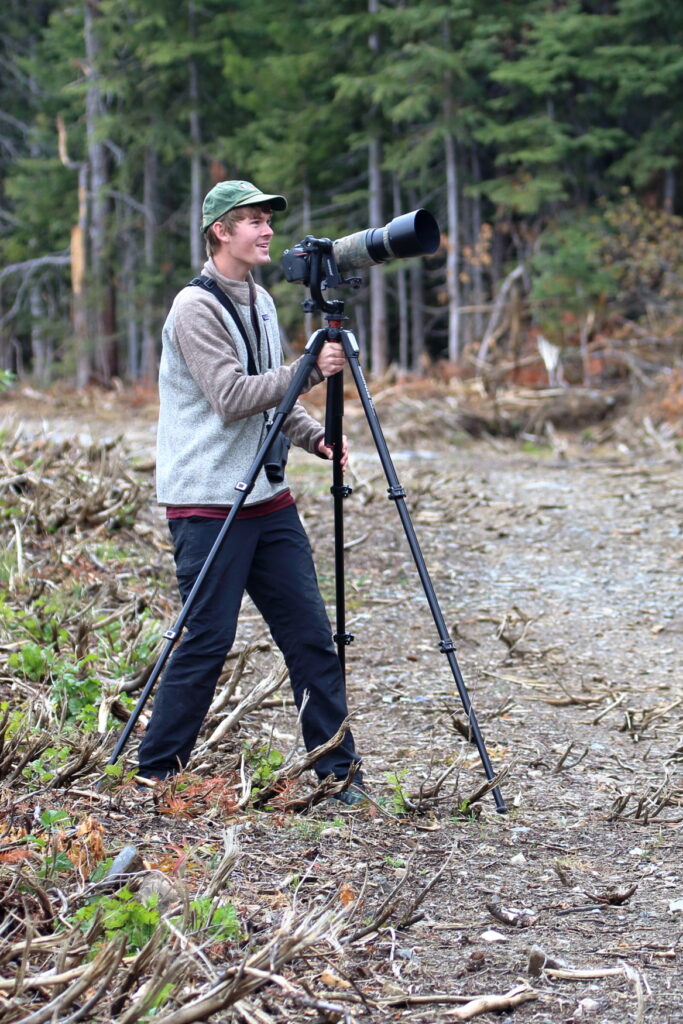
I picked up Braydon at his house at 8 a.m. as a crescent moon rose into a growing dawn, and he led me to a logging road across from Finley Point on Flathead Lake. In no time, we were climbing up the breathtaking face of the Mission Mountains. Finding a Spruce Grouse sat foremost in our minds, but we began musing that if fortune shined down on us, we might find all three possible grouse: Ruffed, Dusky, and Spruce! This especially appealed to me because—and I don’t know if I should even admit this—I hadn’t seen ANY of them in 2023. I’d spotted almost all of the other game birds in Montana including Greater Sage-Grouse, Sharp-tailed Grouse, and even White-tailed Ptarmigan, but the three in my own backyard? Nada. Zilch. Rien. Shum davar.
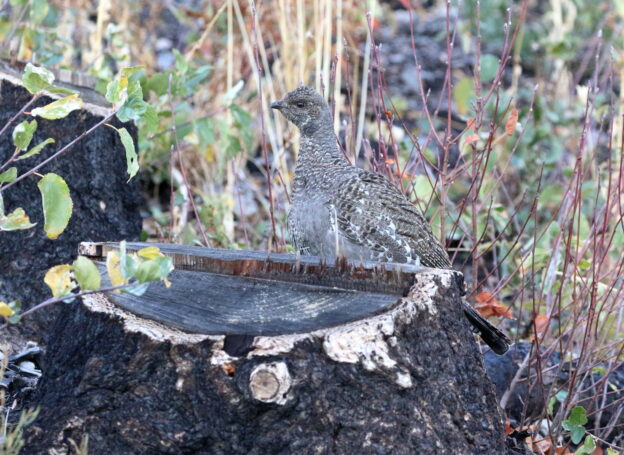
Our idea to win the “grouse-fecta” got off to a great start when, after the first five miles, Braydon hollered “Stop! Dusky Grouse!” I hit the brakes of my wife’s CRV which, on Braydon’s sage advice, I’d borrowed in favor of the minivan. “Where?” I asked, already reaching for my camera. Braydon pointed at five chicken-sized birds scurrying up into the brush.
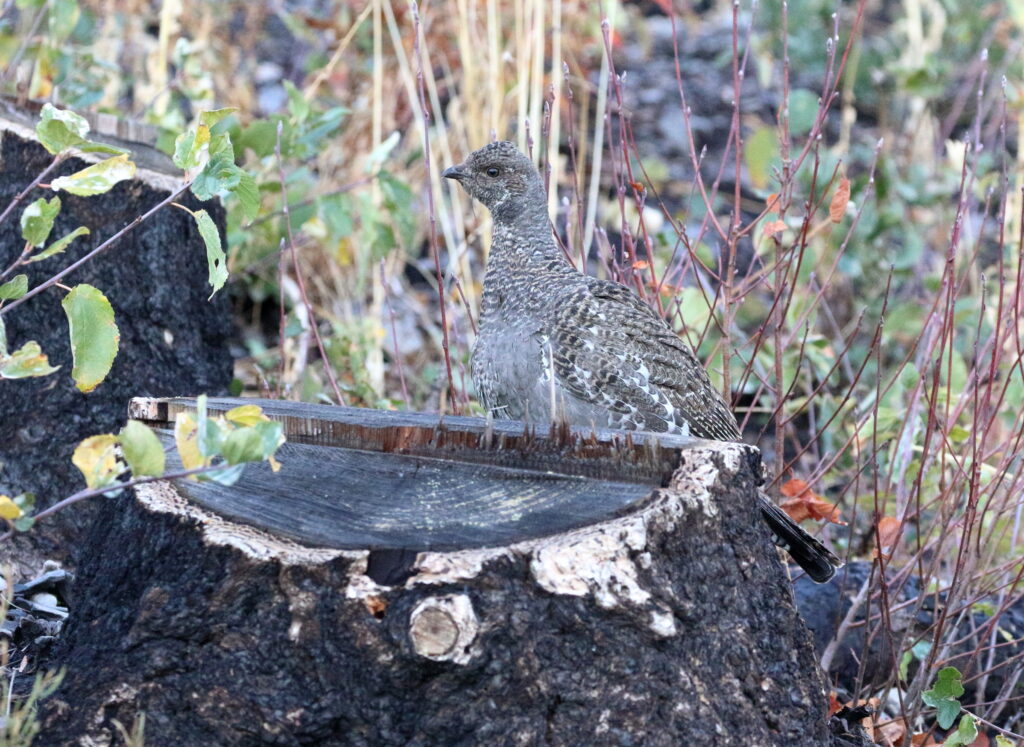
Fortunately, grouse tend to be pretty unreactive, placing far too much faith on their amazing camouflage to escape detection. Four of the grouse made their way into photo-unfriendly territory, but the fifth, a female, posed attractively on a stump. This allowed me to capture one of my best Dusky Grouse photos ever, and afterward, I happily climbed back into the car.
“One down, two to go,” I said.
We continued climbing switchbacks past smoldering stumps and log piles—efforts to reduce slash after recent logging and a forest fire several years ago. At around 5,700 feet, Braydon said, “I hear a Boreal Chickadee.” To be honest, this was almost as exciting as a possible Spruce Grouse. Only the week before, Braydon had been the first person ever to confirm and photograph Boreal Chickadees in Lake County! As for me, I had never seen one outside of Glacier National Park. (See our post “Are You Ready for . . . the QUACH?”)
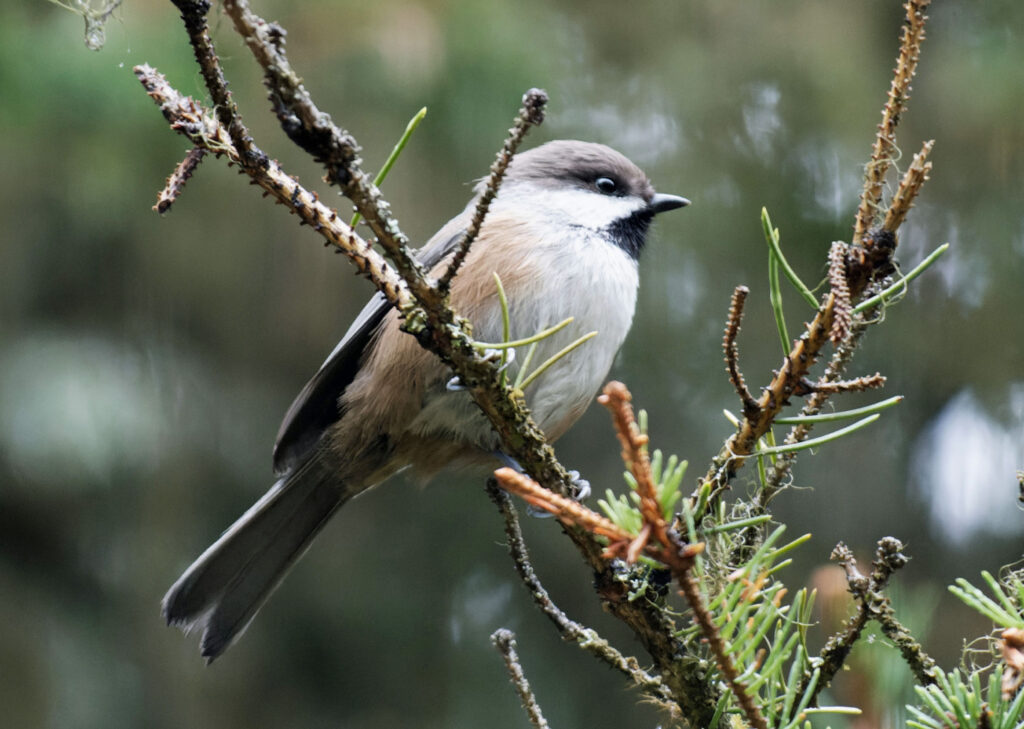
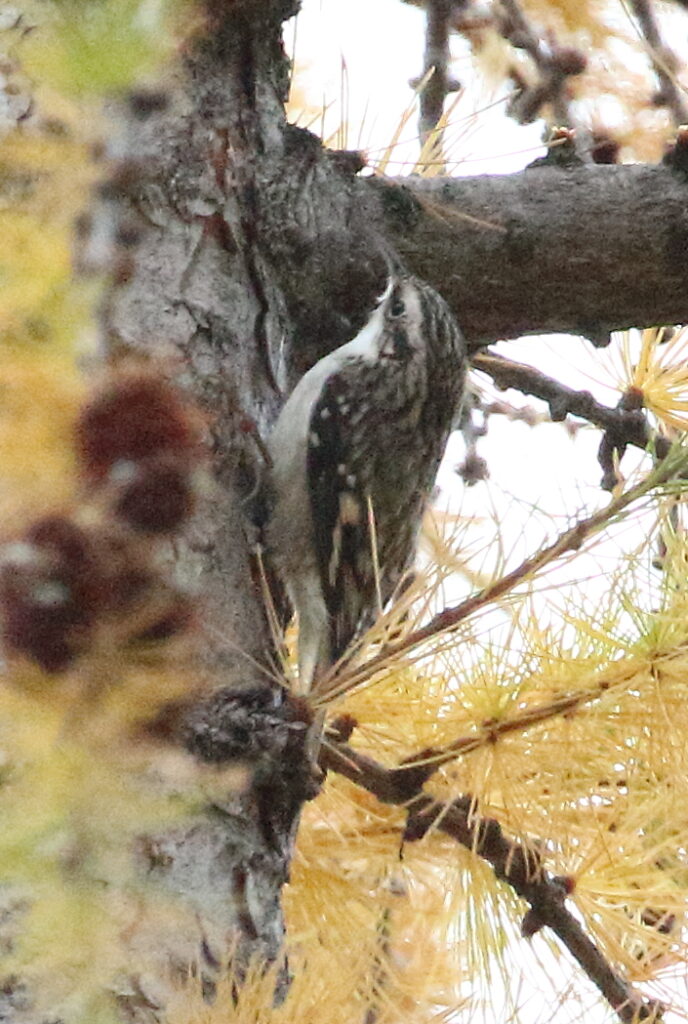
We scrambled out of the car and quickly found ourselves in a wonderful mixed flock of both Boreal and Mountain Chickadees, Golden-crowned Kinglets, Red-breasted Nuthatches, Canada Jays, and one of my favorite mixed-flock birds—the secretive Brown Creeper. With my new hearing aids (more on that in another post), I could pick up more call details than I’d heard in years, and Braydon managed a great photo of a BOCH that briefly alighted on the end of a branch. “But where are the Spruce Grouse?” Braydon lamented as we continued picking our way around rocks and slash down the muddy road. “They were all over here last week.”
I tried to be philosophical. “I probably just haven’t put in enough time looking for them,” I said. “The grouse gods have not yet deemed me worthy.” Unfortunately, the road continued to deteriorate, with puddles the size of small lakes appearing in front of us. I powered through several of these, but about 18 miles in, I finally began fearing the wrath of my wife Amy if I had to abandon her car in a deep muddy lake in the middle of the mountains. Reluctantly, I performed a five-point turn and we headed back toward civilization. “We’re going to see Spruce Grouse on the way back,” I said, but didn’t really believe it.
We continued to keep our eyes out, but relaxed into conversation about birds, careers, and life. I learned that Braydon is taking a gap semester after high school and plans to pursue a career in wildlife, probably after a degree from the University of Montana. In fact, Braydon asked a number of questions about my son Braden’s plans and what made him choose the University of Maine. As we were chatting amiably, however, I rounded a corner—and saw three shapes fifty yards ahead of us.
I slammed the brakes. “Grouse!”
“Spruce Grouse!” Braydon confirmed.
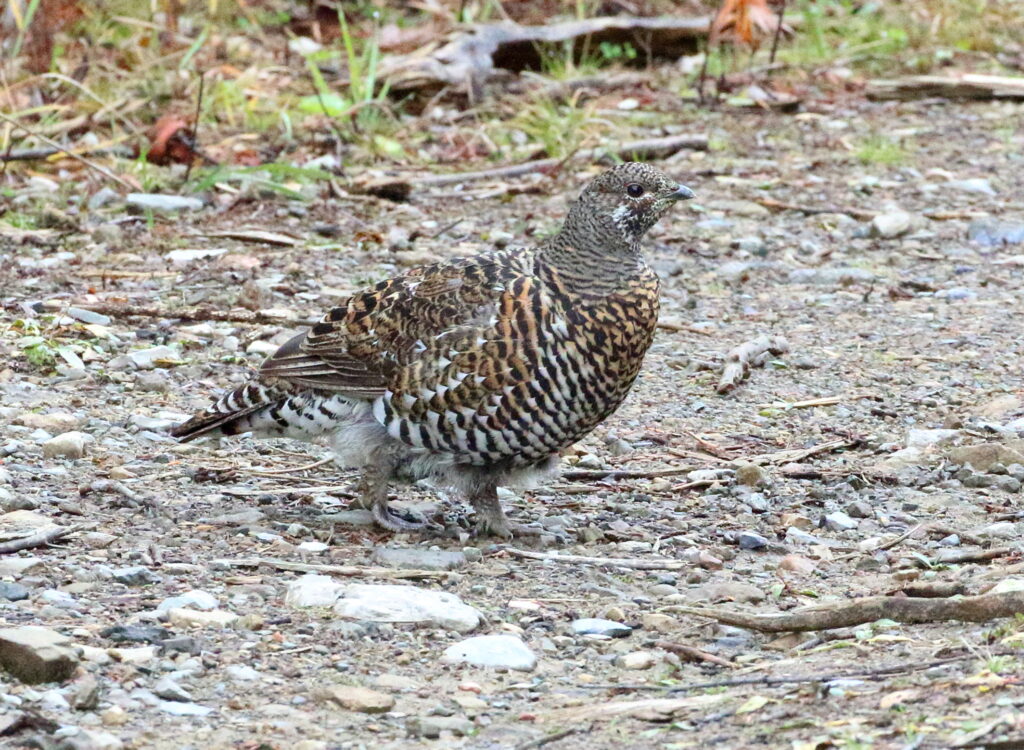
Sure enough, two females and a male lifted their heads in surprise as we stopped. Unfortunately, as we cautiously got out of the car with our cameras and binoculars, the male and a female ambled into the scrub—but the other female seemed completely unperturbed by our presence. In fact, as we crept forward, the other female joined her, allowing us great photos of both birds. I was especially glad of that because I hadn’t realized how gorgeous the females truly are. As usual, most attention goes to the males, but these females displayed striking stripes and almost golden rufous patterning. True, I would have liked to see a breeding male, but I felt exultant. Not only had The Curse of the Spruce Grouse been vanquished forever, this bird was 998 on my Life List—only two birds away from that magical number 1,000. (See our recent post “From One Nemesis Bird to Another.”)
Elated, we again lapsed into lively conversation as we continued down the road. Only a couple of miles later, however, Braydon again exclaimed, “Stop!” I saw immediately what he was looking at, but it looked suspiciously like a rock.
It wasn’t.
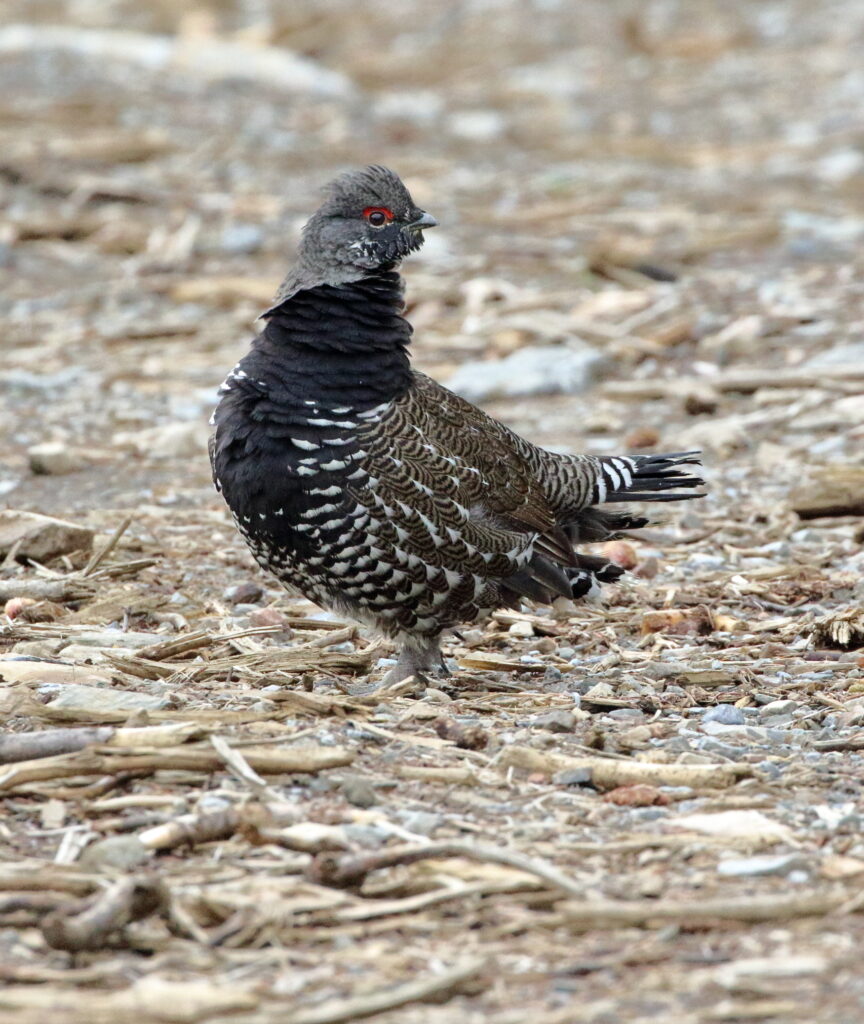
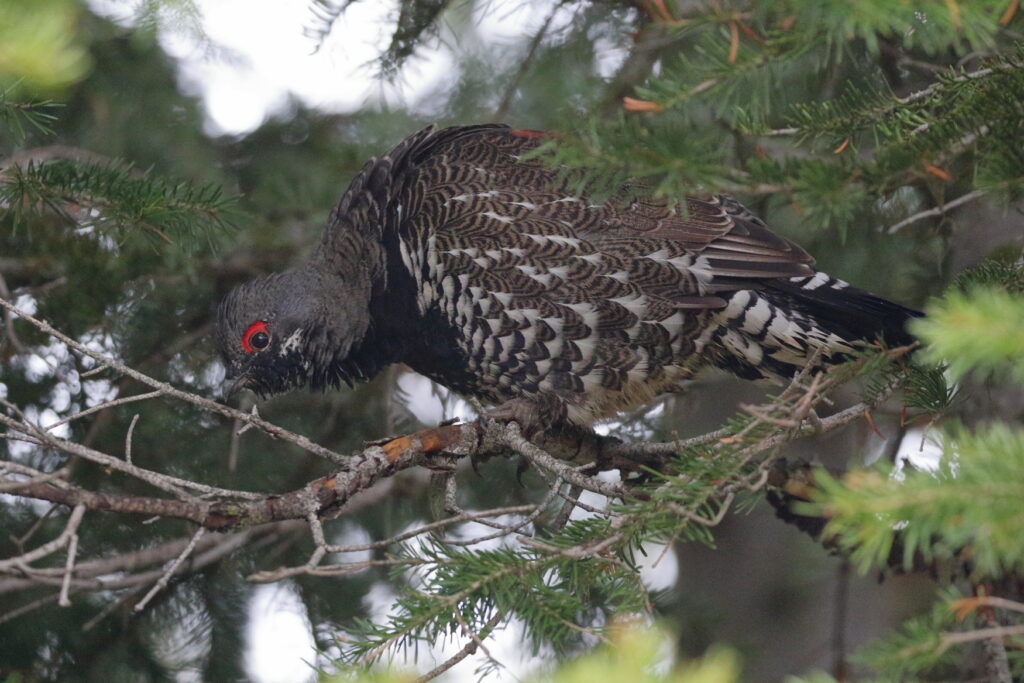
There, in the middle of the road, sat another Spruce Grouse—a resplendent male. Even better, this one didn’t flee as we climbed out of the car, and we were able to walk to within twenty yards of it, getting some great photos. After a few minutes, the bird decided it would rather view us from above, so with a few quick flaps of its wings, it skedaddled into a space between two spruce trees. There it stayed, giving us more decent photos before we left it in peace and headed back down the mountain.
Alas, we were still one grouse short of our “grouse-fecta”—a Ruffed Grouse. Still, I felt optimistic. Ruffies live down at lower elevations, often in riparian areas, so our chances would improve as we made our way back down to Flathead Lake. We rounded corner after corner expecting to see one—alas to no avail. Our bookie walked away with our fat grouse-fecta bets, an important lesson in getting too grouse-timistic. Braydon, though, redeemed this minor setback by locating one of the first Pacific Loons of the year on nearby Flathead Lake. The bird preened far out on the water, but its gray head clearly showed itself—a wonderful bonus in a day I would long remember.