“The Northern Goshawk (Accipiter gentilis) is an apex predator occurring across North America and Eurasia. The species has received considerable conservation focus in late-seral conifer forests of western North America, where its habitat has been substantially reduced and altered by timber harvest and is increasingly at risk from high severity fire, drought, and forest pathogens. In the Sierra Nevada range of California, management and conservation of goshawks are hampered by a lack of knowledge of their basic space use and movement ecology.” —from abstract of Blakey et al. “Northern Goshawk (Accipiter Gentilis) Home Ranges, Movements, and Forays Revealed by GPS-Tracking” J. Raptor Res. 54(4):388–401.
In this third installment of his California adventure, Braden describes his job surveying for Northern Goshawks (see paragraph above for why). The birds are extremely difficult to locate, but as the team heads out into a particularly difficult survey block, success may be just around the corner . . .
The point of my “volunteer position” (with stipend) this summer is to find as many Northern Goshawks in Stanislaus National Forest as possible. The Institute for Bird Populations, my employer, has developed a protocol for looking for goshawks, one that my team follows to the best of our ability, although heat, brush, and apparently, bears, sometimes cause us to modify our schedule and strategy.
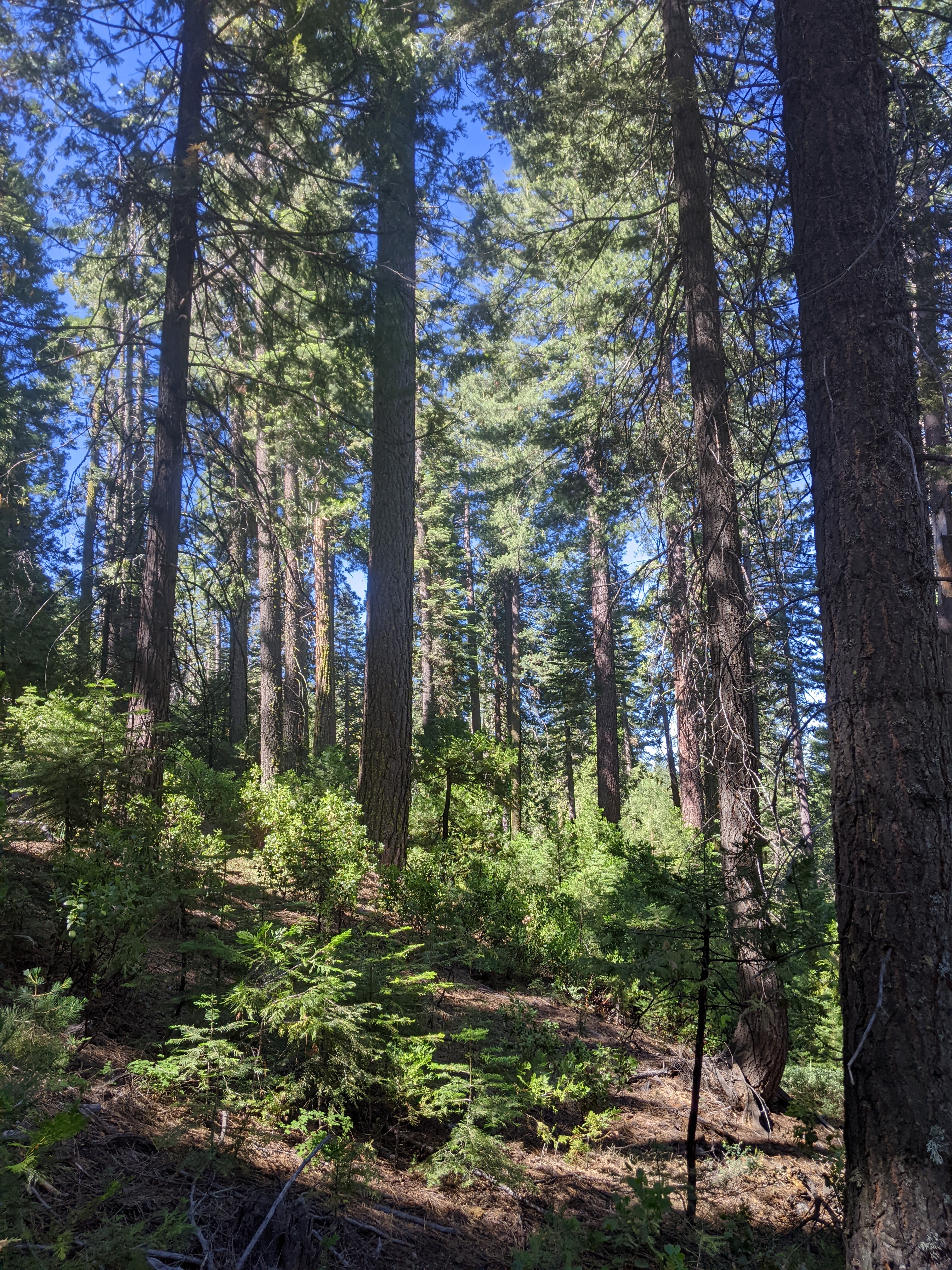
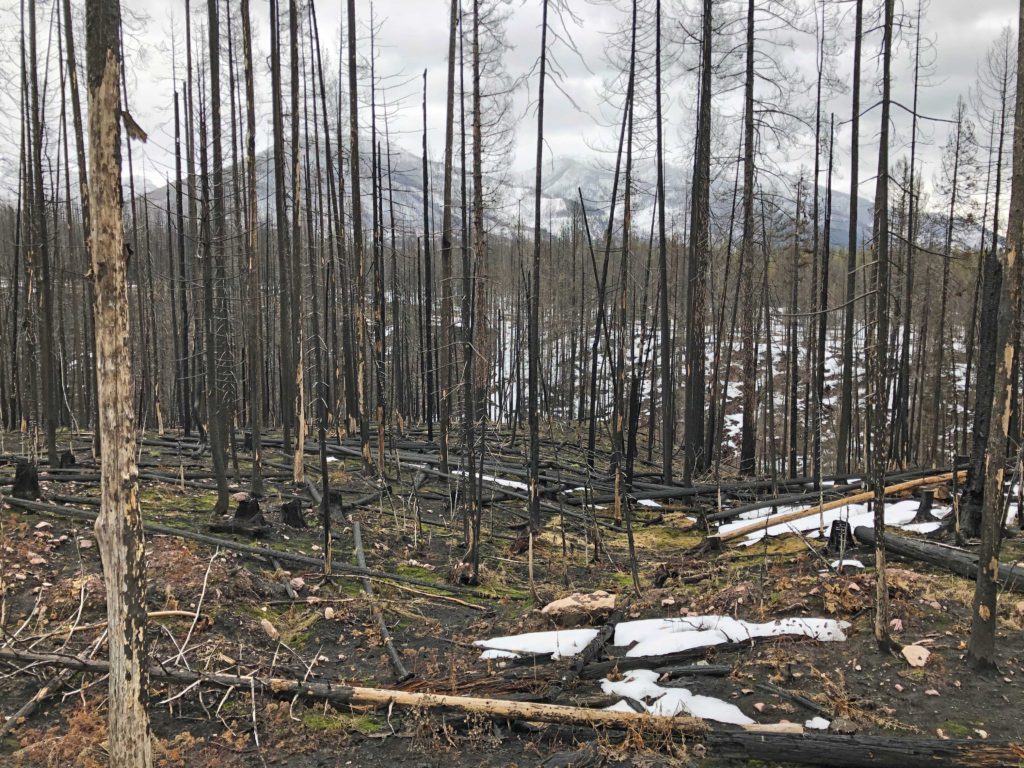
In late June, after roughly two weeks without any goshawks, we arrived early to another one of our PACs—the areas created for us to survey based on Northern Goshawk territory sizes, analysis of goshawk habitat from GIS and private property lines. I am not allowed to reveal the PAC’s location without violating half a dozen National Security laws, but this one looked particularly difficult. We also got off on the wrong foot when I had to walk back to the truck and retrieve batteries for our FoxPro—aka the “FoxSparrow”—the large speaker we use to call for goshawks. As we finally got started, however, we spread out thirty feet from each other, then followed our compasses north down an intensely steep ravine littered with decaying logs. What’s more, this PAC was the shape of a paint splatter, with all sorts of offshoot areas that would require us to walk up and down the sides of ravines over and over. The Mountain Misery we’d experienced at Brushy Hollow had been a piece of cake compared to this.
After six hundred meters of our first transect, Ivara’s voice crackled through the radio. “Whitewash.”
Now, whitewash (the term for bird poop on a branch or base of a tree) could be evidence for any bird species. After all, every bird poops—I’ve seen statues covered in pigeon whitewash in the middle of cities. However, what caught our attention was what Ivara said next: “Lots and lots of whitewash.”
The four of us halted, scanning the ground for evidence of raptors, and I quickly noticed additional whitewash all over the ground and trees around us. And then Sam spoke up.
“I’ve got an active raptor nest.”
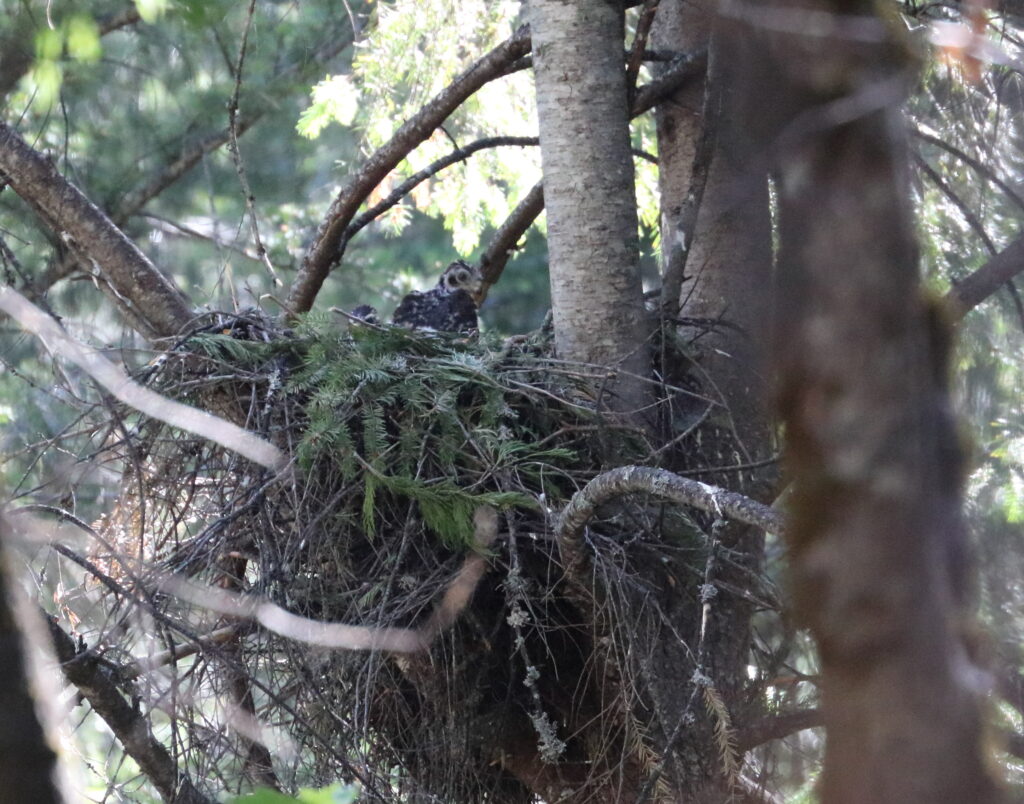
Within minutes, all four of us had gathered to watch the nest from Sam’s vantage point, puzzling over the chicks inside it.
“They don’t look like the Red-tailed chicks we saw at Lyon Ridge.”
“Live boughs are a good indication of a goshawk nest.”
“That thing is so shaded. Would a Red-tailed nest there?”
We hiked a little closer, heading to a nearby hill so I could document the nest and chicks with my camera. Then we waited. No one in our crew had much experience identifying baby raptors, although we certainly got good views of them, but it was only a matter of time before the adult returned. Then we’d have our answer.
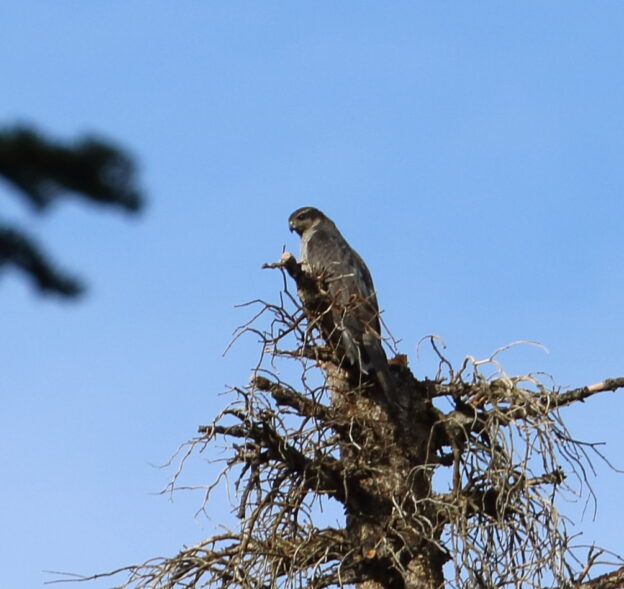
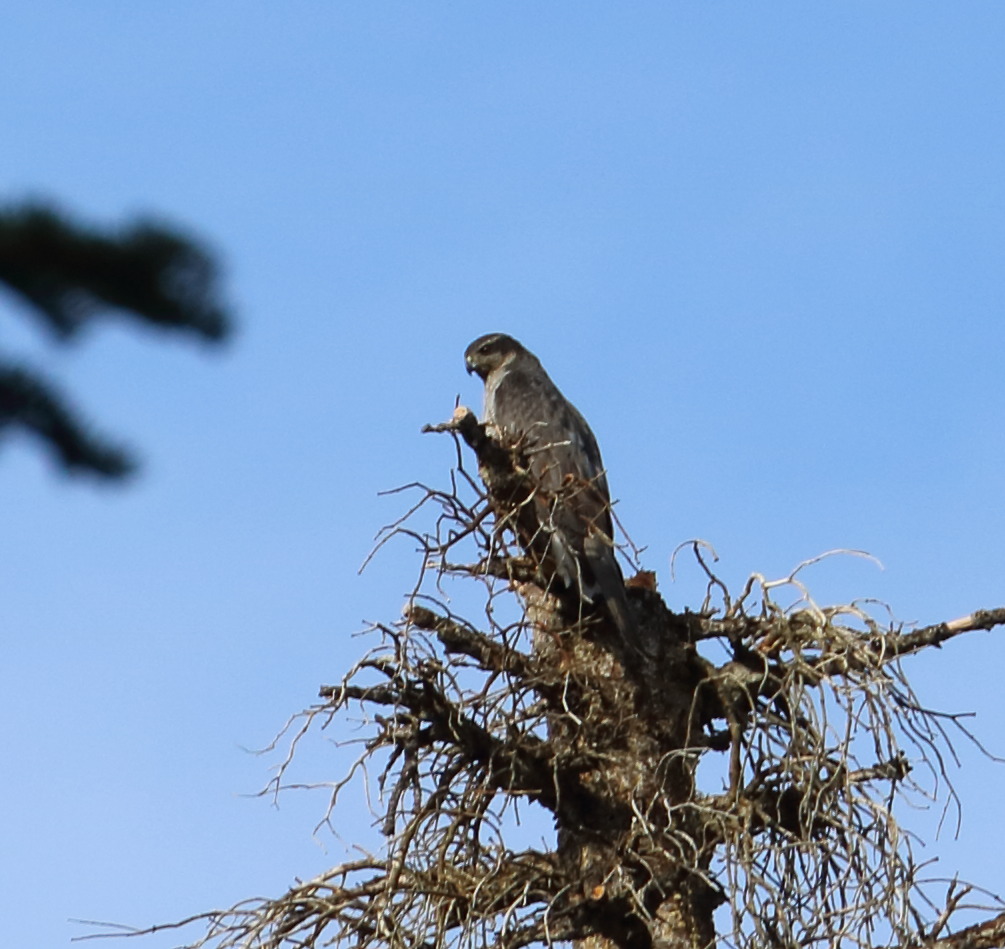
And return the adult did, after about twenty minutes. All four of us heard it simultaneously—the call we’d been broadcasting from the FoxSparrow for the last two weeks. The goshawk appeared through the trees, heading right for us. It swooped low, then alighted on a branch above our heads, immediately giving me the best looks I’d ever had of a Northern Goshawk. Miles and Sam quickly went off down the slope towards the nest tree to look for prey remains and identify the tree species, and the adult began to circle us, screaming its head off. After we collected the information we needed, we took one last look at the majestic creature and its babies, then got out of there.
It was our first nest of the season, and the first goshawks we’d detected all on our own! Arriving back at the truck at roughly 9 in the morning, we crossed the PAC off of our list, then headed into town to pick up some celebratory s’mores.