Braden here.
“Pigeon Guillem-wait, no that’s just a pigeon,” my dad said as we stood underneath the ferry dock in Anacortes, Washington, “I must have guillemots on the brain or something.”
Just then, a football-shaped bird shot out from underneath the platform we were on. It was jet black, with white wing patches and strawberry-red feet—an actual Pigeon Guillemot!
“Awesome!” I said as we high-fived, “It appeared just as you said it! Wait a minute…Marbled Murrelet.”
Unfortunately for us, a Marbled Murrelet did not shoot out from under the dock like the guillemot had, but we weren’t that disappointed. My dad hadn’t seen a guillemot since the year we started birding!
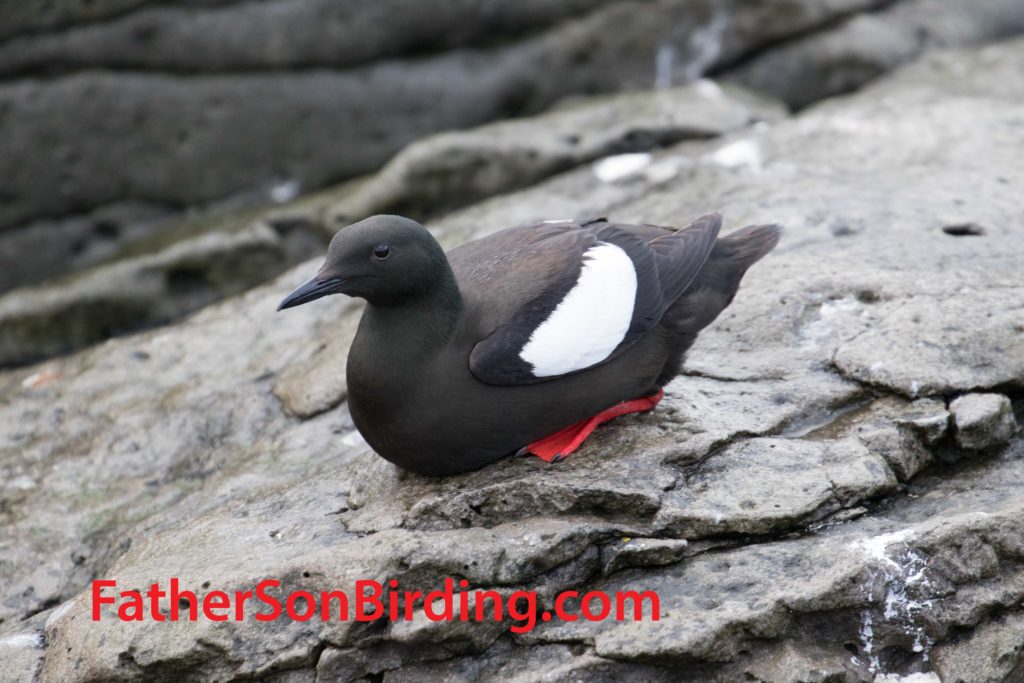
A Black Guillemot, identified from a Pigeon Guillemot by the lack of the black stripe across the wing patch.
The Pigeon Guillemot is a seabird belonging to a family of birds called Alcidae, or alcids. Alcids are the penguins of the north, and share many similarities: they both are much better in water than on land, they both(for the most part) live in the colder parts of oceans, and they even share the same coloring! Once upon a time, there was even an alcid that couldn’t fly, the Great Auk. Sadly, it went extinct in 1844 thanks to hunting and invasive species. Guess where the last individual lived? Iceland.
Iceland is a great place to start learning alcids. It has at least six fairly-regularly ocurring species: the Atlantic Puffin, Common Murre, Thick-billed Murre, Razorbill, Dovekie, and Black Guillemot, the last of which is the Arctic-dwelling cousin of the Pigeon Guillemots we saw in Washington.
When I was in Iceland, I saw all of these except the Dovekie, which, during the breeding season, only inhabits the pack ice of the high Arctic. Each one was under slightly different conditions. When it came to colonies, Puffins were the weakest of the bunch, digging burrows in dirt, while Razorbills nested in cracks and ledges on sheer rock cliffs. Unlike most birds, Razorbills actually lay lopsided eggs so that they will roll in a circle and not off the cliff. If not for seasickness and an angry ocean, I would’ve gotten to see Latrabjarg cliffs as we passed it, a huge expanse of rock in western Iceland home to 40% of the world’s nesting Razorbill population!
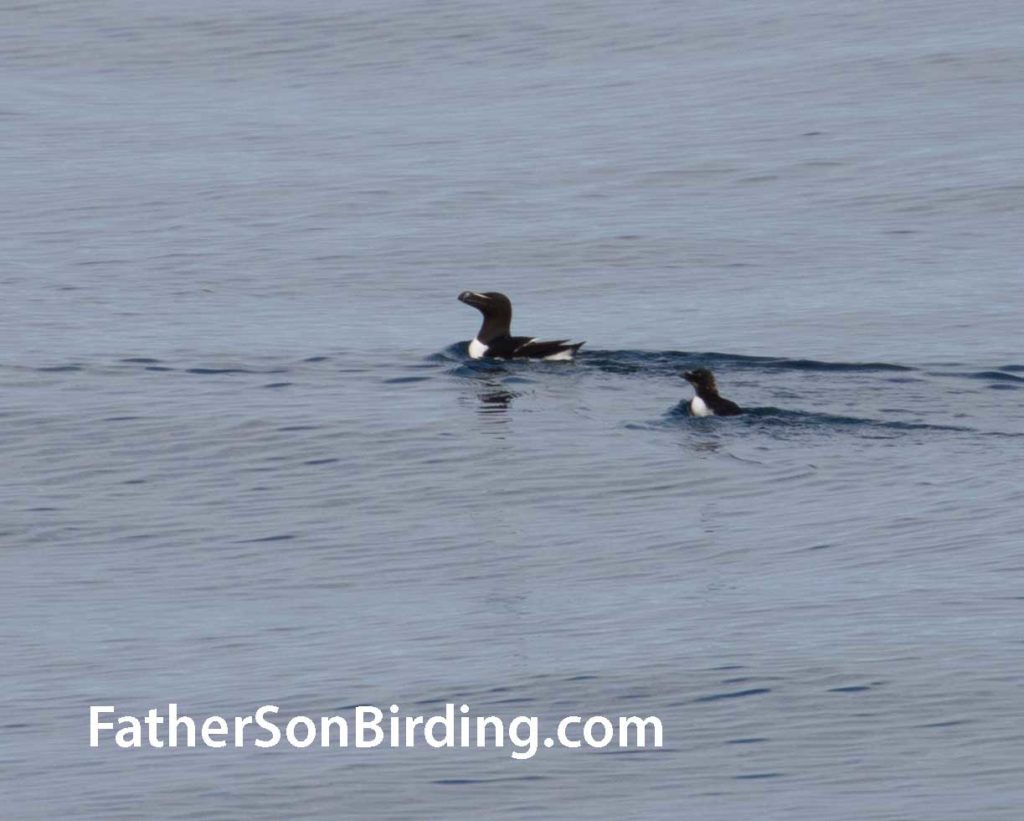
Razorbills are named for the white stripe that crosses their beaks.
We also saw Razorbills farther away from shore than the other alcids, some accompanying flightless chicks. Once the chicks are ready to leave the nest, one naturalist told me, it would jump straight off the cliff! The parent, and sometimes parents would then join it and undergo catastrophic molt—molting all of their feathers at the same time, meaning that for a few weeks, neither the adults or the chicks would be able to fly!
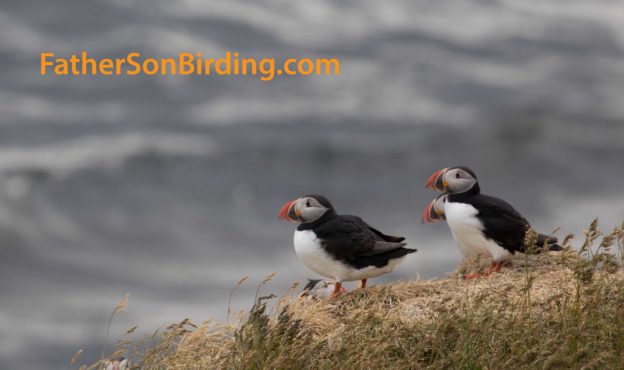
Not all alcids are as devoted parents, though. After a while, Atlantic Puffins just stop bringing food to the nest, forcing the starving chick to leave and fend for its own. And while this may be for many reasons, it is not for lack of food—using the spines on their bills, puffins can carry up to 20 fish at a time, unlike other alcids. The record for one bird is 80 fish!
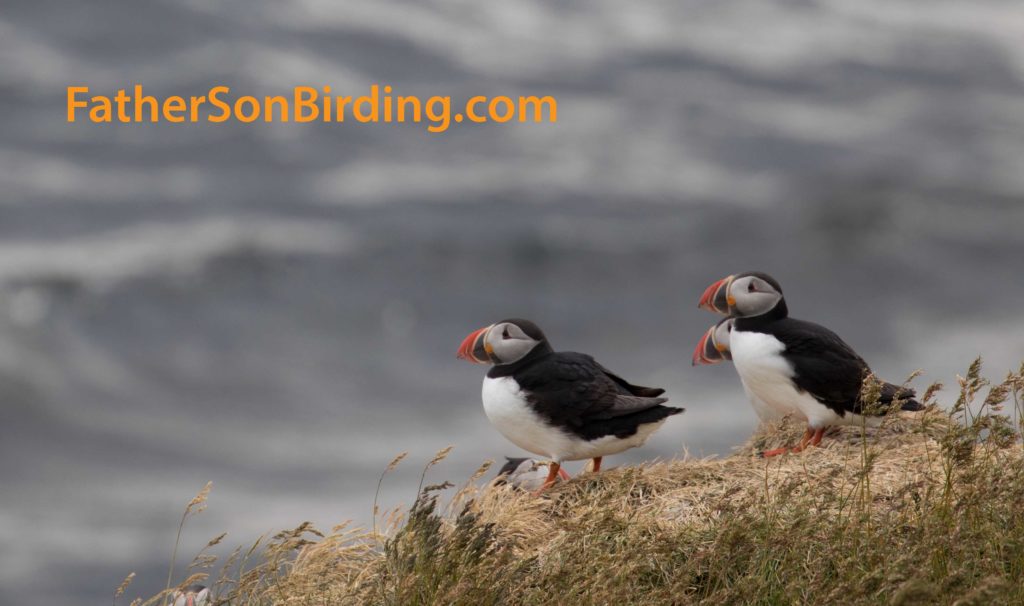
Atlantic Puffins are declining in southern Iceland, as their main food supply, the sand eels, moves north. This also is affecting Arctic Terns.
Some alcids live all over the Northern Hemisphere, while others are much more localized For instance, while I saw Common Murres in both Iceland and Washington, every other species was unique to one of the locations. If you are looking for alcids, I suggest you start in Alaska, which is home to 17 species alone!