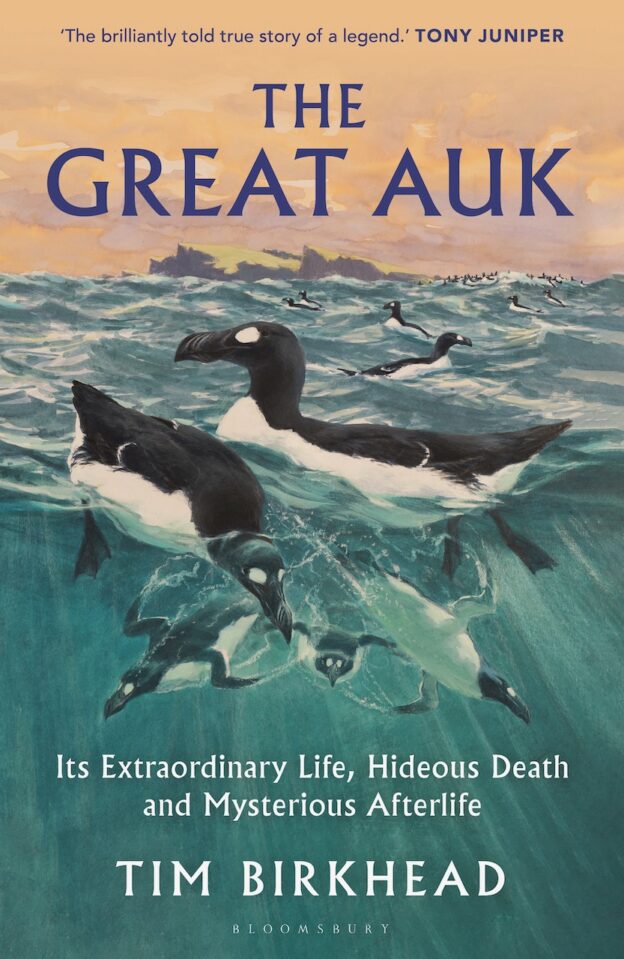
If you are a fan of entertaining tales that blend bird biology, history, and human eccentricity, Tim Birkhead’s new work The Great Auk (Bloomsbury, 2025) will find a welcome place on your night stand. I have to confess that this is the first Birkhead book I have read, but the title suggested a fascinating story about a topic I knew very little about, so right away I requested a review copy from the publisher. My efforts did not disappoint.
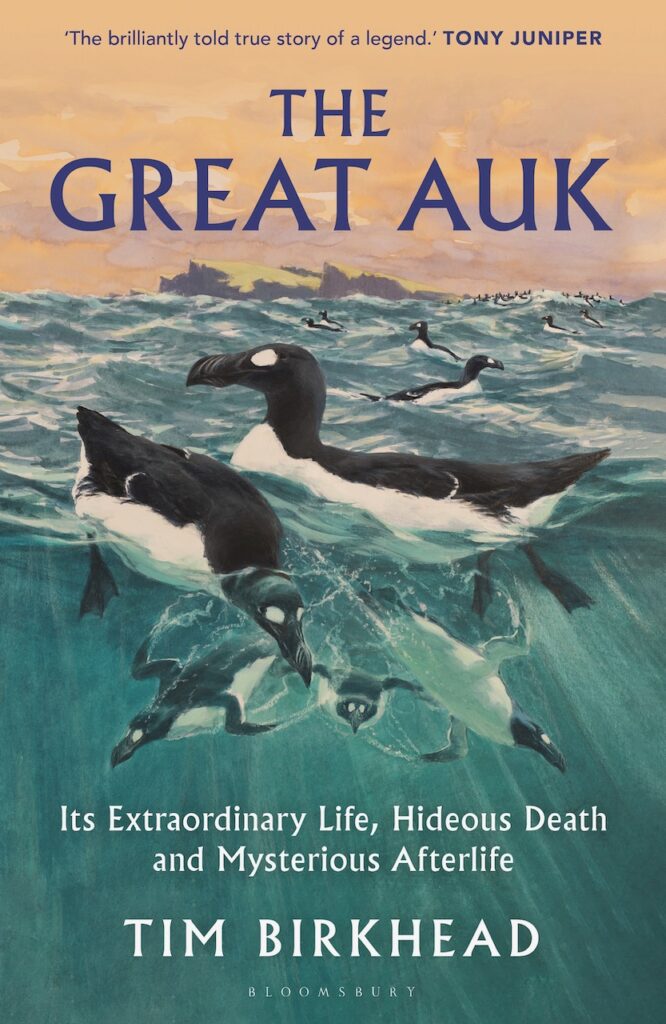
For me, the first question that needed answering was, “What the heck was a Great Auk?” I had, of course, heard of Great Auks during my twelve years observing, researching, and writing about birds but I hazily lumped them in with the totally unrelated Dodo and elephant birds. Why? Probably because all of these birds had been large and flightless—and all had gone extinct. Other than that, I knew almost nothing about Great Auks.
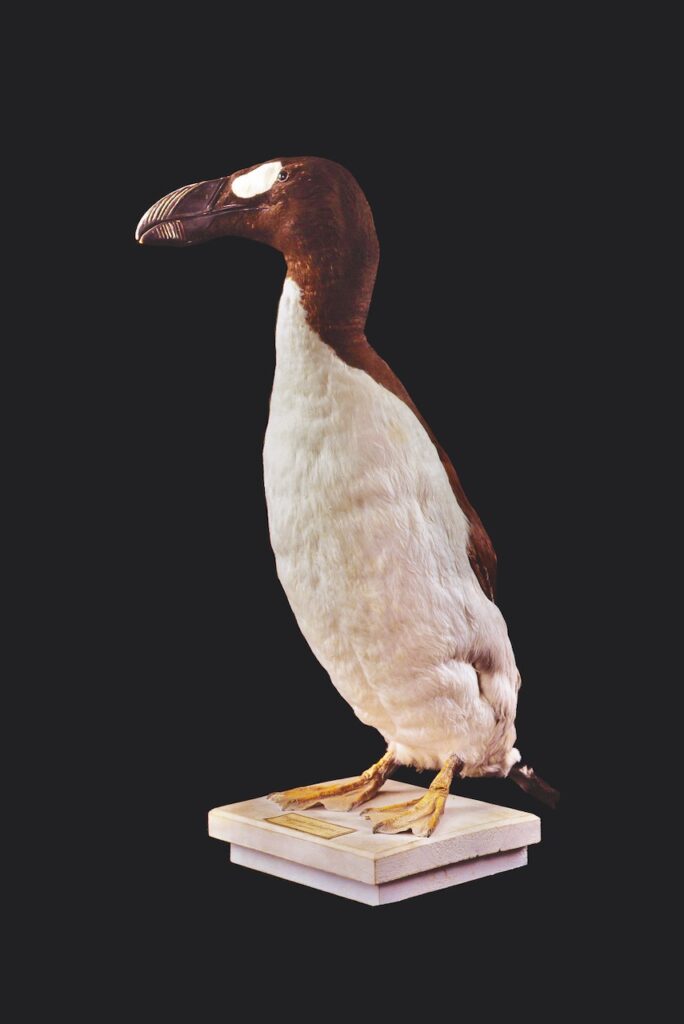
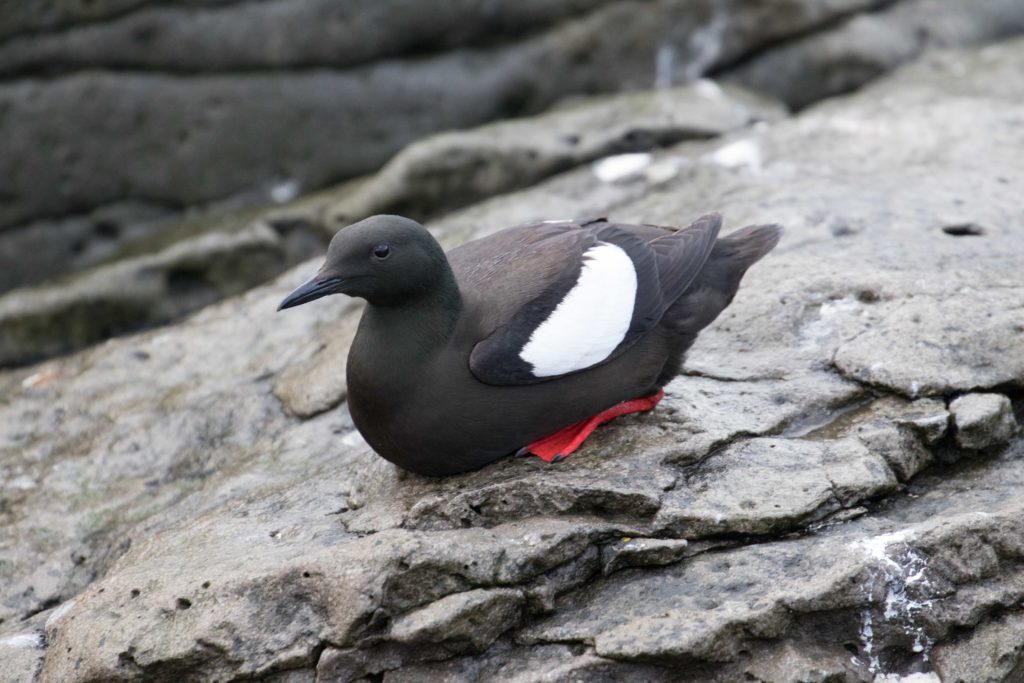
Upon opening Birkhead’s book it was therefore a great relief to learn, “Oh, yeah. Great Auks are actually auks—seabirds!” I mean, duh, right? Members of the Alcid family, their closest living relatives appear to be Razorbills, something I found delightful since Braden showed me my first Razorbills only last Thanksgiving when our family had the chance to visit Cape Cod (see post Birding Race Point). Birkhead is quick to point out, however, that surprisingly little is known about Great Auk biology, much of it speculation from the relatively scant specimen material that has survived.

Which, of course, brings us to the tragic fact that Great Auks were quickly and efficiently wiped out almost as soon as seafaring Europeans on their way to North America figured out where the birds nested. That happened to be remote islands in the North Atlantic, and in historical times, there probably never were more than a handful of breeding sites for the birds. In early chapters, Birkhead especially focuses on what was clearly the most important site, Funk Island. Here, tens—perhaps hundreds—of thousands of Great Auks gathered every year. Couples would each lay their single, exceedingly large egg and work together to feed the resultant, rapidly-growing chicks from the abundant fish schools nearby.
When Europeans did discover the auk bounty to be had, the slaughter began. Ships heading to what is now northeast Canada stopped over to feast on the auks and preserve them for food. Later, egg, skin, and feather collectors helped finish them off. Birkhead especially documents the brutal habits of egg collectors. Not wanting to obtain eggs with well-developed embryos inside, the collectors would intentionally crush every egg that they found. Returning a few days later, they could be assured that the embryo inside of any new egg had not yet developed, and its contents could be easily removed through a tiny hole made in the shell. Officially, the last two auks were killed in 1844, though it is likely that a few isolated individuals survived into the following couple of decades.
Birkhead neatly divides The Great Auk into two parts. The first focuses mainly on the history of the bird, its demise, and what can be constructed of its biology from historical accounts, surviving specimens, and extant relatives. Part 2 focuses mainly on some of the more rabid egg and skin collectors, especially Vivian Hewitt, who somehow managed to acquire thirteen Great Auk eggs for his vast collection of approximately half a million bird eggs.
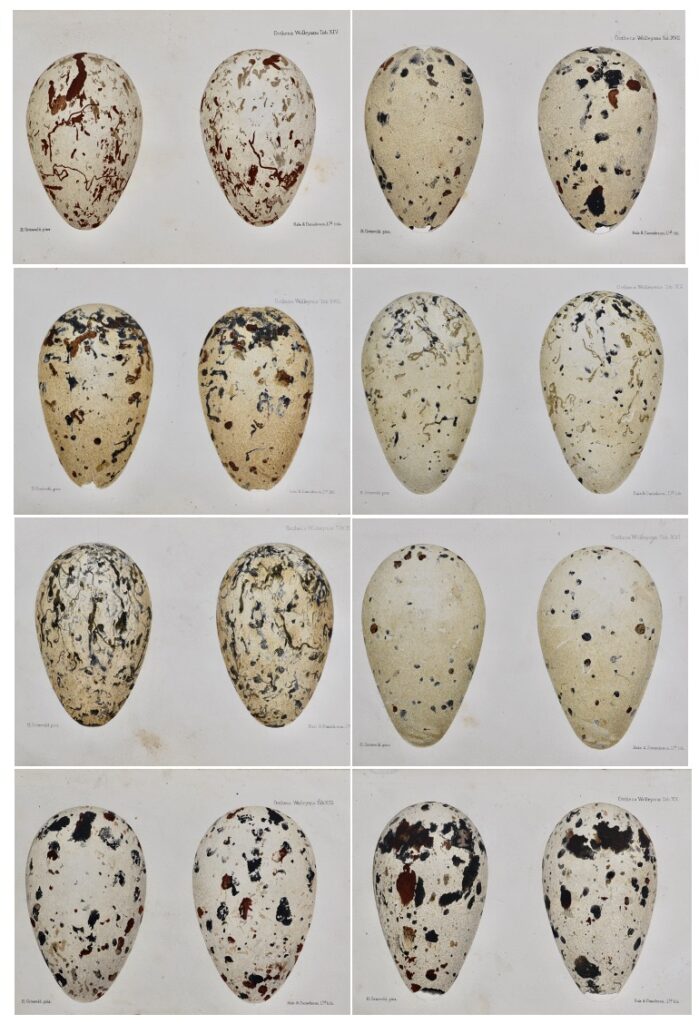
I have to say that I enjoyed Part 2 just as much as Part 1. Few of us realize this today, but oologist—a term coined for egg collectors that attempted to confer scientific legitimacy upon a practice that we now consider despicable—was all the rage in the early 1900s. It was practiced much as stamp and coin collecting were when I was a kid—and with little thought about the consequences for birds. Collectors routinely not only gathered an egg of a species, but entire clutches of eggs and even hundreds from the same species, searching for variety, fame, and fortune.
As perhaps the wealthiest participant in the field, Hewitt spent a small fortune both obtaining individual eggs and opportunistically snapping up entire collections of other egg collectors when their fortunes turned for the worst. Most prized of Hewitts acquisitions were the eggs and mounted specimens of the Great Auk that he managed to obtain, each of which has a story—and many of which Birkhead traces to fascinating effect. I won’t say more about this fine book, but if you enjoyed Christopher Skaife’s The Ravenmaster and Joshua Hammer’s The Falcon Thief, you are almost guaranteed to love The Great Auk, too. And if you do, why not help prevent the extinction of other bird species by donating to the American Bird Conservancy, the National Audubon Society, or another group working to protect our precious surviving species? Thousands of bird species are in trouble and the need is great.