Join Braden and me at our last book signing of the year at The Well-Read Moose in Coeur d’Alene, Idaho this Friday, November 23 at 6 p.m. Also be sure to share this post and subscribe to our blog in the box down on the column to the right. Happy Thanksgiving!
I just returned from speaking on an author panel at the annual convention of the National Council of Teachers of English in Houston, Texas. It was a terrific event, but I confess that I looked forward to Texas birding possibilities even more!
As soon as I picked up my rental car, I headed toward Winnie, Texas, racing the sun so that I could have an hour or so at Anahuac National Wildlife Refuge before bedding down for the night. I arrived a little later than desired, mainly because of a couple of irresistible caracaras and a Scissor-tailed Flycatcher that almost literally flagged me down. Still, I managed thirty minutes driving the Shoveler Pond Loop. I needed at least an hour but managed fun looks at White and White-faced Ibises, Common Gallinules, a Black-bellied Whistling Duck, and a surprise Common Yellowthroat.

Semipalmated Plovers greeted me at Rollover Pass on the Bolivar Peninsula.
The next morning, after a stop at Rollover Pass, I headed to the Houston Audubon Society refuge at the tip of the Bolivar Peninsula. Before the trip, Braden had been drilling me on plovers, and his work paid off. Plovers are well-known for their ability to distract potential predators by faking wing injuries or sitting on “false nests.” Except for the ubiquitous Killdeer, however, they were a group I’d never knuckled down and studied before and I hoped to see all of the Big Five on my list: Black-bellied, Snowy, Wilson’s, Piping, and Semipalmated. At Rollover Pass, I’d found a number of Semipalmated, so that left me only four more at the Bolivar sanctuary.
Unfortunately, the long beach of the sanctuary seemed bereft of the numbers of shorebirds I had hoped for and I struggled to ID many of the birds in their winter plumages. I patiently began picking away at them, though. “That’s a Willet. I know that one. Those are Sanderlings. Hm…is that a Dunlin? I’ll have to ask Braden about that one later.”
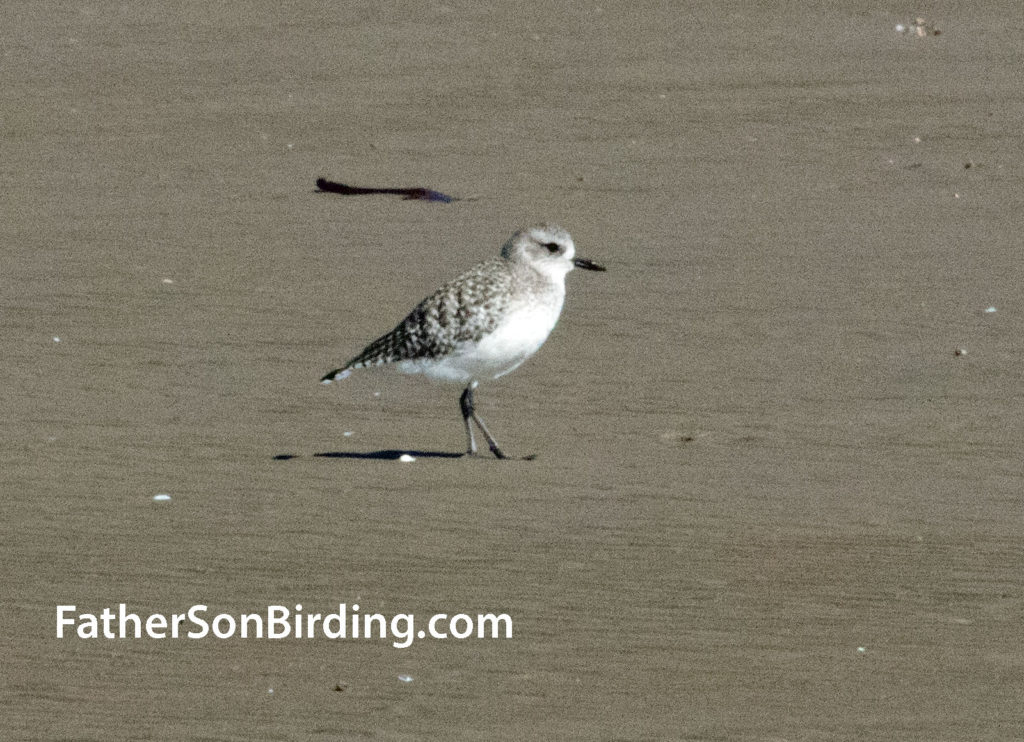
Winter-plumage Black-bellied Plovers were one of several shorebirds I at first couldn’t identify. Once I got them, though, I got ’em!
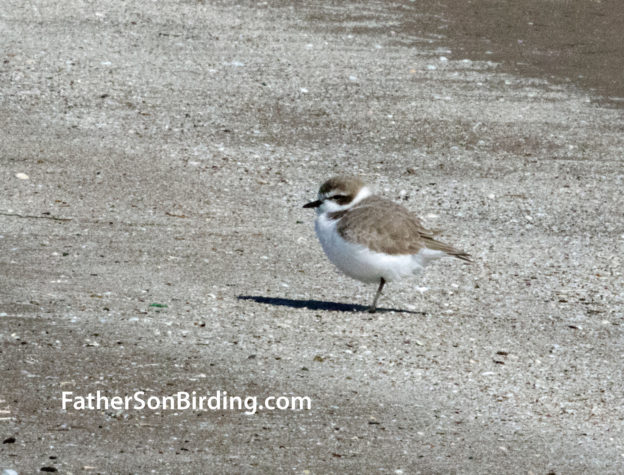
Then . . . jackpot. Suddenly, I was seeing plovers in all directions. The problem? Identifying them! The two kinds around me looked very similar. Both were tiny and had broken breastbands. Individuals of both also had leg bands. Still, one kind was definitely darker than the other and they had distinctly different-colored legs. When I showed my photos to Braden, he affirmed my thoughts: I had seen both Snowy and Piping Plovers. As a bonus, I saw numerous Black-bellied Plovers, too!
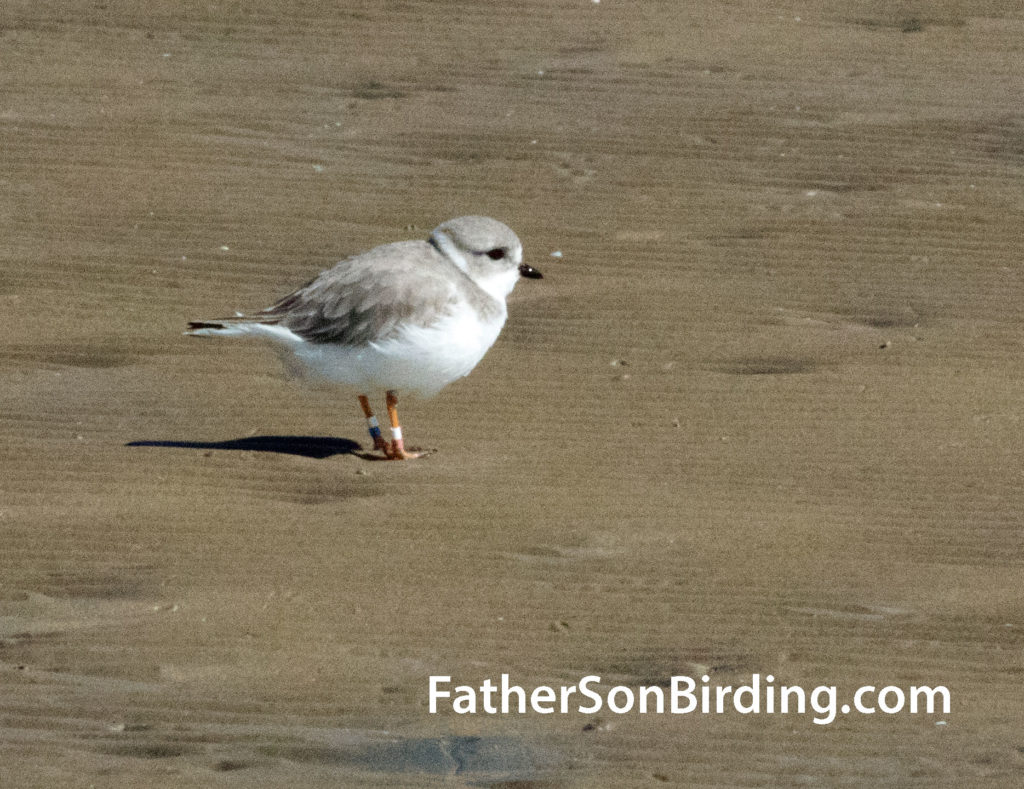
I didn’t realize until after my visit that Piping Plovers are an endangered species, with only an estimated 8000 individuals according to BirdLife International.
Four out of five plovers? I’d take it—especially because Piping and Snowy Plovers are both endangered species due to their preference for the same beach habitats that humans enjoy. These little, cool birds definitely made up for the shortage of gulls, whimbrels, jaegers, and other birds I’d also hoped to test myself against.
Even better, my Thanksgiving Texas birding adventures had just begun . . .
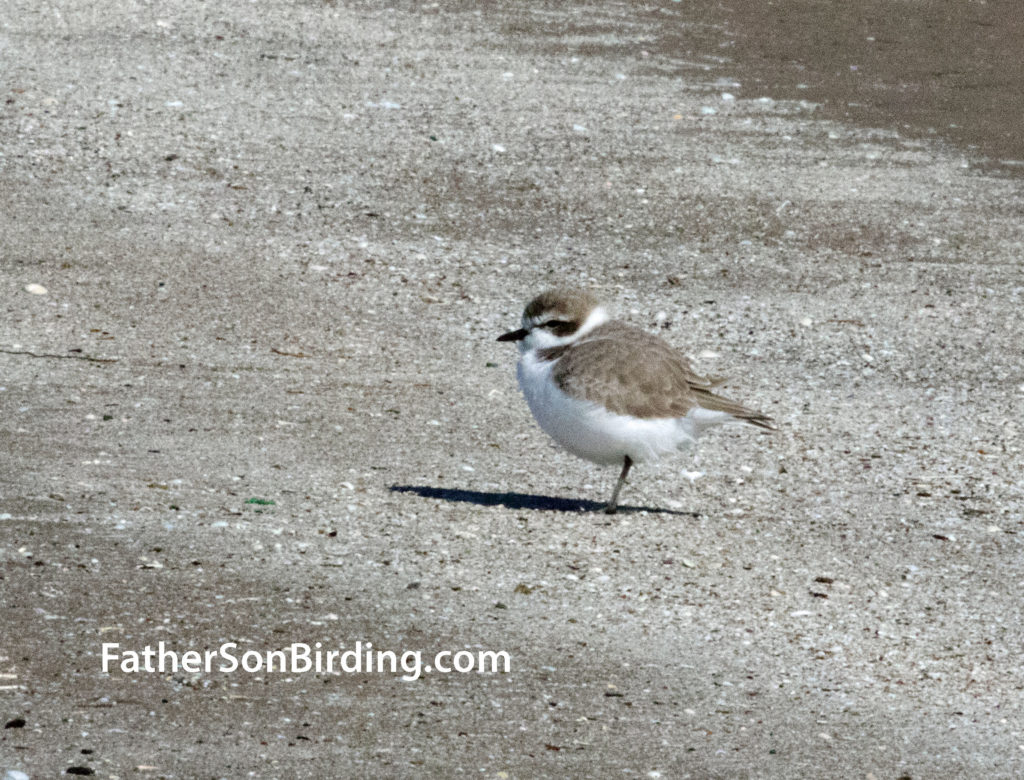
This Snowy Plover surprised me as I’d only seen them on the West Coast before. Note the darker facial markings and differently-colored legs than the Piping Plover in the previous photo.