Category Archives: Colombia

In Search of the Green-tailed Towhee

Please support our efforts at FatherSonBirding by buying a *New* copy of Birding for Boomers or one of Sneed’s other books shown to the right—and by donating to Montana Bird Advocacy, a wonderful grassroots scientific organization doing novel and unique research on Montana birds.

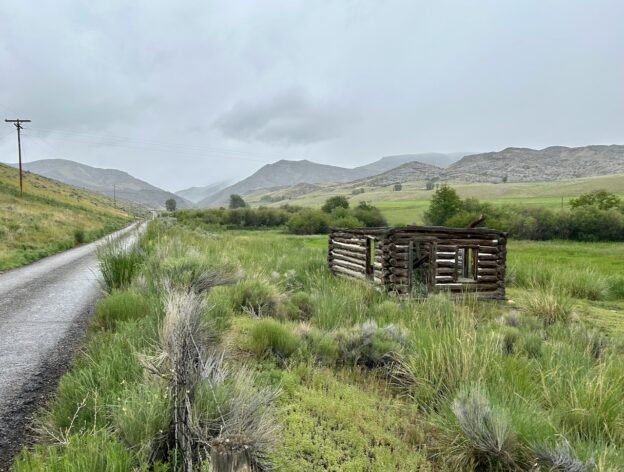
Confession: Despite the title of this blog, the the main purpose of last weekend was not to find Green-tailed Towhees; it was to learn about a wonderful study of Gray Flycatchers with biologists Jeff Marks and Nate Kohler. However, as I set out Saturday morning, defiant of the grim weather forecast for the next day, I did have a secondary mission in mind—to find and visit with some of the birds in the arid southwest corner of the state. Over the years, these sagebrush areas, from Bear Canyon (see Bear Canyon—Montana’s “Tropical Birding” Paradise) all the way west to Beaverhead County, had become some of my favorite parts of Montana. I credit that partly to my own childhood living in the dry chaparral country of southern California, but I also just love the ecosystems and birds in this part of Montana. I’d have trouble calling myself a real birder if I didn’t get down there at least once each year.

Since you’re pressing me on the issue, I also had a third objective for this trip—to move closer to breaking my all-time one-year species record. The record belonged to 2017, when our family traveled to Ecuador and Peru and I recorded a total of 527 species for the year. This year, thanks to last-minute invitations to Colombia (see THIS POST) and Texas (see THAT POST) I unexpectedly found myself at 498 species—perilously close to setting a new record. That task loomed more difficult than it might appear since once spring migration has passed and breeding season gets underway, it becomes much more difficult to find new species. Still, a trip to the southwest part of Montana promised to nudge me closer to this new goal, and my first target was one of the state’s coolest birds: Green-tailed Towhee.

On Braden’s advice, my first real birding stops of the trip were along the Jefferson River before Lewis & Clark Caverns.

Green-tailed Towhees winter in the American Southwest and Mexico, but generally breed in the the Great Basin region of the West, including southern Montana. Though the birds are not strictly rare, I could count the number of times I had ever seen one, and I felt eager for another GTTO encounter. To find this bizarre, poorly understood beauty, I hit I-90 at dawn and steered toward Lewis and Clark Caverns, two-and-a-half hours to the east. To entertain me along the way, I had checked out an audio version of Eat, Pray, Love, a book that invites all kinds of snarky comments but, I found, actually proved moderately amusing. On Braden’s advice, I pulled over alongside the road leading to the caverns and was rewarded with a wonderful assortment of river and cliff birds including Rock Wren, Lazuli Buntings, and White-throated Swifts. Once inside Lewis and Clark Caverns State Park itself, I focused on finding Green-tailed Towhees.
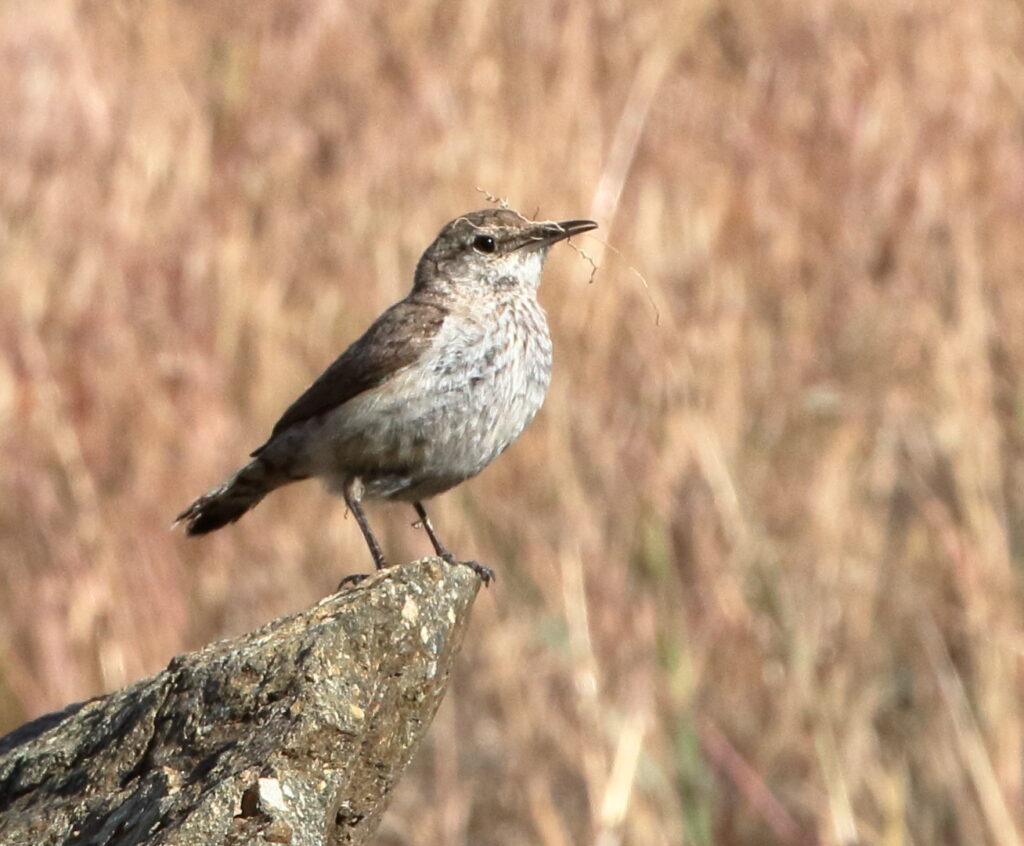
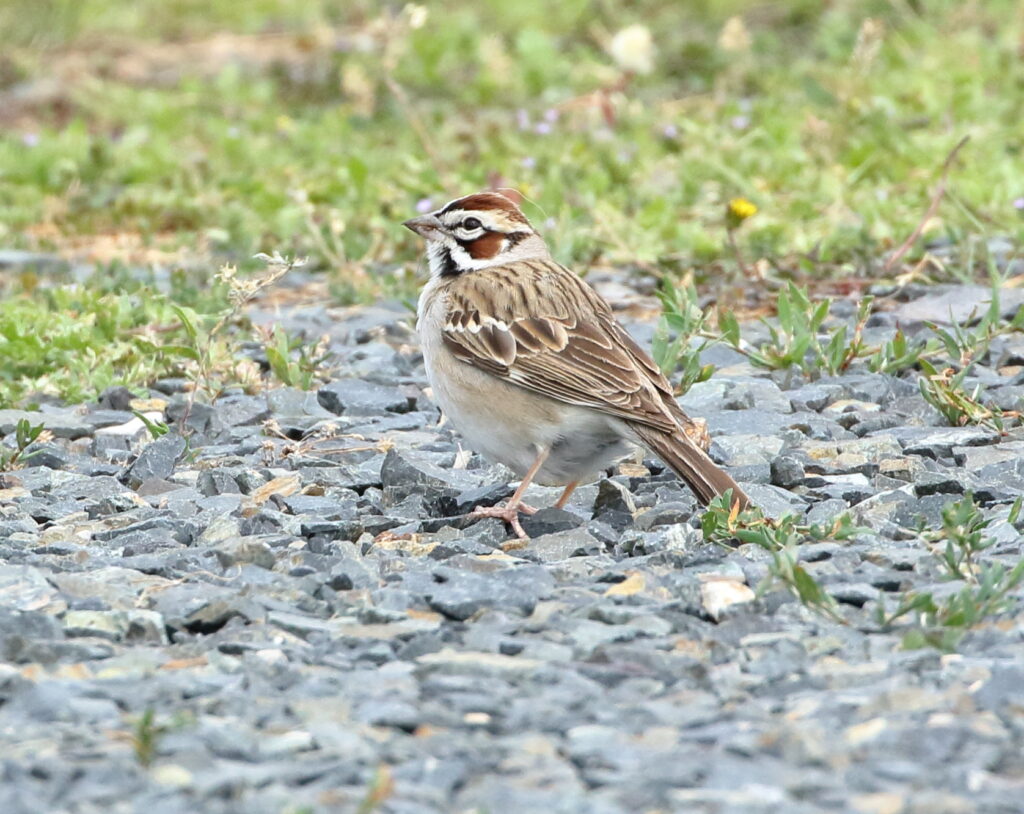
I struck out. I spent a good hour and a half checking along the road, up around the main parking area, and in the campground. Merlin’s Sound ID picked up a putative GTTO song at one point, but I neither heard nor saw a trace of the bird.

I have to admit that this made me feel like a total failure. I mean, here was my first target bird of the trip, and one that shouldn’t be that hard to find, and I totally “whiffed” on it, as Braden might say. I didn’t plunge into despair exactly, but it definitely put a damper on my mood as I began questioning just what I thought I was doing out here pretending to be a birder! Well, I thought, maybe I’ll have better luck at my next destination.

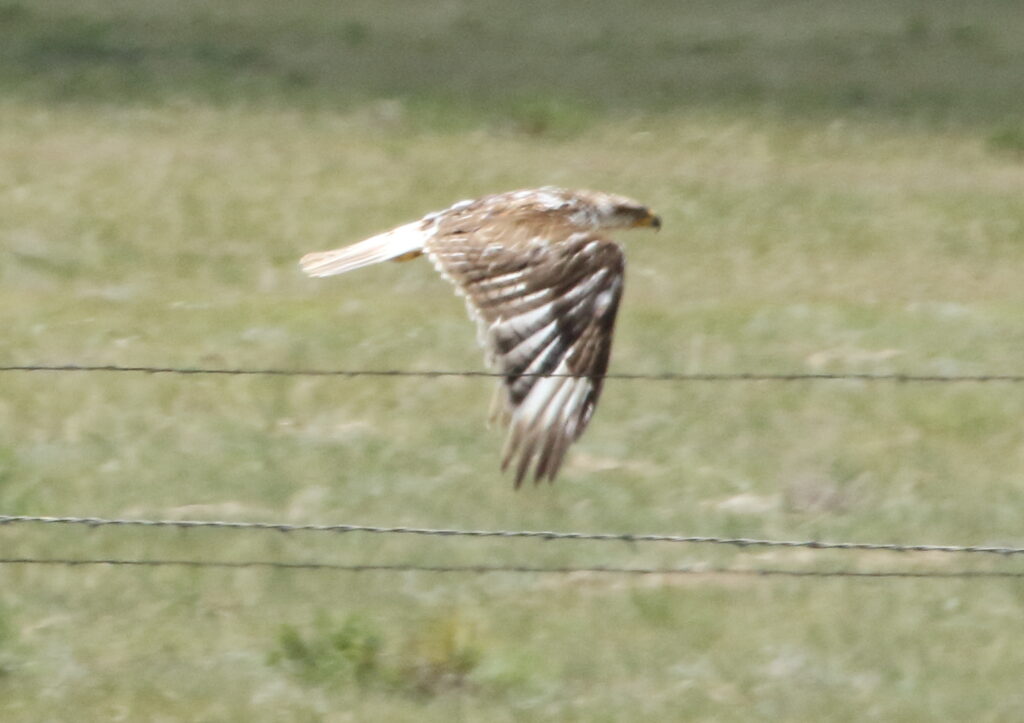
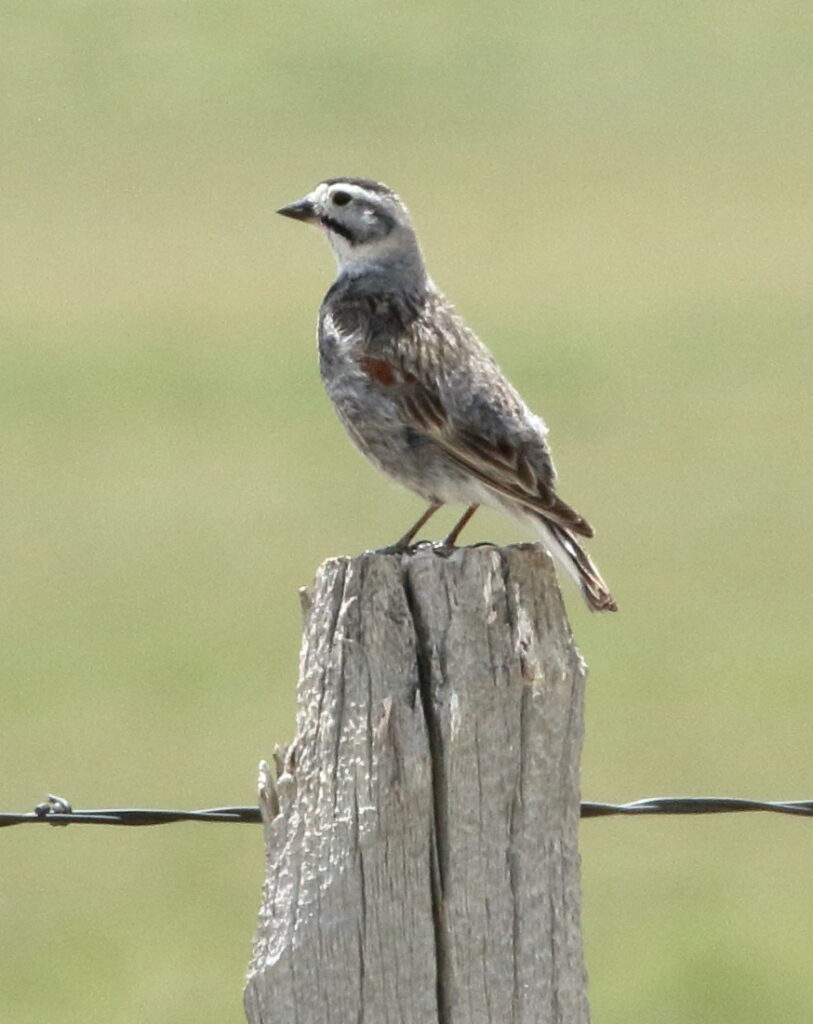
Which happened to be Birch Creek Road north of Dillon in Beaverhead County. Several years before, Braden and I had found our lifer Thick-billed (formerly McCown’s) Longspur on this road, and once again, the road delivered. I’d driven only a mile before I saw a suspicious dark shape on a fence. I actually didn’t think it was a Thick-billed, but my binoculars revealed otherwise. “Yay!” I exclaimed, feeling the weight of my earlier “whiff” lifting slightly. A few minutes later, I was examining another TBLO when I noticed a large shape sitting in a field about one hundred yards away. “Clearly a hawk,” I thought, “but what kind?” The answer: the best kind, at least for my goals for the trip—a ferruginous hawk. This was another bird I needed for the year and one that isn’t always easy to find in the state.
Digging out the peanut butter sandwich I’d made earlier, I tooled down I-15 for my next destination, Clark Canyon Reservoir. Braden and I had only ever birded here once before, and as near as I recall, we hadn’t found much, so I kept my expectations low. I stopped at one overlook and was surprised to see a Common Loon on the water below, along with a Double-crested Cormorant and a couple of Ring-billed Gulls. Violet-green swallows swirled around me and, as always, they brought a smile.

Snaking around the reservoir, I approached a sign for Horse Prairie Campground and spontaneously swerved left onto a dirt access road. The reason? Tall, healthy-looking sagebrush! Hm, this just might have one of my other target birds for the day. Almost immediately, I saw a really cool bird that had not been on my target list—a Common Nighthawk peacefully chillin’ on the split-rail fence. The bird barely blinked as I fired away with my camera through the car window from only thirty feet away.
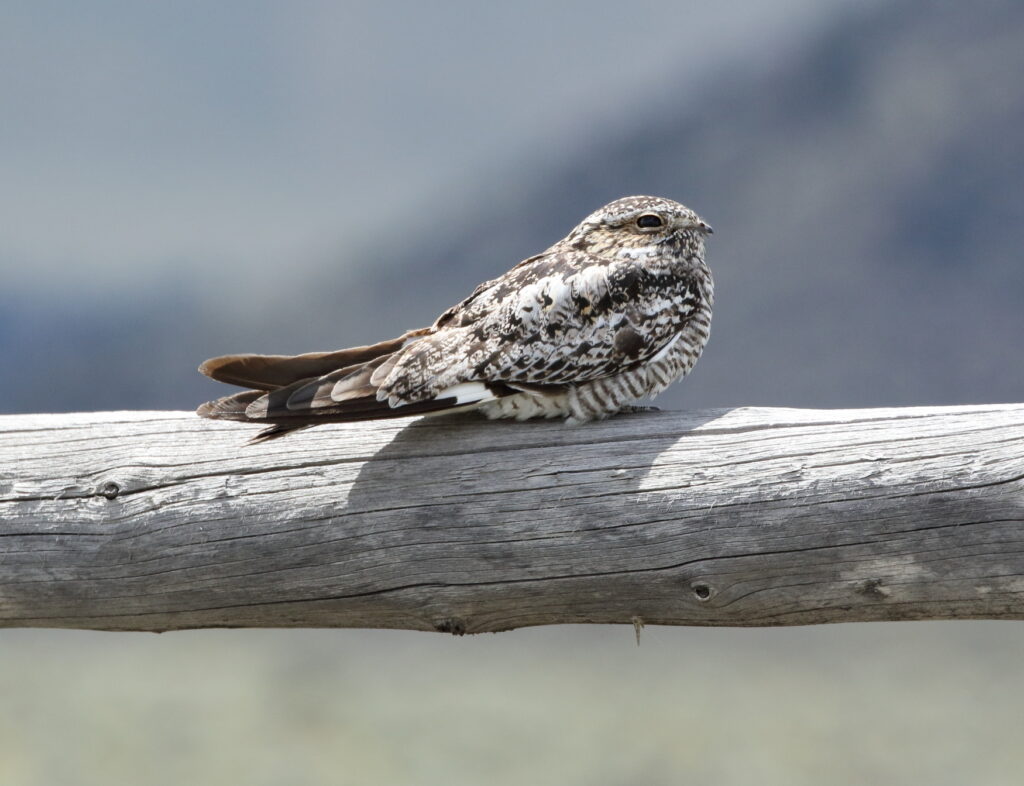
The first of three Common Nighthawks I spotted chilling on the wooden fence leading down to Horse Prairie Campground.

Creeping slowly forward, I heard a song I didn’t recognize—which was no great surprise in itself, but I did have a guess of what it was. Sound ID confirmed it: Brewer’s Sparrow! This bird loves healthy sagebrush and makes up for the world’s dullest plumage with a vigorous song that bewitches any birdwatcher who hears it. A few moments later, one even sat still long enough for a decent photo. Check. Another target bird—but not the one I expected to find here!
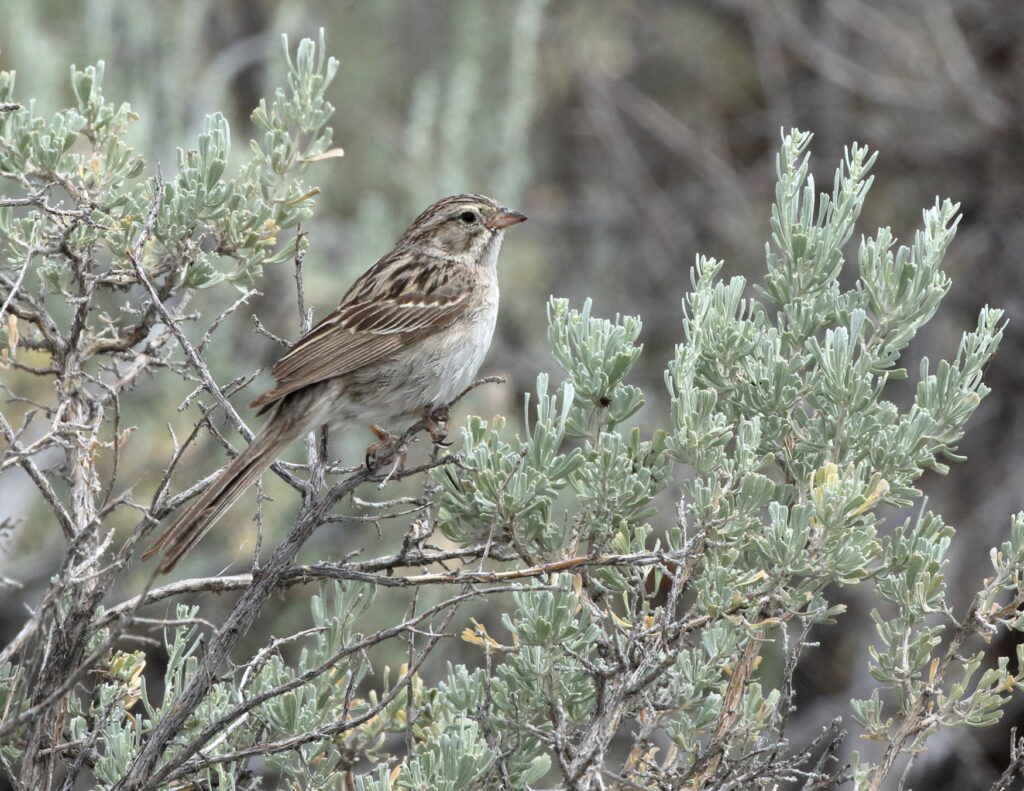
One of Montana’s drabbest birds, the Brewer’s Sparrow has an enchanting song.

I kept driving slowly toward the campground and spotted a medium-sized, slender bird up ahead. Wishfully, I thought it might be a Say’s Phoebe—another bird I happened to need for my year list—but it flew off before I got close. As I pulled into the campground, though, two brownish birds were chasing each other around. I assumed they were robins, but when one landed on a “Day Use Only” sign, I realized with a start that it was exactly the bird I had hoped to find here—a Sage Thrasher!
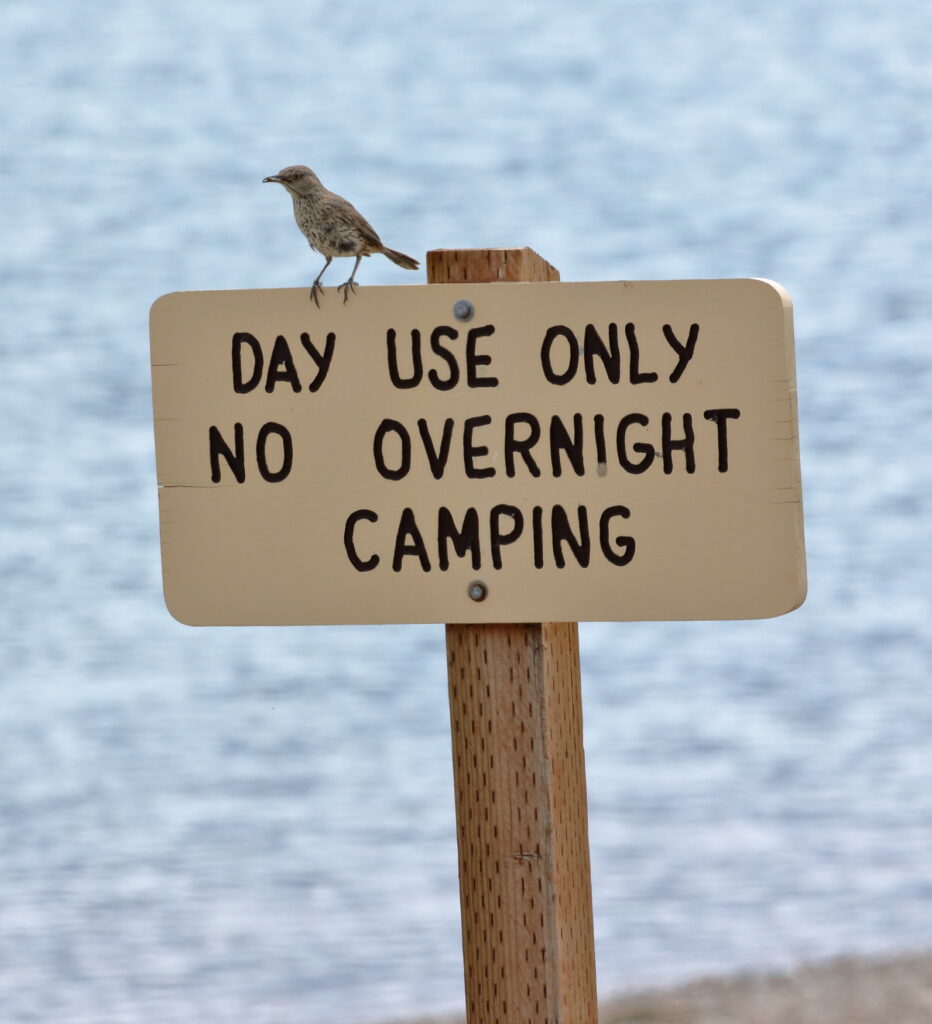
Sage Thrashers are so flighty that seeing one on a sign was about the last thing I expected!

Braden and I have never met a thrasher we didn’t like, but Sage Thrashers hold a special place in our birding hearts. For one, they’re the world’s smallest thrashers—which is why I mistook them for robins or phoebes. For another, they are charismatic songsters and often are the most common bird you see in sage country. As I sat in the car, in fact, I counted three more Sage Thrashers around me. Whoo-Hoo!
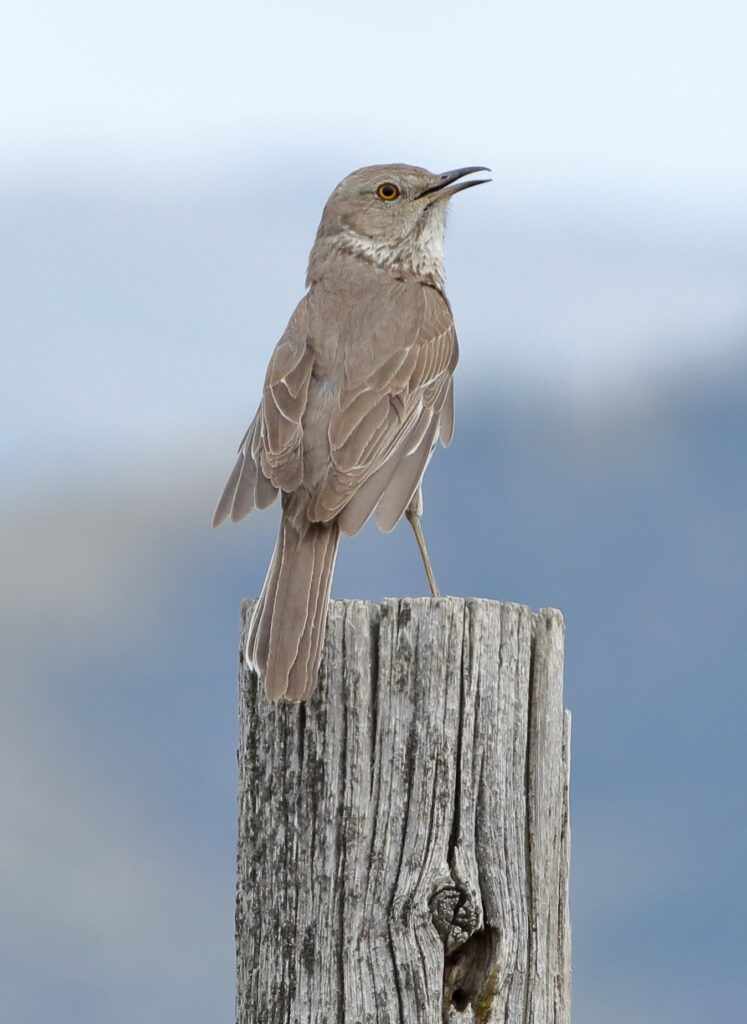
One of our favorite Montana birds, Sage Thrashers seemed to be everywhere I looked this afternoon.

Later, on the road where I was to meet up with Jeff Marks and Nate Kohler, I encountered seven more Sage Thrashers! It was a veritable thrasher party—by far the best experience I had ever had with these good-looking birds.

Unfortunately, the next morning, heavy rain and spitting snow kept me from seeing Gray Flycatchers with Jeff and Nate. More on that in another post. Almost as bad, I began the drive home without a Green-tailed Towhee under my belt and no expectations of seeing one. But bless Nate Kohler’s heart. He told me about a canyon I should check out on the way home. It was still raining when I got there, but I drove slowly and stopped frequently, listening and watching. Lazuli Buntings chattered everywhere and I saw a good variety of birds—but no towhee. Finally, I put on my raincoat, got out of the car and played a Green-tailed Towhee song. Almost immediately, a small shape darted up out of the sagebrush—the bird I was looking for! Not only that, it held still long enough for a photo—but the story hadn’t quite finished.
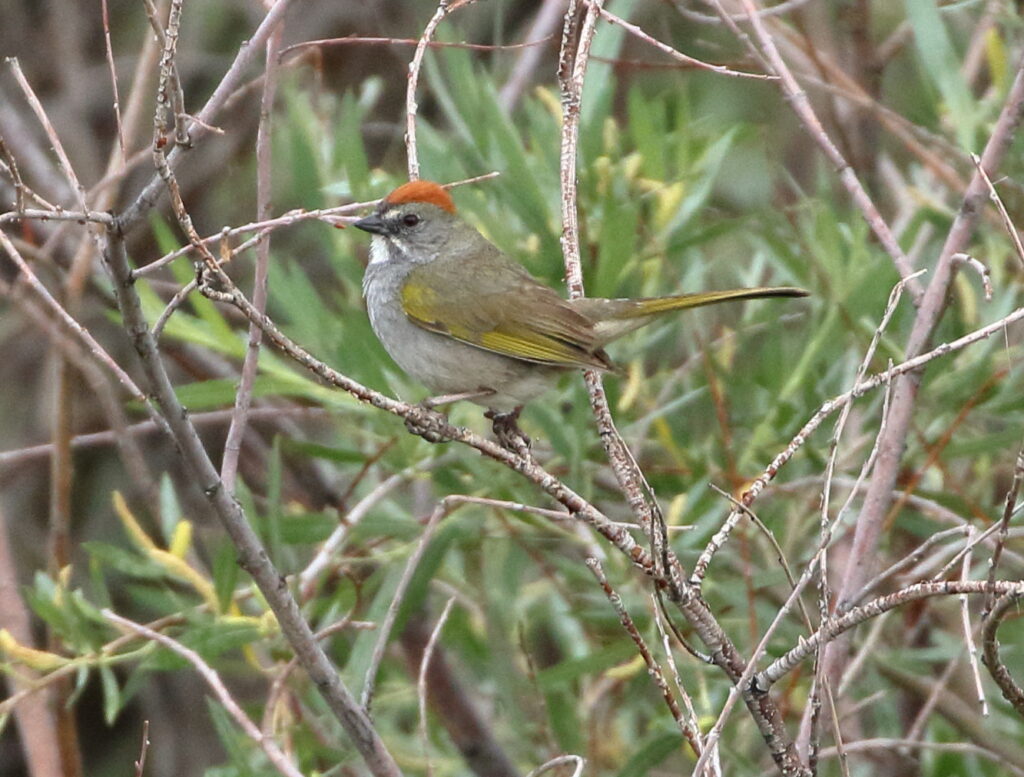
I worked hard for this Green-tailed Towhee—only to find that it wasn’t a year bird after all!

Once I got home and posted all of my checklists for the trip, I was surprised that eBird hadn’t added GTTO to my year list. What’s going on? I thought, and did a quick search to see if I had somehow seen one down in Texas and forgotten about it. Nope. What I did forget was the rare vagrant GTTO I had seen in Victoria, BC during Amy’s and my January trip (see Birding Victoria, BC)! So this one was not a year bird after all, but still a lot of fun to see. Meanwhile, my year list swelled to 503 species thanks to the Thick-billed Longspur, Ferruginous Hawk, Brewer’s Sparrow, Sage Thrasher, and a Prairie Falcon I had spotted the afternoon before. Not exactly the trip I expected, but one I already cherished.
Cock-of-the-Rock Extravaganza—with Video! (Colombia Birding Part 5)

We wrap up our Colombian birding blogs with a terrific post by Roger Kohn, sharing his recent experiences with one of South America’s most famous birds—the Andean Cock-of-the-Rock. If you’ve been reading recent posts, you know that in addition to being a past guest contributor to FSB, Roger was the evil genius behind getting Sneed to Colombia! Alas, an injury kept Sneed from seeing the cock-of-the-rock this time around, but Roger was able to experience these wondrous birds in full glory. He even took an awesome video of a male Andean COTR that’s almost like being there. Our big thanks go out to Roger, and we know you will enjoy this post. Oh, and be sure to watch the Cock-of-the-Rock video below!

Four a.m. My cell phone alarm chirped and the screen lit up and pierced the early morning blackness, rousting me from a sound sleep. If you want to see one of the iconic birds of the Andes, you’d better be dragging yourself out of bed well before dawn!

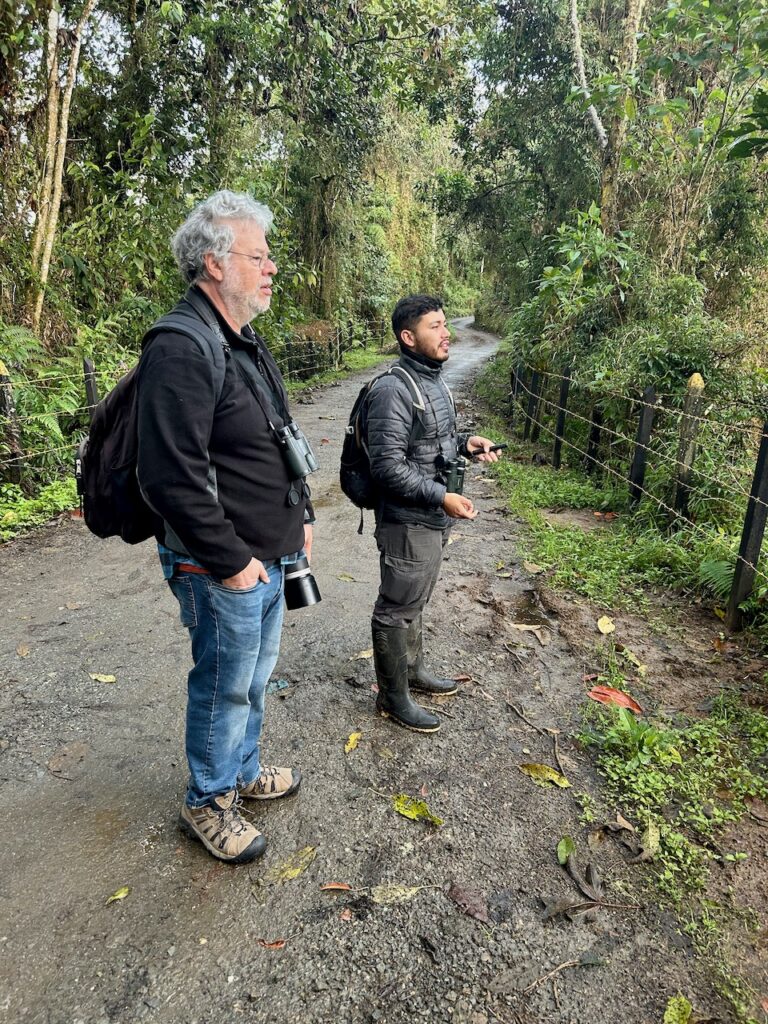
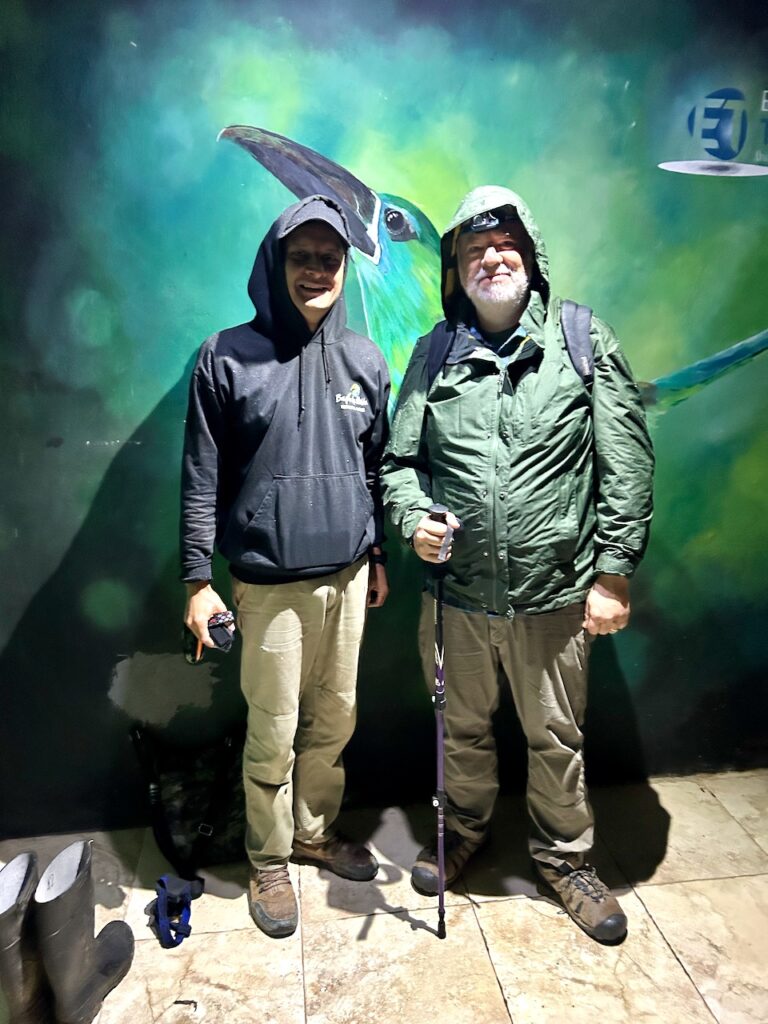
Our guide Luis with Roger before they went slippin’ and a slidin’ down to see one of South America’s most iconic birds.

Today was one of the most anticipated days of my Colombia birding expedition. Sneed and I would visit “Alto Anchicayá – El Descanso,” commonly referred to as Doña Dora’s place. The owner, Doña Dora, began her business by selling empanadas and coffee to workers on their way to and from a nearby hydro-electric facility. The small restaurant quickly became popular with birders because its location, perched in the cloud forest at about 4,000 feet above sea level in Colombia’s Western Andes, attracts a huge variety of bird species to its feeders and offers some of the best birding in South America. As if that weren’t enough, birders have the opportunity to see the Andean Cock-of-the-Rock, a bizarre-looking bird that inhabits narrow ribbons of cloud forest slicing through the Andes of Bolivia, Peru, Ecuador, Colombia, and Venezuela.

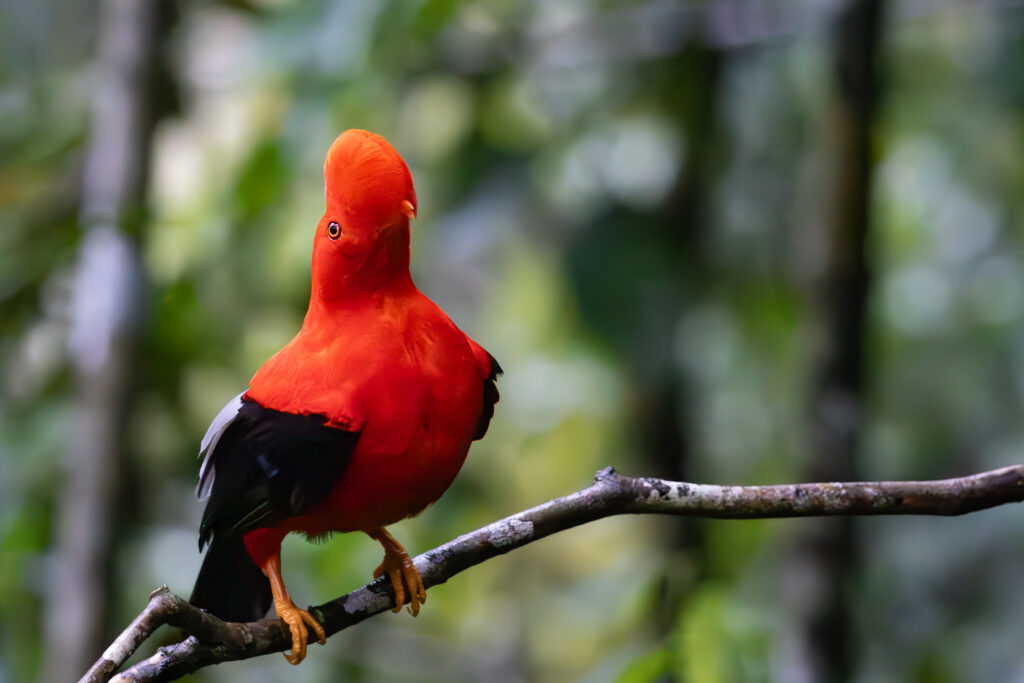
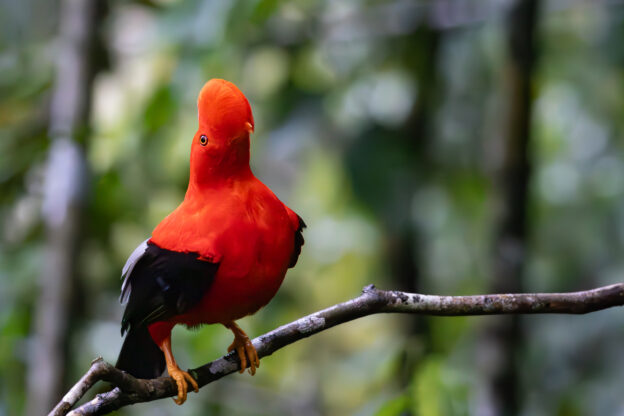
A male Andean Cock-of-the-Rock in its full, bizarro glory!

After Sneed and I downed a quick cup of coffee and a muffin, our guide Luis picked us up at the Araucana Lodge (see “Video Post: A Visit to Araucana Lodge”) at 4:30 a.m. Light rain fell as we drove west for about 50 minutes. Our destination? An Andean Cock-of-the-Rock lek located in steep terrain below Doña Dora’s place.

Leks are assembly areas where males of some bird species, including Greater Sage-Grouse and Greater Prairie-Chickens in North America, perform courtship displays to attract prospective mates. At this time of year, we were pretty much guaranteed of seeing the Andean Cock-of-the-Rock between approximately 6 and 7 a.m.; the only question was whether we would see both sexes or only males.

Arriving at Doña Dora’s, the last raindrops fell as we gathered our walking sticks and prepared for the hike down to the lek. I was a little nervous, having heard that the trail is rough and steep. The recent rain added an additional layer of concern. Turning on our headlamps, Luis, David—a visiting birder from Spain—and I departed in the darkness. Sneed, nursing a sore leg and having already seen the Andean Cock-of-the-rock in Peru, opted to skip the hike and instead get an early start birding at Doña Dora’s.

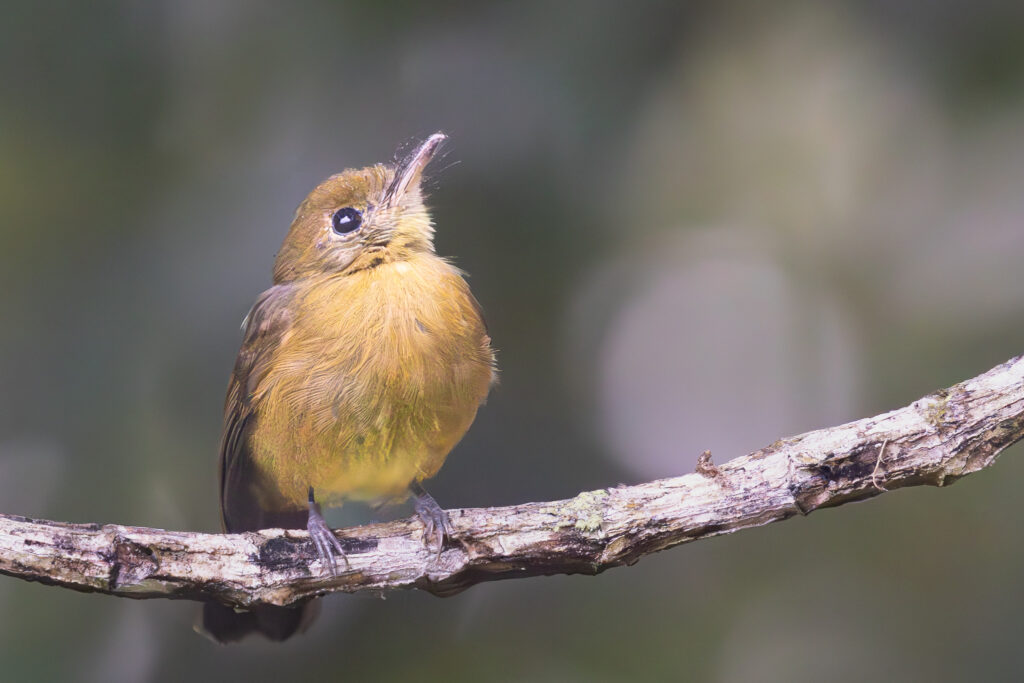
Tawny-breasted Flycatcher, one of five flycatchers Roger saw on his ACOR trek.

Fortunately, the trail wasn’t as treacherous as I feared. The ground was damp, but the soil and leaves seemed to have absorbed most of the rainfall, so the trail didn’t have much mud and standing water. Steps built into the trail, along with a rubber handrail, made the descent very do-able. Pausing at the moth trap, a great birding area we would visit on the way back up, we turned off our headlamps as the first light of the day penetrated the cloud forest, and made our final push. About 25 minutes after we had departed, we arrived at the lek, an area with lots of open space for the birds to strut their stuff, and a small shelter with benches for birdwatchers.

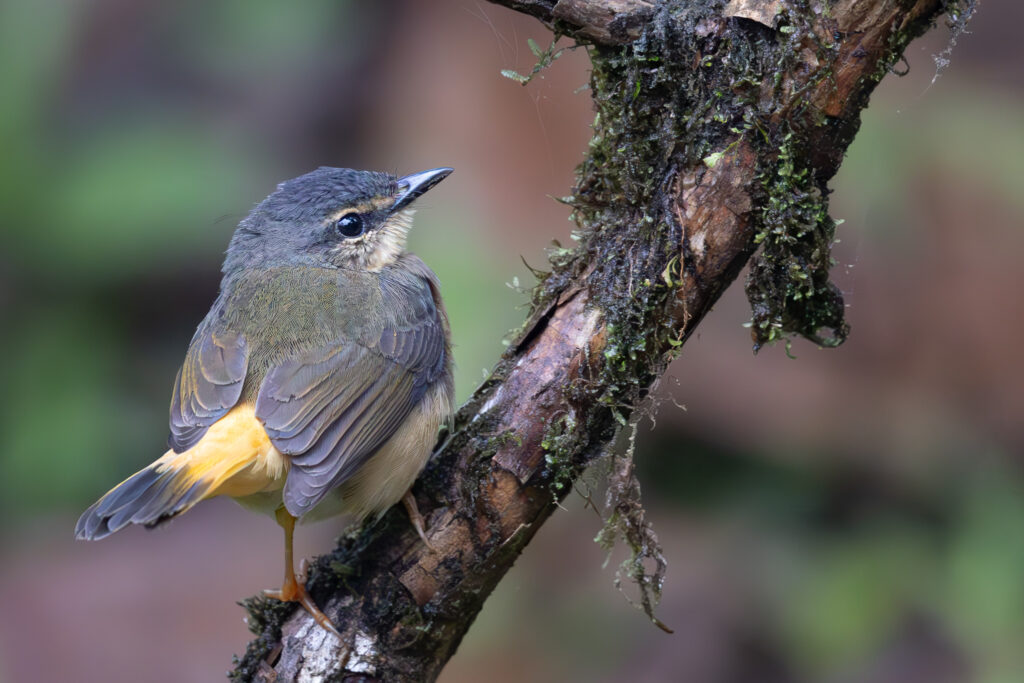
Buff-rumped Warbler, a New World warbler species that does NOT migrate to the US—or anywhere else for that matter.

Immediately we saw two male Andean Cock-of-the-rocks, then three, and eventually five. These were the strangest-looking birds I’ve ever seen — veritable avian aliens. Bright red on the head and chest, black wings, silver tertiary feathers in the back, large pale staring eyes, a helmet-like round crest on the head with their bills only barely visible at certain angles, and bright orange legs. They perched on branches, and periodically pranced with herky-jerky movements to attract the attention of females. Their periodic calls, which eBird describes as “piglike squeals,” were odd guttural shrieks, comical to the human ear.

Ever wonder what male Andean Cock-of-the-Rocks do at their leks besides drink beer and boast about past conquests? This highly-classified video gives you a behind-the-scenes look! (Copyright Roger Kohn)

We did not see any females, which are brownish and look more like a conventional bird species, but we assumed they lurked nearby. Despite the absence of the females, I felt privileged to witness this display and add this remarkable Andean cloud forest dweller to my Life List. It was a sublime encounter that I will always treasure.

Andean Cock-of-the-Rock female (photo taken at Machu Picchu, Peru, copyright Sneed B. Collard III)

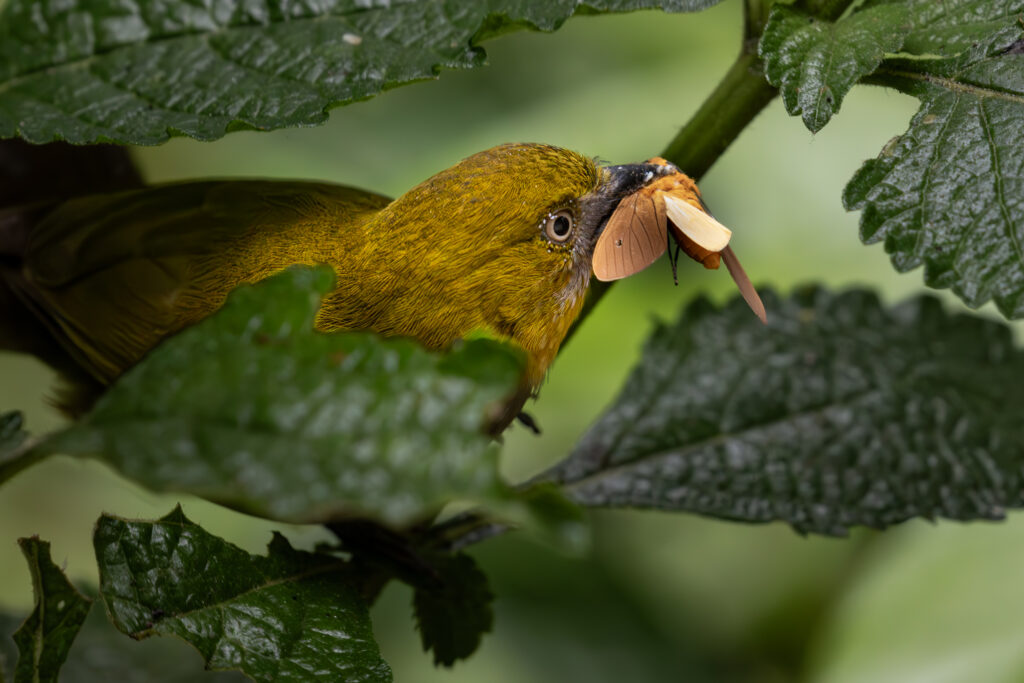
A huffy puffy ascent awaited us—but also a treat about a third of the way back to the top: the moth trap. The trap is a large white canvas sheet suspended vertically, and is a birder’s delight. Moths and other insects land on it, providing a feasting opportunity for resident cloud forest birds, which converge and gorge on bugs they pick off of the canvas. Pausing here, we racked up 15 species in 20 minutes of very fun birding. They included four species you can find in the United States: Summer Tanager, Canada Warbler, Acadian Flycatcher, and Blackburnian Warbler. The rest were species I’ve never encountered before. We saw five flycatcher species, including great looks at a handsome Tawny-breasted Flycatcher. Four warbler species graced us with their presence, including a very cooperative Buff-rumped Warbler. A Yellow-throated Chlorospingus, a yellowish “tanager-like sparrow” (eBird), dined on a big fat moth.

A Yellow-throated Chlorospingus, a member of a bird group Sneed & Roger had never heard of before the trip.

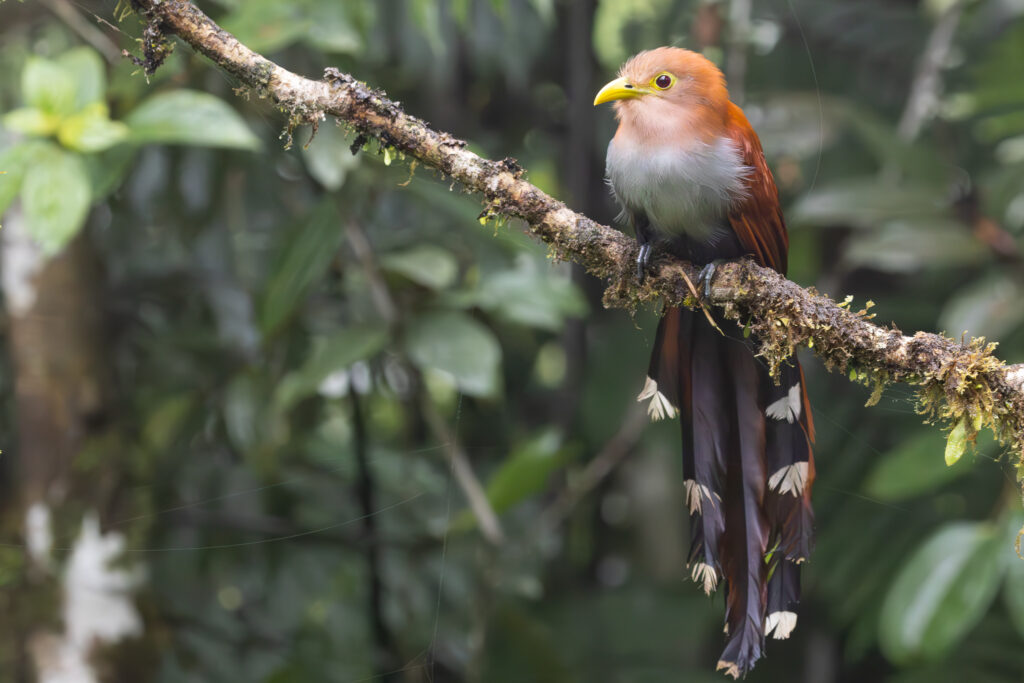
The superstar of the show was a Squirrel Cuckoo, a large dull orange bird with a yellow bill and a long black and white tail. It flew in and perched on a branch out in the open right in front of us, giving us fantastic looks and unbeatable photo opportunities. It would be my only sighting of that species during my 16-day Colombian adventure.

Is this a good-looking bird or what? Squirrel Cuckoos are quite common throughout Latin America, with a range extending from Argentina all the way up into Mexico.

Elated, we climbed up the remainder of the trail, arriving back at Doña Dora’s place, where a pile of scrambled eggs and a full morning of world-class birding awaited us. If you ever have the chance to take a birding trip to the birdiest country on earth, do not miss the opportunity to visit this cloud forest gem.

https://ebird.org/checklist/S215430499

If you enjoyed this post, be sure to check out our previous Colombian birding blogs:

Video Post: A Visit to Araucana Lodge (Colombia Birding Part 4)

Antpittas and Tody-Flycatchers (Colombia Birding Part 3)

Owl’s Watch Ecolodge (Colombia Birding Part 2)

Layover Birding in Bogota, Colombia

Video Post: A Visit to Araucana Lodge (Colombia Birding Part 4)

Roger and I could easily write another ten or twelve posts about our recent birding adventures to Colombia, but I thought it would be fun to pack a lot of our experiences into a video featuring our main destination down there, the Araucana Lodge. The video not only introduces you to the joys of lodge birding, but features some of the famous birds and birding opportunities to be had in the mountains above Cali. Since large files don’t always work well on this blog host, we embed a YouTube link below. Let us know what you think—and enjoy the show!

Click Here to see the first of our Colombian birding post!

Antpittas and Tody-Flycatchers (Colombia Birding Part 3)

Note: This blog post—and all others on FatherSonBirding—are written by REAL PEOPLE! No compensation or gratuities were provided to us in connection with this post. If you’d like to support FSB, please consider buying one—or ten—of Sneed’s books and contributing to a bird conservation organization of your choice. Thank you!

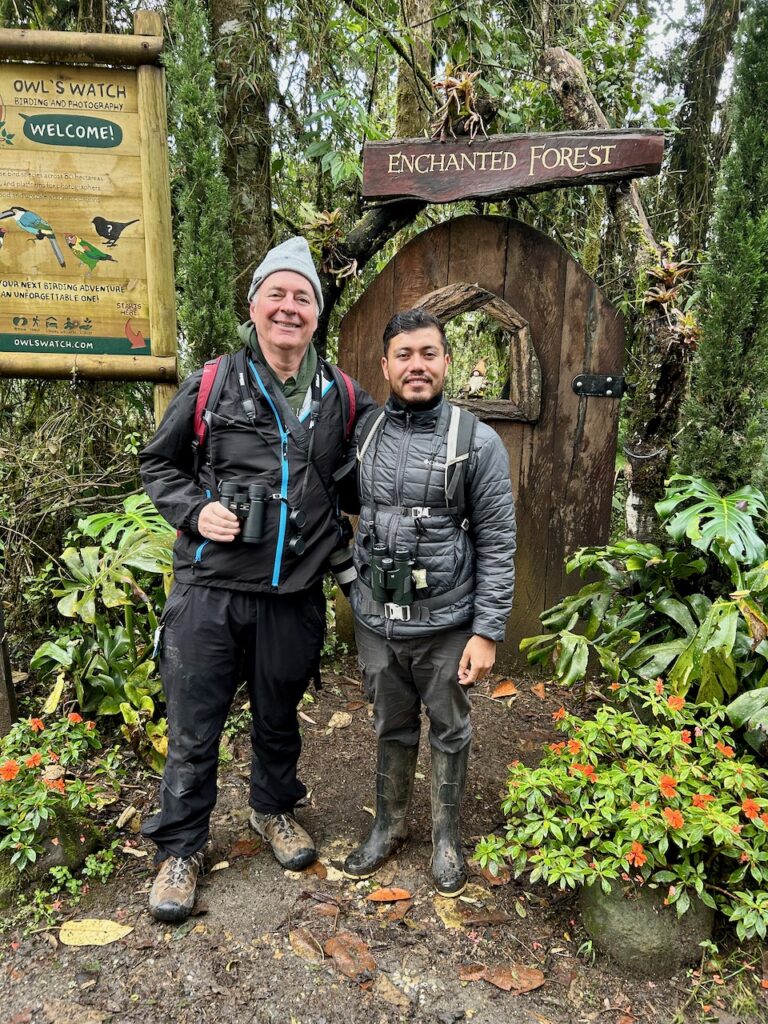
Our second morning at Owl’s Watch ecolodge, Roger and I felt particularly excited. Although we’d had a great day birding on our own the day before (see post Owl’s Watch Ecolodge Colombia Birding Part 2), this would be the first time we went out with an expert guide. We met Owl’s Watch owner, Dennis Bailey, at 6:00 a.m. at the Social, the lodge’s main meeting building, and he served us coffee and a snack. Then, we climbed into his pickup and he drove us up to the Enchanted Forest. This was an area of cloud forest at the top of his property, where he and his team had developed a nice trail system complete with hidden gnomes associated with an information guide about the ecosystem. This is also where we met Daniel Muñoz Buitrago, our Colombian guide for the day.

Our guide Daniel (right) posing with one of the educational gnomes set up along the trail.

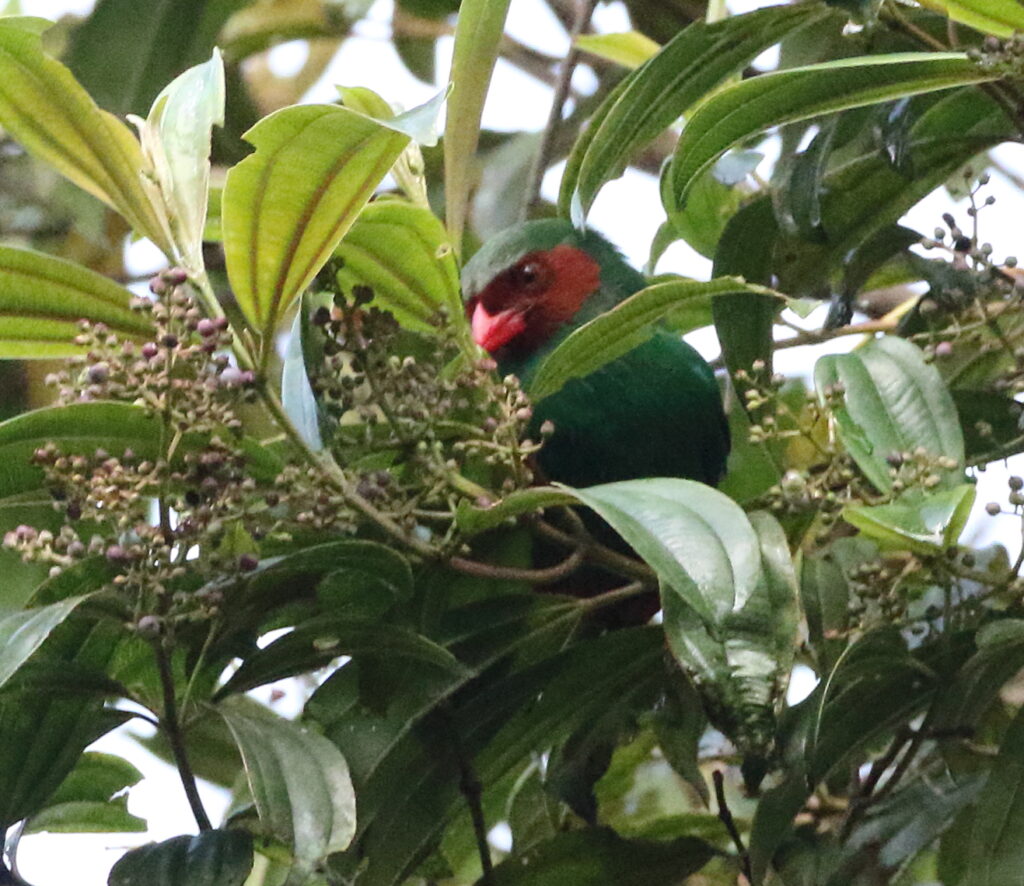
Both Roger and I liked Daniel immediately, and he began our tour by walking us along the road above the forest. “This is often where mixed flocks of tanagers can be found,” he explained, and sure enough, it wasn’t long before he started calling out names: Blue-capped Tanager, Saffron-crowned Tanager, Beryl-spangled Tanager, and one I especially hoped to see—Grass Green Tanager. This bird sports a stunning green color with a vividly contrasting red mask across its face.

One of my favorite tanagers of the trip, a Grass Green Tanager, backlit in the top of a tree.

Along with the tanagers, Daniel called out names of warblers, wrens, woodcreepers, and other birds. We glimpsed some of these, but I must pause here to say a word about what it’s like to bird in tropical forests. Many people see fabulous photos of tropical birds and naturally assume that these birds will be dripping from every branch. Unfortunately, tropical forest birding can often be very challenging. Many birds never show themselves at all and are “heard only” species, identifiable only by their songs and calls—and yes, Merlin’s Sound ID still has a long way to go to become accurate in places like Colombia. Many other birds can be seen—but mainly high in the tree tops against gray, backlit conditions. This makes it tough to get good views through binoculars, and darned well impossible to capture good photos. Daniel, though, was about to greatly improve our “photography problem.”

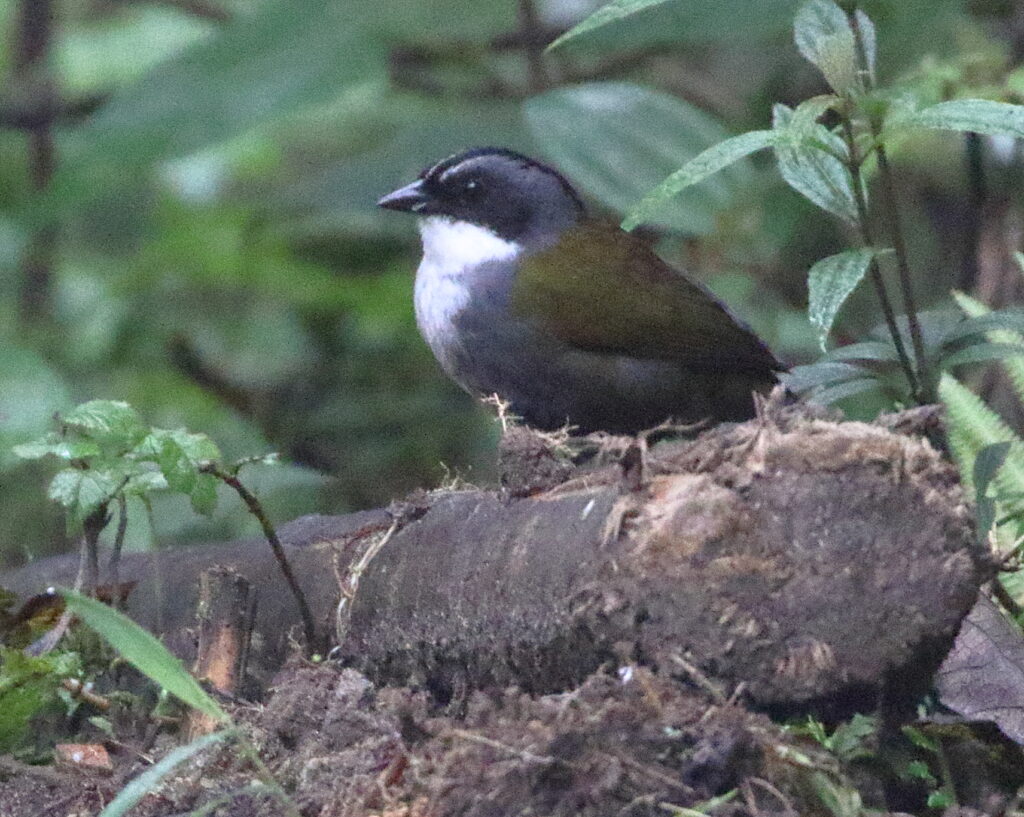
Brushfinches are difficult to see in any conditions, but we did get lucky with this look at a beautiful Gray-browed Brushfinch along the road.

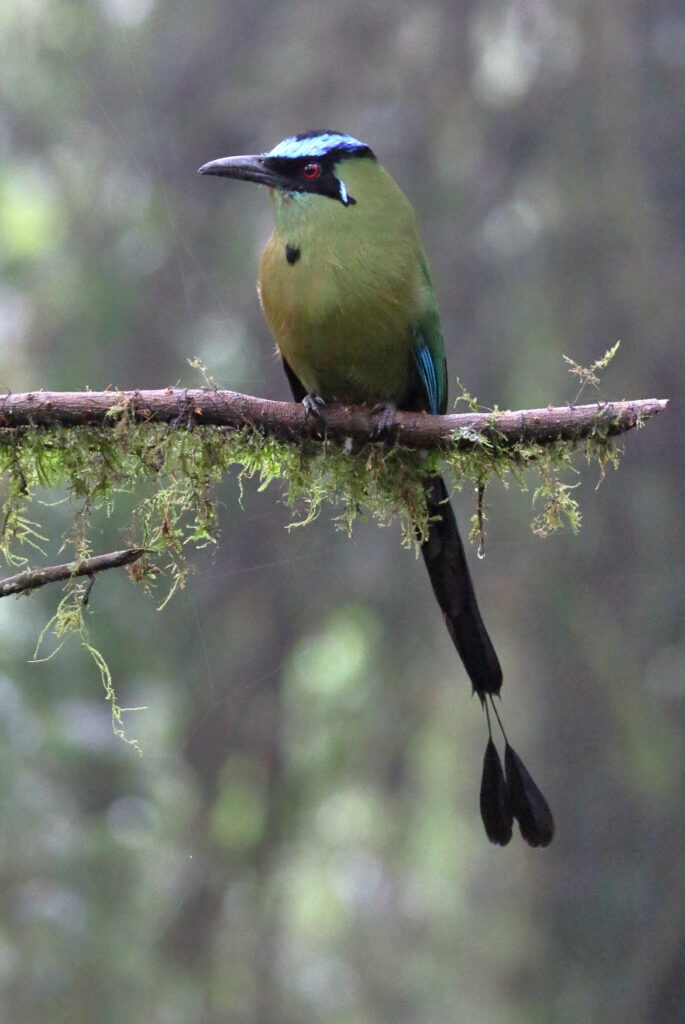
Heading into the Enchanted Forest, he took us down to a set of bird of feeders and began hanging bananas and grapes from various wires and branches. In no time, one of the forest’s most spectacular birds showed up—an Andean Motmot! We had glimpsed this bird on the drive in two nights before, but were delighted to have this additional excellent, intimate look.

Andean Motmot.

After we’d filled our share of camera memory space with the motmot, Daniel motioned us to follow him fifty meters down the trail. Even before we arrived, he started calling “Brownie, where are you? Come out, come out!”—or the equivalent in Spanish. As he did so, he set a few worms on a little fallen log about fifteen feet in front of us. Soon, he said, “Get ready. He’s coming!”

Moments later, a brown, football-shaped bird about ten centimeters (4 inches) high hopped up out of nowhere. “There he is!” Daniel cooed.

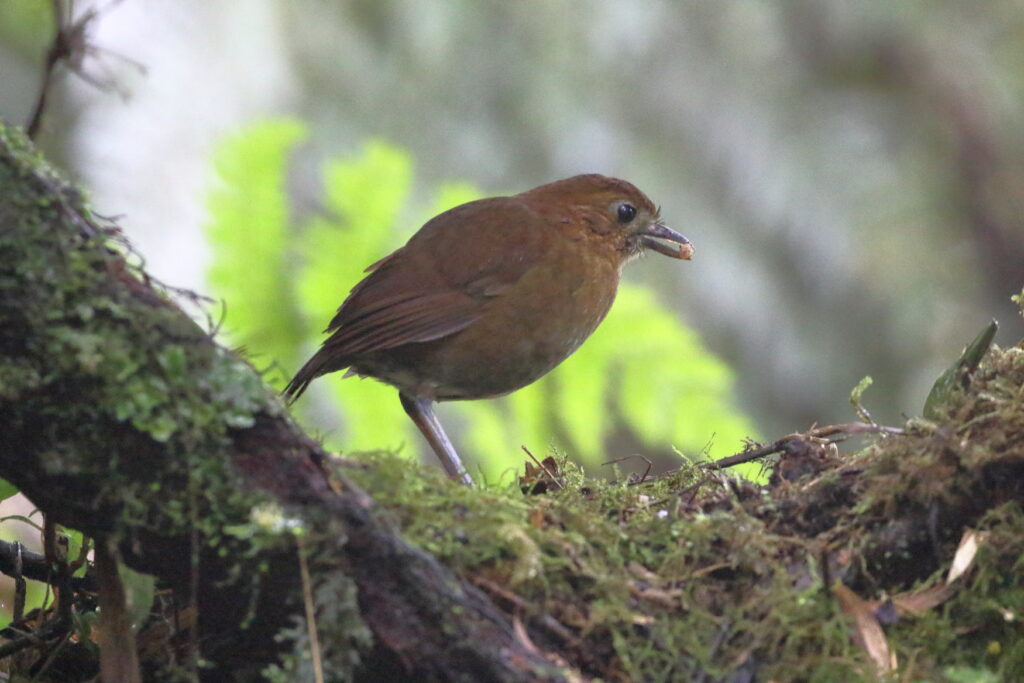
The “he” in this story was a Brown-banded Antpitta, one of Colombia’s most difficult-to-photograph species—and about as adorable as you can get. Its appearance was no accident, either. Daniel had trained the bird for months to respond to his calls—and the worms. I, for one, was grateful because I never imagined I’d get to see an antpitta in the wild. Not only are they very secretive, they often have very restricted ranges. In fact, the Brown-banded Antpitta is classified as Vulnerable due to habitat loss, and little is known about its biology and behavior.

“Brownie”, the Brown-banded Antpitta. These birds are extremely difficult to observe, but thanks to patient “trainers” like Daniel, lucky visitors like us occasionally get to see them.

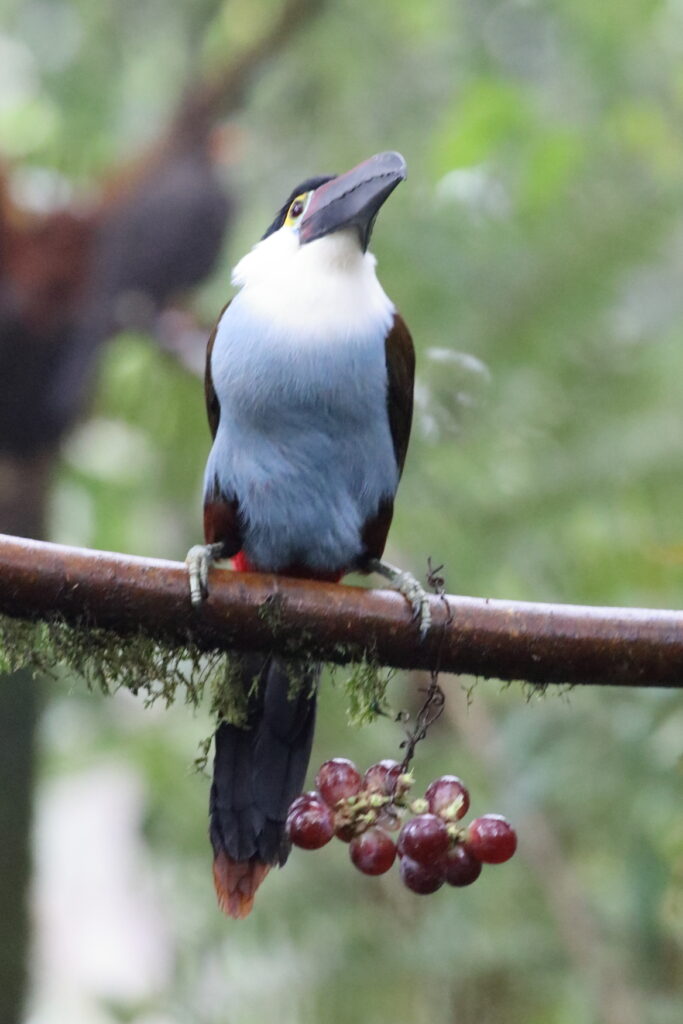
We left Daniel to “clean up” after Brownie and walked back to the feeders. As I was about to step into the clearing, however, I hissed, “Roger, stop!” There, perched on a feeder branch only seven or eight meters away, sat one of the other birds we especially hoped to see—Black-billed Mountain-Toucan! Roger quickly snapped some excellent photos, but I managed only a couple of crummy ones before the bird flew. Still, it was the only BBMT we would see on the trip.

Snooze, you lose. Due to having my camera on incorrect settings, I managed only a poor shot of this Black-billed Mountain-Toucan before it fled with its fruity booty.

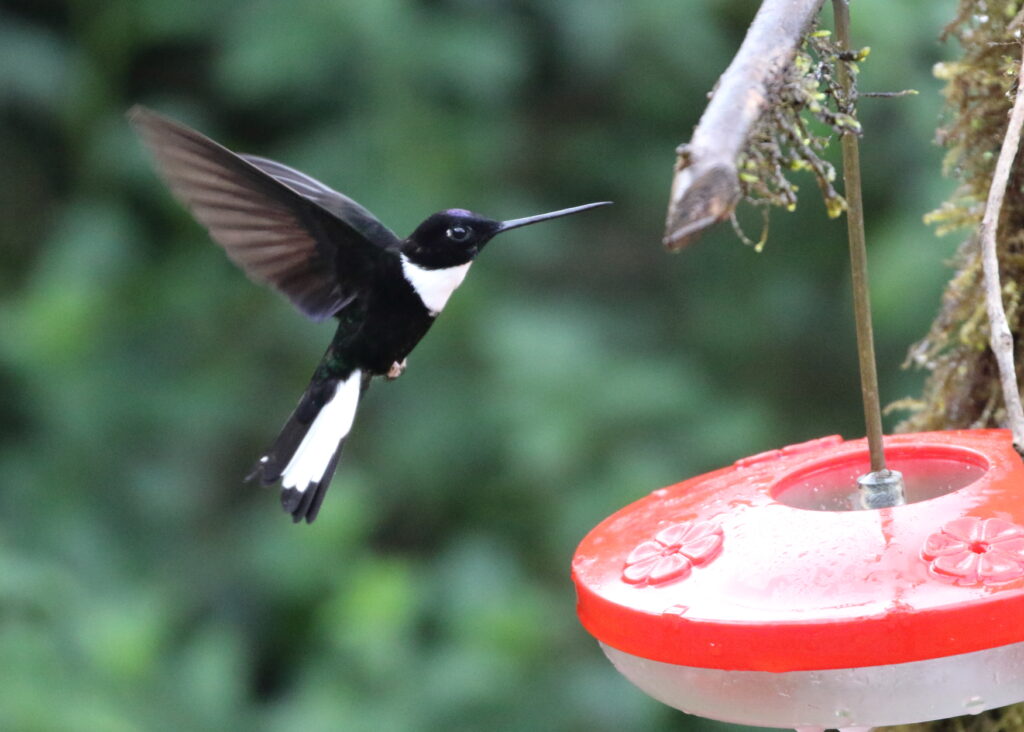
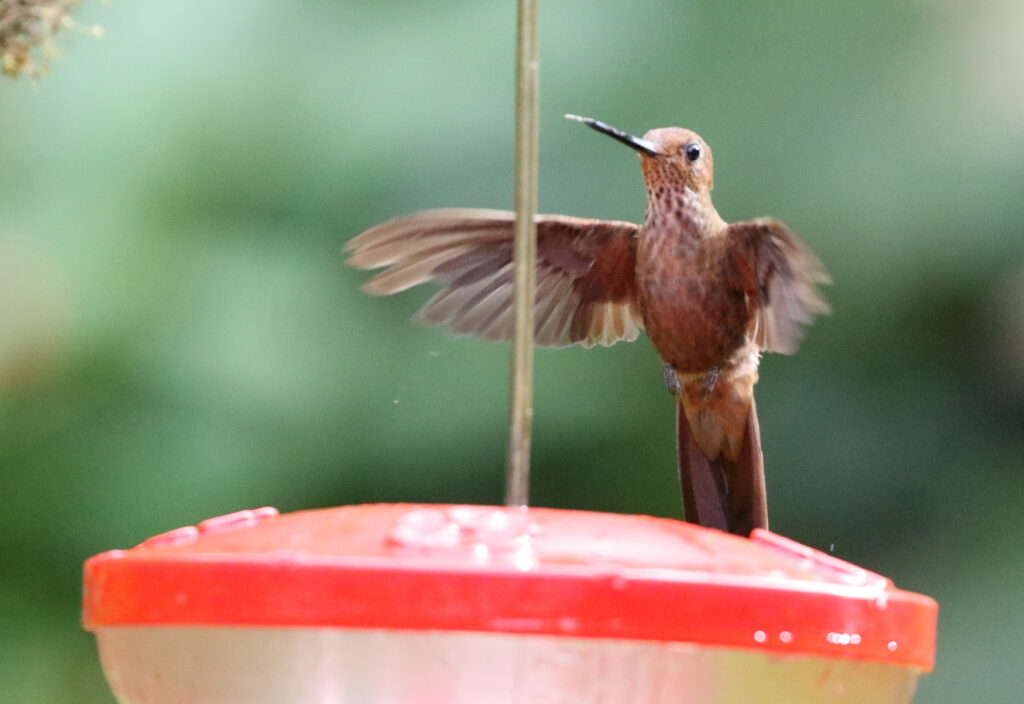
Back on the road, we made our way through cloudy conditions down to the trail that left from the parking area above the lodge (see previous post). We returned to the hummingbird viewing platform and immediately saw a species that got Daniel excited: an uncommon hummingbird called a White-throated Daggerbill. Of course, there were also eleven other species of hummingbirds as well (always, always, hummingbirds), but unbeknownst to us, we were about to meet one of the coolest birds that we’d ever seen.

After a few minutes watching the hummingbird action, Daniel motioned us to follow him down to another little spot about thirty meters away. Here he again pulled out his worm bag and began calling, “Gordita! Gordita! Come out!” Gordita, of course, means “little fat one” in Spanish, and both Roger and I chuckled. But who exactly was Gordita?

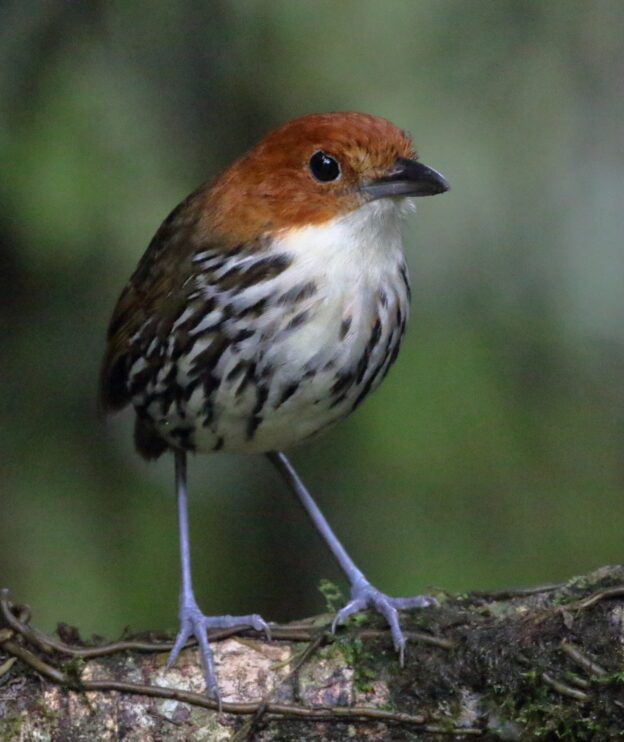
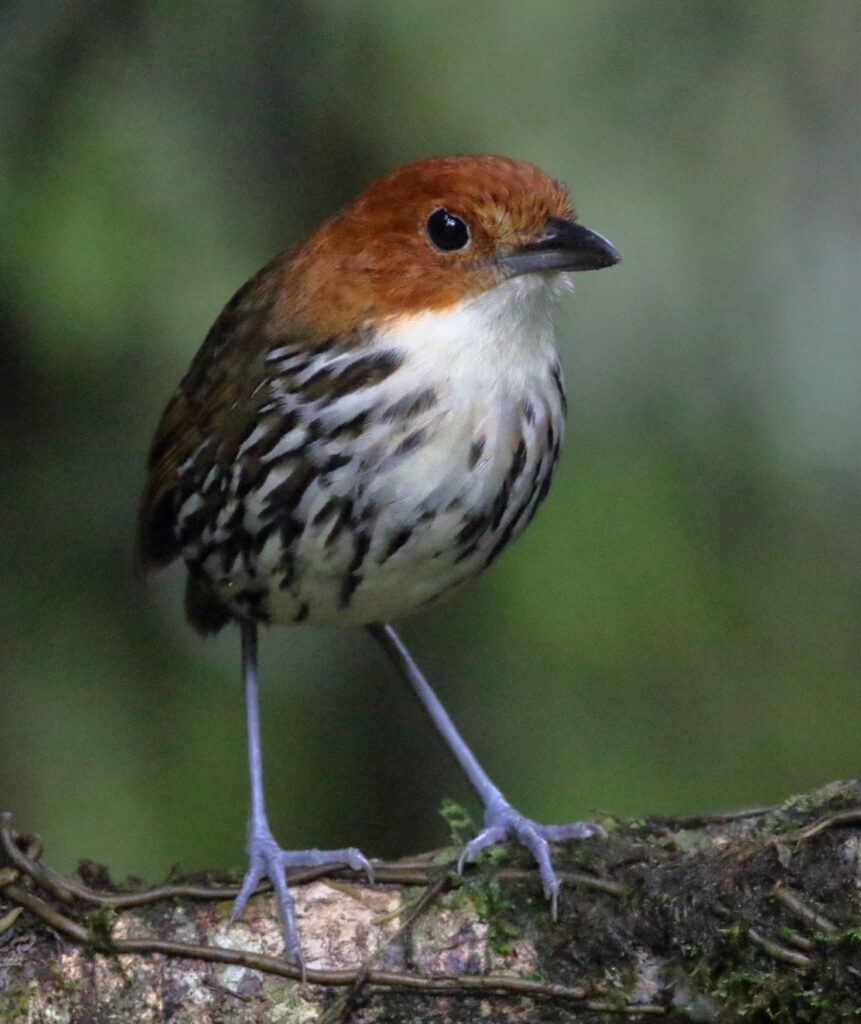
R2D2? No, meet Gordita—a Chestnut-crowned Antpitta that quickly hopped into our hearts.

After a few moments, out hopped one of the most remarkable birds I’d ever seen. It was another antpitta—this one, a Chestnut-crowned Antpitta! The bird was about twice the size of Brownie the Brown-banded Antpitta and to me it looked just like a little R2 unit from Star Wars. In an instant, it became one of my favorite birds ever, and I’m pretty sure Roger felt the same way.

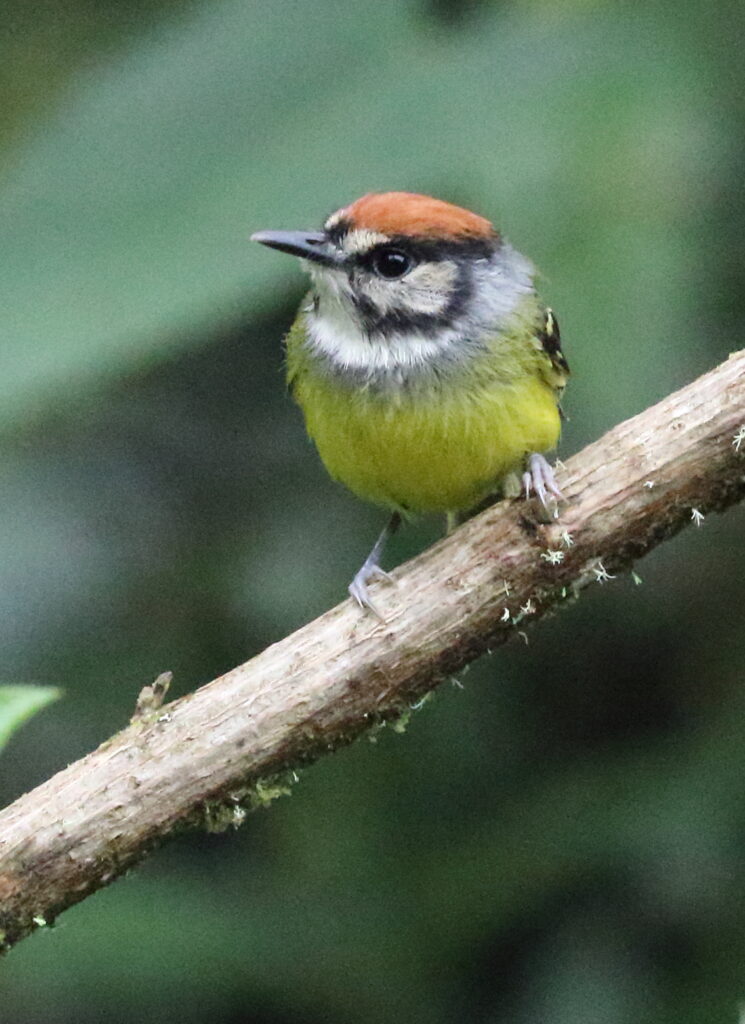
Daniel’s surprises weren’t over. Continuing on down the trail, he called in another remarkable bird—a Rufous-Crowned Tody-Flycatcher. At least three or four of these would easily fit into your hand, but again, we never would have seen it without Daniel’s knowledge and expertise.

Rufous-capped Tody-Flycatcher.

Which brings up an important point about Colombian birding. While it is possible to bird on your own in Colombia, I highly recommend taking advantage of its growing network of lodges. Although much safer than it used to be, the country does still have its share of problems, ranging from common crime and armed conflict to dangerous road and trail conditions. Taking advantage of the expertise of lodges will help make sure you don’t accidentally wander into a hazardous area. Even better, the lodges we encountered use locally-trained, Colombian guides. Many, like Daniel, speak excellent English, and prices are extremely reasonable. By hiring them, foreign visitors are giving a boost to the local economy—and creating more incentive to protect Colombia’s environment.

After getting our fill of the tody-flycatcher, Daniel led us back down to the Social for a well-deserved (or at least well-received) lunch prepared by the Owl’s Watch cook, David. It had been a splendid day all-around and we so appreciated everything Daniel had shown us. Even better, we were excited to have one more day of birding at Owl’s Watch. That, however, didn’t keep us from eagerly anticipating our next great Colombian lodge destination—which I’ll introduce in the next post!

Roger and our guide, Daniel, birding the road above Owl’s Watch.

Owl’s Watch Ecolodge (Colombia Birding Part 2)

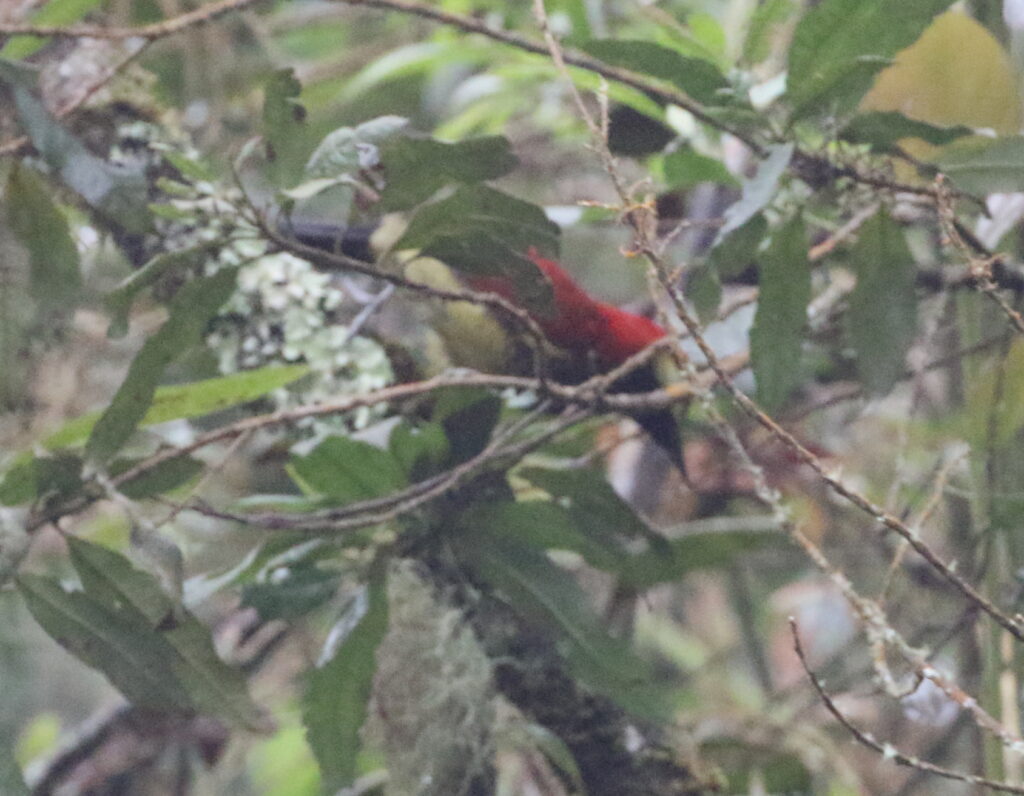
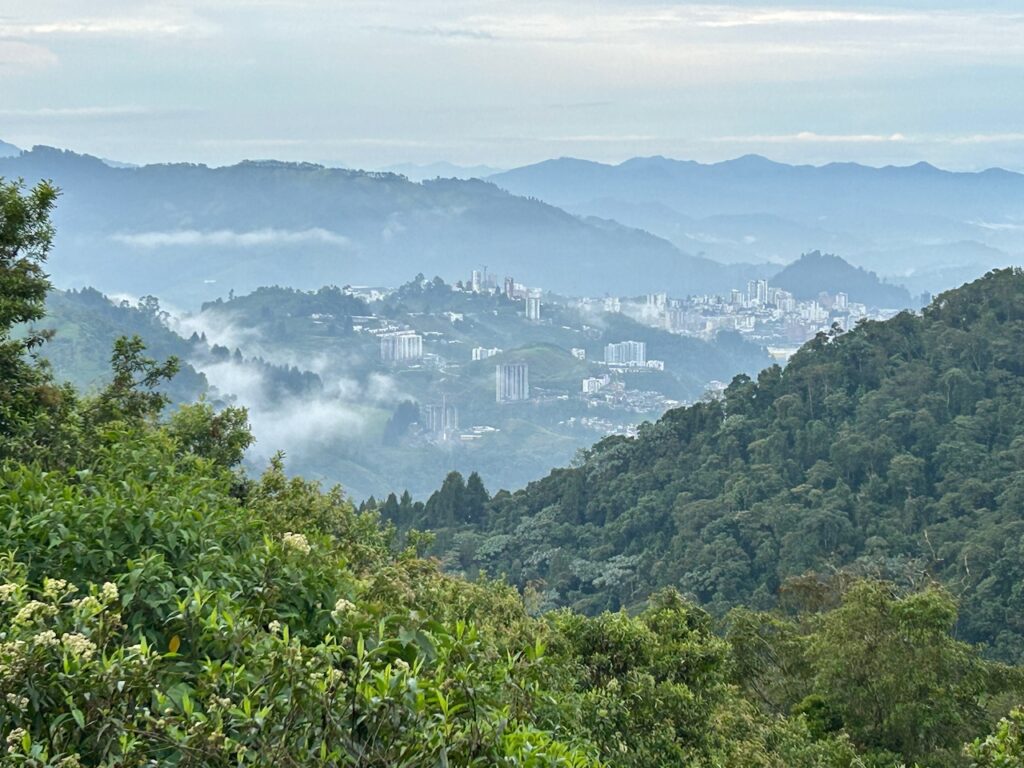
As light spread across the sky, I slipped on my flip-flops and ventured out onto the porch of our cabin at Owl’s Watch Ecolodge in the department (county) of Caldas, Colombia. Misty clouds clung to the Andean peaks surrounding us. Far below rose the high-rise apartments and businesses of Manizales, a city of almost half a million. Unidentified bird calls rang across the vegetation surrounding us and a couple of flocks of Eared Doves flew by on a morning commute. Suddenly, I saw a shape that stirred familiarity. It landed in a distant tree, but thanks to my amazing new binoculars, I was able to focus in on it. Even though I knew very little about Colombian birds, the way it clung to the side of the tree made me  think, “Woodpecker.” Then, I caught a reddish hue on its nape and back, and my excitement rose. When it turned its head, it revealed a large white face patch that clinched the ID. I couldn’t believe it. In my first moments of serious birding in Colombia, I had found one of the birds I most wanted to see: a Crimson-mantled Woodpecker!

It’s risky to post such a crummy photo of a Crimson-mantled Woodpecker as the post’s very first bird shot, but it highlights how difficult it often is to photograph birds in tropical forests—a topic I’ll discuss in a forthcoming post.

As mentioned in my last post, “Layover Birding in Bogota, Colombia”, I had traveled to South America at the last-minute invitation of my friend and FSB contributor, Roger Kohn. Now, only two weeks later, I felt in awe of the fact that we were actually here, about to launch into our first Colombian day of birding together.

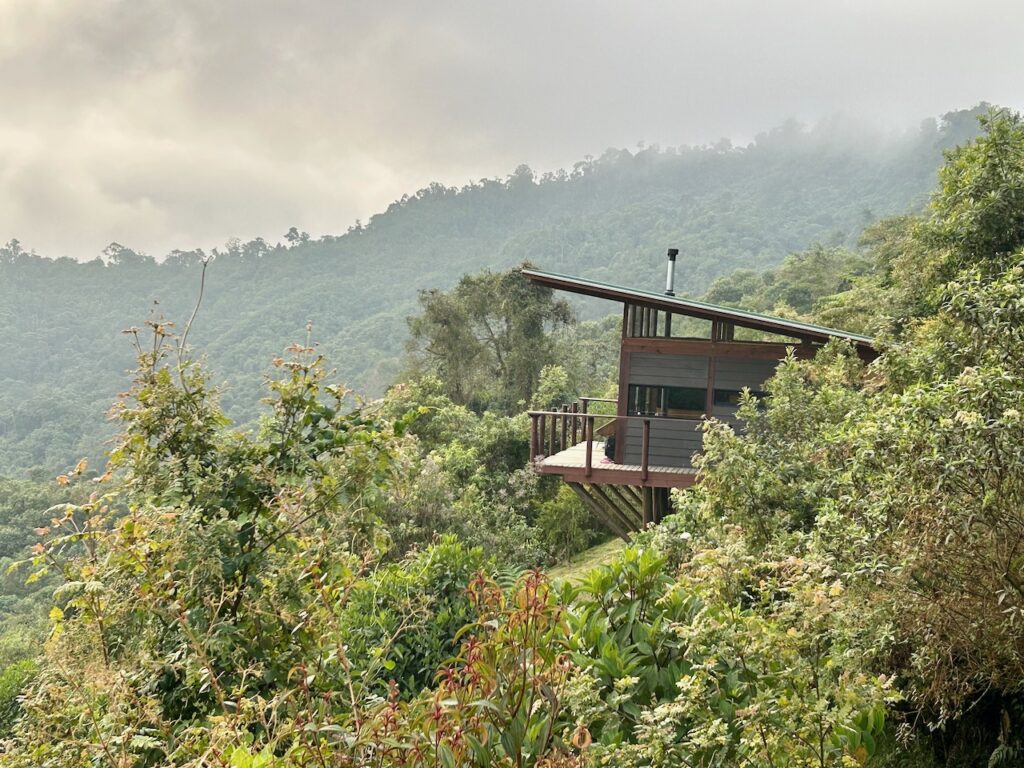
One of the two luxurious cabins at Owl’s Watch, with great views of the surrounding landscape. As popularity of the lodge blossoms, Dennis is considering adding additional cabins.

Roger had planned our entire itinerary, which included booking our first four nights here at Owl’s Watch, a comfortable new lodge with two modern cabins perched at the edge of a large, protected watershed that ensured a dependable water supply for the city of Manizales below. The lodge had been built by American expat Dennis Bailey and his Colombian wife, Adriana. Interested in restoring land that had been cleared for agricultural activities, they had purchased a farm, or finca, that was an inholding of the nearby protected area. As they worked to revegetate the land and allow it to heal itself, they decided to build Owl’s Watch for nature lovers—especially birders.

The following day, we would be heading out with a guide, but today Roger had wisely allocated time for us to bird and explore on our own—a day to get familiar with some of the local birds and rest up from our two-day journeys from the States. I’m more of an early riser than Roger, but to my surprise, he soon joined me on the porch, eager to get started.

One of the amazing things about Owl’s Watch is that you are able to gaze down on Manizales, a city of almost half a million people, while being surrounded by nature.

We decided to begin by climbing the long steep “driveway” that headed up from the lodge to the road above. Almost immediately we saw large turkey-like birds that, from taking eBird quizzes, I recognized as Sickle-winged Guans. Moments later, I glimpsed a furtive shape fly across an opening and dive into a bush—a White-naped Brushfinch.

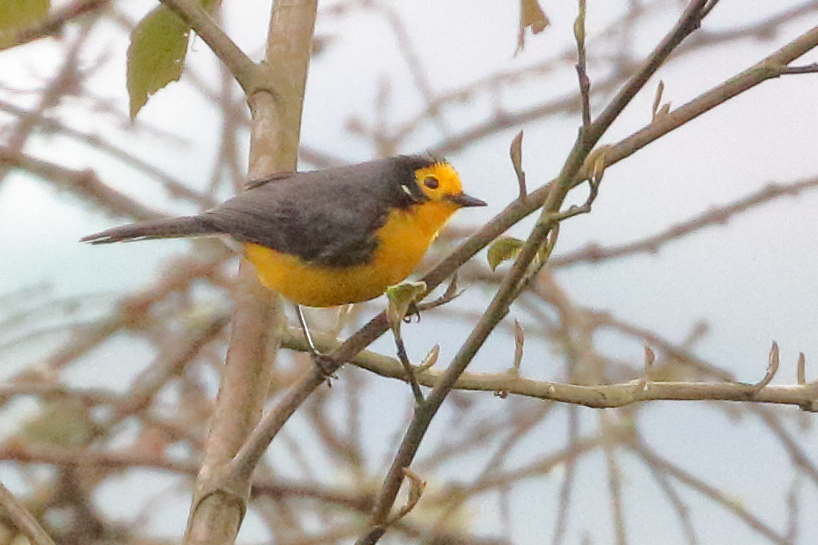
At the top of the drive, we reached a small parking area bristling with even more activity. In the trees surrounding the area, we quickly identified the orange head of a Blackburnian Warbler, and then got super excited to see a pair of equally small birds with bold, sunburst golden throats and breasts—Golden-fronted Redstarts!

Golden-fronted Redstarts, a New World warbler, were one of our exciting finds from our first day of birding at Owl’s Watch.

As I chased these around, Roger used Sound ID to get onto a bird I never thought we would see, Azara’s Spinetail. Its call sounded like “bis-QUICK! bis-Quick!” and while we never got great looks at it, we were thrilled to get a glimpse of this handsome, skulky species.

From the parking area, we headed down a pleasant trail that would wind its way back to the to the main lodge building, dubbed “the Social.” Soon, a covered viewing platform came into sight and we paused to check out hummingbirds at the feeders and flowering bushes surrounding the spot. Someday, I’ll write about my ambivalence about hummingbirds, but I gotta say, they were spectacular to watch. What got me most excited was seeing a White-sided Flowerpiercer. I’d seen my very first flowerpiercer only the day before in Bogota, and here I was, looking at a second species the very next day!

Though not as colorful as many other tropical birds, I was especially excited to discover this White-sided Flowerpiercer. Notice the hook at the end of the bill? That’s a key to picking out flowerpiercers from other small tropical birds.

We continued hiking down the trail, past the Secret Garden, another great birdwatching spot Dennis had set up. Along the way, I spotted a rather plain brown bird that I quickly recognized as a Swainson’s Thrush. As I indicated in my last post, it’s a special thrill to see a bird from “back home” in its alternative, wintering environment. I also took a photo of a nondescript bird that turned out to be a Mountain Elaenia, a kind of tyrant flycatcher.

Don’t get me wrong. I am NOT an expert at identifying flycatchers, but a guide and the Merlin app helped me figure out this Mountain Elaenia.

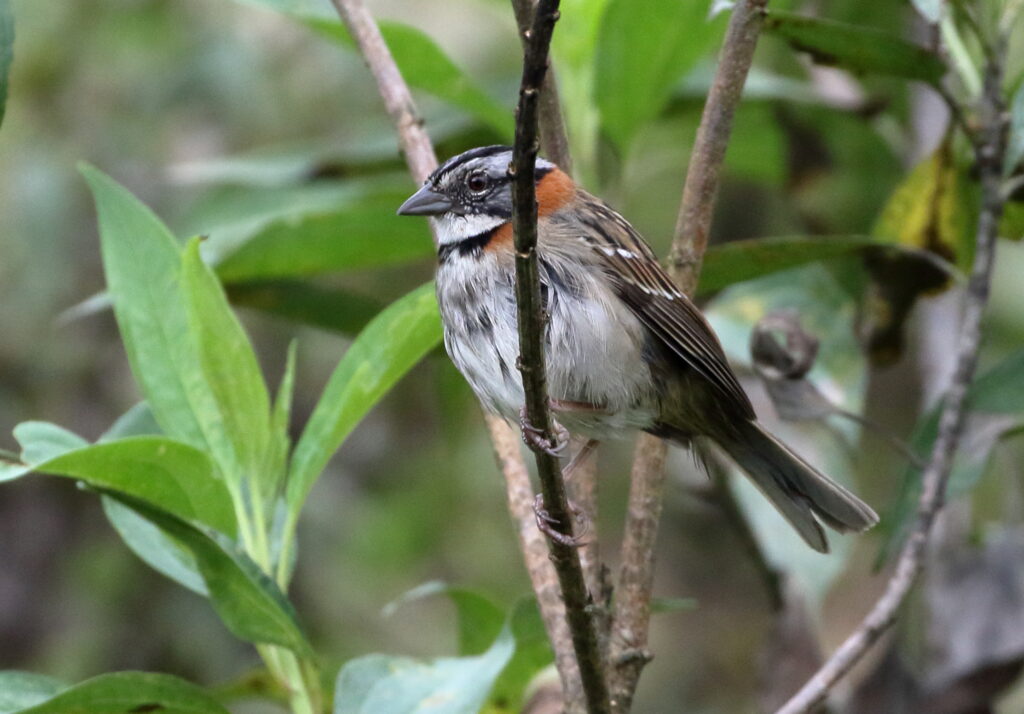
Soon, we found ourselves back at the Social. David, the fabulous Owl’s Watch cook, fixed us a scrumptious breakfast and we dined while enjoying yet more hummingbirds—at least nine species—along with more flowerpiercers, Rufous-collared Sparrows, and Great Thrushes.

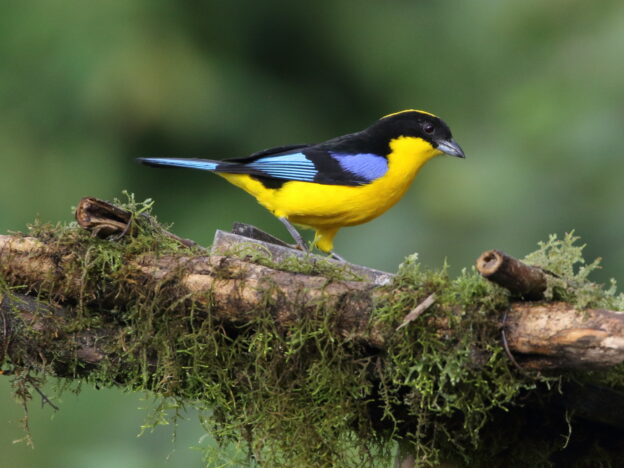
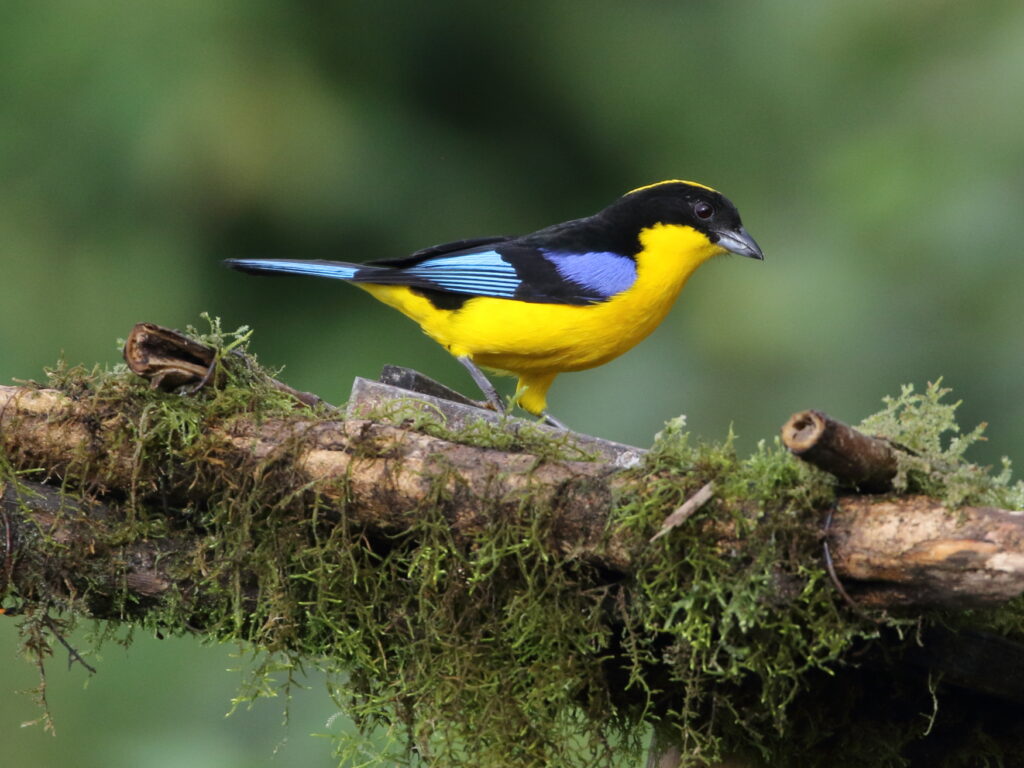
Along with the hummingbird feeders, Dennis’s crew had set up a fruit feeder off to the side, and there we beheld one of the most spectacular of the area’s birds, Blue-winged Mountain Tanagers.

Blue-winged Mountain Tanagers were definitely one of the “best-dressed” birds of our first day birding at Owl’s Watch.

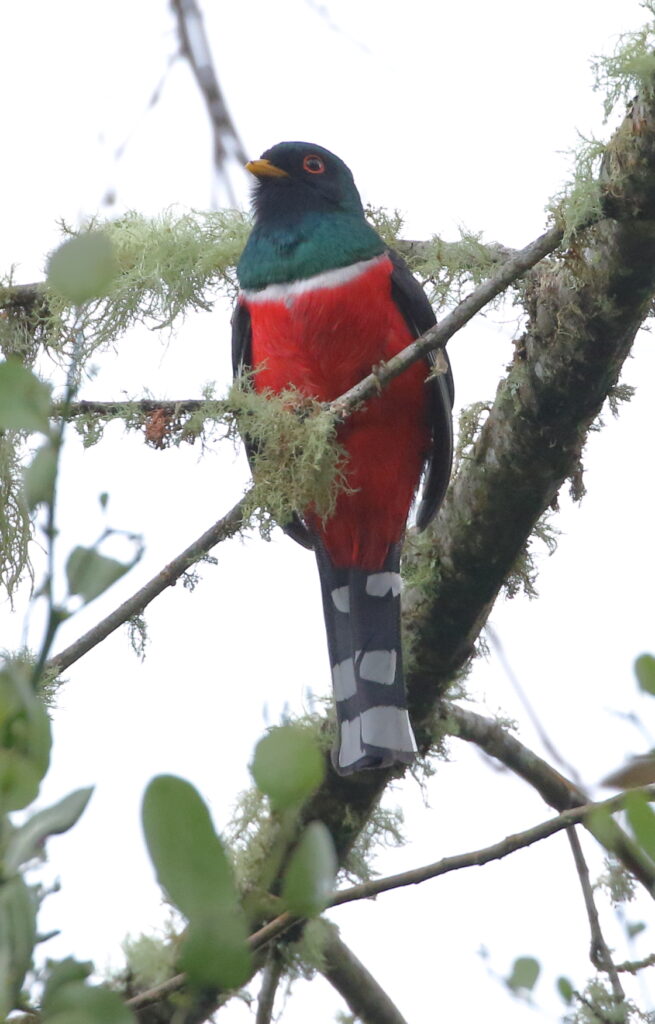
After we got our fill of hummingbirds (if that’s even possible), we took another path that wound around to our cabin. Before our trip, Braden had encouraged me to listen for weird noises, and now I did indeed hear a very bizarre, almost plaintive, series of falling notes. As we rounded a corner, we met the source of these calls—a Masked Trogon! Trogons are some of those birds you always hope to see in the tropics, but when you finally do, you’re left wondering if the bird is really perched there in front of you, or if you’re just imagining it! Fortunately, this was no mirage, and even better, it sat cooperatively while Roger and I did our best to capture decent photos of it against the backlit sky. How did we do? You will have to judge for yourself:

Even this so-so photo reveals what stunning birds Masked Trogons are. While this was our best look at this species of the trip, other trogons would soon follow!

Note: This blog post—and all others on FatherSonBirding—are written by REAL PEOPLE! No compensation or gratuities were provided to us in connection with this post. If you’d like to support FSB, please consider buying one—or ten—of Sneed’s books and contributing to a bird conservation organization of your choice. Thank you!