Tag Archives: Spotting Scopes

Binoculars & Scopes for the Happy Holiday Birder (FSB Shopping Guide, Part 1)

Today, Braden and I celebrate our 250th blog post! We can hardly believe it ourselves, but it just shows what can happen when the passion of birds and birding infuses your souls. We also celebrate our first year of mixing things up by adding book and equipment reviews. Ahead of the holiday buying season, in fact, we’d like to recap some of our favorite items for that “Bird Nerd” in your life—or maybe even for yourself. If you’re tired of buying stuff, we also include some of our favorite groups working to protect birds around the globe. In Part 1 of this three-part effort, we run down great binoculars and spotting scopes. In our next two posts, we’ll talk about some of our favorite bird books and bird conservation groups. As always, we thank you for your interest and urge you to share these posts with your friends and family—especially if you want them to buy you something!

Serious about upgrading your birding optics? Read on!

As 2025 draws to a close, we don’t claim to have tested every brand and model of optics out there, but have been fortunate to put products from both Nikon and Vortex through the paces. We gotta say that if you’re in need of great optics at reasonable prices and with amazing warranties, you won’t do better than these two brands. Nikon products tend to sell close to their official list prices and can be purchased from their website here, or from third parties (see below). Vortex products, on the other hand, usually can be found at much lower prices than what they list for. To get the best price, start with your local indie sporting goods store, but if you can’t find what you want, Dick’s Sporting Goods, B&H Photo, and Land, Sea, & Sky are solid, reputable businesses we’ve had great experiences with.

Binoculars for around $100

Our most popular post of this year was our review of the Vortex Triumph HD 10X42 binoculars, and for good reason. Not only do the Triumphs offer excellent quality at an amazing price, they come with Vortex’s mind-boggling no-questions-asked replacement and repair warranty, something I still can’t believe even exists! One downside to the Triumph HDs is that their minimum focal length is a fairly long 16 feet. Then again, I only need a closer focus than that once or twice a year, so a casual or beginning birder will hardly be affected. See our full review here.
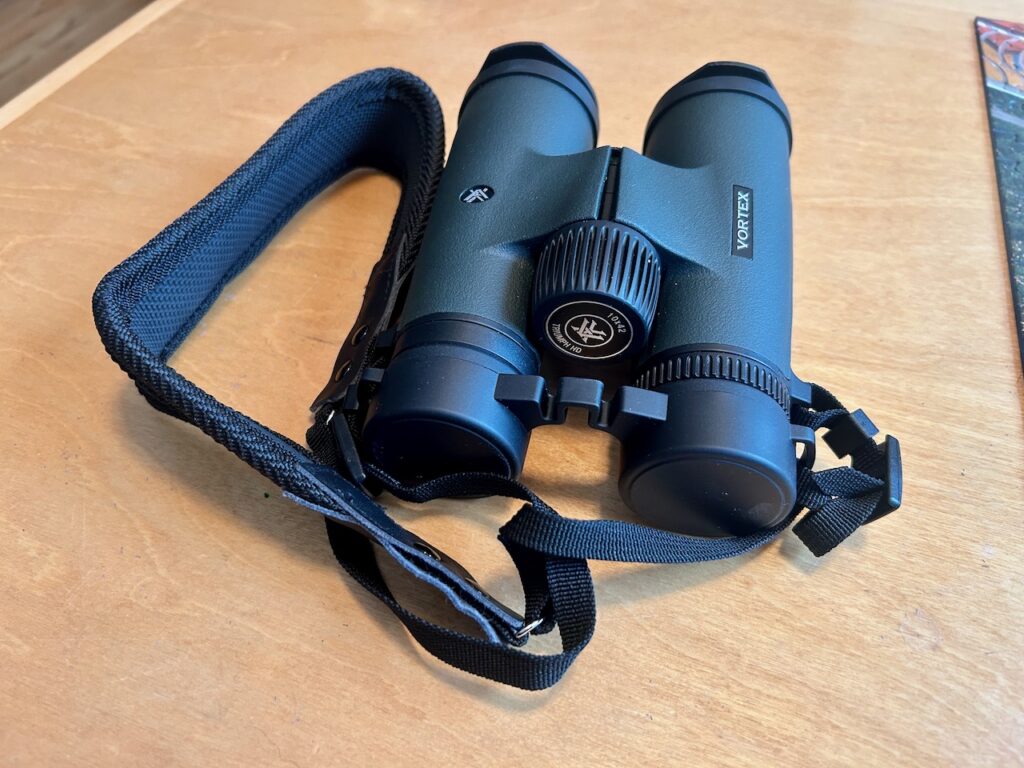
Vortex Triumph HDs offer excellent value for most beginning birders and, like other Vortex products, come with a lifetime no-questions-asked warranty.

Especially if small and lightweight is your goal—or if you’re buying binoculars for the kid in your life—you will also want to consider the new Vortex Bantam HD 6.5X32. Though aimed at kids, these lightweight little gems are fantastic for travel, backpacking trips, or people with sore backs. I loaned a pair to my brother and he didn’t want to give them back! Even more amazing, they can purchased for about $70—a sizzling deal at a time when many of us have to cut back on spending. See our full review here.

Binoculars for about $300

The first serious binoculars Braden and I ever bought were Nikon 10X42 Monarch M5s—and Braden still uses them today! How can that be, you ask? Well, not only are the Monarch M5s solid, well-built binoculars with sharp, clear optics, Nikon offers great repair and replacement policies. Braden has sent his in twice for repair—and received brand-new replacements free of charge. You can’t beat that. For $300, these are an excellent investment for those on a budget, but still wanting binoculars that are up for almost any birding situation.
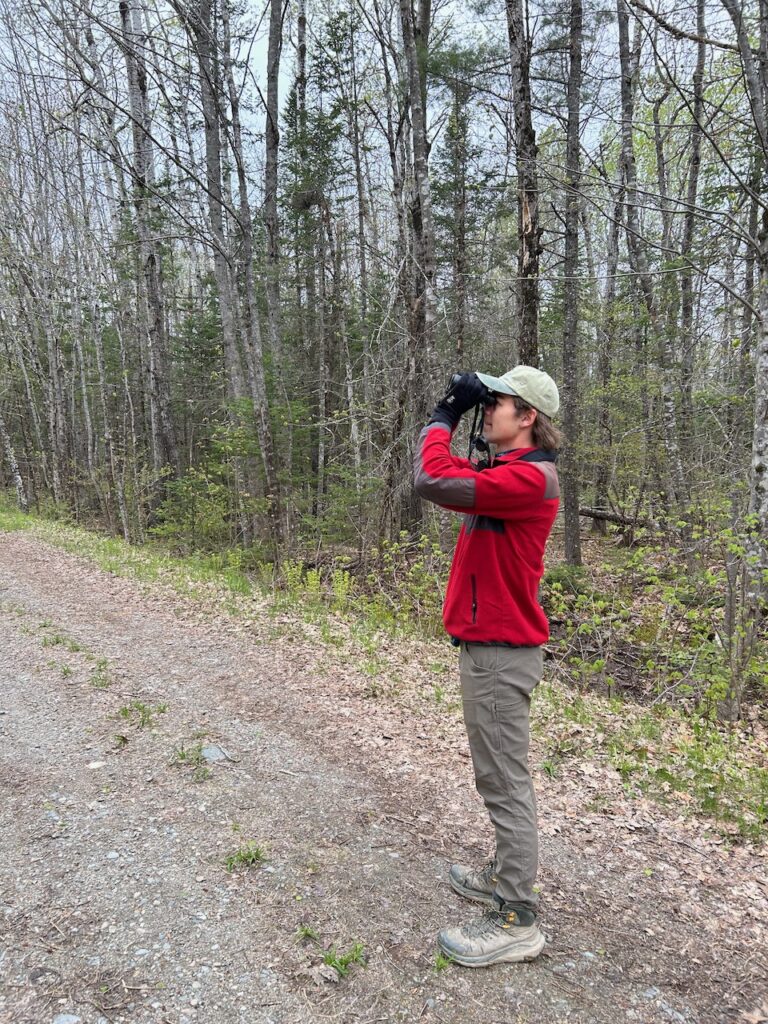
Braden and I both relied on our Nikon Monarch M5s for the first eight years of our birding. They are still Braden’s go-to optics!

“Best Bang” Binoculars for about $500

If you’re willing to shell out just a bit more, I was especially impressed with Vortex Viper HD binoculars. In fact, I’ll go so far as to say that these may deliver the best bang for your buck available. During my trip to Texas last spring, they performed extremely well in a variety of conditions. Our guest contributor Roger Kohn and his wife Claudia also use these and are very happy with them. See our full review here.
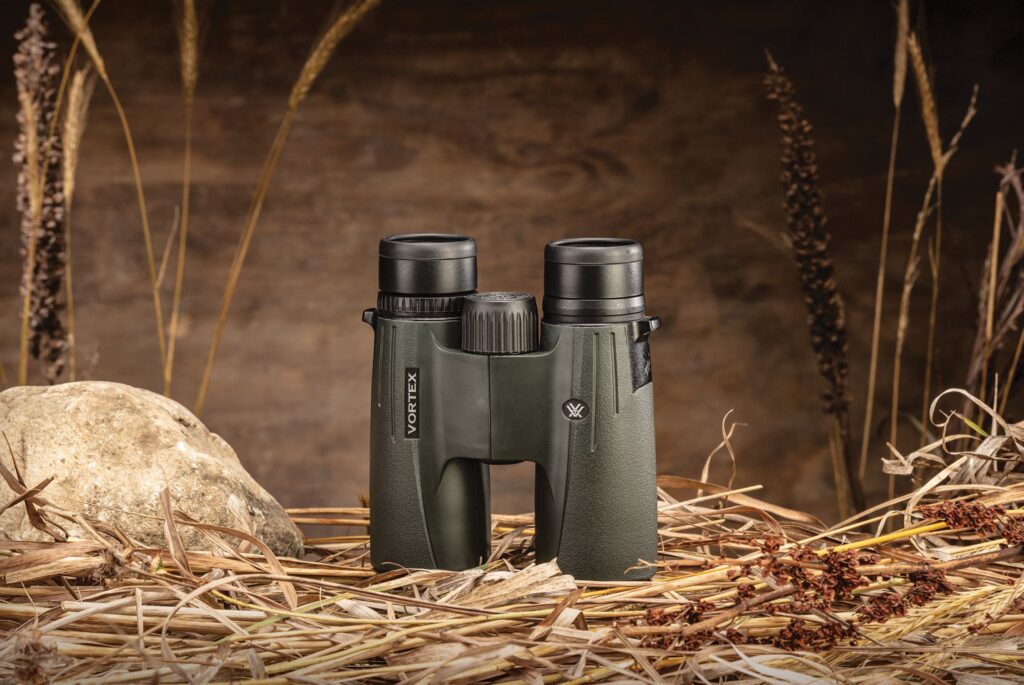
After testing products across the Vortex line, I have to say that I think Vipers deliver the biggest bang for your birding buck!

Gasp! Shelling out a Grand!

I’ll admit it: I never thought I’d be using $1,000 binoculars, but boy am I glad that I do! Especially if you bird a lot in dark, overcast conditions—or even in shockingly bright ones—stepping up the quality can really make a difference. My top pick in this price range? Nikon Monarch HG 10X42s. I took these on last winter’s trip to Colombia and was uber-impressed. My very first morning, I saw a woodpecker fly into a dark, overhanging branch of a tree at least two or three hundred yards away. I thought “No way will I be able to ID that.” When I raised my Monarch HGs to look, though, I was astonished to be able to recognize it as one of the birds I especially wanted to see: a Crimson-mantled Woodpecker! See our full review here. I must add that because these were the first binoculars I reviewed this year, I didn’t realize just how good the optics are, so if you have the cash, you will not regret getting these.

Also in this price range, you will want to check out the Vortex Razor HDs, also priced at about $1,000. I have been using the Razors extensively since last spring and have been very happy with them. I especially love the extra-smooth center focus knob. See our full review here.

Me and my birding amigo Roger in Colombia last February, where my Nikon Monarch HGs delivered superior performance! Meanwhile, Roger is shown happily birding with his trusty Vortex Vipers.

Ready for a Spotting Scope? Sure You Are!

When we first started birding, Braden and I resisted getting a spotting scope because they seemed like such a pain to shlep around. Within a couple of years, we realized that scopes are essential birding equipment. Many, many manufacturers make and sell spotting scopes, but I’ll tell you, this is a purchase you will want to stretch for. We bought a cheaper scope in the $300 range—and are sorry we did. A couple years later, we sprung for a Vortex Viper HD 20-60X85, and love it. I just looked these up at B&H Photo and it looks like they can be had for about $700—a screaming deal. Don’t forget, though, that you also need a tripod to go with that scope. If you can afford it, I recommend buying a Vortex tripod to go with your Vortex scope, so that you won’t have to keep messing with a tripod adapter, which will invariably come loose as you are lugging your scope around.
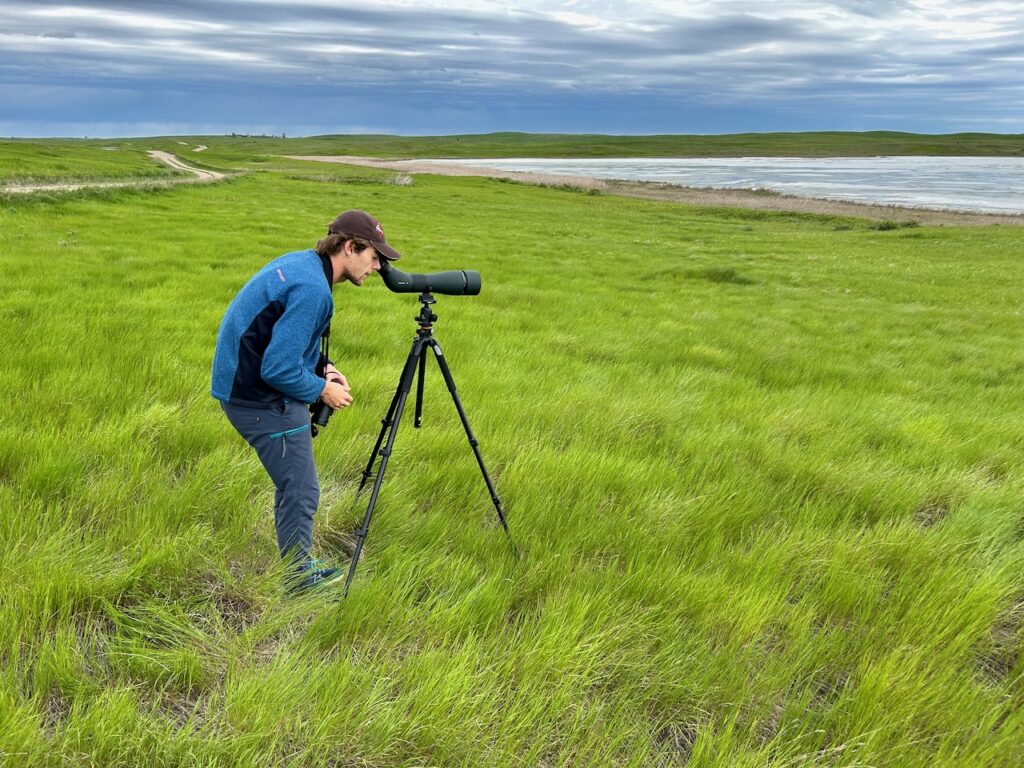
Braden zeroing in on a rare Piping Plover in eastern Montana using our beloved Vortex Viper HD 20-60X85 spotting scope.

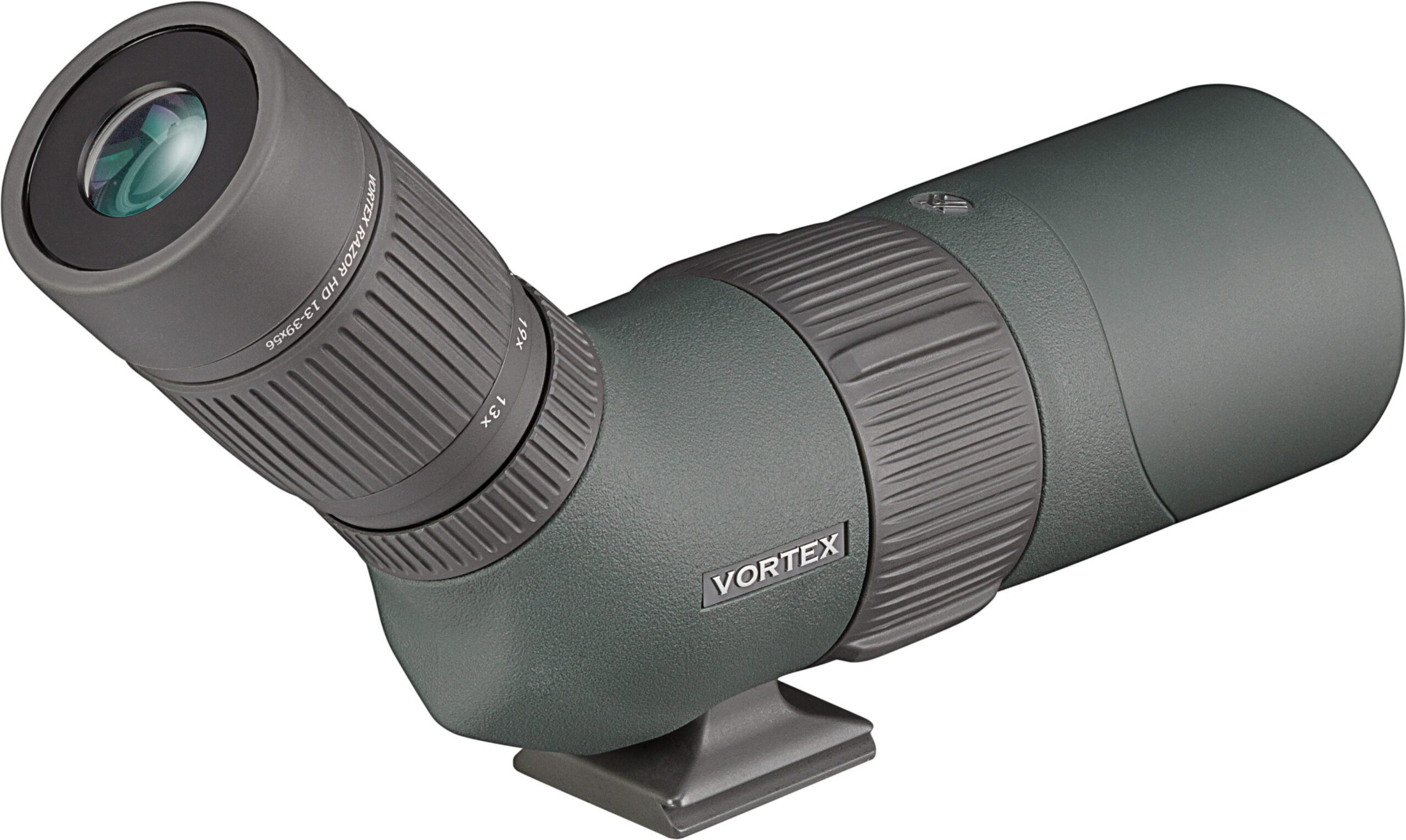
The above scope is definitely a “car model,” meaning it’s heavy enough that you won’t want to carry it more than a couple hundred yards. Last summer, though, I also tested a Vortex Razor HD 13-39X56 spotting scope with Mountain Pass tripod. At a total weight under five pounds, this lightweight combo is perfect for taking on planes in your backpack or even heading out into the wilderness if you’ve got to have a spotting scope with you. Just checking different outlets, it looks like the scope/tripod combo can be had for about $1,000 right now. It won’t pack the magnification of the bigger scope mentioned above, but it’s a great trade-off for those of us who travel a lot. In fact, I didn’t want to send my evaluation scope back to Vortex and am considering buying one for my own holiday gift! See our full review here.
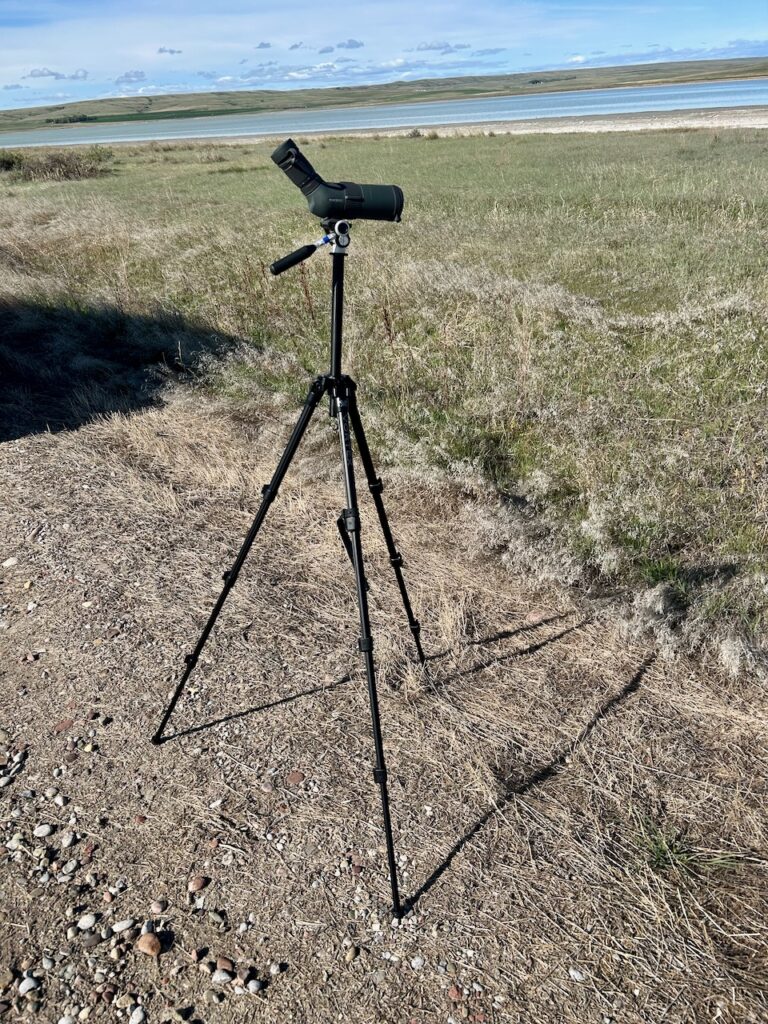
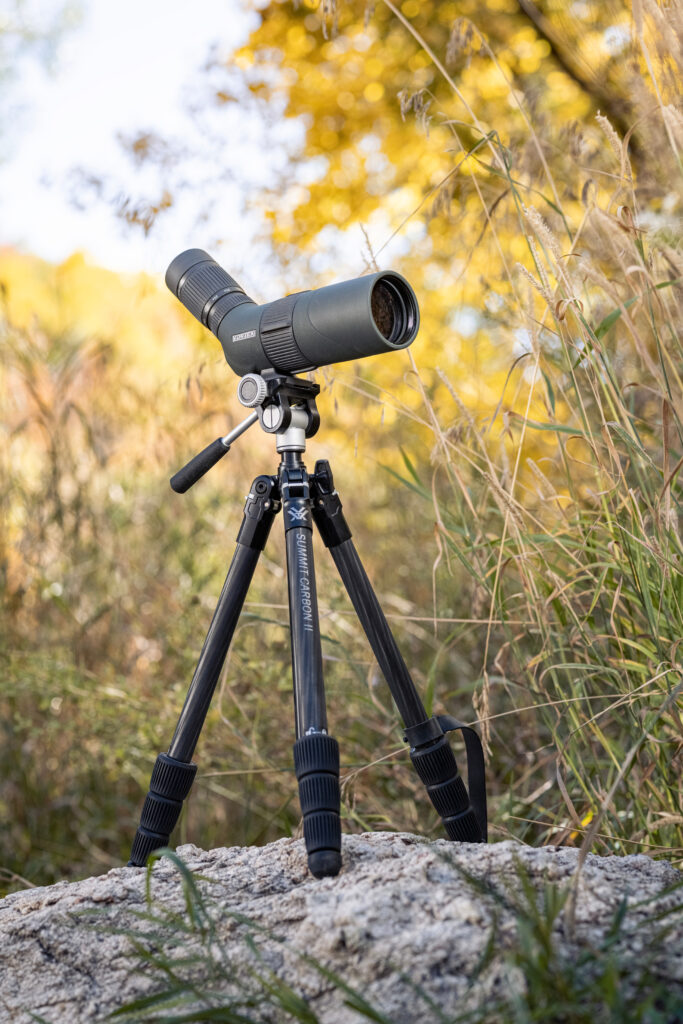
In calm conditions, the Razor HD 13-39X56 and Mountain Pass tripod perform like a dream. Because they are lighter, wind produces more shake, just as it does for all but the heaviest scope/tripod combinations, but a convenient hook allows you to hang a stabilizing weight from the tripod.

Vortex Razor HD 13-39X56 spotting scope with Mountain Pass tripod: A Perfect Travel Combo? (Equipment Review)

When it comes to equipment, birders tend to follow similar progressions. With binoculars, for instance, most of us start by borrowing any binoculars at hand. From there, we buy our own binoculars, focusing more on the sale price than the quality. Then, one day, we happen to look through a friend’s really good binoculars and it’s like “Whoa! I’ve got to save up for these!” If you’re at that point, check out our two recent reviews of binoculars that we highly recommend:

Birders, though, also go through a progression with spotting scopes, from not thinking we need one at all to wanting to get the best possible scope we can afford. But birders who travel a lot also progress to another step: getting a scope that is easy to travel with. Which is where I currently find myself. After going through the typical birder “evo-scopo-lution,” Braden and I bought ourselves a Viper HD 20-60X85 a couple of years ago. I can’t sing the praises of this scope highly enough. I like it so much that I lugged it with me on recent trips to California (see our post “Chasing Migrants”) and Canada (see our post “Birding Victoria, BC”). The problem? It’s not exactly travel-friendly. At eighteen inches (45 cm) long and weighing in at five pounds (2.3 kg), just the scope alone demands some tough packing decisions. Add in five pounds for a sturdy tripod, and just like that, you’ve increased your travel calculations by an awkward ten-plus pounds!

I was discussing this dilemma with a Vortex dealer account manager recently and I asked him, “Hey, do you have any good travel scope/tripod combos I can try out?” Three days later I received a Vortex Razor HD 13-39X56 scope with a Vortex Mountain Pass tripod. Even better, I was just about to head out on a trip to central Montana where I would be able to put it through its paces (see our last post, “Hi-Line Report”). But before I critique this dynamic duo, let me give you some basic stats:

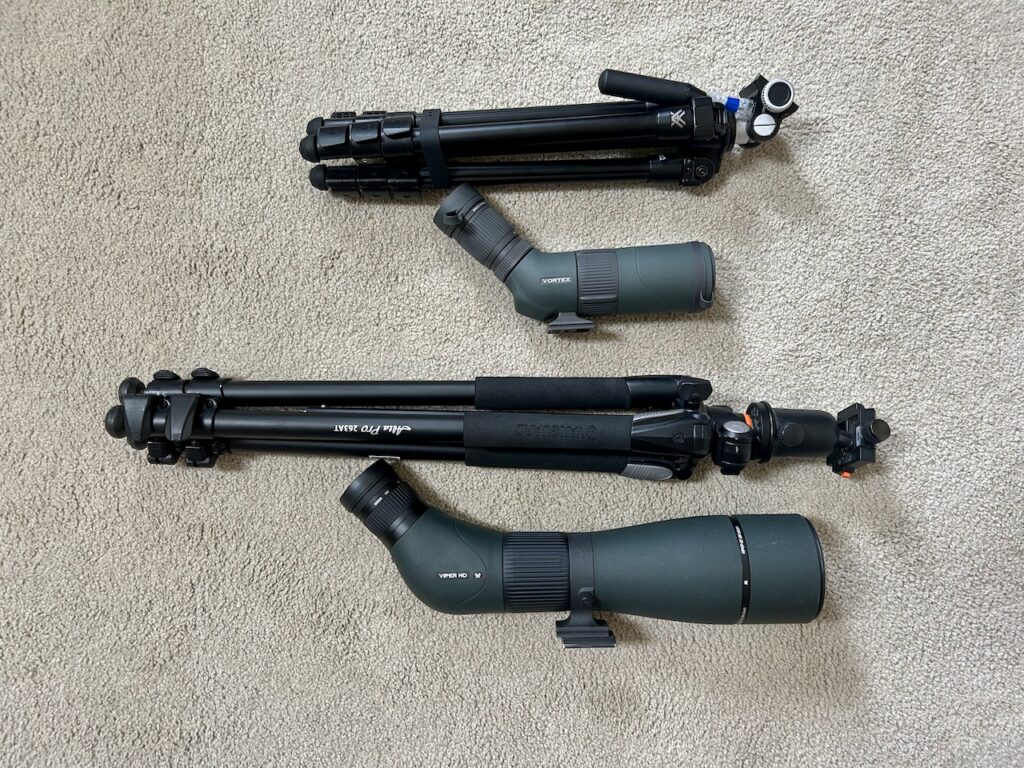
* Fully assembled, the Razor HD 13-39X56 scope measures only 10.5 inches long—short enough to fit into almost any backpack. When the eyepiece is removed, it shrinks to an incredible 8 inches!

* The Razor HD 13-39X56 weighs only 1 lb. 14 oz—less than one of those silly two-pound weights many of us buy for rehab exercises.

* The Mountain Pass tripod measures just over 21 inches—also short enough to slip into many backpacks—and weighs almost exactly 3 pounds.

One glance shows the dramatic difference between packing my usual scope/tripod combo (bottom) and the Vortex Razor HD 13-39X56 scope with Mountain Pass tripod (top).

In other words, the entire combo comes in at an almost feather-light 5 pounds—less than half of what I am used to lugging around. This alone gave me a huge crush on it! But (suspense building), how did it perform? I had the chance to use the scope in both optimal and stormy conditions, so let me take those one at a time.

Optimal Conditions: Basically, I could not be more pleased with the Razor HD 13-39X56/Mountain Pass combo in great conditions. For its size and weight, the scope’s optics are terrific, giving sharp, clear images at distances of at least a couple of hundred yards. In fact, under the vast majority of conditions, interference from heat waves and similar air turbulence will distort the image before the scope’s distance precision is exceeded. Birds and other animals look like they are almost right in front of you in all their crisp, colorful glory. What’s more, I took the combo out on a two-mile jaunt at a local birding hotspot and hardly paid it any attention as I strolled along with it resting over my shoulder. This is in sharp contrast to my other, heavier scope/tripod combo, which Braden and I have to frequently trade carrying as it digs into our shoulders.

I did not try this myself, but the scope is light and convenient enough to easily mount on a window, say, at Freezeout Lake or Bowdoin? (Special window mount required.)

Stormy Conditions: During my recent trip to Bowdoin National Wildlife Refuge, I unfortunately encountered very gusty conditions. As you might imagine, using the scope/tripod combo proved more challenging. The optics, of course, stayed the same, but the combo’s light weight began to be a factor. I had to hold down the tripod with one hand to reduce shake enough to get on distant ducks and other birds—but this is a problem even with my heavier scope/tripod combo and every other combo that I have used in windy weather. To help compensate for this, the Mountain Pass tripod comes with a hook from which you can hang a stabilizing weight, but that means you have to bring this along with you (or use a boot, young child, or other handy hangable weight). I did not try this myself, but I’d guess that even with the weight, gusty conditions will pose a challenge. That’s no criticism of the combo—just a fact of birding life.

In calm conditions, the Razor HD 13-39X56 and Mountain Pass tripod perform like a dream, as I learned on a recent trip to Freezeout Lake near Great Falls. Because they are lighter, wind produces more shake, just as it does for all but the heaviest scope/tripod combinations.

To help matters, you don’t have to use the lightweight Mountain Pass tripod. The Razor HD 13-39X56 is so good that you might make it your only scope purchase, and if you do, you might consider buying a heavier tripod that will deliver better performance in rough conditions.

As this photo clearly shows, beefier carbon-fiber tripods are available for the Vortex Razor HD 13-39X56. Check out the Vortexoptics.com for details.

However, the point of this article is lightweight travel, and I have to say that the Razor HD 13-39X56/Mountain Pass combo strikes a wonderful balance between weight, magnification, and quality. An added advantage to this combo is that because Vortex makes both products, you won’t need an additional mounting plate to affix the scope to the tripod. Mounting plates generally are a pain in the rump, always coming loose at inopportune moments, so for me this is a significant advantage.

You are probably asking yourself, “Does the Vortex Razor HD 13-39X56 scope have enough magnification for distant birds?” With a maximum magnification of 39, the answer is that it certainly has less than what I have on my 60X85 scope. That said, I did not feel very limited by this. Again, in my experiences atmospheric disturbances are usually more likely to limit your observations than the power of this scope.

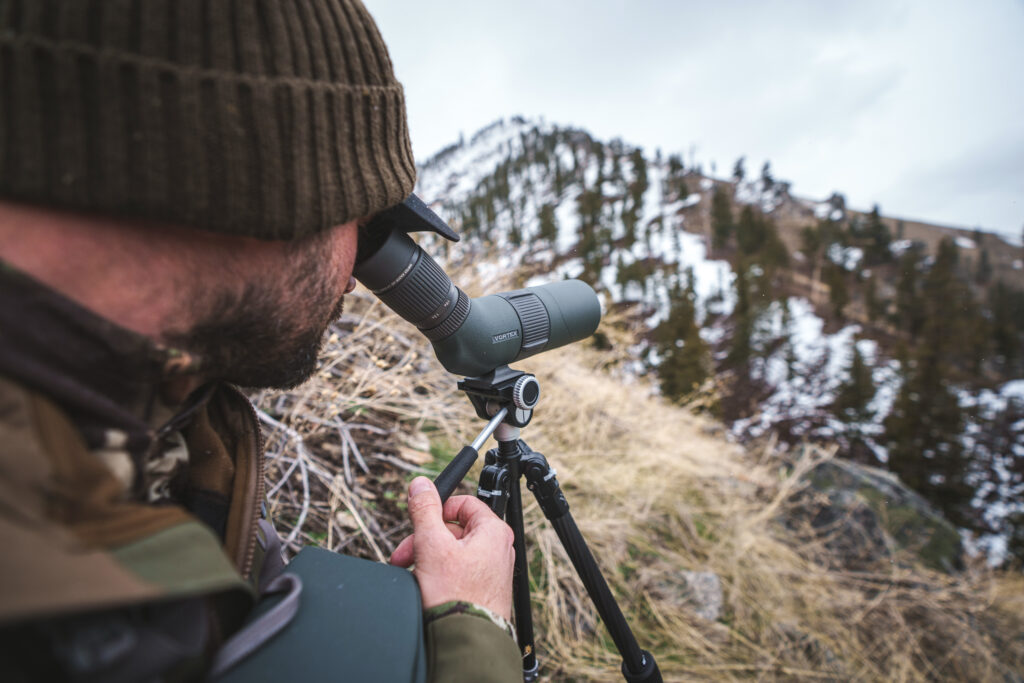
This guy is obviously using his scope to check out a Northern Goshawk for his life list. Er, or maybe he’s looking at an elk. Either way, the Vortex Razor HD 13-39X56 delivers enough oomph (magnification and clarity) to serve as your primary birding scope in most situations.

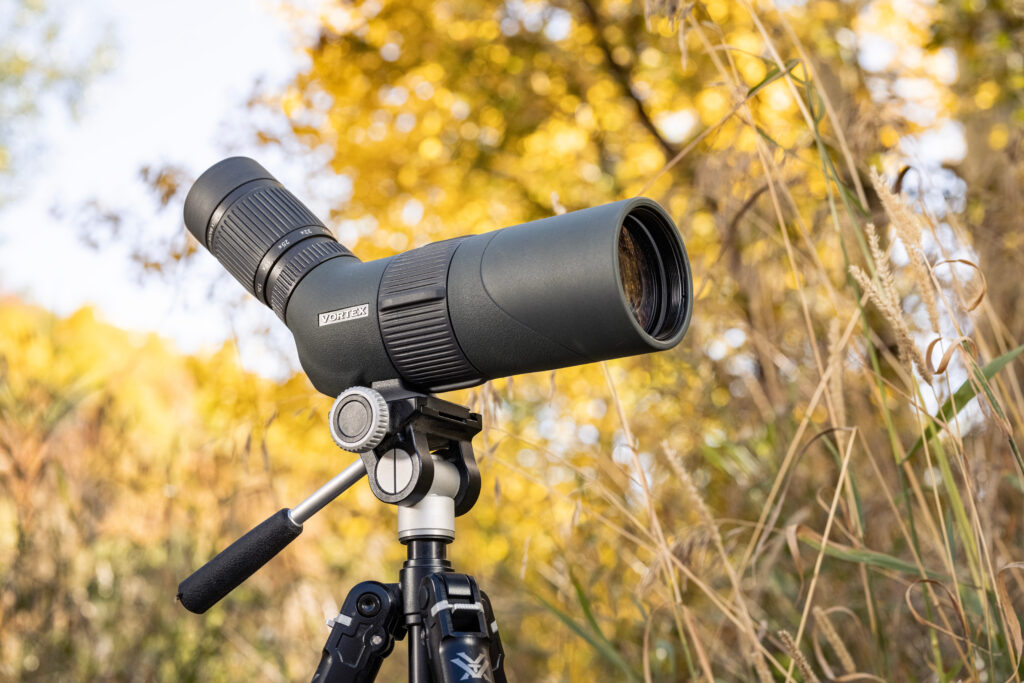
More about the tripod: I should point out that before receiving the Mountain Pass tripod, I was a strict adherent to “ball head” tripod heads, ones that allow you to quickly tilt and rotate the scope in any direction with a single control knob. The Mountain Pass head, though, comes with a “pan and tilt” head, but unlike some other pan and tilt heads I’ve used, both the pan and tilt also are controlled by a single knob. This makes the whole thing almost as easy to use as a ball head. To lock down the swivel of the head, you just hand-tighten the knob further. I suspect that this may wear out or get stripped over time, but as I’ve mentioned in other posts, Vortex’s lifetime warranty has you covered.

Like many other tripods, the Mountain Pass features four-part, telescoping legs that allow it to adjust to almost any height (though folks over 6-feet tall may want a taller tripod). The tripod legs also have levers that allow them to splay extremely wide for observing, say, a grouse lek at eye level.

Pricing: I have been so taken with this scope that I’ve neglected to mention the price. Although listed considerably higher, the Vortex Razor HD 13-39X56 scope can currently be purchased for right around $1000 while the tripod runs about $150. These are not insignificant sums, but are a great value for the quality you get—as anyone who has used cheaper scopes and tripods will quickly learn.

Bottom line: I love the Vortex Razor HD 13-39X56/Mountain Pass combo and am deeply upset that I have to return it to Vortex. Who are they to ask for their equipment back, anyway? I suspect, however, that I will be purchasing this combo in the future and am already looking forward to using it on a host of future travel birding adventures.

The Vortex Razor HD 13-39X56 delivers a high-quality, reasonably-priced product that is both outstanding for travelers, and powerful enough for most everyday birding situations.