Tag Archives: Seabirds

San Diego Seabirds

Well, it looks like we have solved our Russian hacker problems but we’re still missing half of our subscriber list. You can help by sharing this with your birding friends and urging them to resubscribe. If you have a problem doing this, please let us know at collard@bigsky.net and I’ll subscribe you. We thank you, birder to birder!

Our last day of the San Diego Bird Festival took us away from shore on the mighty birding (and perhaps fishing) vessel New Seaforth. This would be Braden’s and my third California pelagic birding cruise and in many ways it proved the most memorable. Almost immediately upon leaving the safety of Mission Bay, we began seeing dozens of Black-vented Shearwaters heading north and, of course, we followed them. They led us to a massive fish feast, where from 5-10,000 shearwaters gorged themselves on acres of anchovies. At least a thousand gulls, countless cormorants, and sea lions and common dolphins joined the fray.
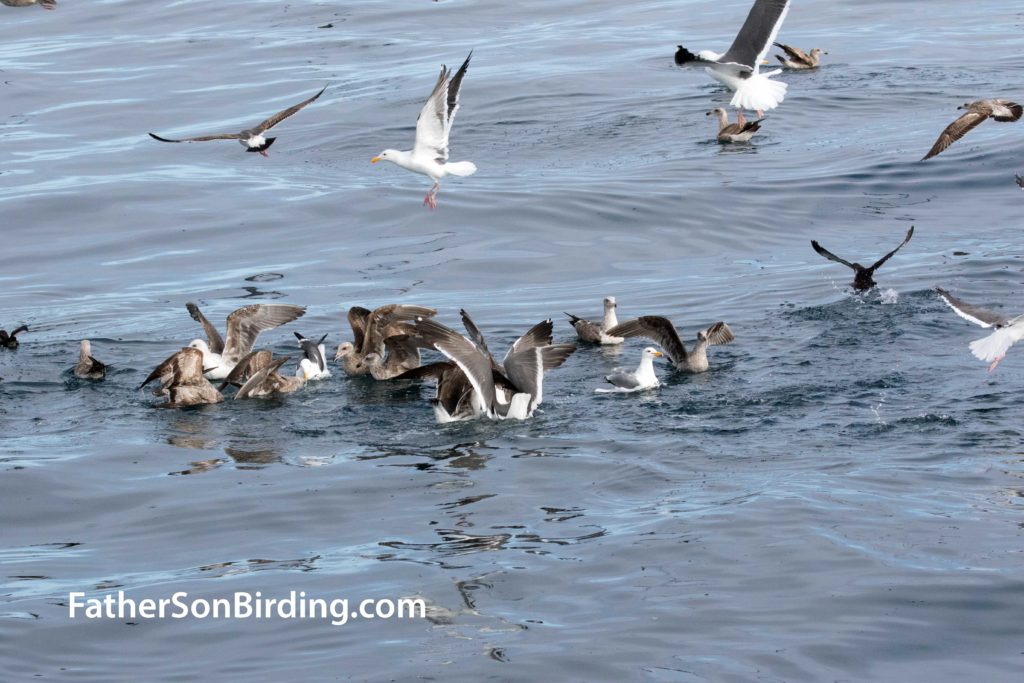
Every time a shearwater surfaced stuffed with anchovies, gulls mobbed it until it regurgitated part of its catch. Note the shearwater on the far right fleeing the gang ‘o gulls!

After enjoying this spectacle for half an hour, we turned south and angled farther out to sea. Braden said, “I have three priorities today: Scripps’s Murrelets, Pomarine Jaegers, and Brown Boobies.” My own priority was simpler: I really wanted to see a Brown Booby—or any booby for that matter. It wasn’t long before our target species began showing up.
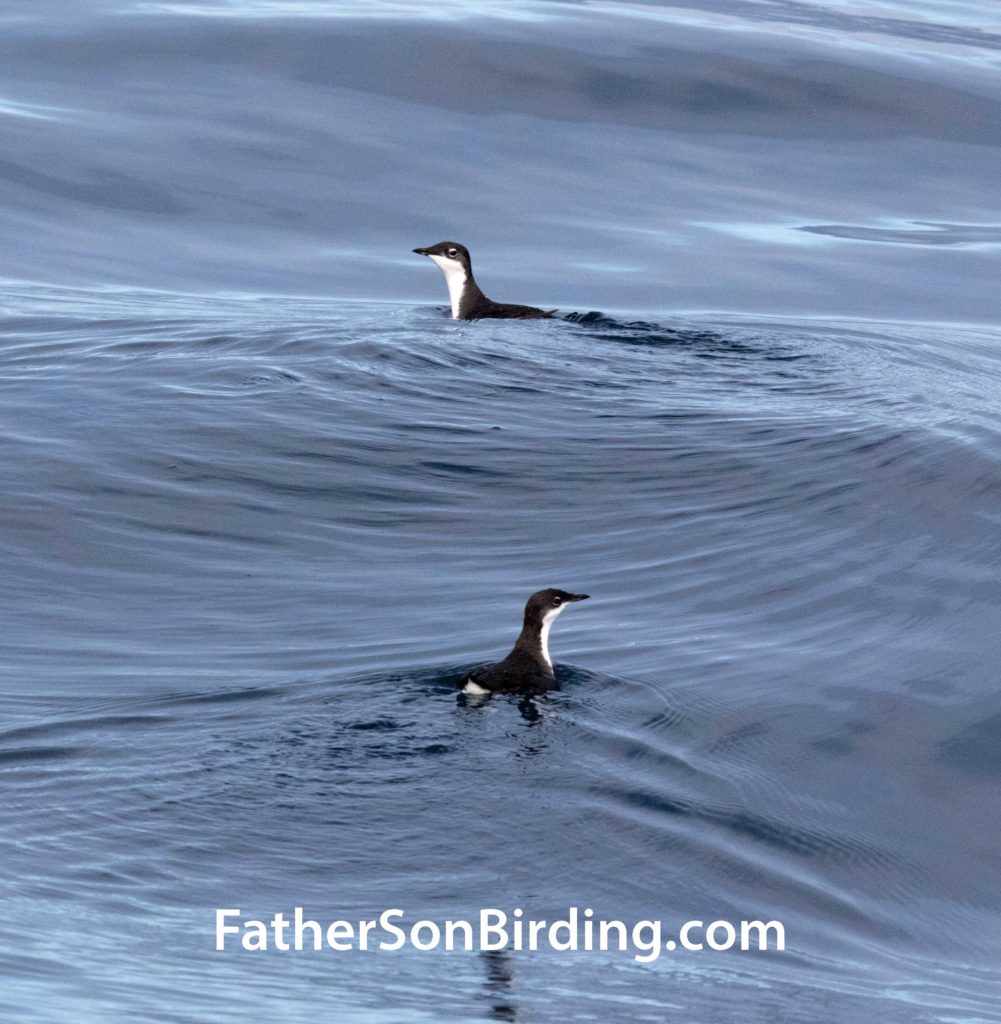
Scripps’s Murrelets were only described for science in 1859 and were heading toward extinction before efforts to rid their nesting islands of invasive rats and cats.

Undoubtedly the stars of the day were the Scripps’s Murrelets. These birds nest only in the Santa Barbara Channel Islands and on Mexico’s Coronado Islands, which loomed in the distance. The murrelets lay gigantic eggs compared to their body sizes—a full twenty percent of an adult’s weight. This advanced “in egg” development is no accident. Only two days after hatching, the chicks sneak away to the ocean to be raised by their parents almost entirely at sea. As we steamed south, we saw more and more of these adorable alcids, usually floating in pairs.

The boat “chummed” with popcorn, and that kept the gulls busy behind the boat, but also attracted brief visits from Braden’s second target, Pomarine Jaegers. Then Paul Lehman, our leader for the day, shouted over the PA, “Brown Booby at 12:00 o’clock, coming straight toward the boat!”
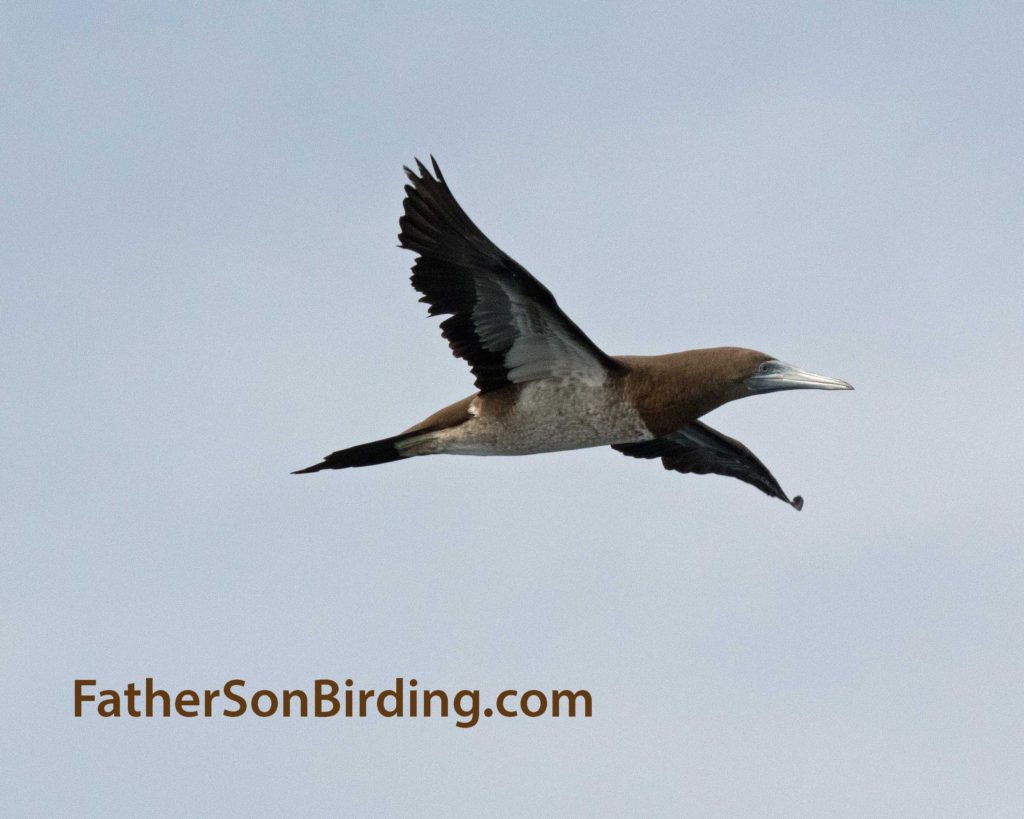
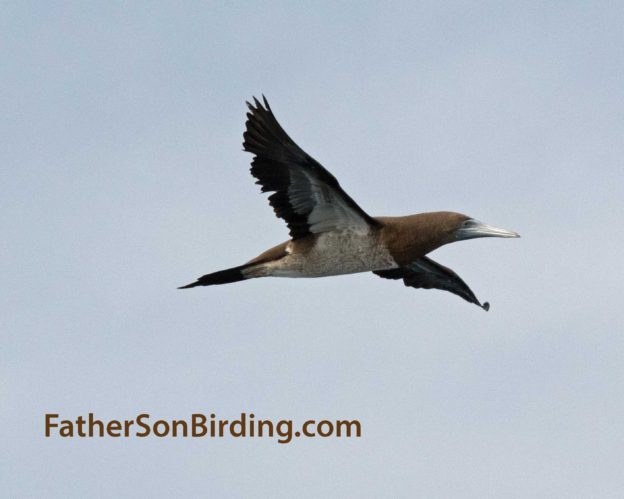
Braden and I had longed to see a booby in American waters since visiting the Galapagos in 2016.

I hurried to the rail in time to see the elegant “gannet shape” of the booby as it sped fifty yards off the port side. The bird even did a quick circuit around the stern, giving us all good looks at its handsome chocolate-covered head and back before speeding away again.

“Yes!” I whispered to myself.

The day wasn’t without its challenges. The steady 3-foot swell took a toll on Braden, forcing him below deck for part of the journey. Still, he agreed that the birds were worth the queasiness and, as if to drive home the point, a pod of common dolphins escorted us part of the way back to the mainland.

Hasta la vista, San Diego—until the next time!
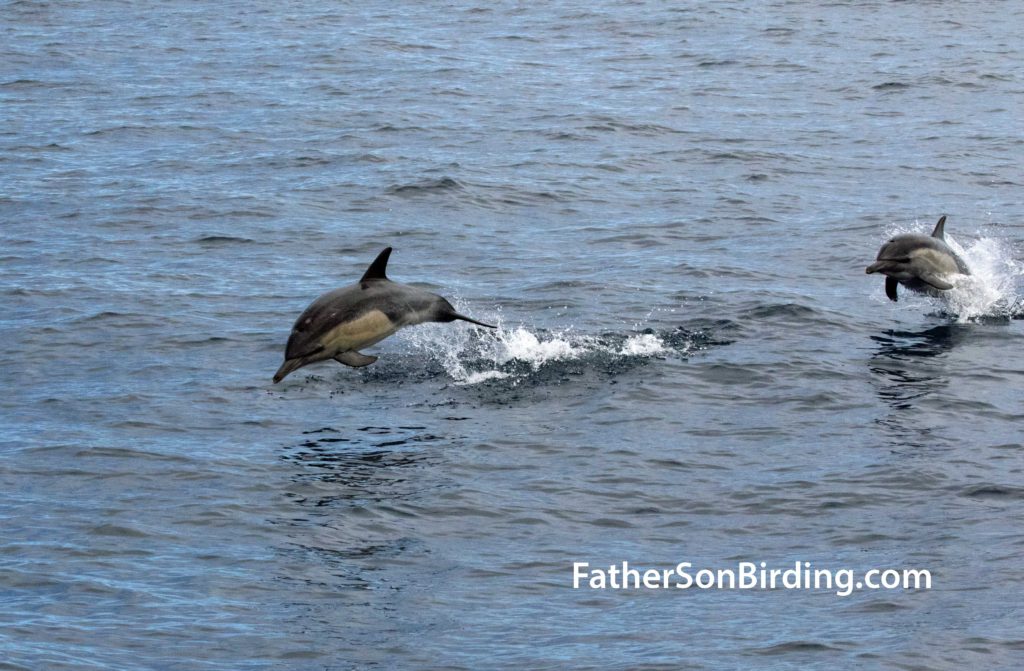
Dolphins are a highlight of any pelagic birding adventure—even if they are mammals!

Icelandic Seabird Storm

To Subscribe to FatherSonBirding, please fill out your name and email in the appropriate boxes in the right-hand column. Thanks, and don’t forget to share 🙂

Braden here again for my second Iceland post.

Saturday, July 14th, 2018. 9:00 a.m.

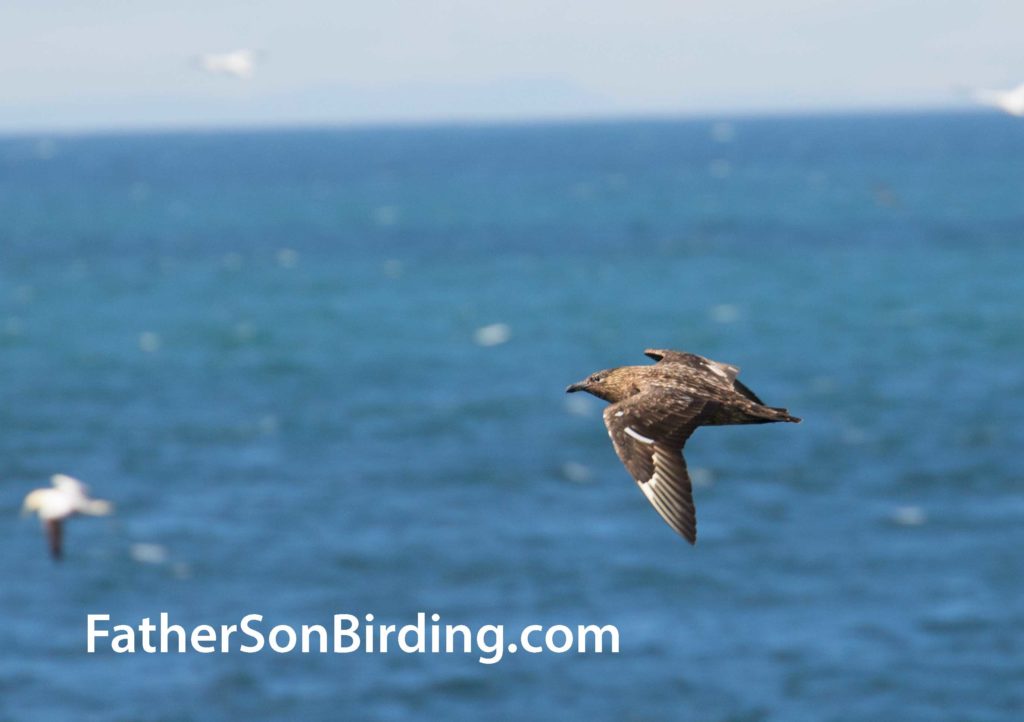
I have just finished breakfast and arrived on the bridge of the National Geographic Explorer. We are continuing our circumnavigation of Iceland, and this is our first day with some free time at sea. I have chosen to spend that time on the bridge, searching for marine mammals and possibly life birds. There are two seabirds in specific I am hoping for: Great Skua and Northern Gannet. Neither are particularly rare, but I have yet to see them.

Great Skuas, the “pirates of the seas”, will chase down other birds and steal their food. (Photo by Braden Collard)

James (Jamie) Coleman, one of the ship’s naturalists and leading bird experts, is also on the bridge, and he knows my quest. “You seen a Skua yet?” he asks me. “They’re everywhere this morning.”

“No, I’ve mostly been focusing on sleeping and eating.”

“Ah. I guess that’s also important. Anyways, keep your eyes open. We’ve also seen some White-beaked Dolphins.”

I settle into a chair, and, seeing no activity in or over the water, begin reading a large guide book titled Marine Mammals of the World.

“Is that the one by Bob Pitman?” Jamie asks.

I nod.

“He’s seen every marine mammal in the world but two, I think.”

“Has he seen a Vaquita?” I ask, knowing that the endangered porpoise’s last stand was going down in the Gulf of California.

“Yeah—he’s working with the Mexican government right now to save them.”

“Cool!”

“Oh, I’ve got a skua!” Jamie suddenly exclaims. “Flying right in front of the bow!”

I quickly raise my binoculars to see a large, dark bird with silver wing patches flying directly in front of the ship, its wingbeats heavy.

Approximately one second later, the Explorer’s captain, Aaron Woods, shouts, “Gannet! Even with the horizon—two o’clock and moving left!”

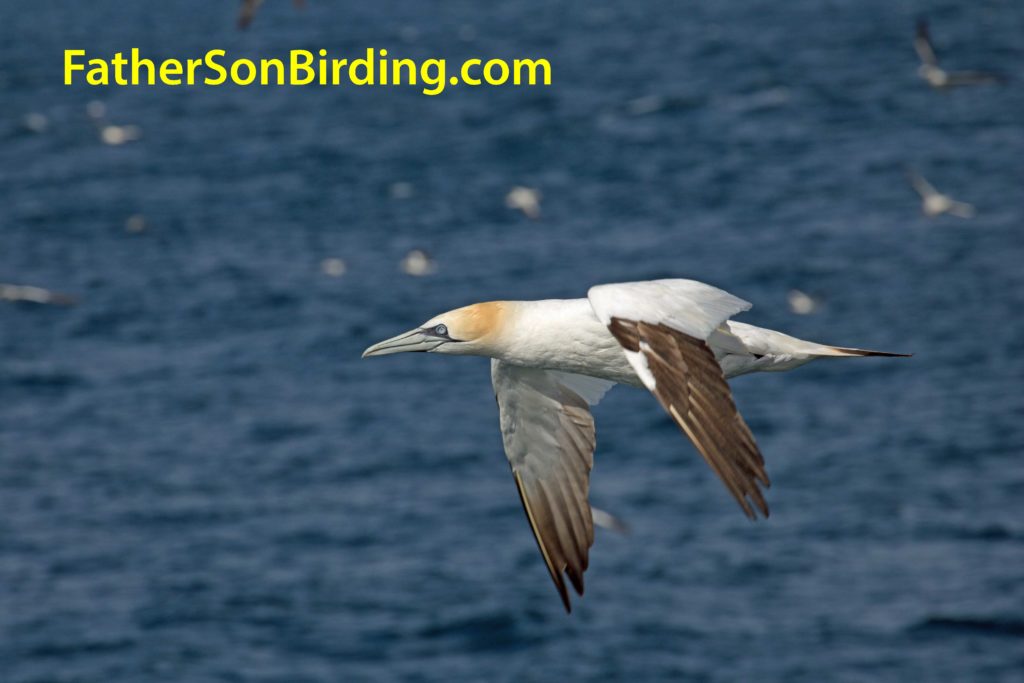
I again raise my binoculars level to the horizon. Far off, a bird that appears to be the opposite of a skua catches my eye. Its feathers are a clean white, with black tips on the wings, and its outline is sleek.

Like their southern cousins the boobies, gannets will perform spectacular vertical plunge-dives while hunting. (Photo by Braden Collard)

“How’s that?” Jamie asks, “Two lifers in the same two seconds!”

I grin. “Awesome!”

During the next couple of days, as we continue back towards Reykjavik, seabird numbers pick up. On my last full day on the ship, it all culminates in one big seabird showdown.

We have just left the island of Heimaey, the only inhabited island of the Westmann Archipelago, and the Explorer is headed for Surtsey, the new island to the south. I am on the bridge again, as is Jamie, talking about what else has been spotted. Suddenly, he looks up and spies a large, white cloud in the distance.

“Feeding frenzy!”

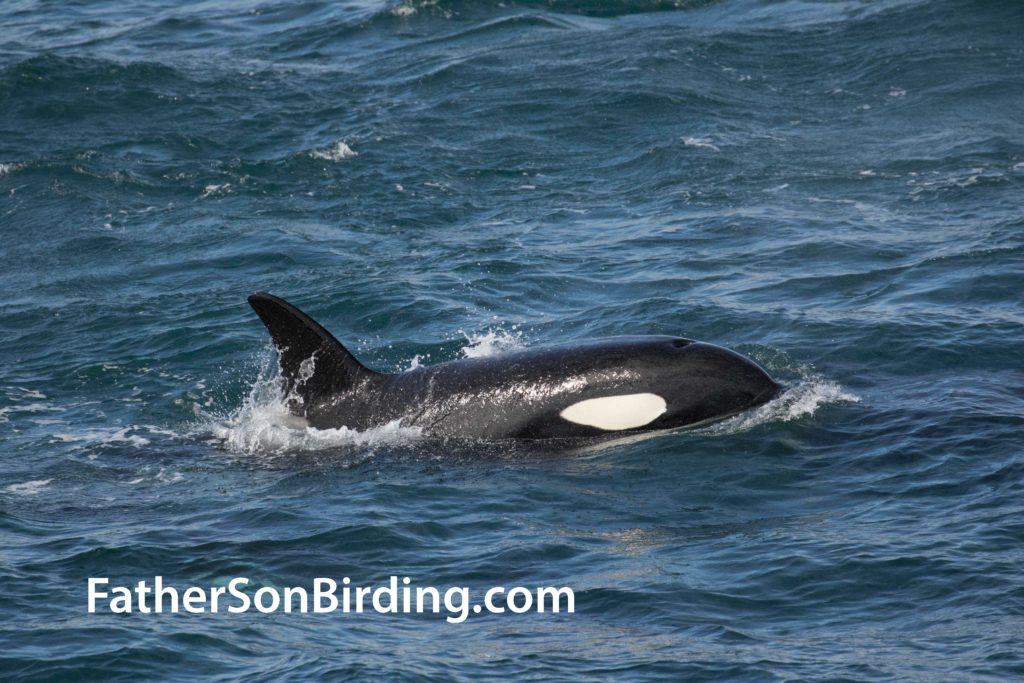
As our ship draws closer, I see large, straight dorsal fins rising from the water. Killer Whales!

Killer Whales, or Orcas, are actually dolphins–the largest in the world!

There are at least 30 Killer Whales, or orcas, on all sides of the boat now, feeding on whatever huge school of fish swarms below the waves. The whales aren’t the only ones feasting. A tornado of gannets has engulfed us, following the whales. At certain points, squadrons of them leave the storm to plunge-dive, torpedoing straight into the water.

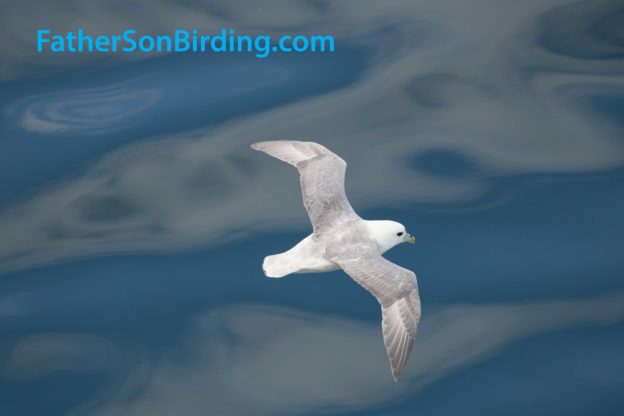
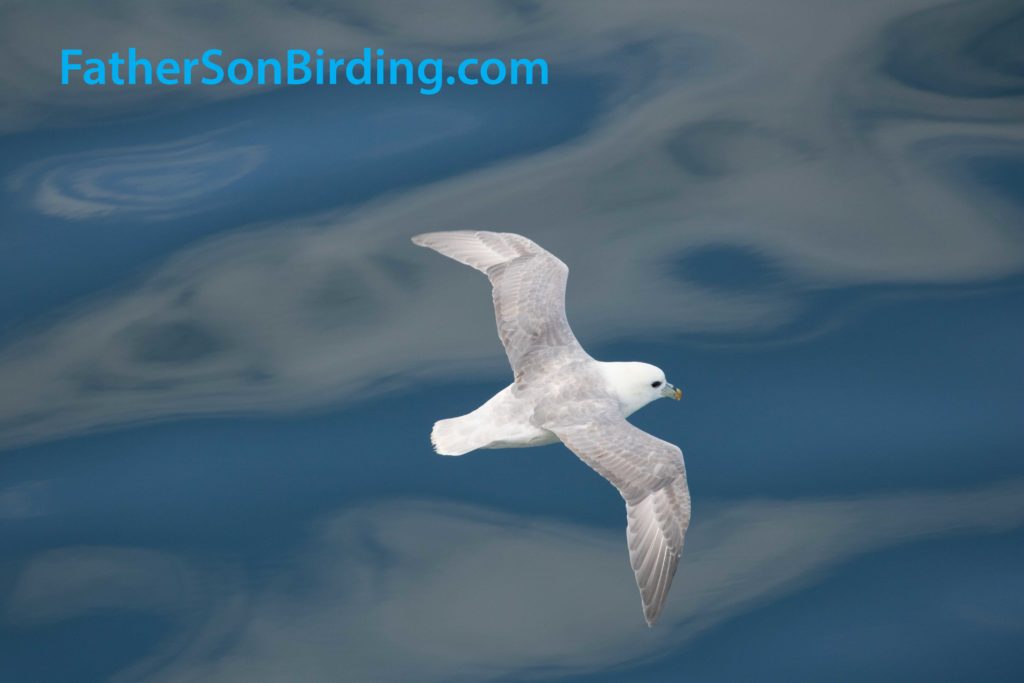
Northern Fulmars, the common tubenoses here, are also in large numbers, and have attracted their rarer cousins, Manx and Sooty Shearwaters! These just remind me of how many miles seabirds have under their wings—the Manx’s have probably bred on the coast of Britain, while the Sooties could have travelled from as far as New Zealand!

Northern Fulmars are circumpolar–meaning they live all around the Arctic Ocean. (Photo by Braden Collard)