Conservation Update: Not long ago, I wrote about an amazing opportunity to protect a key piece of habitat on the famed Bolivar Peninsula in Texas. This property is a critical resting point and staging area for birds migrating across the Gulf of Mexico, and Houston Audubon is leading the effort to raise $3 million to purchase the property. To learn more, please read our recent blog post, and if you have not already done so, consider contributing to this once-in-a-lifetime opportunity to protect birds by clicking here. So far, more than four hundred donors have chipped in, but many more are needed! Thank you and please spread the word!
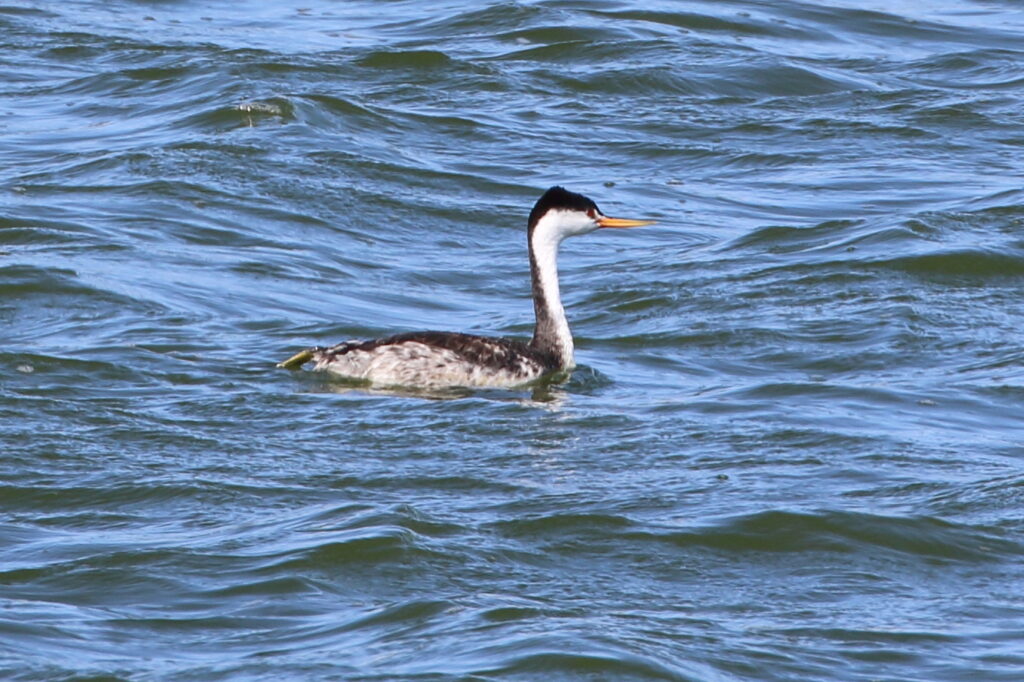
For birders, fall migration is a season like no other. That’s because birds fail to look at the range maps of where they are supposed to be and show up in all kinds of unusual and surprising places! You may recall that recently, I have been moving perilously close to breaking my all-time one-year global species record of 527, but instead of frantically trying chase down species (and burning up a lot of gas in the process), I have decided to see how many species just come to me during the fall. Last week, I picked up a Clark’s Grebe in the local Missoula Gravel Quarry, moving me to within seven species of a new record. That really wasn’t too surprising since a few pairs of Clark’s do breed in Western Montana, and it made sense that one might end up passing through my home town. A couple of days ago, however, when I saw a report of a Red Phalarope, my mind shouted “Whoa!”
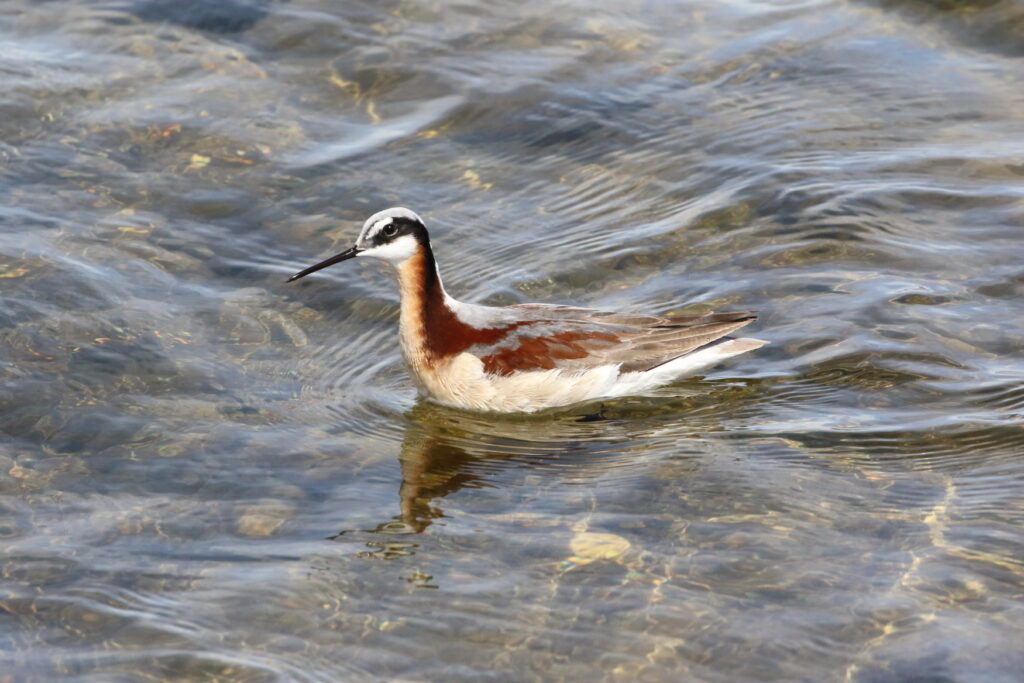
Braden and I have mentioned phalaropes in several past blogs (see, for instance, THIS POST), and they are fascinating birds. Phalaropes are shorebirds in the family Scolopacidae and in the entire world, there are only three species: the Wilson’s, Red-necked, and Red (called the Gray Phalarope in Europe). Montana is fortunate to host Wilson’s Phalaropes each spring and summer, as they are the only phalarope to breed in the interior of the continent. The first time we encountered these beauties was in 2015 at Lee Metcalf National Wildlife Refuge. I had barely heard of phalaropes when we drove past the main pond at Metcalf and Braden—who was and still is better prepared than I—shouted Wilson’s Phalaropes! Since then, I have become increasingly enchanted by these birds and, according to eBird, have seen them 123 times.
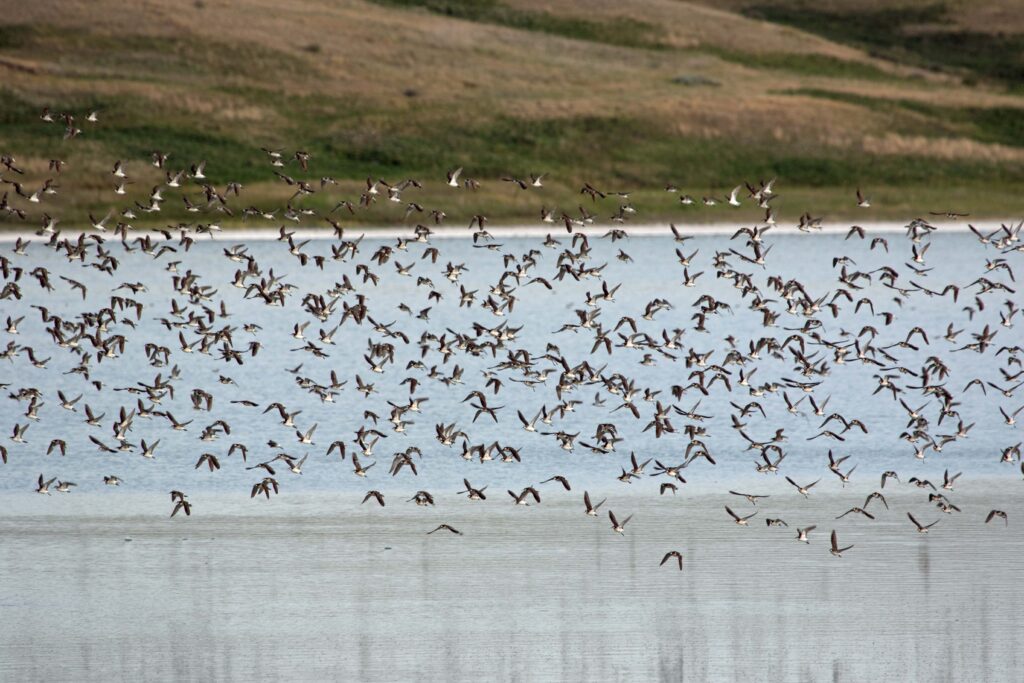
Several things make phalaropes stand out from other birds. For one thing, they flip the rule on “males are brighter than females.” With phalaropes, it is the female that is the stunning, brightly-colored sex during breeding, not the male. Females compete for males to mate with and may even “service” several different males, leaving the guys totally in charge of parental care once the eggs are laid. Can I hear legions of human females shouting “Amen”?
Another thing everyone loves about phalaropes is their method of hunting by spinning rapidly on the surface of the water. This spinning creates a little aqueous “tornado” that sucks up crustaceans and other invertebrate prey from below. The birds also hunt in more traditional shorebird manners by probing shallows and even picking off prey from nearby vegetation.
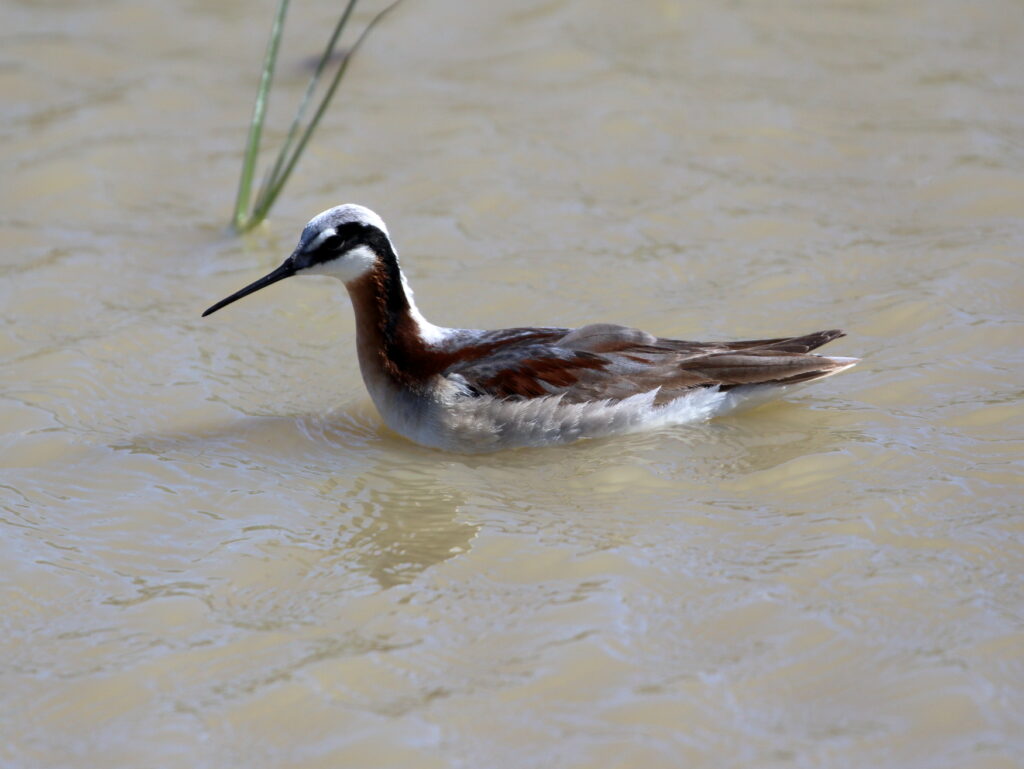
Whenever Braden and I are lucky enough to visit eastern Montana in spring and summer, we usually see large numbers of Wilson’s Phalaropes feeding and setting up nesting sites (see THIS POST). If our timing is right and we stay persistent, we also usually spot a few Red-necked Phalaropes. With their dramatically contrasting red, white, and dark gray heads, these phalaropes are even more stunning than the Wilson’s. The window to see them is short, however, as they breed high in the Arctic and can only be “caught” while they are resting or staging for their final journeys north. A couple of times we have also spotted them heading back south in August, when they are invariably in their duller gray-and-white plumages.
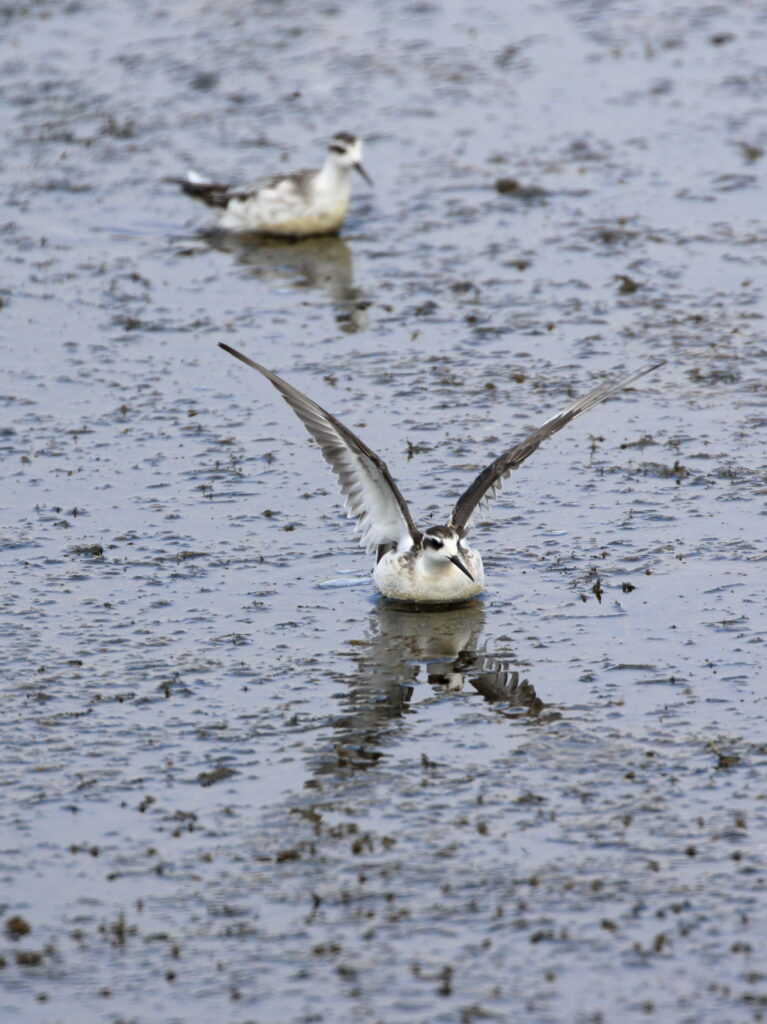
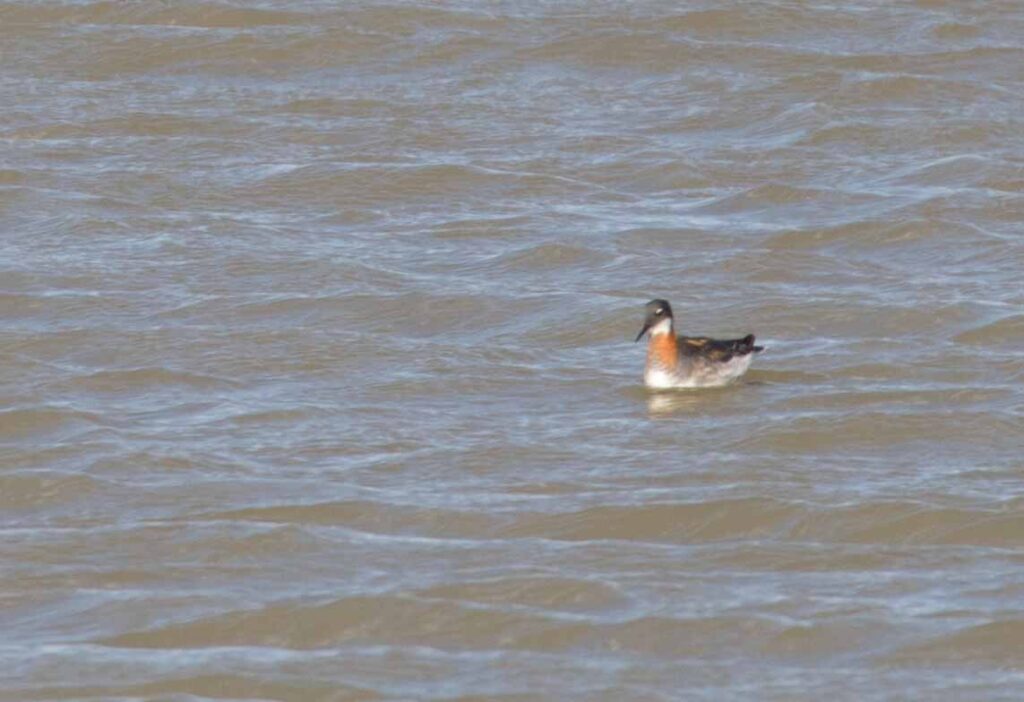
However, one phalarope that we have never seen in Montana in more than a decade of birding is the Red Phalarope. The reason is that, in general, these birds migrate over the ocean—not over the interior of the continent. Red Phalaropes are the most pelagic of the three phalaropes and, except during breeding, spend their lives out at sea. In fact, the only Red Phalaropes that Braden and I ever saw was a single pair off the coast of San Diego during the San Diego Birding Festival several years ago. Only about twenty sightings have ever been reported in Montana.
Naturally, when I read the recent report of a Red Phalarope in Missoula, my excitement went into overdrive. The next morning, after Amy and I went to a pickleball class, I convinced her to drive down to a little spot called Cattail Corner where the Red Phalarope had been reported. Mind you, this is not where one would expect to see a rare bird. It’s just a tiny wetland wedged between a shopping center, a gas station, and two busy roads. I used to bird there a lot just to see what I could find, and recently the dense cattails had been cleared out, creating more open water and even a bit of shoreline. Early this spring, Braden and I were surprised to find several Spotted Sandpipers hopefully setting up breeding territories there, but still . . . a Red Phalarope???????
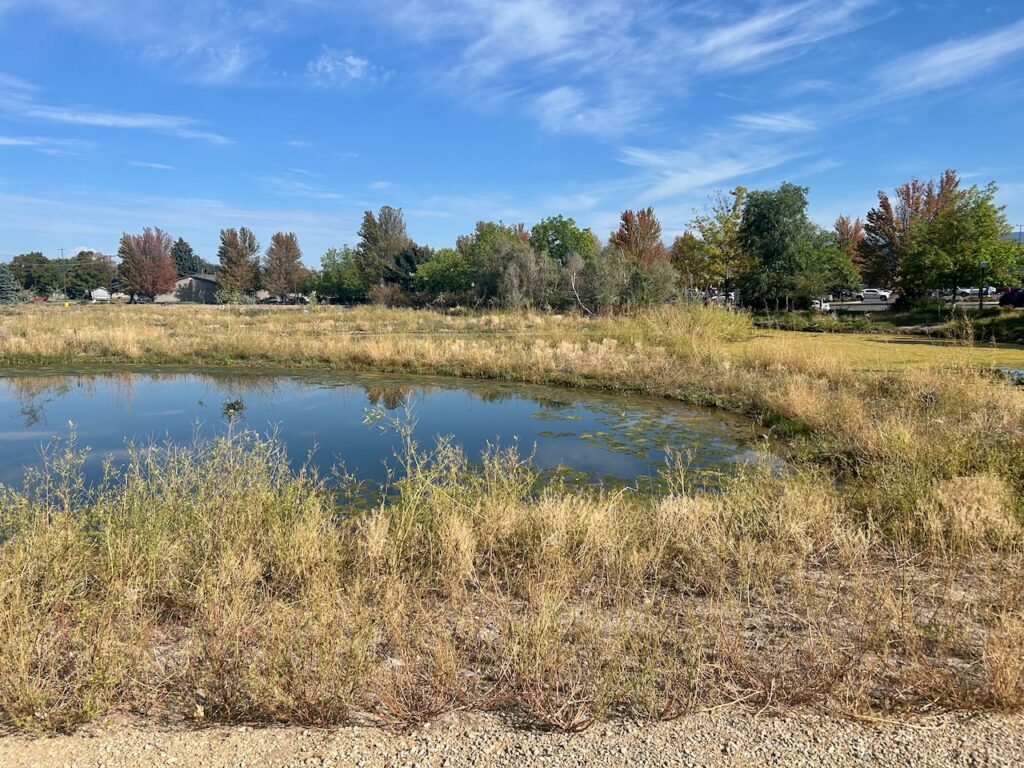
As soon as we parked, I grabbed my camera and binoculars and Amy and I began circumnavigating the little wetland. My natural pessimism kept repeating, Oh, I’m sure it’s gone now. After all who would want to hang out in this crummy little wetland? Sure enough, Amy and I spent thirty minutes walking around the ponds without a single sighting of anything resembling a phalarope. Oh, well.
As we were leaving, our friend and fellow birder Susan Snetsinger arrived. We told her we hadn’t seen the phalarope, but if she happened to spot it to please call right away. Then, we got back in the car and began heading home, a bit disappointed but not surprised at failing to find the bird. Besides, Amy had a lot to do and I needed to tackle a number of chores myself.
We were just passing Tremper’s shopping center when the phone rang. I hit the “answer” button on the steering wheel and it was Susan. “Did you see a phalarope at all?” she asked. “No.” “Well, I’m looking at one now, but I’m not sure it’s a Red Phalarope.” “We’ll be right there!” I told her.
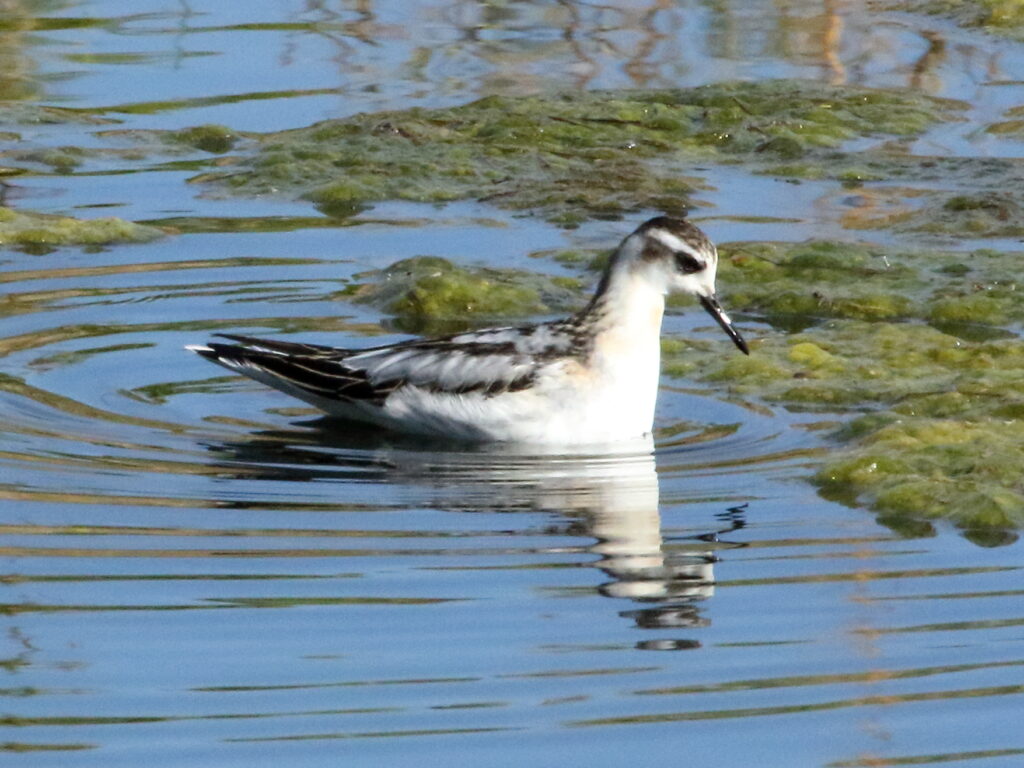
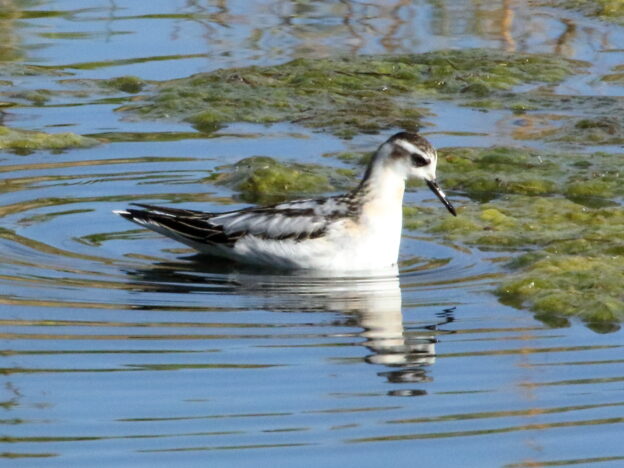
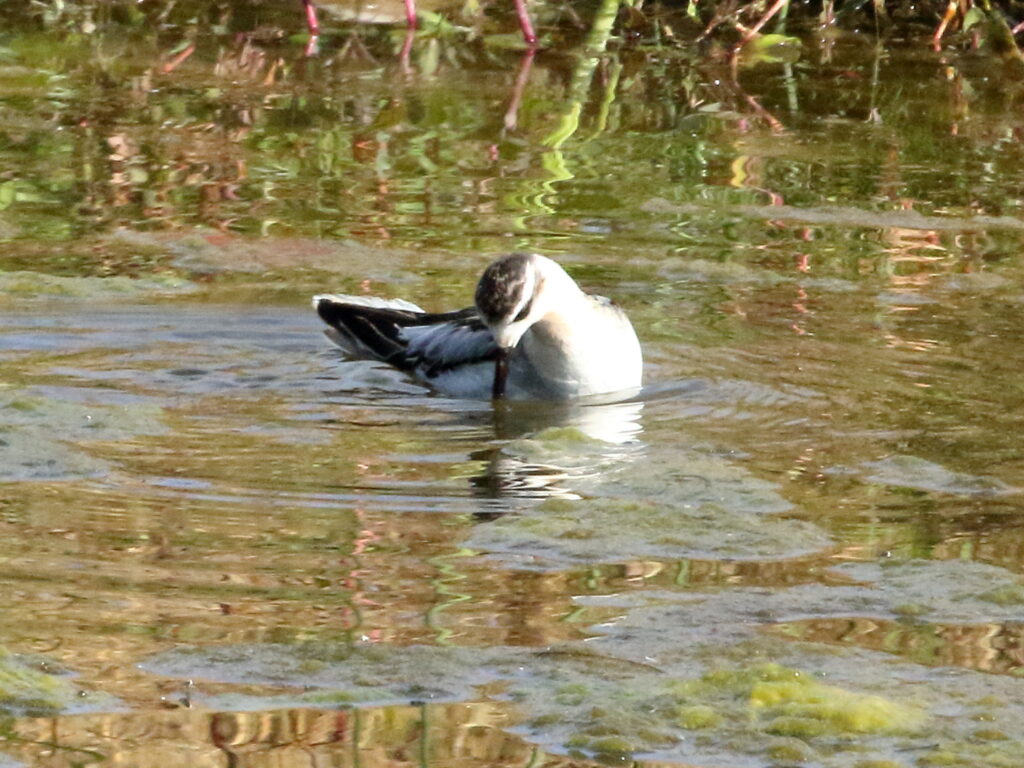
I made a quick U-turn and in five minutes was again parking the minivan. We quickly spotted Susan on the far side of the shore, and even before reaching her, I could see a phalarope on the water. “How on earth did I miss that?” I asked Amy. What’s more, the phalarope seemed blissfully unconcerned as we drew close enough for good viewing and photographs. The problem? This bird was in basic (nonbreeding) plumage and it looked remarkably similar to a Red-necked Phalarope in the same plumage. In the fall, both birds are basically gray and white, with prominent black patches behind the eyes. Red Phalaropes are a bit larger than Red-neckeds, but if they aren’t side-by-side that’s not a useful feature. According to Sibley, Red-neckeds also are streakier on their backs—but this bird before us also looked pretty darned streaky to me.
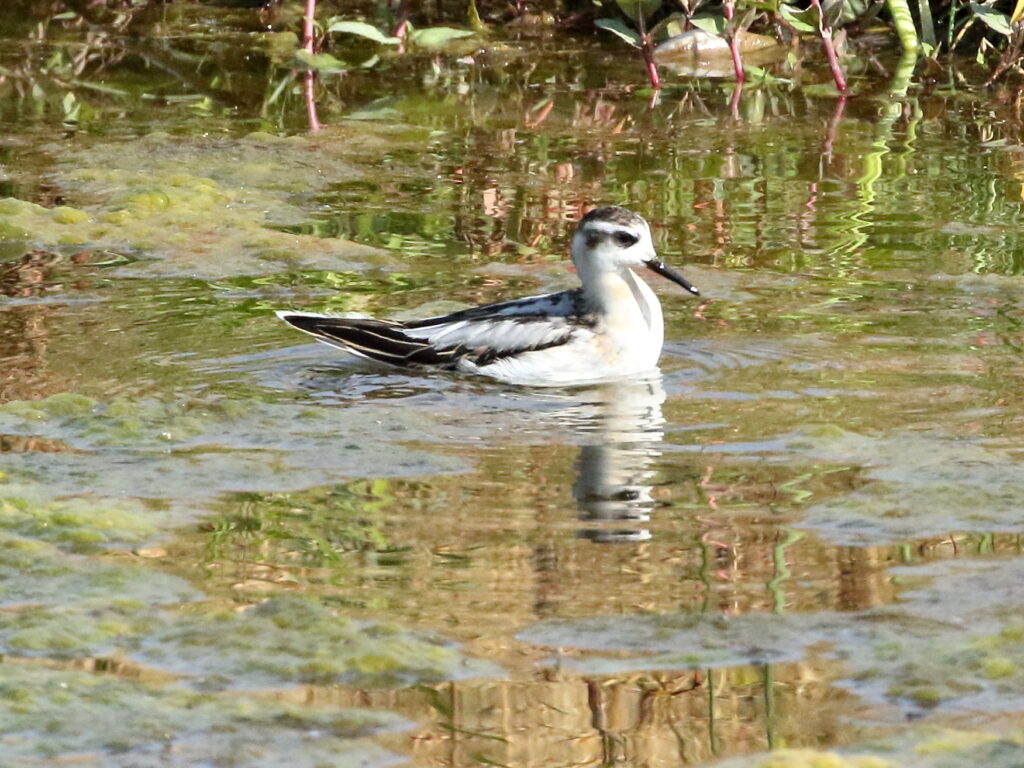
From what I can glean, the key ID feature that distinguishes the two birds is the thickness of their bills. While Red-neckeds have thinner, needle-like bills, those of Reds are thicker, almost pencil-like. The bird in front of us did indeed seem to have a thicker bill, but there is so much variation in these kinds of features that I still felt less than confident—even though this bird had already been confirmed as a Red Phalarope by the eBird Powers That Be. Later Dan Casey, prominent Montana birder and co-author of Birds of Montana, sent me a phalarope comparison guide that helped convince me further. This can be found at:
We watched the phalarope for about ten minutes and then, to my surprise, it climbed ashore and disappeared into the weeds. “Ah, that’s why we didn’t see it earlier,” I told Amy, grateful that the bird had decided to put in an appearance out on the water where we could see it.
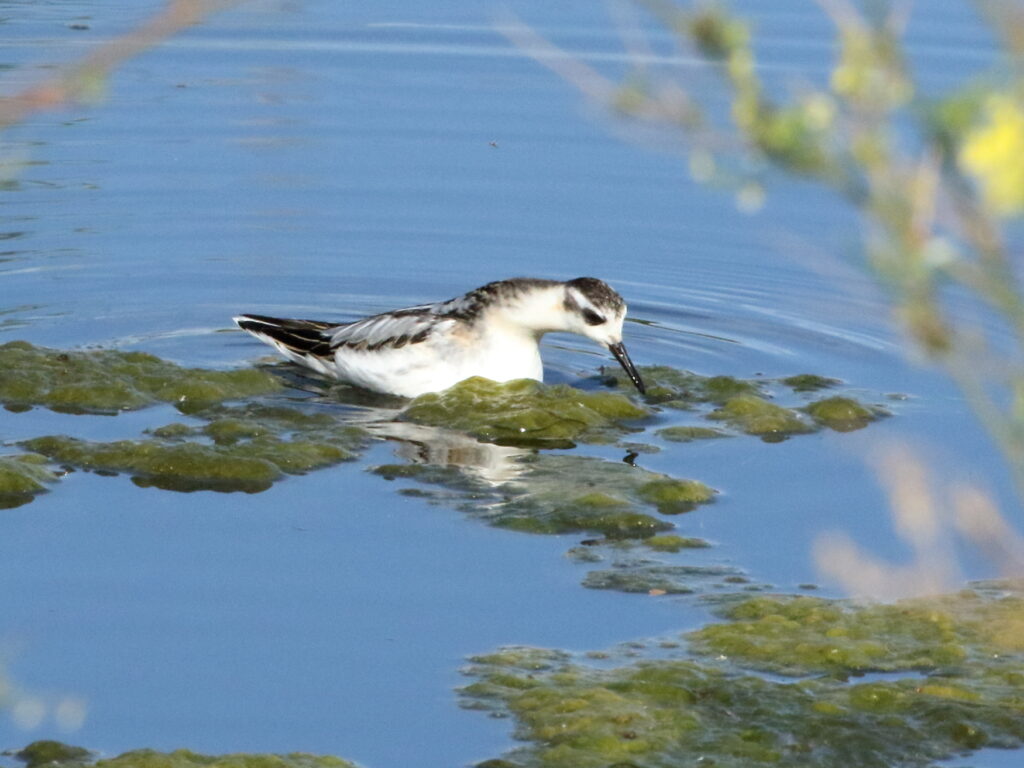
But the Bottom Line? Red and Red-necked phalaropes are very difficult to tell apart in their basic, nonbreeding plumage, so never assume you’re looking at one or the other. Personally, I hope to get more chances to observe and get to know them in the field in the future.
The other Bottom Line? It was WAY COOL to see a Red Phalarope here in my hometown and it became my Montana Lifer #312. As a bonus, I now need only six more species to break my all-time one-year record. Hm . . . I wonder what will show up next?
To learn more about phalaropes, we recommend the book The Shorebirds of North America, reviewed here.