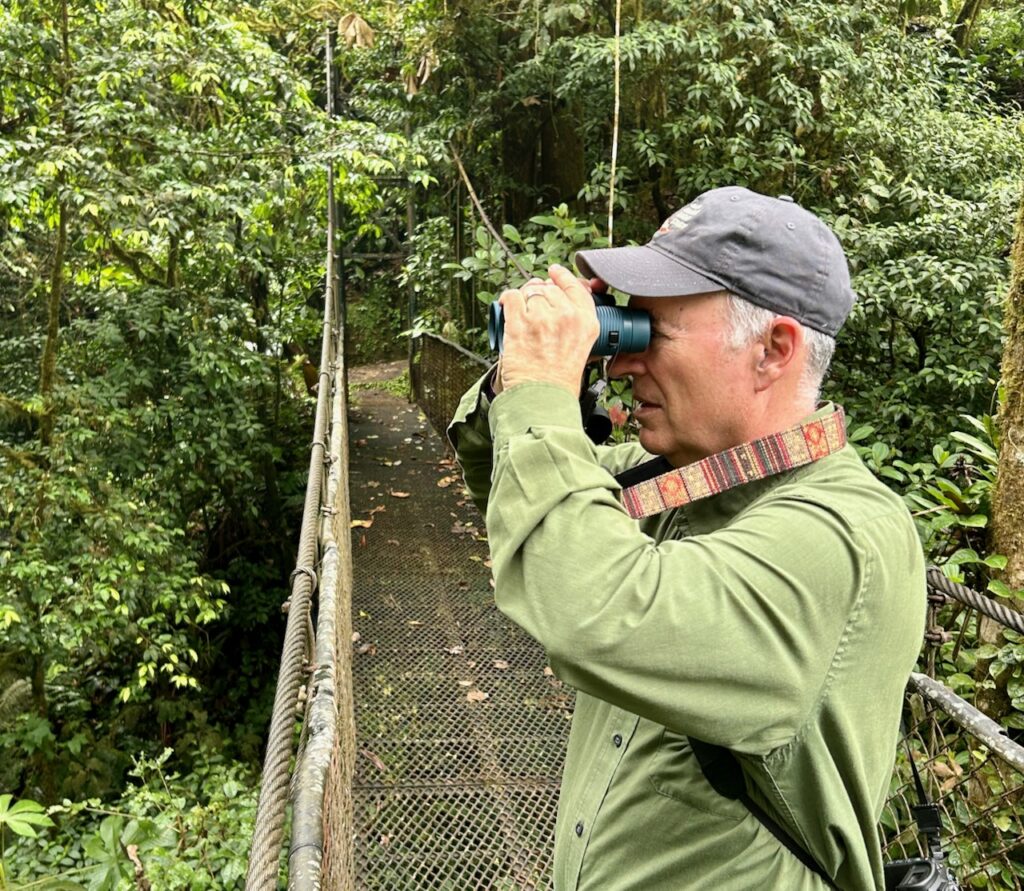
If you read our last post, you know that Braden and I recently completed an epic birding adventure to Costa Rica. One thing I didn’t mention is that, besides offering the chance to see an astonishing variety of neotropical birds, the trip gave me the opportunity to field test an exciting new piece of equipment: the Nocs Provisions Pro Issue 8X42 binoculars. And boy, did I put them to the test!
I must confess that I liked the Pro Issues right out of the box. As I explained in my recent review of the company’s Field Tube monocular, Nocs has put real thought into designing equipment that looks and feels different from the vast majority of products out there. The rubberized protective casing of my Pro Issues features a stylish ribbed design that is easy to grip, yet feels very comfortable to hold. Like the Field Tube monocular, these binoculars also have “pop in” caps for the objective lenses that are much more secure than any other design I’ve encountered.
With my review sample of the Pro Issues, Nocs took the trouble to send me one of their woven tapestry neck straps, and if you purchase any Nocs binoculars, I highly recommend picking up one of these, too. Not only does the strap look way cooler than standard bino neck straps, it is more comfortable against the skin—and easier to attach to the binoculars than any other design I’ve seen. As far as the build, these binoculars couldn’t feel more solid. I fortunately didn’t drop them, but felt that if I had—or if I whacked them against a strangler fig tree—they would survive unscathed.
If you purchase Nocs binoculars, I highly recommend buying the woven neck strap, which is both easy to attach and very comfortable around the neck.
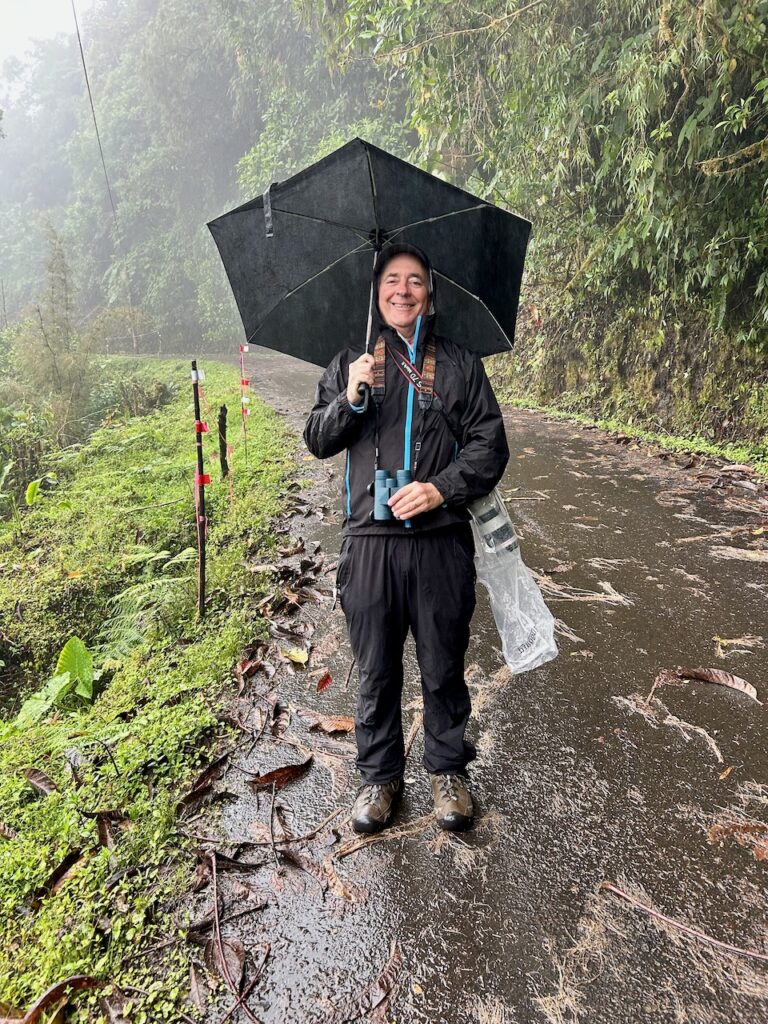
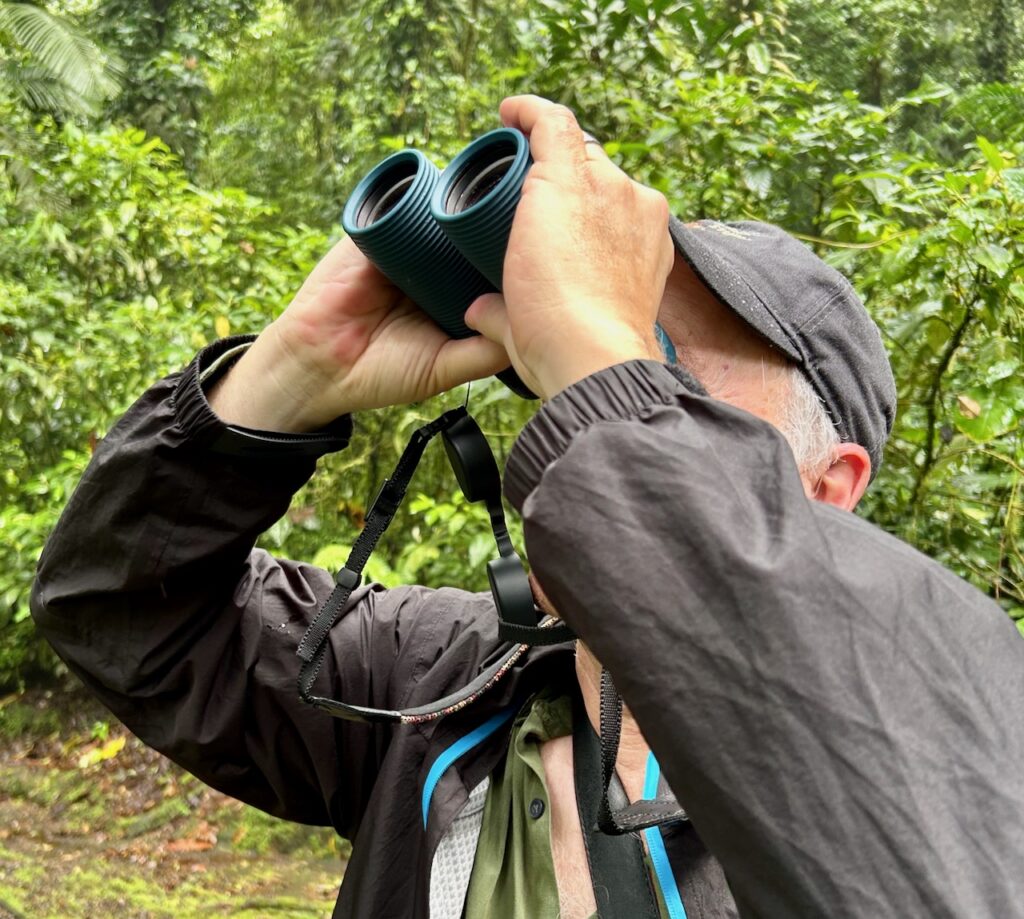
When I decided to take the Pro Issues to the tropics, I realized that waterproofing would be important—but I didn’t realize how important! For about half of our trip, Braden and I endured one of the wettest “dry seasons” on record. I mean, we got dumped on—to the point where, several times, we just stood under a tree and tried to will the rain to stop. Not only did the Pro Issues take on this full exposure without allowing water to penetrate the casing, the binoculars didn’t fog up even in the worst conditions.
As you can see, the rain on our trip showed no mercy—but the Pro Issues survived these tough conditions better than either Braden or I!
I should mention that one smart thing Nocs has done with their optics is to recess the objective lenses deep inside the tubes. This means that as they hang from your neck, rain won’t land on or “creep around” to the lenses—avoiding a potential constant hassle. One thing I do hope Nocs incorporates into future products is a “faster” focusing knob, requiring fewer revolutions to go from very close to very far focus. This would make it easier to zoom in on fast-moving birds.
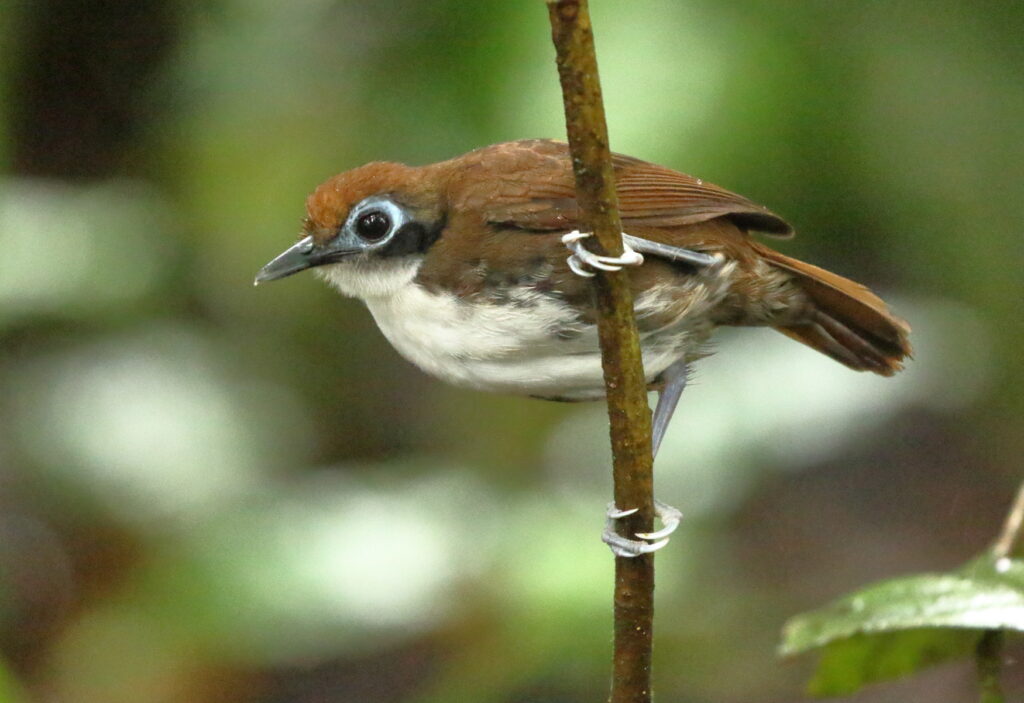
Even in the rainiest conditions, my Pro Issues stayed tightly sealed and did not fog—allowing me to fully enjoy marvelous birds such as this Bicolored Antbird (teaser for our next post!).
Of course none of the above matters without good quality optics, and the Pro Issues definitely hold their own against other equipment in a similar $300 price range. Nocs uses BaK-4 prisms, a higher quality prism that ensures even, full-spectrum light transmission. Like other quality companies, Nocs uses coated, scratch-resistant glass. The result? In bright to medium-low light, I got nice crisp, well-lit, full color looks at birds, even from a good distance. Taking 8X42 instead of 10X42 binoculars proved a good choice for in-close rainforest conditions by giving me a wider field of view and more light, and I rarely missed the extra 2X magnification of 10X42s.
As every birder knows, however, things do get tough in very dark, overcast rainforest understory conditions, challenging the abilities of almost any optics. In my equipment testing, finding binoculars that will “see through” the darkest most abysmal conditions—or the most awful gray backlit situations—requires a price jump up into the $1,000 range, not something most birders can afford. (See, for instance, this review and this one). That said, for $299.95 the Pro Issues offer solid, competitive value while boasting some additional advantages . . .
Nocs is committed to operating sustainably and that includes avoiding plastic packaging. Note, I especially like the cloth carrying bags (left, under the binoculars) that come with their equipment. While offering less protection than hardshell cases, the bags are much less bulky, saving precious space when traveling.
In an age when many corporations throw their weight around with little regard to the environment and social justice, Nocs offers a refreshingly positive set of values for the ethically responsible birder. The company is a member of 1% for the Planet, donating 1% of its revenue to supporting environmental organizations. It is also certified as climate neutral and is fully committed to sustainable packaging. In fact, I haven’t found a single piece of plastic packaging on any of the Nocs products I’ve received. The quality of its products also ensures that they will last long into the future, reducing the need for buying—and discarding—cheaply made equipment over and over. If your Nocs product should somehow break or fail, the company offers its “No-Matter-What Lifetime Warranty.”
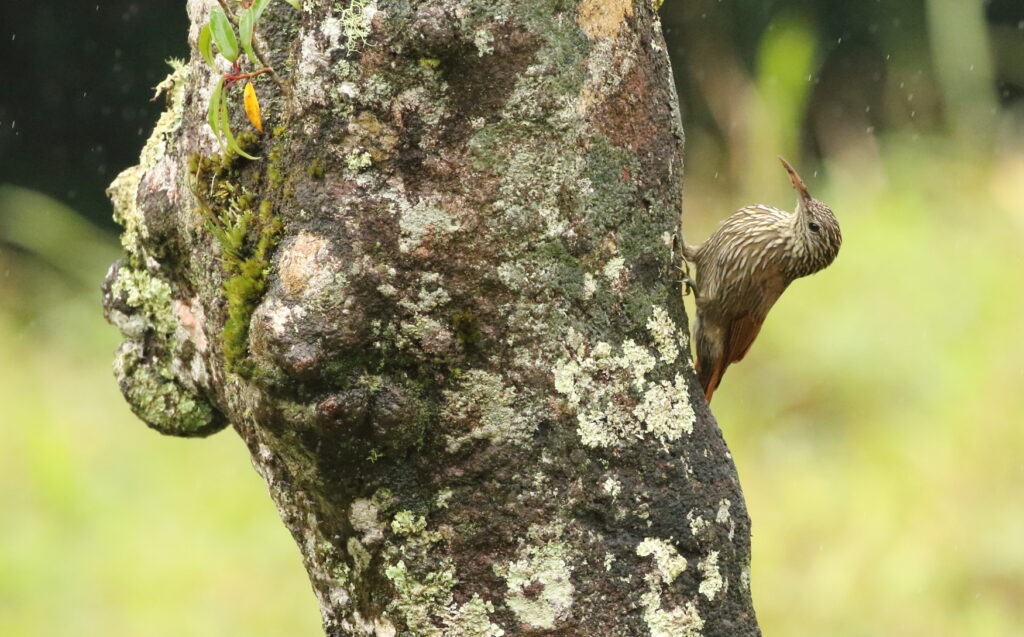
This Streak-headed Woodcreeper is just one of more than 300 bird species I enjoyed observing in Costa Rica using my Pro Issues.
All of this makes me give the Pro Issues a big thumbs up. If you’re still not convinced, I should mention that the 8X42 Pro Issues come in Ponderosa (green), Oxblood Maroon, and Marianas (blue) colors. That will ensure that in addition to having a great set of binoculars to accompany you on your birding adventures, you will be the most stylish birder anywhere in sight!
The author received no financial compensation for this review.
Some of our most popular posts have focused on exotic travel destinations, and today we kick off our latest series on one of North American birders’ most popular choices: Costa Rica. Braden and I just returned from an exhilarating, intense, nine-day birding adventure to the land of Pura Vida, and over the next couple of months I’ll be posting blogs on our most memorable birding experiences interspersed with our usual entertaining “paella” of reviews, domestic birding, and other fascinating topics. Again, we do not receive compensation for our blogging efforts, so if you wish to support our work, please purchase a few new copies of Birding for Boomers, Warblers & Woodpeckers, First-Time Japan, or any of Sneed’s other books. If you already have copies, why not pick up some for your friends? With that, let’s dive into Costa Rica at—where else—the airport!
Braden and I arrived at Juan Santamaría International Airport at 10 p.m.—just time enough to get to the rental car office before it closed. After collecting our vehicle, we drove to a nearby Airbnb so we could get a fresh start in the morning. Having spent a lot of time in Costa Rica the past couple of years, Braden had organized our entire birding itinerary and even picked this first place to stay—not only because it was convenient to the airport, but because it happened to have a terrific, little-known birding spot just down the street.
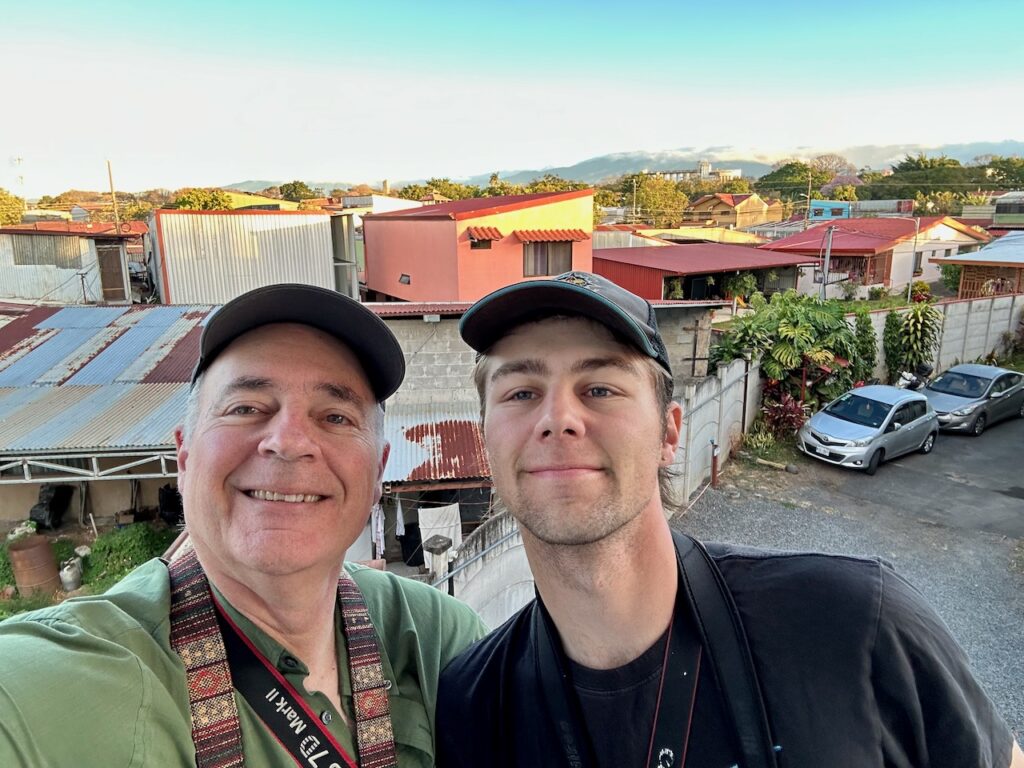
Braden and I from the porch of our Airbnb in Alejuela—practically under the flight path for San Jose’s international airport, and loaded with birds!
Braden and I are big fans of birding near airports, and have often found hidden avian treasures where you’d least expect them. Just last spring, on my final morning in Texas, I had a remarkable birding session in the vacant lot behind my hotel next to the airport in San Antonio, Texas. And during his spring Costa Rica trip last year, Braden had discovered a special little place only two blocks from our Airbnb. This year, as soon as dawn crept over Alejuela (where San Jose’s airport is actually located), he and I grabbed our binoculars and cameras and headed out.
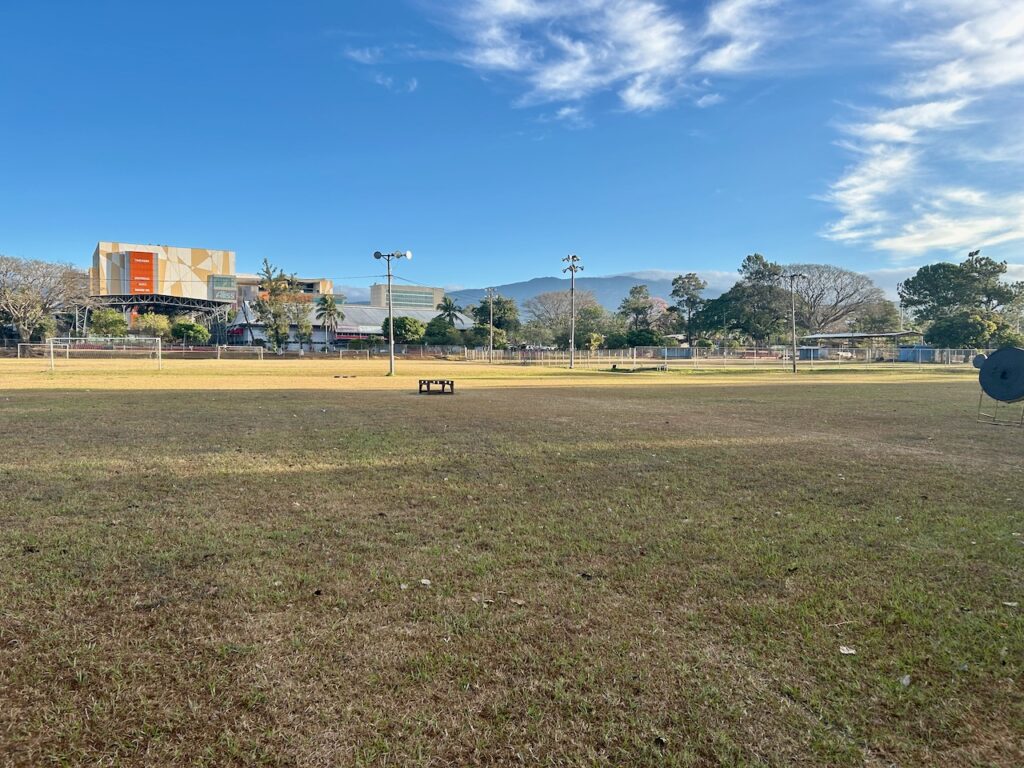
Our destination was a large city park with the even larger name of Caminito Magico de la Tranquilidad. Being unfamiliar with the rather poor-looking neighborhood, I admit that I felt a bit nervous about our safety, but my concerns quickly vanished. At the park, people were jogging, biking, doing exercises, visiting over coffee, and walking around as in any park anywhere. The park covered several hectares, mostly devoted to playing fields, but a lot of trees threaded the fields and lined the park’s perimeter, and Braden led the way in guiding us on a full circuit.
Even at dawn, Caminito Magico de la Tranquilidad park was bustling with people—and birds! Note the giant mall rising in the background—a good place to escape the heat and grab a bite, though a much better little soda (cafe) sits only a block from the park entrance.
I had spent two months in Costa Rica in 1994, but tragically, that was before I took an interest in birds. Since Braden and I started birding a dozen years ago, I had been fortunate to bird in Latin America several times—most recently in Colombia con mi amigo, Roger—but it was fair to say that I was a novice at Costa Rican birds. I had been studying, however, and to my delight Caminito Magico park presented a perfect warm up for the week ahead.
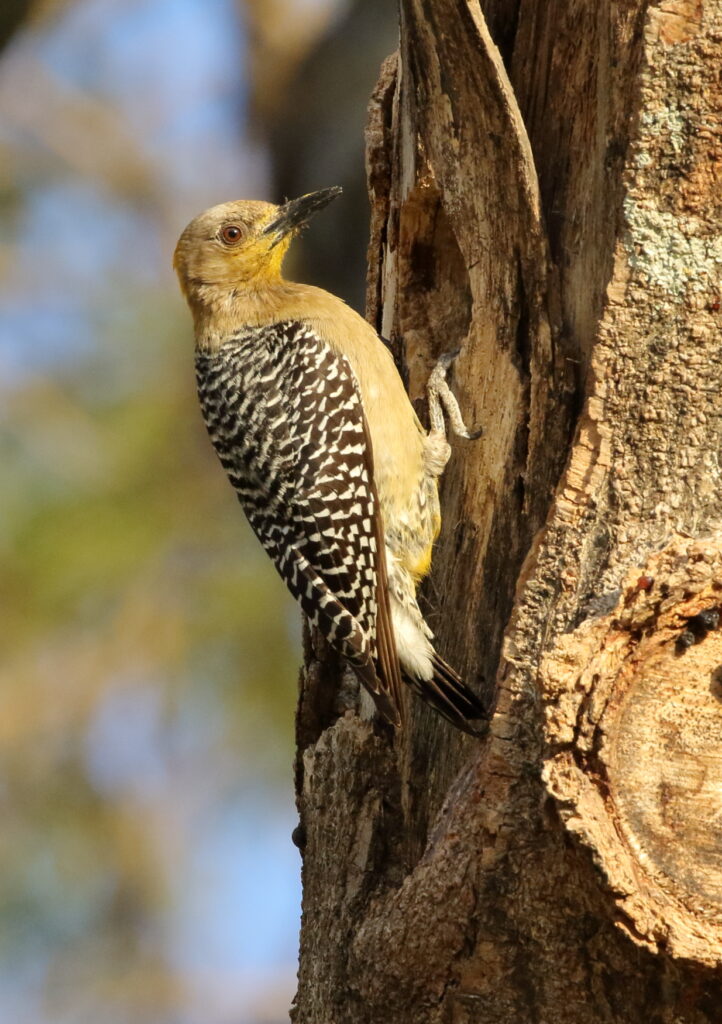
Entering the park, a Squirrel Cuckoo immediately flew across a soccer field in front of us. Braden identified Orange-chinned and Crimson-fronted Parakeets loudly squawking overhead, and I was thrilled to see my first ever Hoffman’s Woodpecker land in a nearby tree.
My very first Hoffman’s Woodpecker put me in an ebullient mood as we kicked off our first Costa Rican birding session!
The park was filled with many of the more common birds any visiting birder will quickly get acquainted with. These included five kinds of pigeons and doves, Tropical Kingbirds, Great Kiskadees, Great-tailed Grackles, and Costa Rica’s national bird, Clay-colored Thrushes. Blue-gray Tanagers flew between trees while Blue-and-White Swallows darted for insects overhead.
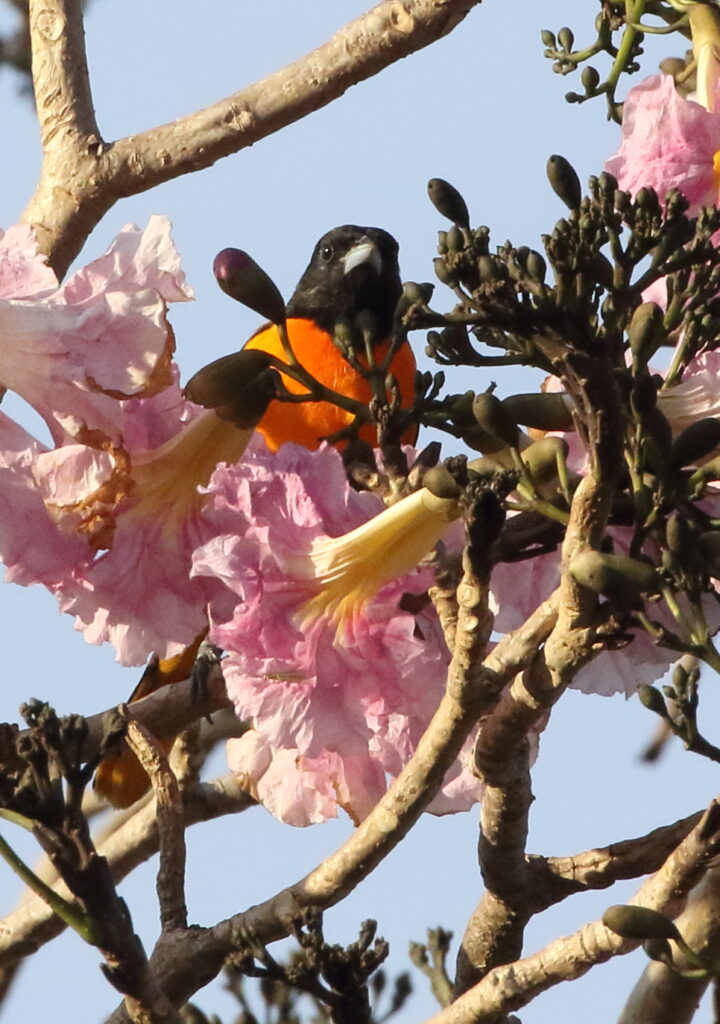
Baltimore Orioles are common throughout Costa Rica—and never fail to raise a smile for a visiting Norteamericano birder!
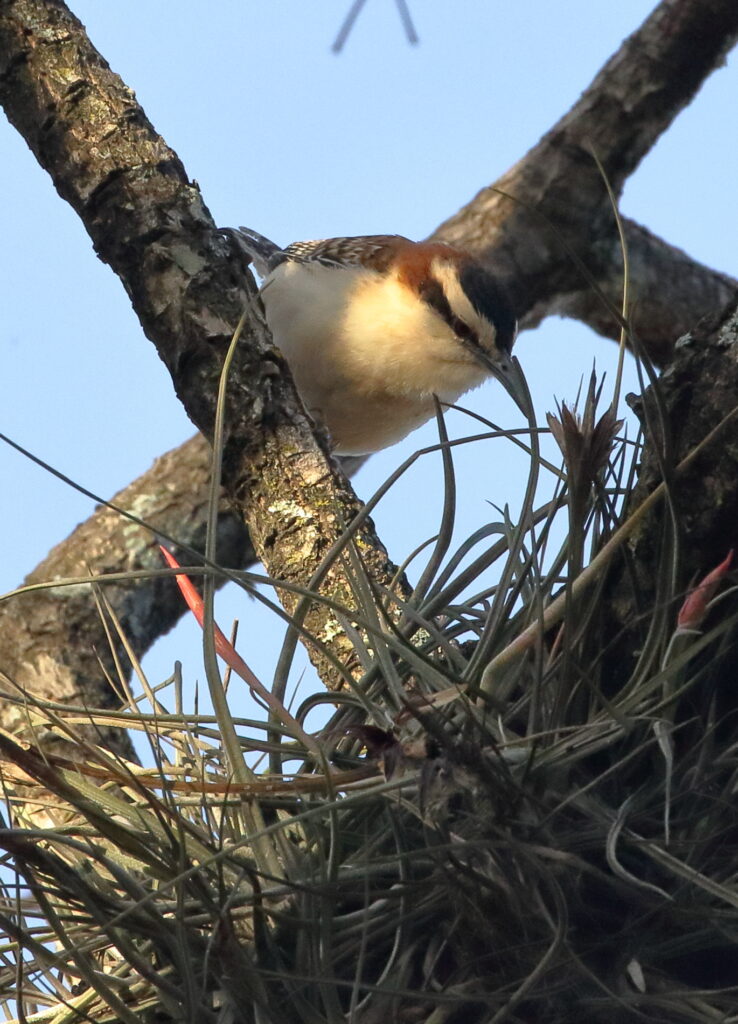
As we reached the far perimeter, I was delighted to find that a creek skirted about half of the park’s boundary. Trees grew thickly here, and following the pleasant path, the birds got even more interesting. Braden began pointing out Chestnut-capped, Northern Yellow, and Tennessee Warblers while I focused in on a stunning male Baltimore Oriole in a flowering tree. Braden also detected several kinds of wrens: Southern House Wren, Rufous-and-White Wren, Cabanis’s Wren, and the beautiful bruisers of the bunch, Rufous-backed Wrens.
This would be the only location on our trip where we would see the “giant” Rufous-backed Wren—another reason to bird the San Jose area before heading into Costa Rica’s hinterland.
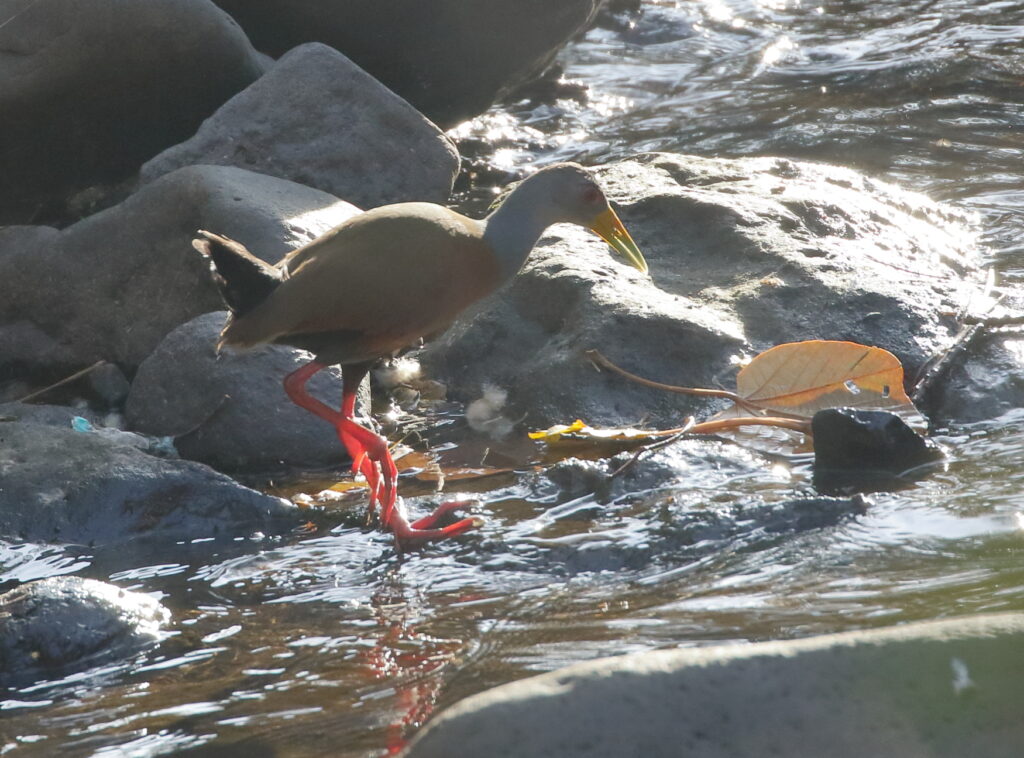
This being in the heart of Costa Rica’s largest city, I gotta tell you that I had no expectations for the creek itself, especially because it was strewn with an assortment of trash. The birds apparently didn’t care and almost immediately, Braden pointed out one of the birds I had most wanted to see on the trip—Bare-throated Tiger-Heron! I was thrilled, but hardly had time to appreciate it as we spotted a quail-sized coot-like bird skulking the banks—a Gray-cowled Wood-Rail!
For me, seeing a Bare-throated Tiger-Heron and Gray-cowled Wood-Rail (above) were stunning surprises in the heart of Costa Rica’s largest city!
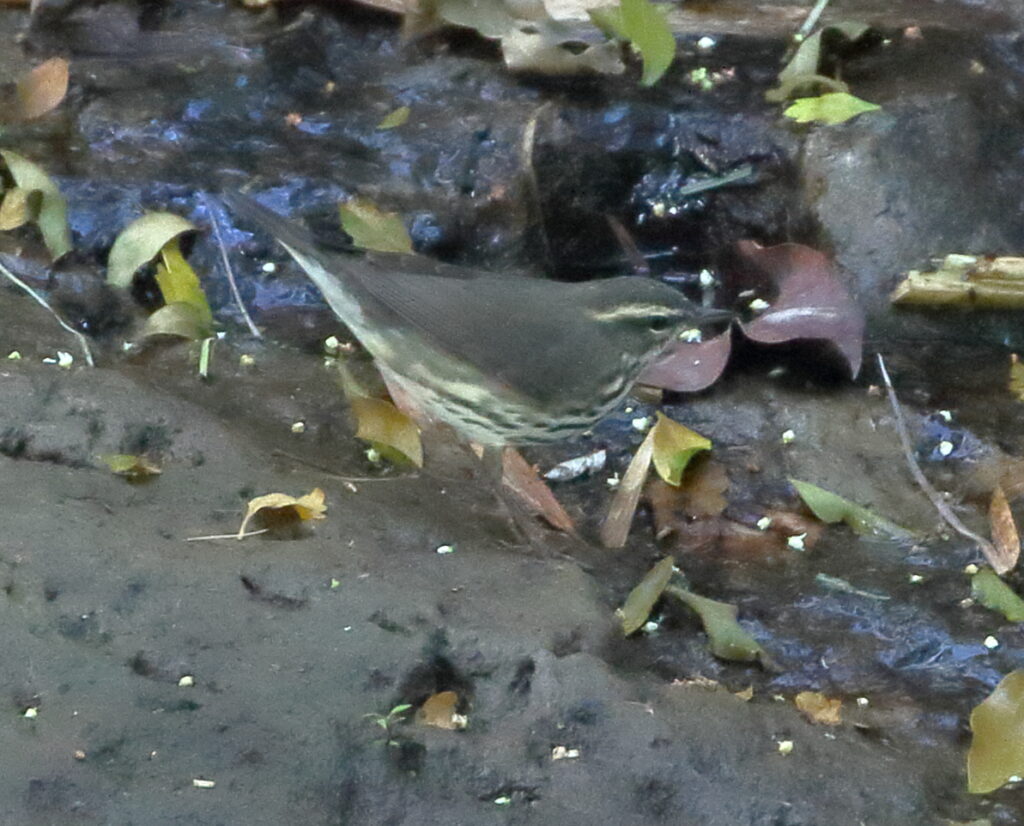
Soon after, Braden pointed out a Northern Waterthrush while I spotted a Green Heron along the opposite bank. This, of course, is one of the magical things about birding the neotropics: how in the midst of all of these amazing new tropical birds, we find many species that are totally familiar to us in North America. It begs the definition of just what a neotropical bird is since in reality, many species we Norteamericanos consider “our birds” are just visiting us for a short time, and can more rightly be considered tropical species. Maybe that’s how this park got the name “Magico”?
Seeing “North American” warblers such as this Northern Waterthrush in the tropics makes you rethink what we consider “our” birds.
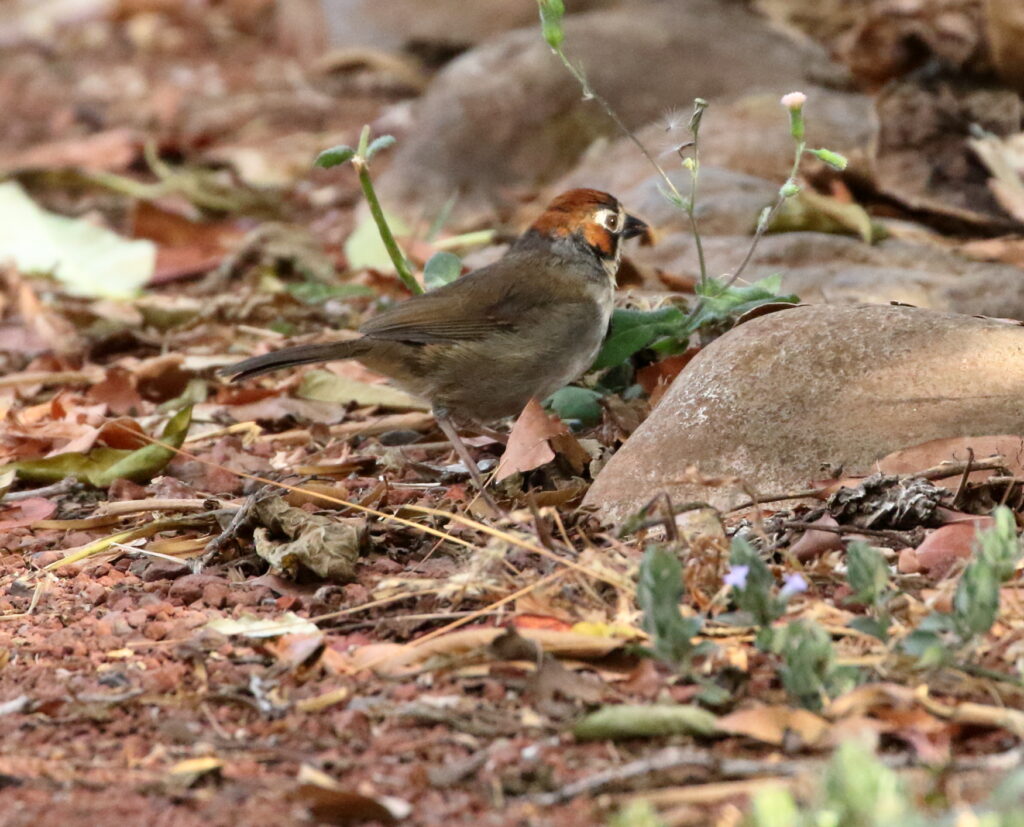
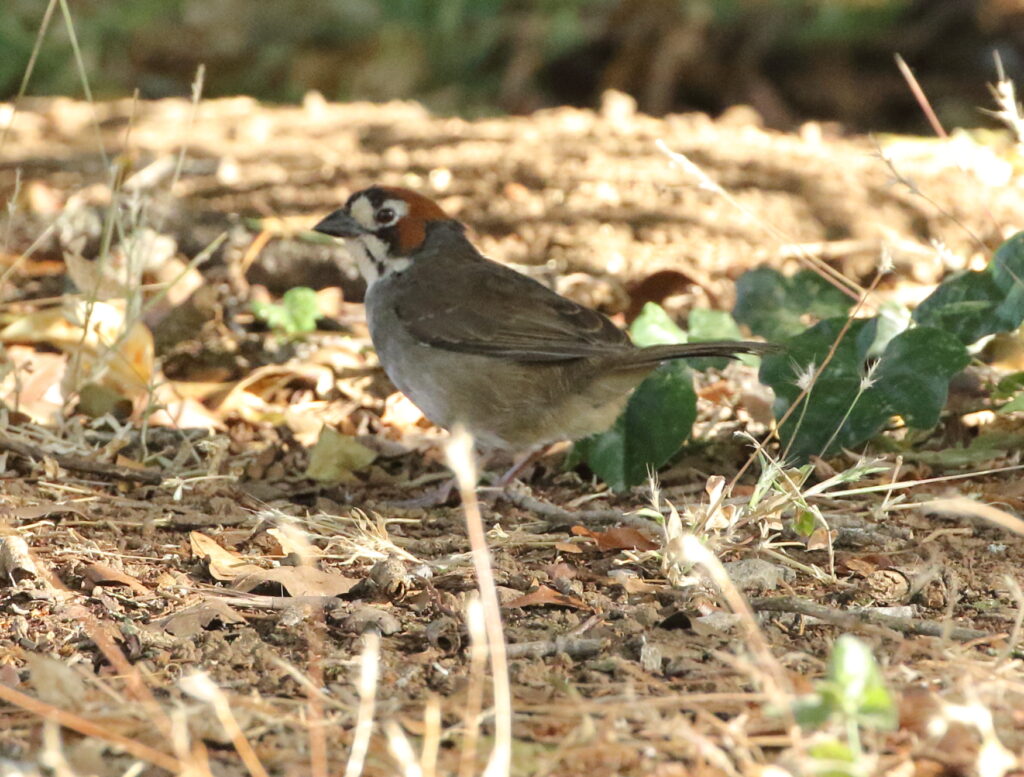
Our delightful discoveries were far from over. At the far corner of the park, we met an amateur naturalist who visited this spot almost daily to monitor wildlife, and he generously shared that only minutes before, he had seen one of the San Jose Valley’s most intriguing endemics. We hurried down the trail and only fifty meters later saw them: Cabanis’s Ground-Sparrows.
Cabanis’s Ground-Sparrows are related to White-faced Ground-Sparrows, but live only in the San Jose area—an intriguing case of endemism that would make a great PhD research topic!
These are birds that Braden especially wanted to show me—but didn’t think he could. These handsome little guys live only in central Costa Rica, specifically in the valley occupied by San Jose. While not rare, they often tend to be pretty shy, making them challenging to see. They prefer scrubby, disturbed places like forest edges, coffee plantations, and apparently, city parks with lots of places to hide. Braden and I both began clicking off photos, but mostly we enjoyed watching them, one of dozens of unexpected surprises we would encounter over the next nine days.
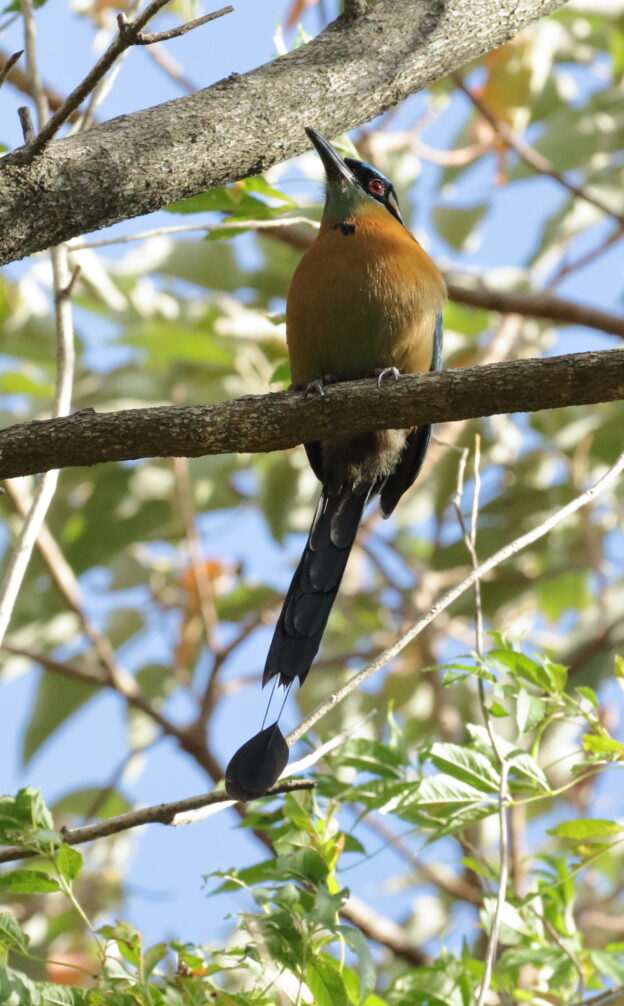
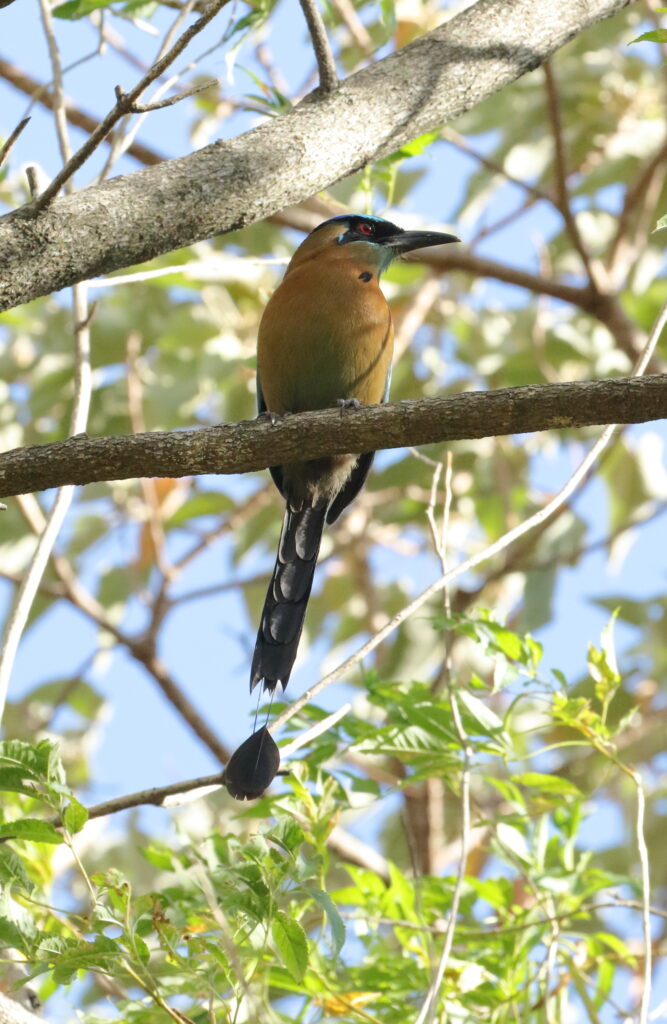
As we were winding down our visit with the Cabanis’s Ground-Sparrows, I saw a larger bird swoop past us and land on a nearby branch. “Braden,” I hissed. “Look!” It was a final gift from this amazing city park: a Lesson’s Motmot! Not only that, it struck an incredible, leisurely pose. Motmots, of course, are some of Latin America’s most distinctive tropical birds and always high on a visitor’s to-see list. I was no exception, and felt enormously grateful to see one in our very first hour or two of Costa Rica birding.
Seeing a Lesson’s Motmot in our first birding session left no doubt that we were birding somewhere far different from Montana!
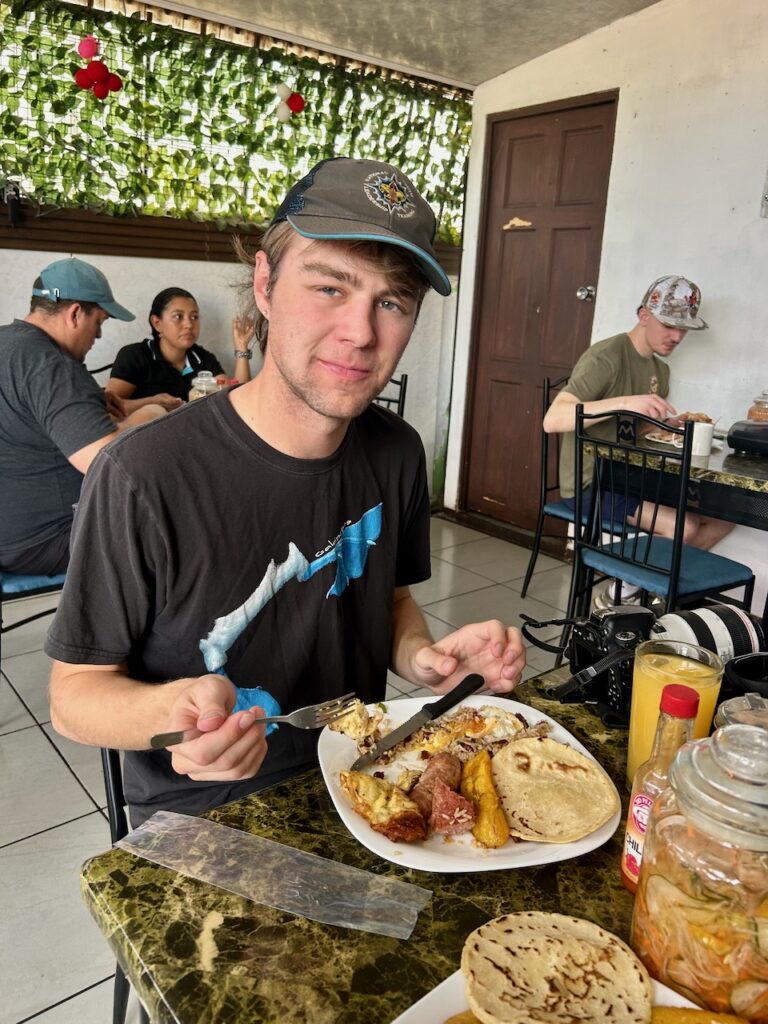
We finished our list with 47 species—almost as many birds as I’d seen in Montana in the first seven weeks of 2026! It was an awesome kick-start to our expedition, and we celebrated by grabbing our first Tico breakfast of rice, beans, eggs, and fruit at a little family diner only a few meters from the park entrance. We couldn’t predict how many highs and lows the next nine days would hold for us, but we were grateful and happy for such a promising start!
Braden has a passionate fondness for Costa Rican food, and after our first birding session we wasted no time in getting him a traditional Tico breakfast just a block from the park entrance!
2024 has been a record-breaking year for FatherSonBirding—and in more ways than one. Let’s start with the stats. Number of views to our site increased by almost 50% over last year to almost 14,000, while the number of visitors increased 65% to about 10,000. Much of what is driving these increases is interest in our posts about foreign birding destinations including Japan, Costa Rica, and Spain. In fact, viewers from 104 different countries visited our site this past year. Top views from countries other than the US were:
Japan: 445
United Kingdom: 384
Canada: 352
Australia: 244
Singapore: 208
Despite being published in 2023, our birding posts from Japan dominated views this year, especially with FSB visitors from foreign countries! Here, Tessa and I visit The Great Buddha, or Daibutsu, of Kamakura—apparently the second largest Buddha in Japan, one that harkens back to about 1252.
So which of our posts received the most views? Here is our Top 10 for 2024 (plus/minus 10 views each, given the quirks of the statistics-accumulating program):
A couple of things become evident from this list. One is that many birders are travelers. Even though they are from 2023, our Kyoto and Tokyo posts (links above) continue to get hits every day, often from people outside the United States. Despite this stiff competition, our post about San Antonio’s Riverwalk still wears the crown of our all-time most viewed site. It doesn’t take a genius to figure out that all of this is because of how many birders are out traveling the world!
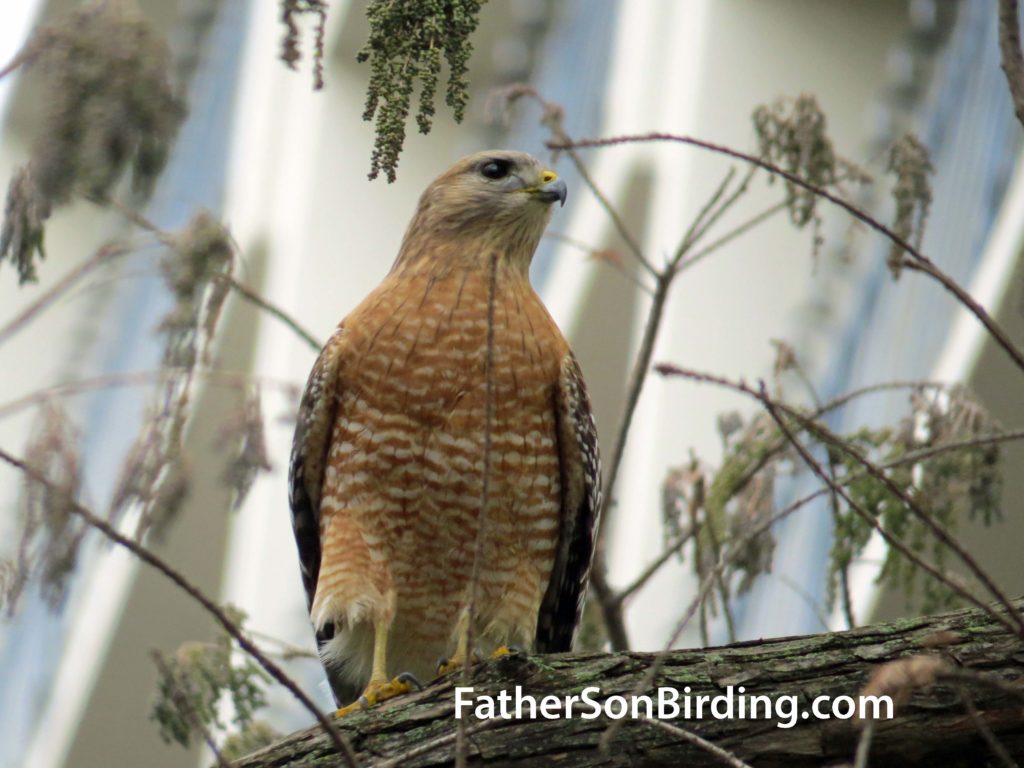
If you remember this Red-shouldered Hawk, you’ve been reading FSB almost from the beginning! Our post on birding San Antonio’s River Walk still holds the title of our most viewed post ever, with almost 2,000 views.
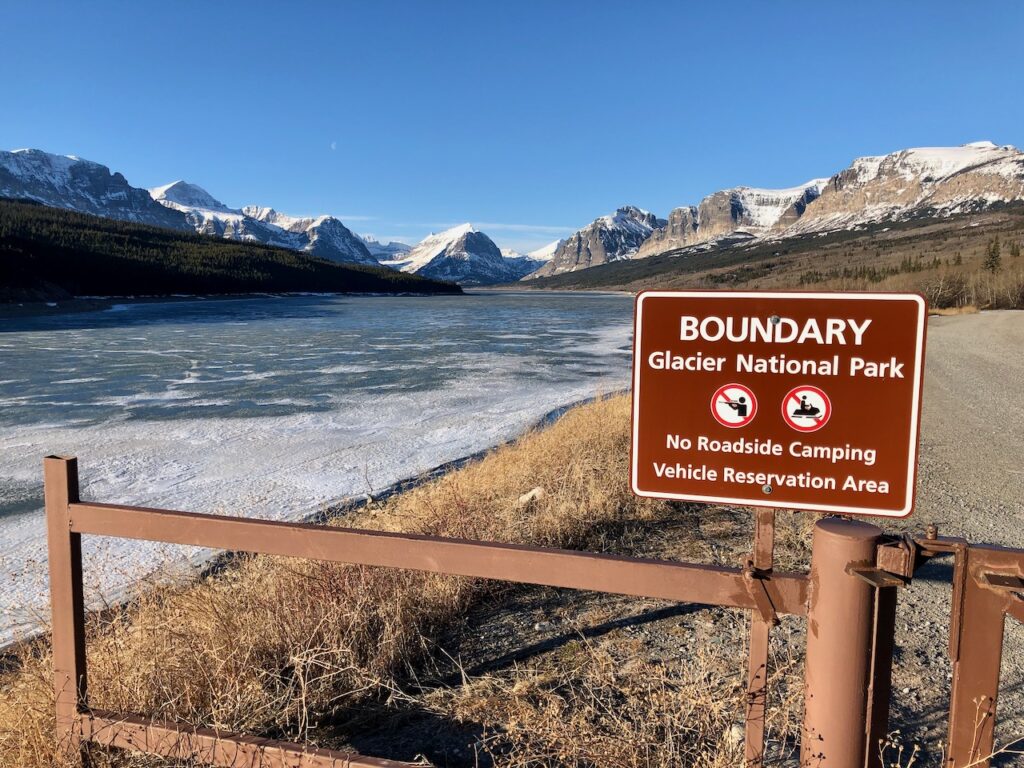
Our top posts, though, also reveal that readers of FSB have a major interest in environmental issues, as is revealed by our Glacier National Park post and our post “Turning Useless Lawn into Vital Habitat.” We take great satisfaction in that because one of the main reasons we write FSB is to help increase awareness of the environmental plight of our planet—and birds in particular—and what we can all do to improve the situation. Planting native plants in our yards is an especially simple, effective approach to increasing vital habitat that birds and their prey depend on. We’re happy that so many people took time to read our post on this topic.
Enthusiasm for our post on the dry hot winter of 2024 revealed a strong interest in the environment among FSB readers. Good job, readers!
But the year is only a little about statistics. Braden and I both had wonderful birding adventures in 2024. Thanks to his semester abroad in Costa Rica, Braden saw a remarkable 736 species of birds in 2024. More important, he got dozens of other young people into birding by starting the wildly successful UMaine Birding Club. The club did all kinds of fun activities, from leading dozens of birding outings to hosting movie nights and launching a project to reduce bird strikes on the UMaine campus building windows. Braden and I also finally got to take the eastern Montana birding safari of our dreams, spending two weeks exploring corners of the state we’d never before visited.
Braden’s adventure-packed semester in Costa Rica led him to see a remarkable 736 species of birds for 2024.
I had my own birding adventures including my wife’s and my trip to Barcelona last February, where I picked up a dozen species for my life list and had a whole lot of fun with Amy. I had two great trips to California: one to show my youngest, Tessa, a couple of potential colleges for next year; the second a great Bay Area trip to visit family and friends, including four fab days of birding with my childhood buddy, Scott. Work travel gave me additional opportunities to bird in Oregon, Washington, and throughout Montana. The highlight of the end of my year was getting to bird Cape Cod with Braden during Thanksgiving Week. I am also elated that my newest book, Birding for Boomers, is off to such a great start, reaching #8 the Pacific Northwest Booksellers Association bestseller’s list for nonfiction paperback books!
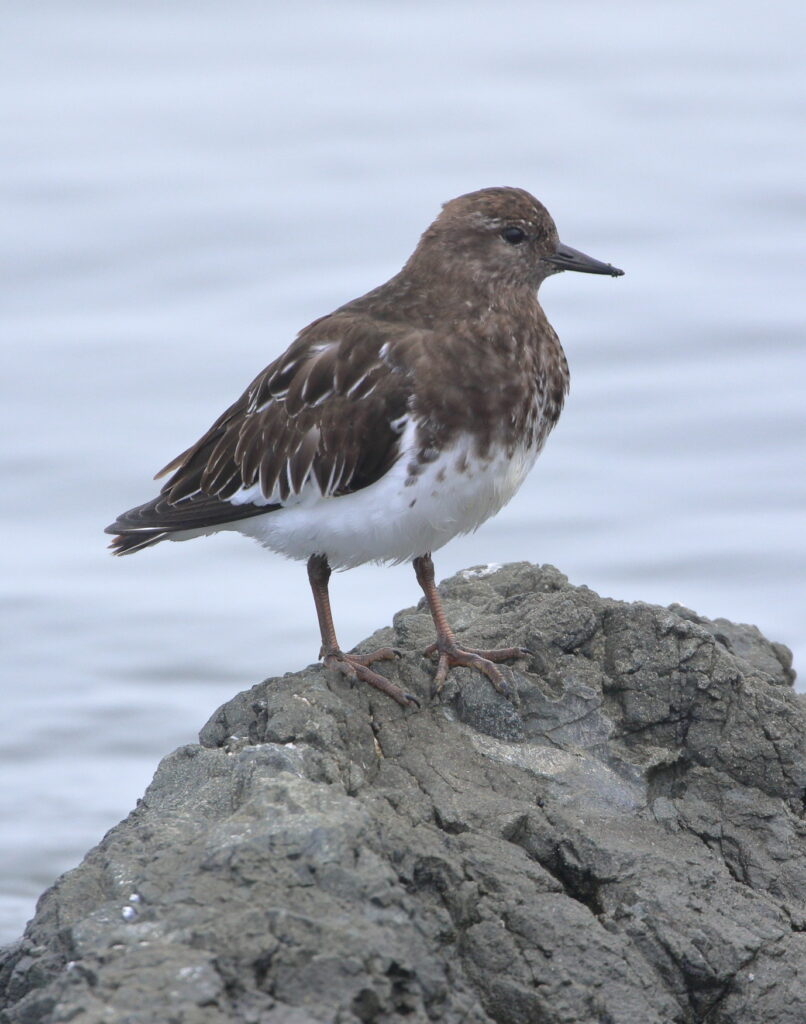
Thanks to the year’s second trip to California, I got to spend more time than usual with friends—and coastal birds such as this Black Turnstone.
As usual, Braden and I have only vague ideas where 2025 will take us and what we will be moved to write about. A few destinations in the mix: Indonesia, Vancouver Island, Texas. Whatever adventures we have and end up writing about, we deeply appreciate all of you for checking in and taking an interest in the coolest group of critters on earth. We also appreciate you supporting our work by buying our books and sharing FSB with your friends, family, and colleagues.
Until next year, Happy New Year, and may 2025 bring you joy, satisfaction, closer connections and, of course, a whole lotta birds!
Braden and I write FatherSonBirding in the hopes of sharing the wonders of birds and birding, and the urgency to protect them. We do not accept advertising or donations, but if you’d like to support our work, please consider buying *NEW* copies of some of Sneed’s books—First-Time Japan, for instance, or my recent Orbis Pictus Award winner, Border Crossings. We appreciate your interest and hope you will keep reading!
A low growl emanated from the dense jungle up the hillside from the highway, stopping me in my tracks. The sun hadn’t even thought about rising yet, since I’d woken up before 5 a.m., but some animals were awake, including the Crested Owl I’d just heard call from the rainforest. I laughed in disbelief as I stood on the side of the highway, looking up the hill. While I could not see the animal, Crested Owl was one of the country’s largest owl species and one I’d been hoping for but not expecting to get during my time here. And yet here one was, singing for me as I began my trek from El Chontal (my hostel) to the Río Rincon Bridge in extreme southwestern Costa Rica.
The walk from the hostel to the bridge was about an hour, and as I plodded along the highway, I could hear and feel the forest waking up. Little Tinamous and Great Curassows called in the dark, and about half an hour before dawn many other species of birds started up. Immense roars echoed from high in trees as male Mantled Howler Monkeys welcomed the sun into the sky, and I eventually arrived at my destination, the bridge spanning the Río Rincón. Nearly every birder visiting the Osa Peninsula stopped here, albeit usually with a vehicle and not on foot. The bridge offered great views of mangroves to the east and rainforest to the west, as well as a wide open vista from which to watch parrots of many species leave their roosts in search of food. The primary reason birders stopped here, however, was for a specific, critically-endangered bird species: the Yellow-billed Cotinga.
My early morning walk rewarded me with multiple looks at Yellow-billed Cotingas, rare and beautiful birds endemic to southwest Costa Rica.
Cotingas are a strange, remarkable and hilarious group of birds. These plump birds feed primarily on fruit and come in a wide variety of shapes and colors, including tangerine orange, like the Andean Cock-of-the-rock, shadow black, like the Bare-necked Umbrellabird, or electric blue, like the Turquoise Cotinga. The family features some of the world’s weirdest species, like the monk-like Capuchinbird, and the loudest birds in the world, the bellbirds, one of which resides in Costa Rica (and will be my target for my final weekend trip in this country, so stay tuned!).
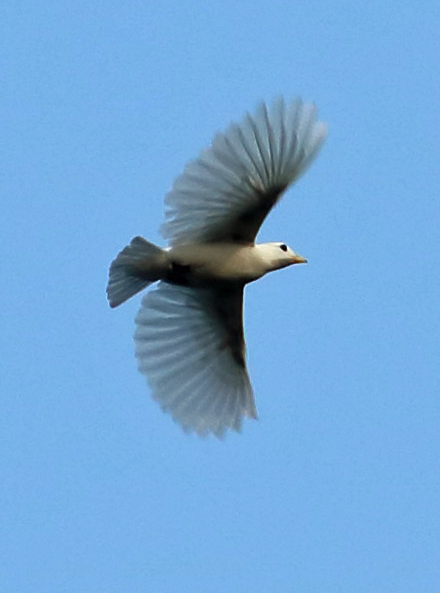
Yellow-billed Cotingas are angelic white, and are endemic to southwestern Costa Rica and extreme western Panama. They live in extensive lowland rainforest and mangroves, and thanks to habitat decimation, are largely restricted to the Osa Peninsula, one of the country’s wildest remaining areas. This species was one of the primary reasons that I had requested to skip classes this week and visit this far-away peninsula, and the Río Rincón Bridge was the most reliable place to see them.
By the time I arrived, barely before dawn, the birds were already active. Hordes of parrots, from the pint-sized Orange-chinned Parakeets to the chunky Red-lored Parrots to the spectacular Scarlet Macaws, flew over me towards distant locations. A Bare-throated Tiger-Heron hunted for fish in the river, and another one, a juvenile covered in its namesake black and orange stripes, watched from a nearby tree. The sandy river island hosted several Spotted Sandpipers, a Willet and a Northern Jacana—the first I’d ever seen. Jacanas have massive feet which they use to walk atop lily pads, although there weren’t any lily pads in sight here. Flocks of swallows and swifts wheeled overhead, and I spotted a few Fiery-billed Aracaris swooping across the river, their flame-colored bills shining in the sun.
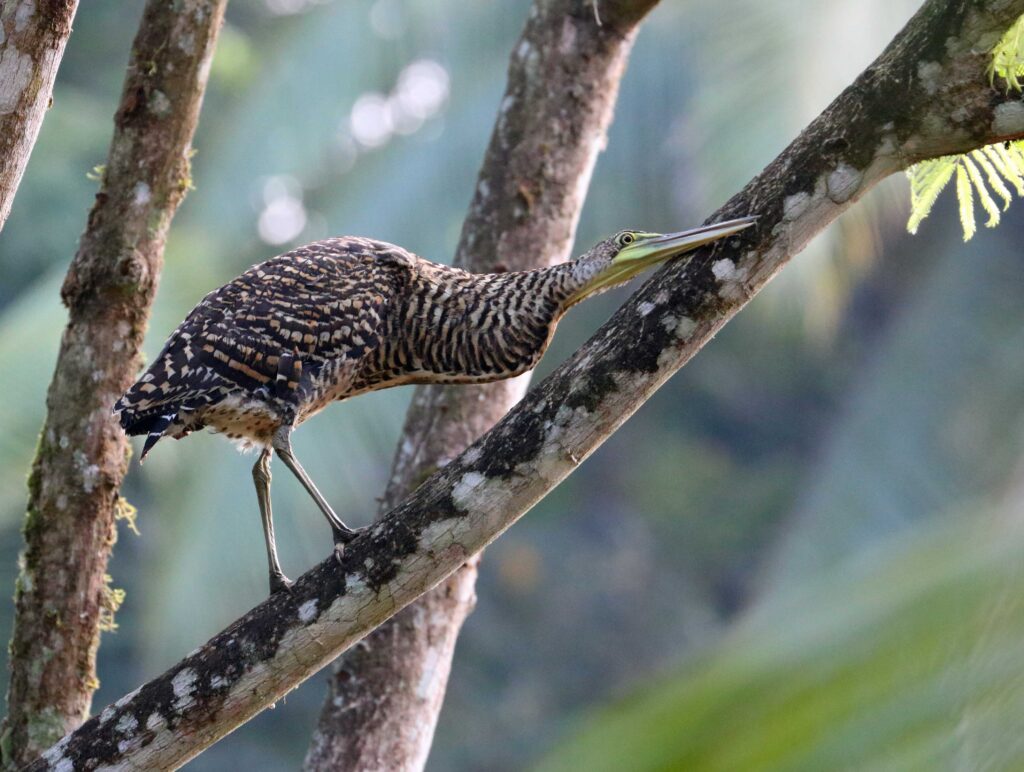
Even though I’d already seen them on the trip, I had yet to grow bored seeing a Bare-throated Tiger-Heron.
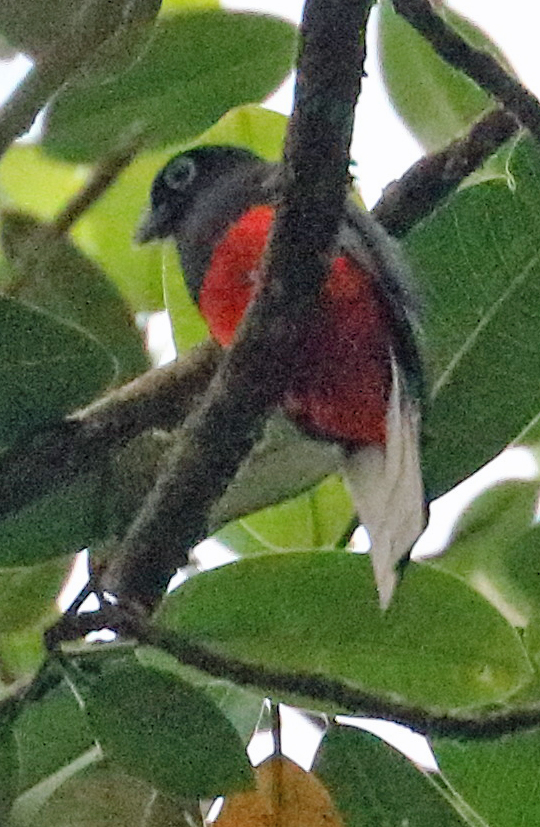
As I stood on the bridge, unsure of where to look for the cotingas, I heard a distinctive song from a nearby tree. The “bouncing-ball” call sounded exactly like a Wrentit, a bird native to the chaparral of California, which had never been recorded in Costa Rica and probably never will be. I knew exactly what it was, though, since I’d studied the song the night before and noticed the resemblance it had to a Wrentit. I walked over to the tree and whipped out my speaker, playing the call right back at the bird. Then, a large, blue and red bird flew in and landed several dozen feet above my head in clear view: Baird’s Trogon. This had also been one of my chief targets on the Osa, given that it was difficult to find nearly anywhere else in the country, and I snapped some poor photos of it before returning to my cotinga watch. After about fifteen minutes, that watch paid off, as a mottled gray female cotinga flew over, landing briefly in a tree in front of me before disappearing in the foliage. “Well, that wasn’t the view I’d hoped for,” I said to myself, a bit disappointed but still relieved that I’d seen my target species. The cotingas weren’t done yet, though. Over the next hour and a half, I spotted seven more of the birds flying over, many of them strikingly-white males. I got a decent picture of one in flight, too.
Despite the poor photo, Baird’s Trogon was one of the chief targets of my Osa Peninsula trip—and at least the sixth species of trogon I’d seen in Costa Rica!
After two hours of great birding, I walked back along the highway to my hostel. From there, I packed up and caught the bus down to Puerto Jiménez, the largest city on the Osa (which is still quite small). I found a small soda (the name for any number of small, family-owned restaurants in Costa Rica) and waited there for about an hour before a tiny, run-down van pulled up in front of it at 11. “Dos Brazos?” asked the lady driving it, and I nodded, throwing my bag in the van and climbing up after it. The interior of the van was in rough shape, although the seats were comfortable, and I taught the lady’s young son how to use my binoculars as we rattled up dirt roads towards the “town” of Dos Brazos, hidden deep in the rainforest.
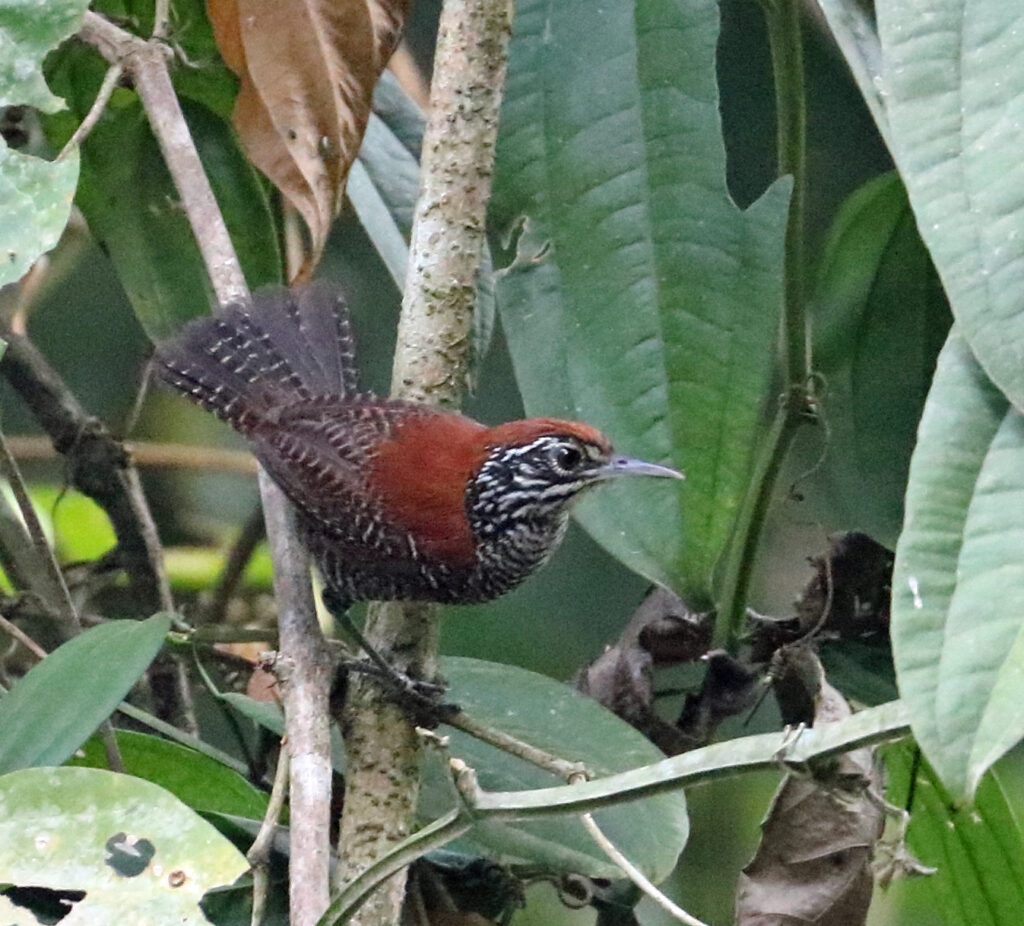
Riverside Wren—Costa Rica’s Most Stylish Wren???
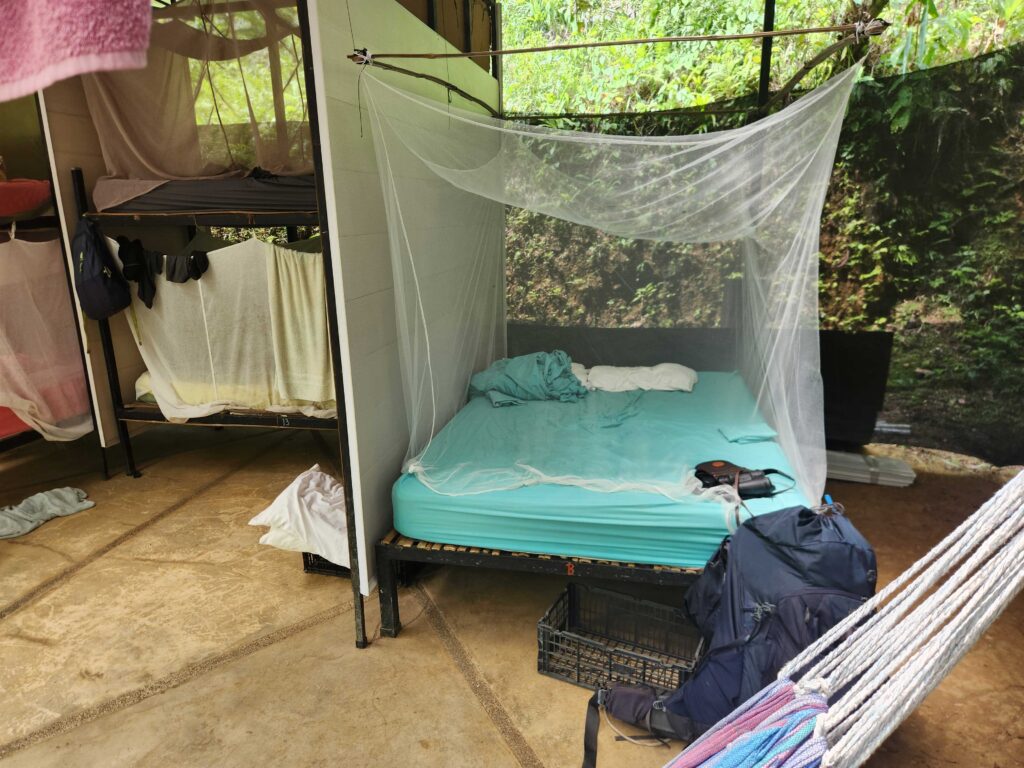
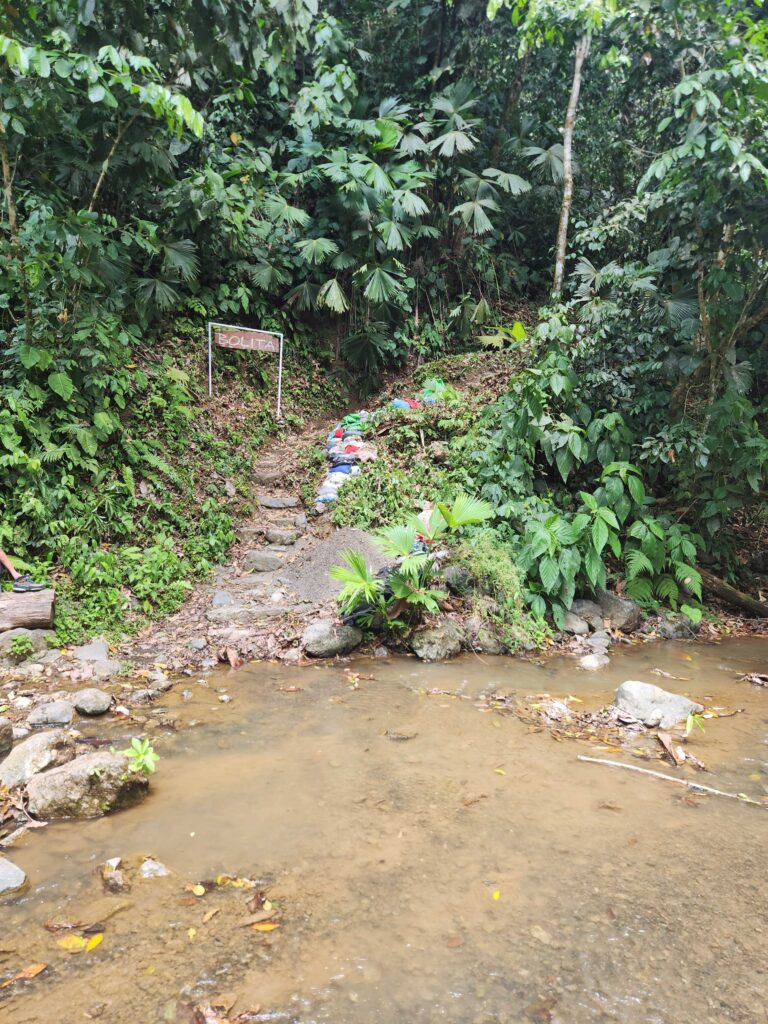
The woman let me off in front of the reception house for the Bolita Rainforest Hostel, where an American greeted me. “Welcome to Bolita! The hostel is a 30-minute hike that way,” she pointed up into the jungle. So, I set off, my heavy pack on my back. I spotted a pair of Buff-rumped Warblers next to a creek I had to cross, and eventually arrived at the open-air hostel, caked in sweat. Another American and several volunteers from all over the world greeted me cheerfully, showing me to my “room”, an outdoor bed with a mosquito net over it. There was no “inside” at Bolita, except maybe the supply closet, which hosted half a dozen roosting bats on its walls. After I settled down, Pascal, an older French volunteer, noticed my binoculars.
I wonder how many Hilton Honors points I’ll get for my stay at the Bolita Rainforest Hostel—a place with superb “air-conditioning!”
“Are you a birdwatcher?”
I nodded, and she proceeded to pull out a faded “Birds of Costa Rica” book, flipping it open to a page with small, colorful birds on it. She pointed to the bird that just so happened to be my number one remaining target for the entire trip: Orange-collared Manakin.
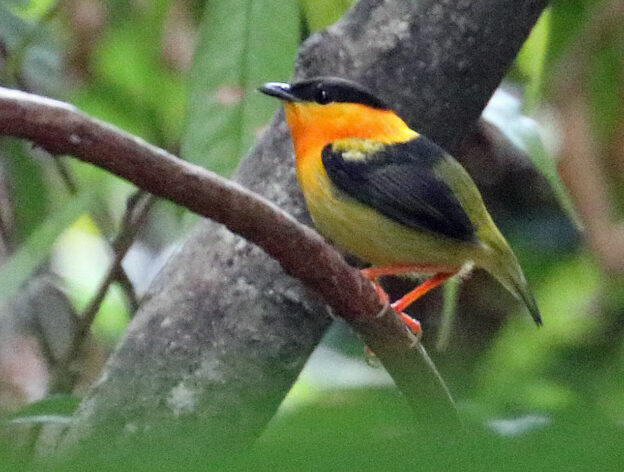
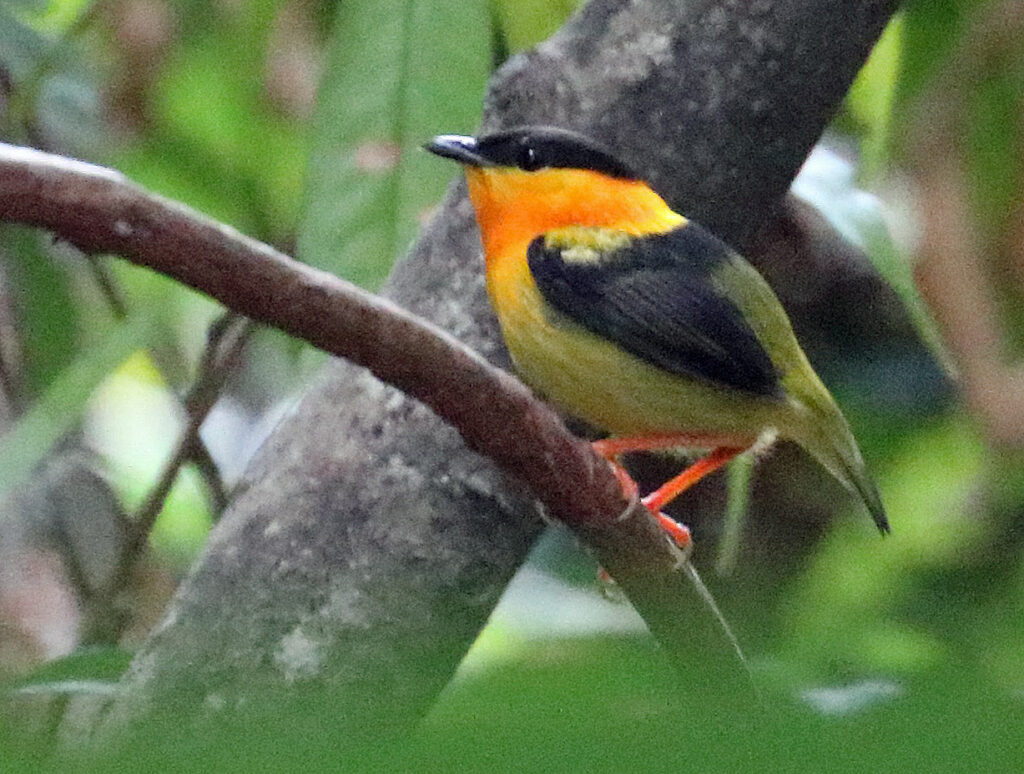
“I saw these guys here! The males all dance for the females at places called leks, and I found a lek on one of the hostel trails. I can show you if you’d like!”I nodded profusely—fate had somehow delivered to me the perfect opportunity to see the bird I wanted to see most here. Soon, Pascal led me and a few other interested guests up the “Big Banana Trail.” After twenty minutes of hiking, we rounded a corner and heard claps from the nearby trees. Pascal waded a few feet into the foliage off the trail, and pointed. There they were, tiny, football-shaped birds with sunset-colored collars and tiny black caps, like the White-collared Manakins I’d seen in Sarapiqui but with fiery rather than white throats. We enjoyed them for fifteen or minutes or so before everyone else wandered back down towards the hostel. I decided to poke around the trails a bit longer—and I’m glad I did.
Once I arrived at the hostel, and thanks to a new friend, it took me only minutes to find my last remaining Osa Peninsula target bird, Orange-collared Manakin.
Almost immediately, I heard the loud, repeating call of a wren coming from a tangle near me, and with a little verbal coercion, I was able to spot the culprit: a Black-bellied Wren, another southwestern Costa Rica specialty bird. This wren happened to be the beginning of a large mixed flock and I spotted several more wrens as well as antshrikes, antwrens, a foliage-gleaner, and a Little Tinamou, a hard-to-see forest bird, feeding right on the trail in front of me. I stopped at one lookout and watched as the birds came to me: parrots, flycatchers, hummingbirds and more. Highlights included a female Thick-billed Seed-finch, a tiny bird with a massive bill; an Olive-sided Flycatcher, a bird that winters in South America and summers in the boreal forest of Montana and Maine; and a Purple-crowned Fairy, a flashy, usually-arboreal hummingbird that steals nectar from flowers rather than pollinating them. Extremely satisfied with this mid-day birding, I headed back to the hostel to watch the sunset.
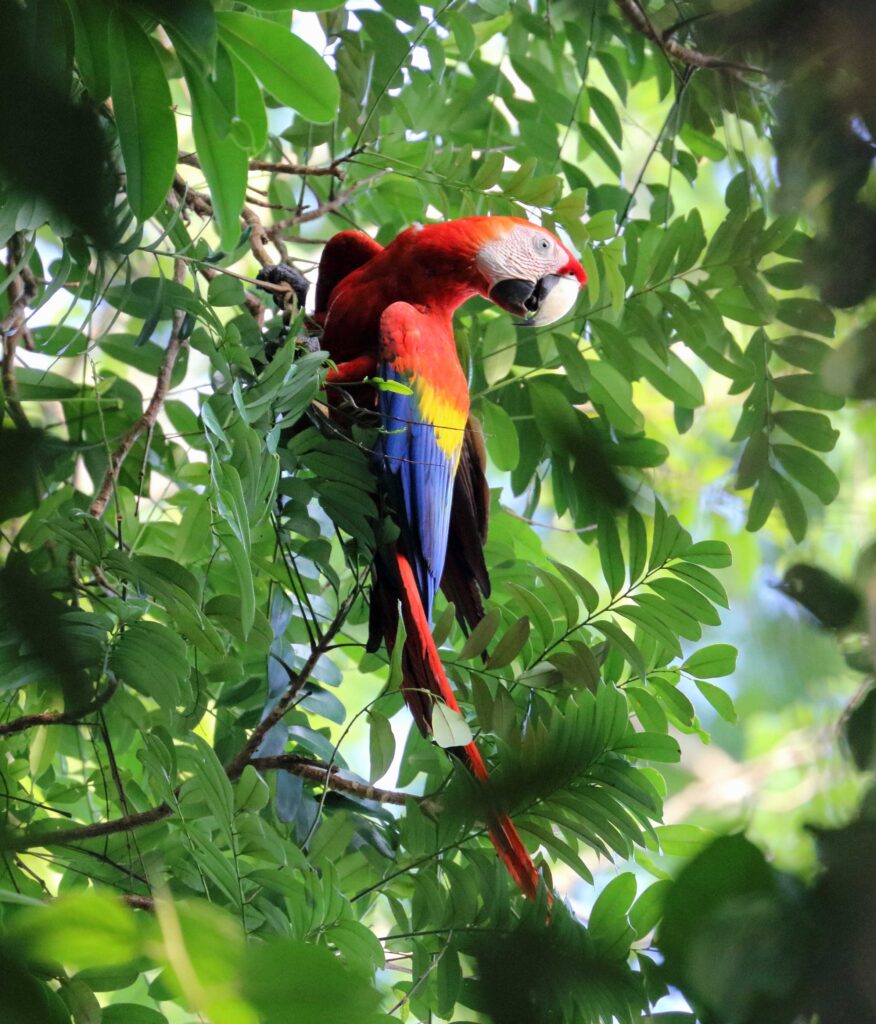
Scarlet Macaws are one of the birds most people want to see in Costa Rica, and in the Osa Peninsula, I found no shortage of these spectacular creatures.
I found a nice little bench overlooking much of the rainforest and quickly realized that even the hostel had great bird activity. Piratic Flycatchers, Scarlet-rumped Tanagers and Bananaquits flew around me, and about an hour before dusk, I spotted another bird that blew me away: another cotinga, this one the color of the sky. I’d looked for Turquoise Cotingas three days earlier and completely missed them, and yet here they were, delivered right to my doorstep in all their blue and violet glory. I had gotten, quite simply, every bird I’d wanted to see on the Osa Peninsula. And I still had one morning left!
One of the trails I explored near the Bolita Rainforest Hostel.
That morning was spent exploring more of the trails behind the Bolita Rainforest Hostel. With no real targets, I just set off into the jungle, hoping to discover something unexpected, and I did! I spotted three more lifers, including Black-crowned Tityra, Black-cheeked Ant-tanager (the only species completely endemic to the Osa Peninsula) and a Northern Black-throated Trogon, which was one of four trogon species I reported on my hike. I heard dozens of antbirds, antwrens, antshrikes and antthrushes, spotted groups of Scarlet Macaws flying high above me, and watched the sunrise over the misty hills stretching all the way out to the Pacific Ocean. I’d seen some beautiful places in Costa Rica so far, but none had been so wild as here. From one vantage point, I could see no signs of human habitation—just forest and sea. Even for a country that has done so well protecting its environment, places like this are rare, and I’m so happy I got to experience it.
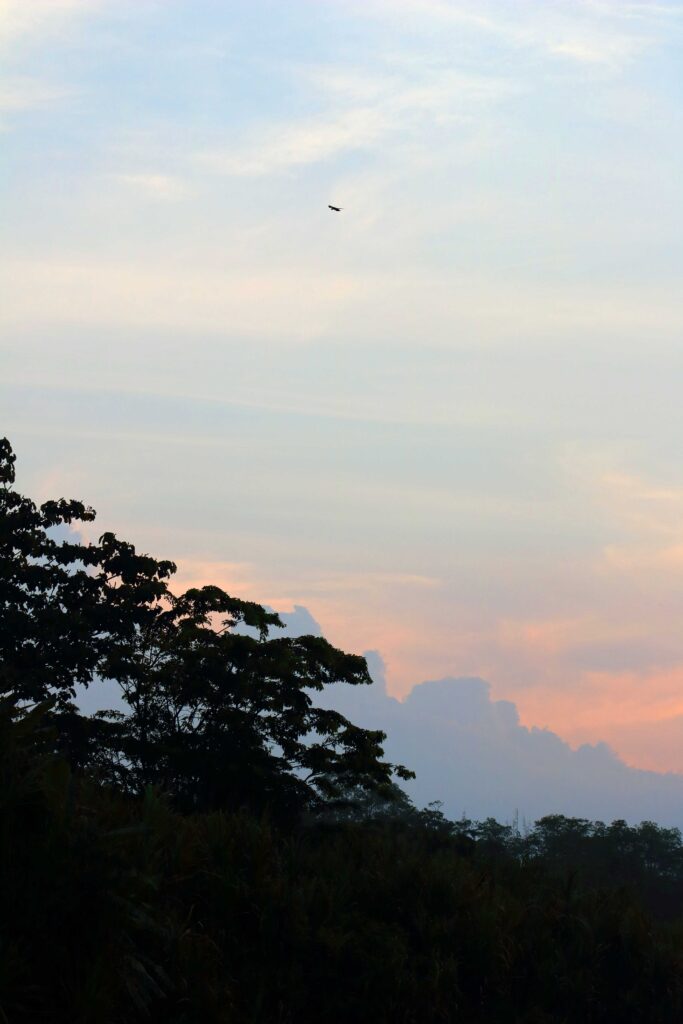
A lone Scarlet Macaw flies across the dawn sky—my last morning in the Osa Peninsula, and one I’ll never forget.
You can experience it too! Whether you want to see the jungles of Central America, like me, or the snow-capped peaks of the Alps or the Andes, the castles of Europe, the hubbub of Tokyo or the grasslands of the Serengeti, you can, with the help of the Gilman Scholarship! I’m sure I sound like a broken record, but it’s because it’s true—the Gilman can help low-income college students reach far away destinations to study abroad with just a simple application! I urge you to apply today, so you can have a life-changing, international experience during your college years, like me!
Not many of us have the resources to bird outside of our own regions, and if you are part of that large club, you’re in luck. Braden is spending the spring semester of his junior year studying abroad in Costa Rica. He has 16 full weekends to work with and it’s no surprise that birding is on the agenda for every one of them. Here is his latest report—to a place that is not only a wonderful birding destination, but a model of sustainable agriculture. Enjoy!
I arrived at La Reserva El Copal just as the sun dipped behind the rainforest-covered foothills, my clothes soaked with sweat and every part of my body tired from the four bus rides and two-hour walk it had taken to get to one of Costa Rica’s best birding locations. My weekends in Monteverde and Jaco had been eventful and fun, but I was in need of some solo birding time, and so four days earlier I had made a reservation for this inexpensive, out-of-the-way property sitting on the lower slopes of the Cordillera de Talamanca. Patricia and Beto, the couple that ran the reserve, warmly welcomed me as darkness fell, showing me to my room and then to the dining hall for a dinner by candlelight. As I stared at the photos of rare and colorful hummingbirds on the walls, I realized that I was the only guest staying here for the night. Patricia served my rice and beans and said that she and Beto usually lived in Pejibaye, the town the final bus had dropped me off in, and only came up here when guests arrived, which wasn’t particularly frequently in January and February. This surprised me, given El Copal’s location and the high number of desirable bird species reported from here.
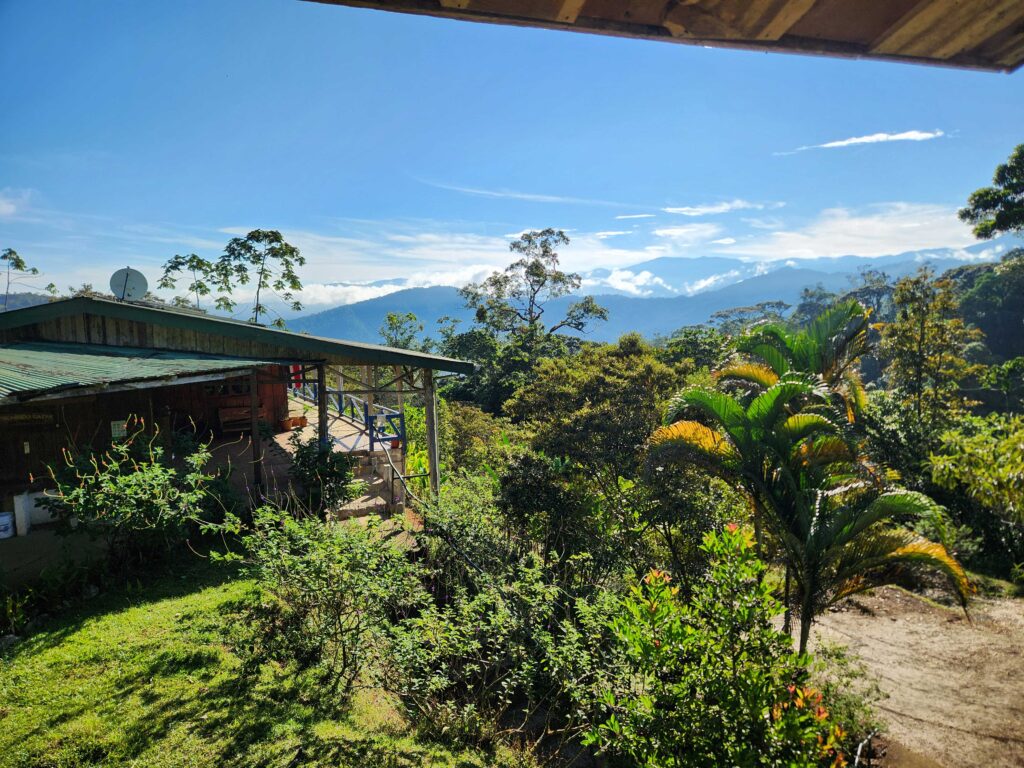
Even a glance of the grounds explains why El Copal is one of Costa Rica’s top birding destinations.
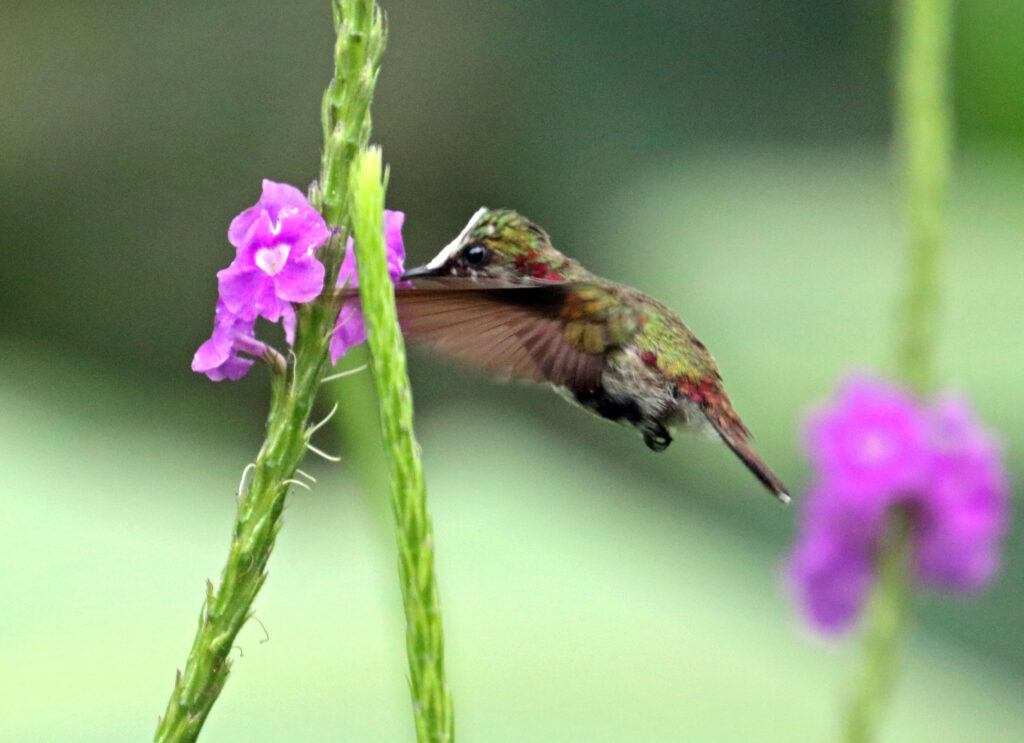
The next morning I arose at dawn, grabbed my binoculars and camera and headed off into the property as the trees began to glow with increasing sunlight. Almost immediately after stepping outside, a small, dark hummingbird buzzed by me, stopping to feed at one of the many flower bushes adorning the property. Despite the fact that it was still dark, I could clearly see the brilliant white cap for which the bird was named—Snowcap, which, in the weeks leading up to my trip to Costa Rica, had quickly risen up the ranks as one of my most-wanted birds. Rare denizens of the Caribbean slope, there were very few places in the country where these birds were reliable. El Copal was one of them, and I ended up seeing at least half a dozen of them during my stay here. The tiny, fairy-like hummingbirds eliminated any doubt I had about making this trip!
El Copal is one of the few places to reliably see Snowcap hummingbirds, and fortunately, they are there in abundance!
El Copal is full of rare birds. Back in the late 90s, the land now holding El Copal had been purchased by several families for agriculture. Instead of developing the rainforest, however, they decided to first establish a form of sustainable agriculture, then open it up for ecotourism, preserving much of the primary forest on the property. Now, some of Costa Rica’s most sought-after birds (and other animals) thrive here, thanks to the decision of those local farmers. This includes the Snowcap and a variety of other hummingbirds, as well as my #1 Target Bird for the whole country: Yellow-eared Toucanet. Of the six toucan species found in the country, this toucanet is the rarest, only found in middle elevation-rainforest on the Caribbean slope. El Copal seemed to be one of the best places to find them in the whole world, and I had my fingers crossed as I headed up the steep trails leading into the reserve.
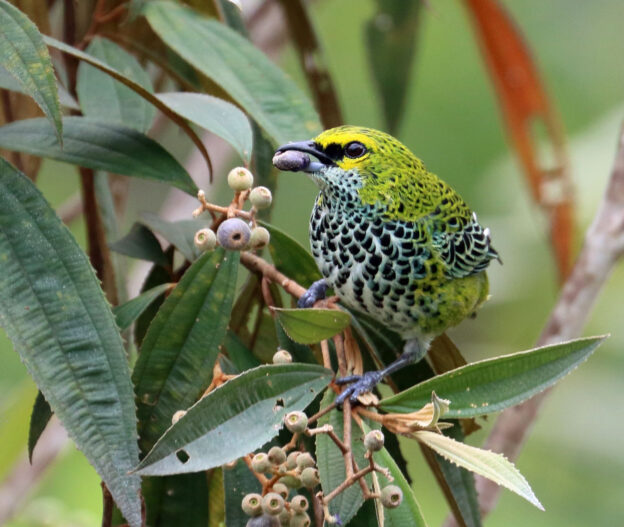
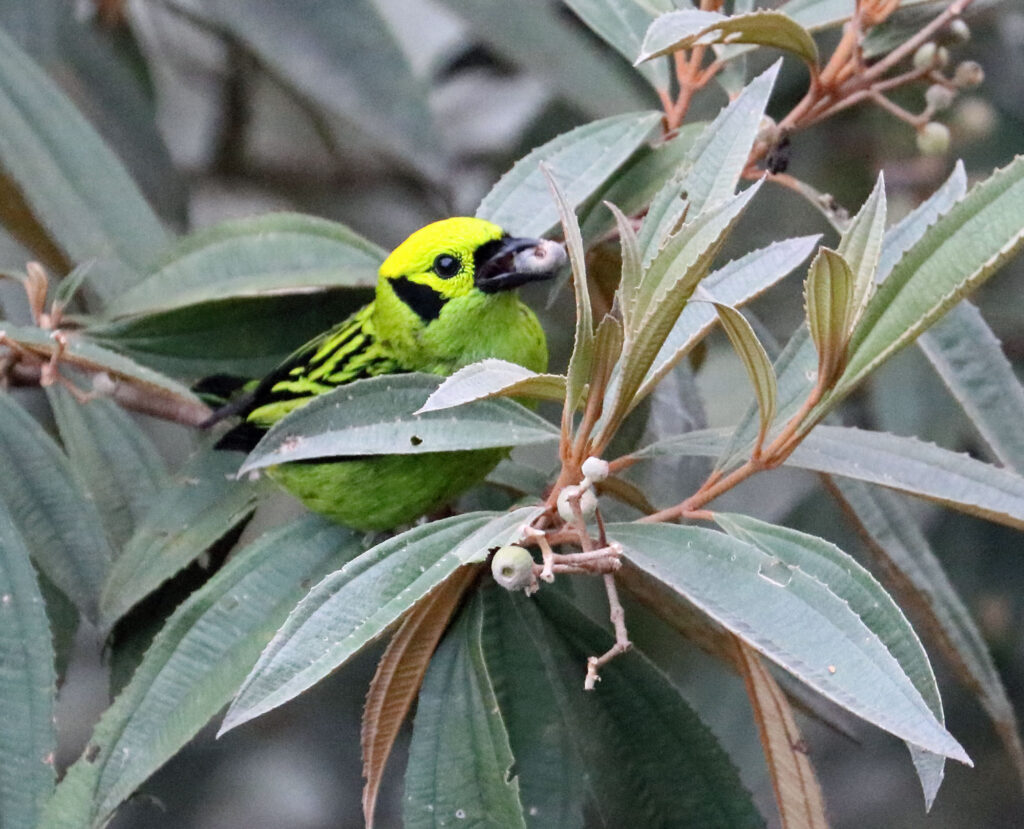
The morning was…complicated. I heard a whole lot of birdsong, but very few of the singers actually presented themselves for good looks. Merlin (the bird identification app developed by the Cornell Lab of Ornithology) was only so helpful, as there are significantly fewer recordings of Latin American species than North American species. Bird sounds that the app identified for me included Bright-rumped Attila, Broad-billed Motmot, and Northern Schiffornis, the latter of which is an entirely brown bird with one of the most entertaining whistling songs I’ve ever heard. Despite my frustration at not being able to see many of the birds hidden in the foliage, I did get eyes on a few. I spotted both a Collared Aracari and a Keel-billed Toucan, two species of toucans quite common in this type of rainforest. And I did lay eyes on several large, mixed flocks of tanagers, colorful birds that traverse the forest in search of fruit. The species I picked out at the tops of trees included Silver-throated, Emerald, Speckled, Golden-hooded, Hepatic, Summer, Scarlet-rumped, Tawny-crested, Black-and-yellow, and Bay-headed Tanagers. I also got to watch a family group of coatis quietly foraging on the trail ahead of me. They scattered when I stepped on a branch by accident.
The tanagers put on a real show around the El Copal lodge—including this spectacular Emerald Tanager.
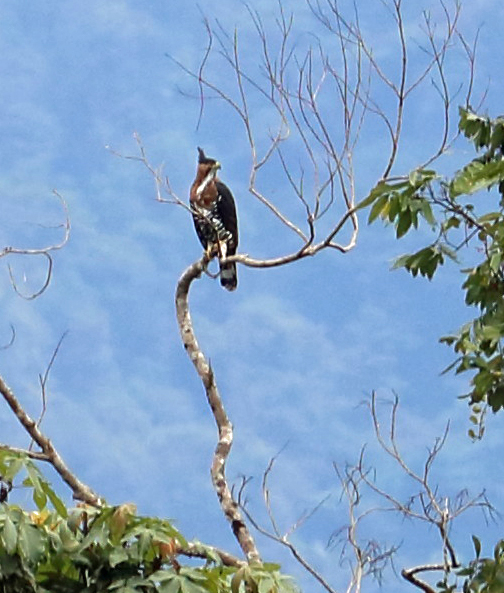
I returned to the main property for breakfast, then headed off on a different trail, this one leading down towards a stream. I found a Buff-rumped Warbler foraging on the rocks in the water, and peered around tree ferns and buttressed trees to try and glimpse the calls I was hearing. This trail also took a left turn and then continued up the mountain, and further up I spotted Scarlet-rumped Caciques and Chestnut-headed Oropendolas, big grackle-like birds making crazy calls. As I rounded a corner, a shiny green bird with a long bill alighted on a branch in front of me. The bird’s beak was longer and thinner than that of a kingfisher, and it had a warm, orange belly complementing its shimmering, green back: a Rufous-tailed Jacamar! Few birds had given me such a good look that morning, and I stood there for several minutes, watching the bird peer down at me curiously. A few minutes later, a large Ornate Hawk-Eagle soared through a gap in the trees, and my attitude began to improve—the birds were showing themselves! On the way down, I heard a rising and falling song, signifying the presence of an antbird. I poked around a little, eventually getting eyes on a Bicolored Antbird overturning leaves! This species, like many other antbirds, are ant-following obligates, meaning that they depend on army ants to find food. As large swarms of army ants rush through the rainforest, they stir up and scare hundreds of other insects, who leap out of the way, straight into the waiting mouths of antbirds, antwrens, woodcreepers and a variety of other birds that just follow the ants around. Ground-cuckoos, one of the most enigmatic groups of birds, also belong to this ant-following group.
While I didn’t actually lay eyes on any army ants, the antbirds signified that there must have been some nearby. The leafcutter ants, meanwhile, were everywhere. Their trails ran alongside and crisscrossed the walking trails, and I always had to keep an eye on the ground so I wouldn’t step on any.
One of the best parts of my visit to El Copal was meeting Carlos, who pointed out this perched Ornate Hawk-Eagle near the lodge.
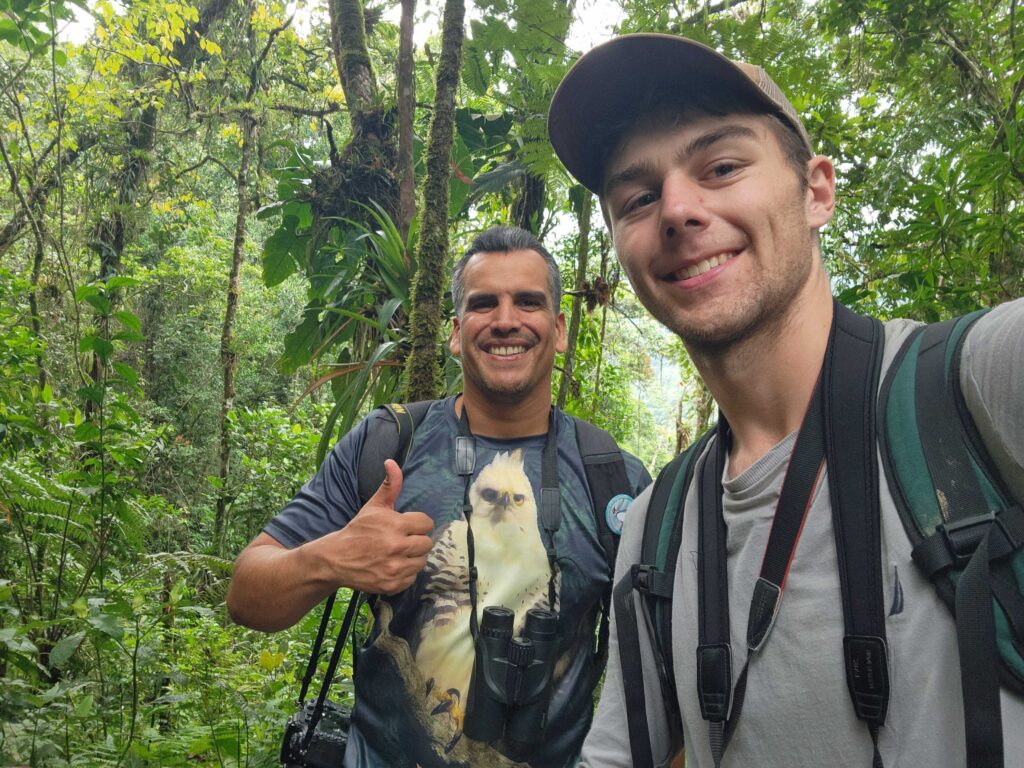
When I arrived back at the lodge for lunch, another birder who had just arrived pointed out another Ornate Hawk-Eagle, this one perched up on a distant snag. As I peered at the bird through his spotting scope, he introduced himself as Carlos, a local also living in Pejibaye. Carlos is an English teacher and regularly visits El Copal during weekends to search for the hundreds of bird species found here. I told him that I hailed from the University of Maine, and spoke of my hunt for the Yellow-eared Toucanet. He looked at his watch. “I’ve got a few more hours…do you want to hike the trails and look for the toucanet together?” So, after a quick lunch, we headed back up the mountain in search of my target.
Thanks to my chance meeting with Carlos, a teacher and Costa Rican bird expert who can identify most of the birds by sound, I got to see one of my most sought-after Costa Rican species (keep reading).
Carlos’s knowledge of the birds of the area was impressive. For one, he could identify many of the calls I’d felt hopeless about earlier, which included more species of antbirds, Collared Trogon, and several species of wrens. He also knew exactly where all the birds hung out, at one spot pointing down the side of the cliff to a White-crowned Manakin, a tiny black bird with a white cap, sitting in a bush fifty meters away. “He’s always here.”
As we gained altitude, I could begin to see the influence of cloud forest. Slightly different species lived here, and the plant composition looked different, too. One thing in particular made us realize we’d entered a higher-altitude area, however. “Toucanet!” Carlos yelled, pointing to a large, bromeliad-covered tree rising from the slope. I held my binoculars up to see, not my target bird, but an entirely green toucan: a Northern Emerald Toucanet! We tried in vain to photograph the species but neither of our cameras would cooperate, although it will be a long time before I forgot what it felt like to see that bird. This species is much more common at higher altitudes, and it was the first time Carlos had ever seen one on the property! It was, of course, a lifer (a bird I’ve never seen before) for me. As if the Emerald Toucanet wasn’t enough, as we rounded the corner, Carlos stopped me again.
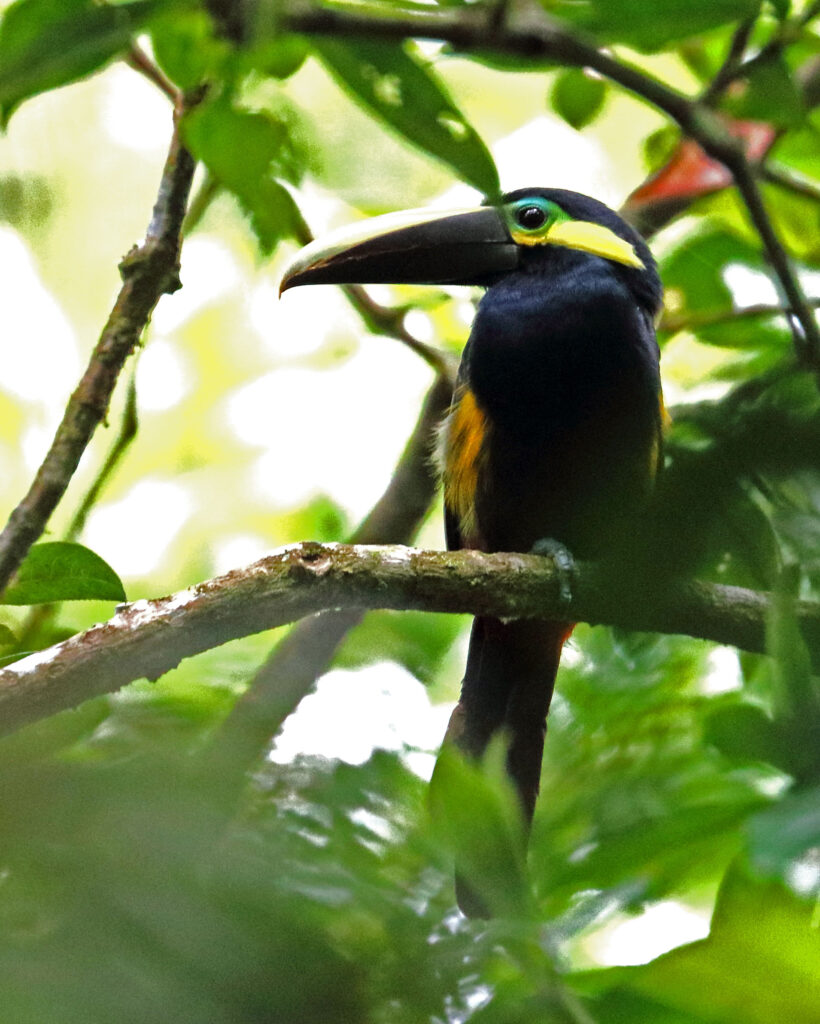
Slowly and quietly, he pointed out a large-ish bird sitting about twenty meters in front of us, up in a tree. The bird was black, with a chestnut cap complementing the blue and green skin around its eye. Its long yellow and black beak, combined with green wings, orange flanks and red rump, identified it as the bird I’d been searching for: a female (hembra in Spanish) Yellow-eared Toucanet. I just about lost my mind, holding my camera up slowly with shaky hands. Never had I actually believed I would lay eyes on one, and yet, here one was, right in front of us. Then, the male appeared, sporting that yellow ear the species was named after.
Again thanks to Carlos, I had an unforgettable experience with the bird at the top of my “must see” list—a pair of Yellow-eared Toucanets (male shown here).
We enjoyed the birds for about ten minutes, then headed off, as Carlos had to get back home. I thanked him profusely for sharing these amazing birds with me, and we exchanged contact information. Then, I spent the rest of the evening looking at and deleting photos and enjoying the tanagers feeding in the fruiting trees in front of the rooms. Before I went to bed, I spotted several of what I believe to be bioluminescent beetles flying through the rainforest (though they may have been fireflies. I’m not good with bugs.).
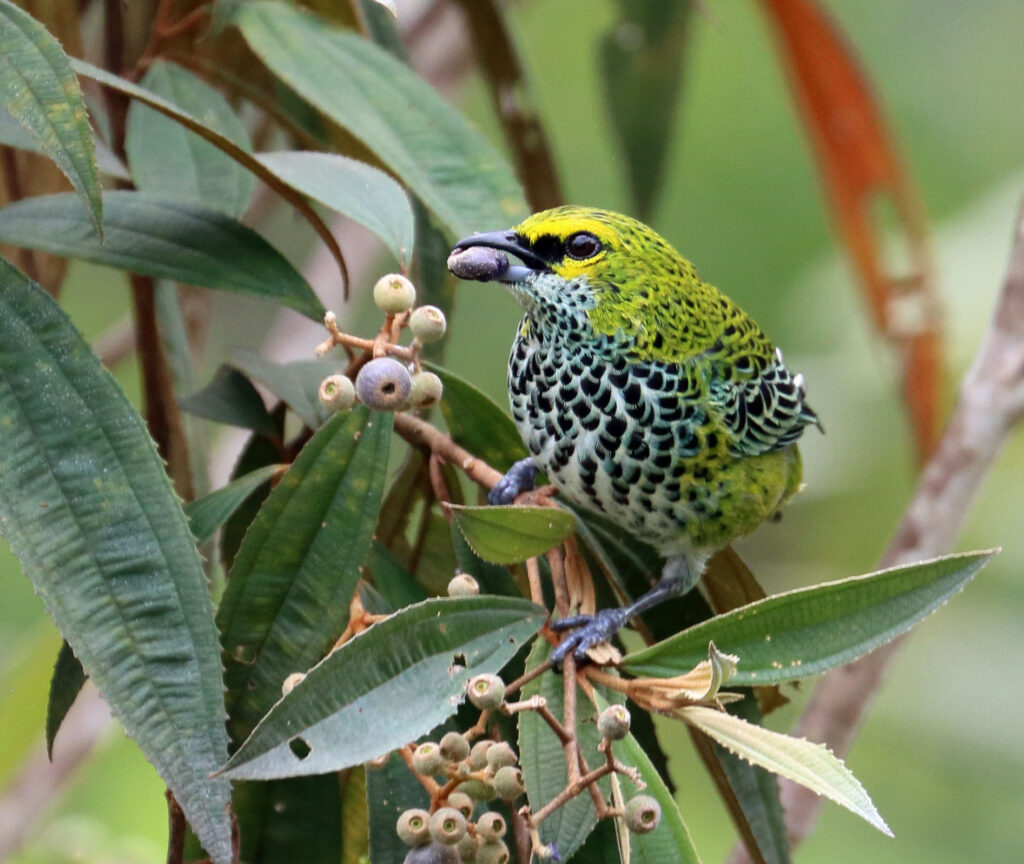
No, this Speckled Tanager was not touched up by artists for my visit!
In total, I spotted 117 species at El Copal over the weekend, including a few the next morning like King Vulture, Gartered Trogon and Green Thorntail. La Reserva El Copal could be described as nothing short of magical. Are there places like this that you’ve always wanted to visit? A mountain range full of endemic plants? A reserve dedicated to protecting endangered amphibians? Perhaps your bucket list is topped with places like the Serengeti, the Great Barrier Reef, the ancient castles of Ireland? If you are, the Gilman Scholarship can help you get to these places! Studying abroad is an experience that every student should have the opportunity to have, and the Gilman helps put this philosophy into practice. The money they awarded me has helped me afford to go on adventures like this, the rain-forested foothills of Costa Rica, and they can help you too! So please, if you’re considering studying abroad (which you should be), apply to the Gilman!