Category Archives: Braden’s Transcontinental Birding

Campsite #512: Algonquin Provincial Park, Canada (Maine to Montana, Part 4)

Today, we continue Braden’s epic birding trip from Maine to Montana with an astonishing visit to a place few people get to experience: Algonquin Provincial Park. Enjoy this latest installment, and if you’d like to support FatherSonBirding and independent journalism, please consider buying one of Sneed’s books shown to the right. Oh, and please share this post!

Twelve hours west of the Maine border, I spotted the giant sign reading “Welcome to Algonquin Provincial Park.” When many birders think of Canada, they imagine huge tracts of boreal conifer forest filled with the birds of the north: Canada Jays, Yellow-bellied Flycatchers, crossbills and, of course, Black-backed Woodpeckers and Spruce Grouse. Much of my drive from western Maine towards Ontario did not give that impression at all. In fact, the part of Canada that includes Montreal and Ottawa (both cities that I drove through) is lower altitude than western New England, and much of it lies in the St. Lawrence River Valley, a warmer, more humid region filled with deciduous forests, agriculture and suburbs. The area reminded me more of central Pennsylvania or New Jersey than of western New England, despite being at a similar latitude.

But Algonquin Provincial Park was noticeably different from the St. Lawrence River Valley. Three hours west of Ottawa, this large preserve sat at a higher elevation than the valley. The soil was rockier and because of that, far more conifers grew here, especially around the various lakes and bogs scattered through the park. Finally, I felt like I was back in good boreal habitat.
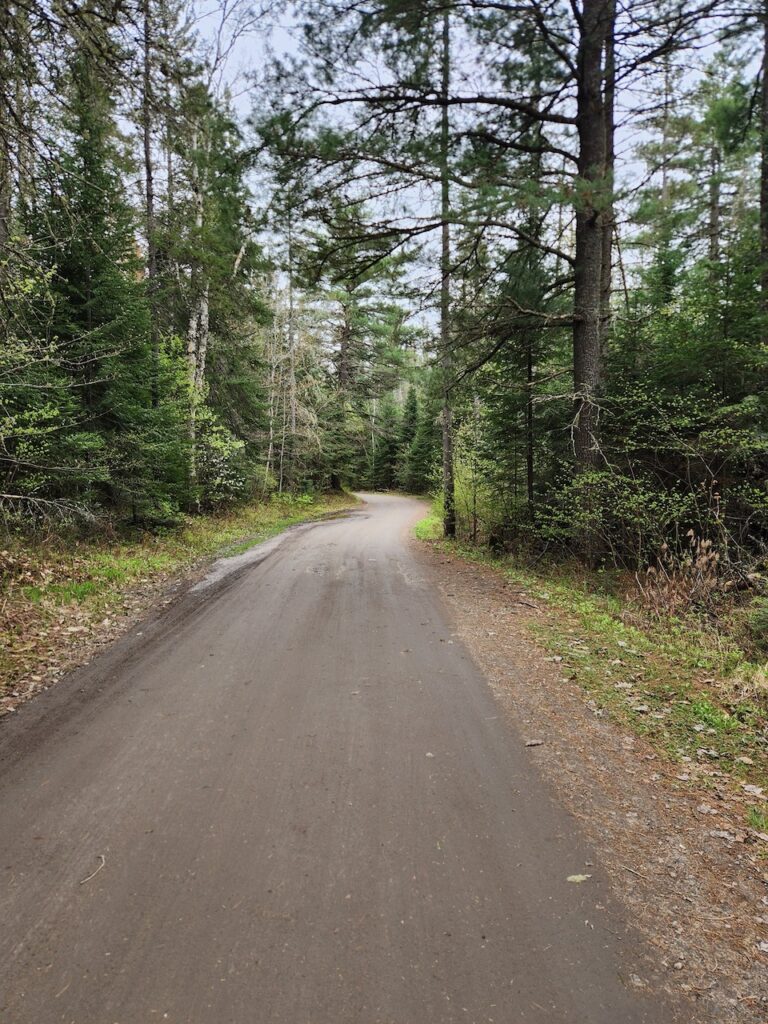
Algonquin Provincial Park represented a significant departure from lower altitude St. Lawrence River Valley only a few hours away.

I wasn’t allowed to camp in the park without paying a hefty fine, so I pitched my tent on a dirt road right outside it, in what appeared to be a site for keeping horses on the shore of a large lake. As dusk fell, I heard the twitter of an American Woodcock displaying high above. I’d seemingly settled in the middle of his territory, and he kept me company all night as I dreamed of what birds I’d see the next day.
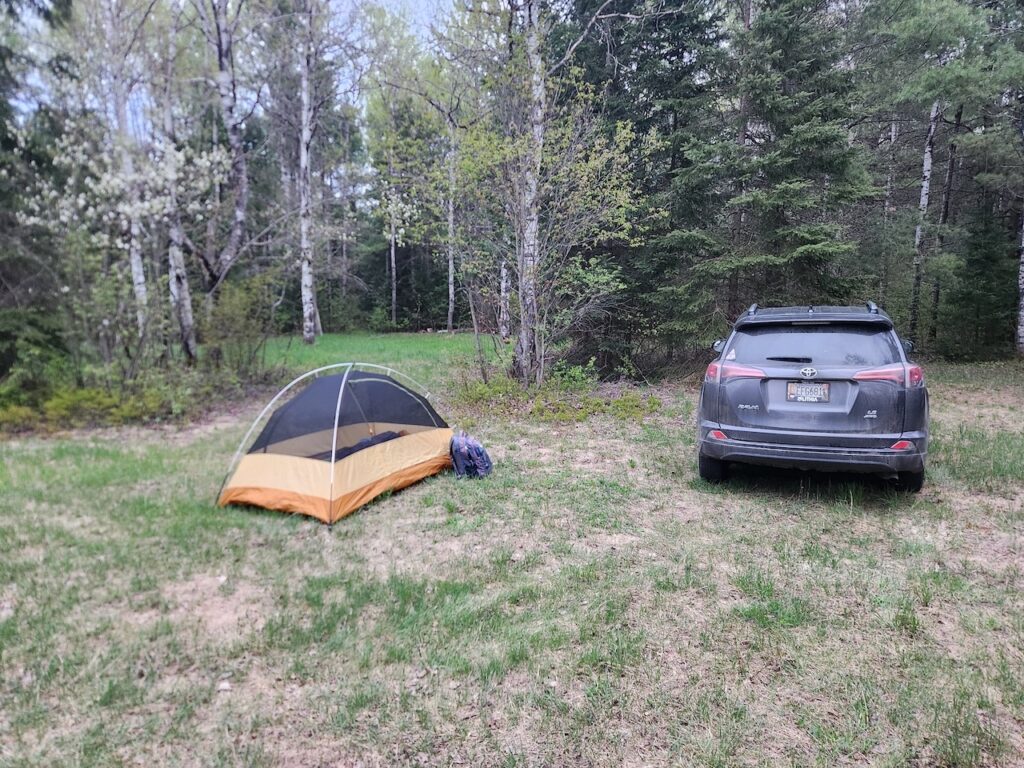
My impromptu campsite outside of the park rewarded me with an American Woodcock that serenaded me to sleep.

After a short walk around my campsite at dawn, during which I detected a few Cape May Warblers, I headed into the park. My first location: the Spruce Bog Boardwalk. Spruce bogs, which I’d gotten to know during my time in Maine and the Northeast, are strange, almost other-worldly habitats scattered across the northern United States. Generally consisting of an outer area dominated by spruce trees with a core of peat moss floating atop water, they are home to a variety of unique species including carnivorous plants like pitcher plants and sundews. Because of their unique habitat structures, spruce bogs are also havens for a variety of boreal bird species that are otherwise less common in more southern parts of their range. So, as I set foot on the boardwalk, I found myself once again searching for Spruce Grouse and Black-backed Woodpecker—species I find myself looking for frequently.

Extensive searching brought no luck, although I did find more boreal warblers, including several Cape May Warblers and another great look at a Bay-breasted. I also heard a Lincoln’s Sparrow, my first of the year, singing from the wet back half of the bog. I had much of the day to bird Algonquin Park, so after striking out on my main targets at the boardwalk, I decided to take a short stop at the visitor center. 
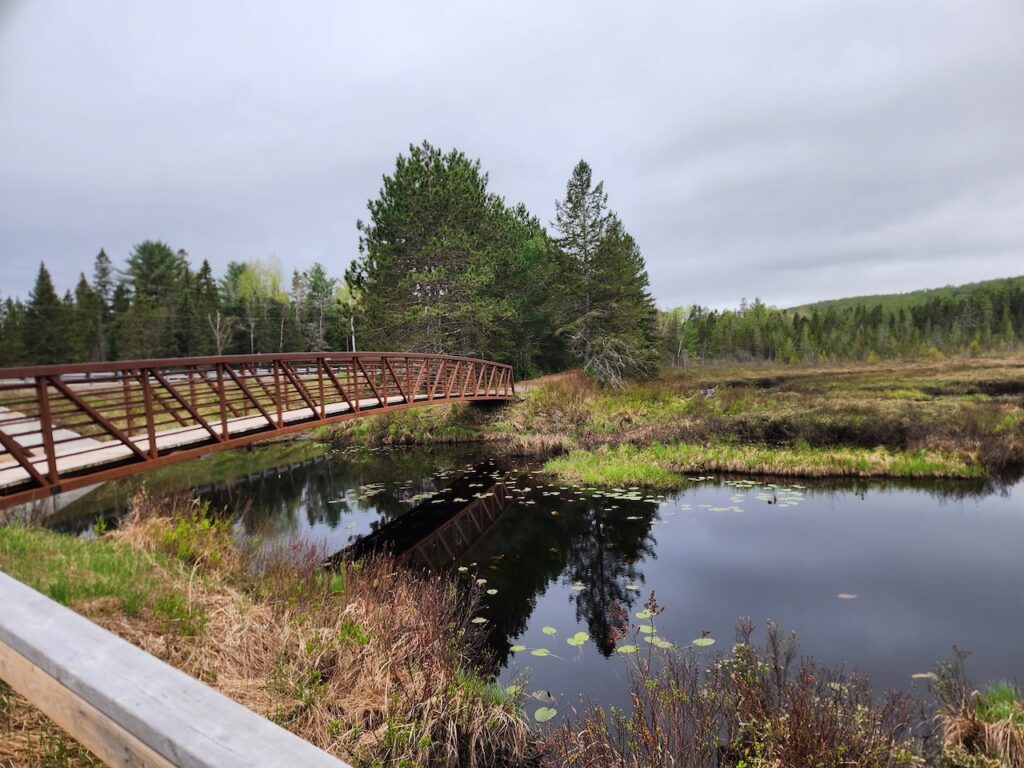
I had hoped for both Black-backed Woodpeckers and Spruce Grouse in this spruce bog, but struck out with both species.

Within ten seconds of pulling out onto the road my Toyota RAV4 screeched to a halt. There, ten feet away, staring me down, stood a huge female moose. The animal had to be at least five feet tall, though from my seat in the car it seemed a lot taller! After we shared several seconds of each other’s presence, the moose trotted off into the woods. I didn’t end up seeing any of my bird targets at the visitor center and the center itself was closed, but I was now filled with adrenaline—I’d just scored my most wanted mammal of the trip!

Next, I hit Rock Lake Road. While I hadn’t seen many reports of my target boreal birds here, I figured that this road—a dirt track winding past marshes and through patches of spruce and budding Paper Birch—was as good a spot to try as any! Over the next hour and a half I drove slowly with my head out the window. Again, no woodpecker and no grouse, but I ended up tallying 40 species, 15 of which were warblers! Nashville and Magnolia were the most abundant, along with a smattering of Black-throated Blue, Blackburnian, Canada and others. Near the beginning of the road I also heard several Wood Thrushes singing, a surprise this far north. Along my drive I was also accompanied by the near-constant drumming of Ruffed Grouse, and the loud, piercing whistles of a pair of Broad-winged Hawks.
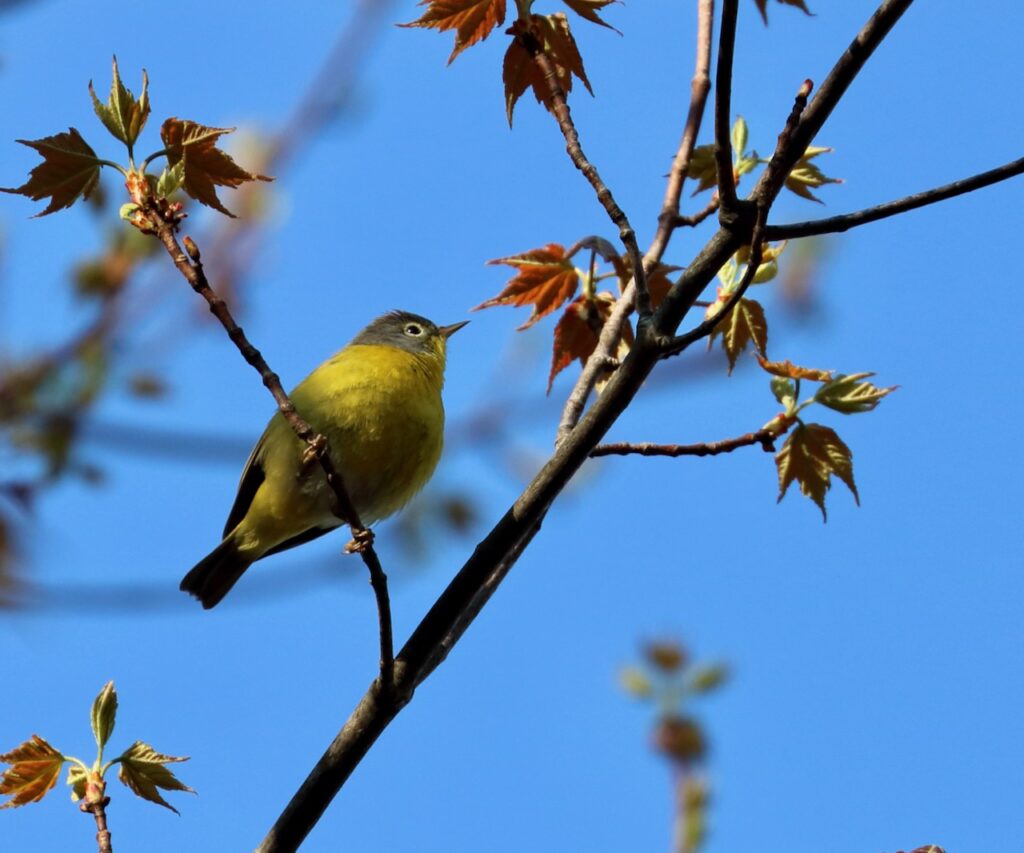
Though I continued to strike out on BBWOs and SPGRs, Algonquin presented a nice assortment of warblers including Nashvilles, always a favorite!

At this point I admit that I was feeling a bit ungrateful. I’d been birding for three or four hours and had not so much as glimpsed either of my targets—birds that were supposed to be somewhat regular within the park, and had compelled me to drive through Canada in the first place. Sure, I’d seen some great birds and a moose. But if I went the whole day without getting a Black-backed or a Spruce Grouse, I was going to be a bit salty. I jumped on eBird to check on any recent reports of either of them nearby and elected to visit, as my last stop of the morning, Pog Lake Campground. A Black-backed Woodpecker had been seen there only a few days before, and I figured it would be my best chance before continuing my journey west. I parked the car and began walking toward Pog Lake, keeping my ears and eyes peeled for my target species. One of the first birds I heard was a Tennessee Warbler, another boreal species with an electric song, singing loudly from a campsite nearby. I recorded it and continued onwards.

Then, I came across Campsite #512. Surrounded by gorgeous coniferous trees, it at first seemed just like any other campsite in Pog Lake Campground. The first thing that made Campsite #512 stick out, though, was the Ruffed Grouse drumming in the bushes nearby. Now, I’ve heard plenty of Ruffed Grouse drumming in my life—and had heard dozens on this trip already. Seeing one in action was a different story. I’d tried to sneak up on them before, but was always unsuccessful—the birds would flush from under my feet. However, this particular bird sounded incredibly close so I shelved my other goals and went into full stealth mode, sneaking towards the campsite to see if I could watch the grouse in action. After about ten minutes of tiptoeing around, I heard the beating of its wings—and that’s when I spotted it. Through ten feet of dense foliage, there the grouse stood, its wings striking its chest to make the sound that you feel more than hear.

I promptly sat down and spent the next thirty minutes with that grouse. Every five minutes or so, it would stand upright on its mossy log and begin its display. Bom-bom-bom-bom-bom-bom-bom. I watched it drum five or six times—with and without binoculars, and filmed it on my phone’s camera. It was magical. (Click the above image to watch my short clip.)

After twenty minutes, I also heard honking overhead. At first, I couldn’t see any birds above me, but I figured it was just a flyover flock of Canada Geese, though the calls sounded a bit strange. Then, in the gap above Campsite #512, I spotted several flocks of two hundred or so geese—and quickly realized that these were not Canadas. Between a bad view I got through my binoculars and listening to their sounds on Merlin, I realized I’d just seen a massive flock of Brant migrating over me, headed for the Arctic! I’d never seen these birds away from the ocean and never in such numbers! Sure enough, though, Algonquin Park lies right in the middle of Brant’s narrow migration route across Canada, and I’d just happened to be in the right place at the right time.

The Brant disappeared into the distance and the grouse drummed again, and I decided that, even though I hadn’t found my targets, I felt more than satisfied with my experience with Pog Lake Campground. But Campsite #512 hadn’t finished with me. 

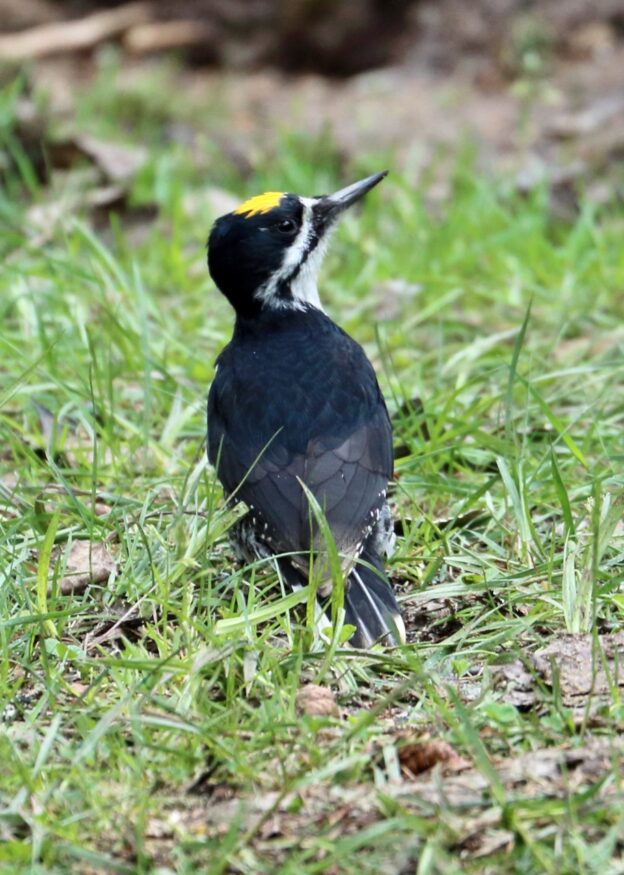
As I slowly stood, taking care not to startle the grouse, I heard strange, frantic calls coming from the woods on the other side of the campsite. I quickly recognized them as calls I’d been listening for all morning, and suddenly, a male Black-backed, decked out in sleek black feathers with a yellow cap, flew into the campsite. It landed on a downed log near me, and proceeded to hop along the ground, getting closer and closer to until it stood only five feet away! It either didn’t notice me or didn’t care, poking for insects in the roots of the nearby spruce trees. After a minute or two, the woodpecker flew away, leaving me debating if I should EVER leave Campsite #512.
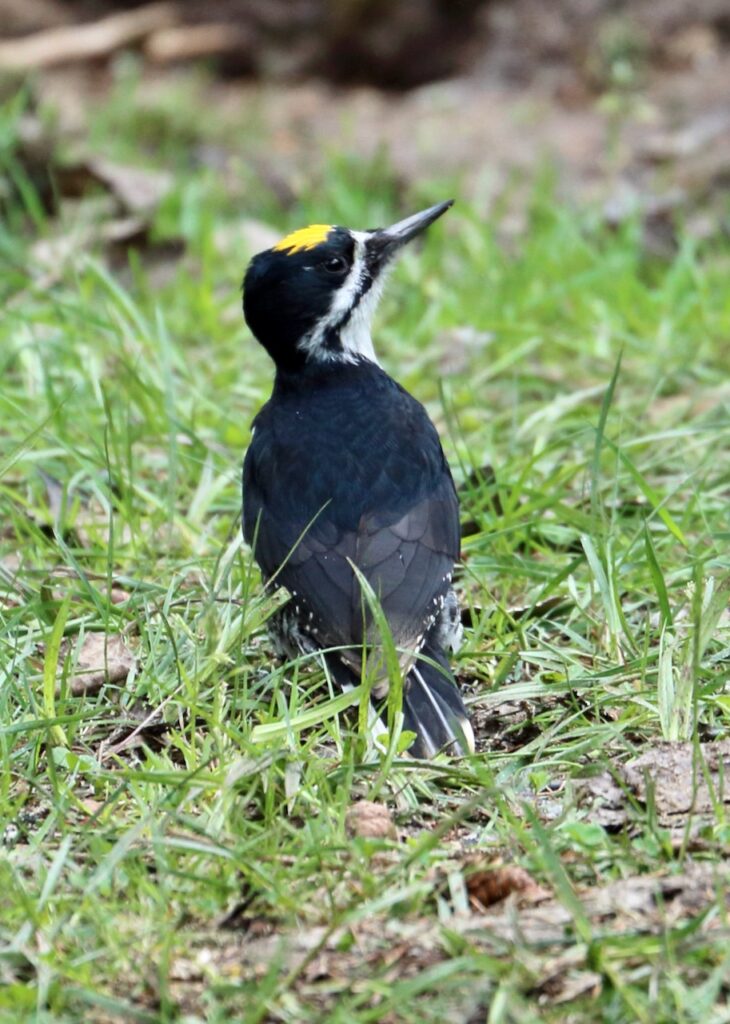
My best-ever look at a Black-backed Woodpecker will forever embed Campsite 512 in my birding heart.

As you can probably guess, I did continue on my journey, but knew that my visit to Campsite #512 would become one of my most memorable birding mornings ever, one that would be etched in my brain for a long, long time.
Redstart Rendezvous at Sears Island, Maine (Maine to Montana, Part 3)

Today, we are pleased to offer the third in Braden’s series about his adventures driving across the country from Maine to Montana. Already, it’s been an incredible birding journey—and he’s not even out of Maine! Sneed is also pleased to announce that two of his books, Birding for Boomers and Like No Other, have been named finalists for the High Plains International Book Awards. We hope some of you Montana residents will join Sneed for the celebration and to crown the winners at the awards ceremony in Billings on October 4th!

I had never seen so many American Redstarts. The birches and maples standing on the northern tip of Sears Island, at times, had more warblers on their branches than leaves. According to Wesley Hutchins, this was the norm for Sears Island during spring, and part of the reason why he’d been wanting to bring me here since we’d become friends four years ago.

I’d met Wes a month or two after arriving at the University of Maine, and thanks to the hours and days we’d spent together exploring the forests and coasts of the state, I now considered him one of my closest friends. Wes and I kept in close contact during the summers when we worked out-of-state (California and Pennsylvania for me, New York for him), keeping each other updated on all of the awesome birds we were seeing around the country. He’d graduated a year before me, but still visited UMaine every week to spend time with me and his other friends there. I had never visited his hometown of Belfast, however, despite it being only an hour away from the campus where I’d gone to college. This week, I was bent on changing that, and now here I was birding the spots that he’d fallen in love with over the last few years.

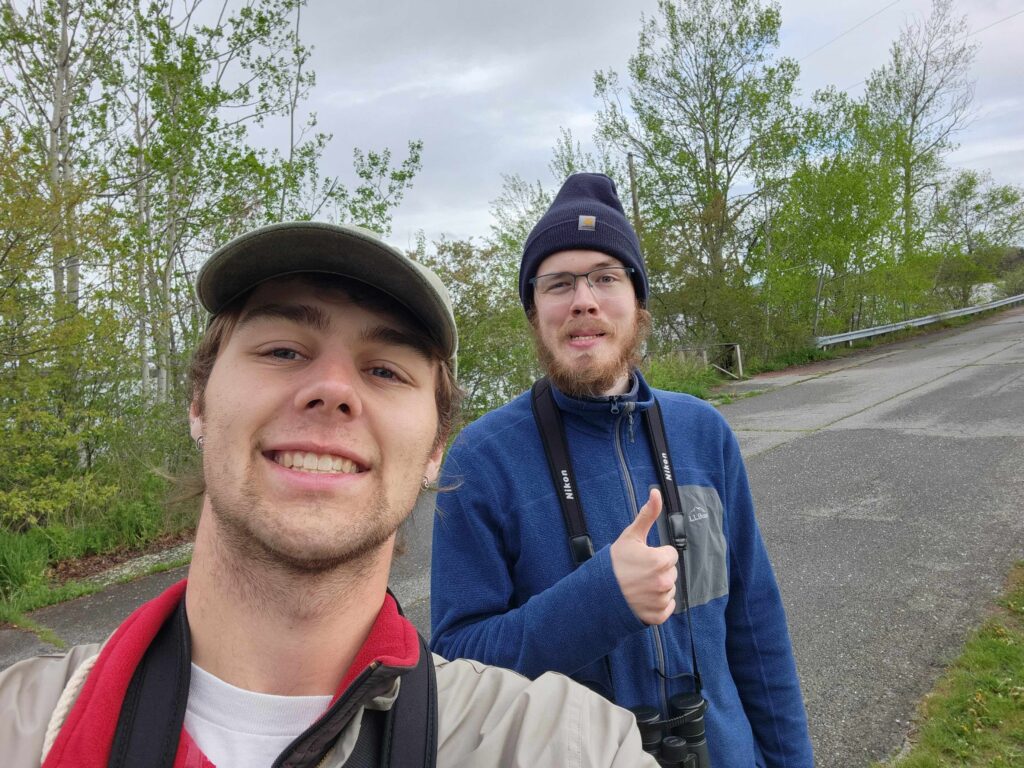
Selfie of me and Wes at one of his favorite birding spots, Sears Island, Maine.

“It’s really weird seeing you here—in the good way!” Wes admitted, and I nodded. I’m sure I would feel the same way once I finally convinced him to visit me in Montana.

We’d spent the previous evening walking around Belfast Harbor, a pleasant little cove tucked away into the side of Maine’s midcoast region and another one of Wes’s favorite birding spots. This morning, however, he’d taken me to Sears Island, Waldo County’s best birding hotspot and a prime location to see migrating warblers. Upon setting foot on the island, I began to notice warblers—redstarts, a Chestnut-sided, a Northern Waterthrush—but nothing out of the ordinary. I’d been seeing warblers like this all week. We wandered a bit, down into the forested center of the island, but things stayed eerily quiet. After about twenty minutes, Wes turned to me and said, “We should go back to the northern point. That’s usually where all the action is.”

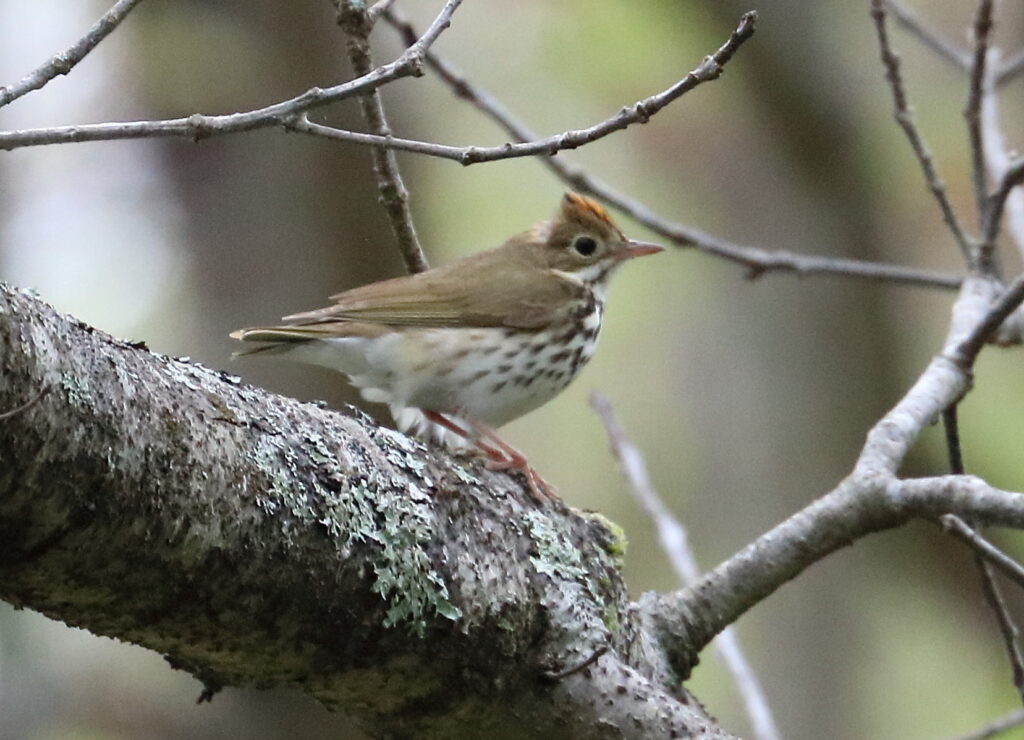
Unlike the other warblers, Sears Island’s Ovenbirds were keeping pretty quiet on the day Wes and I visited.

I felt skeptical. I much prefer walking around to staying in one spot to bird, but Wes had the local knowledge so I followed his lead. We walked back and we immediately began to see birds we hadn’t seen just twenty minutes ago—a Blackburnian Warbler and a couple of Magnolias. Then, I looked up.

In the sky above us floated dozens of warblers, all seeping and chipping as they struggled to combat the winds rushing over the island. Many of the birds faced north, while others zoomed in from the north, landing in the trees directly to our right and left. We stationed ourselves directly in front of a flowering apple tree that seemed to be overflowing the warblers and began calling things out.

“I’ve got two Magnolias on the same branch.”

“Is that a Tenness—no, it’s just a REVI.”

“Here’s our third Wilson’s of the day, a nice male!”

“Six redstarts in this one tree alone. Scratch that, seven.”

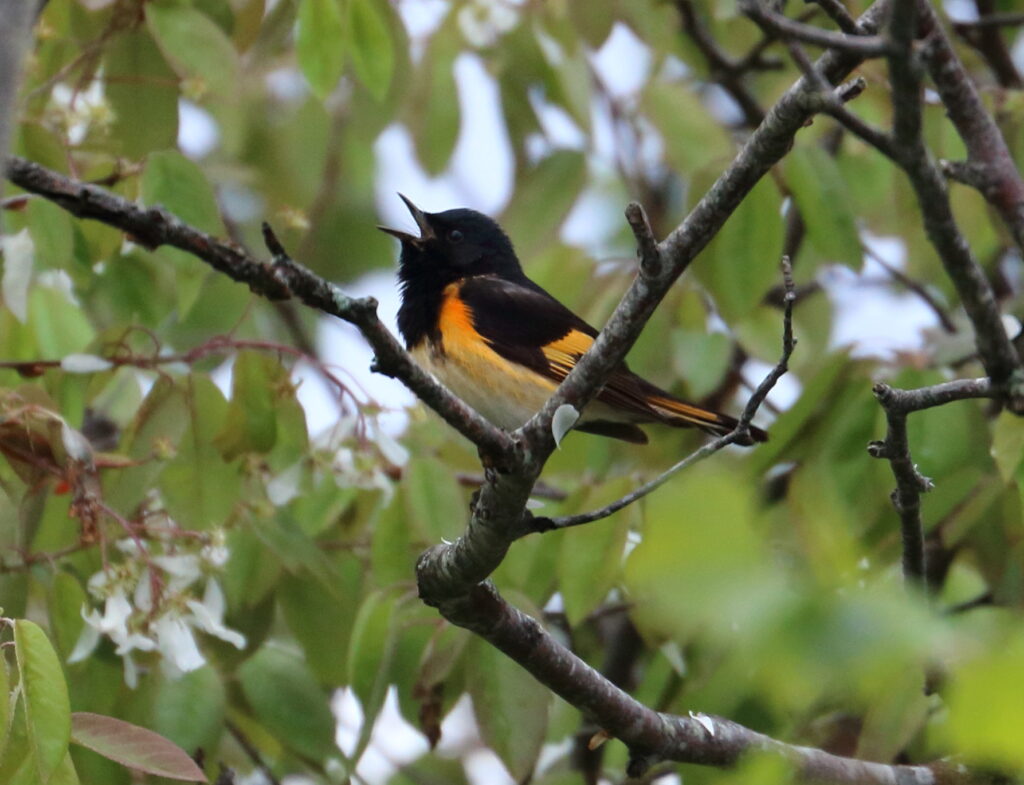
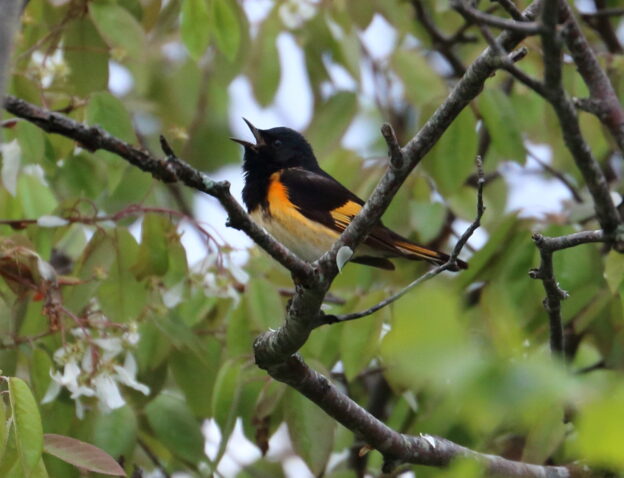
One of approximately one hundred American Redstarts we counted at Sears Island.

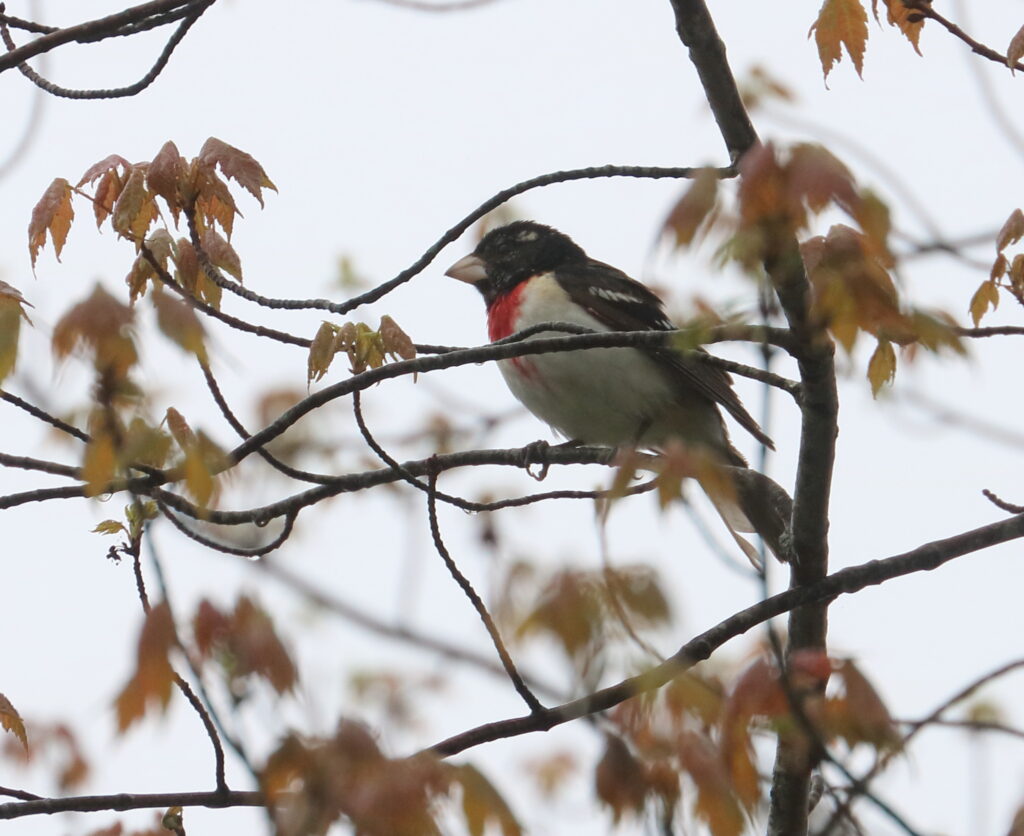
What we were experiencing was a river of warblers. Every three minutes or so, the birds we’d been staring at would vacate and be replaced by new birds dropping in from above, all slowly making their way toward the causeway that connected Sears Island to the mainland. One in every three warblers was an American Redstart, and there were easily hundreds of warblers. Mixed in with the warblers were small numbers of other species: vireos, flycatchers, a couple Rose-breasted Grosbeaks. It was exactly the experience I’d hoped to have when I’d signed up to go to school on the east coast. The West doesn’t do songbird migration like the East does, especially when it comes to warblers. Montana has fourteen regularly-occurring species of warblers. On Sears Island, we’d seen fourteen species in a matter of minutes.

Rose-breasted Grosbeaks added further spice to an incredible wave of warblers migrating in!

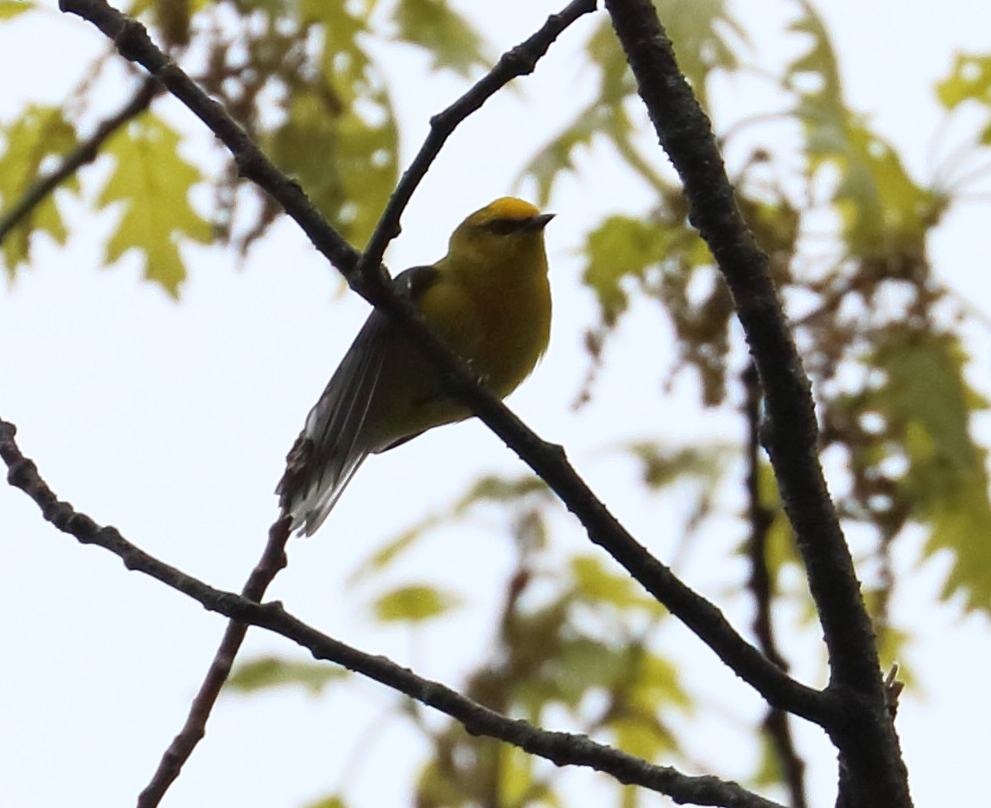
My focus had been warblers the whole week, in fact, with the notable exception of the Acadia Puffin Cruise (see our recent post, Puffin Party). Just a day or two earlier, I’d spent two nights in Portland, Maine, with my good friend Hayden Page. We’d birded hard, visiting many of Maine’s famous birding hotspots like Scarborough Marsh, Laudholm Farm and Portland’s urban Capisic Park. The morning we’d hit Laudholm Farm had been incredible, with 81 species at the preserve including seventeen warbler species and a White-eyed Vireo, a rarity this far north. At an airport in Brunswick, Main, we’d also chased a Blue-winged Warbler—another southerner not supposed to be here. In the coming decades it wasn’t hard to imagine both the vireo and the warbler showing up more and more frequently in Maine thanks to warming temperatures and changes in habitat.

A Blue-winged Warbler—an unusual migrant that may become much more common in Maine as global temperatures warm.

The week had also exposed me to the diversity of Maine’s habitats. Living in Bangor during the colder months, my impressions of the state had mostly been of woods. And it is true that Maine has woods—it’s the most forested state in the country. But southern Maine, especially, holds its fair share of unique ecosystems. Kennebunk Plains Preserve, which I’d visited twice this spring, is a patch of grassland with Vesper and Grasshopper Sparrows and Eastern Meadowlarks. It is regularly burned to keep shrubs and trees from encroaching on it. Grassland used to be far more common in the state, following the intensive logging of the 1800 and 1900s, but now that the forest had grown back Kennebunk Plains was one of the only spots for certain species to be found.

Scarborough Marsh, which my dad and I had visited when we’d come out to Maine in fall of 2021 (see this post), held the largest chunk of salt marsh in the state. This habitat, which looks like a savannah floating on the edge of the sea, is also threatened, both in the state and worldwide, thanks to rising sea levels. The birds that live here include Willets and Saltmarsh Sparrows, the latter of which was the focus of my Honors Thesis Project and is one of North America’s most endangered birds. 

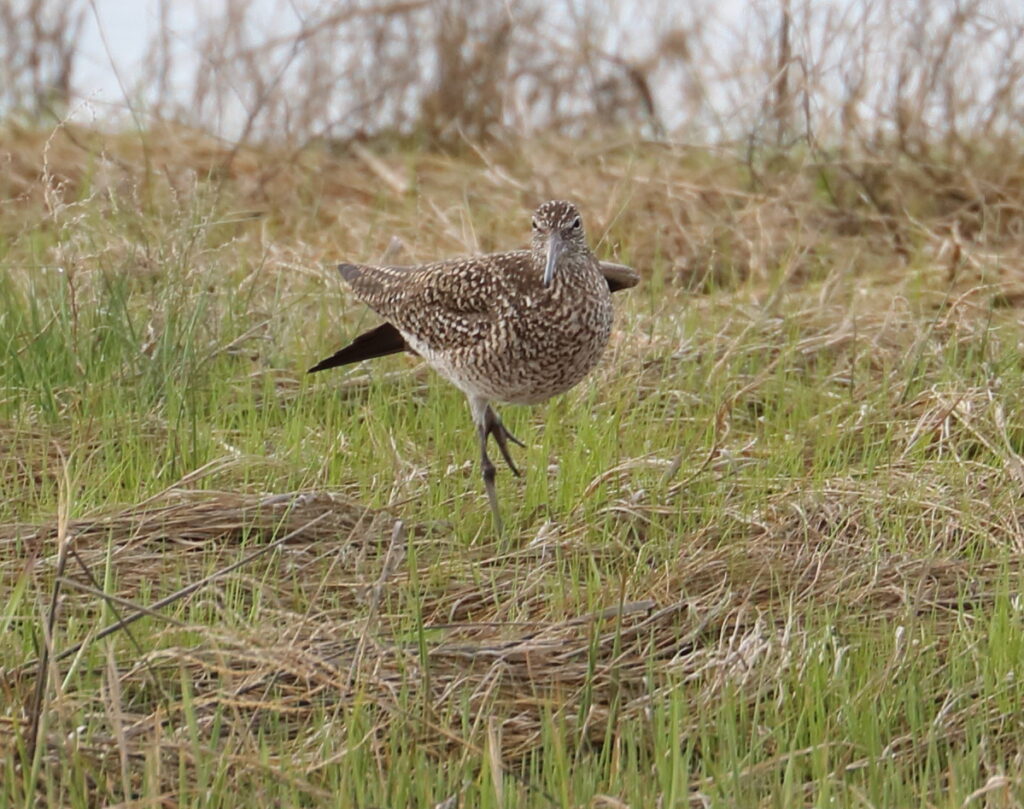
A Willet, one of our most common large shorebirds, at Scarborough Marsh.

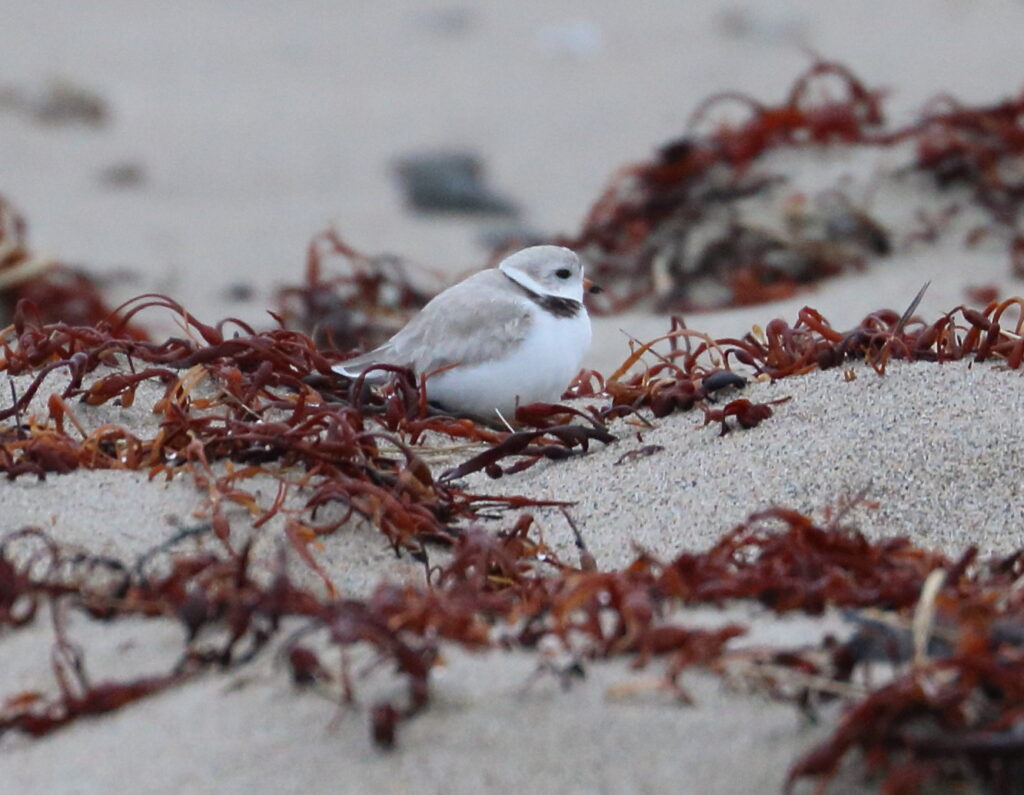
Southern Maine is also a prime location for sandy beaches, and both the birds and the tourists know it. Maine’s coastal towns go from sleepy and affordable in winter to bustling and expensive during the summer, when Americans from all over flock to them to enjoy the summer. This has created problems with the wildlife that depend on sandy beaches as their homes, namely the Piping Plover and Least Tern, two species who spend their days hunting for invertebrates along the coastline and breed in the grassy dunes just upland of the beach. Thankfully, the state of Maine has put in a lot of work to close off these dunes to tourists and their destructive dogs, allowing the birds to nest in a fragile security. At Pine Point, just five minutes from Scarborough Marsh, Hayden and I got to watch a trio of Piping Plovers chasing each other around the beach at close range. It was also at Pine Point that I got to see my lifer Roseate Terns, along with the more common Least and Commons. 

Keeping Piping Plover populations going requires careful monitoring and protection from the swarms of people and dogs crowding East Coast beaches each summer.

Though I’d always joked about the cold weather, lack of mountains, and isolation of Maine, I was certainly going to miss the state I’d spent four years getting to know. The places AND the people. This was especially present in my mind after giving Wes a hug goodbye and driving away from Belfast, from the University, and from some of the best friends I’d ever made. I would make sure to see them again, though it would never quite be the same. Thankfully, I had one more night to spend in Maine before leaving, though it wouldn’t be in the comfort of a friend’s air mattress. No, I was headed for the last county I’d never visited in the state: Franklin County, the land of wind, mountains and moose. 

To learn more about Sears Island and the ongoing fight over developing it, click here: https://friendsofsearsisland.org/wind-port-fact-sheet/ 

Sears Island provided just the kind of warbler experience I’d been hoping for my past four years in Maine.

Braden’s Maine to Montana Birdventure, Part 1: A Day in “The County”

Today, FSB kicks off Braden’s accounts of his truly remarkable spring birding trip from Maine to Montana. This adventure would take him to an astonishing variety of habitats most of us never get to experience. Along the way, he would drive 5,000 miles, visit nine states and provinces, and record 264 bird species, seven of them lifers. He begins this series with a visit to Maine’s arguably wildest and most inaccessible county: Aroostook.

Twenty-four hours after walking across the stage of the Cross Insurance Center in Bangor and receiving my college diploma, I was alone in a tent in Northern Maine. I’d gone to school in the state for four years, but never experienced it in the summertime, those three months when Maine is at its best. Now, with an abundance of time, I could leisurely make my way back to Montana instead of the six-day dash I’d done across the country last August. Because of this distant deadline, I’d arranged to spend a week in Maine birding and exploring following my graduation, and there was no better place to start than with one of the two counties I’d never visited: Aroostook County.

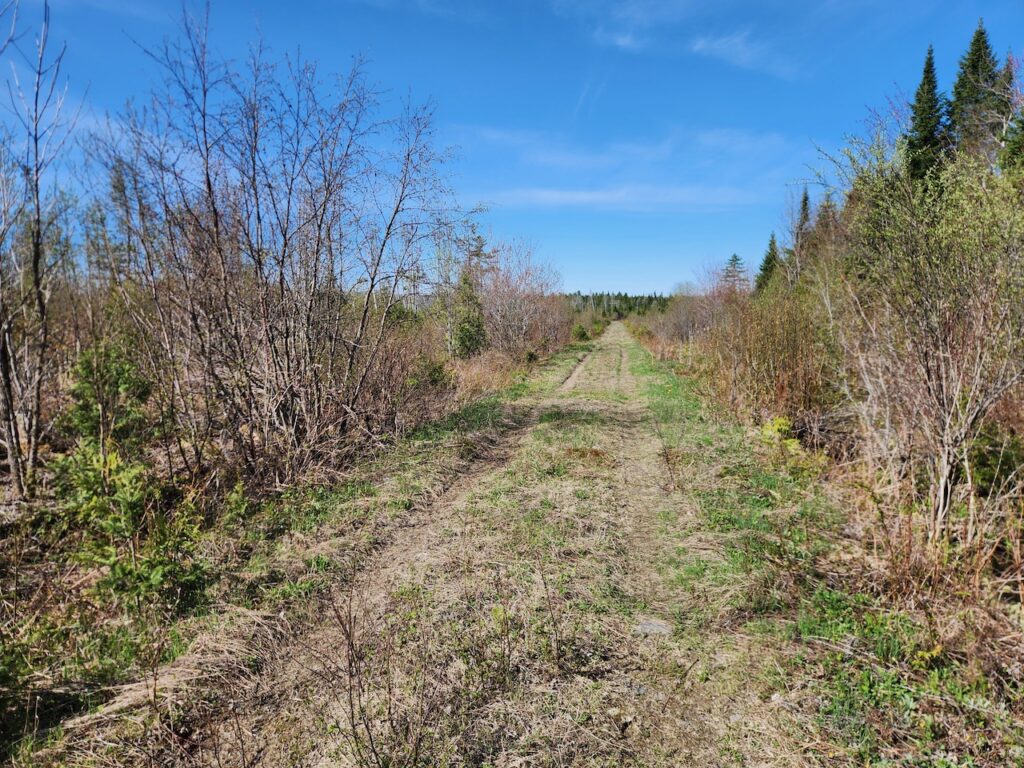
A Cedar Bog up in Aroostook County! This one shimmied with Palm and Magnolia Warblers.

Known simply as “The County” to locals, Aroostook is by far the largest and least populated part of Maine. The County contains a large portion of the state’s agriculture, mostly located on its eastern flank, whereas the rest is coniferous forest. Aroostook’s high latitude and cooler climate create a haven for many boreal species of birds that have receded from their more southerly haunts because of warming and excessive logging that promotes regrowth of a different, unsuitable habitat. This northern conifer forest is also a hotspot for the primary topic of my dad’s previous post: warblers.

Warblers, in fact, were a major factor in my decision about where to go to school. I wanted to go to college somewhere where I could see as many warblers as possible, and Maine fit that bill perfectly. With almost thirty species of breeding warblers (nearly triple what Montana, a state twice the size, has) there is no better place to be, and that is especially true of Aroostook County, where most of them could be found. Lying in bed the night of Monday, May 12th, I felt nervous. It was still fairly early as far as migration goes. What if the birds weren’t here yet?

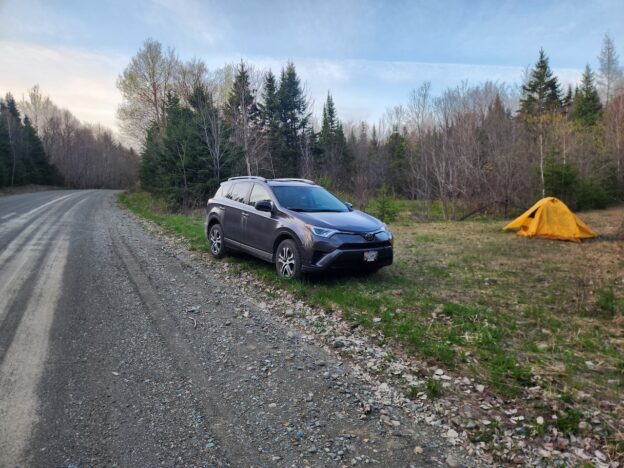
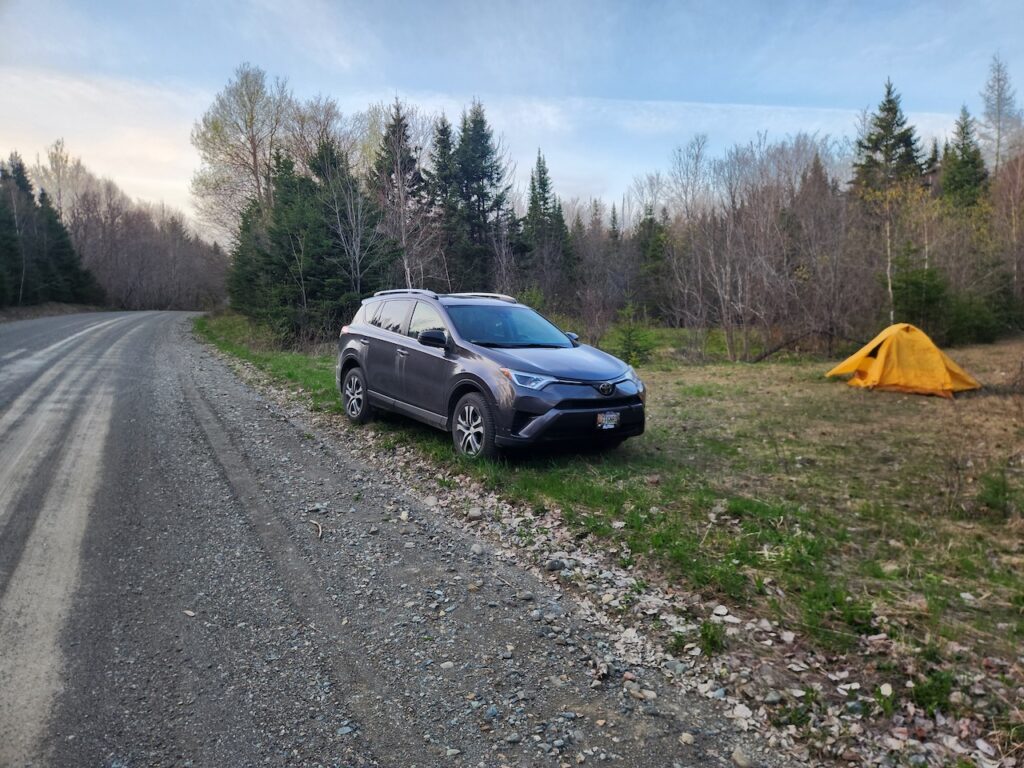
This was my camping spot in Aroostook County, on a backroad in northern Maine!

On Tuesday, May 13th, my worries were settled when I woke up to the sound of a Nashville Warbler singing above my tent. I dressed as quickly as I could and set off down the logging road I’d driven in on, my ears receptive to any and all of the birds sounding off in the surrounding woods. Every level of the forest had songsters belting out their tunes: Ovenbirds from the ground, Black-and-white Warblers from spruce trunks, Magnolia Warblers from ten-year-old firs and Yellow-rumped Warblers from high in the canopy. Present in lower numbers were species like Blackburnian Warblers, Black-throated Blue Warblers, and American Redstarts, all likely early representatives of their species, most of which were still farther south, booking it north.

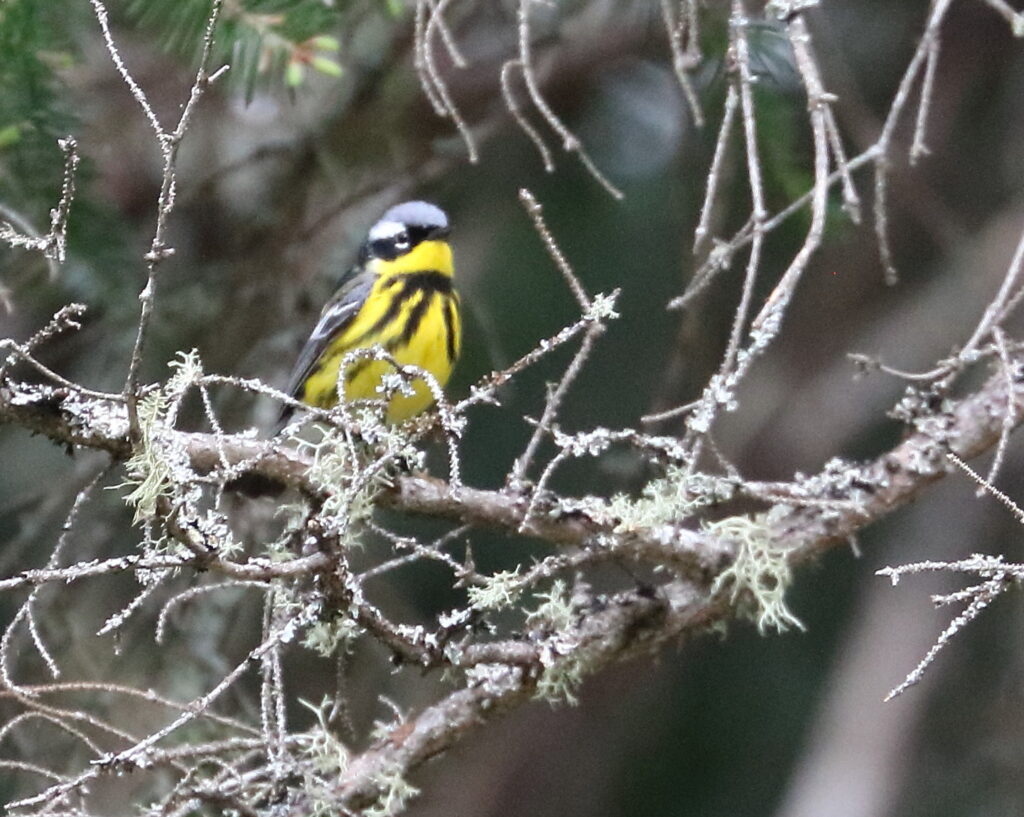
Magnolia Warbler in a spruce tree.

I was especially excited about the two Cape May Warblers. While I’d seen a fair number of Cape Mays before, I’d rarely seen them in their breeding colors and I’d never heard them sing before. This is because of their distributions. While I’d encountered many of the East Coast warblers on their breeding grounds during my time in Pennsylvania, I was hundreds of miles too far south for Cape Mays, which use contiguous spruce-fir forest and are mostly confined to Canada. These warblers (which are named after Cape May, New Jersey, where they neither breed nor spend the winter) are particularly dependent on an insect known as spruce budworm. Budworms are spruce parasites, and their populations are cyclical. During outbreak years the insect infects and ravages thousands of acres of spruce trees before the population crashes. Cape May Warblers, Bay-breasted Warblers, and Evening Grosbeaks, therefore, all have populations that rise and fall with the populations of this insect.

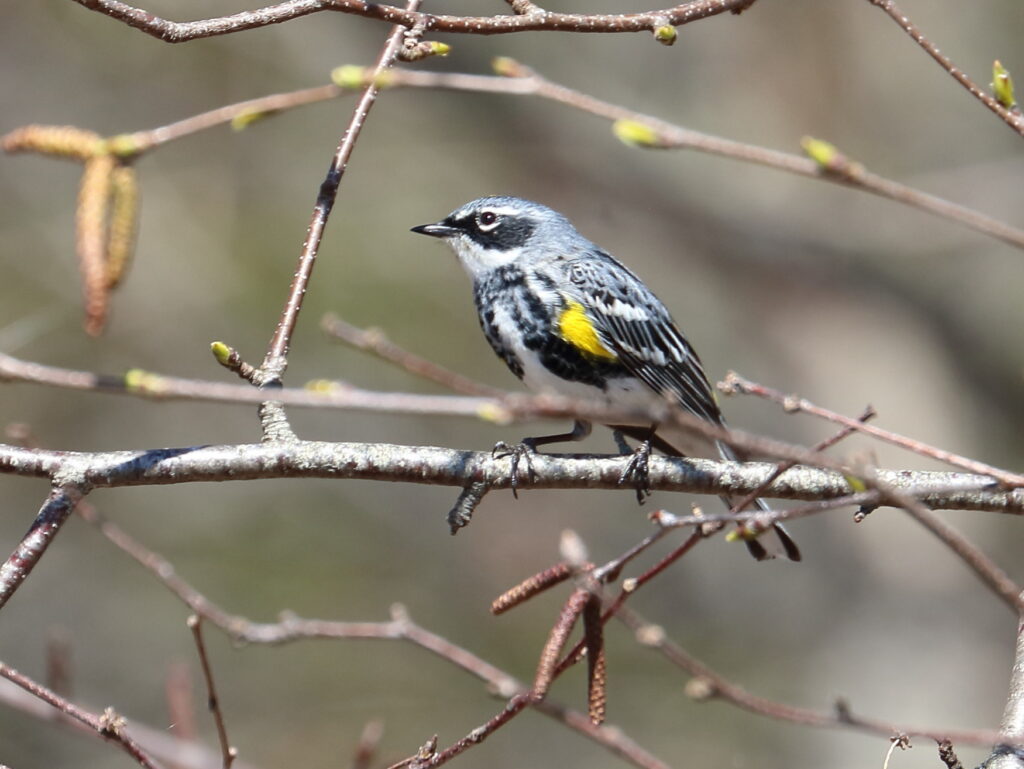
A “Myrtle” Yellow-rumped Warbler, which is the subspecies that lives on the East Coast!

Besides agriculture, the main industry in Aroostook County is logging, and understandably, the logging industry is not the biggest fan of an insect that defoliates thousands of acres of their crop. Unfortunately, the industry’s historical response to spruce budworm outbreaks (which, remember, are ecologically “normal” and important for the birds dependent on them) has been to clear-cut hundreds of hectares of infected forest. Spruce-fir forest is a mature ecosystem that takes centuries to develop, however, and the forest that grows back after these clearcuts is not coniferous but deciduous. This is a major reason why many spruce budworm-specialists, like Cape May Warbler, and many other birds found in boreal forests, like Canada Jays and Black-backed Woodpeckers, have retreated from much of southern Maine in the last hundred or so years. Their habitat has simply disappeared.

I saw evidence of this as I birded The County. Sure, there was a lot of seemingly healthy spruce habitat. There were also massive empty lots, covered in nothing but slash and debris. The forests were filled with birds, while the lots had almost none. It almost seemed apocalyptic. At least the empty lots provided good views of Mt. Katahdin, Maine’s highest peak, rising in the distance.

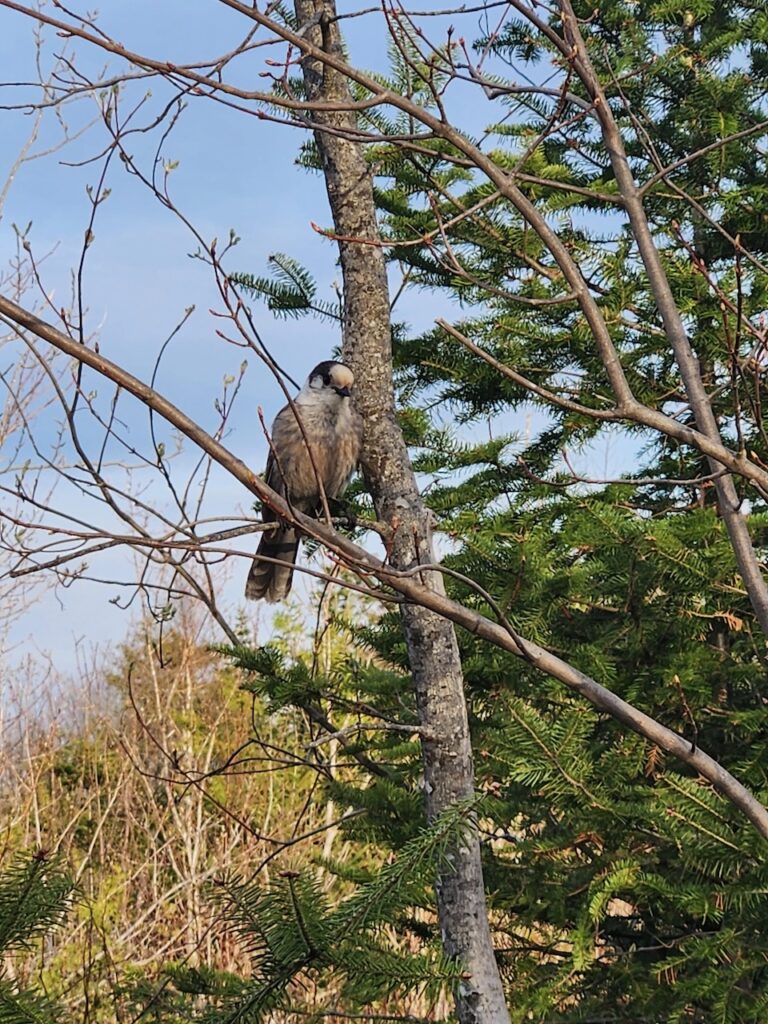
Again, though, the forests DID have birds, and not just warblers. Many migrants had not yet arrived (namely the flycatchers, of which I saw very few), but I recorded dozens of Ruby- and Golden-crowned Kinglets, Blue-headed Vireos, and Winter Wrens. Ruffed Grouse drummed from wet thickets, Hermit Thrushes foraged in the road, and I even got to see an American Goshawk bomb overhead at a million miles per hour, chasing something or perhaps just trying to give me as least satisfying a look as possible. In the evening, a walk along a side road yielded incredible, up-close views of Canada Jays, or “Whiskeyjacks” as they are known colloquially. These subtle, white-and-gray corvids landed in the trees less than five feet from me, curiously searching for insects while paying me no mind.

A photo of a Canada Jay that I took with my phone!

After a night and a day spent in The County, I headed back south to investigate the other corners of Maine I had yet to explore. Stay tuned!

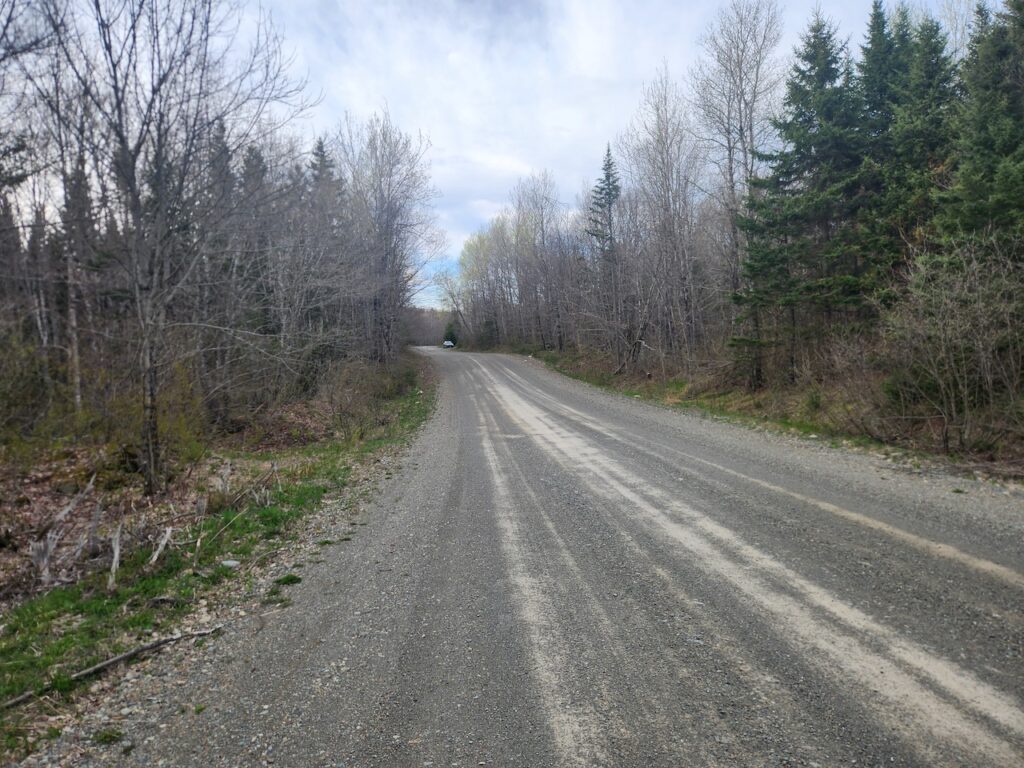
What the forest looked like in Aroostook!