Category Archives: Raptors

Puffin Party! (Maine to Montana, Part 2)

The state of Maine can be simplified to four things: lobster, moose, blueberries, and puffins (with Dunkin Donuts as a runner-up). During the four years I’d spent going to school in the state, I’d eaten lobster rolls, visited blueberry bogs, and tried my hardest to find a moose, a quest that would continue later this week. Through no fault of my own, I had never even tried to see a puffin and the reason was simple—my school year did not overlap with the Atlantic Puffin school year. This year, however, was different. I was actually still in the state of Maine as puffins were arriving at their breeding colonies, and was not going to miss my last chance to see these iconic seabirds. So, on May 14th, I boarded a large boat in Bar Harbor and took my seat in the cabin, binoculars and camera ready.

Unlike previous boat rides I’d taken to see birds, this cruise was relaxed and family-friendly. About two hundred people crowded the deck, many of whom were just as interested in the Bald Eagles and American Herring Gulls circling above the harbor as the prospect of seeing any alcids (Alcidae is the family of birds that includes puffins, murres, auks, and guillemots). Over the intercom, a very knowledgeable guide spouted off a non-stop stream of facts about the islands, lighthouses, and wildlife of the area as we headed for Egg Rock, a sparse strip of land just barely visible to tourists standing onshore in Bar Harbor. With the coastline of Acadia National Park to our right, we slowed as we approached the island.
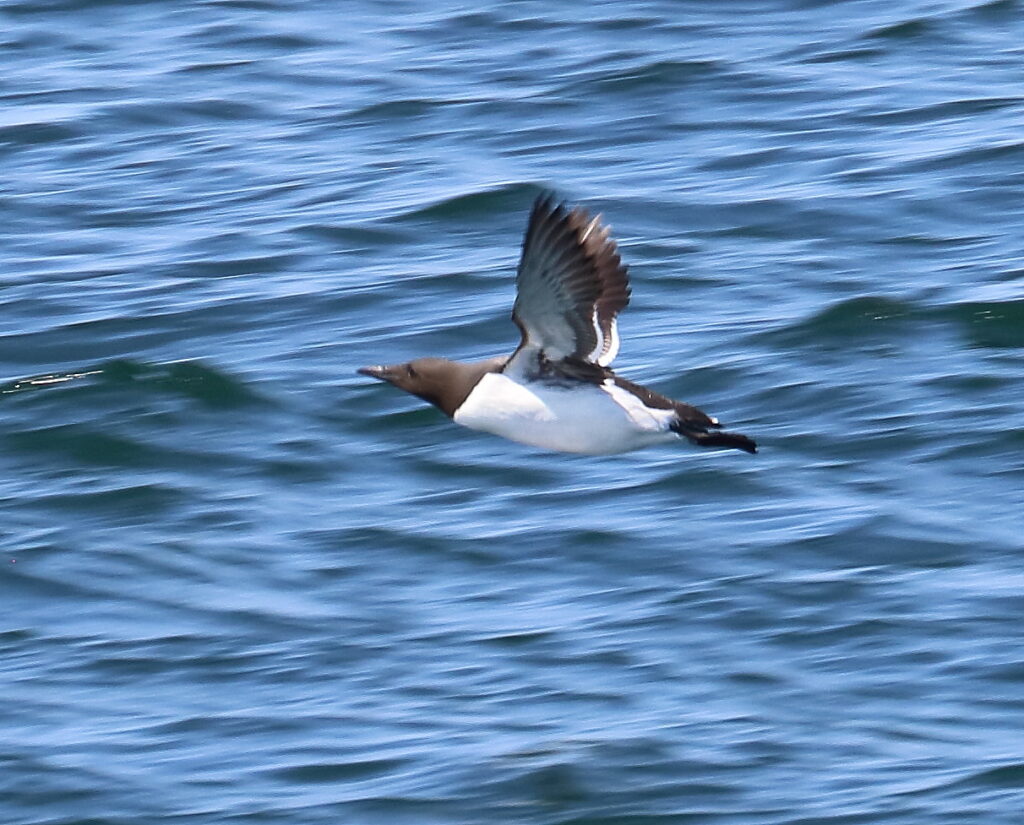
This Common Murre was the only one I saw the whole boat ride. While this species hasn’t yet started nesting at Petit Manan, the ornithologists are hopeful that they will soon!

Egg Rock did not have a puffin colony—it was too close to shore for that. What it did have were colonies of several other species of seabirds. Gulls dominated the island, mostly Herring with scattered numbers of Great Black-backed Gulls mixed in, their charcoal backs sticking out amongst the sea of gray. Cormorants patrolled the southern side of the island, standing tall like gargoyles on the rocks. And in the waters lapping up against the side of the island I saw my first alcids—Black Guillemots! Although guillemots, which are black with white wing patches in the summer and white with black wing patches in the winter, are in the same bird family as Atlantic Puffins, they are far easier to see in Maine. Not only do they breed right on the coast during the warm months, they also stay for the winter—something that the puffins do not do. That’s one of the reasons why I’d never seen puffins here during my time at the University of Maine: From August to April, these birds stay as far from shore as possible, floating around somewhere in the North Atlantic.

After circling Egg Rock to look at the seabird colonies, as well as the dozens of Harbor and Gray Seals lounging on the rocks, the boat picked up speed and headed out to sea. While we never lost sight of the coastline, it grew hazier and hazier until eventually, a new island appeared on the horizon: Petit Manan. The first thing I noticed about Petit Manan were the buildings. Many islands off the coast of Maine had lighthouses, built during centuries past to help steer ships into harbors. As recently as the late 1900s, lighthouse keepers and their families lived on the islands and maintained the lighthouses, although by now many of the keepers had left, likely because boats had better forms of navigation at their disposal. The houses they left behind had been taken over by people working a very different type of job.
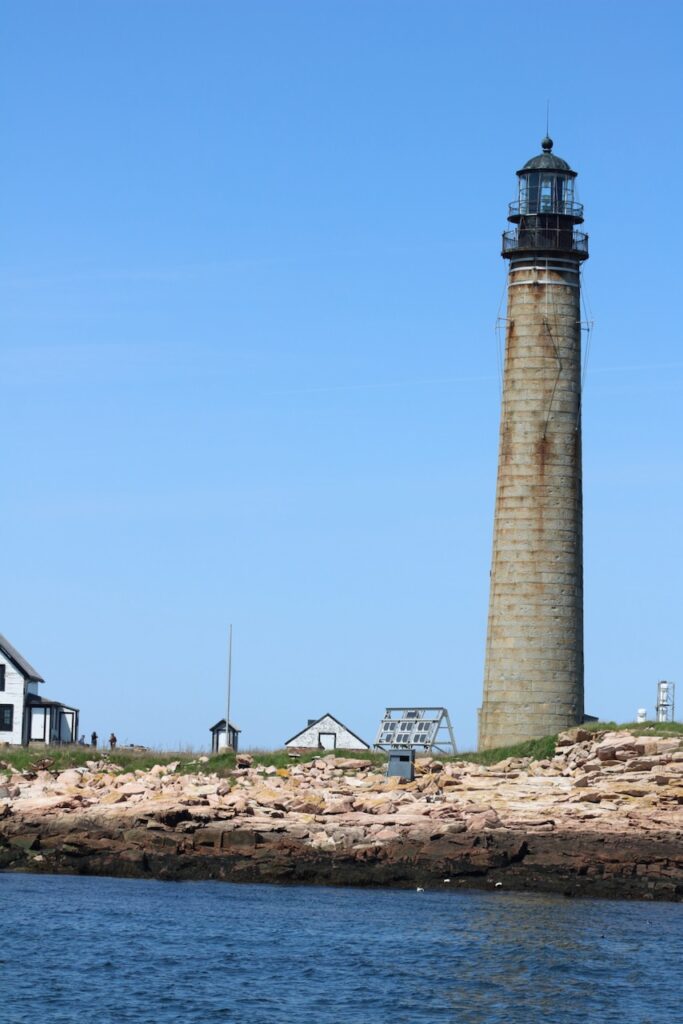
The Lighthouse on Petit Manan Island.

Both Egg Rock and Petit Manan are part of a large reserve known as Maine Coastal Islands National Wildlife Refuge. Every summer, dozens of wildlife technicians head out to these islands to spend weeks and months working with the birds that live there. On some islands, like Petit Manan, this work includes Atlantic Puffins, but it also includes monitoring and conservation of other species like Common, Arctic, and Roseate Terns, Common Murres, Black Guillemots, Razorbills, Common Eiders, and Leach’s Storm-petrels. Several of my peers at the University of Maine worked for Maine Coastal Islands and would be heading out to their assigned locations within the next few weeks.

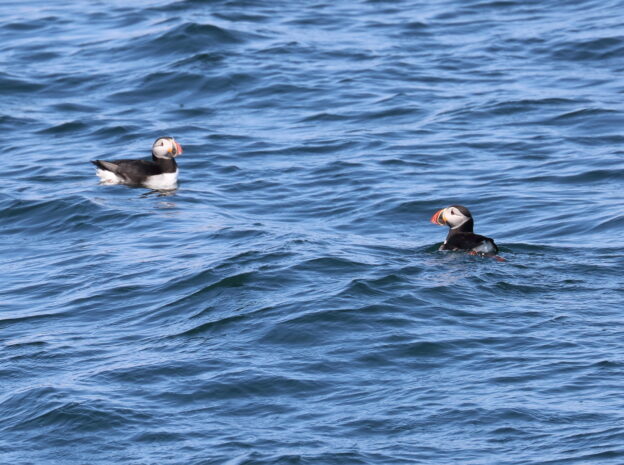
I began to make out large rafts of birds next to the island as our boat approached, and was delighted to spot football-sized alcids with rainbow bills taking off in front of us. I raised my binoculars and smiled—these were the first Atlantic Puffins I’d seen in seven years, since 2018 when I’d been lucky enough to visit Iceland with my grandparents (see my post “All About Alcids”). The birds lounged in the water close to the rocks, and our guide told us that many of them had likely just returned for the summer from their mysterious marine wintering grounds. I counted ninety or so during our half hour stay at Petit Manan.
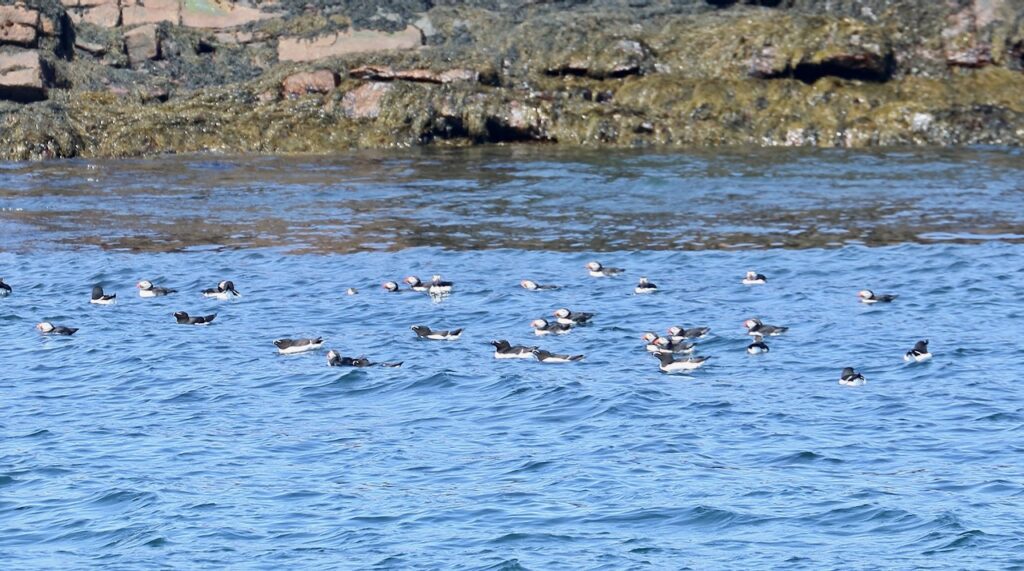
A raft of Atlantic Puffins and Razorbills!

The puffins weren’t alone. Black Guillemots were here, too, as were a couple dozen Razorbills, another gorgeous black-and-white alcid named after the unique shape and decoration of its beak. I spotted a single Common Murre amongst their ranks, my fourth alcid of the day and a species that had not yet attempted to nest at Petit Manan—but scientists were optimistic! A dozen or so Common Terns circled the island loftily, letting out loud “kyeeeer” calls to notify everyone who was really in charge here. In a few weeks, the numbers of terns would swell into the hundreds, and include Arctic as well as Common. Terns were the aggressive defenders of islands, and would dive-bomb anything they perceived as a threat, including people. I remembered one walk in Iceland when we were asked to hold a tall, wooden stick so the Arctic Terns there would target that instead of our heads!

These birds are the reason that so many alcids nest at Petit Manan. The huge tern colony on this and other islands provide safety for the puffins from predators like gulls and Peregrine Falcons that might otherwise raid their nests. Of course, the biologists working for Maine Coastal Islands NWR were also there to aid these species and chase predators off the island. It hadn’t always been that way, unfortunately.
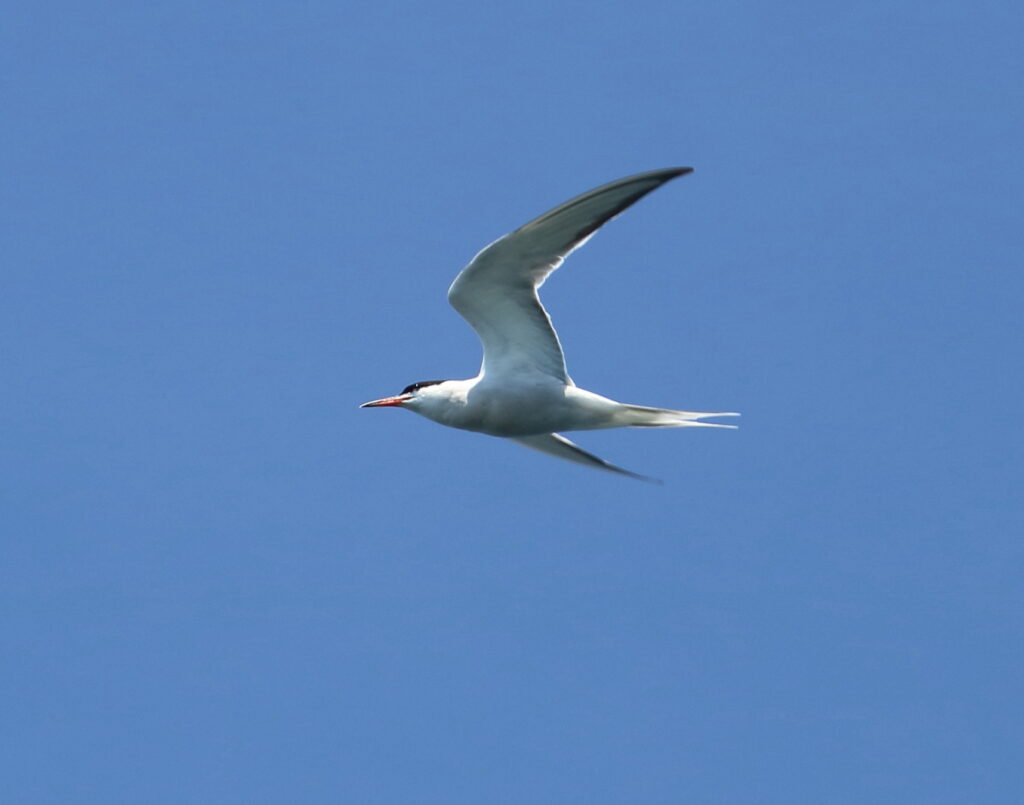
Common Terns nest in huge, aggressive colonies along the Maine coast!

A hundred years ago, feathered hats were all the rage in cities across the east coast of North America. The demand for white feathers meant that large numbers of terns, gulls, and egrets were harvested—to the extent that these species declined dramatically across much of the country. With no terns to protect them, puffins nesting in Maine were faced with higher predation, but not just from other birds. Rampant collection of eggs and puffin meat also plagued many of Maine’s islands, leading to a dramatic decrease in this species down to just two tiny colonies. Sadly, it was looking like the Atlantic Puffin would join the ranks of the Great Auk and Labrador Duck in Maine’s list of extinct birds.

Thankfully, ornithologists and bird-lovers alike noticed how much environmental damage was being caused by these practices and stepped in. Groups like Audubon formed and began lobbying for the protection of birds, eventually leading to the passing of the Migratory Bird Treaty Act of 1918. And in 1973, Audubon launched Project Puffin. Scientists were sent out to islands equipped with broadcasting equipment and decoys, as well as a small number of puffin chicks donated from colonies in Canada. Step one was the rearing of chicks on islands that had previously been occupied by puffin colonies; step two meant attracting terns back to the islands. Finally, with their defenders back in place, Atlantic Puffins began returning to many of the islands they’d previously been extirpated from. They now occupy six colonies in Maine.

Today, Atlantic Puffins are doing well, but are still being monitored very carefully. Puffins feed on fish that thrive in deep, cold water. That’s why the species only nests on the outermost islands in Maine. Our guide told us, “Puffins would lay their eggs in the ocean if they could.” Unfortunately, the Gulf of Maine is warming faster than any other body of water in the world, and this means that puffins are having to travel farther and farther out to sea to obtain their prey items of choice. During particularly warm years, puffins have switched their selected prey entirely to other species. Many of these other species of fish, which are brought back to their chicks on Petit Manan and other islands, differ in their size and the toughness of their skin. Often puffin chicks cannot eat them, and will starve even when food is sitting right there.
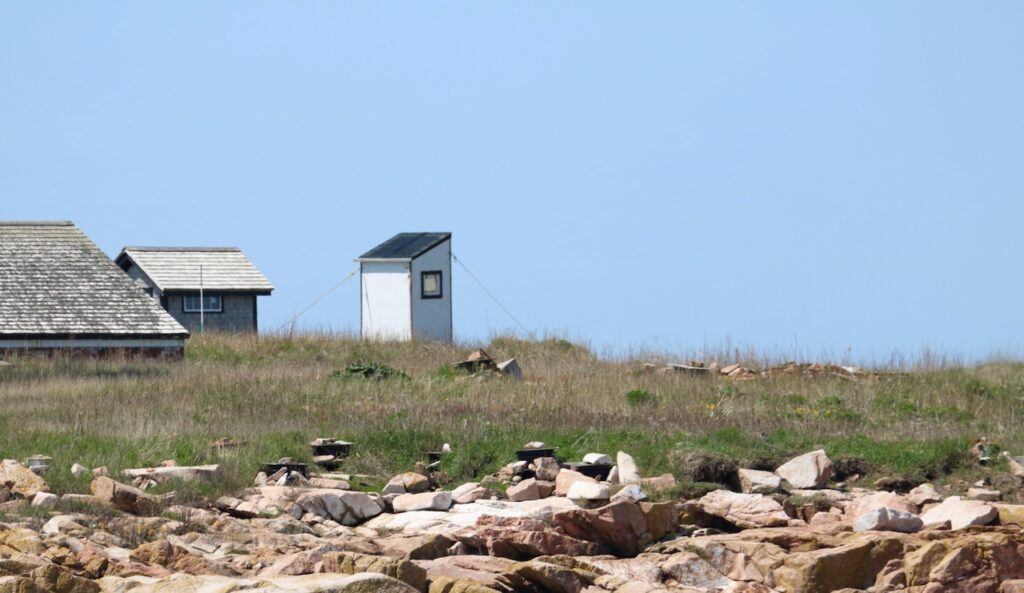
The man-made burrows where puffins nest on Petit Manan!

The good news is that there are many, many people keeping an eye on these birds, doing their best to keep their numbers high. Last year was an especially good year for the species, so optimism is in the air. I felt cautiously hopeful for the future of this species as the Bar Harbor Puffin Tour headed back to shore, content with the pictures and new memories I’d experienced with this iconic Maine species.
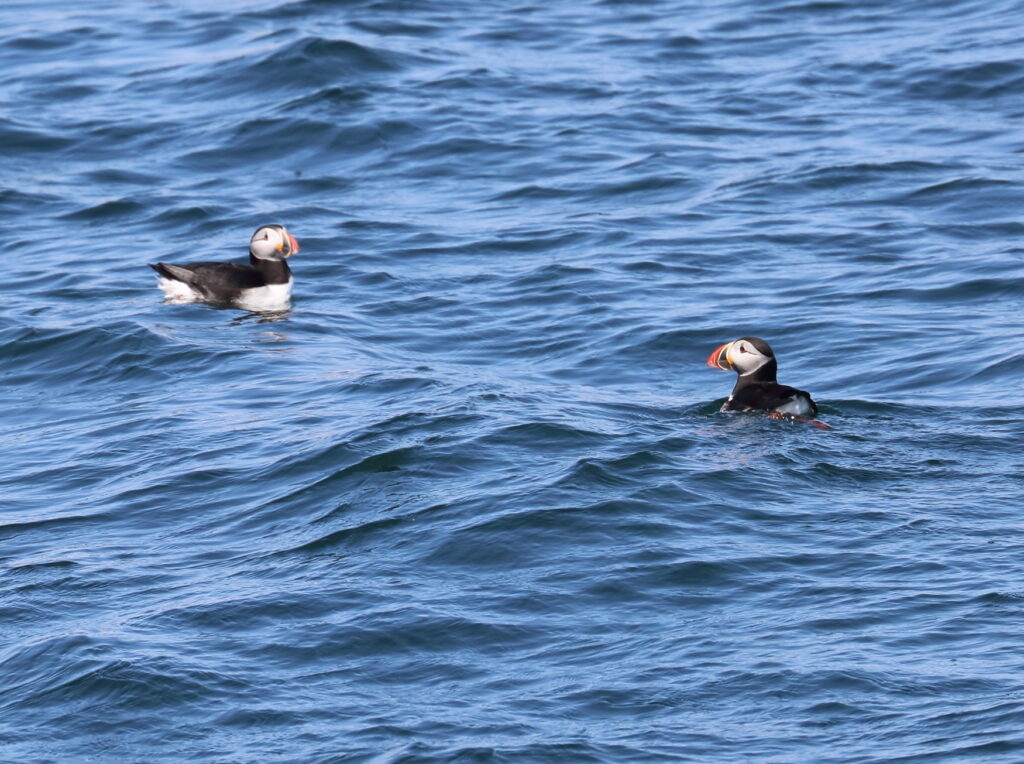
A pair of Atlantic Puffins!

Braden’s Maine to Montana Birdventure, Part 1: A Day in “The County”

Today, FSB kicks off Braden’s accounts of his truly remarkable spring birding trip from Maine to Montana. This adventure would take him to an astonishing variety of habitats most of us never get to experience. Along the way, he would drive 5,000 miles, visit nine states and provinces, and record 264 bird species, seven of them lifers. He begins this series with a visit to Maine’s arguably wildest and most inaccessible county: Aroostook.

Twenty-four hours after walking across the stage of the Cross Insurance Center in Bangor and receiving my college diploma, I was alone in a tent in Northern Maine. I’d gone to school in the state for four years, but never experienced it in the summertime, those three months when Maine is at its best. Now, with an abundance of time, I could leisurely make my way back to Montana instead of the six-day dash I’d done across the country last August. Because of this distant deadline, I’d arranged to spend a week in Maine birding and exploring following my graduation, and there was no better place to start than with one of the two counties I’d never visited: Aroostook County.

A Cedar Bog up in Aroostook County! This one shimmied with Palm and Magnolia Warblers.

Known simply as “The County” to locals, Aroostook is by far the largest and least populated part of Maine. The County contains a large portion of the state’s agriculture, mostly located on its eastern flank, whereas the rest is coniferous forest. Aroostook’s high latitude and cooler climate create a haven for many boreal species of birds that have receded from their more southerly haunts because of warming and excessive logging that promotes regrowth of a different, unsuitable habitat. This northern conifer forest is also a hotspot for the primary topic of my dad’s previous post: warblers.

Warblers, in fact, were a major factor in my decision about where to go to school. I wanted to go to college somewhere where I could see as many warblers as possible, and Maine fit that bill perfectly. With almost thirty species of breeding warblers (nearly triple what Montana, a state twice the size, has) there is no better place to be, and that is especially true of Aroostook County, where most of them could be found. Lying in bed the night of Monday, May 12th, I felt nervous. It was still fairly early as far as migration goes. What if the birds weren’t here yet?

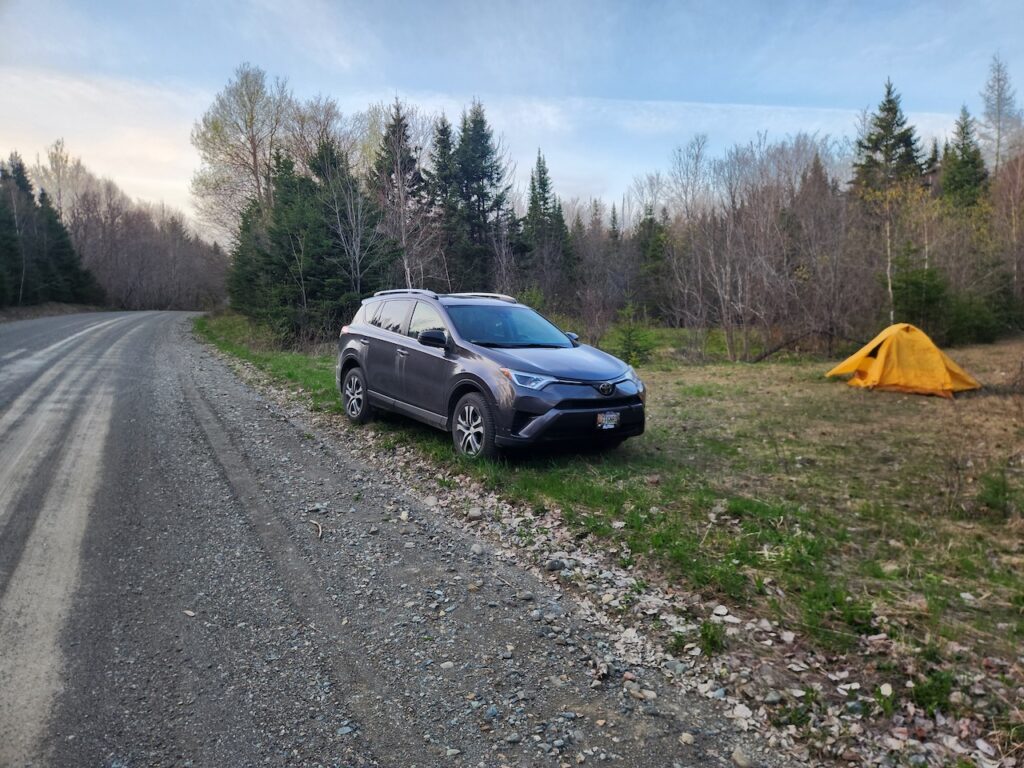
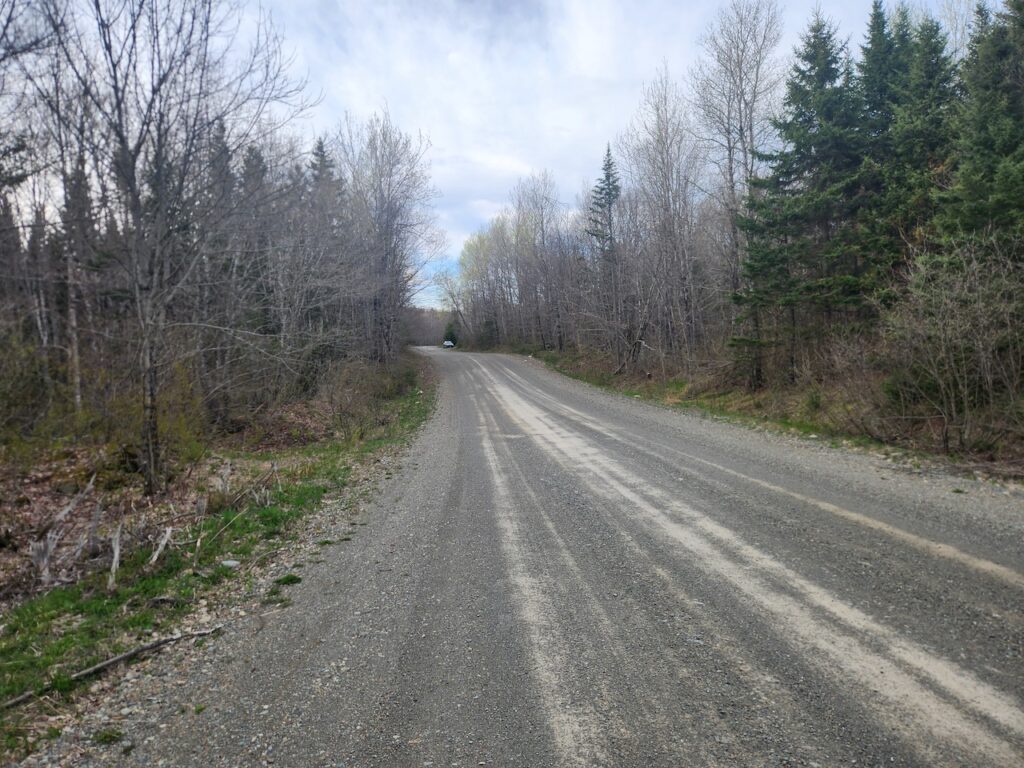
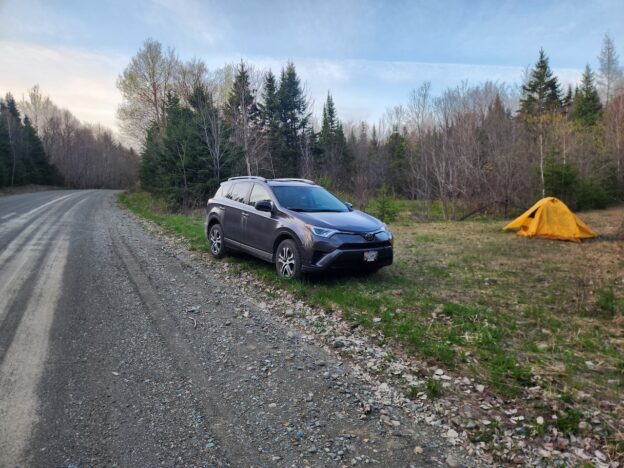
This was my camping spot in Aroostook County, on a backroad in northern Maine!

On Tuesday, May 13th, my worries were settled when I woke up to the sound of a Nashville Warbler singing above my tent. I dressed as quickly as I could and set off down the logging road I’d driven in on, my ears receptive to any and all of the birds sounding off in the surrounding woods. Every level of the forest had songsters belting out their tunes: Ovenbirds from the ground, Black-and-white Warblers from spruce trunks, Magnolia Warblers from ten-year-old firs and Yellow-rumped Warblers from high in the canopy. Present in lower numbers were species like Blackburnian Warblers, Black-throated Blue Warblers, and American Redstarts, all likely early representatives of their species, most of which were still farther south, booking it north.

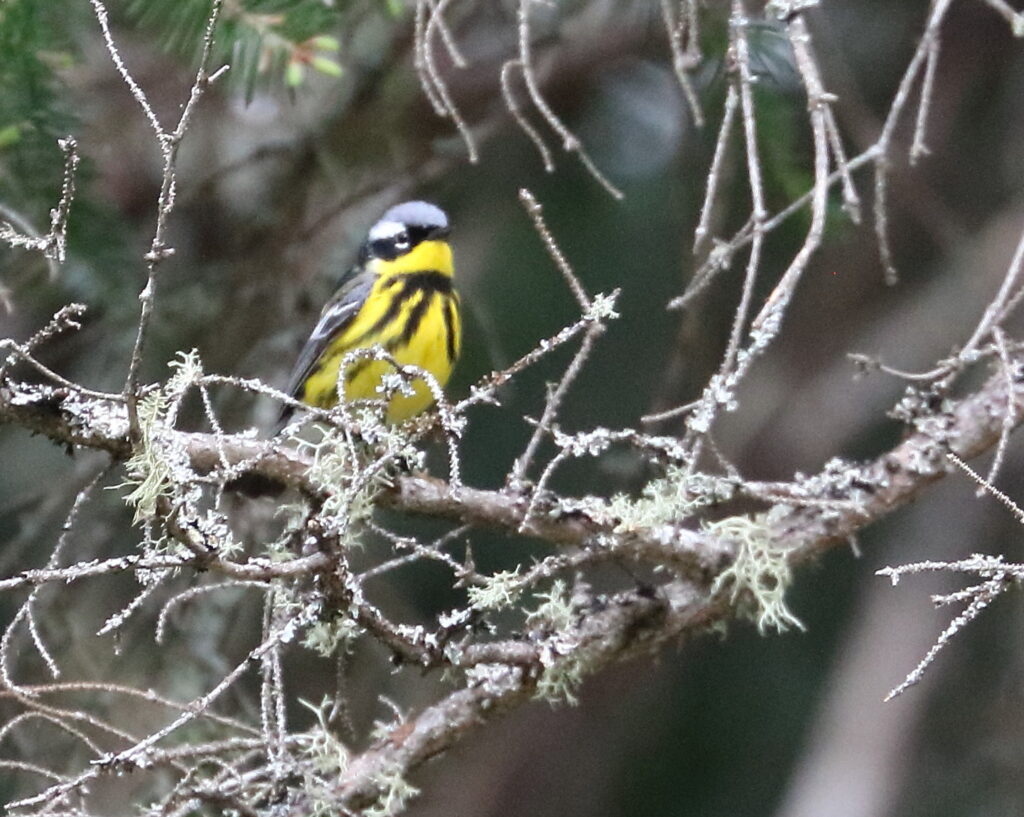
Magnolia Warbler in a spruce tree.

I was especially excited about the two Cape May Warblers. While I’d seen a fair number of Cape Mays before, I’d rarely seen them in their breeding colors and I’d never heard them sing before. This is because of their distributions. While I’d encountered many of the East Coast warblers on their breeding grounds during my time in Pennsylvania, I was hundreds of miles too far south for Cape Mays, which use contiguous spruce-fir forest and are mostly confined to Canada. These warblers (which are named after Cape May, New Jersey, where they neither breed nor spend the winter) are particularly dependent on an insect known as spruce budworm. Budworms are spruce parasites, and their populations are cyclical. During outbreak years the insect infects and ravages thousands of acres of spruce trees before the population crashes. Cape May Warblers, Bay-breasted Warblers, and Evening Grosbeaks, therefore, all have populations that rise and fall with the populations of this insect.

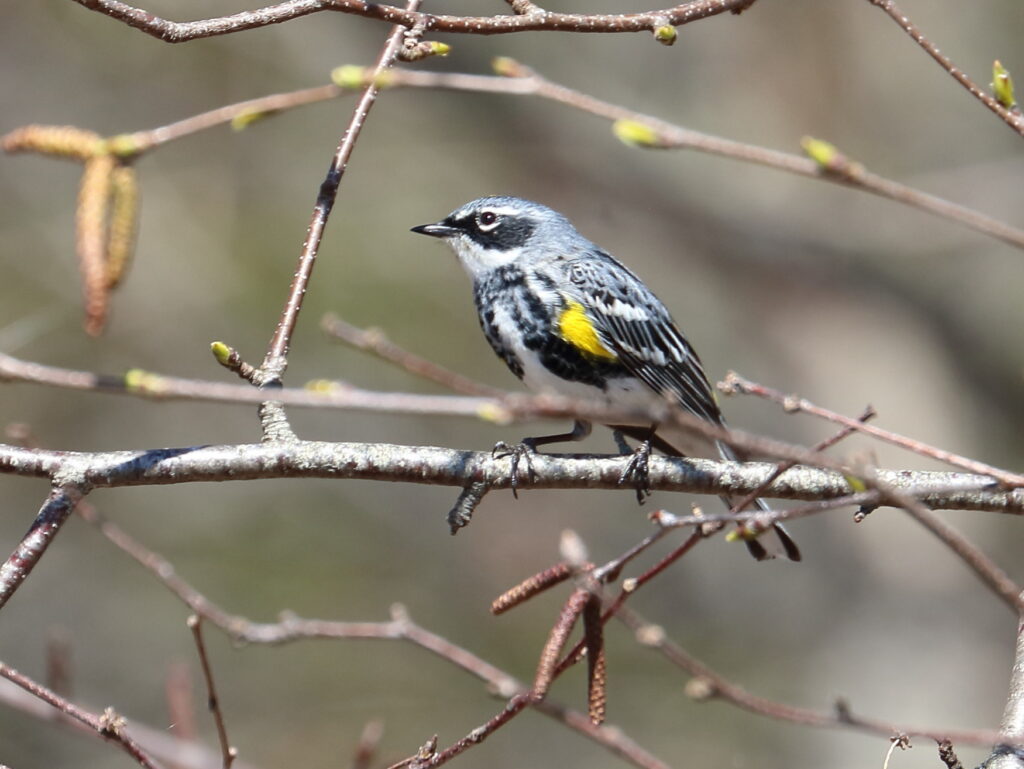
A “Myrtle” Yellow-rumped Warbler, which is the subspecies that lives on the East Coast!

Besides agriculture, the main industry in Aroostook County is logging, and understandably, the logging industry is not the biggest fan of an insect that defoliates thousands of acres of their crop. Unfortunately, the industry’s historical response to spruce budworm outbreaks (which, remember, are ecologically “normal” and important for the birds dependent on them) has been to clear-cut hundreds of hectares of infected forest. Spruce-fir forest is a mature ecosystem that takes centuries to develop, however, and the forest that grows back after these clearcuts is not coniferous but deciduous. This is a major reason why many spruce budworm-specialists, like Cape May Warbler, and many other birds found in boreal forests, like Canada Jays and Black-backed Woodpeckers, have retreated from much of southern Maine in the last hundred or so years. Their habitat has simply disappeared.

I saw evidence of this as I birded The County. Sure, there was a lot of seemingly healthy spruce habitat. There were also massive empty lots, covered in nothing but slash and debris. The forests were filled with birds, while the lots had almost none. It almost seemed apocalyptic. At least the empty lots provided good views of Mt. Katahdin, Maine’s highest peak, rising in the distance.

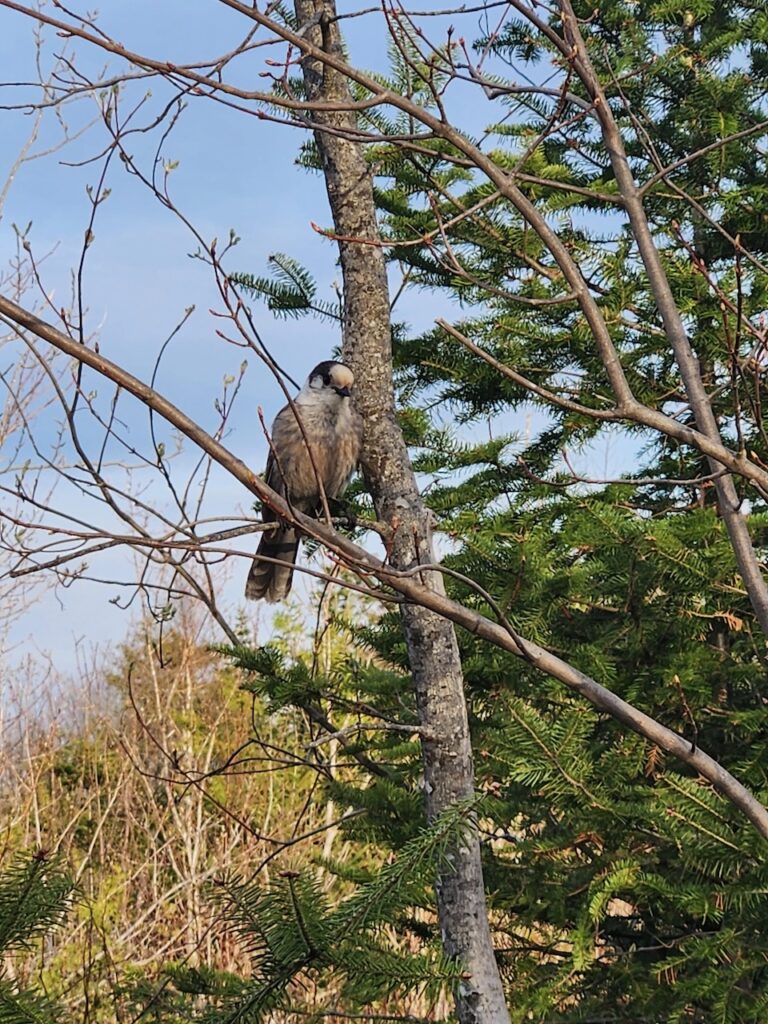
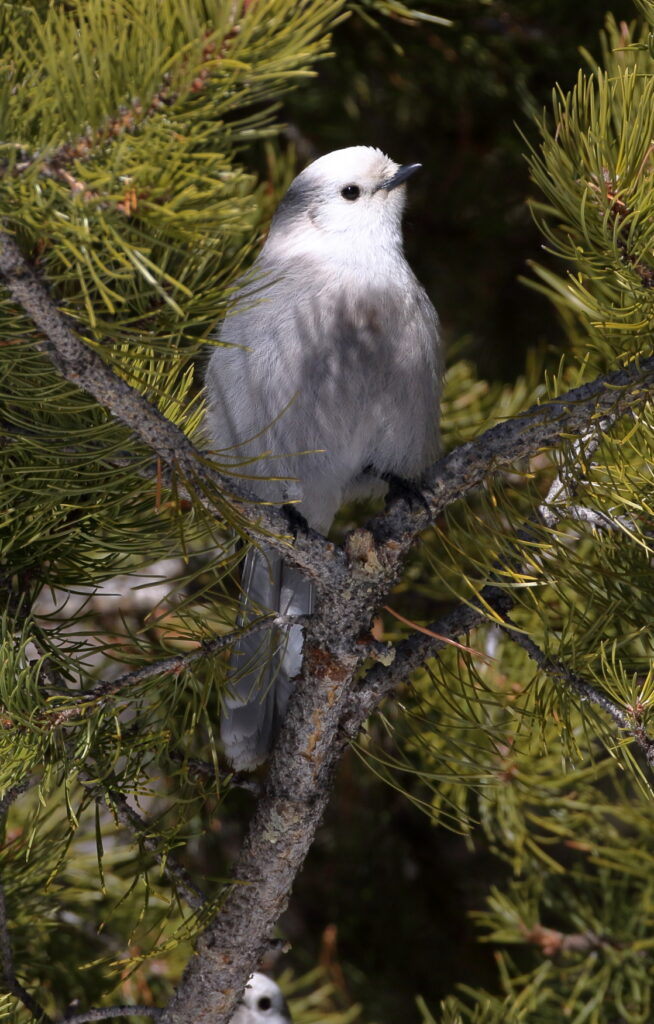
Again, though, the forests DID have birds, and not just warblers. Many migrants had not yet arrived (namely the flycatchers, of which I saw very few), but I recorded dozens of Ruby- and Golden-crowned Kinglets, Blue-headed Vireos, and Winter Wrens. Ruffed Grouse drummed from wet thickets, Hermit Thrushes foraged in the road, and I even got to see an American Goshawk bomb overhead at a million miles per hour, chasing something or perhaps just trying to give me as least satisfying a look as possible. In the evening, a walk along a side road yielded incredible, up-close views of Canada Jays, or “Whiskeyjacks” as they are known colloquially. These subtle, white-and-gray corvids landed in the trees less than five feet from me, curiously searching for insects while paying me no mind.

A photo of a Canada Jay that I took with my phone!

After a night and a day spent in The County, I headed back south to investigate the other corners of Maine I had yet to explore. Stay tuned!

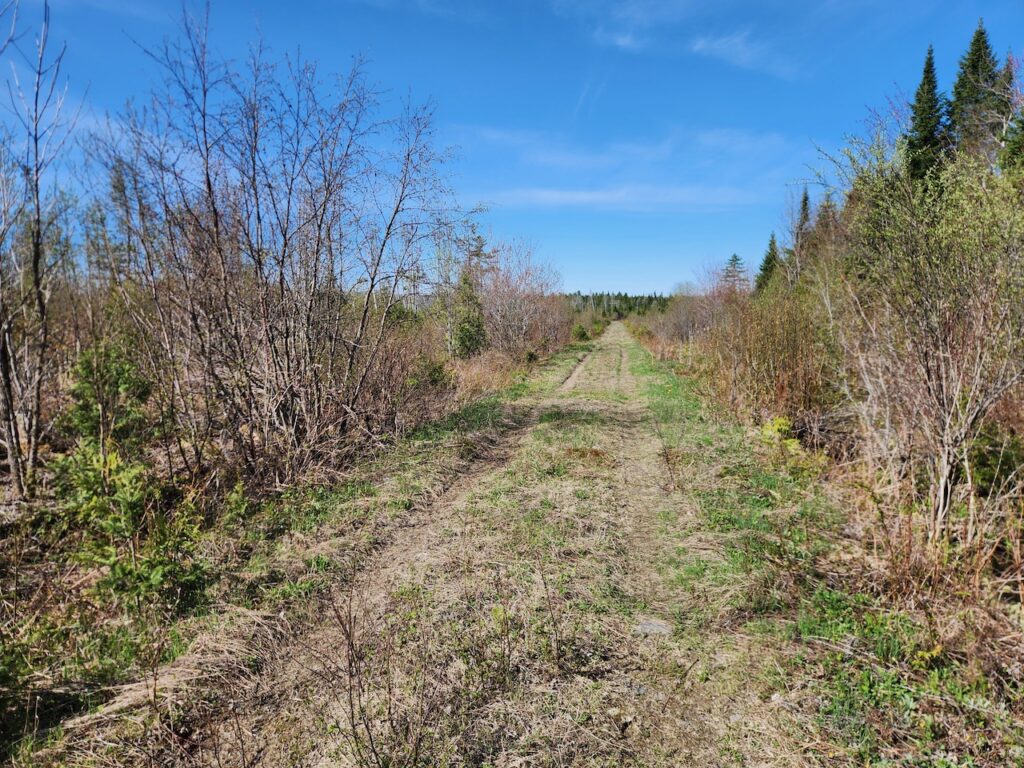
What the forest looked like in Aroostook!

Layover Birding in Bogota, Colombia

“Call me asap,” Roger’s text read. A few minutes later, I dialed his number. “What’s up?”

The answer: a chance of a lifetime.

As faithful FSB readers know, Roger is a longtime friend of mine from UC Berkeley, and a guest contributor to FatherSonBirding. More than six months ago Roger and his wife, Claudia, began planning a dream birding trip to the world’s epicenter of awesome birding—the country of Colombia. How awesome is Colombia? Well, during the Global Big Day of birding each year, Colombia regularly kicks butt on all challengers. In 2024, its birders recorded an astounding 1558 species in a single 24-hour period—more than twice the number of the US despite submitting only about 15% of the number of checklists. It is widely considered to have the highest biodiversity per square meter of any country on earth.

Sadly, Colombia has a long history of violence that has made it mostly off-limits to birders for decades. That began to change in 2016, when a peace agreement was signed between the government and FARC, the military wing of the Colombian Communist Party. Violence still racks some parts of the country, but that has not prevented a growing number of birders from seizing the chance to visit one of the world’s most spectacular ecological regions. About six months ago, Roger decided to join those growing ranks. He and Claudia mapped out a two-week trip that would include a feast of birding opportunities. However, as the great oracle of our time, Neil Young, sang, “The devil fools with the best-laid plans.” Two weeks before their trip, Claudia was forced to cancel, and Roger asked if I wanted to fill her slot. With a quick nod from Amy and the urging of Tessa, it took me about two minutes to decide.

The plan was to meet up in the Andean city of Pereira to begin our birding adventure (of which I’ll write much more later). Roger planned to fly from his home in Bend, Oregon to Miami and spend the night; then fly to Pereira via Panama City the following day. Being a Delta Airlines loyalist, I left a day earlier, spent the night in Atlanta and then flew to Bogota for a night. This excited me greatly because it would give me a morning to myself before catching a flight to Pereira to meet Roger. Gee, what oh what might I do with that morning?

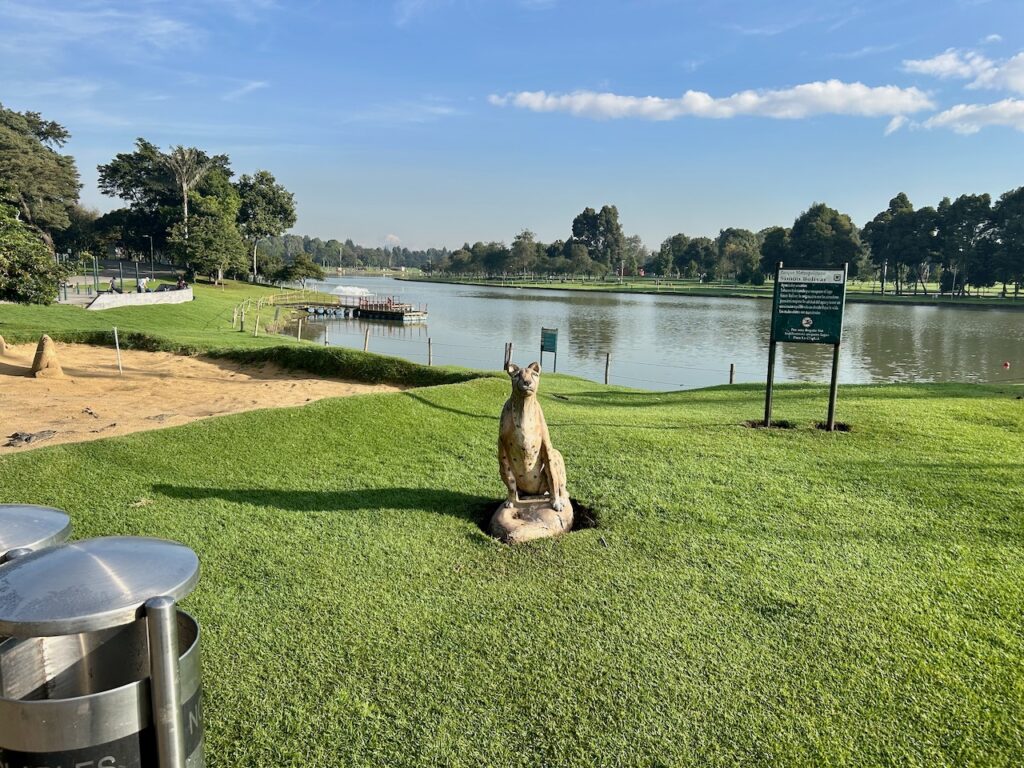
Simon Bolivar Park, Bogota.

Not by accident, I booked a room in the Hotel Capital, strategically located a short taxi ride to two major birding possibilities. Rising early, I wolfed down a granola bar for breakfast and then caught a cab to Parque Metropolitano Simón Bolívar, one of the world’s largest urban parks. In my atrocious Spanish, I told the cab driver of my interest in birds and he dropped me off at the SW corner of the park near a large central lake. I had worried a bit about carrying my camera and binoculars in this unfamiliar city, but my hotel concierge had assured me the park would be safe. Sure enough, I was relieved to see a steady stream of joggers, dog walkers, and cyclists taking advantage of a beautiful sunny morning. But what of the birds?

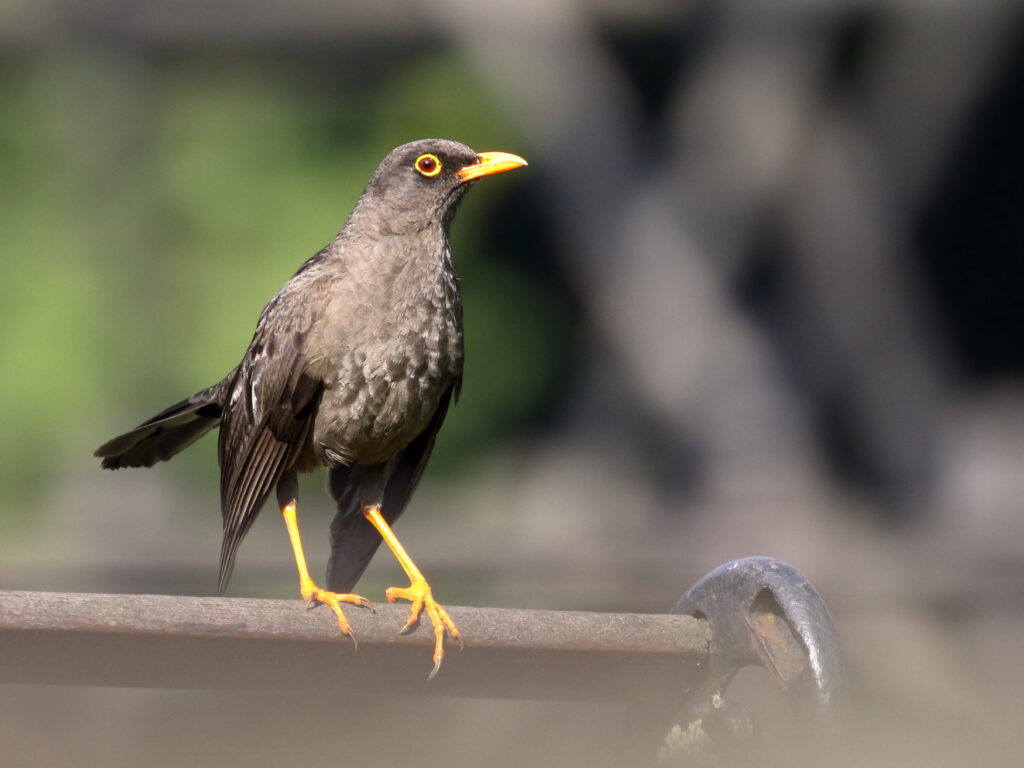
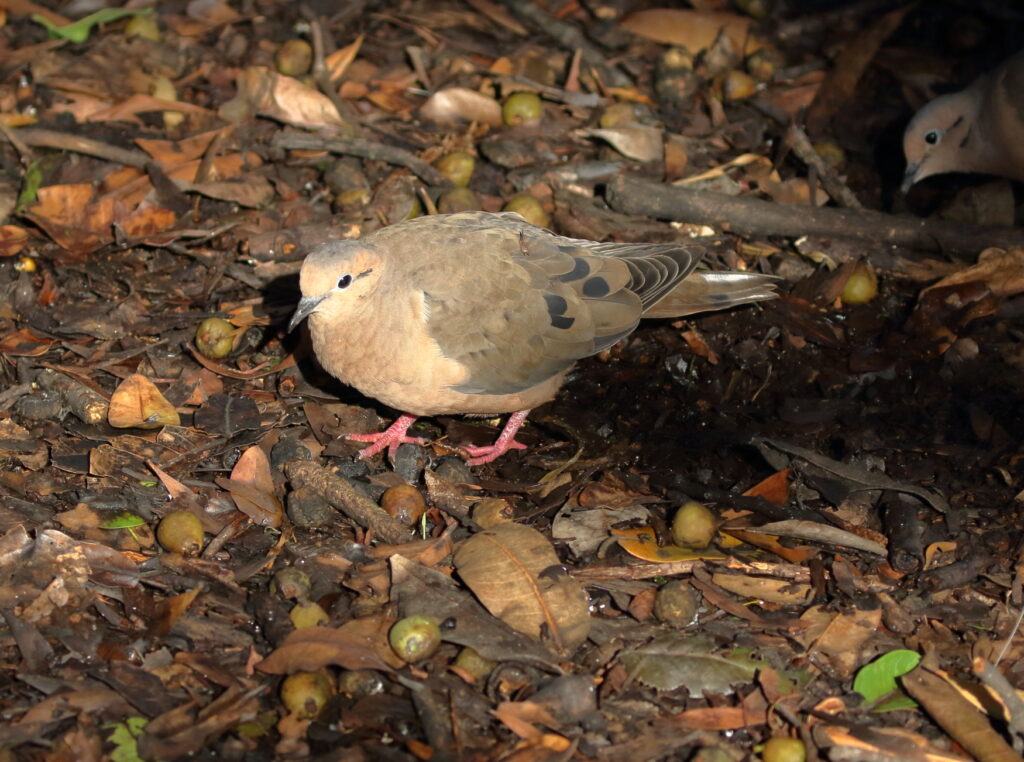
As I walked toward the lake, I saw plenty of Great Thrushes and Eared Doves, and Sound ID picked up the songs of Rufous-collared Sparrows, a bird Braden and I had become friends with on our family trip to Ecuador and Peru in 2017.

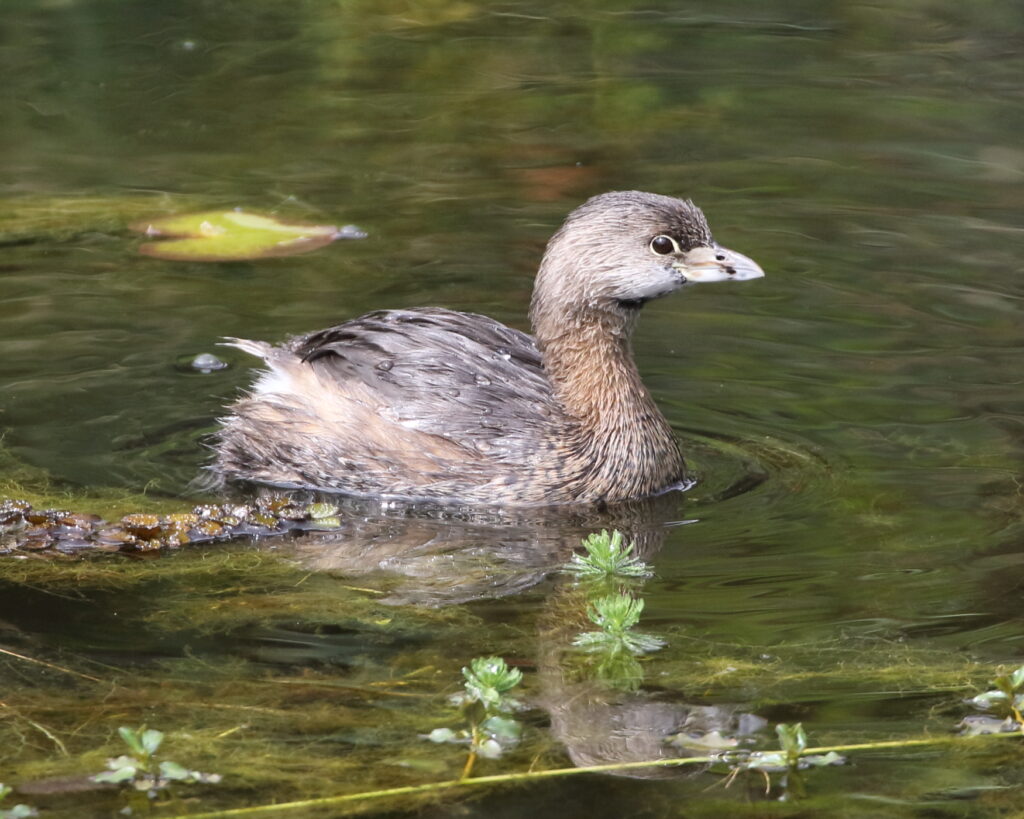
Like a birder magnet, however, the lake drew me forward. When approaching a large body of water like this, I always look for legions of water birds to be gracing the water, and in Japan and last year’s trip to Barcelona, that had indeed been the case. Not today. Evidently, ducks just aren’t as big a deal in the tropics as in temperate zones. I did spot what looked like a domestic hybrid duck of some sort, accompanied by a much smaller bird, and I focused in on the latter for the day’s first surprise—a Pied-billed Grebe! “I didn’t know they lived this far south,” I thought. Indeed, I later learned that in the Americas, Pied-billed Grebes have the largest distribution of any grebe, stretching from mid-Canada almost to the tip of South America.

Pied-billed Grebes have the widest distribution of any American grebes.

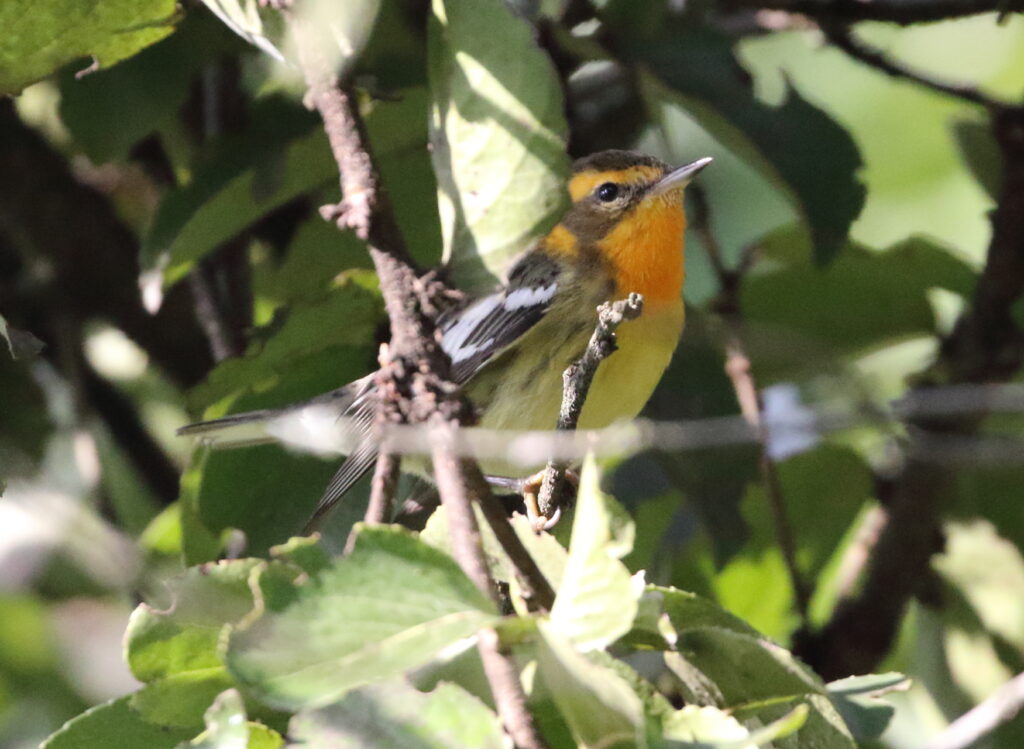
A hundred meters farther, I caught movement in bushes and discovered one of the real prizes of my outing—a mixed flock of warblers! And not just any warblers, but three species that breed in the eastern US. One revealed a brilliant splash of orange on its face. Can you guess which one it was? That’s right—Blackburnian Warbler! It was accompanied by several Tennessee Warblers and my first look at an actual Rufous-collared Sparrow.

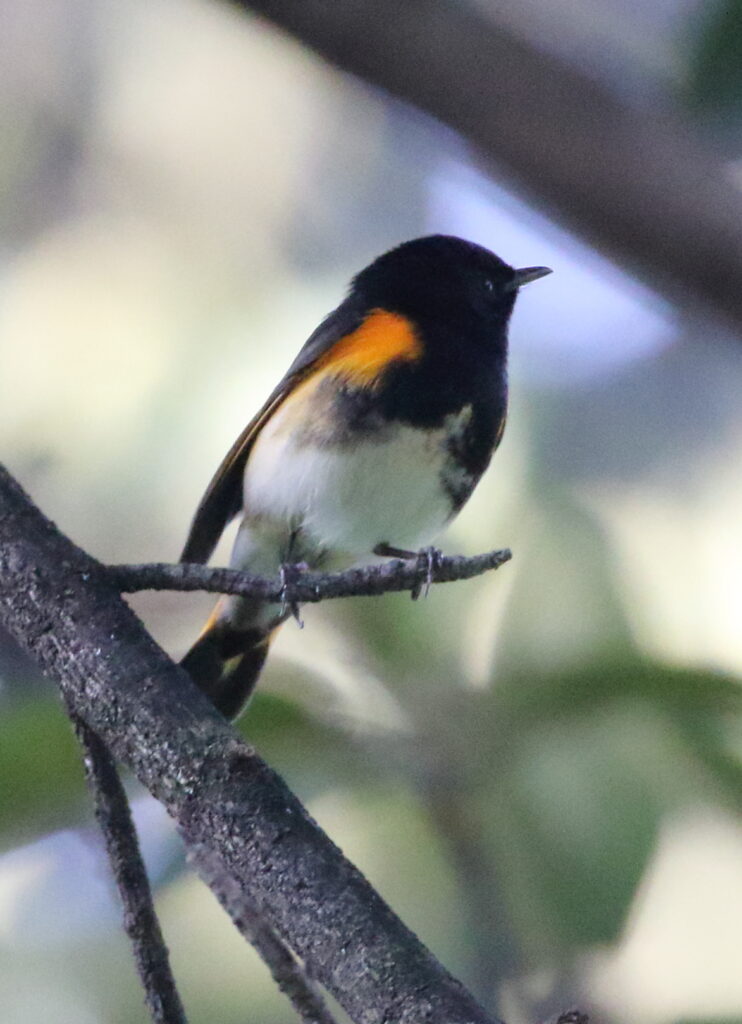
As I followed the flock around, I got an even bigger surprise—a bonafide American Redstart. “Wow!” I said out loud, trying to get a photo of one of everyone’s favorite warblers.

From the main “parky park,” I crossed a pedestrian bridge over jammed up morning traffic and entered a sprawling sports complex.

You’ll be relieved to learn that Colombia has the same kinds of traffic problems as we do!

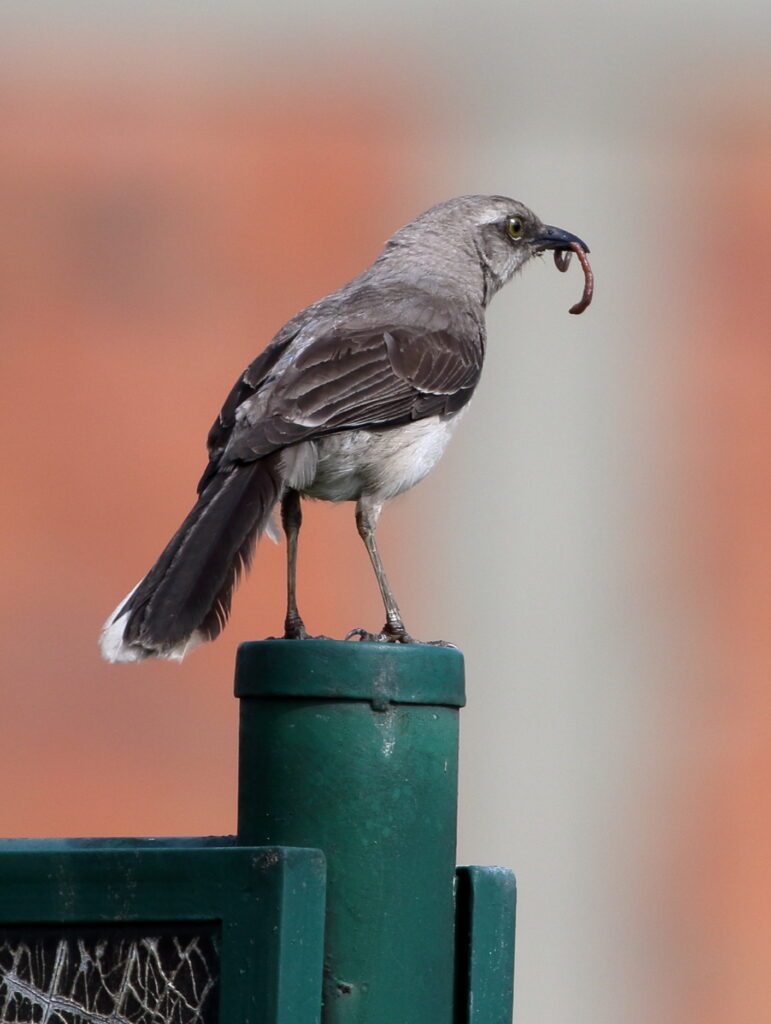
Soccer players were warming up, track and field athletes ran around a track, and tennis players smacked balls back and forth. Next to the walking path, a pair of familiar-looking black-and-white birds hopped up onto a sign. It didn’t take me long to figure out they were Tropical Mockingbirds—the only ones I would see on the trip! Then, a familiar, largish bird flew noisily by and disappeared over the wall into a stadium. Here, Braden’s and my travels to Israel paid off. Southern Lapwing! my mind immediately shouted. My real destination, though, lay just ahead.

Look familiar? It didn’t take me long to figure out that this handsome fellow was a Tropical Mockingbird.

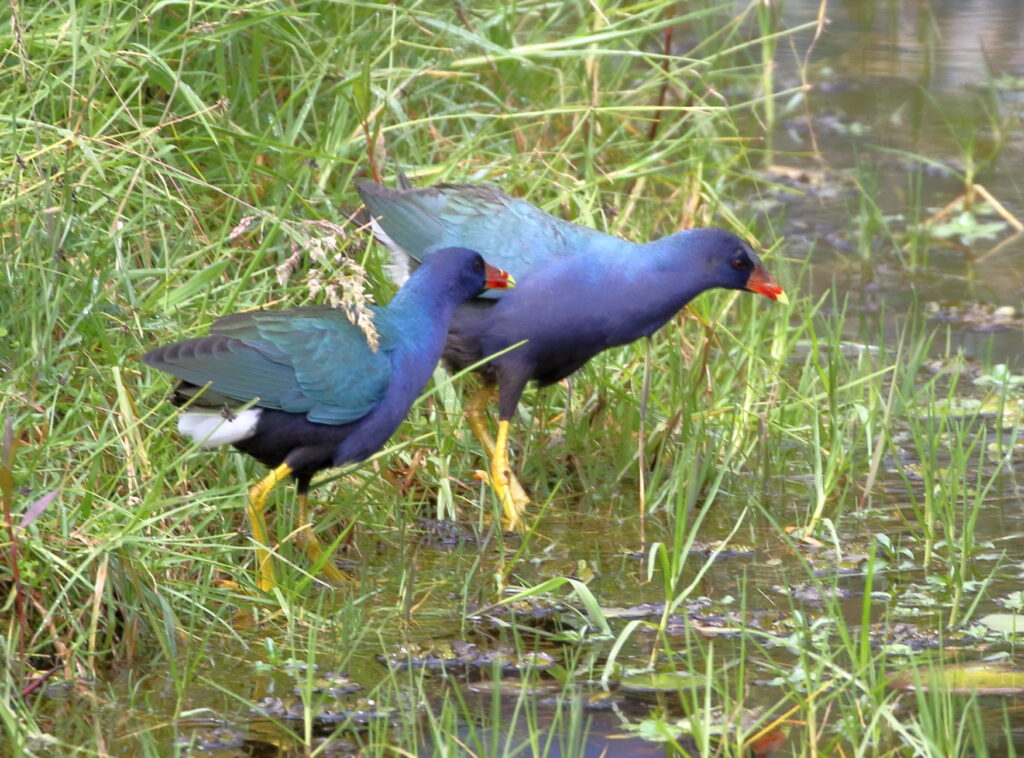
I paid two bucks to enter the Jardin Botanico de Bogota—which, like the sporting complex, was technically part of the Simón Bolívar Park—and asked a greeter where I might find birds. Then, I set off to explore. My first find? Gorgeous Purple Gallinules. Hummingbirds also flew by, but knowing just how many hummers fill South America, I wasn’t psychologically ready to tackle those just yet.

It’s hard not to be impressed with the technicolor plumage of Purple Gallinules.

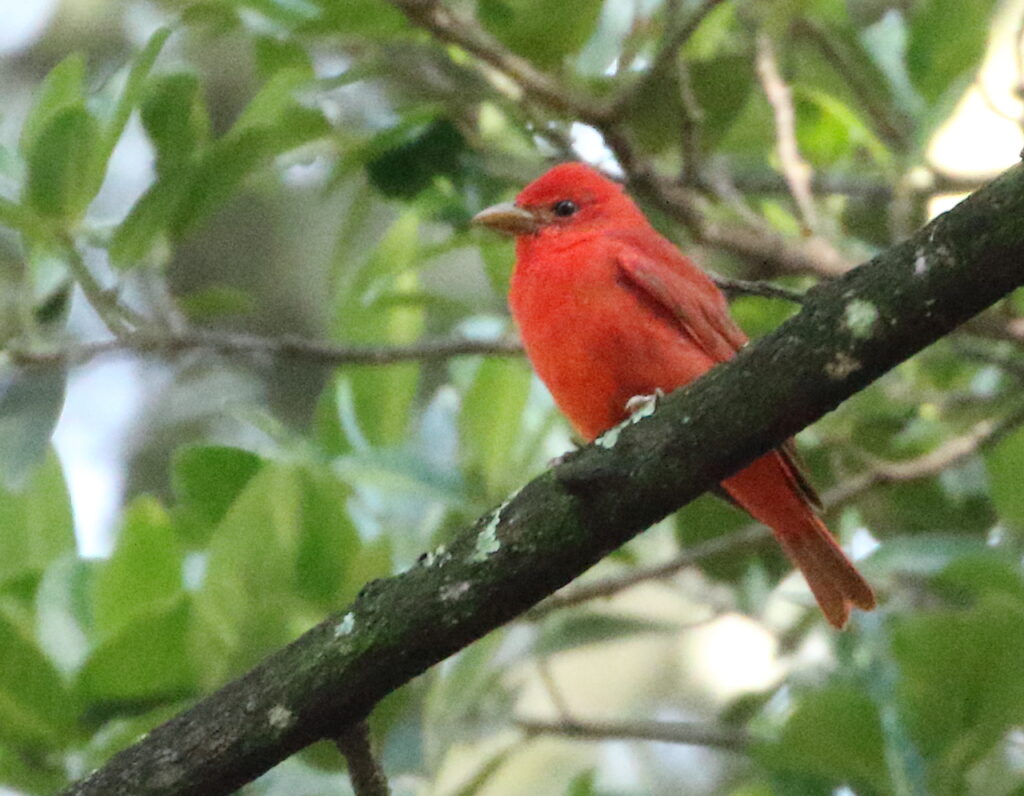
Continuing on alongside a wooded area, I spotted a bright red shape about twenty feet high on a branch—my first South American Summer Tanager! I saw another traveler staring up into the trees and walked over to introduce myself. “My name is Edwin,” he told me, along with the fact that he was from the Netherlands. “Are you seeing anything?” I asked him. “Yes, but I don’t know what they are,” he confided. I got my eyes on fast-moving, small shapes and recognized another Blackburnian Warbler, along with what I think were more Tennessee Warblers. I told Edwin what I was seeing.

“Hey, did you see the Summer Tanager?” I asked, and his eyes widened. “No!” So I led him back to where I’d spotted it, relieved to finding it still perched, evidently being well-paid by the botanical gardens staff to stay in place.

I had hoped to see some of our northern birds in their southern wintering grounds, but didn’t expect to see a Summer Tanager in downtown Bogota!

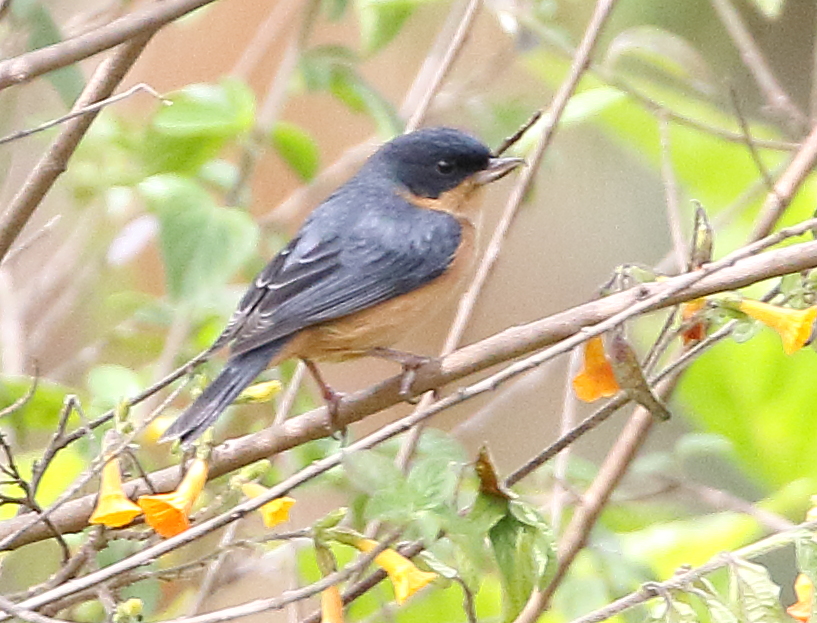
By this time, I was only up to about twenty species, which seemed like a rather poor showing for a morning in a brand new tropical country, even if I was in a major city. Only one of those species, Shiny Cowbird, was a lifer. Even worse, it was about time for me to flag down a cab and make my way back to the hotel so that I could shower, pack, and get to the airport for my flight to Pereira. Before leaving the gardens, however, I decided to make one last stop where I had seen the gallinules. Suddenly, I detected a small bird flitting among some flowers, and my pulse picked up. I didn’t know what it was, but got some decent ID shots of it. As I zoomed in on one of my photos, a smile spread across my face. It was a flowerpiercer—the first I had ever knowingly seen! Later, I consulted with Braden and we agreed that it was a beautiful little species called a Rusty Flowerpiercer.

I was thrilled to find this Rusty Flowerpiercer, the first flowerpiercer I’d ever identified on my own.

It was a great way to finish off a fun morning of layover birding in a new country. It also laid the groundwork for what would promise to be an adventurous—sometimes too adventurous—next couple of weeks.

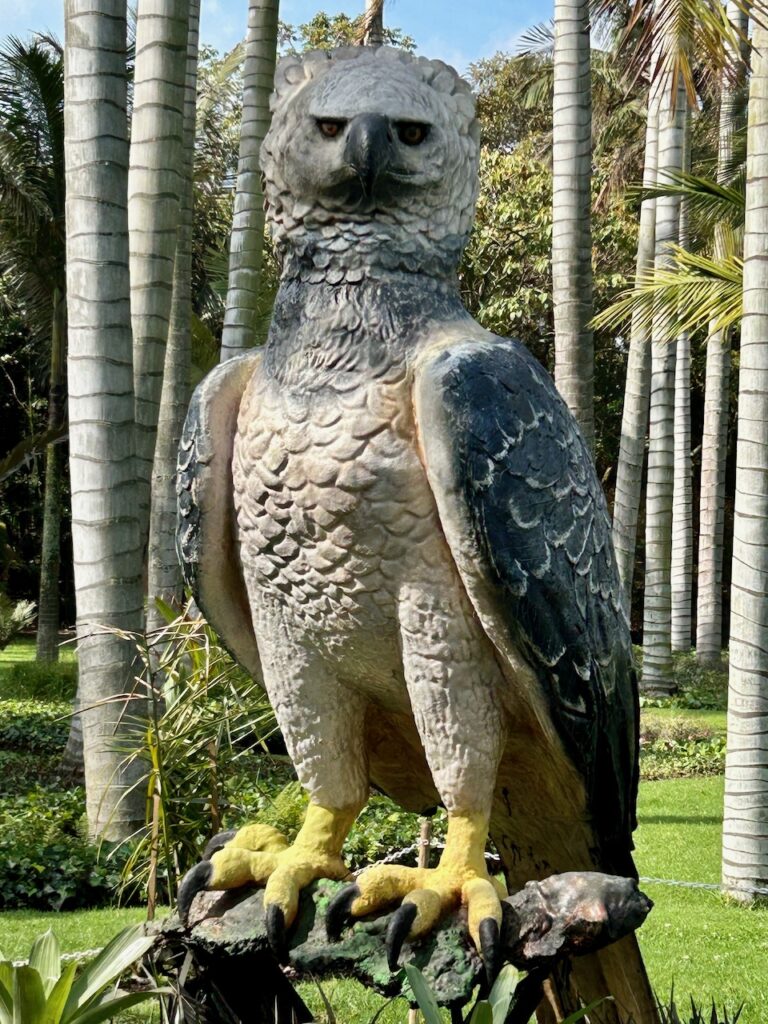
Oh, wait, did I forget to mention the giant Harpy Eagle I saw in Bogota’s Botanical Gardens?

My Big Silly January

Setting and surpassing goals plays a big role for many of us birders. Big Years, Big Months, Big Days, State Big Years, Bicycle Big Days, Global Big Days—the list of ways we challenge ourselves are endless. And while I’m no longer a big fan of Big Years that require burning up a ton of fossil fuels, Braden and I still partake in local challenges, or those that unfold seemingly on their own. Such was the situation I found myself in late January.

Thanks mainly to a vigorous day of birding with Braden on January 2nd, in which I found 47 species here in western Montana, and the surprise trip to Victoria that Amy planned for my 65th birthday (38 more species), by January 20th I found that I had seen 88 bird species for the month. They were awesome birds, too, ranging from Short-eared Owls and Golden Eagles here in Montana to Pacific Loons, Harlequin Ducks, and a Marbled Murrelet in Canada (click here). Interestingly, I realized that with ten days to go, I needed to see only four more species to make this my best January of birding ever! Even so, I had a lot of writing to catch up on and I wasn’t sure that I wanted to intentionally make the effort. A couple of things convinced me to go for it.

Lola played an instrumental role in advancing my Big January goals!

The first was that while walking our dog Lola in the neighborhood, I found my first Northern Pygmy-Owl of the year—a delightful little guy soaking up the last rays of sun high in a Ponderosa Pine. The next day—also while walking Lola, through Greenough Park—I espied my first American Dippers of the year. Three days after that, the year’s first White-breasted Nuthatch visited our backyard feeder, the first I’d seen there in a couple of years. Suddenly, just like that, I was one bird away from breaking my record. What, oh what, to do? Too much sittin’ on my butt and a forecast for a beautiful winter day answered the question. I called our friend Susan, who has been getting into birding more and more the past couple of years. I told her, “You know, there’s a Rusty Blackbird over near Deer Lodge, and we may be able to find some Snow Buntings. Do you want to go see if we can find them?” She also needed a birding break, so the next morning, we headed east.

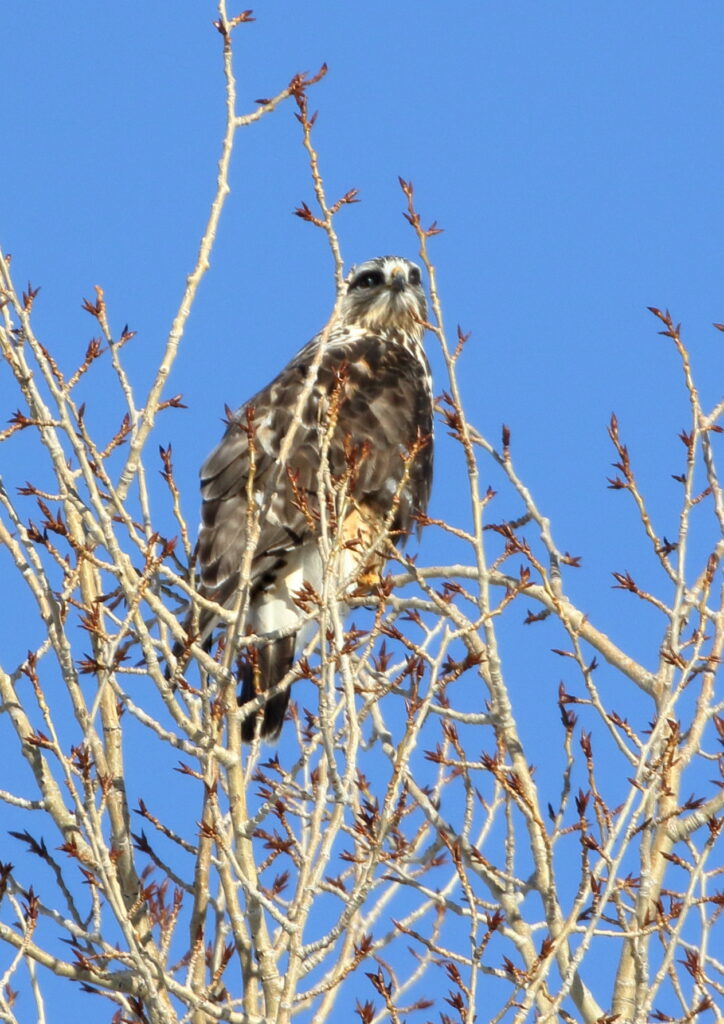
Though we didn’t find Snow Buntings or the Rusty Blackbird, Susan was especially excited to get to know Rough-legged Hawks better.

We spent a delightful morning driving the roads between Deer Lodge and Anaconda. We may have seen a Snow Bunting, but it flew away before we could make a definite ID. We also saw the Rusty Blackbird—right as a couple of other birders scared it away. Since we couldn’t ID it ourselves, we didn’t put it on the list, either. Fortunately, in the parking lot that led to the Rusty Blackbird, we found four Horned Larks! Yay! I had it! A new January record!

Susan and I failed to get an ID-able look at a rare Rusty Blackbird. But note the famous Anaconda smelter stack in the distance!

But here’s the problem. Once you break one record, and realize that you are perilously close to another landmark—in this case, 100 birds for the month—it’s virtually impossible not to go for it. By now, I had revealed my January ambitions to Susan, and not only did she get as excited as I did about them, she was all in on getting me to 100 species for the month. As we pulled away from the Horned Larks, I said, “Are you up for driving by Discovery Ski Area on the way home?” “Let’s do it.”

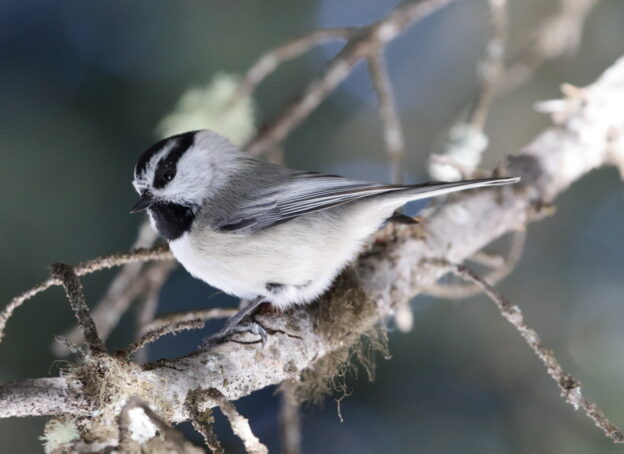
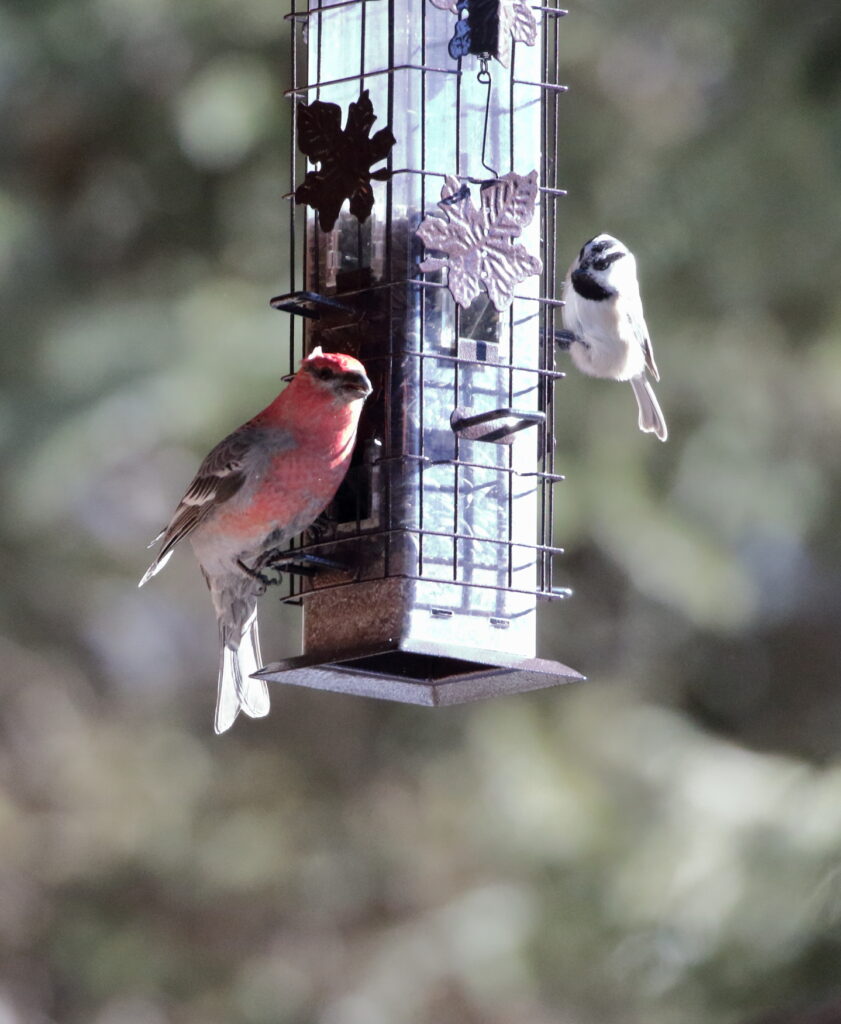
Employees at Discovery kindly put out bird feeders that keep Pine Grosbeaks, Mountain Chickadees, and other higher-altitude birds nurtured during cold winter days.

Loyal readers of FatherSonBirding will recognize that in years past, Discovery Ski Area has been a go-to place for Braden and me to pick up several challenging species, and as Susan and I approached the parking area, we saw our first of these: Canada Jay. After parking, we visited the bird feeders and had a fun time picking up two others: Mountain Chickadee and Pine Grosbeak. Clark’s Nutcracker was the only bird that didn’t cooperate with my 100-species plans, but still, I left the ski area with 96 species. Could I really get four more species before the month ran out? Did I want to? No, I decided. I didn’t need to drive around burning up gas just trying to break a silly record. However, the Universe seemed to have other plans.
Portrait of a Canada Jay. See them while you can. Canada has announced that it will no longer allow these birds to be in the US if President Trump does indeed impose tariffs on our northern neighbor.

The afternoon of January 29th, I was again walking Lola in the neighborhood when I saw two more birds I needed for the month and year: Hairy Woodpecker and Cedar Waxwing, both of which I thought I’d already seen! Then, a Greater White-fronted Goose was sighted out beyond the Missoula Airport. I had never seen one of these birds in Montana, and it was a rare opportunity to do so, so on January 31st, I loaded my spotting scope and camera into the car and headed out to the site. My January and Year lists now stood at 98 species.

Long-story short: I did not find the Greater White-fronted Goose among the Canada Geese that were out there. As I was watching other CAGOs fly in, however, I was stunned to see a white goose flying with them! Stupidly, I did not try to gauge the size of this surprising arrival. If it were a bit larger it would be a Snow Goose; a bit smaller, Ross’s Goose. Either one would get me to 99 species—but not if I couldn’t identify it! Sighing and simply putting down “white goose” on my list, I resigned myself to not breaking that magical 100 number.

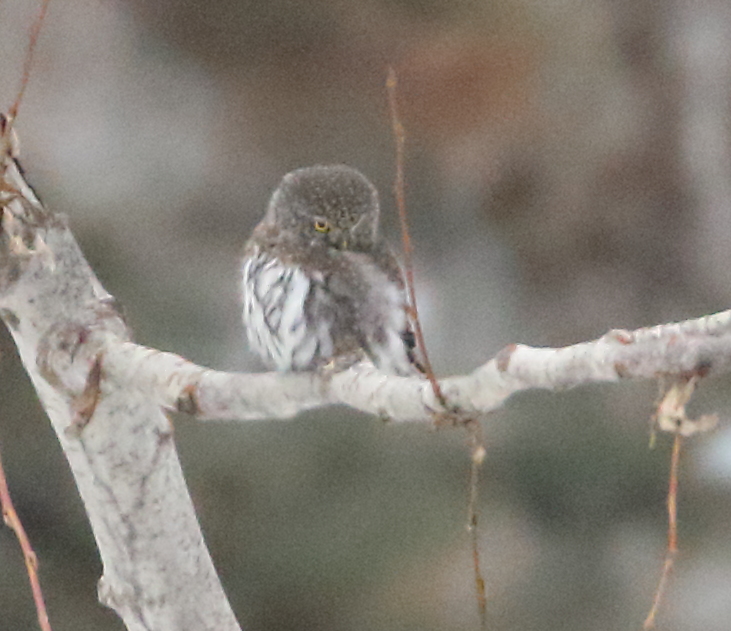
Since I was out there, however, I decided to swing by Council Grove State Park for a look around. The number of birds out there in the dead of winter surprised me. I was delighted to hear a Belted Kingfisher and spot Green-winged Teals and a Great Blue Heron. Then, two Killdeer flew by. As I was following a trail back around to the parking lot, however, I espied a small, soft lump on a branch out of the corner of my eye. “No way,” I muttered, and trained my new binoculars on it. It was another Northern Pygmy-Owl—the first I’d ever found all on my own. Even though it wouldn’t help with my goal of 100 birds, I was totally psyched by this find and spent ten minutes watching it before it winged away at hyper-speed.

Even though it didn’t help me with my 100-bird goal, seeing this Northern Pygmy-Owl was an awesome way to finish out an awesome January of birding.

So, no 100 birds. No century mark.

Or so I thought.

That evening, when I happened to glance at my bird list for the month, I was surprised to see that it stood not at 98 species as I expected, but at 99! The Killdeer I saw at Council Grove, it turned out, were also a new species for me for 2025! And then, several other birders confirmed that the white goose that I saw was indeed a Snow Goose! Ka-ching!

I’ll admit that getting to 100 wasn’t pretty, but like I said, the Universe seemed to want me to get there and, well, I’ll take it. It just shows you that a lot of great things can happen in birding—even setting silly records!

Partial FSB Reveal: We won’t be posting near the end of February and early March, but if all goes as planned, we should have some truly stunning posts for you then. Stay tuned!

Morro Bay Bird Festival report (Guest Post by Scott Callow)

(All photos copyright Steve Rosso or Scott Callow.)

My former work colleague, Steve, and I spent 2 hours deciding which walks and talks we would do at our first winter Morro Bay Bird Festival. It was just over a week since the registration opened. Everything we chose turned out to be full, even with over 263 events, 191 of them field trips.  Lesson learned. (We later learned that the Pelagic Boat Trip filled within an hour.) We were able to sign up for two outings, a Big Day at the inland Santa Margarita Lake and a “Back of the Bay” walk in Los Osos. Steve also made the wise demand to stop at the Pinnacles National Monument on our way down, and convinced me to spend the extra money ($55) on a boating tour of Morro Bay itself. (Readers are encouraged to open up a map of the region.)

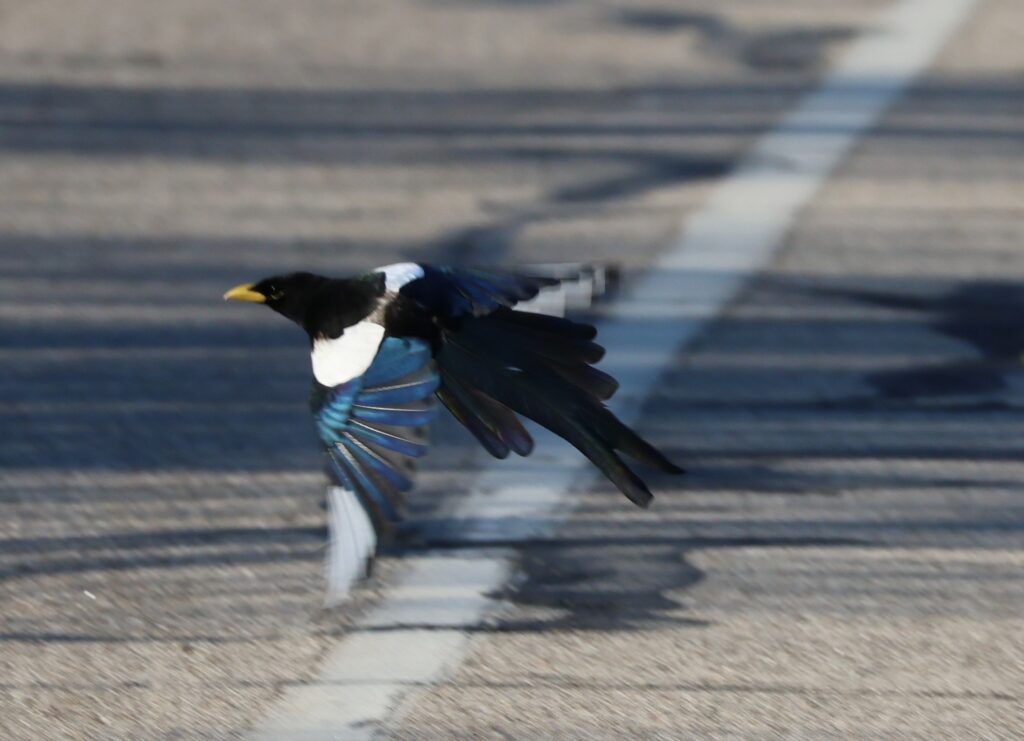
On our trip down, we got good looks at a well-known California endemic, Yellow-billed Magpie (see post “College Search Birding in California”).

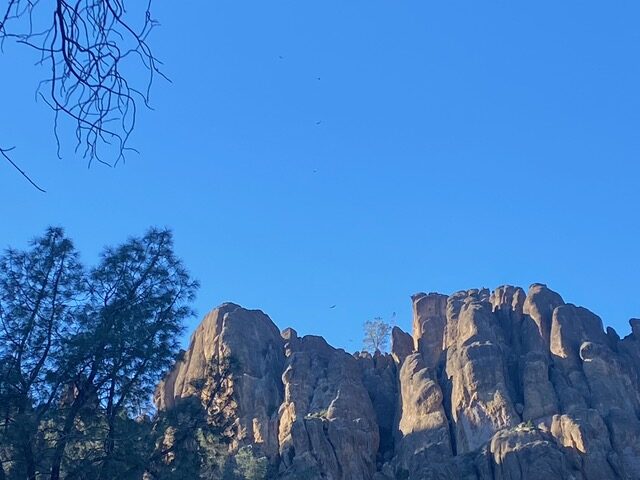
Our first stop was along the lonely Highway 25 between Hollister and Pinnacles’ east entrance. We badly wanted one soaring raptor to be a California Condor but it turned out to be a Golden Eagle. Later (2-3pm), at the observation overlook a mile up the Condor Gulch Trail, more than 15 dark soaring birds suddenly appeared as a group from behind the eroded sandstone Hain’s Peak. I confidently identified four as Condors, one as a Golden Eagle (clearly seeing the difference between each’s white markings on the undersides), and many Turkey Vultures. Steve’s new camera clicked away. At the trailhead, a ranger told us that, years ago, the population was below 10 individuals when reintroduction began and now the local population had swelled to “three digits.”
Pinnacles National Park. And yes, at least some of those black specks are California Condors!

The next morning we embarked on our first festival field trip: a Big Day at Santa Margarita Lake. It was led by Mark Holmgren, retired curator of the natural history museum and collection at UC Santa Barbara (my alma mater and where Sneed got his master’s degree). Highlights included comparing Eared, Horned, Western, Clark’s and Pied-billed Grebes, listening to Fox’s Sparrows, California Thrashers, and Wrentits, and observing raptor behavior. Speaking of, we saw Ospreys and Bald Eagles fishing (one birder theorized the adult eagles were teaching the juvenile), two Peregrine falcons mobbing a raven, and two Peregrines (perhaps the same) apparently fighting over food in mid-air or in courtship display. I got good looks at the yellow lores of a White-throated Sparrow.

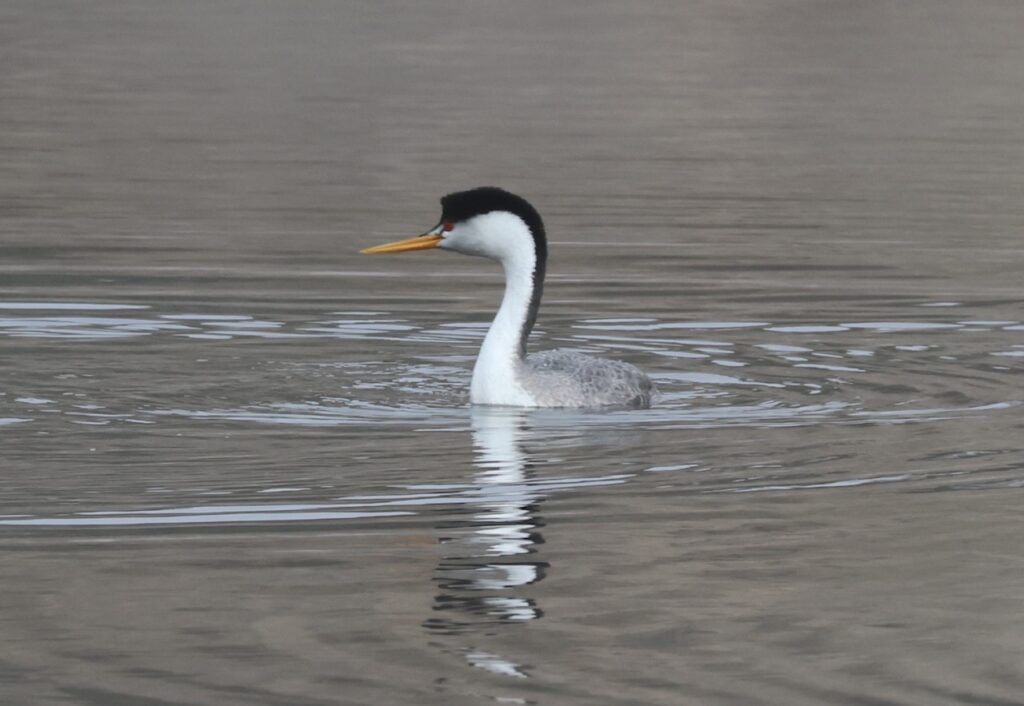
Winter is a nice time to compare Clark’s (shown here) and Western Grebes, which can sometimes be difficult to tell apart. Clark’s Grebes have more orangish bills versus greenish-yellowish on Westerns. The black also rises above the eye on Clark’s, though that’s not as clear-cut on this individual.

Tired from our long day, we drove to the Morro Bay Community Center downtown and attended one of the two  receptions. Included in the cost of registration were free local wines (multiple pours allowed), and extensive noshing trays of cheese, meats, veggies, crackers, and artisan chocolates.  The adjacent bazaar impressed with booths for 3-4 high-end binocular/gear manufacturers, book shops, authors, nature art and nature organizations. The bazaar was well attended and the noise generated rivaled that of a Spring morning chorus.

The bird fest’s exhibit area had a nice variety of vendors and non-profits to occupy us between birding trips, talks, and meals.

Our dinner at Morro Bay’s affordable, healthy and creative Asian fusion cafe, Chowa Bowl is recommended, as is the lunch combo Big Deal of sushi roll and ramen noodles at Baywood-Los Osos’ funky hangout, Kuma. This is important info to a birder even though food and beverages are barely mentioned in The Avian Survival Kit chapter of Birding for Boomers. Good food and libations can elevate a birding trip. (Editor’s Note: We at FSB take exception to this criticism, as we have frequently mentioned fine dining establishments such as McDonald’s, Wendy’s, and Starbucks.)

Next day’s Back of the Bay trip was not only highlighted by lunch, but by Audubon’s Sweet Springs Nature Preserve. It’s a small preserve with a spring-fed creek and excellent views from its wooden observation decks of the bay’s mudflats and its shorebirds, ducks, gulls, and terns—tons of them (which is saying a lot since birds are so light.) With Morro Rock and Morro Dunes in the background, we saw Lesser and Western Sandpipers, too many Brants to count, 30+ Green-winged Teals, 4 Blue-winged Teals, American Wigeon, Northern Shoveler, Bufflehead, Long-billed Curlew, Killdeer, Black-bellied Plover, Great Egret, and Greater Yellowlegs. We learned the Greater has three notes in its call compared to the two notes of the Lesser. Ring-billed Gulls, Belted Kingfishers, and Forster’s Terns were seen flying above the bay.

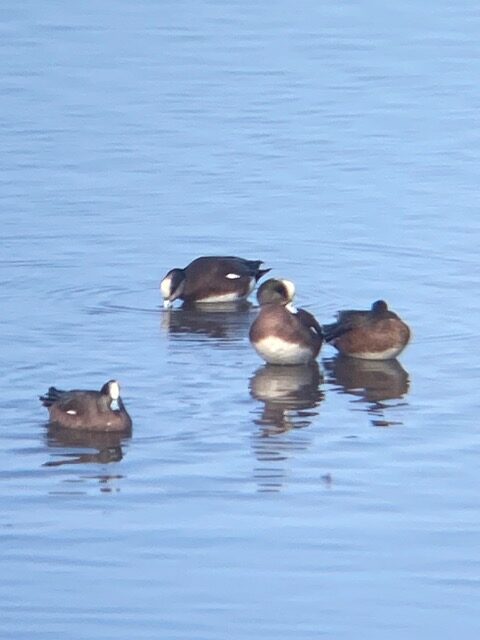
These are the ducks that inspired The Guess Who’s 1970 Number One single “American Wigeon”. Fun Fact: Sneed saw The Guess Who’s lead singer, Burton Cummings, perform this song live in Rapid City, South Dakota in 1977. Sneed was favorably impressed by this performance—until ZZ Top took the stage and basically burned the place down.

In the narrow woodland area between street and bay we saw both Hairy and Nuttall’s Woodpeckers, and Chestnut-backed Chickadee. Then, local guide Dean led our car caravan down the road apiece to his friend’s house which sported about six bird feeders that earned a hot spot ranking on eBird. More chickadees, the ubiquitous House Finch, the most common local warblers—Yellow-rumped, Orange-crowned, Townsend’s—and Lincoln’s, Golden-crowned and White-crowned Sparrows. We also saw our Oak Titmouse, formerly lumped with Plain Titmouse, at the bird feeders. Its range is mostly endemic to California (stretching into parts of Oregon and Mexico) and the bird shares its place with the Acorn Woodpecker as a signature species in California’s oak woodlands.

Dean also shared his mnemonic for our (Pacific Group) White-crowned Sparrow – “Awf man!, I dough-ont wanna see”. It’s a bit of a stretch but “I don’t want to see” sums up many people’s  self-engineered denials of science nowadays, so I decided to add it to my mnemonic checklist.

The rarity highlight of the trip was the sole Blue-winged/Cinnamon Teal hybrid. I “put good eyes on it” but Steve left his camera in the car because he logically thought he’d get better shorebird and bay bird shots on the following day’s boating trip.

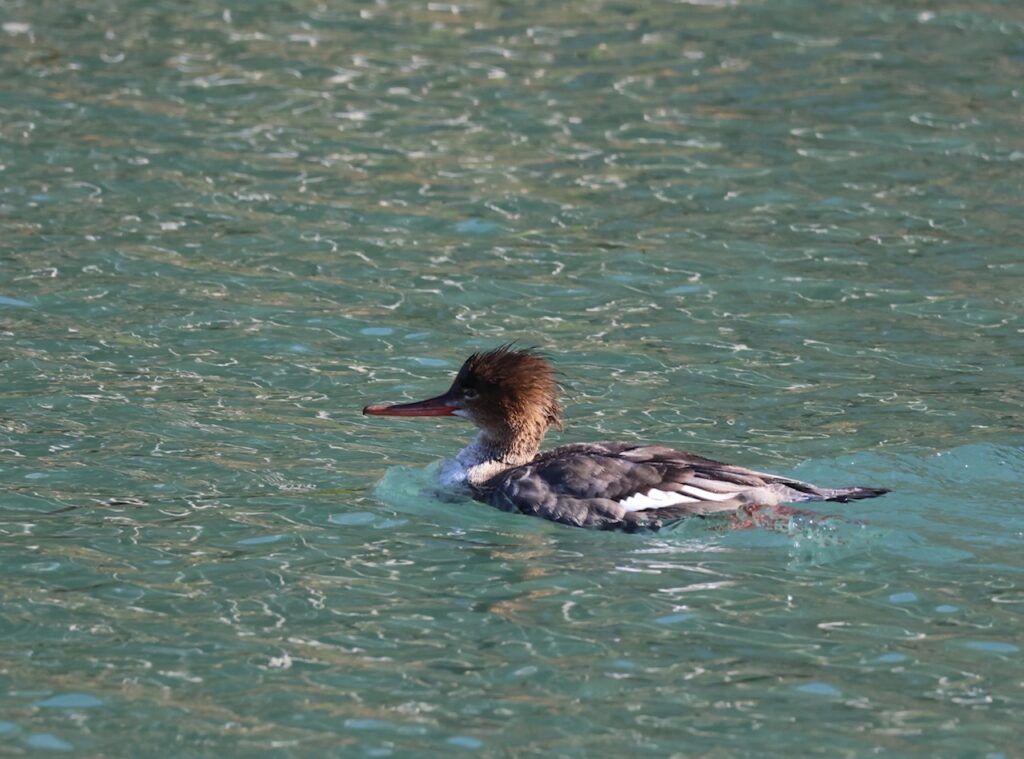
Female, juvenile, and nonbreeding Red-breasted Mergansers (above) can be difficult to distinguish from Common Mergansers, especially in winter, when they can be swimming side by side. We think this is a Red-breasted because of its a) slightly thinner, upturned bill b) indistinct transition between the brown and gray on its neck and c) its crazier “hair-do”.

Our inside-the-bay boat trip the next day also included a fellow (and local) birder, Mike, who led bird trips. Steve and I learned a lot from him. The trip was created as a photography outing and the leader focused on pointing out good shots. The captain, also a birder, put the boat in good lighting and locations for the photographers. We were inspired to overtip him. The trip started in a downtown marina and we made a loop up to Morro Rock, along the rock jetties past the bay’s opening to the ocean, and then back into the bay to the mudflats of the Morro Bay Estuary. As we returned back to the docks, we passed the Morro Bay State Park Boardwalk, the Museum of Natural History, the Morro Bay Water Access, and Heron Rookery Natural Preserve—all excellent spots to bird from the shore, and perfect for photographers from the water due to the sun’s location.

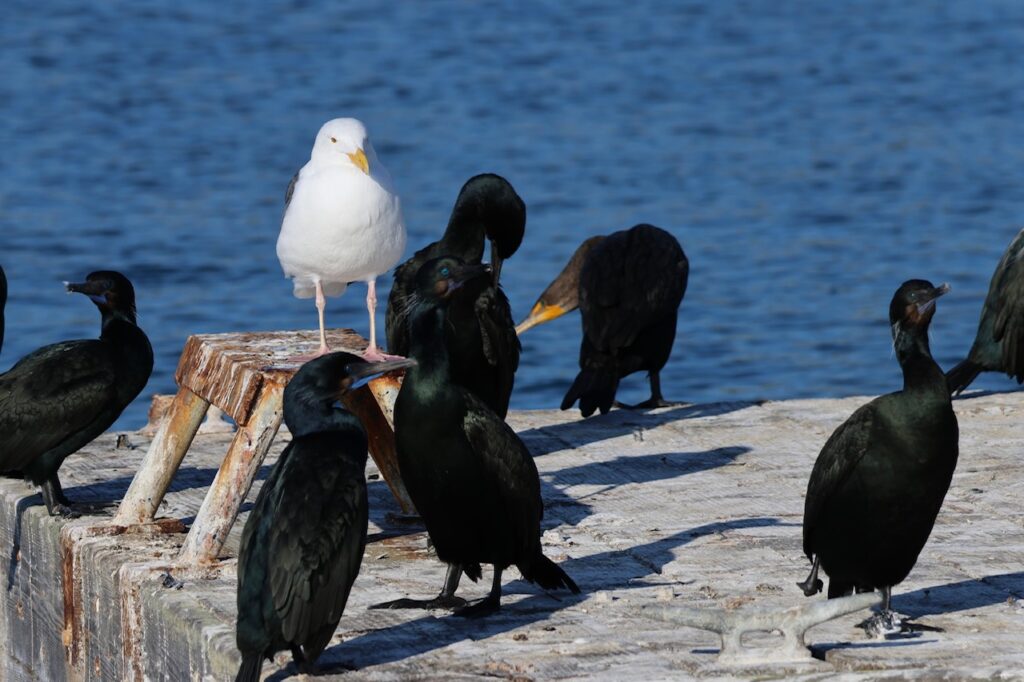
We saw Peregrine Falcons above The Rock, Black Oystercatchers and Black Turnstones on the rocks, Black-crowned Night Herons in the trees, Ospreys on the masts, Common and Red-breasted Mergansers, several Eared Grebes and a Horned for comparison, and a nice collection of Brandt’s, Pelagic, and Double-crested Cormorants floating on a wooden raft. The Brandt’s Cormorants were especially striking with their iridescent coats and bright blue throat pouches. We were surprised to see some of the adults sporting very early breeding plumage marked by brilliant white “whisker” feathers around the ears and shoulders.

Cormorants put on a show under the gaze of their Western Gull overlord. Note the brilliant blue gular pouches on the Brandt’s Cormorants, along with their wispy white breeding feathers on the necks. A Double-crested with yellow markings skulks in the background.

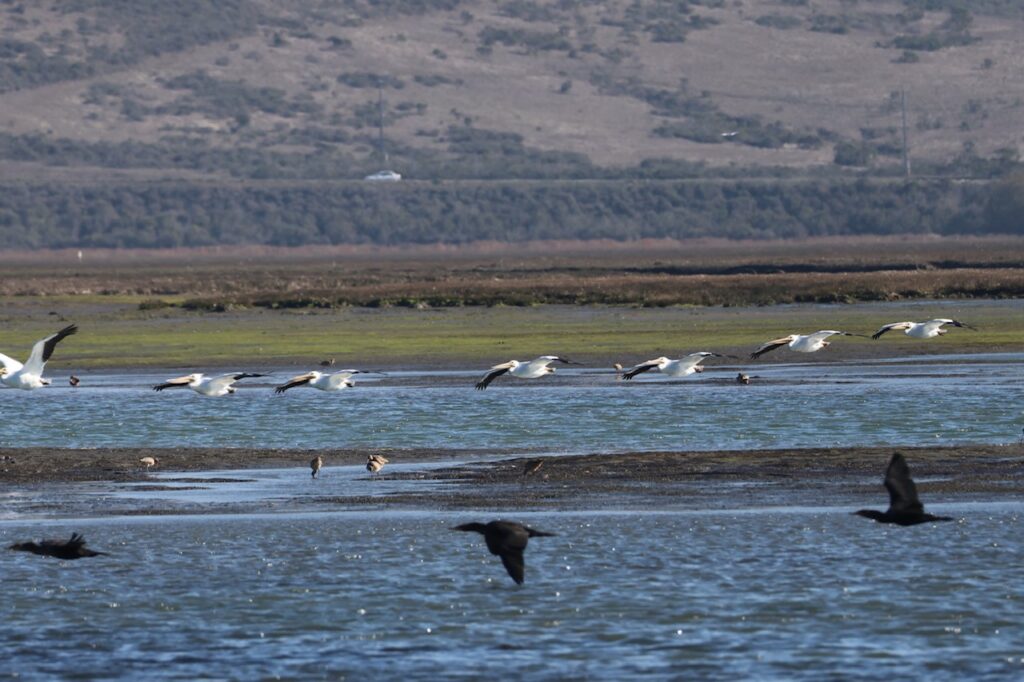
Further inside the bay near the mudflats we saw large numbers, reaching into the hundreds, of Double-crested Cormorants, Marbled Godwits, and other shorebirds too far away to ID, plus good showings of White Pelicans, Ospreys, Ring-billed and Western Gulls, Northern Pintails, Buffleheads and Long-billed Curlews, Willets, and Greater Yellowlegs, as well as other common shorebirds not listed.  Mike told us that the Pelagic Boat Trip ($160) was fantastic. If interested, check the bird list from the trip on the festival’s website.

Our “Inside of the Bay” boat trip featured a great variety of seabirds and shorebirds. Here, American White Pelicans earn extra style points.

The last night’s keynote speaker was Kenn Kaufman, author of Kingbird Highway, multiple nature guides, and his new The Birds that Audubon Missed: Discovery and Desire in the American Wilderness. He extolled birders to persist in their nature explorations, even beyond birds, and to pause the inclination to aggressively list in order to truly observe. He described the Morro Bay region as a “globally important ecological area” and the all-volunteer festival as top-notch and well organized, ranking it among the highest of the many he has attended. 

232 species were identified collectively during the 5-day festival in mid-January. Events included typical bird walks, birding by boat, bicycle and kayak, birding for youth, beginners and advanced birders, birding with wine and olive oil tastings. Sites extended beyond the Morro Bay area including the  Kern National Wildlife Refuge, the Carrizo Plains Ecological Reserve, various ranches, Atascadero, San Luis Obispo, and Pismo Beach. Check out the Long Report of the Festival Events Including Details on the website. More details than you will need to convince you to make next year’s festival are found at morrobaybirdfestival.org.

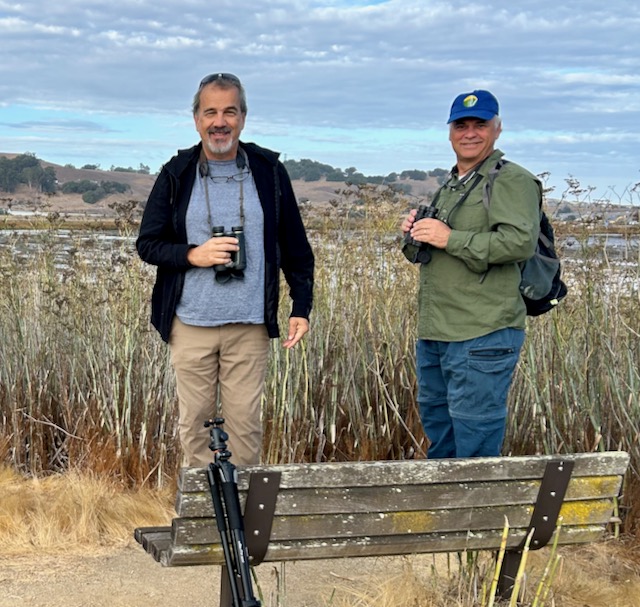
Scott (right) and Steve (left) while birding with Sneed in Marin County last fall. (I don’t know why Scott’s head looks a bit squished. I blame climate change, not my photographic skills.)